I. Introduction
Nobel Laureate in Economic Sciences Elinor Ostrom's authoritative book Governing the Commons (Ostrom Reference Ostrom1990) and nearly every other work she wrote on the subject of the commons (e.g. Ostrom et al. Reference Ostrom, Burger, Field, Norgaard and Policansky1999; Ostrom Reference Ostrom2010) strongly criticizes Garrett Hardin's seminal article “The Tragedy of the Commons” (Hardin Reference Hardin1968). The tragedy of the commons is a metaphor that refers to the ultimate destruction of a commons – such as a grazing pasture, an irrigation system, a fishing ground, or a forest – that occurs when users who are relatively numerous lack communication and overuse the commons.
Hardin (Reference Hardin1968) suggested that (1) users of a commons are selfishly rational, short-term maximizers and that they will consequently overuse a commons, resulting in the tragedy of its destruction; (2) users are locked into a system that does not allow them to avert the tragedy; and (3) only two solutions – coercive state involvement and privatization provision – exist to cope with the tragedy.
Drawing on case studies of common pool resources that had been governed and managed for long periods without either state control or privatization, Ostrom criticized Hardin's tragedy metaphor and his pessimistic perception of humankind. Challenging not only Hardin but certain neoclassical or game theoretic models of the commons, Ostrom used empirical findings from these case studies to argue that users are not necessarily always thoughtlessly short-term maximizers, and that they are not locked into a social system in which they cannot communicate and self-govern a resource that they value (Ostrom Reference Ostrom1990; Ostrom Reference Ostrom2010). Through a growing number of managed common pool cases researched by Ostrom and her colleagues, she showed instead that in many instances, users develop self-governing institutional arrangements to regulate the commons in order to prevent tragic outcomes without either state control or privatization (Ostrom Reference Ostrom1990, Reference Ostrom2009, Reference Ostrom2010; Ostrom et al. Reference Ostrom, Burger, Field, Norgaard and Policansky1999).
Ostrom's criticism of Hardin and her research on user self-governance of the commons have, however, generated some misperceptions of her views. A series of reviews, studies, and commentaries (e.g. Block Reference Block2011, Reference Block2013; Block and Jankovic Reference Block and Jankovic2016; Gallagher Reference Gallagher2009; Giltsoff Reference Giltsoff2010; Jankovic and Block Reference Jankovic and Block2013; Obeng‐Odoom Reference Obeng-Odoom2016; Place et al. Reference Place, Ajayi, Torquebiau, Detlefsen, Gauthier, Buttoud and Kaonga2012) have variously and mistakenly represented Ostrom's work as anti-privatization, anti-statist, anti-Hardin, or anti-libertarian. Journalist Kevin Gallagher (Reference Gallagher2009) reported in the Guardian that, “In a nutshell, Ostrom won the Nobel prize for showing that privatizing natural resources is not the route to halting environmental degradation.” Tamara Giltsoff (Reference Giltsoff2010) made a similar statement about Ostrom's work, stating that “her analysis of economic governance shows how privatizing natural resources is not the route to long-term sustainable economies.” A series of scholars including Place et al. (Reference Place, Ajayi, Torquebiau, Detlefsen, Gauthier, Buttoud and Kaonga2012), Block (Reference Block2011, Reference Block2013) and Jankovic and Block (Reference Jankovic and Block2013) mischaracterized her as either anti-private property or anti-government.
Wall (Reference Wall2014), who has written extensively on Ostrom's scholarship, says that he initially mistook Ostrom for a Marxist because scholars interested in the commons tend to be following Marx's discourse on socialism. As he continued to reflect further on Ostrom's scholarship so as to understand her better, he found it hard to place her and her husband “in a pre-existing ideological category” (Wall Reference Wall2014: xv). He argues that Ostrom belongs neither to the Marxist left, which proposes the holding of the key means of production in common, nor to the liberal right; nor does she belong to anarchism because she believes in institutions and governance. Further analysis from Wall (Reference Wall2014, Reference Wall2017) shows that the Ostroms’ scholarship was heavily influenced by liberal and free-market intellectuals such as Adam Smith, Friedrich Hayek, and James Buchanan, but their work does not fall into any one ideological category. It is possible that Ostrom's unusual worldview has developed in this way because of her efforts to resolve the problem using an interdisciplinary and closely empirical approach to understand specific problems in specific contexts. While Ostrom criticized scholars for their radical views (e.g. that centralized coordination and privatization are the only the means by which to maintain social order), and although she advocated that self-organized governance systems operate successfully, she is neither a radical anti-private-property socialist nor a radical anti-government anarchist (Sarker et al. Reference Sarker, Ikeda, Abe and Inoue2015; Sarker Reference Sarker2013).
Political ecology scholars eager to advocate “the commons” as an alternative to private property and capitalist economic organization have pointed to Ostrom's work as somehow proving that communal ownership and management of resources is superior to governmental regulation or private use, painting her view of the commons as not merely critical of Hardin but as some sort of anti-tragedy view, as if she were a kind of “tragedy denier.”
This paper addresses these misperceptions. In her research and theorizing about the commons while writing Governing the Commons and afterward, Ostrom did not utterly reject the prospect of Hardin-esque tragic outcomes in the commons, nor did she reject private property or governmental regulation as alternative possibilities that might be appropriate or even necessary under some circumstances. Directing our attention to the many cases in which user self-governance of the commons had occurred and even succeeded, Ostrom did not reject any other way of preserving or protecting common pool resources. For reasons explained in this paper, Ostrom opposed panaceas in response to common pool problems, and she resisted the imposition of policy solutions on resource users based on what she viewed as simplistic analyses. “Anti-panacea” refers to the idea that there is no one-size-fits-all solution or that no single solution – be it user self-governance, the state, or privatization – can resolve all problems related to commons management issues in all contexts (Ostrom Reference Ostrom2007, Reference Ostrom2009, Reference Ostrom2010). In other words, Ostrom was not an advocate against statist solutions or privatization provisions, nor was she even in blind favor of community-based management; instead, she was against any of these responses being viewed as a panacea. Her decades-long insistence on this position came not from an anti-state or anti-privatization attitude, but from a deep concern with the direction of modern social science and the relationship between our scholarship and our future as citizens.
2. Misperceptions of Governing the Commons
The misperception of Ostrom's stance in Governing the Commons (Ostrom Reference Ostrom1990) as anti-statist and anti-privatization generally results from a shallow understanding of her research focus and of the basis of her appreciation for user self-governance. Ostrom explored user self-governance or community-based management as a new alternative to challenge the convention that common property resources are ineffectively managed unless they are regulated by the state or privatized. By challenging the convention, she aimed principally to establish that user self-governance can be a third option to resolving the tragedy rather than rejecting the convention outright.
Nearly three years before Hardin (Reference Hardin1968) published his Science article, Olson (Reference Olson1965), in his trailblazing book The Logic of Collective Action, argued that, because humans are rational and self-interested, they lack the capability to solve problems of the commons without a coercive force such as a government to compel them to do so, particularly in large groups. Along a similar line of advocacy to that of Olson (Reference Olson1965), Hardin (Reference Hardin1968) proposed that there are only two solutions to the tragedy of the commons: the coercive state and privatization. Having studied and written her doctoral thesis about a successful case in which overuse and degradation of a common pool resource had been arrested and reversed through action by the users themselves, Ostrom was prompted by Hardin's article to further explore user self-governance as a possible third solution. Consequently, her research on the commons became weighted toward how resource users can communicate and cooperate to develop self-governing institutional arrangements that avert the tragedy without the need for state involvement or privatization. In her exploration, as she developed the theoretical and analytical frameworks with which to account for these cases, she identified shortcomings in the statist solution and privatization provision, even demonstrating how government coercion and privatization can result in greater tragedy (Ostrom Reference Ostrom1990, Reference Ostrom2010; Ostrom et al. Reference Ostrom, Burger, Field, Norgaard and Policansky1999). As she stated repeatedly, however, her intention behind exploring the possibility of a new alternative and highlighting the shortcomings of the two already-known alternatives was not primarily to reject the latter. Rather, the purpose of highlighting their shortcomings was to show that the state and privatization solutions are not panaceas or one-size-fits-all solutions. Furthermore, Ostrom presented cases of successful user self-governance at a time when countries that had nationalized or privatized commons were experiencing real tragedies (Ostrom et al. Reference Ostrom, Burger, Field, Norgaard and Policansky1999). By presenting several cases of long-enduring common property arrangements, Governing the Commons rejects the notion that these property systems are fragile and unsustainable. Thus, the novelty of sustained user self-governance combined with Ostrom's highlighting of the shortcomings of the traditional approaches could easily have led some who did not understand her research goals to mistake her stance as anti-government and anti-privatization or even as denying the existence of commons tragedies.
The titles of some of Ostrom's works – especially her Nobel Lecture, “Beyond Markets and States” (Ostrom Reference Ostrom2010) – are likely to give someone who is unfamiliar with her scholarship the immediate impression that she is suggesting that we leave the market and state approaches behind and instead adopt an alternative (titles of her other works, such as “Not Just One Best System” (Ostrom Reference Ostrom, Cernea and Kassam2006) and “A Diagnostic Approach for Going beyond Panaceas” (Ostrom Reference Ostrom2007), have perhaps been overlooked). The potential for misperception also arises from the multidisciplinary approach that she and her husband, Vincent Ostrom, often deployed to address research questions, such as the institutional analysis and development framework derived from a combination of Austrian economics, classic political economy, neoclassical microeconomic theory, institutional economics and public choice theory, transaction cost economics, non-cooperative game theory, and linguistics (Ostrom Reference Ostrom, Kaufmann, Majone and Ostrom1986a, Reference Ostrom1986b; Ostrom et al. Reference Ostrom, Gardner and Walker1994). Her multidisciplinary approach arose as a result of diverse insights from multiple perspectives, making it difficult to place Ostrom in traditionally established ideological categories. For example, collective action and commons ownership are usually approaches advocated by communism or socialism, but Ostrom does not refer to collective action or the commons in the same sense as those approaches. Incomplete understandings of Ostrom's scholarship may therefore provide the foundation for misperceptions of her work on the commons.
Another important source of misperceptions of Ostrom's work on institutional analysis and development could be attributed to an inadequate understanding of the difference between framework, theory, and model (Aligica Reference Aligica2014; Aligica and Boettke Reference Aligica and Boettke2009). Ostrom's approach is framework-based rather than theory- and model-based (Ostrom Reference Ostrom2005). A framework-based approach is more inclusive and flexible, while models and theories are more restrictive and abstract. Advocacy of statist and privatization approaches for managing the commons have tended to be theory- and model-based, and consequently limit the contexts and situations to which they are appropriately applied. In contrast to this, a framework-based approach identifies and includes (often several) important variables applicable to a set of situations and therefore allows varying yet relevant institutional arrangements to develop for a particular situation. What all this means is that the framework approach does not automatically preclude statist or privatization solutions. This may be seen clearly by reviewing Ostrom's institutional analysis of common pool situations, not only in Governing the Commons itself but in other works she composed at the time and later.
Ostrom acknowledges the reality of commons tragedies, but she also contends that theorists tend to predict tragic outcomes for all instances of the commons because they employ models and theories that foreclose any other possibilities. She is certainly not a “tragedy denier.” She states clearly: “The phenomenon known as tragedy of the commons will occur in highly valued open-access commons where those involved and/or external authorities do not establish an effective governance regime” (Ostrom Reference Ostrom2008:7). This view, which she sometimes characterizes as “the conventional theory,” is based in presumptions about the structure of the situation and the motivations of the actors. Where those presumptions are valid, she writes, the predicted outcome is indeed likely to follow: “the conventional theory is generally successful in predicting outcomes in settings where large numbers of resource users have no links to one another and cannot communicate effectively” (Ostrom Reference Ostrom2009: 750), and the “tragedy of the commons (Hardin Reference Hardin1968) is created when these incentives remain unchanged and those involved continue to follow strategies that destroy the very resource” they value (Ostrom Reference Ostrom, McCay and Acheson1987: 250). The problem she raised was that, while the predictions indeed followed from a model, the model's presumptions did not really fit very many common pool resource situations found in the world.
3. Ostrom, Hardin, and the commons dilemma
Before exploring Ostrom's perspective further, we need to familiarize ourselves with the concept and characteristics of the common pool resource (CPR) that she and her husband developed. The term “commons” is generically defined and has diverse meanings in the literature of common property resources (Wagner Reference Wagner2012), whereas a CPR is a well-defined commons.
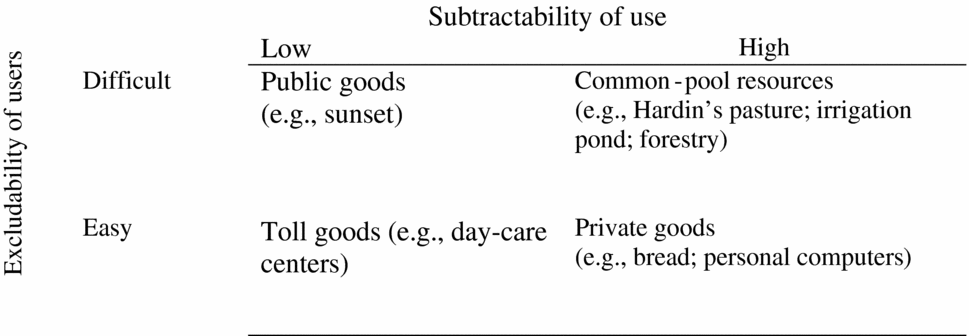
Figure 1 shows the classification of goods and services based on the two characteristics of subtractability of use (i.e. benefits) and excludability of users (i.e. beneficiaries) (Ostrom Reference Ostrom1990, Reference Ostrom2005; Ostrom and Ostrom Reference Ostrom, Ostrom and Savas1977; Ostrom et al. Reference Ostrom, Gardner and Walker1994). A CPR is a natural or human-made scarce resource with or without property rights assigned to it that satisfies two criteria: (1) it is difficult to exclude users from withdrawing benefits from the resource, and (2) the benefits taken up by one individual are unavailable to others (Ostrom Reference Ostrom1990; Ostrom et al. Reference Ostrom, Gardner and Walker1994).
A general classification of goods and services

Along the lines of Ciriacy-Wantrup and Bishop's (Reference Ciriacy-Wantrup and Boshop1975) classification of common property resources, we can conceptualize CPRs as closed-access and open-access. Ciriacy-Wantrup and Bishop (Reference Ciriacy-Wantrup and Boshop1975) classified common property resources into open-access common property resources, such as the open seas and outer space, for which property rights have not been well-defined, and closed-access common property resources, such as an irrigation system or forest, for which property rights have been well-assigned to a group of users. Thus, we can refer to a CPR without common property rights as an open-access CPR and one with common property rights as a closed CPR.
One can now easily frame Hardin's famous cattle pasture example in terms of Ostrom's open-access CPR context. Each of the cattle herders is a rational being and finds it sensible to take as much grass (as a resource unit) as possible off the pasture resource system held in common. Once a certain amount of grass is used by a herder, it is no longer available to other herders, which satisfies the high subtractability criteria. With regard to the second CPR criterion, it is not impossible, but it is difficult or costly, to exclude a herder from taking grass from the resource system (Hardin (Reference Hardin1968: 1244) expressed the situation vividly: “Picture a pasture open to all”). Given that the resource system has a limited carrying capacity and that grass is a scarce resource unit, the average amount of grass decreases over time, generating negative externalities for all herders. Consequently, the pasture eventually encounters destruction, the metaphorical tragedy of the commons.
Hardin came to the following conclusion:
Therein is the tragedy. Each man is locked into a system that compels him to increase his herd without limit – in a world that is limited. Ruin is the destination toward which all men rush, each pursuing his own best interest in a society that believes in the freedom of the commons. Freedom in a commons brings ruin to all. (Hardin Reference Hardin1968:1244)
Hardin (Reference Hardin1968) – in a line of advocacy much similar to Olson (Reference Olson1965) – proposed that there were only two measures, namely coercive government or state solutions and the provision of privatization that will help us avert the tragedy (Hardin Reference Hardin1968).
Ostrom reacted by both agreeing and disagreeing:
Users are pictured as trapped in a situation they cannot change. Thus, it is argued that solutions must be imposed on users by external authorities. Although tragedies have undoubtedly occurred, it is also obvious that for thousands of years people have self-organized to manage common-pool resources, and users often do devise long-term, sustainable institutions for governing these resources. It is time for a reassessment of the generality of the theory that has grown out of Hardin's original paper. . . . An important lesson from the empirical studies of sustainable resources is that more solutions exist than Hardin proposed. Both government ownership and privatization are themselves subject to failure in some instances. (Ostrom et al. Reference Ostrom, Burger, Field, Norgaard and Policansky1999: 278)
Ostrom's perspective thus conflicts strongly with Hardin's on several grounds, as she endeavors to correct Hardin's major assumptions that the state and privatization are the only alternatives to managing commons. Hardin was unequivocal in explaining how an unmanaged commons brings forth disastrous consequences, but in Ostrom's view, his prescription for the prevention of the consequences was way off the mark, reflecting simplistic analyses of both the problem and the possible solutions.
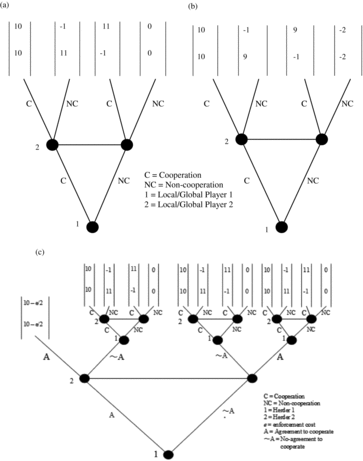
In Governing the Commons, Ostrom (Reference Ostrom1990) develops game theoretic models drawing on the widely known prisoner's dilemma (PD) game to illustrate her perspectives on Hardin's tragedy (see Games 1 to 3 in Figure 2). In the PD game, when two self-interested rational suspects are kept in two different cells for questioning, they are trapped in a system in which they cannot cooperate and optimize their joint payoff by minimizing their jail terms. When a police officer gives them options (to confess or not confess) and attaches a payoff to each choice, the suspects end up confessing to their involvement in their crime. Following a similar line of thought, Hardin's assumption captures the general notion that the herders are trapped in social cells and are unable to communicate with each other; consequently, their joint payoff is suboptimal.
Ostrom did not categorically reject the classification of Hardin's herder game as a PD game, but she did conceptualize the herder game as an assurance game because it can be played repeatedly, and it develops institutional arrangements for players to contribute jointly to collective action over an extended period of time (Ostrom Reference Ostrom1990; Ostrom et al. Reference Ostrom, Gardner and Walker1994). Unlike a PD game, an assurance game provides an institutional structure in which players have weak incentives to defect and strong incentives to cooperate (Bisaro and Hinkel Reference Bisaro and Hinkel2016; Cole and Grossman Reference Cole and Grossman2010; Ostrom et al. Reference Ostrom, Gardner and Walker1994).
For the sake of simplicity, let us assume that there are two herders who share a cattle pasture CPR. In Game 1 (Figure 2a), according to Hardin (Reference Hardin1968), herders are unable to cooperate and negotiate the amount of grass they can appropriate from the pasture, and their payoff is always suboptimal (0, 0) because of the over-appropriation of grass; consequently, the tragedy occurs inexorably. Hardin further suggests that herders cannot cooperate and develop self-governing institutional arrangements required to achieve the optimal payoff (10, 10) and therefore the state must resort to the use of coercive measures to force herders to appropriate the correct amount of grass.
(a) Game 1: Two herders without cooperation, (b) Game 2: State-authority CPR game with complete information and (c) Game 3: User self-governance CPR game without central authority

In Game 2 (Figure 2b), Ostrom (Reference Ostrom1990) argues that achieving a (10, 10) payoff is possible only when state officials have all the complete information, including the sustainable yield of the meadow, the amount of grass a herder should appropriate, and the amount of grass a herder is actually appropriating. If a herder does not cooperate by appropriating an amount of grass greater than the prescribed amount, then the central authority penalizes two units of profits. In this case, the game's solution is a (10, 10) payoff.
Ostrom (Reference Ostrom1990) states that as a distant authority, state officials, are hardly likely to possess complete information. The officials are likely to make an error in penalizing the player accurately. Game 3 demonstrates the user self-governance solution proposed by Ostrom (Reference Ostrom1990). In this game, the herders are not norm-free. They formulate a self-enforcing contract through negotiations and promise to keep to them. Nevertheless, negotiation is costly and involves an enforcement cost (e), and each player bears the cost as e/2. In this case, the equilibrium payoff is (10 – e/2, 10 – e/2), which is less than (10, 10) but is much higher than the tragedy payoff (0, 0). Ostrom shows that, despite transaction costs, resource users can develop self-governing institutional arrangements through communication and negotiation, irrespective of property rights. For Ronald Coase, when transaction costs are quite high users are unable to research collective bargaining agreements; consequently, judicial intervention may be necessary to define property rights arrangements (Reference Coase1937, Reference Coase1960). Coase, however, does not consider state intervention or private property rights as universal solutions to the problems of externalities and transaction costs.
While agreeing with Hardin that the tragedy is a real possibility when users are selfish and norm-free, Ostrom disagrees that humans are always so, basing her view on the emerging literature from experimental settings and from the psychological and behavioral literature on bounded rationality and norm-based decision making. Furthermore, instead of rejecting Hardin's state and privatization solutions altogether, Ostrom clearly indicates that these solutions may be useful but are not necessarily the only means of averting the tragedy, and under certain circumstances might even make things worse. Empirical research demonstrates that there is an alternative: user self-governance.
Ostrom restated the propositions of the central control and market advocates as hypotheses, as statements of impossibility and necessity, i.e. that preservation of the commons was impossible without their prescription or that their prescription was necessary to the preservation of the commons (Ostrom Reference Ostrom, McCay and Acheson1987: 252–3).
Either hypothesis could be disproved by a single contrary observation. As it turned out, several contrary cases had been identified by the time Ostrom wrote Governing the Commons, and more were being documented every day. Using one example documented by Robert Netting, she wrote:
This study is a strong challenge to the empirical validity of either [hypothesis]. It does not appear necessary either to divide the commons into privately owned land or to place such land under a central, public authority to achieve development patterns that avoid overuse or underdevelopment of common resources. (Ostrom Reference Ostrom, McCay and Acheson1987: 257).
It is important to recognize both what Ostrom does and does not state here. She does successfully challenge the propositions that only central government regulation or private property assignment can work. She does not declare that central government regulation or conversion to private property can never work. As we have seen, Ostrom in fact states the opposite – government regulation could work, and privatization could work. What she rejects is the claim by advocates of either solution that nothing but their prescription might work.
Thus, a fuller understanding of her intentions and her research reveals that her scholarship is neither anti-statist nor anti-privatization. Instead, Ostrom emphasizes that there are more solutions than those suggested by Hardin and others. What she saw, in other words, were possibilities: the tragedy might be a real possibility, but it is not inevitable. Cases that she and others had researched were “strong testimony to the possibility of long-term, stable outcomes that are not the tragedies posited in the theory” (Ostrom Reference Ostrom and Berger1993: 87). One such possibility was user self-governance, which she explored as a third alternative without claiming that it was the only solution (Ostrom Reference Ostrom1990). For our purposes, it is important to underscore the fact that Ostrom repeatedly and emphatically rejected any claim that user self-governance was the only way or the best way to govern and manage CPRs.
4. Ostrom's essential conclusion – no panaceas, no blueprints
Ostrom emphatically rejected central government control and privatization as blueprint solutions to be applied to all CPR situations. The rejection was not only a rejection of those policy prescriptions themselves, however. It was entailed in her rejection of any one approach to governing and managing the commons as a panacea to be imposed on all cases.
Ostrom's rejection of panaceas also applied to user self-governance; as she conducted research and began to develop the argument that would appear as Governing the Commons, Ostrom also emphasized that the appearance of some successful cases of user self-governance of the commons should not be misunderstood as demonstrating that user self-governance is a necessary condition for commons management. “Success is, of course, not the only outcome,” she wrote. “Establishing a possibility is not the same as establishing necessity” (Ostrom Reference Ostrom1986c: 25, emphasis in original). She reiterated this observation after Governing the Commons had been published (Ostrom Reference Ostrom and Berger1993: 87).
Going even further, Ostrom also clarified that she was not claiming that user self-governance would necessarily result in optimal resource management. Her assertion was much more tentative: “communal ownership, rather than private ownership or central control, can be an optimal institutional arrangement for some types of common-resource problems” (Ostrom Reference Ostrom, McCay and Acheson1987: 251–2, emphasis added). There was no reason to believe that a resource management regime would survive just because it was organized by the users, nor any reason to believe that such a resource management regime would automatically generate optimal results. Successful and enduring use of the commons was something toward which user-organized management might evolve, but not necessarily:
Rules governing property and inheritance often go far into the cultural past, and although they may be adapted to ecological conditions, they did not necessarily originate from them . . . . An alternative hypothesis is that the rule currently in use is the first one adopted in the village for which conformance is sufficiently high and the results sufficiently beneficial that villagers were satisfied with its consequences. Such a hypothesis is fully consistent with the view that institutional rules start from a process of trial and error and are changed by efforts to improve on the results through analysis and design. (E. Ostrom Reference Ostrom, McCay and Acheson1987: 261)
Here we see that Ostrom's interest in the commons was one dimension – an important and shaping dimension, but nonetheless just one dimension – of her larger scope of interest and research on human beings’ development and use of institutional arrangements of all kinds. This is a point to which we shall return in section 5 below.
User self-governance was a possibility; in Ostrom's view, that alone was enough to make it important and deserving of our attention, in light of the either–or dichotomy that had been presented by Hardin and others. As she gathered and understood cases of user self-governance, Ostrom wrote, “At least we are now aware of several systems which work quite well without being either pure market or pure central control systems” (Reference Ostrom1986c: 28). The key message was that “it is possible for those involved in a commons dilemma to arrive at a set of rules that enables them to keep total use within the limits of sustainable yield” (Reference Ostrom, McCay and Acheson1987: 262). The success or failure of those arrangements was contingent, not guaranteed, and this was the case with other institutional forms as well: “Not all groups of resource users are successful. But then, not all entrepreneurs who establish private firms are successful either; nor are the leaders of national governments able to achieve all they set out to do” (Reference Ostrom and Berger1993: 95).
A clear window into Ostrom's thinking around the time of Governing the Commons is provided in the transcript of a discussion with other scholars in 1993. There we find Elinor Ostrom interrupt another participant, James Fox, in order to emphasize and underscore her point that local self-governance is a possibility, not a guarantee. Here is the excerpt:
James Fox: At least part of the message I have received here is the idea that local institutions work –
Elinor Ostrom: Can work. (E. Ostrom Reference Ostrom and Berger1993: 113)
Years later, she reflected further upon success and failure as the possibilities in all three main institutional forms of commons management:
There are many well-documented examples of private property, community property, and government property systems that work effectively over time to keep the common-pool resource sustainable. Unfortunately, there are also a multitude of empirical examples where private, community, or government ownership is faltering or has collapsed. There are other examples where resource users have not succeeded in overcoming common-pool dilemmas – usually when the resource system is very large. (E. Ostrom Reference Ostrom2009: 751)
Ostrom did not view private property arrangements as either guaranteed to succeed or doomed to fail. She did not see governmental regulation as either guaranteed to succeed or doomed to fail. Furthermore, even though she brought to light many examples of long-standing and effective user-governed natural resources, she did not view community self-governance of the commons as guaranteed to succeed or doomed to fail. A principal and persistent focus of her work on the commons was to demonstrate through a combination of theoretical reasoning and empirical examination that privatization and government control were not the only options and that self-governance in the commons was a real possibility.
Several of Ostrom's papers clearly emphasize her stance that no single, oversimplified policy solution – state, privatization, or user self-governance – is a “panacea” for all the complex and diverse problems of the commons in all contexts. In personal conversations with each of us as well as in her publications, Ostrom stated that there was no guarantee that user self-governance is applicable to all cases and would thus resolve all CPR problems throughout the world. She also once wrote that she did not wish to see Ostrom, Hardin, and Olson treated as polar opposites (Ostrom to Sarker, personal correspondence).
In an interview with Pal (Reference Pal2010: 35), she clarified her position in plain language, stating: “In some places, privatization has worked well. I'm not anti-it. I'm anti-it as a panacea.” In addition to panaceas, she often used the terms “blueprint” and “blueprint thinking” in her critiques of the one-system-fits-all approach sometimes found in the literature on resource governance and management, and that had all too often found its way into the policy recommendations of development agencies as well. Either expression – panacea or blueprint – represented to her a kind of single, oversimplified governing system such as government ownership, privatization, or user self-governance, for addressing all complex problems.
Consequently, although Ostrom's major finding is the validity of user self-governance, unlike Hardin and his statist and privatization solutions, she did not present her finding as the only means to resolving the tragedy of the commons. Instead, she demonstrated that an approach – be it state intervention, privatization, user self-governance, or one that combines elements from these alternatives – that is consistent with specific problems of the commons can create opportunities to challenge and overcome the predicted tragedy (Ostrom Reference Ostrom2005, Reference Ostrom2014; Ostrom et al. Reference Ostrom, Burger, Field, Norgaard and Policansky1999). It was the blueprint thinking, the myth of the panacea, that was bound to fail, rather than any one particular policy option (Ostrom et al. Reference Ostrom, Janssen and Anderies2007).
Before concluding this section, some additional comments on the role of government are worthy of note. It is very important to understand that Ostrom is critical of a coercive, top-down authoritarian state. In design principle 7, she says that “If external governmental officials presume that only they have the authority to set the rules, then it will be very difficult for local appropriators to sustain a rule-governed CPR over the long run” (Ostrom Reference Ostrom1990: 101). Nevertheless, she is supportive of the state when it plays a positive role, saying that, “If a political regime does not provide arenas in which low-cost, enforceable agreements can be reached, it is very difficult to meet the potentially high costs of self-organization” (Ostrom Reference Ostrom1990: 146).
Rather than keep the state away from the CPR management regime, Ostrom highlighted the importance of the state in promoting user self-governance. Design principle 7, one of her eight well-established and widely cited design principles (see Ostrom Reference Ostrom1990, Reference Ostrom2005) found in long-enduring commons governance arrangements, indicates that at least minimum recognition from the state authorities can be essential to strengthen the capacity of users’ rights to self-organize more effectively over time (Ostrom Reference Ostrom2005). Users may not necessarily achieve intervention through the formal jurisdictions of the state, at a minimum non-interference from the state and preferably the support and recognition of the state had proved to be important in many cases.
Further, the engagement of larger jurisdictions can be beneficial. In the above-mentioned interview with Pal (Reference Pal2010), Ostrom underscored the usefulness of state authority involvement in managing CPRs at the local level – for example, through the provision of scientific information that may be outside the capacity of local communities. Ostrom stated that she basically advocates democratic governance at the very local level within multiple governance scales (Pal Reference Pal2010). This is substantially consistent with design principle 8, relating to nested enterprises, which indicates that “when common-pool resources are larger, an eighth design principle tends to characterize robust systems – the presence of governance activities organized in multiple layers of nested enterprises” (Ostrom Reference Ostrom2005: 269). Shortly after publishing Governing the Commons, Ostrom stated directly: “You cannot rely on local jurisdictions alone; you really cannot” (E. Ostrom Reference Ostrom and Berger1993: 111).
5. The basis of Ostrom's interest in self-governance in the commons, and its importance for institutional economics and political economy
While Ostrom did not advocate the view that user self-governance should be adopted to resolve the problems of all commons in all contexts, it is important to understand that the data she collected supported the view that in many cases, self-governing institutional arrangements outperformed other alternatives. Going beyond the initial and essential claim that user self-governance was a possibility, Ostrom and her colleagues found that in many instances, user self-governance had strengths that alternative arrangements did not. In some of her publications, therefore, Ostrom reports upon these success stories in ways that advocate self-governance. For example, Ostrom, Lam, and Lee (Reference Ostrom, Lam and Lee1994) and Shivakoti and Ostrom (Reference Shivakoti and Ostrom2002) showed credibly that farmer-managed irrigation schemes in Nepal outperformed state-run schemes; consequently, she and her colleagues strongly advocated for greater community control over irrigation in Nepal, and Andersson and Ostrom (Reference Andersson and Ostrom2008) reported similar findings from a comparative study of forestry management regimes in Bolivia. As stated briefly above, she collected strong theoretical and empirical data in her endeavors to establish user self-governance and polycentric institutional arrangements as a new and more powerful alternative to centralized and privatized options.
Ostrom's larger project was the study of institutions as the basis of human organization, combined with a normative concern for whether and in what ways institutions contributed to or impeded economic, political, and social development and the sustainability of democratic societies. Her broad-ranging pursuit of the study of institutions led her to a wide array of important influences, from Austrian economists’ perspectives about the role of institutions, information, and the nature of entrepreneurship to evolutionary ecologists’ and biologists’ conceptions of the dynamic complexity of natural systems, to psychologists’ and institutional economists’ inquiries into bounded rationality, to classical and contemporary political theorists’ views on the challenges of democratic governance, and more (see Aligica Reference Aligica2014; Cole and McGinnis Reference Cole and McGinnis2014, Reference Cole and McGinnis2015).
The variety of institutional options fed the Ostroms’ interest in polycentricity. As Elinor Ostrom's work demonstrated, a polycentric approach can capture complex economic and institutional systems, accommodating state, privatization, and user self-governance solutions (Ostrom Reference Ostrom2005, Reference Ostrom2014; Ostrom et al. Reference Ostrom, Burger, Field, Norgaard and Policansky1999). A polycentric governance system, which was originally advanced by Vincent Ostrom and his colleagues in 1961, combines multiple levels and various types of association from the public, private, nonprofit, and community sectors, which in turn have overlapping jurisdictional and functional areas (McGinnis and Ostrom Reference McGinnis and Ostrom2012). In other words, multiple policy alternatives are accommodated and configured in polycentric governance systems, while independent authorities operate interdependently to address specific problems of the commons or the tragedy thereof at a particular center – or level – which is typically that of the local community (Arrow et al. Reference Arrow, Keohane and Levin2012; McGinnis and Ostrom Reference McGinnis and Ostrom2012; V. Ostrom et al. Reference Ostrom, Tiebout and Warren1961).
Ostrom observed that a polycentric governance system can facilitate a plurality of institutions that can be combined and recombined in a variety of ways to provide solutions to certain local problems that result from complex economic interactions at various levels of the property regime and governance (Ostrom Reference Ostrom2005). Ostrom (Reference Ostrom1990) and Ronald Coase (Reference Coase1960; Reference Coase1937) contributed to institutional economics in distinct yet (to an extent) overlapping governance settings in which they have accommodated two separately identifiable but interlinked concepts: externalities and transaction costs. A comparison of these authors’ novel perspectives through the use of these two concepts can clarify Ostrom's scholarly stance and her contributions to institutional economics.
Ostrom's primary focus is on community-based natural resource management and on economic governance in both vertical and horizontal directions within a polycentric governance system. On the other hand, Coase tends to address problems in a firm's corporate governance and economics. Coase's most remarkable contribution to institutional economics is his identification that transaction costs exist and that institutional arrangements such as markets and firms are not free of costs (Pagano and Vatiero Reference Pagano and Vatiero2015).
When looked at from the perspective of externalities, Ostrom's and Coase's scholarship can provide us with the insight to identify Ostrom's novel contributions to institutional economics. Coase is concerned with unidirectional externalities, while Ostrom focuses on the problems caused by both unidirectional and multidirectional externalities. For instance, when users jointly manage a river for irrigation, upstream users generate unidirectional externalities for downstream users through their water withdrawal. This also occurs when an industrial source discharges chemical effluents into the river and thereby contaminates the river's water. When users commonly manage a pond for irrigation, all water withdrawals provide multidirectional externalities for all users, as such withdrawals reduce the average amount of water available for all users. When users dispose of household waste in the pond, they generate multidirectional externalities, as they afflict each other with negative externalities.
From the perspective of transaction costs, Coase proposes that one who provides a negative externality (e.g. a polluter) and the victim of this externality can bargain to resolve the problem if the bargaining has zero transaction costs; this would be true irrespective of which party possesses the property rights (Coase Reference Coase1960).
Coase also notes that government intervention is necessary to define and allocate property rights if two parties are unable to solve a problem through negotiation and if that negotiation may end in failure because of significant transaction costs. Ostrom (Reference Ostrom1990) posits that, by drawing on social norms and traditions, users can conduct face-to-face communications to develop institutional arrangements, including the sharing of the transaction costs; a government authority's interference may cause a breakdown in the users’ social norms, which would have potentially harmful effects (see Figure 2b). When management of the commons involves many users or is otherwise complex, Ostrom recommends a polycentric governance system to assist users in resolving their problems at the local level through vertical and horizontal interactions across multiple levels. A firm – which can be considered as a self-organizing corporate enterprise – continues to exist, as it minimizes transaction costs and governs the authority relationship among several units through vertical hierarchical interactions (Coase Reference Coase1960; Williamson Reference Williamson1975).
Ostrom challenges neoclassical economics, which posits that individuals are extremely rational and self-interested and that they are unable to communicate in a collective action scenario. Ostrom instead advances institutional economics, in which humans are often able to communicate and cooperate to sustainably manage the commons (Ostrom Reference Ostrom1990). Both Ostrom (Reference Ostrom1990) and North (Reference North1990) were concerned about institutions’ adaptive evolution, continuity, and durability. They took the perspective of path dependence, which entails self-reinforcing and self-organizing institutional dynamics. Form North's perspective, institutions reduce uncertainty and ambiguity in complex and uncertain environments. For Ostrom, in the institutional evolutionary process, individuals who follow institutions continue to pursue ambiguous and contingent strategies in complex, dynamic, and turbulent environments.
Mansbridge (Reference Mansbridge2010, Reference Mansbridge2014) identifies four key roles of the state in a polycentric system, and Governing the Commons captures all of these roles:
The state has four potentially crucial roles in a polycentric system. The first is to threaten to impose a solution (a “public-interest penalty default”) if local parties cannot come to a negotiated agreement. The second is to provide a source of relatively neutral information to mitigate the problem of self-serving bias regarding the relevant facts. The third is to provide an arena for negotiating that facilitates low-cost, enforceable agreements. The fourth is to help monitor compliance and sanction defection in the implementation phase. All four arise in Governing the Commons. (Mansbridge Reference Mansbridge2014: 8)
Hardin had advocated the role of the state as a coercive force that recommends “[m]utual coercion, mutually agreed upon by the majority of the people affected” (Hardin Reference Hardin1968: 1247). In Hardin's view, the government must supply external institutional arrangements and impose them upon users of the commons, and many of the users must accede to external coercion for their own benefit. Judging from the focus of arguments in his paper, Hardin suggested that the basis of mutual coercion must be compulsion from a law-enforcing authority (Keohane and Ostrom Reference Keohane and Ostrom1995). To Ostrom, Hardin's prescription was based on a presumption that the users of a CPR are trapped in their situation and are helpless to change it. On both normative and empirical grounds, Ostrom rejected that presumption. Ostrom instead demonstrated both theoretically and empirically that self-interested individuals in a community have a strong incentive to develop and comply with norms, standards, and rules, and that this motivation and capability are fundamentally different from the need for coercion (Keohane and Ostrom Reference Keohane and Ostrom1995; Ostrom Reference Ostrom1990).
Ostrom's thesis suggests that users are able to develop their own self-governing institutional arrangements to govern their commons and that the role of the government must be to support this (Aligica Reference Aligica2014; Aligica and Boettke Reference Aligica and Boettke2009; Frischmann Reference Frischmann2013; Hodgson Reference Hodgson2013; Toonen Reference Toonen2010). Ostrom further argues that reciprocity, trust, monitoring, compliance, and reputation can be effective in addressing the problems of the commons without the hierarchical coercion that Hardin thought was inevitable (Keohane and Ostrom Reference Keohane and Ostrom1995).
Hardin's approach can be conceptualized as a monocentric hierarchy, while Ostrom's polycentric approach provides a preferable alternative to monocentricity. As Cole (Reference Cole2011: 405) says, in a monocentric hierarchical system, “governmental units at higher levels make all collective-choice decisions, and units at lower levels simply follow commands from above,” while in Ostrom's polycentric governance system, “governmental units both compete and cooperate, interact and learn from one another, and responsibilities at different governmental levels are tailored to match the scale of the public services they provide” (see also Cole Reference Cole2015). Consequently, although the state is the central problem solver in Hardin's thesis, Ostrom does not regard it as such, but advocates a supportive and democratic role for it.
6. Conclusion
This paper has demonstrated that Ostrom explores user self-governance as a third policy alternative to Hardin's statist and privatization alternatives but does not disregard the potential roles of the state and privatization provision. In many instances, user self-governance has proven to be a much more powerful solution than statist and privatization efforts have, but Ostrom does not claim that user self-governance is the only means of averting the tragedy of the commons. Further, despite her criticisms, she does not completely reject Hardin's solutions or the tragedy itself. In essence, she challenges the claim that the two options provided by Hardin are the only viable solutions to the problem, and it is undeniable, on the basis of her research, that user self-governance is her preferred choice to other alternatives in the many contexts where the statist solution and privatization performed poorly.
Misperceptions of Ostrom's scholarship depict her stance as anti-statist, anti-privatization, anti-“The Tragedy of the Commons,” and/or anti-Hardin. A deeper understanding of her scholarship reveals that despite her stress on the shortcomings of statist and privatization responses to the tragedy, Ostrom neither undervalues the role of said efforts nor does she claim that user self-governance is the only means of resolving the tragedy.
Despite her exploration of user self-governance as a powerful policy alternative, her ultimate goal is to establish a complex, adaptive multilevel governance approach, such as polycentric governance, to cope with the diverse issues of the tragedy (Ostrom 2012). Ostrom's position can, therefore, be regarded as anti-panacea, by which we mean that she rejects the idea that there is a simple, single solution – be it user self-governance, the state regulation, or privatization – to resolve complex problems in all contexts.