1. Introduction
In 1887, women workers from a flax-spinning factory in Armentières sent to the Préfet of the département du Nord (France) a petition written on cheap paper in a shaky hand and signed by dozens of them. According to the petition, their bosses had ignored the law and forced them to work during breaks: ‘the police believe that everybody step out [sic] for lunch and tea but only the men paid by the piece and the kids … step out but … all the women (around 200) always work with no break’.Footnote 1
The protest launched by these women spinners was not merely an illustration of the kinds of friction spreading throughout the process of industrialization and multiplying during the Belle Époque. Similar elements might have been found centuries earlier, for instance in the conflict which broke out in the second half of the fourteenth century between the burghers of Troyes and their weavers, who wanted to be able to stop work in order to eat – even though in this particular case an ordinance of 1372 issued by King Charles V reminded these workers that ‘if they wanted soup, their wives had to bring it to them at the loom they were working on, so that they would not in any way be troubled in their tasks’.Footnote 2 The same occasions for conflict thus appear in periods quite removed from one another and in very different circumstances, whether the issue was breaks, as in the case just quoted, or as found elsewhere: the time when work began or ended; overall work-times; or even the intensity of the efforts workers were supposed to make. Thus, the development of temporal quantification characterizing Western society could be observed particularly clearly in the field of work relations as early as the fourteenth century or even before, as Alfred Crosby argued.Footnote 3 Contrary to what Edward Thompson asserted in his famous 1967 article, the notion of keeping track of time predated the onset of industrialization. If, for him, the advent of industry represented a turning point in temporal discipline, particularly at work, numerous studies, in England and in continental Europe, have shown that this was not the case. Pre-industrial societies were aware of time constraints.Footnote 4
The division of history into periods, while not as rigid as it once was, still has unfortunate consequences, and significantly hampers this kind of contextualization. While specialists in contemporary history insist on the extent to which workloads increased during the Industrial Revolution, many historians of the early modern era for their part follow Jan de Vries and discover in the Protestant countries of the seventeenth century an ‘industrious revolution’,Footnote 5 which in turn is dated by some medievalists as early as the middle of the fourteenth century, and mostly associated with Catholic, Southern Europe, as a development linked to the multiplication of paid activities in both the cities and the countryside.Footnote 6 Indeed, some authors do not hesitate to postulate a relationship between the monastic timetable as defined by the Benedictine rule and the ‘industrial religion’ that gradually took over Europe.Footnote 7
The characteristics of work time have been repeatedly studied in England in relation to the Industrial Revolution.Footnote 8 However, the situation is much more contrasted on the European continent.Footnote 9 Ever since the article by Jacques Le Goff in 1963, medievalists do not ignore the relationship between time and work, contrary to the great majority of early modern historians.Footnote 10 While the notion of ‘industrious revolution’ suggested by de Vries revived the debate about the offer of paid labour by Western families before the nineteenth century, again the research was concerned mostly with England.Footnote 11 On the continent, outside of the Netherlands,Footnote 12 studies have been extremely rare, being limited mostly to the question of public holidays.Footnote 13 This article aims to extend the scope of investigation to continental Catholic Europe, especially France, Belgium and Italy.Footnote 14
Our primary goal is to understand first of all the definition of what a ‘workday’ was because it was, until the nineteenth century, one of the measures of paid work and no other form of remunerated work was totally free of considerations about time.Footnote 15 Contrary to conventional wisdom, the workday was not necessarily to be confused with daylight. Consequently, how was the effective length of daily work time organized in those situations in which it is possible to determine it? This topic must first be addressed before there can be any discussion of how daily work time might have grown longer during the first period of industrialization (Section 3). Indeed, if we anticipate, the workday before the nineteenth century may have been just as long as in the years 1780–1840. Our conclusions for the areas considered here agree with what has already been claimed by H. J. Voth about England, even though we reached them through other means.Footnote 16
Moreover, the question of the number of workdays in the year is also essential and has been extensively written about.Footnote 17 We propose to reassess this issue, by making use of business accounts that duly recorded this number. Beyond the legal work year, this makes it possible to reconstruct on the one hand the number of effective workdays in a ‘business’ however defined, and on the other the number of those same days worked by each of the workers, the two numbers not necessarily being consistent. Measuring the work year thus remains far from obvious, and calls for the most individualized approach possible (Section 4).
An element frequently overlooked in many studies is that considerations about the length of work time have no meaning if the content of this time is not considered. One workday is never equal to another. As early as the Middle Ages, there are signs that entrepreneurs had no intention of wasting time. More or less elaborate empirical strategies on how to combine time-based remuneration and work volume can thus be identified very early on (Section 5). From the seventeenth century, these strategies were combined with scholarly considerations along the same lines. In the nineteenth century, all of these approaches produced a systematization of the quantification of workers’ work. This led to what has come to be known as ‘Taylorism’, which in its simplest form is the analysis of gestures in order to reduce their duration, but which has roots much older than is commonly supposed.
2. Methodological choices
To conduct this investigation, we have chosen a resolutely empirical approach. Drawing on current work by sociologists on ‘work in crumbs’, we relied on a number of case studies, some by us and others published by a large number of fellow scholars.Footnote 18 These case studies allowed us to delineate the universe of possible solutions available to actors at the time, that is, to build a complete picture of the full range of observed situations and of the highly varied work lengths and intensities they entailed over the very long run. This is why we have adopted a ‘patchwork’ approach, taking specific examples from a wide variety of fields. The aim here is not to ‘compare what cannot be compared’, but to offer a certain number of benchmarks with the possibility of adding many more. We defend a bottom-up approach, taking us as close as possible to the lived experience of various groups of workers. One has to go down to the level of the individuals caught in the midst of their activity, and to reconstruct their personal schedule, at least in the workplace being studied, while at the same time being aware that these individuals are beyond our grasp once they have left.
Thus, we rely on three categories of sources. First, regulations of all kinds, long held as largely pointless because of the differences between theory and practices, highlight how early work time became an issue of interest and provide a wealth of useful information. Second, various sources ranging from legal disputes to the broad inquiries launched in the nineteenth century, with the addition of the few available autobiographical testimonies, provide the point of view of the individuals involved. Last, we have made use of multiple accounting documents, some drawn from previous research by other scholars, and others we studied ourselves, including among the latter 100 years’ worth of records relating to the workshops and construction sites managed and financed by the Medici in Florence between the end of the sixteenth century and the first half of the eighteenth century. These are combined with data coming from the construction sites of religious buildings in Paris, Milan and elsewhere, or with those of textile manufacturers and mills. This approach, based on field research, allows us to vary our points of view according to time, geographical area and type of activity. Of course, accounting records have two major drawbacks. They give us access only to salaried work, which is what we will be analysing here; they also offer only a reconstruction of reality and include a strong dimension of uncertainty. They therefore call for great caution when being commented upon. Nevertheless, they enable us to go beyond the construction of averages that offer a reassuring impression of comprehensiveness but actually gloss over the multiple variations existing in real life and end up hiding some dimensions of a work time that was highly variable in practice. Indeed, statistically generated figures tend to erase the distance between practices that were sometimes worlds apart, depending as they did on the social context, the period, the craft, the gender and the culture one would consider. The point here is rather to recover this diverse reality so as to begin answering some basic questions, such as whether one worked more, or less, before, during and after industrialization, and whether computing work time is meaningful if the intensity of the work is not taken into account as well.
3. What was a workday?
Historians have long accepted that, before artificial lighting, the workday corresponded ‘naturally’ with daylight. In many sectors of paid employment, however, this was not the case.
3.1 Before industrialization, workdays were already long
Some medieval jurists distinguished between the ‘natural day’ (dies naturalis), measured by solar time, and the ‘artificial day’ (dies artificialis) for work, which in their view lasted 12 to 14 hours, according to the season.Footnote 19 Thus, while the workday was no doubt based on natural daylight, it was nevertheless differentiated from it by an increasingly precise definition of working hours. Guild regulations are replete with time-related statements defining the workday for an ever larger number of trades, with a length ranging from 8 to 17 hours or more, a variation much broader than the jurists claimed it to be. The changes of ‘season’, often no more than two alternating ones, depended much more on the customs of the different trades than on any correspondence to the natural rhythm of sunlight, shadow and darkness.Footnote 20
Nothing really seems to have changed during the modern era: perhaps taking as its model the Statute of Artificers enacted under Elizabeth I in 1563, a French royal edict of 1567 codified the hours of masons, stonemasons, carpenters, tile-makers, roofers and unskilled workers, and allowed for a daily amplitude fluctuating between 12 (from 6 a.m. to 6 p.m.) and 14 hours (5 a.m. to 7 p.m.). The edict was later reaffirmed in 1667, 1675 and 1712.Footnote 21 Still in France in the eighteenth century, work time from 5 a.m. to 7 p.m., the amplitude thus defined being 14 hours, seems to have been so widespread that the Encyclopédie by Diderot and D’Alembert as well as the Dictionnaire de commerce by Savary used it as the basis of their definition for ‘day-labourers’ (‘gens de journée’).Footnote 22
Thus, in the city as well as in the countryside, and whatever the sector, the days frequently looked alike despite the numerous variations related to the specificities of each activity. Without multiplying examples, one might at least refer to the large textile manufacturers, the hours of which fitted into already established practice. The Sedan manufacturer had received a privilege in 1646 to make cloth imitating Dutch production, and its cloth shearers, of whom we will speak later, were present from 5.30 a.m. to 7 p.m., that is, for 13.5 hours. Obviously, each manufacturer had its own hours, but the amplitude was rarely any less. In 1726, the regulations of a silk mill in Farra d’Isonzo, near Gorizia (Italy), allowed for a 14-hour workday,Footnote 23 an amplitude that can be found also in the glass factory of Saint-Gobain (France) for those workers paid by the day.Footnote 24 The hours for day-labourers in agriculture were just as set as those of craftsmen or mill workers, though the way we know them comes mostly from what disputes over them reveal.Footnote 25 Arthur Young gave some indications of workdays in the course of his travels. Thus, in Mozzatta, in the Milan area, the daily amplitude of farm work would have been 17 hours, that is, just as long as the time suggested for silk mills in the area by Antonio dell’Acqua in 1777.Footnote 26 What changed in quite a few trades during the modern era was that the schedule sometimes became the same throughout the year, moving from a possible workday amplitude to a required schedule, thus increasing disciplinary issues and what was at stake in them. In the countryside, in those places where agricultural methods became more demanding and proto-industry gained ground, it was sometimes the case that days in the off-season were just as full as those during ploughing and harvest.Footnote 27 Yet, obviously, the daily time amplitude did not correspond to actual work since the workday was marked by pauses varying both in number and in length.
Regulating pauses actually became an increasingly current practice in the fourteenth century. Variations are so numerous from one trade to the next that it is impossible to make an inventory of them all. However, one principle can be identified, since it was adopted very early on and remained accepted for a very long time: when the workday was the longest, pauses were also at their most frequent and longest. While the midday pause was almost sacrosanct, morning and afternoon pauses were more variable.Footnote 28
It is therefore possible to know not only the daily amplitude of the workday but also the legal length of actual work time. Thus, in the fifteenth century, this length fluctuated between 8 and 11 hours in the trades in Brussels.Footnote 29 The variation was even wider at the end of the eighteenth century for the employees of the Toulon arsenal, who were to work between 7 hours a day (in December and January) and 11.5 hours a day (in July).Footnote 30 Construction workers in Paris would have worked between 8 and 10 hours,Footnote 31 as did many of their colleagues elsewhere in this particular branch, who almost everywhere seemed to have worked the fewest hours, probably along with miners.Footnote 32 The cloth shearers from Sedan, working all-year-round 11-hour days, were much worse off, even though they worked less than their colleagues from Eupen and Hodiment (Belgium), who were working at their tables ‘twelve hours and two thirds a day’.Footnote 33 In the countryside, workdays lasting up to 13 hours of actual work can be found frequently.Footnote 34
Thus, the workday, far from being undefined for a long period, was characterized very early on by a schedule of starting and finishing times and of pauses. Such schedules were often put in place after disputes in which local authorities, or even the prince, had to intervene, since the stakes in this matter were very high indeed.Footnote 35
One of the first tasks in marking out work time was of course to make sure that the volume of work expected in a day and the wage for that same day matched up, at a time when the question of the ‘just wage’ was being dealt with in theoretical and practical thinking, following Thomas Aquinas.Footnote 36 This is what is explained in the mine regulations of Massa Marittima during the same period (mid-thirteenth century), transforming work into what is paid by the worker in return for a salary: ‘so that the masters and mineworkers pay back those who pay them at the same level as the salary received, we order masters and workers to go into the pits and workshops on Monday at Nones’.Footnote 37
In fact, the principle of ‘to a shorter day, a lower salary’ was frequently applied in the fourteenth century, sometimes even earlier, even if time was far from being the only variable governing remuneration.Footnote 38 Along with this apparent concern with the ‘just wage’, regulations were also based on three other employer concerns: the fear that the time that was paid was wasted in doing nothing; the wish to establish a link between the wage and the number of hours worked, which were fewer in the middle of winter than in the middle of summer, even though hourly wages somehow remained incompletely developed, and were found only in a very small number of cases until the eighteenth century; and lastly the growing fear, especially after the Black Death, that overly high salaries would encourage greater idleness to the extent that it would not be necessary to work every day. From the employees’ perspective, the goal was to be paid for potential overtime.Footnote 39
Moreover, from a very early date employers strived to gain control of the entire day of those whom they paid. This goal was a difficult one to meet given the widespread practice of holding several jobs at once and the general resistance to such control. Yet it demonstrates to what extent this issue of control over the time of labouring men and women was important. Guild tribunals sometimes played a role in attempting to reserve for the masters even the ‘nights’ of those working for them, thus ensuring that they would not work for anyone else.Footnote 40 Conversely, obtaining a set schedule could be a way for employees to limit the control their employers could exert over their time.Footnote 41 In this sense, the hours and conflicts in the paper industry are highly representative: in this sector, almost everywhere in France, workers began their work long before daybreak.Footnote 42 This was clearly of their own will, against the wishes of their bosses who wanted to avoid the cost of candles and the sloppy work done by their light. But nothing could be done about it, since workers operating this way gained a good part of their day to go about various activities of which nothing is known, but which they persistently protected against both royal decisions and the efforts of even the most pugnacious employers.
All in all, it may be recalled that in many workplaces, whether concentrated or dispersed, multiple norms have framed the working day since the Middle Ages. Depending on the activity and the season, and despite considerable diversity, salaried workers were mobilized for lengths of time that in no way contrasted with those encountered in the nineteenth century.
3.2 The nineteenth century: more continuity than change
The theory of the lengthening of the workday in the nineteenth century was expressed by Karl Marx, who saw it as a process beginning in the fourteenth century, and essential to the formation of surplus value.Footnote 43 Many social observers who were far from endorsing his general theory also insisted on the long factory workdays. But what was really the case? Some English historians are sceptical about this thesis, even in the famous Black Country of coal mining (West Midlands).Footnote 44 What of the continental areas? Our study of textile establishments in the area of Verviers (Belgium) reveals a weekly volume of 79 actual hours, that is, slightly over 13 hours a day.Footnote 45 There is much evidence in other textile regions corroborating similar numbers at mid-nineteenth century.Footnote 46 Can we conclude from these data that there has been a large increase in work compared to earlier centuries? Actually, these highly localized figures, while certainly spectacular, are not that far from what can be encountered in the seventeenth and eighteenth centuries in mills or in the countryside.Footnote 47 But they do strike the imagination because they included women and children, who were thus moved from providing largely invisible labour, as was the case previously, into a highly visible situation of exploitation.
Indeed, ‘protecting’ children, and later women, motivated limitations on the length of the workday in several nations of continental Europe (with the notable exceptions of Belgium and the Mediterranean nations). As in England, where the first Factory Act to have a relative impact dates back to 1837, France, preceded by the German states and Switzerland, was gradually adopting legislation that might at first glance seem restrictive. Still, one can wonder about the actual value of all these legal regulations. They are too easily credited, as if all legislation led to enforcement. This was hardly the case: a number of entrepreneurs circumvented these rules, and on top of it there were a myriad legal loopholes. Moreover, broad economic sectors were ignored, particularly any work related to the countryside or to household production. Among entrepreneurs, the realization that the ‘useful day’ could arise from reduced work time was very slow, and aroused the ire of a number of staunch opponents in the various parliamentary chambers. What prevailed over and over again was the intensification of labour, combined with the continuation of the working hours as they had been set 30 or 40 years earlier. Twelve hours of effective work remained the norm in a number of firms at the end of the century, regardless of the state of the legislation in each of the countries studied. Indeed, the standard of 12 hours of daily work found in Ghent was also found in Roubaix, even though the complete lack of Belgian legislation starkly contrasted here with the French regulatory environment. Overall, assessing the daily duration of work remained a difficult task, all the more so because the variability of working hours from one day to the next remained high, and could even extend to a part of the night.
But the nineteenth century did not invent the nightshift any more than it did the lengthy workday, contrary to what has long been said. In a whole series of trades linked to the use of fire, working at night had long been a technical imperative. This was the case in glassworks, iron and then steelworks, soap-making, coal-mining and other mines in which the mineral was processed by fire, as well as refineries for sugar. Indeed, these are the very same industries for which nineteenth-century laws created exemptions from the ban on night work for children and women. In all these industries, work teams were set up as early as the Middle Ages and alternated every four, six or eight hours.Footnote 48 Indeed, there were also many other sectors in which night work was widespread and remained so in the nineteenth century: this was notably the case for the food trades, which had to prepare the supplies feeding the urban populations during the day.Footnote 49 In many other activities, night work was not widespread, but neither was it unheard of, especially when there was an urgent need for it.Footnote 50
Was there more night work in the nineteenth century because of the relative progress of gaslight? This was in no way the case. In France at the beginning of the 1890s, fewer than 5 per cent of textile establishments reported regular night work.Footnote 51 There were two reasons for this, according to employers: the cost of lighting and the poor quality of the work performed. These arguments, again, were hardly new.Footnote 52
In fact, contrary to conventional wisdom, up until the end of the nineteenth century, daily working hours remained both highly variable and very long overall. Compared to the pre-industrial world, continuities dominated over changes. Hence the importance of assessing not just the length of the day but also the number of days worked in a year.
4. How many workdays were there during the year?
The question of the number of workdays in a year remains a conundrum for all historians having looked at the evolution of wages and living standards over any extended length of time.Footnote 53 Indeed, while daily wages are generally known thanks to a large number of account books, information is incomplete when it comes to the yearly number of workdays. In order to solve this problem, one will often try to come up with a (largely hypothetical) set number of workdays in the year, 200 or 250 days, depending on who is counting.Footnote 54 What these reconstructions thus gloss over is the difference between workdays and days actually worked, as well as the possible evolution of the ratio between the two.
4.1 Were holidays creating two different Europes?
Within the framework of Jan de Vries’ hypothesis of an ‘industrious revolution’ sweeping northwestern Europe from the seventeenth century, the evolution of the calendar of days worked is a key element. According to him, the increased number of workdays would be in large part the result of a reduction in the number of holidays, forced upon the churches by states trying to boost the wealth of the nation, and encouraged by populations eager to work more so as to consume more. However, the empirical basis on which this assertion is built is very narrow.Footnote 55
As we take up these questions once again for continental Europe, the evidence for an ‘industrious revolution’ related only to a decrease in the number of holidays is far from conclusive. Focusing the debate on the number of holidays – and consequently on the number of workdays – harkens back to the period of European mercantilism when, following controversies begun during the Reformation, it was considered a given that Protestants worked more than Catholics.Footnote 56 This fact was seen to have been the basis of the prosperity of the former and of the relative poverty of the latter, even according to the staunchest Catholics. However, when submitted to close scrutiny, these self-evident facts become much less so.Footnote 57 Protestant Europe on the whole was characterized by large variations between countries, and by transformations which unfolded neither in the same way nor at the same time. Thus, the almost total abolition of religious holidays was only true of two countries in Europe, Reformed Switzerland and the United Provinces of the Netherlands. In this appraisal, England, along with Sweden, was no doubt one of the Protestant countries enjoying the greatest number of non-working days since it not only kept at least 27 former holidays but also added new political ones.Footnote 58 Thus, it is difficult to see whence a 50-day difference between England and the Catholic countries would come, even though this difference was insistently presented as fact by a number of eighteenth-century authors. In the same fashion, how is it possible to estimate that there was a 20 per cent increase in legal work time in England, as de Vries maintains? This assertion, like the ones before, relies on broad, overly general data rather than on the specific realities of each region, or even each trade. Past and present promoters of a Protestant ‘lead’ mainly seem to be trying to uphold Protestant distinctiveness from Catholic countries, whatever the evidence otherwise. Contrary to de Vries, we believe that variations play a decisive role: situations are so disparate that they need to be grasped in their individuality whenever possible.
In these same Catholic countries, the discussion surrounding the number of holidays dated back to at least the thirteenth century, and it should be pointed out that there was no greater consistency on this issue than in Protestant countries.Footnote 59 Nevertheless, by the middle of the eighteenth century, there were no major differences from one Catholic country to the next: 287 working days in France, 284 in Lombardy and Tuscany, and 282 in Spain.Footnote 60 Thus, when at the end of the same century an admittedly very limited increase in the number of workdays took place, it was enough to turn those lands faithful to Rome into only slightly less industrious countries than the Protestant territories. In Amsterdam, the length of the theoretical legal year was a mere 6 per cent longer than in Florence, Madrid or Paris. These figures thus put into some perspective the legal foundation of the famous ‘industrious revolution’, all the more so as disruptions in production, owing to weather and the shortage of workers and raw materials, likely cost many more days of production in early modern Europe than the demands of religious calendars.
Yet, in any case, not too much credence ought to be given to calendar restrictions, and consequently to these figures. In Catholic as in Protestant areas, requests for permission to work on holidays were numerous and the number of violations even more so.Footnote 61 Sundays may have been better respected in Protestant than in Catholic countries, but whenever workers faced a really urgent task, necessity prevailed. So, counting Sunday systematically as a day without work is just as much of a problem. Consequently, it is difficult to assert that there was a radical break between work time and religious holiday time.
Once the French Revolutionary episode had come to an end, and with it an attempt to upend the calendar that we will not analyze here, a process of rationalization of the work week spread throughout Europe. As early as the 1820s, one can observe the main European countries consistently converging toward 52 Sundays in the year theoretically reserved for rest, plus around 10 and up to a dozen holidays, differing in part and set in various ways depending on the country and the political regime. Overall, then, with some countries, whether Catholic or Protestant, lagging behind others, a figure of approximately 300 workdays in the year seems adequate. In the last analysis, the issue of the number of workdays never really divided Europe into two conflicting blocs. The number of working days, that is, days actually worked, however, led in practice to a much more heterogeneous reality, with large variations from one firm to the next, and even more from one worker to the next.
4.2 The number of working days across firms: a fairly stable range of possibilities
To attempt to evaluate the number of days actually worked in a number of sectors, the historian has at his or her disposal accounting records which, most of the time, were used to specify how much employees would be paid. Admittedly, they exist only for activities which, given their importance, generated an increasingly systematic recourse to figures. It is thus possible to reconstruct the yearly work time from the point of view of a business, a construction site, a mill or a factory. While the representation they give of the work world is incomplete and fragmented, these account books nevertheless reveal a general trend once again masking important disparities. In broad terms, in continental Europe, most industrious firms were open for business generally for between 250 and 260 days a year in the fourteenth century, whereas the figure seems to have reached over 270 days as early as the fifteenth century, increasing sometimes to over 280 days in the second half of the seventeenth century.Footnote 62 Yet figures like these could also sometimes be observed during the fourteenth century. If the evolution was linear – and this was far from being the case – it would represent an increase of only slightly over 10 per cent.
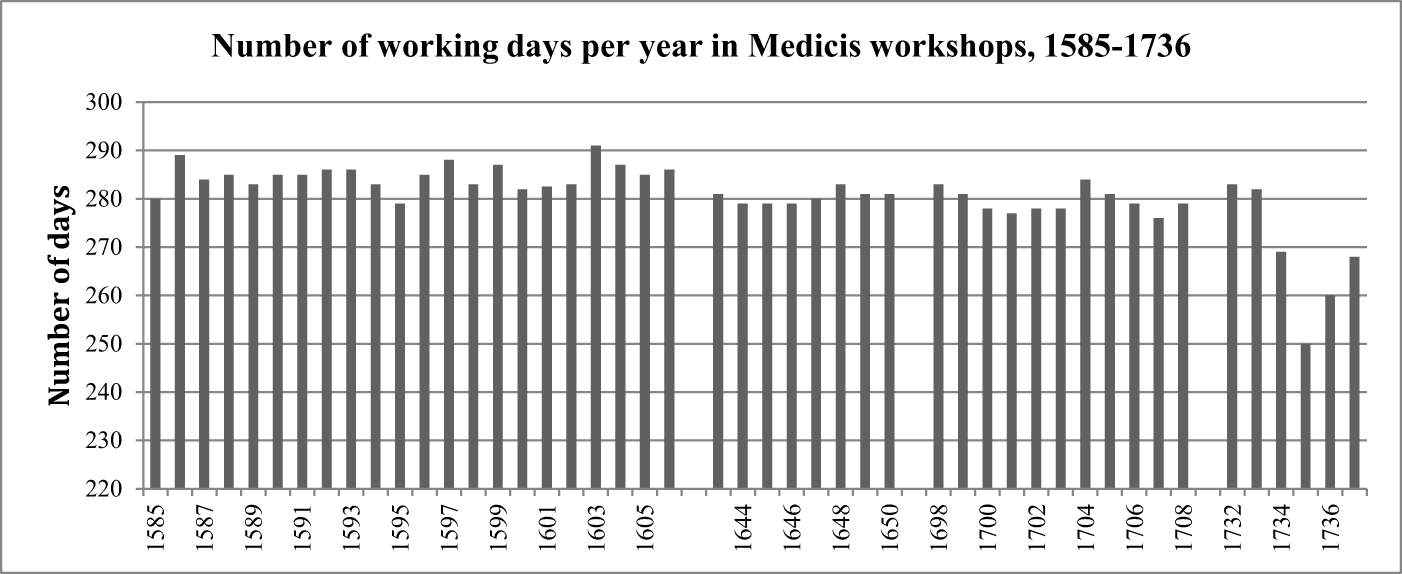
However, these account books generally existed for only a few years. We very rarely have access to accounting records covering a very long period of time. This is, however, the case for the ‘lists of workers’ employed by the Medici from 1585 to the end of the dynasty in 1737 (see Figure 1).
Number of working days per year in Medici workshops (Florence, Italy), 1585–1737.

The uniformity of these records is quite surprising and the very limited evolution that can be observed goes in the opposite direction to what might have been expected, since the longest work years occurred at the end of the sixteenth century (with an average of 284 working days per year over 20 years), not at the end of the following century (with an average of 279 working days per year over 10 years). While the Florentine registers are exceptional in terms of their duration, specific comparisons with other major construction sites show that they are not atypical: in 1645, for example, the number of working days is comparable to those of Saint Germain des Prés in Paris (262 days) or the construction of the Duomo in Milan (254 days). What is more, a detailed day-by-day comparison between these registers shows that the most significant differences are linked to the specific circumstances of the building sites (snow interrupting construction, waiting for materials, construction stages and so on), rather than to a difference in the number of feast days.
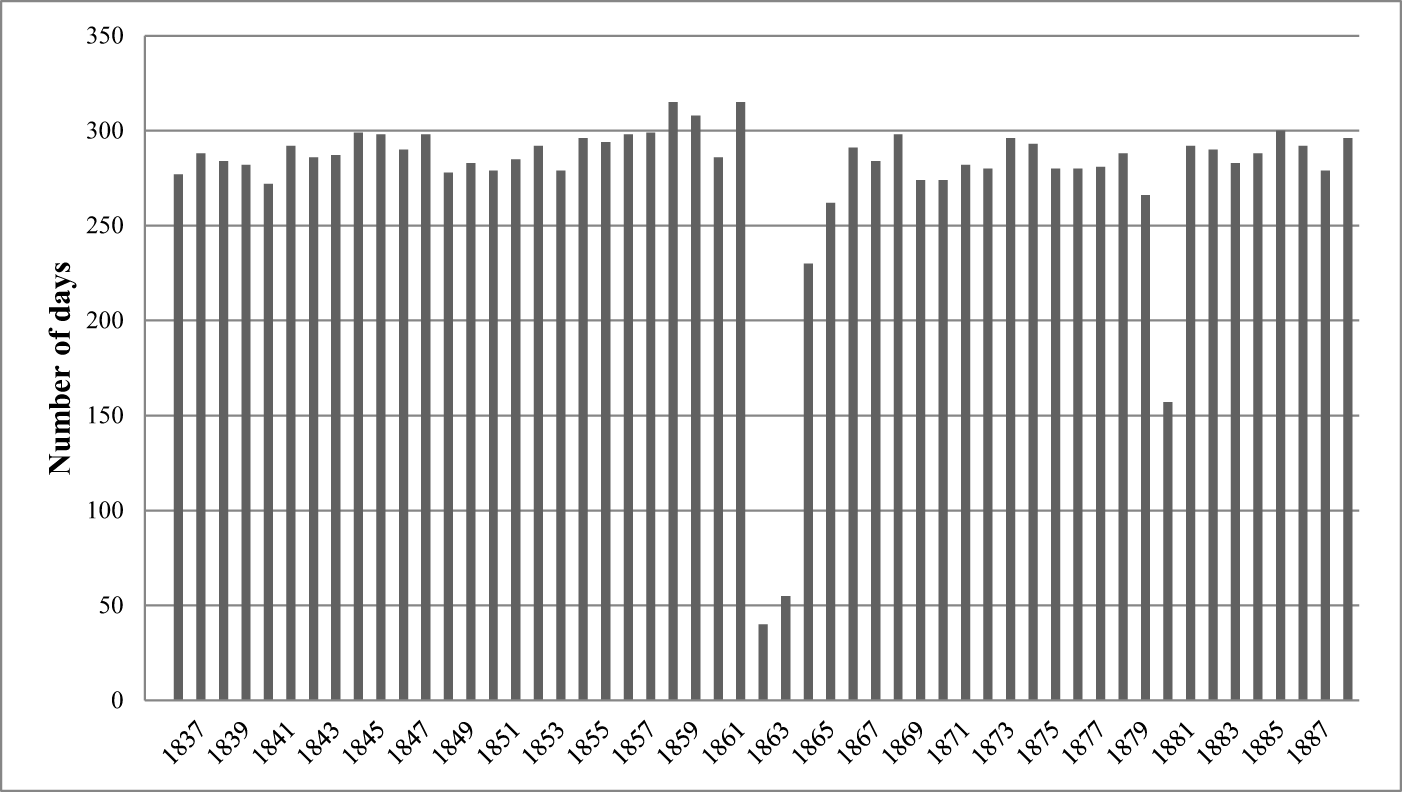
What is most surprising is that at the end of the nineteenth century in the large textile companies, nothing much had changed, since the work year varied between 280 and 290 days in large woollen or cotton plants. Here, again, one could not preclude serendipitous hazards and varied unexpected occurrences. The recovery was often as rapid as the fall in activity, however. For instance, once the crisis sparked by the cotton famine in the early 1860s had passed, production returned to its previous levels (see Figure 2).
Workdays at Voortman cotton-mill (Ghent, Belgium), 1836–1888.

Thus, the number of days worked in the most industrious firms did not change spectacularly over the long run. This in turn does not sit well with Voth’s hypothesis that the number of working days per year significantly increased as industrialization developed.Footnote 63 Moreover, in the nineteenth century just as much as during earlier periods, many firms were far less active over the year. In 1848, 1860, 1880 and 1892, the inquiries launched by the French state included detailed tables providing the number of days worked per year in each industrial sector. Whatever the reservations one can have as to the accuracy of these figures, it is impossible to deny that the results provided were extremely divergent. Around 1890, it was claimed that the miners and metalworkers from Rive-de-Gier, or from the Saint-Étienne and Lyon areas, were guaranteed 275 to 300 working days. Figures ranging from 220 to 270 working days are found in paper mills, in Annonay, in the shoemaking centres in Drôme and Isère, in the new, mechanized textile weaving factories in Beaujolais. As for domestic producers, their situation could be downright disastrous at times, with an average figure set at 200 to 220 days for the cotton cloth weavers in the Beaujolais countryside, the passementerie makers of Saint-Étienne and the hatmakers of Grigny. At the bottom of the ladder one finds the Lyon canuts [silk-weavers], who could reach 200 days of work per year only by constantly moving from one master to another. Thus, the situation was not so far from the pre-industrial one, but one also has to take into account that the work time of a firm was never exactly the same as the work time of its employees.
4.3 Observing down to the level of individuals so as to perceive a fragmented reality
Contingencies, constraints and personal or family choices no doubt dictated to a much greater extent each individual’s work calendar. Indeed, this is what Vauban had observed when he reckoned that 180 was the plausible number of workdays of a rural day labourer or weaver.Footnote 64 But rather than arguing, as he did, from the perspective of a hypothetical ‘average worker’, it seemed more useful to us to try to grasp the breadth of what was possible at various moments by focusing deliberately on those working within a single business. However, we did not consider workers who did not have an official employer, including many women and children, or who held more than one job, who sometimes can be followed only through notarized agreements.Footnote 65
The artisans and workers labouring in the shops of the Uffizi or the construction workshops of the Medici chapels were surprisingly assiduous. In 1644 as in 1645, the stability observed is quite remarkable: 160 workers were present for those two years, with traces of many of them for much earlier and much later periods; 57, on the other hand, were present only one year out of two.Footnote 66 Stability of employment prevailed, therefore, to which must be added regularity in the workplace: 69 per cent of stonemasons, 70 per cent of those labouring in the chapel and 84 per cent of those present in the workshops worked for more than a year, the vast majority having worked regularly and continually during these two years. This kind of situation was found in the more stable sectors of the labour world.Footnote 67
At the opposite end of the spectrum of possibilities, we find the building site of the Milan Duomo during the same period. If we focus only on yearly averages, the workers on the Milan work site worked from only 26 per cent (the average in 1648 when the work year was longest) to 55 per cent (the average in 1644 when the work year was shortest) of the time when work was offered to them by the business. Above all, this observation shows that averages do not adequately reflect the many individual variations in work behaviour. This should be reason enough to track each worker individually.
Doing so leads to the discovery that there were actually two types of workforce, labouring side by side.Footnote 68 A small number of employees, in this case 7 out of 59 during this period, worked constantly during the five years observed, over 250 days a year for 5 of them: thus, less than 12 per cent of the workforce was stable and in all likelihood had no other employment than that of the Fabbrica, contrary to the 55 other employees who for the most part worked on the site only very temporarily, essentially as an auxiliary labour force. Between these two extremes were those who worked full years but not every year, or those whose presence on the worksite was almost constant but not very regular.Footnote 69 This contrast between a stable workforce and one that came and went, whether by choice or enforced from outside, is characteristic of most of the activities of the pre-industrial era, from workers on the land to craftsmen in workshops, factory workers, mill hands and mine workers, or domestic servants.Footnote 70 While this employment structure was indispensable to the functioning of the economy of the Old Regime, this did not hinder employers from attempting to impose stability upon their most qualified workers in various ways – with certificates for time off, advances on salaries and notarized contracts, for example.
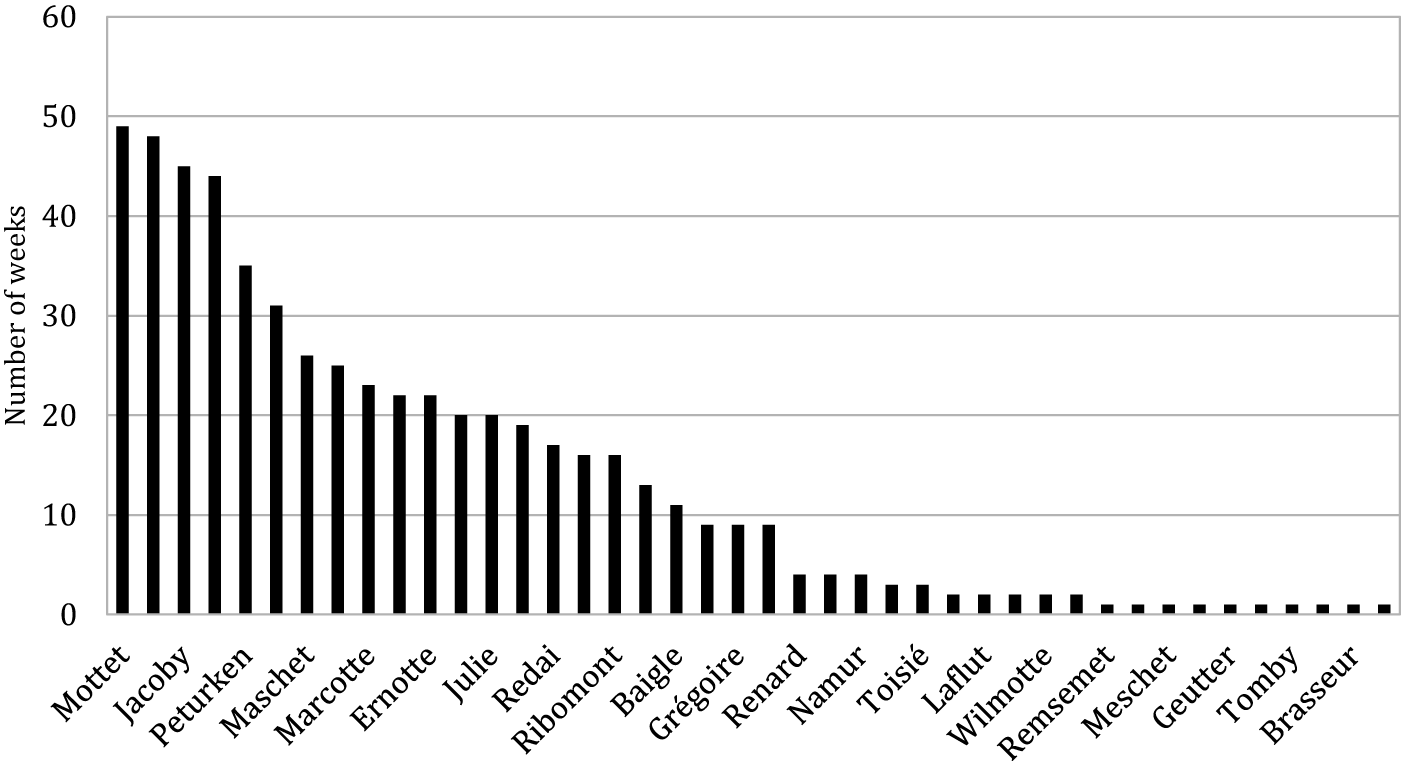
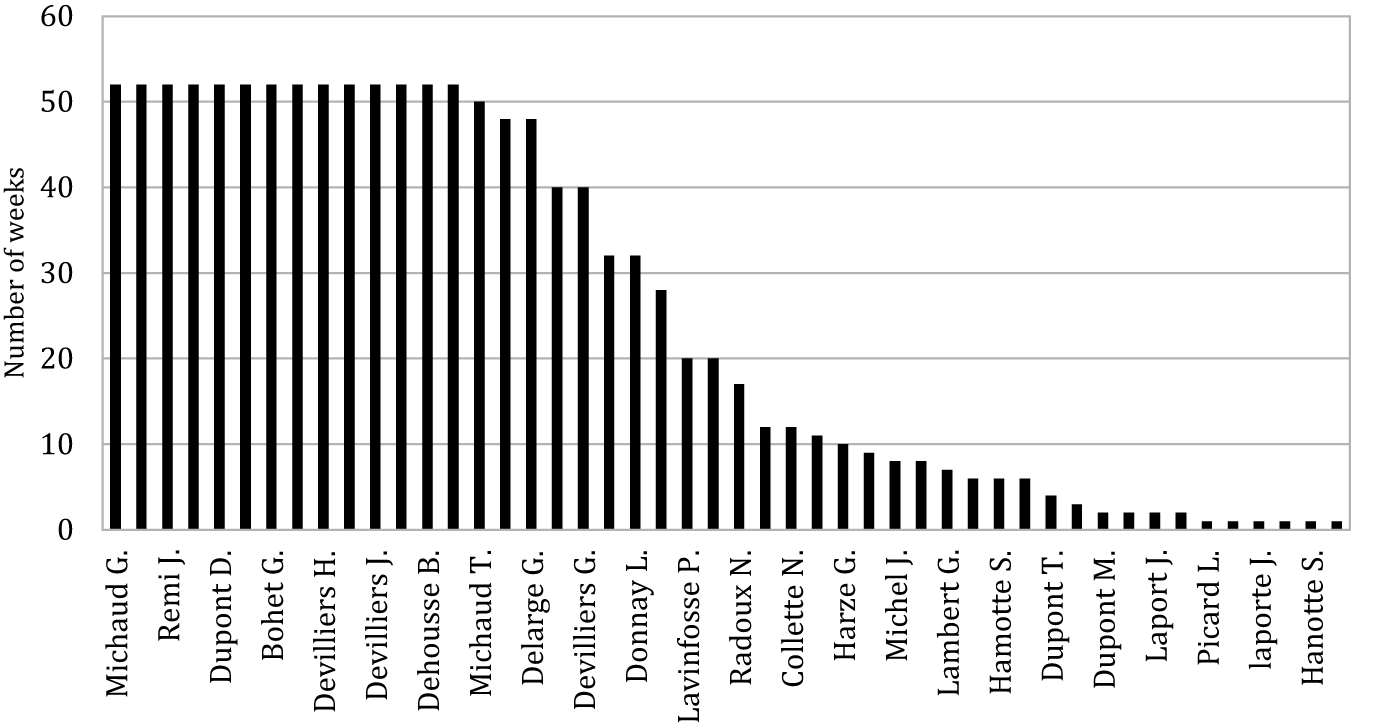
Nevertheless, the instability did not disappear later on; indeed, rather the reverse is true.Footnote 71 We know that nineteenth-century populations tended to be extremely footloose, a tendency that the authorities and employers just as often tried to fight. In the Damseaux-Renoz firm in Verviers as in the Grande Bacnure mine in Liège (Belgium), the same binary structure of the workforce can be observed, with a few relatively stable members and a majority of workers who were only passing through. Yet even when we consider only the former group, it can be observed that there is a relatively high level of absenteeism (see Figures 3 and 4).Footnote 72
Number of weeks worked by carders in a textile mill at Damseaux-Renoz (Verviers, Belgium), 1851.

Number of weeks worked by coal cutters at the mine of Grande Bacnure (Liège, Belgium), 1851.

In woollen mills, carders worked for very disparate hourly totals since the difference between one worker and the next could amount to over a third. In the mine, one pickman (or hewer) worked a total of 304 days, a second 249 and a third 187. Nonetheless, during the first part of 1851, the length of time of their work was almost identical; then, in the summer and at the beginning of the fall, one stepped up his efforts, another was regularly absent and the third was totally absent for fortnights at a time. Was this because of a temporary inability to work, a dismissal from the mine, a new position elsewhere within the business or a temporary suspension of activity for a miner who was also a peasant? All of these are possibilities and show the extent to which the statistical assessments that we have come up with should be corrected by the reconstitution of individual trajectories. For the work time in these two companies was a multifaceted reality, analogous in many ways to what can be observed in pre-industrial societies.
In short, all these results – whether the yearly number of workdays in large businesses or the individual presence of workers in the workplace – make it difficult to generalize. The diversity of situations remains such that it is impossible to conclude that there was a sharp rise in work in the first part of the nineteenth century, followed by a slow decline from the 1840s onwards, a result again contradicting the claims of historians overly obsessed with round figures.Footnote 73 This is especially true insofar as it is impossible to ignore the content of work.
5. Articulating in an empirical way the length and content of work
Most historians who have studied the question of work time over a long period have taken into consideration only its measurement, as if one workday were equal to another. However, it is clear that the risk that time would be wasted doing nothing was understood very early on by employers, and could potentially be a source of conflict with employees as early as the Middle Ages.Footnote 74 It is thus necessary to take into account this desire for the optimization of work time because it has a tendency to increase work density and to bring about considerable differences between identical work times, independently of any technical change. This pressure is magnified with the increase in the role of machines in the process of production. However, and whatever the case one considers, there were many discussions around the best way to articulate the length and content of work, far predating Frederick Wilson Taylor’s writings at the end of the nineteenth century.
5.1 Densifying work: a goal for the entrepreneurs of the nineteenth century
In 1888, a master ironworker from Charleroi (Belgium) eloquently explained how important it was to him to reconcile a daily length of work time, a minimal demand for duly measured performance and the potential rewarding of individual productivity.Footnote 75 Under the penalty of disciplinary action, each worker had to produce a minimal amount attributed to a hypothetical ‘average worker’. Each worker was free, if he wished to earn more money, to increase his efforts and to reach levels of performance, the upper limits of which were not defined, as long as what was produced was of good quality.
Beyond this single example, there are many indications that by then goals of this kind were shared by many businessmen. In France, from the mines of Carmaux (coal) to the company of Saint-Gobain (glass) and in the railroad companies, the system described by the master ironworker of Charleroi could be found in various forms.Footnote 76 For all of these employers, work could never be reduced to the time when workers were present; that was why they demanded, in increasingly rationalized ways, efforts that would measure up to the objectives of profitability of the business, even if at the beginning of the 1890s, continental industries had not yet reached the level of proficiency of their English competitors in this area.Footnote 77
A more frequent situation in industrial branches such as textiles was the recourse to piecework, a solution increasingly favoured by employers as the century moved on. Piecework made it possible to increase the pressure towards densifying work along the whole production line, even though workers, who were not blind to its consequences, were demanding to be paid by the hour. Even with hourly wages, the bodily union of man and machine nevertheless resulted in the workers being dispossessed of control over the rhythm of work, transformed into a timed pace they were unable to influence. It is hardly surprising to find that the risks of burnout were first described experimentally by the Italian physiologist Angelo Mosso towards the end of the nineteenth century. Workers were perfectly aware of these dangers, as was the case for those of Tourcoing, who berated the behaviour of their employers in 1884: ‘They constantly increase the speed of their machines and of their looms; they are never satisfied; they turn us into actual slaves in order to fatten their fortune and live the noble life.’Footnote 78
However, and despite widespread misconceptions on this score, the goal of a better articulation between work length and work contents allowing for increased productivity was quite old, a point we will develop at some length because it is probably the most widely misunderstood.
5.2 Productivity, an issue from the early modern era
In his study of the Sedan cloth industry, Gérard Gayot shows that in 1698, productivity-based wages ‘camouflaged’ as hourly wages were introduced into the particularly sensitive sector of cloth finishing.Footnote 79 In order to be paid for a ‘conventional’ hour, teaselers and shearers had to complete a certain amount of work: more, they earned more; less, their pay was cut. The 1698 regulations would later be referred to constantly in each of the recurring conflicts that developed in this cutting-edge sector of the Sedan manufacture.Footnote 80 Teaselers and shearers did not question the imposed pace or even the reduction of their work to what could be quantified. They refused, however, to carry out unpaid operations and left them to the apprentices or to a few ‘hires’ [gagés], journeymen paid by the month. Some of the manufacturers, on the contrary, wanted to force those tasks upon them, which would lower the cost of their work, while increasing the productivity of those paid ‘genuinely’ according to time. In short, behind demands from which the question of work time was apparently absent, one found nevertheless this same question as the backdrop of extremely violent conflicts in which the shearers would end up being the losers. This case is indeed emblematic; whether in one form or another, this kind of conflict was recurrent whenever work was reduced to what can be measured.Footnote 81
This example is even more interesting as it is precisely contemporary to the calculations made by Sébastien le Prestre, marquis of Vauban and Guillaume Amontons, who also tried to compute how much a worker could achieve in a given time span.Footnote 82 Yet the practices of some employers preceded any theorization. Indeed, attempts to measure how much work was carried out during the time it was being paid for took place as early as the Middle Ages. Notably, it can be observed that during the period following the Black Death ‘seigniorial administrators expected hired servants to work to the best of their pay’.Footnote 83 In the area of farming, is not the journée the surface area which a man is able to work in one day, just as the lieue [the league] is the distance that can be travelled in one hour?Footnote 84 In Renaissance Italy, did not the architect Filarete count how many bricks his masons could lay in one day? In fifteenth-century Germany, did not the Bamberg pavers receive different salaries according to the level of intensity of the tasks carried out?Footnote 85 For some historians, it was also one of the causes of the lower pay of children and women for equal work.Footnote 86 Yet it seems to us that the formal measure of the production demanded of workers during a given period of time truly took shape in a limited number of trades during the early modern era.
One of the earliest examples concerned the printing press. In France, it would seem that what a printer had to do was defined globally for the first time in 1572: 2,650 sheets a day in Paris, but 3,550 in Lyon.Footnote 87 This is far from the only area in which this trend can be observed: in the area of paper mills, a system of daily quotas could also be observed to be taking shape, as became apparent at the end of a strike by the workers of Ambert, which lasted over a month at the end of the seventeenth century. To bring peace to this industrial sector, the regional intendant prepared a general settlement on labour, later approved by the king’s council on 20 November 1688.Footnote 88 Beyond the obligation for employers to feed workers on Sundays and holidays as well as on workdays, it provided for the respect of a mutual period of six weeks to terminate a work contract and, above all, specified once again the quantity of work to be carried out each day for each vat.Footnote 89 The intendant did not innovate much but, backed by the king’s power, he reaffirmed the current practices, the date of origin of which we do not know. In any case, the settlement revealed that there was a desire to measure and to stabilize the quantity of work accomplished during a specific time frame by the workers. We can thus see here how workers’ customs might act as an effective brake against the desire of principals to impose faster rhythms.
In fact, when the Montgolfiers renovated their Vidalon factory in 1780, they were still obsessed with the same issue.Footnote 90 Careful to take on young men or even young boys who were ‘uncontaminated’ by working-class experience and loyalties, the two brothers wanted to modernize their enterprise, that is, at the same time introduce machines, notably cylinders fitted with blades, to reduce rags into shreds three times faster than the former hammers and pestles, and control gestures as well as work rhythms. They thus established a regulated ‘workday’. The calculation made by the two brothers was based on 13 hours of actual work per day, 300 days a year, and especially on 45 minutes for a ‘porse’, a unit measuring the quantity of paper and varying with size and weight.Footnote 91 The salary was thus a productivity-based wage, ‘the day being defined as a system of piece-work remuneration occurring within a workday, with a system of bonuses and fines governing the whole set-up’.Footnote 92 The control was in the hands of the bookkeeping department, which carefully accounted for the daily work done by each worker: human gestures were thus captured in a tight network of written records.Footnote 93 Thus, along with the business owner, we can check whether production quotas were reached, and observe that they were only rarely exceeded and very often not met: the production standard set had placed the bar high enough. While the Montgolfiers imagined a ‘capitalist utopia’ in which the workers were robots, its roots can be found in the system of daily productivity-based wages set up in the same profession before the end of the seventeenth century, that is, at the same time as Vauban’s calculations.Footnote 94
The number of parallels between these procedures and the theories of Frederick Taylor in the later nineteenth century are striking, although a label of ‘proto-Taylorism’ would be a stretch. Nonetheless, the common characteristic between Vauban’s research and that of other scholars, from Amontons to Amar and Coulomb, the efforts of a number of businessmen from the seventeenth century on and Taylor’s thinking is that they all strived to determine the ‘best’ way to work in order to calculate ‘normal’ productivity for workers. In order to achieve this, all of them in fact based their thinking on the production of the best workers and on the quantifiable part of work, whether it was in terms of the components of handiwork (how many physical gestures were required to be completed over a given length of time, as was the case for the Sedan teaselers and shearers) or in terms of what was produced (how much must be produced in a day, in an hour). These calculations made it possible to determine each individual’s income according to what he or she achieved over a given length of time. They also reflect the efficiency of the division of labour, which, it must be recalled, was already extremely important in medieval textiles. The similarities are all the more interesting to emphasize as no one has established any direct influence of these earlier thinkers and practices on Taylor. He seems thus to have rediscovered thinking that had accumulated over many centuries on the normalization of work, its optimization and the efficiency of its division into fragmented tasks. Considerations about physical fatigue, which were developed concurrently, took a much longer time to be taken into account.
6. Conclusion
Studying work time over a long period makes it possible to show how complex the issue really is. A first observation can be made: it appears that the remunerated workday fitted into hourly limits which had long been set by custom or by law on the European continent. This practice was hardly specific to early modern England; nor was it found only within a few very narrow circles, as claimed by Martineau.Footnote 95 Regardless of the extreme diversity of concrete situations, the amplitude of the workday remained roughly the same from the fourteenth to the nineteenth centuries and was distinct from the course of the sun. As for the actual length of the day, it did not necessarily become any longer or encroach more upon the night with industrialization. As early as the fourteenth and fifteenth centuries, there were workers for whom the daily length of the workday was quite as long as for those who would succeed them a few centuries later. It was also for this reason that work discipline was enforced, sometimes very early on, especially with more or less efficient systems of fines for whoever did not respect the proper hours.
As for the number of days actually worked in the year, it seems clear that it cannot be determined by the tally of workdays that has attracted the attention of so many researchers, obsessed for so long, following many eighteenth-century thinkers, by the large number of religious holidays. On this point, the legal year does not seem to have been as different in Catholic and Protestant countries as has been asserted. Anyway, this quarrel was no longer relevant once societies had become more secular in the nineteenth century, even though the number of working days did not really increase significantly then. From the fourteenth to the nineteenth centuries, changes were relatively slow and non-linear.
Quantifying the number of days actually worked during a year nonetheless remains a problem. Accounting records reveal the striking permanence of a maximum number hovering around 270 to 280 actual workdays a year, a permanence that holds true even over a very long period of time. Let us point out also that these are maximum numbers, with many production units, including in the nineteenth century, working much less time. Moreover, the number of workdays in a business or on a worksite, whether in town or in the countryside, never corresponded to an individual’s work time. That is why it is necessary to go down to the individual level to realize that there was no rule, except that there was almost always a rough dichotomy between a relatively stable workforce and those who were only passing through for reasons that often remain unknown. Yet within these two categories, diversity abounded as well.
In this sense, our approach is very different from those based on econometric reconstructions. As interesting as the latter may be, they have a tendency to transform the daily reality of an individual’s work into a statistical illusion. Once again, de Vries’ reliance on big data obscures the particularities of many trades. What we propose also breaks with other narratives trying to posit the existence of a breach linked to what would be the bursting in of the ‘capitalist mode of production’ from the 1780s on.Footnote 96 It seems to us that, on the contrary, a bottom-up history would allow us to put back together the complicated reality we study in the most pertinent way, fleshing out the figures we have. It is also for this reason, although we did not deal with this issue here, that reconstructing average salaries or average living standards is somewhat meaningless: in this area more than in any other, ‘averages are truly outrages inflicted upon the reality of individuals’.Footnote 97
This being said, we are not claiming that nothing ever changed; on the contrary. The only aim of the examples we have been able to gather is to limit the field of possibilities and to show in particular the relative continuity of the highest standards used for work time. They may have been reached at different times and in various places or sectors, with more or less broad consequences depending on how widespread they became. What occurred during the early modern period in a growing number of regions was no doubt a result of the articulation of population growth and economic development. This led progressively to the alignment of the length of work time for most workers to these highest ‘standards’, which for their part had not really changed very much. Their diffusion was prompted by the convergent influence of multiple motivations: on the part of entrepreneurs, there was the pursuit of a maximum gain to be won out of other people’s labour and, to this end, they sought to accentuate the discipline of work; on the part of the workers, there was either the attractiveness of increased consumption, for a minority group, or, for the majority, the necessities of survival.Footnote 98 But if there really was an ‘industrious revolution’, it also came about because of transformations in the contents of labour, which must be taken into account to recapture the whole reality of work time.
Indeed, the definition of specific productivity standards to be reached over a given time is not the exclusive province of the best-performing businesses from the end of the nineteenth century, nor did it begin with Frederick Winslow Taylor. The formalization of the relationship between work time and the quantity to be produced emerged and spread to a growing number of activities and businesses in the seventeenth century, no doubt based on earlier attempts. It made its way into practice as much as into theoretical thinking, and introduced a relatively new form into the language of wage-earning during this period, the specificity of which was to link work time and work quantity in a relatively formal way.Footnote 99
What no doubt marked a profound change, as early as the second half of the eighteenth century, was the idea entertained by a number of thinkers that higher salaries, instead of having the unavoidable effect of producing laziness in workers, might on the contrary set in motion a virtuous circle of growth. In the end, is that not also an idea developed by Taylor and above all by Ford? It was not until the twentieth century that in the Western world, in a way unheard of before, a decrease both significant and stable in the number of working hours took place, associated with a scientific rationalization of tasks, a densification of labour and the simultaneous explosive birth of a consumer society. But in our day and age, who can claim that the decrease of work time has systematically reduced the intensity of the effort of production?
Acknowledgements
This article was translated by Darla and Pierre Gervais.
Competing interests
The authors declare none.