Necrotising enterocolitis is a devastating condition that arises in the setting of immature bowel, decreased tissue perfusion, and altered bowel wall permeability, which results in compromised bowel integrity and tissue necrosis. As such, it is one of the leading causes of gastrointestinal morbidity and mortality in neonatal intensive care units.Reference Hsueh, Caplan and Qu 1 Although it is most frequently seen in very low birth weight infants, necrotising enterocolitis is not unique to this population. In fact, the prevalence of necrotising enterocolitis in children with congenital heart disease is 10–100 times greater than the prevalence seen in term infants without congenital heart disease.Reference McElhinney, Hedrick and Bush 2 In some studies, the prevalence of 1.6–7%Reference Leung, Chau and Hui 3 , Reference Mukherjee, Zhang and Chang 4 among infants with congenital heart disease approaches the 7% prevalence rates of necrotising enterocolitis seen in very low birth weight infants.Reference Lin and Stoll 5 In the case of hypoplastic left heart syndrome, the incidence is often significantly higher.Reference del Castillo, McCulley and Khemani 6 , Reference Jeffries, Wells and Starnes 7
Enteral feeding
The relationship of enteral nutrition and the development of necrotising enterocolitis in premature infants has been well described, with very few patients developing necrotising enterocolitis before the introduction of enteral feeds.Reference Berseth 8 This relationship has not been evaluated in infants with congenital heart disease. Moreover, it is often difficult to balance the interest of advancing enteral feeds with the demands that this places on the intestinal tract, which may already be compromised by reduced perfusion in infants with congenital heart disease.Reference Carlo, Kimball and Michelfelder 9 – Reference del Castillo, Moromisato and Dorey 11 Optimal feeding regimens for this population of infants have yet to be defined,Reference Medoff-Cooper and Irving 12 with some authors advocating for rapid advancement of both feeding volume and caloric density.Reference Pillo-Blocka, Adatia and Sharieff 13 Our study seeks to further characterise the feeding patterns of infants with congenital heart disease who subsequently developed necrotising enterocolitis in the post-operative period.
Aims
We therefore aimed to evaluate the role of enteral feeds in the development of necrotising enterocolitis in the congenital heart disease population. We hypothesised that infants who developed necrotising enterocolitis may have been fed more aggressively than a control population.
Methods
To test our hypotheses, we conducted a nested 2:1 matched case–control study to assess the role of post-operative feeding strategy in the development of necrotising enterocolitis. After obtaining approval from our institution's institutional review board, we reviewed records of patients admitted to either the cardiology or cardiothoracic surgery service at Egleston Children's Hospital from July 1, 2002 to July 1, 2010, who developed evidence of necrotising enterocolitis. Patients were identified through review of an institutional database on complications and an independent (International Classification Of Diseases)-9 ICD-9 query of hospital records. At our institution, patients who exhibit findings consistent with necrotising enterocolitis, including those with abdominal distention with haematochezia, elevated lactic acid, thrombocytopenia, and/or radiographic changes, are evaluated by a paediatric surgery consultant who confirms the diagnosis of necrotising enterocolitis and assists with subsequent management. Patients who are managed medically at our institution are frequently maintained on total parenteral nutrition and started on triple antibiotic therapy, typically consisting of vancomycin, gentamycin, and metronidazole for 7–14 days. The duration of therapy is adjusted on the basis of the clinical severity on an individual basis.
In order to evaluate risk factors independent of prematurity, we elected to focus on infants with an estimated gestational age greater than 36 weeks. Infants with an estimated gestational age <36 weeks, gastrointestinal malformations – for example, gastroschisis or duodenal atresia, isolated post-operative pneumoperitoneum, necrotising enterocolitis that occurred beyond the first 90 days of life, and those with isolated transitional lesions – for example, patent ductus arteriosus, or atrial septal defect – were excluded from the study population. In all, 45 infants were identified who fulfilled these criteria. Subgroup analysis was then performed on the 27 patients who developed necrotising enterocolitis in the post-operative period after the introduction of enteral feeds.
For each study subject, the medical record was reviewed and information regarding their presentation at the time of necrotising enterocolitis diagnosis was abstracted. Each subject was then retrospectively staged according to the modified Bell criteria for necrotising enterocolitis.Reference Kliegman and Walsh 14 Infants with suspected necrotising enterocolitis according to Bell staging were included in the study as this diagnosis is clinically significant, often resulting in multiple days of intravenous nutrition, bowel rest, and parenteral antibiotics. Enteral feeding data were obtained through review of daily patient flow sheets for the entirety of their hospitalisation.
In order to evaluate the role that different enteral feeding strategies may have played in the development of necrotising enterocolitis, we performed a nested 2:1 matched case–control study. All cases were matched to two controls on the basis of type of defect and surgery. Where exact matches were unable to be obtained, Risk Adjustment for Congenital Heart Surgery criteria were used to select controls with similar congenital heart disease severity/risk profiles.Reference Jenkins, Gauvreau and Newburger 15 Our primary risk factors of interest were day of onset of enteral feeds, days at which the patient reached an enteral feeding volume of 80 and 100 ml/kg/day, and the type of formula used. These volumes were used because they represent clinically significant feeding volumes that would allow the infant to be weaned off of parenteral nutrition. Our secondary risk factors of interest included gender, prenatal diagnosis, chromosomal anomaly, heterotaxy syndrome, single-ventricle physiology, and presence of aortic arch obstruction. In order to account for the matching, we first performed conditional univariate logistic regression for each risk factor stratified by the matching. In order to estimate odds ratios in this case–control study, we then intended to perform conditional multivariate logistic regression for those factors with an initial p-value of <0.10, using backward elimination to determine the final significant risk factors.
All statistics were computed using SAS version 9.2 (Cary, North Carolina). An alpha of 0.05 was used to determine statistical significance in the multivariate models.
Results
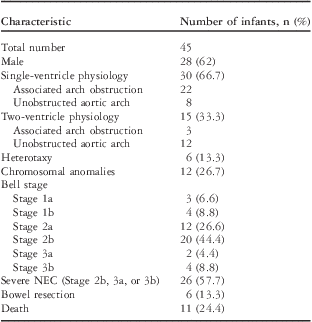
During the 8-year study period, there were 45 term or near-term infants with congenital heart disease who developed necrotising enterocolitis. Of these patients, 11 died before hospital discharge, resulting in an overall hospital mortality of 24.4%. There were six infants who required surgical management including bowel resection. Among the six infants who required surgical intervention, there was a 50% mortality rate. The remaining patients were treated medically. Of these 39 (20.5%) medically managed patients, eight died before hospital discharge.
Population
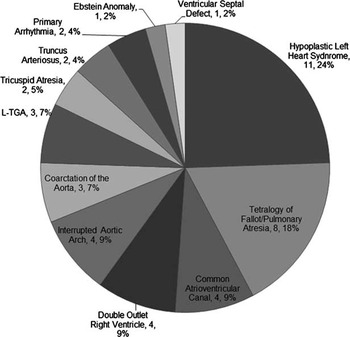
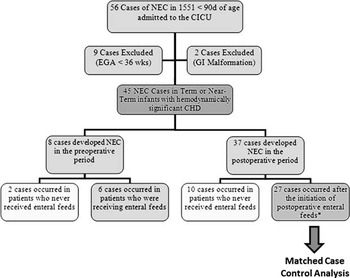
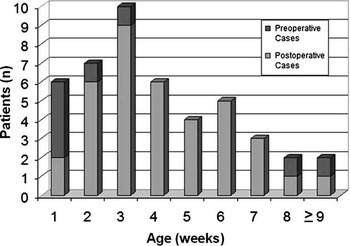
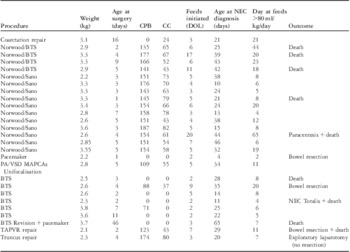
Infants with single-ventricle physiology represented the majority (67.7%) of our cases of necrotising enterocolitis (Fig 1). In all, 25 (55%) of the patients who developed necrotising enterocolitis had congenital heart disease with systemic outflow tract obstruction. There were an additional 11 (24.4%) patients with pulmonary outflow tract obstruction. Of the infants who developed necrotising enterocolitis, 12 of 45 (26.6%) underwent Stage I palliation: eight (17.7%) of these patients had a Norwood/Sano, while the other four (8.9%) underwent Norwood/modified Blalock–Thomas–Taussig shunt. There were an additional 14 (31%) infants who underwent modified Blalock–Thomas–Taussig shunt placement without aortic arch surgery. Of the 45 cases of necrotising enterocolitis that occurred in infants, eight (17.7%) had not undergone cardiac surgery (Fig 2). The remaining 37 (82.2%) cases of necrotising enterocolitis occurred during the post-operative period, chiefly within the first 3 weeks after surgery (Fig 3). There were 27 patients who developed necrotising enterocolitis in the post-operative period after the introduction of enteral feeds. Table 1 details the timing of surgery, initiation of feeds, indicators of operative course, and post-operative haemodynamic status of these patients. In comparing these patients with their matched cohort, there was no statistically significant differences in weight at the time of surgery, age at the time of surgery, duration of the cardiopulmonary bypass, or length of aortic cross-clamp time.
Pie chart demonstrating variety of congenital heart defects present in patients who developed necrotising enterocolitis (NEC).

Flow chart demonstrating breakdown of necrotising enterocolitis cases with regard to operative timing and initiation of feeds. *The 27 patients who developed necrotising enterocolitis after the initiation of post-operative feeds were selected for a nested matched case–control analysis to evaluate the role that post-operative enteral feeding plays in the development of necrotising enterocolitis.

Timing of necrotising enterocolitis (NEC) cases.

Characteristics of patients who developed NEC after feeds were initiated in the post-operative period.

BTS = Blalock–Taussig shunt; CC = cross-clamp time (min); CPB = cardiopulmonary bypass time (min); PA/VSD = pulmonary atresia and ventricular septal defect; MAPCAs = major aortopulmonary collaterals; NEC = necrotising enterocolitis; TAPVR = total anomalous pulmonary venous return; DOL = day of life
Enteral feeding
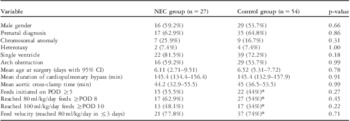
At our institution, infants with congenital heart disease are typically started on continuous feeds via a nasogastric or nasojejunal tube in the post-operative period. If breast milk is not available, infants are fed a standard cow milk protein formula. During the study period, there was a high degree of inter-provider variability with regard to enteral feeding practices. Typically, once the patient had tolerated goal volume, the caloric density was advanced. Upon review of the feeding profiles of the infants who developed necrotising enterocolitis and the control group, there were no statistically significant differences between the two groups. Specifically, the groups were similar with regard to caloric density, formula type, day of initiation of enteral feeds, and feeding velocity (Table 2). Given that there were no risk factors with a p-value <0.10 in univariate analysis, multivariate analysis was not performed.
Comparison of surgical NEC patient demographics with matched controls.

NEC = necrotising enterocolitis; POD = post-operative day
*Four patients in the control group died before the initiation of post-operative feeds and thus were excluded from the analysis of post-operative feeding patterns
Presentation
The overwhelming majority of our cases presented with grossly bloody stools. All patients in whom stool studies were obtained (42 of 45) tested occult blood positive. On radiographic evaluation, 37 of 45 patients had abnormal abdominal films at the time of diagnosis. Ultimately, there were 20 patients who were categorised as having severe necrotising enterocolitis (Bell Stage 2b, 3a, or 3b; Table 3).
All NEC patient demographics (n = 45).

NEC = necrotising enterocolitis
*Of those who required bowel resection, only three of six patients survived
Discussion
In this study, the single largest cohort of term and near-term infants with congenital heart disease who developed necrotising enterocolitis, we found that there was no relationship to the timing of initiation of enteral feeds or feeding velocity and the subsequent development of necrotising enterocolitis. Prior studies that have evaluated necrotising enterocolitis in the congenital heart disease population have used smaller sample sizes or have included infants with transitional lesions or prematurity.Reference McElhinney, Hedrick and Bush 2 , Reference Pickard, Feinstein and Popat 16 This study was designed to look exclusively at the population of infants with an estimated gestational age greater than 36 weeks with haemodynamically significant congenital heart disease who developed necrotising enterocolitis. The overall incidence of necrotising enterocolitis, including preterm infants, in our study of (56/1551) 3.6% compares similarly to the 3.26% incidence of necrotising enterocolitis described over 10 years earlier at a similar, large, tertiary care hospital.Reference McElhinney, Hedrick and Bush 2
Our current review supports the more recently published literature with regard to reduced disease severity of necrotising enterocolitis in infants with congenital heart disease in comparison to the premature population.Reference Mukherjee, Zhang and Chang 4 , Reference Pickard, Feinstein and Popat 16 The overall mortality, 24%, in our group differs markedly from the 57% mortality reported by Cheng et alReference Cheng, Leung and Tam 17 in 1999 for infants with congenital heart disease who developed necrotising enterocolitis. In addition, none of the infants in our study developed subsequent intestinal stricture or short bowel syndrome, which supports Pickard's findings that infants with congenital heart disease as their primary predisposing condition for the development of necrotising enterocolitis seem to be at decreased risk for these complications in comparison to infants with necrotising enterocolitis related to other risk factors.Reference Pickard, Feinstein and Popat 16 The lower likelihood of stricture formation may serve as a clinically useful piece of information when evaluating infants with feeding intolerance, who have congenital heart disease and a history of necrotising enterocolitis. Our experience supports the hypothesis that cardiogenic necrotising enterocolitis represents a distinct pathophysiologic process and likely a separate disease entity in comparison to necrotising enterocolitis seen in premature infants.Reference Pickard, Feinstein and Popat 16 , Reference Torres 18
Enteral feeding
The role of enteral feeding in the development of necrotising enterocolitis in infants at high risk for this condition has been the subject of much debate. Recent Cochrane reviews in very low birth weight infants have suggested that there is no clear relationship between the timing of onset of enteral feeds or the rate at which they are advanced and the subsequent development of necrotising enterocolitis.Reference Morgan, Young and McGuire 19 , Reference Morgan, Young and McGuire 20 The possible contribution of enteral feeding to the development of necrotising enterocolitis is one of the factors that has led to the significant institutional variability with regard to feeding strategies for infants with congenital heart disease.Reference Howley, Kaufman and Wymore 21 , Reference Johnson, Mussatto and Uhing 22 This is particularly true for infants with hypoplastic left heart syndrome during the pre-operative period. In fact, some centres practice strict avoidance of enteral feeds, whereas others suggest that routine feeding of these infants may be “safe practice”.Reference Willis, Thureen and Kaufman 23 , Reference Natarajan, Reddy Anne and Aggarwal 24 Moreover, marginal nutritional status in infants with congenital heart disease after cardiac surgery has been linked to both increased length of stayReference Kelleher, Laussen and Teixeira-Pinto 25 , Reference Gillespie, Kuijpers and Van Rossem 26 and increased out-of-hospital mortality.Reference Eskedal, Hagemo and Seem 27 This has prompted multiple interventions with regard to optimising the nutrition of infants with congenital heart disease, particularly in the post-operative period.Reference Medoff-Cooper and Irving 12 , Reference Pillo-Blocka, Adatia and Sharieff 13 , Reference Braudis, Curley and Beaupre 28
In our study, 12 of the 45 (27%) infants developed necrotising enterocolitis before the introduction of any enteral feeds. This is in contrast to necrotising enterocolitis seen in premature infants in whom the development of necrotising enterocolitis in the absence of enteral feeding is a rare entity. One possible explanation for the 10 patients who developed necrotising enterocolitis in the post-operative period while still nil per os may be due to the reported increased gastrointestinal permeability seen following cardiopulmonary bypass.Reference Malagon, Onkenhout and Klok 29 In the current study, 82% of necrotising enterocolitis occurred in the post-operative period, in contrast to previously published literature demonstrating the majority of necrotising enterocolitis occurring in the pre-operative period.Reference McElhinney, Hedrick and Bush 2 , Reference Pickard, Feinstein and Popat 16 , Reference Dees, Lin and Cotton 30 It is possible that our institutional practice of avoiding enteral feeds in infants with prostaglandin-dependent congenital heart disease may have contributed to reducing our pre-operative incidence of necrotising enterocolitis.
Although the pathophysiology of necrotising enterocolitis in patients with congenital heart disease is likely multifactorial, recent studies have suggested that feeding patterns may play a significant role.Reference del Castillo, McCulley and Khemani 6 del Castillo et alReference del Castillo, McCulley and Khemani 6 described in their single-centre study a reduction in the incidence of necrotising enterocolitis by over 50% with the introduction of an enteral feeding protocol. However, it is worth noting that the initial 18–27% rate of necrotising enterocolitis demonstrated before intervention was significantly higher than the 3–7% described by Leung et alReference Leung, Chau and Hui 3 , McElhinney et alReference McElhinney, Hedrick and Bush 2 , and our current series. The higher rates noted by del Castillo et al may be a reflection of their evaluation of a higher risk population as they only included patients with hypoplastic left heart syndrome. In the current study, when post-operative infants who developed necrotising enterocolitis after the initiation of enteral feeds were compared with matched controls, there were no statistically significant differences in feeding patterns, day of initiation of feeds, feeding velocity, caloric density, or formula type. As such, the strategy of slowly advancing feeds to avoid necrotising enterocolitis may not be justified in this population. This is particularly germane given that numerous studies have demonstrated that infants with complex congenital heart disease typically drop one standard deviation in weight during the newborn hospitalisation.Reference Medoff-Cooper, Irving and Marino 31 , Reference Schwalbe-Terilli, Hartman and Nagle 32
Limitations
A significant limitation of this study is its retrospective nature, which is unable to account for clinical practice changes that occurred during the time course of the study. This is particularly relevant with regard to changes in feeding patterns, which varied significantly throughout the study period. Interestingly, this seems to have had no significant effect on the overall incidence of necrotising enterocolitis in our institution, as the rates of necrotising enterocolitis over the course of the study remained relatively constant. An additional limitation to the current study may be related to power. Given the rare nature of necrotising enterocolitis, it is possible that in spite of the current study design that captures all episodes at a large volume institution over an 8-year period that the study remains underpowered to detect a difference in feeding patterns between those who developed necrotising enterocolitis and those who did not.
Conclusions
In term newborns with congenital heart disease, necrotising enterocolitis is relatively uncommon, but may be catastrophic. Recent studies have linked changes in enteral feeding patterns to reduced rates of necrotising enterocolitis; however, 12 of the 45 (27%) patients developed necrotising enterocolitis before the initiation of enteral feeds. There is likely a subset of patients who develop necrotising enterocolitis whose risk is unlikely to be modified by any enteral feeding strategy. Our current practice of avoiding enteral feeds in the pre-operative patient receiving prostaglandin infusion seems reasonable given the low incidence of pre-operative necrotising enterocolitis in our series. Although strategies to reduce the risk of necrotising enterocolitis in this at-risk population should continue to be investigated, efforts should also focus on early identification and optimal management to lessen morbidity and mortality following diagnosis.
Acknowledgements
The authors would like to thank Pam Carlock, RN and Emily Lawson for their assistance in preparation of this manuscript.