Introduction
Anorexia nervosa (AN) is a psychiatric disorder associated with profound morbidity and dramatically elevated mortality rates. Although recognized for centuries, definitive longitudinal, population-based studies identifying risk factors for AN do not exist and therefore the current knowledge base on the etiology of AN remains limited (Jacobi et al. Reference Jacobi, Hayward, deZwaan, Kraemer and Agras2004; Commission on Adolescent Eating Disorders, Reference Evans, Foa, Gur, Hendin, O'Brien, Seligman and Walsh2005).
A significant challenge in studying the etiology of AN is capturing the complexity of this multi-determined disorder. Potential contributions to increased risk for AN span from the prenatal stage to early adulthood and occur across multiple levels of biology and environment. Another challenge is the low prevalence of the disorder; epidemiological studies indicate that AN afflicts less than 1% of females (Hoek, Reference Hoek, Fairburn and Brownell2002; Hoek & van Hoeken, Reference Hoek and van Hoeken2003; McKnight Investigators, 2003; Commission on Adolescent Eating Disorders, Reference Evans, Foa, Gur, Hendin, O'Brien, Seligman and Walsh2005).
The rarity and intrinsic complexities in the development of AN confer methodological challenges. Studies are often compromised by over-reliance on self-report survey data or loosening of diagnostic criteria to generate sufficient samples. Many studies are also limited by narrow focus, failure to establish time precedence, and lack of appropriate comparison groups. Jacobi et al. (Reference Jacobi, Hayward, deZwaan, Kraemer and Agras2004) identified 28 longitudinal studies examining the etiology of eating psychopathology but none of these studies generated a sufficient number of cases to have adequate statistical power to contribute to the specific knowledge base of AN. Thus, cross-sectional studies using epidemiological, case-control and family history designs remain crucial to building an initial database and developing hypotheses that can subsequently be tested in longitudinal investigations of the etiology of AN.
With increasingly sophisticated methodologies, the complex relationships among biological, environmental and developmental factors are gradually emerging. Gender and age are associated with increased risk for AN. Females are 10 times more likely than males to develop AN (Jacobi et al. Reference Jacobi, Hayward, deZwaan, Kraemer and Agras2004), and eating disorders most commonly arise during adolescence and early adulthood. Genetic contribution is best understood in relation to specific traits or symptoms, but specific genes have yet to be identified (Kendler et al. Reference Kendler, Walters, Neale, Kessler, Heath and Eaves1995; Hinney et al. Reference Hinney, Friedel, Remschmidt and Hebebrand2004; Commission on Adolescent Eating Disorders, Reference Evans, Foa, Gur, Hendin, O'Brien, Seligman and Walsh2005; Mazzeo et al. Reference Mazzeo, Slof-Op't Landt, van Furth, Bulik, Wonderlich, Mitchell, Zwaan and Steiger2006). Mixed findings exist for the role of parenting problems, early childhood experiences, family psychiatric history and health factors as potential retrospective correlates of AN (i.e. retrospectively assessed factors that predate the onset of the disorder; Kraemer et al. Reference Jacobi, Hayward, deZwaan, Kraemer and Agras1997). Thus, AN is a developmental disorder that targets females; however, the task remains to identify those factors that explain why certain females develop AN while most do not.
Two studies using the Oxford Risk Factor Interview (RFI; Fairburn et al. Reference Fairburn, Cooper, Doll and Welch1999; Karwautz et al. Reference Karwautz, Rabe-Hesketh, Hu, Zhao, Sham, Collier and Treasure2001) redress many methodological limitations of earlier studies by using an interview to establish diagnosis, time precedence and evaluate a wide range of putative risk factors comprehensively. (The RFI is available in the online Appendix.) Findings from both studies suggest that although family and individual history of weight, shape and dieting concerns are significant in predicting the development of AN when considered in isolation, their relative contribution is less than other personal vulnerability factors when evaluated in comprehensive models. These findings are especially provocative given the centrality of weight and shape concerns described in the clinical presentation of AN. The personal vulnerability factors that appear to be most significant in predicting AN are perfectionism and negative affectivity. Both studies also reported high parental expectations, parental history of depression, and childhood physical and sexual abuse as significant in the etiology of AN; however, the comparisons with control groups with bulimia nervosa and other psychiatric disorders in the Fairburn et al. (Reference Fairburn, Cooper, Doll and Welch1999) study suggest that these factors are not unique to AN.
Although the investigations by Fairburn et al. (Reference Fairburn, Cooper, Doll and Welch1999) and Karwautz et al. (Reference Karwautz, Rabe-Hesketh, Hu, Zhao, Sham, Collier and Treasure2001) represent significant advances in the study of risk factors for AN, methodological limitations warrant note. Fairburn et al. used an unmatched design, and Karwautz et al. focused primarily on non-shared environmental factors and therefore only included a control group composed of sisters (not matched for age). The present study moves the field forward by using the RFI in a matched case-control study that includes psychiatric and non-psychiatric control groups. AN and control cases are matched for current age and the developmental period assessed.
The present investigation also contributes to the literature regarding antecedent life events that may be proximal triggers associated specifically with the onset of AN. Some evidence suggests an increased number of adverse life events in the year prior to onset of AN (Rastam & Gillberg, Reference Rastam and Gillberg1992). However, other data suggest no differences in the number of adverse life events (Troop & Treasure, Reference Troop and Treasure1997) but emphasize the role that specific types and particularly severe life events (e.g. loss of a first-degree relative) play as proximal triggers for onset of AN (Schmidt et al. Reference Schmidt, Tiller, Blanchard, Andrews and Treasure1997). Limited data suggest that adverse life events that function as proximal triggers for AN may be common factors associated with the onset of a range of psychiatric disorders (Horesh et al. Reference Horesh, Apter, Lepkifker, Ratzoni, Weizmann and Tyano1995; Gowers et al. Reference Gowers, North and Byram1996). In studies of binge eating disorder (BED; Pike et al. Reference Pike, Wilfley, Hilbert, Fairburn, Dohm and Striegel-Moore2006) and bulimia nervosa (BN; Fairburn et al. Reference Fairburn, Welch, Doll, Davies and O'Connor1997), interpersonal stressors and specific comments about weight and shape were especially salient antecedents to the eating disturbances; whether these antecedent life events are also associated with the onset of AN remains unknown.
We hypothesized that, consistent with earlier findings, parental psychopathology, parenting problems, and physical and sexual abuse are general retrospective correlates common to AN and other psychiatric disorders. We hypothesized that family and personal histories of weight, shape and eating concerns, and personal vulnerability factors of perfectionism and negative affectivity are significant retrospective correlates that are more severe for AN than for other psychiatric disorders. Regarding proximal antecedent life events, we hypothesized that similar stressors are associated with AN and for other eating disorders. Specifically, we hypothesized that critical comments about weight, shape and eating represent specific risk for the onset of AN and these factors, coupled with more general interpersonal events, increase in the year immediately preceding the onset of AN. We also hypothesized that the impact of these stressors is cumulative, an increased number of stressors being associated with an increased risk for onset of AN.
Method
Design and recruitment
Under the auspices of the New England Women's Health Project (NEWHP) and the New York State Psychiatric Institute Eating Disorders Research Unit (NYSPI-EDRU), a case-control design compared women with AN, women with no psychiatric diagnosis, and women with non-eating disorder DSM-IV psychiatric diagnoses. After completing a telephone screening interview, eligible individuals were invited to participate in diagnostic interviews, a risk factor interview, and several self-report instruments. Height and weight were measured.
Two recruitment strategies were used. The first involved telephone recruitment using a consumer information database of 10 000 women, aged 18–40 years. The second was an advertising campaign consisting of posters, newspaper advertisements, community referrals and public service announcements that invited interested individuals to call a study phone number. The consumer database yielded the majority of the control group with no psychiatric diagnosis. The psychiatric control group was recruited approximately equally from the consumer database and advertising campaign. AN cases were recruited from the NYSPI-EDRU. All individuals who contacted the unit between 1998 and 2002 and met criteria for current AN were invited to participate in the current study. Of this sample, approximately 50% pursued treatment upon study completion.
Institutional review boards at Wesleyan and Columbia Universities approved this study. (For additional methodological details, see Striegel-Moore et al. Reference Striegel-Moore, Fairburn, Wilfley, Pike, Dohm and Kraemer2005.)
Participants
Participants in this study were 50 women with AN as the primary diagnosis (AN group), 50 women with no psychiatric diagnosis (NC group) and 50 women with non-eating disorder DSM-IV psychiatric diagnoses (PC group). Exclusion criteria for all groups were physical conditions known to influence eating or weight, current pregnancy, or presence of psychotic disorder. Inclusion criteria for the NC group were absence of past or current clinically significant eating disorder symptoms and absence of a current psychiatric disorder. For the PC group, inclusion required a current DSM-IV Axis I psychiatric disorder, but no history of clinically significant eating disorder symptoms. PC group members carried the following primary DSM-IV diagnoses (based on clinical interview as described below): mood disorder (n=27, 54.0%), anxiety disorder (n=17, 34.0%), substance disorder (n=2, 4.0%), and other DSM-IV diagnoses (e.g. body dysmorphic disorder; n=4, 8.0%). In the PC group, 28 individuals (56.0%) had at least one co-morbid diagnosis. In the AN group, 39 individuals (78.0%) had at least one co-morbid diagnosis.
Matching and establishment of index age
NC and PC participants were matched individually to participants with AN on current age (±2 years), and were assigned an index age corresponding to the index age of the AN case to which they were matched. The index age represents the age at which clinically significant eating disturbances emerged for the first time for each AN participant, as determined at the beginning of the Oxford RFI (described below). Clinically significant eating disturbance was defined as the age at which at least one of the following dimensions of eating pathology first began: sustained dieting (i.e. dieting for at least 3 consecutive months); sustained overeating (i.e. overeating, on average, at least once a week for at least 3 consecutive months); sustained purging (i.e. efforts at purging at least once a week for at least 3 consecutive months). All AN cases and matched controls were Caucasian; this racial distribution corresponds to epidemiological findings (see Jacobi et al. Reference Jacobi, Hayward, deZwaan, Kraemer and Agras2004).
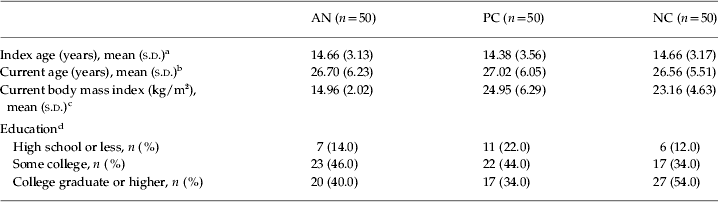
Groups did not differ on the matching variables of age at time of study participation or index age (p>0.05; see Table 1). They did not differ on education (p>0.05) but, as expected, AN participants had a significantly lower current body mass index (kg/m2) than NC and PC participants (p>0.001). Half of AN participants met diagnostic criteria for current restricting type AN (AN-R; n=25, 50.0%), and half (n=25, 50.0%) met criteria for current binge eating/purging type AN (AN-BP). Within this subtype, 19 participants reported both binge eating and purging (38.0% of the AN sample), and six (12.0% of the AN sample) reported purging in the absence of binge eating.
Sociodemographic characteristics: index age, current age, current body mass index, and education
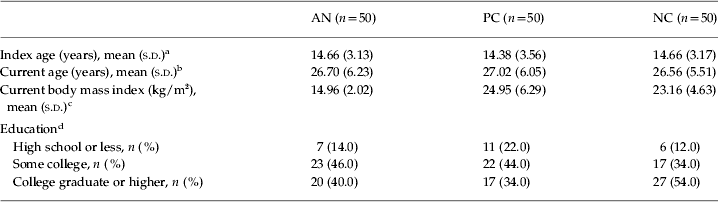
AN, Anorexia nervosa; PC, psychiatric control group; NC, non-psychiatric control group; s.d., standard deviation.
a Repeated measures analysis, F(1, 73)=2.09, p=0.143.
b Repeated measures analysis, F(2, 92)=1.83, p=0.169.
c Repeated measures analysis, F(2, 81)=65.37, p<0.001; post hoc paired t tests: AN<PC, NC, p<0.001.
d Stuart–Maxwell χ2 tests of overall marginal homogeneity, all p>0.05.
Assessment
Diagnostic assessment
Current and lifetime psychiatric disorders were assessed with the Structured Clinical Interview for DSM-IV Axis I Disorders (SCID-IV; First et al. Reference First, Spitzer, Gibbon and Williams1996). Eating disorder diagnoses and psychopathology were assessed through an abbreviated diagnostic version of the Eating Disorder Examination (EDE; Fairburn & Cooper, Reference Fairburn, Cooper, Fairburn and Wilson1993), a semi-structured investigator-based interview. At the outset of the EDE, the index age was determined in AN cases (Fairburn et al. Reference Fairburn, Doll, Welch, Hay, Davies and O'Connor1998). Assessment of risk factors focused on the period before the index age, that is before onset of clinically significant eating symptoms (or age 18 years if it came first for those questions pertaining to family life and experience of parenting), thereby ensuring precedence of the risk factor to the onset of clinically significant eating disturbances. The index age of each AN case was applied to the matched individuals in the NC and PC groups to ensure assessment of the same developmental windows across groups.
Risk factor assessment
Exposure to putative risk factors was assessed using the RFI (Fairburn et al. Reference Fairburn, Doll, Welch, Hay, Davies and O'Connor1998). The RFI assesses biological, psychological and social factors thought to place a person at risk for the development of an eating disorder. To minimize bias associated with retrospective reporting, the RFI uses behavioral definitions of key concepts and establishes a timeline for sequences of events. Degree of exposure to a potential risk factor is rated on a five-point rating scale ranging from 0=no exposure to 4=high severity, long duration, or high frequency of exposure. A conservative cut-off score of 3 or 4 was used when calculating exposure to life events to reduce the risk of false positives. In addition, the Parental Bonding Instrument (PBI; Parker et al. Reference Parker, Tupling and Brown1979), a self-report questionnaire assessing participants' experience of both parents up to index age, was administered. Measures of parental control, overprotection and low care were extracted from the PBI.
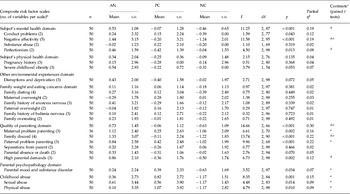
Consistent with Fairburn et al. (Reference Fairburn, Welch, Doll, Davies and O'Connor1997), this study examined seven a priori risk domains: subject's mental health, subject's physical health, other environmental experiences, family weight and eating concerns, quality of parenting, parental psychopathology, and childhood abuse (see Table 2). Within each of these risk domains, multiple items were examined. For the purpose of data reduction, 22 risk factor composite scales were constructed using factor analytic procedures for six of the a priori risk domains (see Striegel-Moore et al. Reference Striegel-Moore, Fairburn, Wilfley, Pike, Dohm and Kraemer2005). These risk factor scales had low overlap and loaded onto one of the six a priori risk domains. The seventh risk domain of childhood abuse, as described in a separate report (Striegel-Moore et al. Reference Striegel-Moore, Dohm, Pike, Wilfley and Fairburn2002), contains two risk factor items, sexual abuse and physical abuse.
Repeated measures analyses for risk factors items and domains by group, planned contrasts, meansFootnote a and standard deviations

AN, Anorexia nervosa; PC, psychiatric control group; NC, non-psychiatric control group; s.d., standard deviation.
a Group means represent the average sum of the standardized scores for the variables included in the factor. They can be interpreted as deviations from the mean.
b All variables reflect exposure before the participant's index age.
c One-tailed t tests, p<0.01.
d AN>PC.
e Combined AN/PC >NC.
Assessment of antecedent life events
In addition to the assessment of risk factors that occurred at any time prior to the index age, the RFI identifies a subset of factors that represent exposure to life events in the 12 months immediately preceding the index age (e.g. major house move; see Table 4). Following the analytic approach described by Pike et al. (Reference Pike, Wilfley, Hilbert, Fairburn, Dohm and Striegel-Moore2006), two composite variables were computed based on content for data reduction purposes: ‘major stress from school, work or other source’ (from two items) and ‘concerns about safety’ (from four items), resulting in a total of 13 items. Initially rated on a four-point scale, items were dichotomized for the statistical analyses: 0=no event occurred (initially coded 0, 1, 2 or 3) versus 1=definitely occurred (initially coded 4).
Data analysis
Because each control subject was ‘yoked’ to a specific AN case, the three groups (AN, PC and NC) were compared using repeated measures analyses of variance (ANOVAs) for each risk factor scale. Planned contrasts were analyzed for all significant F ratios. The first contrast combined the AN and PC cases into a single group representing cases with an Axis I disorder and compared these to the NC group; a significant group difference here indicated general risk factors for a mental disorder (hypothesis: AN/PC >NC). The second contrast compared the AN group to the PC group to determine risk factors more severe in the development of AN compared to other psychiatric disorders (hypothesis: AN>PC). For analysis of planned contrasts, testing directed hypotheses, one-tailed comparisons were performed (paired t tests).
For determination of the impact of cumulative risk on psychiatric status, repeated measures analyses and planned contrasts were conducted on mean scores for each risk factor domain. Stepwise logistic regression analyses were used to identify general risk factors predicting the development of any psychiatric disorder (combined AN/PC groups) versus no psychiatric disorder (NC group) and risk factors more significant in predicting AN versus other psychiatric disorders (PC group). All risk factor scales for which planned contrasts were statistically significant were entered into the regression analyses. Antecedent life events were analyzed using repeated measures ANOVAs on single antecedent life event items and, in order to determine the overall degree of exposure to significant life events, on a categorical variable of 0, 1, 2, and 3 or more events. Significance level for main statistical analyses was set at α<0.05 and for planned contrasts at α<0.01. Partial η2, describing the proportion of total variability attributable to a factor, was displayed for estimation of effect sizes (partial η2: small, 0.01; medium, 0.06; large, 0.14; see Cohen, Reference Cohen1988).
Results
Exposure to risk factors
Table 2 summarizes the results of comparisons of the AN group with the matched PC and NC groups on exposure to risk factors. Significant group differences were found on a number of individual risk factor scales from the domains of subject's mental health, quality of parenting, and parental psychopathology (p<0.05). Large effect sizes were found for maternal problem parenting, paternal problem parenting, family discord, and negative affectivity (all partial η2>0.16). Additionally, exposure to sexual and physical abuse differed significantly between groups (both p<0.05).
Risk factors common to both the AN and PC groups were determined by planned contrasts comparing these two groups of women with a current psychiatric diagnosis (combined AN/PC group) with the NC group. These analyses found that negative affectivity, family discord, maternal and paternal problem parenting, parental mood and substance disorder and sexual and physical abuse were associated with a generally increased risk for current psychiatric disorder (all p<0.01).
For determination of risk factors that are more severe in AN compared to other psychiatric disorders, planned contrasts revealed significantly higher negative affectivity, perfectionism, family discord, and higher parental demands in the AN group than the PC group (all p<0.01).
Exposure to risk factor domains
For the analysis of cumulative risk within risk factor domains, repeated measures analyses revealed significant group differences and large effect sizes on subject's mental health, quality of parenting, and childhood abuse (all p⩽0.001; 0.15⩽η2⩽0.30; see Table 2). Concerning risk factors common to both AN and other psychiatric disorders, both psychiatric groups reported greater problems in the subject's mental health domain, the quality of parenting domain, and childhood abuse than the NC group (all p<0.01). Concerning risk factors more severe in the AN group, planned contrasts revealed greater problems in the quality of parenting domain for the AN group than the PC group (p<0.01).
Prediction of case status
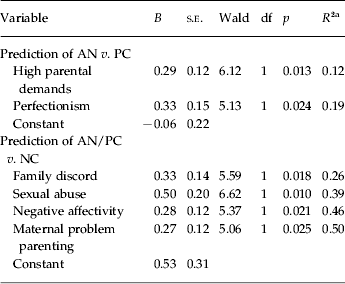
For the prediction of any psychiatric disorder (combined AN/PC groups) versus no psychiatric disorder from risk factor scales, the final logistic regression equation retained four general risk factors (family discord, sexual abuse, negative affectivity, and maternal problem parenting) with positive β coefficients [χ2 (4, n=150)=47.3, p<0.001], accounting for a total of 50.0% of the variance (see Table 3). This analysis correctly classified 82.0% of the AN/PC group and 80.0% of the NC group.
Summary of the final logistic regression models for prediction of the AN v. PC case status and of the AN/PC v. NC case status
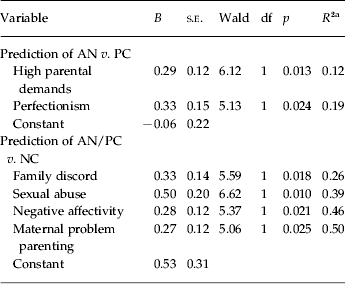
AN, Anorexia nervosa; PC, psychiatric control group; NC, non-psychiatric control group; s.e., standard error.
a Cumulative R 2.
For the prediction of AN v. PC on the basis of risk factor scales, the final logistic regression equation retained two variables (high parental demands and perfectionism), accounting for a total of 19.0% of the variance [χ2(2, n=100)=15.1, p<0.001] and correctly classifying 64.0% of the AN group and 68.0% of the PC group.
As noted earlier, the AN group reported a significantly higher rate of co-morbidity than the PC group (p=0.027). As it is technically not possible to include co-morbidity rate as a covariate in the repeated measures analyses, we included it as a covariate in the logistic regression analysis for prediction of AN v. PC status. Although co-morbidity significantly predicted AN v. PC case status when entered in a first step (B=0.98, s.e.=0.45, Wald=4.78, df=1, p=0.029, R 2=0.07), it became insignificant in the second step of the model (p>0.05). Only high parental demands and perfectionism were retained as significant predictors in the final model, suggesting that they are stronger predictors of case status than co-morbidity.
Antecedent life events
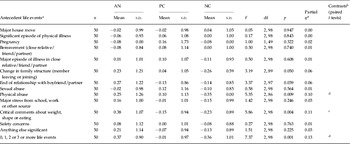
In the 12 months prior to the participant's index age, the combined AN/PC group revealed a significantly greater number of antecedent life events than the NC group, and in particular, greater exposure to physical abuse (both p's <0.01). In addition, the AN group reported significantly more frequent exposure to critical comments about shape, weight or eating than the PC group (p<0.01; see Table 4). Groups did not differ on any other antecedent life event (all p>0.05).
Life events occurring within the year before onset of disordered eating in women with anorexia nervosa and within the equivalent year in general psychiatric or non-psychiatric control women respectively

AN, Anorexia nervosa; PC, psychiatric control group; NC, non-psychiatric control group; s.d., standard deviation.
a Standardized scores. All variables reflect exposure during the year prior to the participant's index age.
b One-tailed t tests, p<0.01.
c AN>PC.
d Combined AN/PC>NC.
Comparison of AN-R with AN-BP
An exploratory comparison of exposure to risk factors items, domains and antecedent life events by AN subtype revealed a few significant differences. AN-BP participants showed significantly greater exposure to disruptions and deprivation than AN-R participants [F(1, 48)=9.98, p=0.003, η2=0.17]. Medium effect sizes were found for greater maternal problem parenting and parental mood and substance disorder, and lower perfectionism in the AN-BP group than in the AN-R group (all η2⩾0.06). During the 12 months prior to index age, the AN-BP group reported significantly greater exposure to sexual abuse and change in family structure, lower exposure to physical illness (df=1, 48; F=5.14, 4.79, and 5.74; all p<0.04; all η2⩾0.90), and a tendency to lower exposure to major house move than the AN-R group (η2=0.06).
Discussion
To our knowledge, this is the first age-matched, case-control study of risk factors for AN. Using standardized assessments, 50 women with AN were compared to 50 age-matched women with non-eating disorder DSM-IV diagnoses and 50 women without psychiatric diagnosis on their exposure to a wide range of potential risk factors. Building on earlier studies, this investigation used more rigorous methodology to examine comprehensively the role of physical and mental health, family and personal history of eating, weight and dieting concerns, parent–child relationships, parental psychopathology, and childhood abuse in the development of AN.
Exposure to risk factors and prediction of casestatus
The results of this study suggest several retrospective correlates for psychopathology in general and several that are more salient for AN. Negative affectivity, maternal and paternal parenting problems, family discord, parental mood and substance disorder, and physical and sexual abuse emerged as general risk correlates for psychiatric disorders. The factors that emerged as more severe risk correlates for AN as compared to other psychiatric disorders were negative affectivity, perfectionism, family discord, and high parental demands.
Consistent with the findings from other studies (Fairburn et al. Reference Fairburn, Cooper, Doll and Welch1999; Karwautz et al. Reference Karwautz, Rabe-Hesketh, Hu, Zhao, Sham, Collier and Treasure2001), the relative contribution of family history of dieting, weight problems or eating disorder was not significant when considered in comprehensive models. These data correspond to other studies suggesting that these family history correlates may be less salient for AN than BN (Fairburn et al. Reference Fairburn, Welch, Doll, Davies and O'Connor1997; Stice & Agras, Reference Stice and Agras1998; Field et al. Reference Field, Camargo, Taylor, Berkey and Colditz1999; Stice, Reference Stice2001). However, it is important to note that these family history data rely solely on the report of the individual with AN. By contrast, studies of genetic liability suggest that such variables may be etiologically important (Mazzeo et al. Reference Mazzeo, Slof-Op't Landt, van Furth, Bulik, Wonderlich, Mitchell, Zwaan and Steiger2006). Further studies comparing eating disorders directly, gathering data from other informants, and advances in genetics research will bring greater clarity.
The findings from this case-control study offer further support for the centrality of both negative affectivity and perfectionism in the etiology of AN. They are consistent with clinical presentation, theoretical writings (Vitousek & Hollon, Reference Vitousek and Hollon1990; Vitousek & Ewald, Reference Vitousek, Ewald, Segal and Blatt1993; Bruch Reference Bruch2001) and previous empirical investigations (Bastiani et al. Reference Bastiani, Rao, Weltzin and Kaye1995; Srinivasagam et al. Reference Srinivasagam, Kaye, Plotnicov, Greeno, Weltzin and Rao1995; Fairburn et al. Reference Fairburn, Cooper, Doll and Welch1999; Halmi et al. Reference Halmi, Sunday, Strober, Kaplan, Woodside, Fichter, Treasure, Berrettini and Kaye2000; Karwautz et al. Reference Karwautz, Rabe-Hesketh, Hu, Zhao, Sham, Collier and Treasure2001; Anderluh et al. Reference Anderluh, Tchanturia, Rabe-Hesketh and Treasure2003; Bulik et al. Reference Bulik, Tozzi, Anderson, Mazzeo, Aggen and Sullivan2003). It is possible that a high degree of perfectionism and negative affectivity are primary retrospective correlates for AN, whereas weight and shape issues may instead intensify in closer proximity to the emergence of the disorder.
Consistent with other studies, parental psychopathology and childhood physical and sexual abuse emerged as retrospective correlates common to the AN and PC groups (Pope & Hudson, Reference Pope and Hudson1992; Wonderlich & Mitchell, Reference Wonderlich and Mitchell1997). These data suggest that prevention interventions for children of parents with mental illness and prevention of abuse could contribute to reducing risk across a wide range of disorders that commonly afflict women.
The logistic regression model conducted to predict case status successfully classified the vast majority of the individuals with psychiatric disorders as compared to those with no psychiatric disorder and successfully classified the majority of AN and PC cases. More risk correlates common to both AN and PC were identified as compared to risk correlates that were more significant specifically for AN, offering support to the view that psychiatric disorders share a common base of risk factors. However, it is important to pursue identification of additional risk factors that might be especially linked to AN given that the identified risk factors accounted for a low to moderate degree of explained variance.
The differences identified in the exploratory comparison of the restricting and binge/purge subtype of AN suggest a pattern of greater disturbance among the binge/purge subtype. These findings are consistent with other reports of higher rates of impulse control problems for this subtype (Jacobi et al. Reference Jacobi, Hayward, deZwaan, Kraemer and Agras2004; Commission on Adolescent Eating Disorders, Reference Evans, Foa, Gur, Hendin, O'Brien, Seligman and Walsh2005). Additional studies are needed to further understand the differences between the two subtypes in terms of both risk factors and clinical features.
Antecedent life events
The findings regarding proximal triggers for AN are provocative and only partially support our hypotheses. It is noteworthy that critical comments about weight, shape or eating constitute the only variable that emerged as a specific proximal trigger for AN. This is especially notable against the longer-term picture, where family weight problems and eating disorders among first-degree relatives were not identified as retrospective correlates for AN. Taken together, these data suggest that weight and shape concerns contribute to AN in proximity to its actual onset and in the context of a longer-term backdrop of retrospective correlates that are unrelated to weight and shape. Our hypothesis that other interpersonal experiences are proximally associated with the specific development of AN was, however, not supported. Physical abuse was identified as a proximal antecedent life event but it was associated with both the AN and PC groups. Nevertheless, cumulative exposure to antecedent life events was associated with the onset of AN. Thus, it appears that in the year preceding onset, critical comments regarding weight and shape are most clearly associated with increased risk, and interpersonal stresses are cumulative but variable, such that specific interpersonal stressors do not emerge as antecedents for AN.
Limitations
Several limitations of this study are noteworthy. The RFI sets an upper limit of 18 years for assessment of family and parenting variables. Because nine of the AN subjects had index ages greater than 18 years, the results may fail to capture some experiences of risk exposure. In addition, although procedures were followed to maximize accuracy of reporting, potential biases due to recall are intrinsic to retrospective case-control designs. The findings represent the subjective experience of respondents, which would not necessarily be consistent with the views of other family members or significant others, for example, when reporting family psychiatric history. Given the extraordinary undertaking of a longitudinal risk factor study, it would be of enormous benefit to gather multiple perspectives on putative risk factors.
Conclusions
The convergent findings from this study and those of Fairburn et al. (Reference Fairburn, Cooper, Doll and Welch1999) and Karwautz et al. (Reference Karwautz, Rabe-Hesketh, Hu, Zhao, Sham, Collier and Treasure2001) move the field closer to defining the factors that should be examined using longitudinal models in the next generation of studies on the etiology and prevention of AN. Defining high-risk groups based on the identified retrospective correlates from these and other studies will increase the focus and feasibility of longitudinal and prevention studies of AN. The assessment of perfectionism, negative affectivity, parenting problems, family discord, and childhood abuse should contribute to delineating high-risk target groups. Such initiatives are urgently needed to advance our understanding of the etiology of AN and improve the efficacy of prevention programs.
Note
Supplementary information accompanies this paper on the Journal's website (http://journals.cambridge.org).
Acknowledgments
We acknowledge the following funding sources that provided partial support for this study: NIMH MH57533 (K. M. P. and B. T. W.); German Federal Ministry of Education and Research 01GP0491 (A. H.); NIMH 1K24MH070446 (D. E. W.); NIMH and NIDDK MH52348 (R. S.-M.).
Declaration of Interest
None.