INTRODUCTION
The coccidian parasite Toxoplasma gondii is one of the most common parasites, with a worldwide distribution in all warm-blooded animal species tested to date (Tenter et al. Reference Tenter, Heckeroth and Weiss2000). It infects nearly 1 in 3 humans in the world and can cause serious illness in immunocompromised people and unborn children if their mothers become infected while pregnant (Tenter et al. Reference Tenter, Heckeroth and Weiss2000). Wild and domestic felids are the only known definitive hosts of T. gondii, and play a crucial role contaminating the environment with oocysts excreted in their faeces (Dubey, Reference Dubey2010). After ingesting oocysts, intermediate hosts (mammals and birds) develop tissue cysts that may persist for life. In turn, animals with tissue cysts become possible sources of infection for predators, including cats, thus completing the parasite life cycle (Dubey, Reference Dubey2010).
In the Canadian Arctic, there is evidence of high rates of exposure of Inuit to T. gondii (Gyorkos, Reference Gyorkos1980; Tanner et al. Reference Tanner, Staudt, Adamowski, Lussier, Bertrand and Prichard1987; Messier et al. Reference Messier, Levesque, Proulx, Rochette, Libman, Ward, Serhir, Couillard, Ogden, Dewailly, Hubert, Dery, Barthe, Murphy and Dixon2009). In particular, in Nunavik (northern Quebec above 55°N latitude), the overall seroprevalence in the Inuit population is 60% (Messier et al. Reference Messier, Levesque, Proulx, Rochette, Libman, Ward, Serhir, Couillard, Ogden, Dewailly, Hubert, Dery, Barthe, Murphy and Dixon2009). This is surprising since felids are rare or absent in much of the Arctic and sub-Arctic. The relatively low rates of exposure (5–10%) in northern Cree (50–53°N) who share roughly the same ecosystem and water supply as the Inuit, point to differences in hunting practices and dietary habits between these two ethnic groups (Levesque et al. Reference Levesque, Messier, Bonnier-Viger, Couillard, Cote, Ward, Libman, Gingras, Dick and Dewailly2007; Campagna et al. Reference Campagna, Levesque, Anassour-Laouan-Sidi, Cote, Serhir, Ward, Libman, Drebot, Makowski, Andonova, Ndao and Dewailly2011). The regular consumption of uncooked meat of marine mammals, particularly seals, by the Inuit has been proposed as a possible source of T. gondii infection in Inuit communities in previous epidemiological studies (Forbes et al. Reference Forbes, Measures and Gajadhar2009; Messier et al. Reference Messier, Levesque, Proulx, Rochette, Libman, Ward, Serhir, Couillard, Ogden, Dewailly, Hubert, Dery, Barthe, Murphy and Dixon2009).
How marine mammals become infected with T. gondii, in the absence of direct contact with oocysts from the feces of infected felids in the Arctic, is unknown. To date, there is no known definitive host for T. gondii in the marine environment (Measures et al. Reference Measures, Dubey, Labelle and Martineau2004). However, recent evidence from California suggests that the parasite can sometimes cross from terrestrial (domestic cats) to marine ecosystems (sea otters or Enhydra lutris nereis) via T. gondii oocysts that reach the coastal marine environment in surface run-off (Conrad et al. Reference Conrad, Miller, Kreuder, James, Mazet, Dabritz, Jessup, Gulland and Grigg2005; Miller et al. Reference Miller, Miller, Conrad, James, Melli, Leutenegger, Dabritz, Packham, Paradies, Harris, Ames, Jessup, Worcester and Grigg2008b). Some pinnipeds from the Arctic have been found to be seropositive for T. gondii including walruses (Odobenus rosmarus), ringed seals (Pusa hispida), harbour seals (Phoca vitulina) and bearded seals (Erignathus barbatus) (Leclair and Doidge, Reference Leclair and Doidge1998; Dubey et al. Reference Dubey, Zarnke, Thomas, Wong, Van Bonn, Briggs, Davis, Ewing, Mense, Kwok, Romand and Thulliez2003; Jensen et al. Reference Jensen, Aars, Lydersen, Kovacs and Asbakk2010), providing further support for the hypothesis of transmission of T. gondii between terrestrial and marine ecosystems. In the Canadian Arctic, very little is known about the prevalence of T. gondii infection in pinnipeds.
In this study, we used serological and molecular methods to assess the potential role of seals as a source of T. gondii infection in the Canadian Arctic. This work raises several questions as to likely transmission pathways of T. gondii in this region and the extent to which seal meat may pose a health risk for Canadian Inuit.
MATERIALS AND METHODS
Samples and data used in the study
A total of 828 blood samples were available for study; mostly from ringed seals (Pusa hispida) (n=788) with smaller numbers of bearded seals (Erignathus barbatus) (n=20) and harbour seals (Phoca vitulina) (n=9). A small number of samples from unknown species were included in some analyses (n=11). The seals were killed by Inuit during subsistence harvests (September to July) between 1999 and 2006 in 7 communities: Sanikiluaq, Arviat, Chesterfield Inlet and Hall Beach in Nunavut (Hudson Bay); and Sachs Harbour, Tuktoyaktuk and Ulukhaktok in the Northwest Territories (Fig. 1). Whole blood, muscle, kidney, liver, lung and lymph node were some of the tissues sampled as part of Fisheries and Oceans Canada sampling programme. All samples were stored at −80°C following collection. Associated data included the sex, age, geographical location of capture and year of sampling of the harvested animals. Ringed and harbour seal ages were determined by counting the annual growth layer groups in the dentine (Northwest Territories seals) or cementum (Hudson Bay seals) of tooth sections (Stewart et al. Reference Stewart, Stewart, Stirling and Street1996). The diet of ringed seals from Arviat, in western Hudson Bay, was explored through the analysis of carbon (C) and nitrogen (N) stable isotopes (SI) in liver and muscle tissues, representing food ingested days and weeks before harvest, respectively, following the methods described by Vincent-Chambellant (Reference Vincent-Chambellant2010).
Location of the seven Canadian Arctic Inuit communities where arctic seals where sampled from 1999 to 2006.

Serological analysis
Blood samples were analysed for anti-T. gondii antibodies using a direct agglutination test (Toxo screen DA®: Biomérieux S.A., Marcy-l'Etoile, France). In each well, diluted blood samples were mixed with formalin-treated toxoplasma tachyzoites that agglutinate in the presence of specific immunoglobulin G antibodies, and 2-mercaptoethanol to suppress non-specific agglutination. Blood samples were tested at 1:40 and 1:4000 dilutions. Samples that obviously agglutinated at a 1:40 dilution were considered seropositive and were further tested at dilutions of 1:60, 1:180, 1:540, and 1:1620. A single reader (A. S.) interpreted all the tests to eliminate inter-observer variability. As a consequence of freezing, whole blood samples contained haemolysed blood. To determine whether or not haemolysed samples contained inhibitors that interfere with the agglutination reaction, we added positive control serum (dilutions 1:40 to 1: 4000) to 5 negative but haemolysed blood samples and re-tested. We found no change in the test results suggesting that haemolysis did not influence the agglutination reaction.
Molecular analysis
To assess the extent to which serological results implicate seal meat as a source of infection for Inuit and to evaluate serological test sensibility (i.e. the possibility for false seronegative test results), we analysed a subsample of seal tissues sampled in Arviat. Using the QIAamp DNA Mini Kit (QIAGEN), DNA was extracted from muscle, kidney, lung and liver of 14 ringed seals (5 seropositive and 9 seronegative) and from the muscle alone of 135 seals (23 seropositive ringed seals and 2 seropositive harbour seals, 107 seronegative ringed seals and 3 seronegative harbour seals) from which suitable tissue samples were available. A real time polymerase chain reaction (PCR) assay was used to detect a 529-bp repeat element occurring up to 200 to 300 times in the T. gondii genome (Kasper et al. Reference Kasper, Sadeghi, Prusa, Reischer, Kratochwill, Forster-Waldl, Gerstl, Hayde, Pollak and Herkner2009).
Statistical analysis
We investigated seal sex, community of harvest, age, year of sampling and seal species, as explanatory variables for seropositivity. In a separate analysis, we assessed C and N SI ratio variables on seropositivity of ringed seals from Arviat. Seals were classified as: pups (<1 year), juveniles (1–5 years) and adults (>5 years) based on dental ages (Holst et al. Reference Holst, Stirling and Calvert1999). Each explanatory variable was screened for potential unconditional association with T. gondii serostatus using a generalized linear model with a logit link function in SAS version 9.1 (PROC GENMOD, SAS Institute Inc., Cary, NC). Those variables significantly associated with serostatus at the P<0·20 level were included in a multivariable regression model. Linearity of the relationship between the SI ratios and the log odds of the seropositivity was assessed by categorizing the continuous SI ratios and visualizing plots of the odds ratio against mean values of the different categories. The possibility for multi-collinearity was investigated by standard diagnostic methods. The possible presence of confounding bias was evaluated by adding all eliminated predictors (whether or not included in the multivariable model), one at a time, and back into the final model to avoid the exclusion of an important predictor potentially masked by another variable. We were unable to test for possible interactions in certain groups because of small sample sizes. The relative goodness of fit of the model was assessed by Pearson and deviance Chi-square tests. The level of significance was P<0·05 throughout the multivariable analysis. To reduce the risk of a Type I error when making multiple comparisons, alpha was reduced using Holm's sequential Bonferroni method.
RESULTS
A total of 86/828 seals (10·4%, 95% confidence interval CI=8·3–12·5) were seropositive for T. gondii. Positive titres were generally low (1:40 to 1:180). No tissue sample was positive by PCR.
Overall, 80/788 ringed seals (10·2%, 95% CI=8·0–12·3), 2/20 bearded seals (10·0%, 95% CI=1·2–31·7) and 2/9 harbour seals (22·2%, 95% CI=2·8–60·0) were seropositive for T. gondii. The difference in seroprevalence according to species was not significantly different (P=0·50). Due to small sample size, no further analysis was performed on the bearded and harbour seal data.
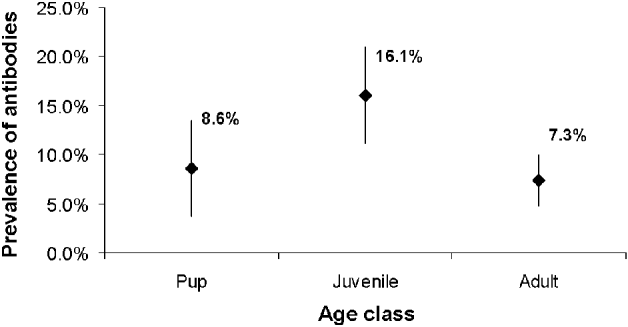
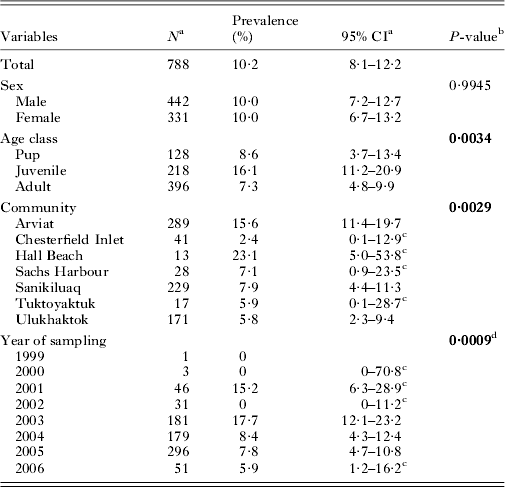
There was no statistical difference in the proportion of seropositive male and female ringed seals (Table 1). Seroprevalence was greatest for juvenile ringed seals (35/218: 16·1%), followed by pups (11/128: 8·6%) and adults (29/396: 7·3%) (Table 1, Fig. 2). There was significant variation in seroprevalence amongst ringed seals sampled in the different communities. The highest seropositivity rates were observed in Hall Beach and Arviat (3/13 and 45/289, respectively) and was lowest in Chesterfield Inlet (1/41) (Table 1, Fig. 1). Due to very low sample sizes (1 and 3, respectively), the data from years 1999 and 2000 were omitted. The model converged and the proportion of seropositive seals varied significantly between years of sampling. The proportion of seropositive samples was higher in seals harvested in 2001 (7/46) and 2003 (32/181) compared to other years (Table 1).
Prevalence of antibodies against Toxoplasma gondii (%) among ringed seals from the Canadian Arctic by age class: pup (<1 year old), juvenile (1–5 years old) and adult (>5 years old). Error bars indicate the standard deviation.

Prevalence of specific antibodies to Toxoplasma gondii among ringed seals from Nunavut and the Northwest Territories, Canada, according to sex, age class, community and year of sampling, and level of significance for unconditional association between T. gondii seropositivity and each explanatory variable

a N=sample size; CI=confidence interval.
b Likelihood ratio test Type III effect in GENMOD Procedure.
c Exact 95% CI (Fisher's).
d Samples collected in 1999 and 2000 not included.
In ringed seals from Arviat, the carbon SI ratio was significantly lower in seropositive seals compared to seronegative seals (P=0·030). This last variable was not tested in a multivariate model because of the correlation with year and age variables. The nitrogen SI ratio was not associated with seroprevalence (P=0·60).
Age class, community and year of sampling (excluding data from ringed seals harvested in 1999 and 2000 and those harvested from Hall Beach where no age data were available) were the variables that remained significant in the most parsimonious multivariable logistic regression model for T. gondii seropositivity (Table 2). No evidence for collinearity was detected among these predictors. The seroprevalence was significantly higher in juveniles than in adults and in ringed seals sampled in Arviat compared to Sanikiluaq. Samples collected in 2001 and 2003 were more likely to be seropositive than those collected in 2005.
Statistically significant explanatory variables in the multivariable logistic regression model of the presence of specific antibodies against Toxoplasma gondii in 738 ringed seals from six communities in the Canadian Arctic

a Adults sampled in Sanikiluaq in 2005 were used as the reference.
b Wald chi-square test.
c OR for 2002 non-existent (prevalence=0%).
DISCUSSION
To our knowledge this is the first large-scale study of T. gondii prevalence in pinnipeds in the Canadian Arctic and it is based on the largest collection of seal blood and tissues gathered to date from this region. Our serological data suggested that at least 10% of arctic seals were exposed to T. gondii. An interesting and unexpected pattern of age-seroprevalence was found in ringed seals: seroprevalence did not increase continuously with age, which is consistent with ringed seals becoming infected primarily at a young age. The seals from Arviat in western Hudson Bay had the highest rate of T. gondii infection amongst ringed seals sampled in the communities under investigation, and exposure to the parasite may have been particularly high in the years 2001 and 2003. In this study, T. gondii DNA was not detected in seal tissues despite large numbers of muscle samples analysed, emphasizing the difficulty of finding T. gondii cysts in tissues by PCR (Hill et al. Reference Hill, Chirukandoth, Dubey, Lunney and Gamble2006). Unfortunately, neither heart nor brain tissues, often considered target sites for T. gondii encystation (Dubey, Reference Dubey2010), were available for PCR testing.
The direct agglutination test that we employed in our study has been widely used to detect T. gondii antibodies in a variety of marine mammals (Oksanen et al. Reference Oksanen, Tryland, Johnsen and Dubey1998; Dubey et al. Reference Dubey, Zarnke, Thomas, Wong, Van Bonn, Briggs, Davis, Ewing, Mense, Kwok, Romand and Thulliez2003, Reference Dubey, Fair, Bossartt, Hill, Fayer, Sreekumar, Kwok and Thulliez2005; Measures et al. Reference Measures, Dubey, Labelle and Martineau2004; Cabezon et al. Reference Cabezon, Resendes, Domingo, Raga, Agusti, Alegre, Mons, Dubey and Almeria2004, Reference Cabezon, Hall, Vincent, Pabon, Garcia-Bocanegra, Dubey and Almeria2011; Jensen et al. Reference Jensen, Aars, Lydersen, Kovacs and Asbakk2010). This test is considered to be both sensitive and specific in mammals (Dubey, Reference Dubey2010), and capable of detecting infection in seals (Gajadhar et al. Reference Gajadhar, Measures, Forbes, Kapel and Dubey2004). In a study on sea otters, all those with demonstrable Toxoplasma infections had detectable MAT antibodies (Thomas et al. Reference Thomas, Dubey, Lindsay, Cole and Meteyer2007). While the state of haemolysis of the samples included in this study could theoretically have affected the direct agglutination test sensitivity, we investigated this possibility and found no evidence for potential effects of haemolysis on seroprevalence results. Since all blood samples were in similar condition, we expect our inter-group comparisons to be valid. None of the positive serological reactions had a titre higher than 1:180, which is consistent with other studies using the direct agglutination test in marine mammals (Cabezon et al. Reference Cabezon, Resendes, Domingo, Raga, Agusti, Alegre, Mons, Dubey and Almeria2004, Reference Cabezon, Hall, Vincent, Pabon, Garcia-Bocanegra, Dubey and Almeria2011; Dubey et al. Reference Dubey, Zarnke, Thomas, Wong, Van Bonn, Briggs, Davis, Ewing, Mense, Kwok, Romand and Thulliez2003, Reference Dubey, Fair, Bossartt, Hill, Fayer, Sreekumar, Kwok and Thulliez2005; Jensen et al. Reference Jensen, Aars, Lydersen, Kovacs and Asbakk2010; Lambourn et al. Reference Lambourn, Jeffries and Dubey2001; Measures et al. Reference Measures, Dubey, Labelle and Martineau2004). In the present study, the samples were haemolysed and using a cut-off dilution lower than 1:40 would have resulted in the test being unreadable for some samples. However, titres even lower than the 1:40 cut-off used in our study may need to be considered since T. gondii cysts were detected in the tissues of a naturally infected whale which had an agglutination test titre of only 1:25 (Mikaelian et al. Reference Mikaelian, Boisclair, Dubey, Kennedy and Martineau2000). It is possible that decline in seropositivity in adult seals could be due to antibody levels declining below a level detectable at a 1:40 dilution.
The seroprevalence rate found in our study is consistent with previous studies on T. gondii in seals harvested in other arctic locations (ringed seals, harbour seals and bearded seals in Alaska (Dubey et al. Reference Dubey, Zarnke, Thomas, Wong, Van Bonn, Briggs, Davis, Ewing, Mense, Kwok, Romand and Thulliez2003); ringed seals and bearded seals in the archipelago of Svalbard, Norway (Jensen et al. Reference Jensen, Aars, Lydersen, Kovacs and Asbakk2010)). The discovery of a non-archetypical strain designated Type×T. gondii in both wild terrestrial carnivores and in a mussel in California supports the theory of a link between terrestrial and marine coastal environment via freshwater run-off (Miller et al. Reference Miller, Miller, Conrad, James, Melli, Leutenegger, Dabritz, Packham, Paradies, Harris, Ames, Jessup, Worcester and Grigg2008b). Indeed, fecal contamination of coastal marine environments by terrestrial mammals is a well-recognized problem for several pathogenic protozoa (e.g. Giardia and Cryptosporidium: (Appelbee et al. Reference Appelbee, Thompson and Olson2005; Miller et al. Reference Miller, Byrne, Jang, Dodd, Dorfmeier, Harris, Ames, Paradies, Worcester, Jessup and Miller2010). We speculate that T. gondii infection of seals in the Canadian Arctic could similarly be due to contamination of the marine environment by T. gondii oocysts excreted by felids in the arctic watershed, and transported via freshwater run-off to the marine environment. T. gondii oocysts can sporulate in seawater and remain infectious for mice for 24 months (Lindsay and Dubey, Reference Lindsay and Dubey2009). The Canadian lynx (Lynx canadensis) is the only widespread and abundant wild felid present in the Canadian arctic watershed (Banfield, Reference Banfield1974) and may therefore play an important role in contaminating the arctic marine environment. Indeed, reported seroprevalence rates are high (44%) in lynx from Quebec (Labelle et al. Reference Labelle, Dubey, Mikaelian, Blanchette, Lafond, St-Onge and Martineau2001). Like other wild felids, a single infected lynx may excrete many millions of T. gondii oocysts into the terrestrial environment during the course of its life (Jones and Dubey, Reference Jones and Dubey2010).
The pattern of seroprevalence to T. gondii among age classes observed in the present study was unexpected. In most infected mammals including humans, both infection and seropositivity can be readily detected for life (Dubey, Reference Dubey2010). If exposure to a pathogen causing a persistent infection is constant, it would be expected that seroprevalence should increase with age at a more or less constant rate. In this study, seropositivity was highest in juvenile ringed seals, while adults had lower seroprevalence rates. This pattern is consistent with infection of ringed seals during their first years of life. A cessation of exposure as ringed seals age may explain natural waning of antibody titres over time in older animals despite continued infection that become difficult to detect with serological tests. There is no evidence to date that infection of seals causes significant morbidity or mortality that could explain the serological pattern observed (Gajadhar et al. Reference Gajadhar, Measures, Forbes, Kapel and Dubey2004). Although spontaneous clearing of infection in the adult ringed seals with a loss of tissue cysts (Opsteegh et al. Reference Opsteegh, Swart, Fonville, Dekkers and van der Giessen2011) could plausibly explain the loss of antibodies, other authors believe in life-long T. gondii infection in seals like most other intermediate hosts (Dubey, Reference Dubey2010). It is also possible that some ringed seals are infected transplacentally as has been suggested for arctic foxes (Vulpes lagopus) (Prestrud et al. Reference Prestrud, Asbakk, Fuglei, Mork, Stien, Ropstad, Tryland, Gabrielsen, Lydersen, Kovacs, Loonen, Sagerup and Oksanen2007), and as seen in others marine mammals such as dolphins and sea otters (Jardine and Dubey, Reference Jardine and Dubey2002; Resendes et al. Reference Resendes, Almeria, Dubey, Obon, Juan-Salles, Degollada, Alegre, Cabezon, Pont and Domingo2002; Miller et al. Reference Miller, Conrad, James, Packham, Toy-Choutka, Murray, Jessup and Grigg2008a). However, reports of transplacental T. gondii transmission in marine mammals are infrequent and this route of infection may be rare (Miller et al. Reference Miller, Conrad, James, Packham, Toy-Choutka, Murray, Jessup and Grigg2008a). Furthermore, congenital toxoplasmosis generally occurs only during acute infection of the mothers (Dubey, Reference Dubey2010) and, considering the relatively low seroprevalence in adult ringed seals, this route of transmission would likely be both inefficient and infrequent. Age-related hunting behaviour, segregation in habitat, geographical occurrence and, therefore, diet may cause young ringed seals to be more exposed to T. gondii than older seals (Born et al. Reference Born, Teilmann, Acquarone and Riget2004; Vincent-Chambellant, Reference Vincent-Chambellant2010). C and N stable isotope ratios support a difference in diet between adult and younger ringed seals, with a higher benthic/inshore component in the former (Vincent-Chambellant Reference Vincent-Chambellant2010).
T. gondii infection in seals might occur via ingestion of oocysts concentrated in their prey (Robertson, Reference Robertson2007). Molluscs, that filter water from freshwater run-off, are a possible source of infection for marine mammals (Arkush et al. Reference Arkush, Miller, Leutenegger, Gardner, Packham, Heckeroth, Tenter, Barr and Conrad2003; Lindsay et al. Reference Lindsay, Collins, Mitchell, Wetch, Rosypal, Flick, Zajac, Lindquist and Dubey2004). However, analysis of stomach contents from ringed seals in Arviat suggests that molluscs are consumed in very small quantities compared to the other prey types (Vincent-Chambellant, Reference Vincent-Chambellant2010). Moreover, the low carbon stable isotope ratio found in young seropositive ringed seals compared to seronegative animals suggests that the former group is not preferentially using the benthic environment to feed compared to the latter. During the open-water season, the diet of ringed seals of all age classes sampled in Arviat consists principally of fish (Vincent-Chambellant, Reference Vincent-Chambellant2010), raising the possibility that fish may be an important source of bioconcentration of oocysts originating from a terrestrial environment. Like molluscs, fish gills could plausibly filter T. gondii oocysts out of seawater making them an efficient T. gondii vector for piscivorous marine mammals (Massie et al. Reference Massie, Ware, Villegas and Black2010).
Toxoplasmosis is a major public health issue in the Canadian Arctic (Messier et al. Reference Messier, Levesque, Proulx, Rochette, Libman, Ward, Serhir, Couillard, Ogden, Dewailly, Hubert, Dery, Barthe, Murphy and Dixon2009). Our study suggests that seals are exposed to T. gondii and may serve as a significant source of infection for Inuit people who frequently consume seal meat uncooked. Broad geographical and inter-annual patterns of seropositivity were observed that could reflect geographical and inter-annual variations in contamination of the marine environment associated with the transport of oocysts from the terrestrial environment. Further studies are needed to better understand these spatio-temporal variations, as well as the differential infection of seals of different ages. In particular, we are currently conducting a risk assessment study to understand whether hydrological transport of oocysts is a sufficient mechanism to explain T. gondii infection in seals and Inuit in the Canadian Arctic.
ACKNOWLEDGEMENTS
We would like to thank the Inuit hunters and coordinators from all sampled communities and Fisheries Joint Management Committee for providing seal samples. Our sincere thanks go to Ole Nielsen, Lois Harwood and Steven Ferguson (Fisheries and Oceans Canada) for allowing use of blood samples and tissues of seals. We thank all our collaborators and especially Rebecca Guy (Public Health Agency of Canada) and Josée Harel (Faculté de médecine vétérinaire, Québec) for contributing their laboratory resources for conducting our experiments, and Donald Tremblay for laboratory assistance. We thank Guy Beauchamp for statistical advice, and Daniel Scholl and Patrick A. Leighton for useful comments on earlier versions of the manuscript.
FINANCIAL SUPPORT
This study was supported by the Network of Centres of Excellence of Canada ArcticNet and by the Ouranos Consortium's Health Program, coordinated by the Institut National de Santé Publique du Québec.