INTRODUCTION
Confabulation, the production of false memories without deliberate intent to lie (Gilboa & Moscovitch, Reference Gilboa, Moscovitch, Baddeley, Kopelman and Wilson2002) or of false narratives purporting to convey information about oneself or the world (Berrios, Reference Berrios, Berrios and Hodges2000), is most well known as a feature of the Wernicke–Korsakoff amnesic syndrome (Victor et al. Reference Victor, Adams and Collins1971). It is also seen in patients with frontal lobe syndrome (e.g. Baddeley & Wilson, Reference Baddeley and Wilson1988; Papagno & Baddeley, Reference Papagno and Baddeley1997). A third disorder in which confabulation, or something similar to it, has been documented is not neurological but psychiatric, namely schizophrenia.
In his confabulatory subtype of paraphrenia, Kraepelin (Reference Kraepelin1913) described patients who ‘bring forward with the most profound conviction an enormous number of extraordinary stories absolutely in the form of personal experiences’. He gave an example of a patient who reported to the authorities that he had dug up a human arm and had then been compelled at gunpoint to keep quiet about it, causing a police investigation. This phenomenon continues to be recognized as the symptom of delusional confabulation (Wing et al. Reference Wing, Cooper and Sartorius1974); the patient appears to make up delusions on the spot, often fantastic delusions and delusional memories, which shift and change and become more elaborate with questioning. Delusional confabulation is rare, but Nathaniel-James & Frith (Reference Nathaniel-James and Frith1996) have argued that confabulation can be elicited more frequently in schizophrenia under experimental conditions. They asked a sample of 12 schizophrenic patients to listen to and repeat a series of fables and found that they all included some recalled information that was not present in the narrative, in contrast to only one of 12 normal control subjects. Nathaniel-James & Frith (Reference Nathaniel-James and Frith1996) considered that schizophrenic confabulations differed from those seen in neurological patients in that the ideas seemed to be involve reorganizing and reconstructing elements in the original story rather than inventing completely new material. They also found that patients with high scores on confabulation had higher ratings on incoherence of speech than those with low confabulation scores, but there were no associations with other symptoms.
Nathaniel-James & Frith (Reference Nathaniel-James and Frith1996) also investigated the neuropsychological correlates of confabulation in schizophrenia. No association with overall intellectual impairment was found. Confabulation was associated with poor recall of the fables used to elicit confabulation, but there was no association with performance on several other memory measures. There was, however, a significant association with impairment on one measure of executive function, the Hayling Test (Burgess & Shallice, Reference Burgess and Shallice1997), a verbal equivalent of the Stroop test, but not with two others, the Wisconsin Card Sorting Test and verbal fluency. In a more detailed analysis of three schizophrenic patients, Nathaniel-James et al. (Reference Nathaniel-James, Foong and Frith1996) documented a somewhat more consistent pattern of impairment on these three executive tests and also on a working memory test. Kramer et al. (Reference Kramer, Bryan and Frith1998) also found support for a lack of association with memory impairment, finding that patients still produced erroneous material in a task where they had to tell a story from pictures, that is where there was no requirement for recall of the material. By contrast, Dab et al. (Reference Dab, Morais and Frith2004), applying the neuropsychological case study approach to three schizophrenic patients who produced confabulations and two who did not, found an association with memory impairment. They also found evidence for a relationship between confabulation and semantic memory impairment, as measured by the ‘silly sentences’ task of Collins & Quillian (Reference Collins and Quillian1969). In this study there was no obvious pattern of worse performance on executive tests in the confabulators.
The present study was undertaken as a further replication and extension of the finding of confabulation in schizophrenia. The study had two main aims. First, because one aim of neuropsychological research in schizophrenia has been to demonstrate relationships between symptoms and neuropsychological function, it was considered important to examine in more detail Nathaniel-James & Frith's (Reference Nathaniel-James and Frith1996) finding that confabulation is associated with thought disorder. Second, given that the existing studies have not produced consistent findings, the neuropsychological associations of confabulation in schizophrenia were examined using a broad range of memory and executive tests, and also paying attention to the potential confounding factor of general intellectual impairment in schizophrenia. The study also incorporated a reexamination of the nature of confabulation in schizophrenia from the perspective of new and invented material versus reorganization and restructuring of existing ideas.
METHOD
Subjects
The patient sample consisted of 34 patients meeting DSM-IV criteria for schizophrenia. All had chronic illnesses (range 5–44 years, mean 19·4 years). Patients were excluded if they had any physical disease affecting brain function, or head injury that had rendered them unconscious, or a history of drug or alcohol abuse. Six patients were in-patients on rehabilitation wards, 22 were living in sheltered accommodation in the community, and six were living independently or with their families. All patients were on treatment with neuroleptic medication and were in stable condition at the time of examination.
The study deliberately sought to recruit both patients with and without clinically obvious thought disorder. This was based on a rating of 1 (present in moderately severe degree) or 2 (severe) on any of the three thought disorder items in the Present State Examination, 9th edition (PSE; Wing et al. Reference Wing, Cooper and Sartorius1974). Patients both with and without general intellectual impairment were also included. The threshold for this was defined on the basis of a current Wechsler Adult Intelligence Scale – Revised (WAIS-R; Wechsler, Reference Wechsler1981) IQ of 85 or more (i.e. within 1 standard deviation of the population mean).
The control sample consisted of 17 healthy adults, recruited to match far as possible the patients for age and estimated pre-morbid IQ, as estimated using the National Adult Reading Test, revised version (NART-R; Nelson, Reference Nelson1991).
Procedure
Confabulation task
Five fable-type short stories each of one paragraph in length were used for eliciting confabulations in a structured setting. Two of them were taken from those used by Nathaniel-James & Frith (Reference Nathaniel-James and Frith1996). The other three were taken from Withers & Hinton (Reference Withers and Hinton1971), and were similar in nature to the first two. Collectively the stories contained a total of 106 different ideas. The subjects were read the stories and were asked to recount them. The five stories are shown in the Appendix.
The subjects' responses were tape recorded and scored similarly to Nathaniel-James & Frith's (Reference Nathaniel-James and Frith1996) method. A correctly recalled idea was scored as 1, a partially recalled idea 1/2 and an idea not present in the story was coded as confabulation. For the purpose of this study, confabulation was also specified as either new, invented material not in the original story (e.g. ‘A rich man made enough money to buy a boat …’; ‘Neptune gave him three guilders …’) or as existing material from the story that was reorganized (e.g. ‘The survivor of a shipwreck knelt down and prayed’; ‘but God says, “You can't be saved, you have to swim”’; ‘A labourer was taking four axes …’). Both together constituted a ‘broad’ measure of confabulation and the former only was considered a ‘narrow’ measure. Four kinds of erroneous material were not counted as confabulations:
(1) Minor errors of fact; for example, a woodworker or gardener instead of a labourer, eyedrops instead of ointment, a bronze axe instead of an iron axe.
(2) Ideas that were not explicitly mentioned in the story but that were plausible inferences or over-specifications of what happened; for example, ‘Neptune took the golden axe back down’, ‘She phoned her doctor’, ‘When she opened her eyes she realized there were no paintings on the walls’, ‘The dog wagged his tail and jumped on him’, ‘The third time the doctor came’.
(3) Statements that simply reflected obvious thought disorder, or where the subject introduced obviously bizarre/delusional material; for example, ‘But it [the donkey] couldn't find the heaven it wanted …’, ‘When he came back, there was God’, ‘… in the salt part of the sea somewhere’.
(4) Perseverations from previous stories; for example, ‘A labourer crossed a stream’, ‘A man lost an axe in the sea’.
Neuropsychological tests
Doors and People Test (Baddeley et al. Reference Baddeley, Emslie and Nimmo-Smith1994)
This episodic memory test provides measures of visual and verbal recognition and recall. There are four subtests: verbal immediate recall (People Test), visual recognition (Doors Test), visual immediate recall (Shapes Test), and verbal recognition (Names Test). These measures can be combined into an overall memory score.
Semantic verification task (Laws et al. Reference Laws, Humber, Ramsey and McCarthy1995)
In this semantic memory task, subjects are presented with a list of 56 sentences, half of which are true (e.g. Buses are driven) and half false (e.g. Geese have four legs). They are requested to answer true or false.
Camel and Cactus Test (Bozeat et al. Reference Bozeat, Lambon, Patterson, Garrard and Hodges2000)
This is another semantic memory test, similar in concept to but designed to be more difficult than the Pyramids and Palm Trees Test (Howard & Patterson, Reference Howard and Patterson1992). Subjects are shown a series of written names of objects (e.g. camel) and they have to decide which of four other words (tree, sunflower, cactus or rose) the word is most closely related to.
Hayling Sentence Completion Test (Burgess & Shallice, Reference Burgess and Shallice1997)
This tests ability to suppress prepotent responses, and so is an executive test conceptually similar to the Stroop Test. The subject is read 15 sentences from which the last word is omitted and is required to give a word that does not make sense for completing the sentence. The test measures both time to respond and errors, but for this study only errors were scored.
Brixton Test (Burgess & Shallice, Reference Burgess and Shallice1997)
This test is conceptually similar to the Wisconsin Card Sorting Test. The subject is presented with many pages showing a rectangular array of 10 circles, one of which is coloured blue. The coloured circle moves around according to various patterns that change without warning. The subject's task is to work out the pattern and say where the coloured circle will be on the next page.
Cognitive Estimates Test (Shallice & Evans, Reference Shallice and Evans1978)
This executive test requires the subject to make educated guesses to questions they would be unlikely to know the precise answer to, such as, ‘How fast do racehorses gallop?’ and ‘What is the age of oldest person alive in Britain today?’
Category Fluency
Subjects were asked to generate as many items as possible in one minute in one specific semantic category (animals). Verbal fluency tests are conventionally regarded as executive tests, but category fluency also taps semantic memory functions, as the items have to be retrieved from the store of knowledge.
RESULTS
Background variables
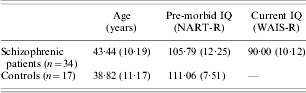
Mean values (±s.d.) for age and NART-estimated IQ in the patients and controls are shown in Table 1. There was no difference between the two groups on either of these variables (age: t=1·48, p=0·15; NART: t=−1·62, p=0·11).
Demographic variables for schizophrenic patients and controls

Values are mean (standard deviation).
IQ, Intelligence quotient; NART-R, National Adult Reading Test – Revised; WAIS-R, Wechsler Adult Intelligence Scale – Revised.
Confabulation in schizophrenic patients versus controls
One patient was excluded from the analysis because she produced very little material in the fable recall task. Using the broad measure of confabulation (invented+reorganized material) the schizophrenic patients as a group produced more confabulations than the controls (mean 2·44 confabulations/5 stories (range 0–16) versus 0·35/5 stories, range 0–2). As there were many zero values in the controls (11 of 17), statistical comparison presents difficulties for both parametric and non-parametric tests (Delucchi & Bostrom, Reference Delucchi and Bostrom2004). Therefore, patients and controls were compared using the two-sample Kolmorogov–Smirnov (KS) test, which is relatively robust to the presence of many zero values (Nimmo-Smith, personal communication). The difference between the groups was significant (KS Z=1·76, p=0·004).
Using the narrow definition of confabulation (invented material only), the schizophrenic patients produced on average 1·41 confabulations/5 stories (range 0–7), compared to 0·18/5 stories in the controls (range 0–1). This difference was at trend level (KS Z=1·34, p=0·06).
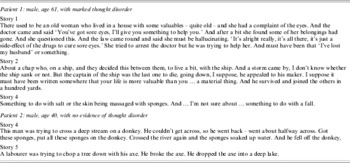
Examples of fable recall from two patients who showed confabulation are shown in Table 2. The schizophrenic patients also performed significantly more poorly than the controls on recall of the fables (39·77±21·24 v. 77·06±10·05, t=−6·84, p<0·001).
Examples of confabulations in two schizophrenic patients

Confabulation in relation to thought disorder
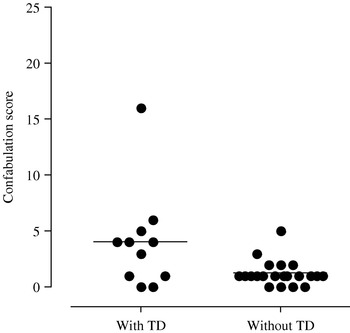
Twelve patients were rated as showing thought disorder (PSE ratings of 1 or 2 on one or more of the three thought disorder items) and 21 as not showing it (ratings of zero). One patient was considered unclassifiable because, although her speech was coherent most of the time, she showed several instances of tangential responses and idiosyncratic use of words. One of the thought-disordered patients was also excluded from the analysis because she produced very little material of any kind in response to the fables (see above). Of the remaining 32 patients, the 11 with thought disorder showed significantly more confabulations than the 21 without thought disorder (mean 4·00, range 0–16 v. mean 1·26, range 0–5) (KS Z=1·45, p=0·03). The findings are shown in Fig. 1. Using a narrow definition of confabulation (invented material only), the corresponding values were 2·27 v. 0·74. This was significant at trend level (KS Z=1·34, p=0·06).
Confabulation scores in schizophrenic patients with thought disorder (TD) (n=11) and without thought disorder (n=21). Two patients were excluded from the analysis.

Confabulation in relation to general intellectual impairment
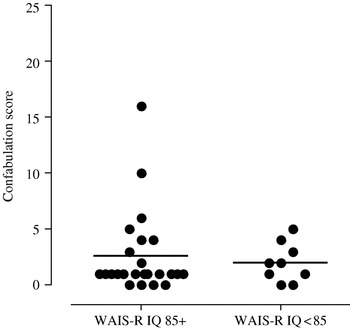
For the purpose of this analysis nine patients with a current WAIS-R IQ of <85 were compared with the remaining 24 who had a WAIS-R IQ of 85+. As shown in Fig. 2, the means for the two groups were similar, some patients in both groups showed multiple instances of confabulation, and some of the highest scores were in the patients with preserved intellectual function. The differences between the groups were not significant, either using the broad criterion of confabulation (mean 2·60, range 0–16 v. mean 2·00, range 0–5; KS Z=0·57, p=0·903) or the narrow one (mean 1·52, range 0–7 v. mean 1·11, range 0–3; KS Z=0·53, p=0·939).
Confabulation scores in schizophrenic patients with relatively intact (n=24) and impaired (n=9) general intellectual function. One patient was excluded from the analysis.

Confabulation in relation to neuropsychological test performance
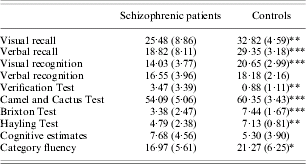
Because multiple neuropsychological tests were used, and performance on these would be expected to be inter-correlated, initial analysis was by means of multivariate analysis of variance (MANOVA) performed using all the test scores. As expected, the patients as a group performed more poorly than the controls (Hotelling T=2·14, F=6·85, p<0·001). The results of univariate F tests are shown in Table 3. This indicates that the differences were significant for all tests except one subtest from the Doors and People Test, verbal recognition, and the Cognitive Estimates Test.
Neuropsychological test performance in patients versus controls

Values are mean (standard deviation).
* p<0·05, ** p<0·01, *** p<0·001 based on individual F tests.
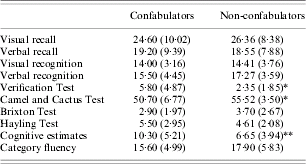
To examine neuropsychological test performance in relation to confabulation, we divided the patient group into confabulators and non-confabulators, based on a split around the maximum number of 2 (broadly defined) confabulations produced by the normal controls. According to this criterion, there were 10 confabulators (those with three or more confabulations) and 23 non-confabulators (number of confabulations of 2 or less). The two groups’ performance on the tests was then compared using MANOVA. The overall difference between the groups was significant (Hotelling T=1·22; F=2·44, p=0·04).
Performance on the individual tests is shown in Table 4. The only significant differences between confabulators and non-confabulators were on the two semantic memory tests, the semantic verification test (F=7·51, p=0·01) and the Camel and Cactus test (F=6·34, p=0·02). There was also a marginally significant difference on the Cognitive Estimates Test (F=4·00, p=0·05). In all cases the confabulators performed more poorly.
Neuropsychological test performance in confabulators (n=10) and non-confabulators (n=23)

Values are mean (standard deviation).
* p<0·05, ** p=0·05 based on individual F tests.
Repeating the analysis using the narrow definition of confabulation made little difference to the findings. The overall MANOVA remained significant and the differences were accounted for by differences on the two semantic memory tests. In this analysis, however, there was no longer a significant difference in performance on the Cognitive Estimates Test between confabulators and non-confabulators.
DISCUSSION
This study replicates Nathaniel-James & Frith's (Reference Nathaniel-James and Frith1996) original finding that a form of confabulation occurs in schizophrenia; when recalling a series of five fables the patients produced up to 16 (mean 2·44) elements not in the original stories, whereas the controls only produced at most 2 (mean 0·35). We found confabulation despite using a somewhat stricter definition of what constituted confabulation than Nathaniel-James & Frith (Reference Nathaniel-James and Frith1996), which excluded perseverations, statements that reflected intrusion of delusional material and instances of thought disorder. At the same time the study had a limitation, in that the ratings of confabulation were performed by a single assessor who was not blind to the subjects' status as patient or control and in whose recall of fables the presence of symptoms such as thought disorder was sometimes evident.
Nathaniel-James & Frith (Reference Nathaniel-James and Frith1996) made three further claims about confabulation in schizophrenia. The first was that it had a different quality to that seen in neurological patients. In particular, they noted that in schizophrenic patients the confabulated material seemed to be due to reorganization and reconstruction of elements in the original story rather than to the incorporation of completely invented material. They gave the example of a schizophrenic patient who, when asked to recall a fable about a rich man who went on a voyage across dangerous seas (see Appendix), began by stating that a rich man went on ‘a swimming expedition’ and then went on to include statements about praying and being hailed by other passengers, material that was already in the story but was introduced in a factually incorrect way. They contrasted this with the confabulations reported in a series of amnesic and Alzheimer patients by Kopelman (Reference Kopelman1987), in which there were numerous examples of entirely new and unrelated material (although there was also some reorganized material; see Kopelman, Reference Kopelman1999). For example, recalling a story from the Wechsler Memory Test in which a woman was robbed of £15, one of Kopelman's patients stated that the woman had got a job in a pub to make this amount of money and that her husband had left her, neither of which were in the original story.
We found evidence of both new and reorganized material in the schizophrenic patients in our study. Like Nathaniel-James & Frith (Reference Nathaniel-James and Frith1996), however, the schizophrenic patients did not produce the kind of gross inventions described in Kopelman's (Reference Kopelman1987) neurological patients. Generally, the confabulations that were seen were constrained by the context of the story; for example, ‘A labourer was trying to chop a tree down with his axe. He broke the axe.’ (instead of ‘A labourer worked along a stream. His axe fell in … ’); and ‘A man was trying to cross a deep stream on a donkey. He couldn't get across, so he went back.’ (in the story there is no mention of a man and the donkey continues across the stream rather than turning back). Probably in keeping with this finding, while the increase in broadly defined confabulations was significant, the increase in narrowly defined ones (i.e. invented material) was only at trend level.
Nathaniel-James & Frith's (Reference Nathaniel-James and Frith1996) second claim was that confabulation in schizophrenia was associated with the symptom of thought disorder. We also found clear evidence that this was the case; seven out of 11 patients with moderate or severe thought disorder showed more than two instances of (broadly defined) confabulation, in contrast to only two of 21 of the patients without thought disorder, and the range of scores was considerably greater in the former group. One other study has examined the association between confabulation and symptoms in schizophrenia; Salazar-Fraile et al. (Reference Salazar-Fraile, Tabarés-Seisdedos, Selva-Vera, Balanzá-Martinez, Martinez-Arán, Catalán, Baldeweg, Vilela-Soler, Leal-Cercós, Vieta and Gomez-Beneyto2004) correlated confabulation in recall of stories with symptom scores in a sample of 33 schizophrenic patients and found a significant correlation only with the conceptual disorganization item in the Positive and Negative Syndrome Scale (PANSS). All three studies to date are therefore consistent in finding that confabulation in schizophrenia is associated with thought disorder. However, it should be noted that Salazar-Fraile et al. (Reference Salazar-Fraile, Tabarés-Seisdedos, Selva-Vera, Balanzá-Martinez, Martinez-Arán, Catalán, Baldeweg, Vilela-Soler, Leal-Cercós, Vieta and Gomez-Beneyto2004) also tested a second group of 33 patients with nonschizophrenic psychoses (made up of patients with schizo-affective disorder, psychotic bipolar disorder and delusional disorder) and found additional significant correlations with delusions and grandiosity.
Nathaniel-James & Frith's (Reference Nathaniel-James and Frith1996) third claim was that, neuropsychologically, confabulation was specifically associated with poor performance on an executive test, the Hayling Test. Like Nathaniel-James & Frith (Reference Nathaniel-James and Frith1996), we found that confabulation was not simply a function of the general intellectual impairment that is now widely accepted in schizophrenia. However, we found no association between confabulation and performance on the Hayling Test. This finding also conflicts with two other studies, one of which found an association with impairment on the Hayling Test (Dab et al. Reference Dab, Morais and Frith2004) and the other with impairment on another test requiring response suppression, the Stroop Test (Salazar-Fraile et al. Reference Salazar-Fraile, Tabarés-Seisdedos, Selva-Vera, Balanzá-Martinez, Martinez-Arán, Catalán, Baldeweg, Vilela-Soler, Leal-Cercós, Vieta and Gomez-Beneyto2004). We also found no association between confabulation and impairment on three other tests of executive function. Here, however, our findings are in agreement with all other studies (Nathaniel-James & Frith, Reference Nathaniel-James and Frith1996; Dab et al. Reference Dab, Morais and Frith2004; Salazar-Fraile et al. Reference Salazar-Fraile, Tabarés-Seisdedos, Selva-Vera, Balanzá-Martinez, Martinez-Arán, Catalán, Baldeweg, Vilela-Soler, Leal-Cercós, Vieta and Gomez-Beneyto2004). Taken the findings together, it seems reasonable to conclude that confabulation in schizophrenia is not a function of a general executive failure, but there appears to be no obvious explanation for this discrepancy between our results and other studies with respect to the particular executive function of inhibition of prepotent responses.
By contrast, our finding of no relationship between confabulation and memory impairment is broadly in agreement with other studies. Nathaniel-James & Frith (Reference Nathaniel-James and Frith1996) found that confabulation was unrelated to performance on the California Verbal Learning Test, and two tests of recognition memory. In a further analysis of three single cases they (Nathaniel-James & Frith, Reference Nathaniel-James and Frith1996) they went on to conclude that memory impairment was neither necessary nor sufficient for confabulation in schizophrenia. Similarly, Dab et al. (Reference Dab, Morais and Frith2004) in another single case study found no consistent trend for confabulators to perform worse on memory tests than non-confabulators, and Kramer et al. (Reference Kramer, Bryan and Frith1998) found that patients could produce confabulations in a task where there was no requirement for recall of the material.
There are two qualifications to this conclusion, however. First, both we and Nathaniel-James & Frith (Reference Nathaniel-James and Frith1996) found that confabulation was associated with poorer recall of the fables used to elicit confabulation. Second, in our study, confabulators showed significantly worse performance on two measures of semantic memory. Dab et al. (Reference Dab, Morais and Frith2004) also found that the patients in their single case study made frequent errors on the ‘silly sentences’ test, although one of their non-confabulating patients also made a similar number of errors on this test.
Perhaps the most widely accepted explanation of confabulation in neurological disease is that a combination of memory impairment and impaired executive function is a necessary, though almost certainly not a sufficient, condition for it to occur (Kapur & Coughlan, Reference Kapur and Couglan1980; Baddeley, Reference Baddeley1990; Benson et al. Reference Benson, Djenderedjian, Miller, Pachana, Chang, Itti and Mena1996; see also Moscovitch & Melo, Reference Moscovitch and Melo1997). This explanation seems difficult to apply to confabulation in schizophrenia, which does not seem to be particularly closely tied to either memory or executive impairment in any of the studies to date. If anything, our findings, and those of Dab et al. (Reference Dab, Morais and Frith2004), instead point to a relationship to semantic memory impairment. In this regard, Nathaniel-James & Frith (Reference Nathaniel-James and Frith1996) also suggested that one of the mechanisms of confabulation in schizophrenia could be an inability to comprehend the gist of the fables. Semantic memory impairment does not figure prominently in the literature on confabulation in neurological conditions. However, Dalla Barba (Reference Dalla1993) has described confabulating patients whose semantic memory was impaired. This semantic memory impairment, although not contributing to the presence of confabulation, was implicated in the bizarreness of the confabulations.
Confabulation in schizophrenia is associated with the symptom of thought disorder. It may also be associated with semantic memory impairment, dysfunction in which is also currently a focus of considerable theoretical and experimental interest in thought disorder (e.g. Spitzer, Reference Spitzer1997; Goldberg & Weinberger, Reference Goldberg and Weinberger2000; McKenna & Oh, Reference McKenna and Oh2005). The question therefore arises of how far schizophrenic confabulation and thought disorder differ from each other; could they possibly even be different ways of describing the same phenomenon? Nathaniel-James and Frith entertained this possibility when they described two schizophrenic patients who showed confabulation in their recall of fables and stated that ‘the two extracts … could be seen as examples of thought disorder in that the accounts appear disorganized.’ In terms of simply equating the two, there are obvious limits on how far such an argument can be taken. For one thing, the speech of neurological patients with confabulation (e.g. those described by Baddeley & Wilson, Reference Baddeley and Wilson1988 and Kopelman, Reference Kopelman1987) is understandable – it is only the factual content of what is said that strikes the listener as odd – whereas the defining characteristic of thought disorder is that speech becomes difficult to follow, even though the patient may be discussing quite mundane matters. For another, it is now universally accepted that thought disorder encompasses a number of different abnormalities, ranging from abnormal word use to disordered structure within individual sentences, to disorders in the connectedness of longer stretches of discourse. Clearly, linguistic and within-sentence abnormality are not features of confabulation.
Nevertheless, if it is accepted that confabulation in schizophrenia is different from the neurological form of the symptom, then some phenomenological overlap with thought disorder might become a more viable proposition. Reorganizing and reconstructing ideas in a story to produce a different series of events is not very different from letting one's ideas slip off the track into closely or distantly ones – Andreasen's (Reference Andreasen1979) definition of derailment. To this might be added that referring to a voyage as a swimming expedition, as one of Nathaniel-James & Frith's (Reference Nathaniel-James and Frith1996) confabulating patients did, does not seem wholly dissimilar to the use of word approximations and idiosyncratic use of words seen in thought disorder. McKenna & Oh (Reference McKenna and Oh2005) developed this line of argument further and suggested that something that might legitimately be considered to be semantic confabulation can be discerned in patients with thought disorder. They pointed out several instances where obviously erroneous knowledge was spontaneously produced during the speech of the thought-disordered patient described in the well-known study of Chaika (Reference Chaika1974). This patient voiced the unlikely propositions that her mother's name was Bill, that St Valentine's day was the official start of the breeding season for birds, that buzzards coo, and that both they and parakeets worked hard. In other words, while episodic confabulation, as seen in neurological disorders, and thought disorder are not the same thing, conceptualizing some aspects of thought disorder as semantic confabulation may be an idea with some heuristic value.
APPENDIX
Fables used in the study divided into ideas
Story 1
An elderly woman / , who lived in a house / full of beautiful paintings and ornaments / , asked her doctor / to treat her sore eyes / . The doctor came / and put ointment / on her eyelids / , but while she sat / with her eyes closed / , he stole / one or two valuable possessions / . Each time he visited / , he took another item / , until the old woman's house was almost bare / . One day / he arrived to treat her / , but he found two policemen / waiting to arrest him / . ‘I'm not a thief!’ / he said / . ‘I didn't say you were a thief’, / said the old lady, / ‘but you are a bad doctor / . Before you cured my eyes / , I could see all my belongings / . Now I can't see any of them / .’
Story 2
A rich man / took a valuable cargo / on a voyage / across dangerous seas / . A storm soon blew up / and the ship went down / , throwing the passengers / into the sea / . They all began to swim / for their lives / except the rich man / who raised his arms to heaven / and promised his god / all kinds of riches / if he was saved / . The other passenger shouted / to the praying man, / ‘Don't leave it for god to save you / , swim for yourself’.
Story 3
A cowboy / went to San Francisco / with his dog, / which he left at a friend's / while he went to buy a new suit of clothes. / Dressed in his grand new suit, / he came back to the dog, / whistled to it, / called it by name / and patted it. / But the dog would have nothing to do with him / in his new hat and coat / and gave a mournful howl. / Coaxing was of no avail, / so the cowboy went away / and put on his old suit, / and then the dog immediately showed its wild joy / on seeing its master as it thought he ought to be.
Story 4
A donkey, / loaded with salt, / had to wade a stream. / He fell down / and for a few minutes / lay comfortably in the cool water. / When he got up, / he felt relieved of a great part of his burden, / because the salt had dissolved in the water. / Long-ears noted this advantage / and at once applied it the following day / when, loaded with sponges, / he again went through the same stream. / This time he fell purposely / but was grossly deceived. / The sponges had soaked up the water / and were considerably heavier than before. / The burden was so great that he fell / and could not go on.
Story 5
A labourer / worked along a stream. / His axe fell in / and, as he could not get it out, / he sat on the bank / and bemoaned his fate. / Neptune / took pity on the man's poverty, / dived / and brought up a golden axe. / The labourer said it was not his. / Neptune dived again / and appeared with a silver axe. / The labourer made no claim. / Again the god dived / and brought up the right iron axe / with the wooden handle. / ‘That is it!’, / the labourer exclaimed. / ‘I wanted to test you’, / replied Neptune. / ‘I am glad you are as honest as you are poor. / Take all the three axes.’
DECLARATION OF INTEREST
None.