The Barrier Canyon style, as defined by Polly Schaafsma, is found in the middle Colorado Plateau, south-east Utah (USA), and comprises monochrome and polychrome pictographs, petroglyphs and combination forms (Schaafsma Reference Schaafsma1971: 69). Despite some recent significant advances showing that this rock art tradition persisted during the transition from the late Archaic into the agrarian Fremont culture (approximately AD 1–1100), at least in the type locality (Chapot et al. Reference Chapot, Sohbati, Murray, Pederson and Rittenour2012; Pederson et al. Reference Pederson, Chapot, Simms, Sohbati, Rittenour, Murray and Cox2014), its cultural status is still debated. This is largely because diversity is evident in this rather protean style, whose variants probably include several ‘schools’ or transitional expressions offering continuities with other styles (Cole Reference Cole and Matheny2004, Reference Cole2009: 59–67; Manning Reference Manning2013). Barrier Canyon style is typified by large, static, abstracted ‘mummy-like’ anthropomorphs with elongated, tapering bodies and missing limbs, but diminutive arms and legs may be present, particularly when these figures seem to hold plants, sticks or snake-like elements. They have long necks and small stick-like or round heads, which are often flattened on top; their facial features are usually limited to large round eyes. Profiles are very rare and most figures are presented in frontal view. They are solidly coloured or pecked, but their dark torsos may have fabric-like embellishments, stripes or zigzags incised through the red-brown paint or added in white, suggesting body paint, tattoos or woven blankets, documented in both prehistoric and ethnographic records. Few other elements occur with them, although sometimes there are geometric forms and phytomorphs, most frequently tiny ‘attendants’: people, composite beings, birds and quadrupeds with quadrangular bodies that are identified as ungulates and canines or felines, with possible badgers and bears. Material culture associations are limited: early archaic figurines of unfired clay were compared to the ‘wrapped’ Barrier Canyon style forms (Coulam & Schroedl Reference Coulam and Schroedl1996), but this resemblance is not conclusive. The Barrier Canyon style ghost-like anthropomorphs, which are sometimes very small (100mm or less) and sometimes larger than life-sized (2m or more), may have antenna-like projections, headgear, crowns, plumes, ears or antlers, and they have long attracted the interest and imagination of rock art enthusiasts (Beckwith Reference Beckwith1931; Grant Reference Grant1967: 115–19; Schaafsma Reference Schaafsma1971: 69).
One of these well-informed amateurs was lawyer Noel Morss, who first reported the Barrier Canyon style figures at Black Dragon Canyon (San Rafael Swell, Utah) after his survey of the Fremont River drainage system in 1928 (Morss Reference Morss1931). Two sets of figures are painted on the sandstone cliff. One is a group of five large anthropomorphs in frontal view accompanied by smaller motifs, one of them being of a bug-eyed type, with a round head and diminutive arms and legs (Castleton Reference Castleton1984: 164–67). The other was reported in 1947 by John Simonson who, in order to interpret more precisely what he believed to be a ‘winged monster’, resorted to the process of chalking: “we meticulously chalked the outline [. . .] eventually we had chalked all that appeared to be paint. We stepped aside and here on the wall was a weird bird” (Simonson Reference Simonson1947: 24–25, 45). Polly Schaafsma, a specialist in the rock art of the American south-west, thought she could recognise a “beak lined with sharp teeth” (Schaasfma Reference Schaafsma1970: 12). This supposed bird was then identified as a pterosaur by the geologist Francis Audray Barnes: “In the San Rafael Swell, there is a pictograph that looks very much like a pterosaur, a Cretaceous flying reptile” (Barnes & Pendleton Reference Barnes and Pendleton1979: 201).
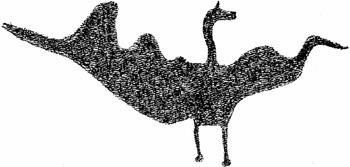
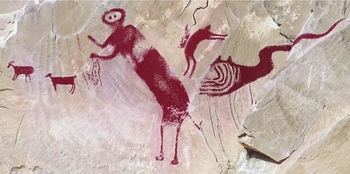
As some authentic fossil traces of pterosaurs have been found in the region (e.g. Stokes & Madsen Reference Stokes and Madsen1979), Dennis Swift deduced that this animal had been painted from life in a period of history, and that it had inspired the ‘thunderbird’ of Native American mythologies (Swift Reference Swift1997: 22). Additional creationists have recently taken up this kind of argument, and even believe they can identify the species in question (Figure 1), claiming it to be a Quetzalcoatlus northropi, which could reach a length of 12m (Isaacs Reference Isaacs2010; Nelson Reference Nelson2011). Other authors simply consider it to be an ‘imaginary monster’ (Stokes & Stokes Reference Stokes and Stokes2002: 31).
The ‘dragon’, ‘monster’ or ‘pterosaur’ of Black Dragon Canyon (after Stokes 2002: 31).

Quite apart from all interpretation, the very existence of such an image was, however, rejected in 1993 by Judith and Jesse Warner, on the basis of excellent arguments: in the view of these authors, the so-called pterosaur is actually made up of the joining of three zoomorphs and two anthropomorphs of the type known as ‘supplicators’ (Warner & Warner Reference Warner and Warner1993). Nevertheless, given that publications popularising the creationist view of this panel continue to appear (Swift Reference Swift1997; Isaacs Reference Isaacs2010; Nelson Reference Nelson2011), Philip Senter felt it necessary to repeat this refutation in 2012 (Senter Reference Senter2012).
As the reading of rock images is often heavily dependent on the observers’ expectations (Le Quellec Reference Le Quellec2007), such refutations simply cannot put an end to the debate: just as the image of the famous ‘duck-rabbit’ of Jastrow is sometimes seen as a duck and sometimes as a rabbit (Jastrow Reference Jastrow1899: 312), the panel in Black Dragon Canyon is sometimes similarly interpreted as a pterosaur by creationists, and sometimes as a combination of anthropomorphs and zoomorphs by archaeologists. The former base their interpretation on the chalked version of the figure (doubtless renewed since 1947; chalking of rock art constitutes an act of vandalism that should be completely prohibited, see Chaffee et al. Reference Chaffee, Hyman and Rowe1994), and the latter base their arguments on a tracing by hand (Warner & Warner Reference Warner and Warner1993) or on a virtual outlining added to a photograph (Senter Reference Senter2012). None of these readings are really definitive, because they are all the result of personal interpretations, which people will tend to accept or refuse according to their expectations.
In order to close this debate and finish off a monster that has already been wounded by the attacks of our predecessors, we present here two new analyses of this panel, each of which avoids any idiosyncrasy but which deal a mortal blow to readings that evoke a pterodactyl.
The first blow
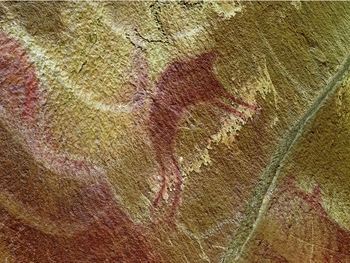
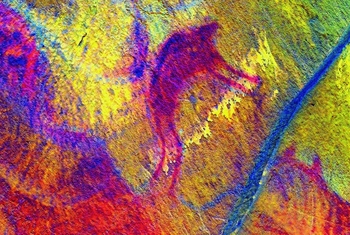
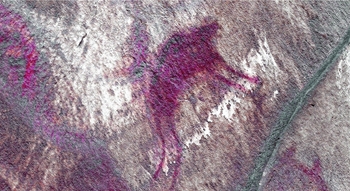
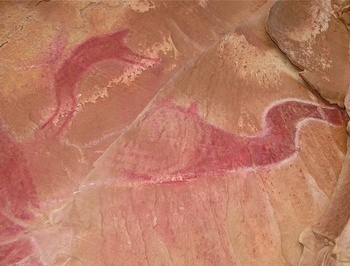
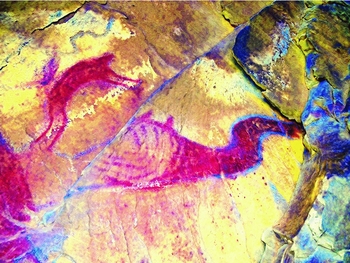
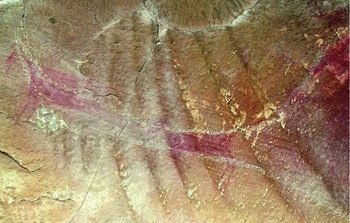
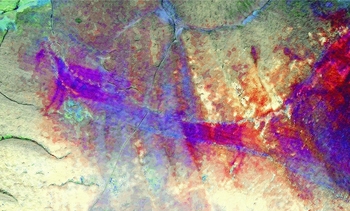
To avoid any influence of the chalking on the wall, and not to give free rein to the illusions of a perception biased by our conscious or unconscious expectations, we used the plug-in DStretch© implemented by Jon Harman for ImageJ©. This tool makes it possible to improve the visibility of images, or to make visible some elements that escape the naked eye, and it offers operator-independent results (Le Quellec et al. Reference Le Quellec, Harman, Defrasne and Duquesnoy2013; Gunn et al. Reference Gunn, Douglas and Whear2014). After a treatment using the Linear Dynamic System model with an automatic correction, a photo of the painting that is interpreted as the neck, head and beak of a pterosaur (Figure 2) clearly reveals an anthropomorph whose arms form the ‘beak’ and whose legs are the ‘neck’ (Figure 3). As the painting was made with red ochre, one can ignore (on the treated photograph) the yellows (that correspond to calcite) and the blues (the chalking). The result is even more eloquent, and shows that the anthropomorph's legs are not connected to the other painted areas (Figure 4). The same procedure, carried out on other detailed photographs, proves that one of the ‘wings’ is actually made up of a serpentiform (Figures 5 & 6), whereas the other comprises two small quadrupeds (Figures 7 & 8). The illusion of continuity comes in part from the chalked outline, and partly from the fact that the painting has become slightly diffuse on the wall, perhaps as a result of it being wetted by indelicate photographers. The repetition of this process on numerous photographs, and then the virtual transfer of the results onto the wall with the restitution of an ochre colour, produces a global recording (Figure 9) that fully confirms those of the Warners and Senter, while correcting them to an extent. On this panel there only exist two painted anthropomorphs, two painted quadrupeds on the left, a large painted serpentiform on the right and a small pecked serpentiform above the smallest anthropomorph (Warner & Warner Reference Warner and Warner1993; Senter Reference Senter2012). The advantage of the method adopted here is that it meets the scientific criterion of replicability—anyone with DStretch© at their disposal and detailed photographs will obtain the same results.
Close-up photograph of the ‘head’, ‘beak’ and ‘neck’ of what creationists observe as a pterosaur (by Jean-Loïc Le Quellec).

The same photograph after treatment by DStretch© LDS-AC.

The same photograph after suppression of all colours except red.

Close-up photograph of one of the ‘wings’ (by Jean-Loïc Le Quellec).

The same photograph after treatment by DStretch© LDS-AC; it is very clear that the serpentiform on the right has been artificially joined to the other figures by the chalk line, visible here in blue.

Close-up photograph of the other ‘wing’ (by Jean-Loïc Le Quellec).

The same photograph after treatment by DStretch© LDS-AC of the previous image.

Photograph of the whole panel (by Jean-Loïc Le Quellec).

The coup de grâce
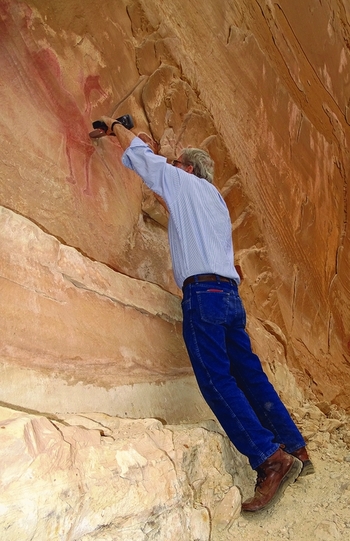
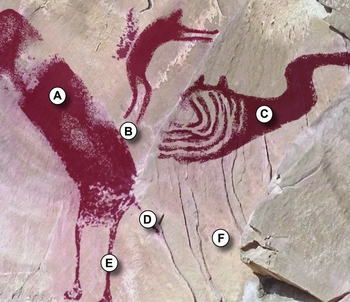
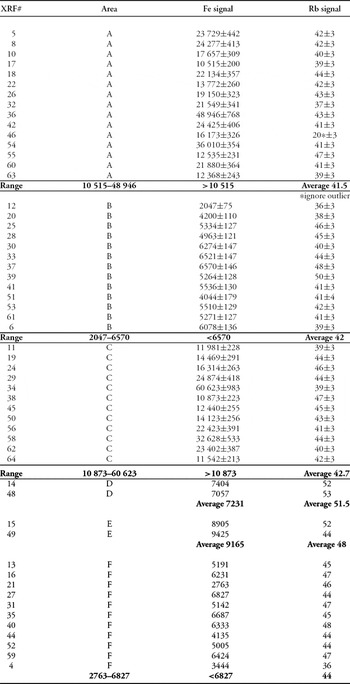
In order to verify this first DStretch© analysis, and confirm that the five subjects painted on the wall are indeed separate from each other and can in no way constitute a single image, we used a portable X-ray fluorescence analyser, which makes it possible to measure in situ the iron (Fe) content that characterises red ochre (Figure 10). Figure 11 indicates the areas where these measurements were taken: two big red patches (A & C), two fine lines (D & E), the part located between the feet of the small anthropomorph and the body of the big one (B), and a part with no trace of paint (F). For each zone, several one-minute measurements were taken (without touching the art), long enough to make the results statistically valid. Fifteen measurements were taken on area A, 13 on B, 12 on C, 12 on D and 11 on F. Two measurements were taken on D and E simply to show that even these very small, pigmented lines (1 and 2mm) indicate iron levels above background (background here simply indicates the natural levels of iron in unpainted rock; most rocks contain a small amount of iron naturally). One would not expect the iron signals here to be as high as in areas that have a larger area covered by paint. The primary X-rays were impinging on a very limited area of paint and so fewer X-rays encounter the iron atoms. The results obtained are presented in Table 1; this table also presents the rubidium (Rb) signals, which are practically constant in all of the areas studied and clearly correspond to a signal from it in the unpainted rock wall itself. Although the instrument shows the signals as %Fe and %Rb, such an assignment is meaningless due to the many factors encountered in rock art analysis: these are set forth in detail in Koenig et al. (Reference Koenig, Castañeda, Boyd, Rowe and Steelman2014). For these reasons, we prefer to refer to the results as signals. The rubidium signals are included to show that it is constant in the rock itself and that the numbers are quite reproducible within the stated standard deviation.
Analysis of various parts of the panel by means of a portable spectrometer by Marvin Rowe (photograph: Jean-Loïc Le Quellec).

Location of the analysed areas; the main result is that zones A and C, corresponding to flatwash paint, yielded comparable figures that were much higher than those from the undecorated area (F), itself comparable to area B; this confirms the analysis by DStretch©.

Nondestructive X-ray fluorescence measurements of iron (Fe) and rubidium (Rb). The Fe signal is indicative of ochre pigment; the Rb signal is from the background rock.

One can see that the test for iron on an area that is apparently devoid of paint yielded results ≤6827, whereas those areas that were definitely painted yielded values higher than 10 515 (for A) and 10 873 (for C). The value of 6827 may be regarded as the highest level of iron recorded in the unpainted rock, i.e. it represents the highest background level observed on bare rock. Even the narrow lines result in signals greater than 6827. Given that this area is located between the ‘neck’ of the supposed pterodactyl and what has been interpreted as this animal's body, these results confirm those obtained by DStretch©. Area B contains no trace of pigment, and one cannot therefore interpret the panel as if it were a single image—unless, of course, one behaves akin to those authors who “conduct their investigations in reverse: they have a pet theory and they look for evidence to support it, discarding anything that seems to disprove the cherished idea” (Grant Reference Grant1992: 5–6).
Conclusions
In contrast to previous approaches, we have analysed this panel using two different methods that exclude the intervention of any personal bias and in accordance with a methodology that is fully replicable. The results obtained definitively refute the readings that are based on a single image, and objectively confirm the presence of several distinct subjects.
Our analyses thus reintegrate this panel into the classic repertoire of the Barrier Canyon style art, and complement previous motif inventories (Firnhaber Reference Firnhaber2007: 352). The large bug-eyed anthropomorph in the middle seems to hold a snake-like element, as they often do (Manning Reference Manning1990: 66; Burrows Reference Burrows2002; Firnhaber Reference Firnhaber2007: 213). It is wearing a small pendant attached to its back, thinner and simpler than the fox-pelt pendants known in six other Utah locations (Manning Reference Manning1990). The sheep figure on the far left is reminiscent of those at Devil's Lane (Castleton Reference Castleton1987: fig. 8.1 left) or Salt Creek (Castleton Reference Castleton1987: fig. 8.9) in the Needles District, but it is slightly less naturalistic than those visible at the eponymous site in Horseshoe (Barrier) Canyon (Castleton Reference Castleton1987: fig. 8.28). The other quadruped resembles the type usually described as ‘dog’, but this identification remains questionable; the second anthropomorph is depicted in a rather dynamic way, echoing several small characters at the aforementioned site (Cole Reference Cole2009: fig. 34.a). The posture is reminiscent of that of a ‘supplicating’ human at Buck Horn Wash (Warner & Warner Reference Warner and Warner1993: fig. 8.b). The pecked line just above it probably depicts a snake and not a simple serpentiform, as it clearly shows a head and a pointed tail. The last figure on the right must be one of the numerous horned snakes found painted or pecked in the area (Reagan Reference Reagan1933; Burrows Reference Burrows2002), and it might be added to the 12 known animal ‘supplicators’ of the snake-with-arms type (Warner & Warner Reference Warner and Warner1993: 5 & fig. 6).
In more general terms, the spectrometric analysis has made it possible to verify the results yielded by DStretch©, and the portable X-ray fluorescence method used here could be adopted in order to tackle similar difficulties in reading other decorated walls.
Acknowledgements
We are grateful to Texas A&M University at Qatar and the Qatar Foundation for access to the pXRF analyser, and to Le Miroir Productions for the organisation of our trip to Black Dragon Canyon. Thanks are also given to Jon Harman, who provided the latest version of DStretch©.