Implications
A high inclusion rate of lucerne at 75% of forage dry matter (DM) within a total mixed ration (TMR) negatively affected diet digestibility and milk yield relative to a low inclusion rate. However, a short chop length increased diet digestibility at both lucerne inclusion rates, and therefore could be used to partly mitigate the negative effects of high lucerne silage inclusion in diets.
Introduction
Lucerne (Medicago sativa) is widely utilised as a forage legume in dairy cow diets in semi-arid environments including parts of the United States, Eastern Europe and Australia. Reduced requirement for inorganic N fertilisation may make it more economical to grow than well fertilised grasses depending on fertiliser price (Phelan et al., Reference Phelan, Moloney, McGeough, Humphreys, Bertilsson, O’Riordan and O’Kiely2015) and therefore shows potential for greater use in intensive Northern European dairy systems. Establishing guidelines for the feeding of lucerne in such systems is critical for efficient utilisation.
Lucerne and maize silages in the diet are complementary to each other with the former providing rumen degradable protein and the latter providing fermentable energy from starch to drive microbial protein synthesis using ammonia and amino acids from lucerne protein degradation. Previous work has shown that the milk yield obtained from lucerne–maize forage combinations can equal that of grass–maize combinations (Sinclair et al., Reference Sinclair, Edwards, Errington, Holdcroft and Wright2015). However, the optimum inclusion rate of each is not certain. In one study where inclusion rates of chopped lucerne hay to maize silage were varied between 25% and 75% lucerne inclusion within forage DM, milk production decreased by 3.3 kg/day with the high rate of lucerne hay inclusion (Akbari-Afjani et al., Reference Akbari-Afjani, Zali, Gangkhanlou, Dehghan-Banadaky, Nasrollahi and Yang2014).
Lucerne is also a source of physically effective NDF in diets for lactating dairy cows as it has a highly lignified stem that can encourage rumination. Physically effective NDF has been defined as the NDF present in longer particles within a feed (Mertens, Reference Mertens1997), typically considered to be particles greater than 4 mm using the Penn State Particle Separator (PSPS) system (Maulfair and Heinrichs, Reference Maulfair and Heinrichs2012). Previous research has shown short chop lengths (5mm theoretical length) of lucerne haylage (Kononoff and Heinrichs, Reference Kononoff and Heinrichs2003) and silage (Beauchemin et al., Reference Beauchemin, Farr, Rode and Schaalje1994) can increase DM intake (DMI) and improve energy balance relative to long chop lengths of 22 and 10 mm, respectively. Therefore, the objective of our study was to examine the effects of lucerne silage chop length on diet DMI and milk yield. A second objective was to investigate how chop length may interact with the inclusion rate of lucerne silage when substituted for maize silage in a TMR. We hypothesised that a lower inclusion rate of lucerne silage and a shorter chop length will increase intake and milk yield in line with previous studies discussed above and that these effects will relate to increased digestibility.
Material and methods
Forage harvesting and clamp sampling
This study involved two separate experiments carried out simultaneously at the Centre for Dairy Research (CEDAR), University of Reading, between June and September 2015. The lucerne silage for both experiments was made on-site in the year before the start of the trial and conserved in concrete-walled clamps sheeted with a layer of oxygen-barrier film, two layers of plastic sheeting and a weighted top sheet. Experiment 1 utilised a first cut, which was ensiled on 31 May 2014 (estimated 10% bloom). The harvested material was windrowed and wilted for 24 h. Alternate swaths originating from the same field area were used to create the two chop lengths, long (L) and short (S), by altering the knife arrangement of the precision chop forage harvester (Claas Jaguar 840 model, Claas Group, Harsewinkel, Germany) from a theoretical chop length of 14 mm (shortest setting) to 19 mm (longest setting). The long chopped material was collected from the field first followed by short chopped material and each were placed in identical adjacent clamps. The resulting silage was ensiled using Axphast Gold additive containing Lactobacillus plantarum (Biotal, Cardiff, UK) for low DM silages. The silage produced for experiment 2 was created on 11 July 2014 in the same way, from the same sward, at second cut (also at an estimated 10% bloom). A longer wilting period of 48 h was allowed, and Axcool Gold additive containing Lactobacillus buchneri (Biotal) for high DM silages was applied. Following fermentation, core samples for all cuts were taken for chemical composition analyses (Sciantec Analytical Services, Cawood, UK). Maize silage for the study was taken from a commercial crop of mixed varieties harvested in autumn 2014 and ensiled in a concrete-walled clamp with no additive and sheeted as described for the lucerne clamps. The average particle size for the maize silage was determined to be 10 mm using a PSPS.
Diets
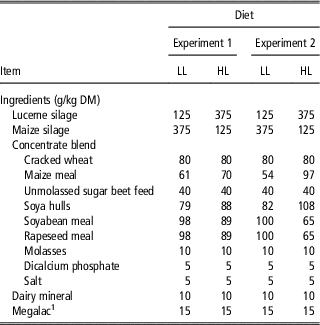
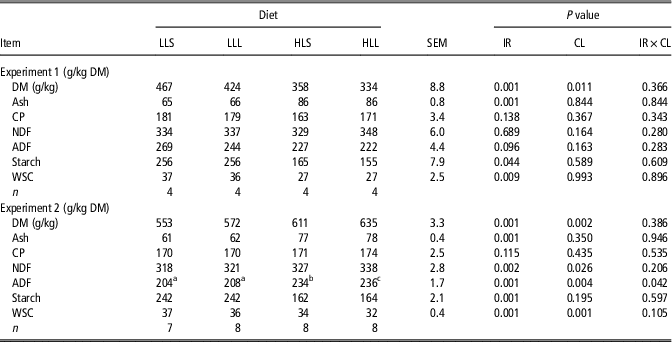
A TMR with 50 : 50 ratio of forage : concentrate on a DM basis was fed. The forage was comprised of maize and lucerne silage in proportions (DM basis) of either 25 : 75 (high lucerne (HL)) or 75 : 25 (low lucerne (LL)), respectively. The two inclusion rates and the two chop lengths (L or S) were combined in a 2×2 factorial design to give four treatments (HLL, HLS, LLL, LLS). Diets were formulated to be isonitrogenous (170 g CP/kg DM) and contain similar levels of NDF (330 and 320 g/kg DM for experiments 1 and 2, respectively) based on an analysis of core samples from the silage clamps used. Maize meal was included at higher rates in the HL diet to partly offset the reduction in maize starch associated with lower maize silage inclusion in these diets (Table 1), however there was still a significant difference between starch concentration in the resulting TMRs (Table 2).
Ingredients used to create experimental total mixed rations in two separate experiments

LL=low lucerne diet; HL=high lucerne diet.
1 Megalac rumen protected fat supplement (Volac International Ltd, Royston, UK).
The chemical composition of four total mixed rations containing a high (HL) or low (LL) concentration of lucerne silage at a long (L) or short (S) chop length fed in two separate experiments

IR=inclusion rate; CL=chop length; IR×CL=interaction between IR and CL; DM=dry matter; WSC=water-soluble carbohydrate.
a,b,cWhere there is a significant interaction, values within a row with different superscript letters differ significantly at P<0.05.
Animals
For experiment 1, 16 multiparous Holstein-Friesian dairy cows in mid lactation (144 day in milk, SEM±4.3) weighing 701 kg and in fourth parity on average, were blocked (4 cows per block) according to milk yield and randomly assigned to one of four initial treatments within each block in a replicated 4×4 Latin square design experiment with three week periods. Cows were housed in a cubicle yard, bedded on sand and individually fed using CALAN gates (American Calan, Northwood, NH, USA). Continual access to water was given. Fresh feed was offered for ad libitum intakes (10% refusals per day) once daily at 1000 h. Refusals were removed on Mondays, Wednesdays and Fridays.
For experiment 2, eight multiparous Holstein-Friesian dairy cows in mid lactation (141 day in milk, SEM±13.4) weighing 704 kg and in fourth parity on average, in two blocks (of which one block contained four cows fitted in a previous lactation with Bar Diamond rumen cannula (Parma, ID, USA)) were randomly assigned within each block to one of four initial treatments according to a 4×4 Latin square design with 3-week periods as in experiment 1. The block of four non-fistulated cows were used for measurements of total tract diet digestion. All procedures carried out in experiment 2 were licensed and monitored by the UK government Home Office under the Animal (Scientific Procedures) Act 1986. Animals were housed in a cubicle yard and individually fed once daily for ad libitum intake through Insentec RIC feeders (Insentec B.V., Marknesse, The Netherlands) during weeks one and two of each period. Cubicles were bedded with wood shavings and continuous access to water was provided. In the final week of each period animals were housed and milked in individual tie stalls situated adjacent to the cubicle yard to facilitate sampling. Animals were given 2 days to acclimatise to the stalls before sampling began. While in tie stalls, animals were fed twice daily at 1000 and 1600 h for ad libitum intake (10% refusals). Refusals were taken daily at 0930 h.
Experimental routine
Intake and diet analysis
Weights of feed offered and refused were taken during the final week of each period. For the four animals used for digestibility measurements (experiment 2) only measurements from 5 days were statistically analysed. The DM of the feed offered and refused was measured in a forced air oven at 100°C for 24 h. Bulked daily grab samples of the TMR and diet components were also taken and frozen at −20°C until analysed. Samples of the constituents of the TMR were analysed for DM, N (using the macro Kjeldahl method), ash (by combustion at 500°C for 16 h), NDF (assayed with heat-stable amylase, inclusive of residual ash), ADF (inclusive of residual ash), starch and water-soluble carbohydrates (WSC) as described previously (Reynolds et al., Reference Reynolds, Humphries, Kirton, Kindermann, Duval and Steinberg2014). Starch was converted to glucose by treatment of the hot water extract with amyloglucosidase followed by acid hydrolysis (Macrae and Armstrong, Reference Macrae and Armstrong1968). Total reducing sugars were measured calorimetrically and the result was corrected for cold water-soluble reducing sugars (Fuller, Reference Fuller1967). Crude protein concentration was calculated by multiplying N (g/kg DM) by 6.25. Concentrations (g/kg DM) of CP, NDF, ADF, ash, starch and WSC in each TMR were calculated based on constituent inclusion rates. Furthermore, TMR and diet components were analysed in triplicate for particle size distribution using a PSPS with holes measuring 4, 8 and 19 mm in diameter and a bottom pan. Material from each sieve was collected and dried (at 60°C for 72 h) to give a DM correction. Average particle size of the sample was calculated as described previously (Heinrichs, Reference Heinrichs2013).
Degradability of DM and N in each forage was measured using an in situ method with rumen cannulated lactating Holstein dairy cattle (Ørskov and McDonald, Reference Ørskov and McDonald1979). These cattle were housed in cubicles, in a dedicated metabolism unit, fed a commercial grass–maize-based TMR diet once daily. Samples (not dried or further chopped) of each silage were placed in polyester bags (40 μm pore size) that were then incubated sequentially in the rumen of three different animals for six time intervals (3, 6, 12, 24, 48 and 72 h). Three replicate ‘0’ h bags were soaked in a tub of cold tap water with agitation for 5 min before being refrozen alongside the bags that were incubated in the rumen. Residue was subsequently analysed for DM and N concentration as described above.
Milk yield and composition
Cows were milked twice daily at 0630 and 1630 h. In experiment 1 separate milk samples were taken during each of the last four consecutive milkings in each period and analysed for fat, CP, casein, lactose, urea and somatic cell count by mid infra-red spectroscopy on a CombiFoss machine (National Milk Laboratories, Chippenham, Wiltshire, UK). In experiment 2, milk samples obtained throughout the 3rd week of each period were analysed as for experiment 1.
Diet apparent digestibility and nitrogen balance
Beginning at 1000 h (before morning feeding) on day 17 of each period cows used for digestion trials were fitted with a harness and chute allowing total collection of faeces and urine for five consecutive 24-h periods (Reynolds et al., Reference Reynolds, Humphries, Kirton, Kindermann, Duval and Steinberg2014). Urine was collected into containers containing 1 L of five molar sulphuric acid. In addition, 200 ml spot urine samples were collected twice daily in each of the five consecutive 24-h periods, immediately acidified using 10 ml of five molar sulphuric acid, and bulked. At the end of the collection period a representative subsample of the bulked spot samples was obtained and stored frozen until analysed for N. The bulked spot samples were used to determine urinary N concentration to account for any volatilised N losses. At the end of each 24-h period the total faeces and urine collected were weighed. Faeces were mixed, and subsampled as a fixed proportion of total volume to produce a representative bulk sample and stored at −20°C for subsequent analysis. Faecal and feed samples were analysed for DM, N, organic matter (OM), starch, NDF and ADF concentration and urine samples analysed for N concentration as described above for feed samples (Reynolds et al., Reference Reynolds, Humphries, Kirton, Kindermann, Duval and Steinberg2014).
Statistical analysis
For silage degradability, an exponential curve fitted to percentage degradation at each time point was used to obtain fractions termed ‘a’, ‘b’ and ‘c’ as described previously (Ørskov and McDonald, Reference Ørskov and McDonald1979). Rumen outflow rate (k) was assumed to be 0.05/h. Feed efficiency was calculated as estimated milk energy yield (Tyrrell and Reid, Reference Tyrrell and Reid1965) divided by DMI. Data from each experiment were analysed separately. Experiment 1 was analysed as four simultaneous Latin squares. Averages for each cow and treatment combination were analysed to determine fixed effects of square, period, lucerne inclusion rate (IR), chop length (CL) and their interaction (IR×CL) and random effects of cow within square using mixed models procedures of SAS (version 9.1). For experiment 2, data obtained within two simultaneous Latin squares were analysed in the same way. For each variable the covariance structure giving the best fit was selected. Data from one cow (not one used for the digestion trial) in experiment 2 in period four was removed as her DMI and milk yield did not fully recover following mastitis that occurred during the adaptation period.
Results
Forage quality
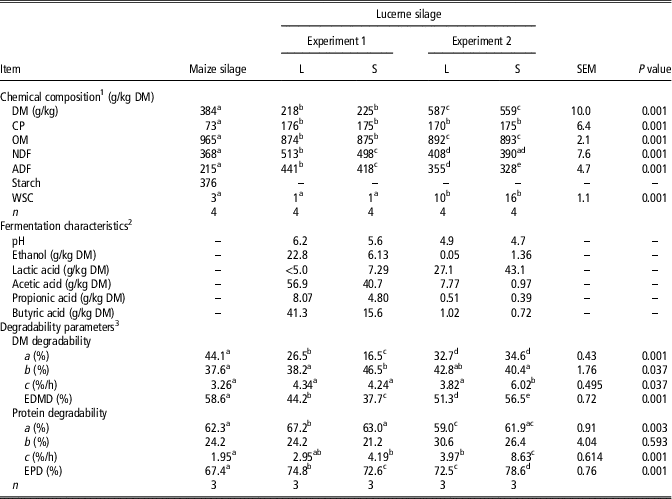
The first cut silage used for experiment 1 had lower DM (−354 g/kg), and a higher pH (+1.1), than the second cut silage used for experiment 2 (Table 3). Higher DM (second v. first cut) and shorter chop length were associated with lower pH and greater lactic acid concentration but reduced acetic, butyric and propionic acid concentrations. Crude protein concentrations were similar for the first and second cut silages (174 g/kg DM). Of particular note, NDF and ADF were higher in the first cut silages then the second cut, suggesting greater maturity in the first cut silages.
Analysis of the chemical composition and degradability characteristics of four lucerne silages harvested at first cut (used in experiment 1) or second cut (used in experiment 2) at either a long (L) or short (S) chop length

DM=dry matter; OM=organic matter; WSC=water-soluble carbohydrates; EDMD=effective dry matter degradability; EPD=effective protein degradability.
a,b,c,d,eWhere there is a significant interaction, values within a row with different superscript letters differ significantly at P<0.05.
1 Average chemical composition from analyses of bulk samples taken in each period of the study analysed using mixed models with fixed effect of silage and period.
2 The analysis from clamp core samples taken at three separate points in the clamp and bulked.
3 Degradability parameters determined by in sacco incubation in the rumen, using the model of (Ørskov and McDonald, Reference Ørskov and McDonald1979) where a=rapidly soluble material; b=non-soluble but degradable material; c=rate of degradation of b; effective degradability=a+b[c/(c+k)] (Ørskov and McDonald, Reference Ørskov and McDonald1979), where k=an assumed outflow rate of 0.05/h. Mean values from each of three cows were analysed using mixed models with fixed effects of silage and random effects of cow.
The degradability fraction a was smaller in the experiment 1 lucerne silages than in the experiment 2 silages (−13%) and there was also reduced effective degradability and total degradation of DM (fractions a+b=64% v. 75% for experiment 1 and experiment 2 silages, respectively). Degradation profiles for protein showed that the lucerne silages had a higher effective protein degradability (EPD) than that of maize. The rate of degradation of protein (c) in the rumen was faster for the short chopped silages for both cuts but the difference was greater within the experiment 2 silages (0.04/h for L and 0.09/h for S; P<0.001).
Forage and diet particle size
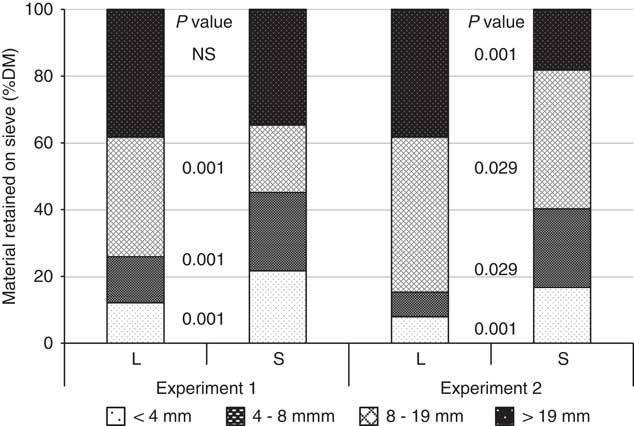
The average silage particle length was 12.6 and 9.4 mm in first cut silages (P<0.006), and 14.3 and 9 mm in second cut silages (P=0.001) for the long and short chop silages, respectively. For both experiments the long chop increased particles retained on the 8 mm sieve and reduced particles on the 4 mm sieve and the bottom pan relative to the short chop silages (P<0.01; Figure 1). The long chop length increased the proportion of particles on the 19 mm sieve for the lucerne silage used in experiment 2 (P<0.001), but not the lucerne silage used for experiment 1 (Figure 1).
The effect of short (S) or long (L) chop length of lucerne silage on the distribution of particles (dry matter corrected) across the sieves of a Penn State Particle Separator for first cut silage (experiment 1) and second cut lucerne silage (experiment 2). Values are the means of measurements taken in each period (n=4).

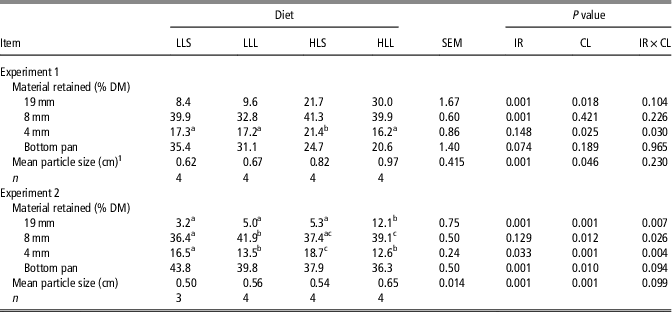
In both experiments, average particle size of the diets fed (Table 4) increased with both greater lucerne inclusion (P<0.001) and chop length (P<0.05, P<0.001 in experiments 1 and 2, respectively). In experiment 1, the proportion of particles retained on the 19 mm screen increased (P<0.02) with increased chop length. The proportion of particles retained on the 4 mm screen in experiment 1 was decreased (P<0.03) by increased chop length for the HL, but not the LL diet (inclusion rate by chop length interaction, P=0.03). In experiment 2, there were greater effects of chop length on particle distribution on the 19 and 4 mm screens for the HL than the LL diets (inclusion rate by chop length interaction, P<0.01) and a greater difference on the 8 mm screen for the LL than the HL diet (inclusion rate by chop length interaction, P<0.05).
The distribution of particle size (DM basis) in four total mixed rations containing a high (HL) or low (LL) concentration of lucerne silage at a long (L) or short (S) chop length in two separate experiments

IR=inclusion rate; CL=chop length; IR×CL=interaction between IR and CL; DM=dry matter.
a,b,cWhere there is a significant interaction, values within a row with different superscript letters differ significantly at P<0.05.
1 Mean particle size was determined using the recommended equation of Penn State University (Heinrichs, Reference Heinrichs2013).
Intake, milk yield and milk composition
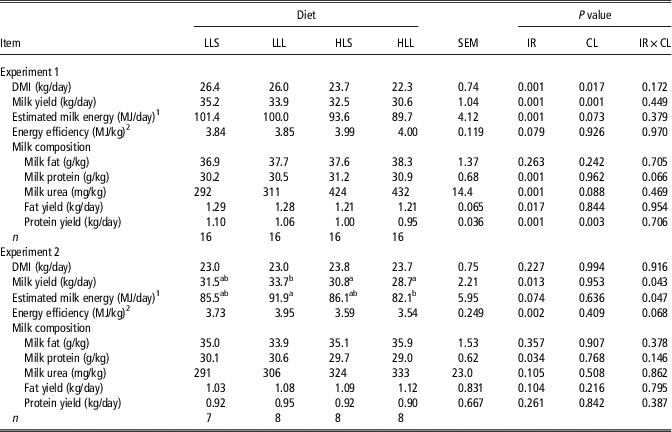
The effect of lucerne silage inclusion rate on DMI varied between experiments with a DMI reduction of 3.2 kg/day where HL diets were fed in experiment 1 (P<0.001), whereas there was no difference in DMI between treatments in experiment 2 (P>0.22). In both experiments feeding the HL diets decreased milk yield (−3.0 and −2.9 kg/day in experiments 1 and 2, respectively; P<0.02; Table 4). In experiment 1, a longer chop length decreased milk yield relative to using a shorter chop length by −1.6 kg/day (P<0.001), although this effect was not observed in experiment 2. As a result, the estimated conversion efficiency of feed DM into milk energy also differed between experiments, with HL diets tending to produce greater conversion efficiency in experiment 1 (P<0.08) and LL diets increasing feed efficiency in experiment 2 (P=0.001).
Milk fat concentration was not affected by treatment in either experiment (Table 5), however, in experiment 1, milk fat yield was greater (P<0.017) when LL diets were fed. In experiment 1, milk protein concentration was increased by 0.7 g/kg (P<0.001) when HL diets were fed, although, due to increased milk yield, milk protein yield was highest (P<0.001) when LL diets were fed. In experiment 2, feeding HL diets led to a decrease in milk protein concentration of 1.0 g/kg (P<0.04) although there were no differences in total protein yield between treatments. Milk protein yield in experiment 1 was reduced by chop length, where a 45 g/day reduction with longer chop length (P<0.003) was observed. Milk urea concentration was higher (P<0.001) when HL diets were fed in experiment 1.
Dry matter intake, milk yield, milk composition and feed conversion efficiency of lactating dairy cows fed a total mixed ration containing a high (HL) or low (LL) concentration of lucerne silage at a long (L) or short (S) chop length in two separate experiments

IR=inclusion rate; CL=chop length; IR×CL=interaction between IR and CL; DMI=dry matter intake.
a,bWhere there is a significant interaction, values within a row with different superscript letters differ significantly at P<0.05.
1 Estimated milk energy=milk yield (kg)×((fat concentration (g/kg)×0.0384+protein concentration (g/kg)×0.0223+lactose concentration (g/kg)×0.0199)−0.108).
2 Energy efficiency calculated as estimated milk energy in MJ/day divided by DMI in kg.
Apparent digestibility and nitrogen balance
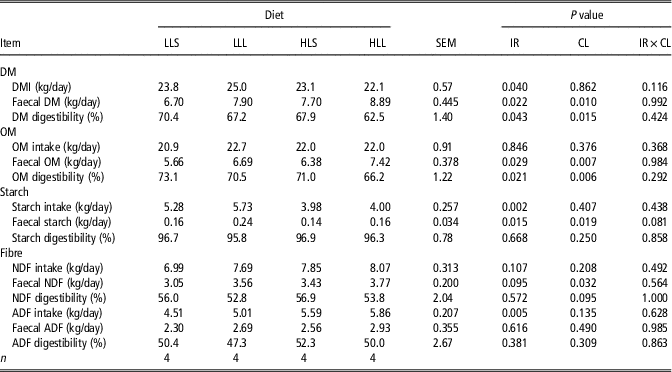
Increasing lucerne inclusion rate decreased DM and starch intake and increased ADF intake of cows used for measurements of digestibility and N balance (P<0.04, P<0.003 and P<0.006, respectively, Table 6). Digestibility of DM was lower for the HL diets by 3.6% relative to the LL diets (P<0.05). Increasing chop length also reduced DM digestibility by 4.3% (P<0.02). Greater inclusion rate of lucerne and longer chop length both decreased the digestibility of OM by 3.7% and 3.2% (P<0.03 and P<0.006, respectively). There were no differences in the digestibility of starch, NDF or ADF between HL and LL diets, although NDF digestibility tended (P<0.10) to be lower for longer lucerne chop length diets.
The apparent dry matter (DM), organic matter (OM), NDF, ADF and starch digestibility of four total mixed rations containing a high (HL) or low (LL) concentration of lucerne silage at a long (L) or short (S) chop length when fed to lactating dairy cows (in experiment 2)

IR=inclusion rate; CL=chop length; IR×CL=interaction between IR and CL; DMI=dry matter intake.
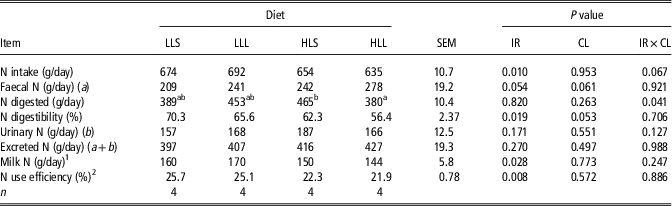
Intakes of N were greater for LL diets (P<0.01) as a result of higher DMI (Table 7). There was a tendency for increased faecal N concentration (P<0.06) when HL diets were fed. Faecal N also tended to increase when the chop length was increased (P<0.07). There was greater partitioning of intake N into the milk for the LL diets with an increase in N use efficiency of 3.3% (P<0.009) and N digestibility was also greater (P<0.02).
The apparent digestibility of N and N balance in lactating dairy cows fed total mixed rations containing a high (HL) or low (LL) concentration of lucerne silage at a long (L) or short (S) chop length (in experiment 2)

IR=inclusion rate; CL=chop length; IR×CL=interaction between IR and CL.
a,bWhere there is a significant interaction, values within a row with different superscript letters differ significantly at P<0.05.
1 Milk N=milk protein yield/6.25.
2 N use efficiency calculated as milk N divided by N intake.
Discussion
Forage quality and particle size
The nutritive value of the four lucerne silages used in the study was variable. Although CP levels were similar at 172 g/kg, the second cut (experiment 2) silages were lower in NDF and ADF than the first cut (experiment 1) silages, suggesting increased maturity in the first cut relative to the second cut forage. In the silage fed in experiment 1, high acetic acid and low lactic acid concentrations indicated poor fermentation, although pH reduction was adequate. High levels of WSC in the experiment 2 silage may indicate that increased time spent wilting this crop (48 v. 24 h for the first cut) resulting in a higher DM reduced fermentation activity, or that the original concentration of sugar in this crop was higher than for the first cut crop. These results collectively indicate increased silage quality in the second cut silage with higher DM concentration. The effective degradation of DM and protein in the lucerne silages ranged from 37.8% to 56.7% and 72.6% to 78.6%, respectively, which are similar to previously published figures (56% for EDMD and 72% EPD for mid-bloom fresh lucerne (Hoffman et al., Reference Hoffman, Sievert, Shaver, Welch and Combs1993)).
Variation between the long and short chop silages within each experiment was observed despite care being taken at harvest to control variables other than chop length. Notably, pH and acetic, propionic and butyric acids were reduced for both short cut silages relative to long cut silages while lactic acid was increased. This may be explained by increased silage density through better compaction achieved with the short chop which helps to create the necessary anaerobic environment in the silo. Short cut silage was also collected from the field after long chopped silage leading to a small increase in wilting time which may also have increased the concentration of sugars available for fermentation.
The differences in physical structure achieved by varying chop length of the silages were similar for both experiments. The theoretical difference between average particle size according to the settings of the forage harvester was 5 mm which was relatively close to the achieved differences of 3.6 and 5.3 mm for experiments 1 and 2, respectively. The differences in mean particle lengths achieved by varying chop length in this study are similar to those used in previous research (e.g. 5 mm, Beauchemin et al. (Reference Beauchemin, Farr, Rode and Schaalje1994); and 7 mm, Bhandari et al. (Reference Bhandari, Ominski, Wittenberg and Plaizier2007)). Although the difference in mean particle length is small, there were larger differences in the relative quantities of particle size fractions measured using a PSPS.
Intake, milk yield and nutrient digestibility
Effects of lucerne inclusion rate
The effects of a higher dietary inclusion rate of lucerne on DMI differed in the two experiments. In experiment 1, feeding the first cut silage at the higher inclusion rate decreased DMI, and milk yield. In contrast, feeding the second cut silage at the same rate to a smaller number of cows had no effect on DMI, but a reduction in milk yield was still observed. In a similar UK study where grass silage was replaced with lucerne silage in the diet a reduction in intake was also seen when 60% of forage DM was comprised of lucerne silage (Sinclair et al., Reference Sinclair, Edwards, Errington, Holdcroft and Wright2015). Rumen fill can be limiting factor on DMI depending on the extent to which the diet is comprised of forage (Beauchemin et al., Reference Beauchemin, Yang and Rode2003). In this case the second cut silages showed 11% greater total DM degradability (a+b) over 72 h than feeding the first cut silage would have resulted in a greater mass of forage DM within the rumen during this time. The differences in forage DM degradability might explain conflicting effects on DMI seen between experiments. Furthermore, the silage used in experiment 1 had a high concentration of acetic acid which has been linked with reduced intake in some studies where dietary concentrations were 25-50 g/kg DM (Daniel et al., Reference Daniel, Amaral, Neto, Cabezas-Garcia, Bispo, Zopollatto, Cardoso, Spoto, Santos and Nussio2013), and this may have also contributed to lower intakes on HL diets in this instance.
Feeding HL diets led to a reduction in the digestibility of DM, OM and N. This indicates that the lucerne silages used in this study were less digestible than the maize silage, reflecting greater ADF concentration. Decreases in milk yield observed for the HL diets in both experiments could be related to this reduction in DM and OM digestibility, and therefore ME, and also the lower starch concentration of the HL diets (Table 2). Furthermore, there would have been a greater imbalance between supply of metabolisable protein to ME in HL diets which would contribute to the reduction in milk yield observed. These findings align with previous studies which show that lucerne typically has a lower ME content than many other forage legumes or grasses (Steinshamn, Reference Steinshamn2010). Efficiency of N utilisation was also reduced when HL diets were fed, which is partly attributable to lower milk yield seen on HL diets. Also, since diets were not balanced for rumen degradable N supply in the present study, there was a surplus of rapidly degradable N for the HL diets which would have contributed to reduced N utilisation and high milk urea values. There was greater partitioning of N into faeces than urine in the present study, which may in part reflect low N digestibility, particularly on HL diets. In addition, the spot sampling method adopted in the present study may not have fully accounted for diurnal changes in urine concentration.
Effects of lucerne chop length
In experiment 1, DMI increased when a short chop silage was fed which was also observed with lucerne haylage (Kononoff and Heinrichs, Reference Kononoff and Heinrichs2003) but was contrary to the results of experiment 2 and a numerous previous studies in which reducing lucerne chop length did not affect DMI (Beauchemin et al., Reference Beauchemin, Farr, Rode and Schaalje1994 and Reference Beauchemin, Yang and Rode2003; Bhandari et al., Reference Bhandari, Ominski, Wittenberg and Plaizier2007). Increased DMI with shorter chop length might suggest increased speed of particle breakdown and/or rumen outflow and lower rumen fill allowing higher rates of intake relative to the longer chop length. Some studies found this to be the case where short and long chop lucerne lengths were compared (using mean particle lengths of 1 and 8 mm; Yansari et al., Reference Yansari, Valizadeh, Naserian, Christensen, Yu and Shahroodi2004) although others noted no change in passage rate even when an effect on DMI was observed (Kononoff and Heinrichs, Reference Kononoff and Heinrichs2003). The short chop length also increased DM digestibility, and the magnitude of the effect was greater than that of inclusion rate. This may be explained by smaller particles exhibiting a greater surface area for microbial attachment, although this is only one of many factors that govern the rate of cellulolysis in the rumen (Mason and Stuckey, Reference Mason and Stuckey2016). The increase in digestibility might also explain why the short chop mitigated some of the negative effect of the HL diet on milk yield (+1.6 kg/day milk produced on LL diets; Table 6).
Using shorter chop lengths with high lucerne silage diets shows potential as a strategy to partly mitigate reduced nutrient use efficiency when lucerne is included at higher rates in the diet. Further research into lucerne agronomy and variety development for delayed plant lignification to increase the acceptable harvest window is an approach which may improve prospects for feeding lucerne in the future.
Acknowledgements
Funding for the project was provided by AHDB Dairy as part of the Grasslands, Forage and Soil Partnership. The authors thank collaborators within the partnership, including staff of Harper Adams University (HAU) and the Scottish Rural College (SRUC), who offered invaluable advice in the planning of this study. The contributions of Colin Green, Paul Kirton, Rafal Szoka, Chris Fawdry, Deborah Cockman, and other technical staff at CEDAR are gratefully acknowledged.