1 Introduction
As international communication is getting frequent nowadays, bilinguals and multilinguals are often faced with making decisions in a foreign language. For example, during an international business negotiation, a Chinese negotiator will be using a foreign language (e.g., English) to work out and settle new deals. In recent years, it has been shown that people make decisions with fewer biases while in a foreign compared to a native language. Biases like the framing effect (Holleman, Kamoen, & Struiksma, Reference Holleman, Kamoen and Struiksma2021; Keysar, Hayakawa, & An, Reference Keysar, Hayakawa and An2012; Winskel, Ratitamkul, Brambley, Nagarachinda, & Tiencharoen, Reference Winskel, Ratitamkul, Brambley, Nagarachinda and Tiencharoen2016), the hot hand fallacy (Gao, Zika, Rogers, & Thierry, Reference Gao, Zika, Rogers and Thierry2015), the causality bias (Díaz-Lago & Matute, Reference Díaz-Lago and Matute2019), and the risk aversion (Costa, Foucart, Arnon, Aparici, & Apesteguia, Reference Costa, Foucart, Arnon, Aparici and Apesteguia2014) were reduced in a foreign language. This phenomenon is known as the foreign language effect (for reviews, see Hadjichristidis, Geipel, & Keysar, Reference Hadjichristidis, Geipel and Keysar2019; Hayakawa, Costa, Foucart, & Keysar, Reference Hayakawa, Costa, Foucart and Keysar2016). The present study investigates the foreign language effect within an altruistic decision-making process. Participants chose whether or not to protect another person from pain at their own (economic) cost/sacrifice. This means the decision focuses on decisions that affect others (as studied in the previous literature) at a cost to oneself. Furthermore, event-related potentials (ERPs) were explored to identify the underlying cognitive mechanisms that modulate the foreign language effect.
To the best of our knowledge, the majority of existing studies regarding foreign language effects have overwhelmingly focused on risky decision making (Gao et al., Reference Gao, Zika, Rogers and Thierry2015; Hadjichristidis, Geipel, & Savadori, Reference Hadjichristidis, Geipel and Savadori2015; He, Margoni, Wu, & Liu, Reference He, Margoni, Wu and Liu2021; Keysar et al., Reference Keysar, Hayakawa and An2012; Liu, Margoni, He, & Liu, Reference Liu, Margoni, He and Liu2021b) and moral decision making (Brouwer, Reference Brouwer2019; Cipolletti, McFarlane, & Weissglass, Reference Cipolletti, McFarlane and Weissglass2016; Costa et al., Reference Costa, Foucart, Arnon, Aparici and Apesteguia2014, Reference Costa, Corey, Hayakawa, Aparici, Vives and Keysar2019; Geipel, Hadjichristidis, & Surian, Reference Geipel, Hadjichristidis and Surian2015; see Circi, Gatti, Russo, & Vecchi, Reference Circi, Gatti, Russo and Vecchi2021 for a meta-analysis study), where people are committed to considering the consequence of their decisions to themselves only or to others only. However, to the best of our knowledge, no studies investigated the foreign language effect within social decisions, where deciders need to weigh both their own and others' interests within one situation. Therefore, in the present study, we investigate whether and how the context of a foreign language influences people's social decisions to engage in altruistic behavior at a financial cost to themselves (i.e., altruistic decision making).
Altruistic decision making is suggested to be modulated by contextual factors, such as how a decision is framed. In one recent study, participants had to choose whether or not to protect another person from pain at their own (economic) cost in two different frames (harm frame vs. help frame). In the help frame context, the altruistic behavior was described as “Help the other person to avoid a painful electric shock and subtract 5 Yuan from your own payment”. In the harm frame context, the altruistic behavior was described as “Not harm the other person by subtracting 5 Yuan from your own payment”. It is noteworthy that the statements of the altruistic decision problem in the two framing contexts were different in emotional valence but logically equivalent. The results indicated that participants made more altruistic decisions in the harm frame context than the help frame context (i.e., social framing effect) since avoiding harming others is a more robust moral norm than helping others (Liu, Gu, Liao, Lu, Fang, Xu, Luo & Cui, Reference Liu, Gu, Liao, Lu, Fang, Xu, Luo and Cui2020). Further studies indicated that social context also exerted an influence on altruistic decision making. For example, participants were more likely to help a “fair” partner as compared to an “unfair” partner at a cost to themselves (Gu, Liu, & Cui, Reference Gu, Liu and Cui2019). Thus, the above findings highlighted the role of contextual factors in altruistic decision making.
While influences of several contextual factors on altruistic decision making have been well documented in the literature (Gu et al., Reference Gu, Liu and Cui2019; Liu et al., Reference Liu, Gu, Liao, Lu, Fang, Xu, Luo and Cui2020), the effects of (native vs. foreign) language context on altruistic decision making remain unexplored. We predict that language context will modulate altruistic decision biases since emotional processing in a foreign language usually evokes milder emotional arousal than in a native tongue (Harris, Reference Harris2004; Iacozza, Costa, & Duñabeitia, Reference Iacozza, Costa and Duñabeitia2017; Pavlenko, Reference Pavlenko2012; Sulpizio et al., Reference Sulpizio, Toti, Del Maschio, Costa, Fedeli, Job and Abutalebi2019). The emotion-reducing hypothesis proposed that a foreign language provides greater emotional distance. In turn, this could further lead to more deliberate and rational decisions with fewer decision biases (Geipel et al., Reference Geipel, Hadjichristidis and Surian2015; Keysar et al., Reference Keysar, Hayakawa and An2012). Because altruistic decisions suggest a fundamental role for emotion (Hu et al., Reference Hu, Li, Yin, Blue, Yu and Zhou2017; Tusche & Bas, Reference Tusche and Bas2021; Xiong et al., Reference Xiong, Gao, He, Yu, Liu and Zhou2020), we predict language context will also modulate these decisions. While a crucial role for emotion is set out for the foreign language effect, the exact mechanisms underlying emotion processing are not well understood yet.
ERPs can capture the temporal dynamic of the foreign language effect during altruistic decision making. ERPs can differentiate between early automatic and later deliberate emotion, which relates to the differential involvement of attentional, affective, and cognitive systems during altruistic moral decision making (Zhan et al., Reference Zhan, Xiao, Li, Liu, Chen, Fan and Zhong2018). We focused on N1, N2, and late positive potential (LPP) components in the present study because event-related potentials (ERPs) in previous studies on the foreign language effects concentrated on these components (Wu, Liu, Yao, Li, & Peng, Reference Wu, Liu, Yao, Li and Peng2020). The early ERP components (N1 and N2) have been associated with automatic affective processes. While the N1 modulates by the valence of a stimulus or action (Olofsson, Nordin, Sequeira, & Polich, Reference Olofsson, Nordin, Sequeira and Polich2008; Yoder & Decety, Reference Yoder and Decety2014), N2 reflects the affective evaluation of moral behaviors to others (Yoder & Decety, Reference Yoder and Decety2014). The late ERP components (e.g., LPP) have been associated with more deliberate cognitive elaboration and evaluation of moral actions (Wu et al., Reference Wu, Liu, Yao, Li and Peng2020; Yoder & Decety, Reference Yoder and Decety2014). The emotion-reducing hypothesis proposes that the foreign language effect is associated with decreased emotional reactivity (Hayakawa et al., Reference Hayakawa, Costa, Foucart and Keysar2016; Zheng, Mobbs, & Yu, Reference Zheng, Mobbs and Yu2020). Therefore, we hypothesized that the framing effect observed in the N1/N2 components during a native language context would be reduced or absent when bilingual participants function in their foreign language. By contrast, the LPP response for the framing effect would be comparable across two language contexts.
Using electroencephalography (EEG) during an altruistic decision paradigm, the present study explored the behavioral and neural responses associated with the foreign language effect during altruistic decision making. Notably, we mainly focused on whether functioning in a foreign language reduces the framing effect's decision making bias. Unbalanced Chinese–English bilinguals were recruited to complete an altruistic decision making task adapted from Liu et al., (Reference Liu, Gu, Liao, Lu, Fang, Xu, Luo and Cui2020). Participants made a trade-off between economic benefits and the feelings of others formulated in two different frames (harm vs. help). These decisions were made separately in the native language (i.e., Chinese) and the foreign language (i.e., English). If foreign language reduces or eliminates decision making biases, the framing effect would be present in the native language but reduced or absent in the foreign language context. In other words, in the native Chinese context, but not the English foreign context, participants would make more altruistic decisions at a cost to themselves in the harm frame compared with the help frame condition. Furthermore, recent studies suggested that language background factors might be an essential modulator of the foreign language effect during moral or risky decision making (Čavar & Tytus, Reference Čavar and Tytus2018; Dylman & Champoux-Larsson, Reference Dylman and Champoux-Larsson2020; Miozzo et al., Reference Miozzo, Navarrete, Ongis, Mello, Girotto and Peressotti2020). Therefore, we investigated whether individual differences in language background factors also modulated the foreign language effect during the altruistic decision process. Specifically, we focused on the impact of second language (L2) proficiency and age of acquisition (AOA) on the size of the framing effect (i.e., behavioral and neurophysiological effect).
2 Methods
2.1 Participants
Thirty right-handed adult participants were recruited from Qingdao University to participate in the experiment through advertising. Three participants were excluded because of excessive EEG artifacts, leaving twenty-seven participants included for statistical analysis (10 males, mean age: 20.59 ± 1.62 years). All participants had normal- or corrected-to-normal vision, and none reported neurological or psychiatric diseases. The local ethics committee approved this study. All participants signed a written informed consent before participating in the study and received payment for their participation.
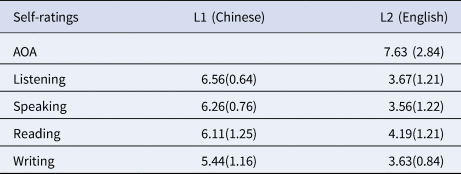
All participants were born in China and had no experience of studying abroad. Chinese is the native language (L1) of participants, who started to learn English (L2) at the average age of 7.63 (SD = 2.84) years. During the experiment, all participants had passed the CET4 (i.e., an English test for college students in China). They rated their proficiency in both languages for listening, speaking, reading, and writing on a scale of 1–7 (1 = very poor, 7 = excellent) (Liu, Li, Jiao, & Wang, Reference Liu, Li, Jiao and Wang2021a). Paired-samples t-tests indicated that the proficiency ratings for all four language skills were significantly higher in their L1 than in their L2 (all ts > 7.706, all ps < 0.001, see Table 1).
Means (and SDs) for language proficiency ratings and age of acquisition (AOA) for both Chinese and English.

2.2 Design and procedure
The paradigm used in the present study was adapted from the task used by Liu et al. (Reference Liu, Gu, Liao, Lu, Fang, Xu, Luo and Cui2020). This task presents a dilemma between the physical pain of other people and the subjective cost to oneself. All participants were required to submit a photo of their identification when registering for the experiment. They were told that when they were assigned to the role of “victim”, the photo would be used in the experimental program. In fact, no participant would be given the role of “victim,”, but always the role of “decider”. The photo was only used to know the gender of the participant and to match it to a confederate (i.e., the “victim”) of the same gender. After arriving in the laboratory, each participant was introduced to another “participant” (i.e., the confederate that will play the “victim”). The participants were then brought to the experiment location. They were told that the “victim” would be in another room and participate via the internet.
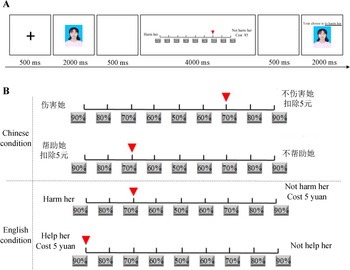
The experiment used a 2 (Frame: harm vs. help) × 2 (Language: Chinese vs. English) within-subjects design. Each trial began with a fixation cross presented for 500 ms, followed by a photograph of the “victim” presented for 2000 ms. After a blank interval of 500 ms, a scale with text descriptions on both sides indicates two possible outcomes. In the “harm frame,” one outcome is “Harm the victim by applying an electric shock and keep your money,” while the other outcome is “Not to harm the victim and deduct 5 yuan from your payment”. In the “help frame,” one outcome is “Help the victim to avoid receiving an electric shock and deduct 5 yuan from your payment”, while the other outcome is “Not to help the victim to avoid receiving an electric shock and keep your money”. It is worth noting that the participant (i.e., “decider”) faced essentially the same choice in both frames – namely, to spend their own money to protect the other person (i.e., “victim”) from electric shock. The only difference between the two frames is how the outcomes were framed. It was framed in terms of (not) harming or (not) helping the “victim”. The two frames were present in both Chinese and English.
The participants were informed that they could influence the probabilities of the two outcomes by clicking the button on a scale. They indicated to what degree (%) they preferred one of two potential outcomes by clicking on one of the percentages on the scale (see Figure 1. B.). The participants had to respond within 4000 ms, after which the trial would disappear. The probability of the outcome, whether to help/harm or not to help/harm, was in line with the indicated chance of an outcome in percentages. For example, if the participant clicked the 90% button on the left side, indicating they preferred to help the “victim”, there was a 90% probability the “victim” would be helped and a 10% probability that the “victim” would not be helped. The scale's initial position (i.e., marked by a red triangle) was randomized across trials.
Experimental paradigm. (A) The procedure of a trial and (B) examples of the four experimental conditions in a 2 (Language: Chinese vs. English) × 2 (Frame: harm vs. help) design.

Following the participant's response, a 500 ms blank screen appeared, followed by the presentation of the outcome for 2000 ms. Participants were informed that the outcome would only be executed on ten random trials (e.g., the “victim” receives an electric shock). They were not informed on which trials the outcome was executed to make sure they would treat each trial equally. Participants were informed that their actual remuneration would be related to their decisions. The actual remuneration would be disclosed at the end of the experiment. Further, participants were asked to experience a real electric shock before the start experiment to make them believe in our experimental manipulation. The electric shock is painful but mild, causing no harm to the human body. Participants had the right to refuse to experience the electric shock; however, nobody refused the electric shock in our study.
The experiment consisted of two parts with the same design, one in Chinese and one in English. There were 160 trials in each language condition (Chinese/English), with 80 trials for each frame (i.e., harm/help). The order of the language conditions was counterbalanced across participants, and the frames were presented randomly from trial to trial in each language condition. There were eight practice trials to help participants understand the experimental task before starting.
2.3 Electrophysiological recording and preprocessing
The EEG data were recorded at 1000 Hz with 64 Ag/AgCl electrodes (Brain Products, actiCAP system) placed according to the international 10–20 positioning system. Impedances were maintained below five kΩ. Data were referenced online to the TP9 electrode and filtered online with a band-pass between 0.05–100 Hz.
EEG data preprocessing was performed offline using EEGLAB in MATLAB software (Delorme & Makeig, Reference Delorme and Makeig2004). Offline, the data were re-referenced to the average of all electrodes and filtered with a band-pass between 1–40 Hz. Ocular artifact reduction was performed through Independent Component Analysis (ICA) component rejection. The continuous recording was segmented time-locked to the onset of the choice screen (i.e., the presentation of the scale for a max of 4000 ms). The time window for the segments was from −200 to 1000 ms. All segments were averaged per experimental condition and baseline corrected from −200 to 0 for each participant.
2.4 Behavioral data analysis
In both harm and help frames, participants faced the same dilemma (i.e., protecting others from pain at a cost to oneself) but with different descriptions. The framing effect was calculated as the tendency to help between the “harm” and “not help” frame types. Specifically, in the harm frame, the weight value was defined as 9 when the participant chose 90% near the option “not harm him/her + cost 5 yuan” and decreased progressively to the other end of the scale, “harm him/her”, with a weight of 1. Similarly, in the help frame, the weight value was defined as 9 when the participant chose 90% near the option “help him/her + cost 5 yuan” and decreased to 1 when the participant chose 90% near the option “not help him/her”. The framing effect expects more altruistic behavior when framed within the “harm” than the “not help” context.
The weight values were compared using repeated-measures analysis of variance (ANOVA) with Frame (harm vs. help) and Language (Chinese vs. English) as within-subject factors. For a potential interaction effect, follow-up pairwise analyses will be performed.
2.5 ERP data analysis
For each participant, the single-trial ERP waveforms were averaged separately for each Frame (harm vs. help) per Language (Chinese vs. English), which yielded four single-subject average waveforms that were time-locked to the onset of the choice screen (i.e., the presentation of the scale for a max of 4000 ms). Afterward, these single-subject average ERP waveforms were submitted to repeated-measures ANOVAs. Three ERP components of interest (i.e., N1, N2, and LPP) were defined after visual inspection of the grand-averaged waveforms of the current data and based on previous studies (e.g., Wu et al., Reference Wu, Liu, Yao, Li and Peng2020; Yoder & Decety, Reference Yoder and Decety2014). The ERP components were identified at different time windows throughout the same scalp region. Specifically, the N1, N2, and LPP were identified over fronto-central electrodes (F1, Fz, F2, FC1, FCz, and FC2) with respective time windows of 70–150 ms, 200–400 ms, and 500–800 ms.
2.6 Correlation analysis
To further investigate whether the individual differences in language background factors modulate the foreign language effect during altruistic decisions, correlation analyses were conducted between language backgrounds factors (i.e., L2 proficiency and L2 AOA) and the framing effect (behavioral and neurological).
3 Results
3.1 Behavior results
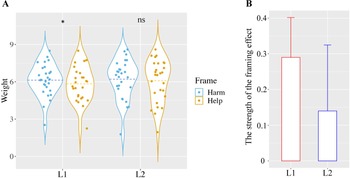
The 2 (Chinese vs. English) by 2 (harm vs. help) repeated-measures ANOVA revealed no main effects of Language (F (1, 26) = 1.019, p = 0.322, η2p = 0.038) or Frame (F (1, 26) = 2.345, p = 0.138, η2p = 0.083). Neither did the interaction between Language and Frame reach significance (F (1, 26) = 1.297, p = 0.265, η2p = 0.048). It was surprising that the framing effect was not significant as it has been reported in previous studies (e.g., Liu et al., Reference Liu, Gu, Liao, Lu, Fang, Xu, Luo and Cui2020). We had predicted the framing effect to be significant in the first but not the second language. Albeit there was an absence of an interaction, we conducted a Post Hoc analysis to describe the patterns of the framing effect in each language. As predicted, the results showed that, in the Chinese context, the weight value was larger in the harm frame than the help frame (6.13 ± 1.31 vs. 5.85 ± 1.41; p = 0.017), indicating a significant framing effect. By contrast, in the English context, the weight value in the harm frame was similar to that in the help frame (6.21 ± 1.58 vs. 6.07 ± 1.71; p = 0.469) (see Figure 2).
Behavioral results. (A) The proportion of altruistic helping choices for each Frame (harm vs. help) in each Language (Chinese vs. English) context. (B) The strength of the framing effect (i.e., harm - help) in Chinese and English contexts.

3.2 ERP results
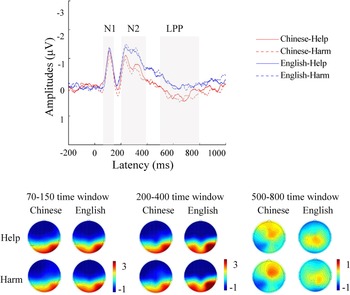
Figure 3 presented the grand average ERP waveforms elicited by help and harm frames in the Chinese and English contexts. For the N1 amplitude, the ANOVA revealed a significant main effect of Language (F (1, 26) = 4.780, p = 0.038, η2p = 0.155), with more negative N1 amplitudes in the English context (−1.09 μV; SE: 0.12) as compared to the Chinese context (−0.90 μV; SE: 0.15). The main effect of Frame was not significant (F (1, 26) = 2.937, p = 0.098, η2p = 0.101). Most importantly, we found a marginally significant interaction between Language and Frame (F (1, 26) = 4.140, p = 0.052, η2p = 0.137). Post hoc analysis revealed that the framing effect (i.e., difference between harm and help frame) modulated the N1 in Chinese (−1.03 μV ± 0.13 vs. −0.78 μV ± 0.12; F (1, 26) = 8.19, p = 0.008, η2p = 0.238), but not in English (−1.06 μV ± 0.13 vs. −1.12 μV ± 0.18; F (1, 26) = 0.31, p = 0.583, η2p = 0.011).
Averaged stimulus-locked (i.e., to the onset of the choice screen) ERP waveforms elicited by help (solid lines) and harm (dashed lines) frames in both the Chinese (red lines) and the English (blue lines) contexts. The N1, N2, and LPP have a fronto-central distribution (pooled over F1, Fz, F2, FC1, FCz, and FC2). The topographical maps for each frame condition are presented below the ERPs for each ERP component in each language.

Concerning the N2 amplitude, the ANOVA showed a significant main effect of Language (F (1, 26) = 20.576, p < 0.001, η2p = 0.442), where a more negative N2 amplitude was observed in the English context (−1.43 μV; SE: 0.19) as compared to the Chinese context (−0.79 μV; SE: 0.16). The main effect of Frame was not significant (F (1, 26) = 0.597, p = 0.447, η2p = 0.022). However, the interaction effect between Language and Frame reached significance (F (1, 26) = 8.247, p = 0.008, η2p = 0.241). As in the N1 analysis, Post hoc analysis indicated a framing effect in the Chinese context (−0.89 μV ± 0.17 vs. −0.69 μV ± 0.16; F (1, 26) = 4.68, p = 0.040, η2p = 0.154), but not in the English context (−1.38 μV ± 0.18 vs. −1.48 μV ± 0.20; F (1, 26) = 2.26, p = 0.145, η2p = 0.077).
For the LPP amplitudes, the ANOVA revealed a significant main effect of Language (F (1, 26) = 14.466, p = 0.001, η2p = 0.357), with more positive amplitudes in the Chinese context (0.35 μV; SE: 0.10) as compared to that in the English context (−0.12 μV; SE: 0.10). However, there was no main effect of Frame (F (1, 26) = 2.552, p = 0.122, η2p = 0.089) nor an interaction between Language and Frame (F (1, 26) = 0.348, p = 0.560, η2p = 0.013).
3.3 Correlation results
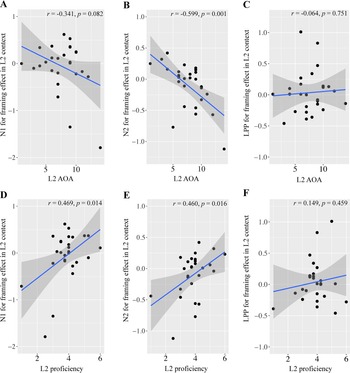
We measured the relation between an individuals' language experience and the foreign language effect with Pearson correlations. Language backgrounds factors included L2 proficiency and L2 AOA. The strength of the framing effect was measured behaviorally and neurophysiologically (i.e., N1, N2, & LPP). We only looked at correlations in the L2 (English) context as framing effect modulations were only present in this context. We failed to find any significant correlations between the language backgrounds factors (L2 AOA: r = −0.063, p = 0.754; L2 proficiency: r = −0.254, p = 0.200) and the behavioral strength of framing effect. However, L2 AOA correlated negatively with the framing effect in the N1 (r = −0.341, p = 0.082, FDR-corrected p = 0.164) and N2 (r = −0.599, p = 0.001, FDR-corrected p = 0.004) components. Note that the N1 component became non-significant after FDR correction. It is important to note that, in the L2 context, the amplitude is relatively more negative for the harm frame than the help frame in the negative components. Therefore, a negative correlation indicates that the lower the L2 AOA, the smaller the framing effect on N1/N2 responses (see Figure 4A & 4B). Furthermore, L2 proficiency correlated positively with the framing effect in the N1 (r = 0.469, p = 0.014, FDR-corrected p = 0.032) and N2 (r = 0.460, p = 0.016, FDR-corrected p = 0.032), with higher L2 proficiency being related to a smaller framing effect in the N1/N2 components (see Figure 4D & 4E). These correlations were not present between the L2 AOA and LPP framing effect (r = −0.064, p = 0.751), nor did the correlation between the L2 proficiency and LPP framing effect (r = 0.149, p = 0.459) reach significance (see Figure 4C & 4F).
Correlations between the language backgrounds factors (i.e., L2 AOA and L2 proficiency) and ERP components (N1, N2, and LPP) for framing effect (harm - help) in the English context. It is noteworthy that N1 and N2 amplitudes are relatively more negative for the harm frame than the help frame in the L2 context. Therefore, the smaller N1 or N2 amplitude difference for the framing effect, the greater the actual framing effect. Thus, the negative correlation between L2 AOA and N1/N2 responses for the framing effect suggested that the earlier the L2 AOA, the smaller the framing effect (see A & B). The positive correlation between L2 proficiency and N1/N2 responses for the framing effect suggested that the higher the L2 proficiency, the smaller the framing effect (see D & E).

4 Discussion
The present study investigated whether the foreign language effect modulates altruistic decision making during which people decide whether or not to protect another person from pain at their own cost. We introduced an altruistic decision making task, where Chinese–English bilinguals could influence the probability of helping or not harming others at a financial cost to oneself within two frames (help frame vs. harm frame). We investigated if the framing effect (i.e., more altruistic behavior during harm than help framing) was influenced by the language in which the choice was presented (native vs. foreign). The behavioral data suggest there might be a framing effect in the native language context, where participants more often protected other people from pain in the harm frame than the help frame. However, this framing effect was absent in the foreign language context. Crucially, the electrophysiological data revealed that ERP responses in the early ERP components (i.e., N1 & N2) differed significantly between the harm and help frames in the native language context but not in the foreign language context. Moreover, the L2 context revealed correlations between language backgrounds factors (i.e., L2 proficiency and L2 AOA) and framing effect (i.e., on the N1/N2 components). These findings demonstrated that the foreign language effect in altruistic decision making originates during emotional processing and that language background factors modulated the strength of the foreign language effect.
Functioning in a foreign language has been shown to reduce (Costa et al., Reference Costa, Foucart, Arnon, Aparici and Apesteguia2014) or even eliminate (Keysar et al., Reference Keysar, Hayakawa and An2012; Experiment 1 in Winskel et al., Reference Winskel, Ratitamkul, Brambley, Nagarachinda and Tiencharoen2016) decision making biases (e.g., framing effect). While previous studies mainly focused on the foreign language effect during risky and moral decision making (Brouwer, Reference Brouwer2019; Costa et al., Reference Costa, Foucart, Arnon, Aparici and Apesteguia2014; Gao et al., Reference Gao, Zika, Rogers and Thierry2015; Keysar et al., Reference Keysar, Hayakawa and An2012; Winskel et al., Reference Winskel, Ratitamkul, Brambley, Nagarachinda and Tiencharoen2016), the present study investigated the foreign language effect within the altruistic decision making process. The present study describes similar results during altruistic decisions as found in the literature for other decision types. There may be a framing effect in the native language but not in a foreign language context. This extends our understanding of language-cognition interactions: the foreign language effect emerged not only during non-social decision making but also during social (i.e., altruistic) decision making. However, what is the origin of the difference in making altruistic decisions in a native or foreign language? We look at the more fine-grained timeline ERP components provide to investigate the origin.
The present study revealed that the early automatic ERP components (N1 and N2) revealed a framing effect in the native but not foreign language. The framing effect in the native language showed smaller negative amplitudes for the harm than the help frame. The harm frame has a clearer moral norm instigating altruistic behavior (i.e., protecting others from harm) than the help frame. This could be because the harm frame can be considered a less acceptable social situation. Previous research in the native language indeed revealed less negative amplitudes for videos of antisocial than prosocial actions (Yoder & Decety, Reference Yoder and Decety2014). Unpleasant pictures also diminished the N1 component compared to pleasant pictures (Keil, Bradley, Hauk, Rockstroh, Elbert & Lang, Reference Keil, Bradley, Hauk, Rockstroh, Elbert and Lang2002). N1 has been associated with automatic emotional valence processing, but not the degree of arousal a stimulus evokes (Decety, Yang & Cheng, Reference Decety, Yang and Cheng2010; Peng, Meng, Lou, Li, Lei & Yan, Reference Peng, Meng, Lou, Li, Lei and Yan2019; Wu et al., Reference Wu, Liu, Yao, Li and Peng2020).
N2 also reflects valence processing and may indicate the anticipation of favorable/adverse outcomes (Hajcak, Moser, Holroyd, & Simons, Reference Hajcak, Moser, Holroyd and Simons2006; Yoder & Decety, Reference Yoder and Decety2014). For example, observing pain in others enhanced N2 amplitudes (Peng et al., 2019). Therefore, we suggest that altruistic (help) situations are processed as more pleasant and rewarding than antisocial situations. Furthermore, this rapid valence distinction between good (help) and bad (harm) social interactions could be made in the native but not the foreign language (i.e., the foreign language effect). Thus, the absence of the foreign language effect on the emotional N1 and N2 responses suggests reduced emotional resonance and decision making bias in the foreign language context. We would like to note that the experimental instructions used in the two frames involved different emotional resonance. The term “harm her” is emotionally stronger than “not help her”. Because the literature on the foreign language effect consistently shows that functioning in a foreign language reduces the emotional resonance of bilinguals, it is not surprising that the framing effect was found only in the native language context. Future studies should use frames with comparable emotional resonance to examine how language affects framing effects on altruistic decision making. It also should be noted that the foreign language (i.e., English) elicited more negative N1 and N2 than the native language (i.e., Chinese). This finding may arise from the fact that processing the foreign-language compared to the native language requires a greater cognitive load (He et al., Reference He, Margoni, Wu and Liu2021; Liu et al., Reference Liu, Margoni, He and Liu2021b).
The later LPP component did not reveal a framing effect in either the native or the foreign language context. LPP has been associated with top-down processes such as cognitive appraisals and evaluation of emotion-laden situations with more positive amplitudes throughout the fronto-central region for positive than negative situations (Yoder & Decety, Reference Yoder and Decety2014). The present study's absence of the framing effect (i.e., harm vs. help situations) during the LPP time window could be because sentences were presented instead of videos. Sentences can be processed quicker than videos. Therefore, the need for cognitive appraisal and evaluation of the outcomes could be reduced during this later time window. Interestingly, we did observe a main effect of Language with more positive amplitudes in the native than the foreign language context in the LPP. This finding could be related to gambling in which rewards enhance later positivity (Hajcak et al., Reference Hajcak, Moser, Holroyd and Simons2006), suggesting that positive outcomes are more personally meaningful (Yoder & Decety, Reference Yoder and Decety2014). In other words, the situations presented during the native context can be considered more personally significant. Overall, our electrophysiological results suggested that the foreign language effect on altruistic decision making might be a consequence of reduced valence and arousal levels of emotions in the foreign language context.
Individuals' language experiences modulated the strength of the foreign language effect in altruistic decision making. Within the L2 context, language backgrounds factors (i.e., L2 proficiency and L2 AOA) correlated with the framing effect in early ERP components (i.e., N1 and N2) but not in the late ERP component (i.e., LPP). This is in line with the main impact of language context on the early components only. The correlations suggest that foreign language factors impact early valence processes but not later cognitive processes. This is the first empirical study indicating the important role of language background factors in moderating the foreign language effect to the best of our knowledge. To sum up, these findings highlighted that language background and emotional involvement in the task contribute to the occurrence of the foreign language effect. This provides an opportunity for future research to examine the relative contributions of these various mechanisms to understand the foreign language effect more fully during decision making.
Our findings supported the emotion-reducing hypothesis, which proposes that the mechanism behind the foreign language effect is the reduction in emotional arousal when using a foreign language (Costa et al., Reference Costa, Foucart, Arnon, Aparici and Apesteguia2014; Geipel et al., Reference Geipel, Hadjichristidis and Surian2015; Keysar et al., Reference Keysar, Hayakawa and An2012). However, the evidence supporting this hypothesis was mainly limited to studies regarding moral or risky decision making so far (Circi et al., Reference Circi, Gatti, Russo and Vecchi2021; Costa et al., Reference Costa, Foucart, Arnon, Aparici and Apesteguia2014; Gao et al., Reference Gao, Zika, Rogers and Thierry2015; Keysar et al., Reference Keysar, Hayakawa and An2012). The present study indicates that the mechanisms driving the foreign language effect on altruistic decision making are rooted in reducing emotional reactions. More specifically, as emotional arousal was reduced in the foreign language context as compared to the native language, participants made more deliberate and rational decisions with fewer decision biases. Thus, the observed framing effect in the native language was absent in the foreign language context. Moreover, our findings demonstrated that individual differences in language background might be another critical mechanism modulating the foreign language effect. To fully understand the mechanism of the foreign language effect, future studies should determine the interplay between language background factors and the foreign language effect.
In conclusion, the current study's findings revealed a foreign language effect on altruistic decision making, as evidenced by the alteration of the framing effect in the foreign language context compared with the native language context during early ERP time windows. The foreign language effect most likely results from a reduced arousal level of emotion. Emotion is less engaged during altruistic decisions when bilinguals function in the foreign language compared to the native language, thereby reducing the decision making bias (i.e., framing effect). Moreover, individual differences in language background factors modulate the underlying effect of foreign language on altruistic decision making. Overall, our findings contribute to understanding the foreign language effect by illustrating how foreign-language impacts neural responses to the framing effect in altruistic decision making.
Acknowledgments
The study is supported by the National Natural Science Foundation of China (62107024) and Natural Science Foundation of Shandong Province (ZR2021QF012). Kalinka Timmer was supported the Ulam grant from Narodowa Agencja Wymiany Akademickiej (NAWA) in Poland (PPN/ULM/2019/1/00215). The authors reported no potential conflict of interest.