Introduction
While suicide rates among the elderly have either declined or remained unchanged over recent decades, in most countries older adults are still at higher risk of suicide than younger adults and this is particularly the case in developing countries (De Leo et al., Reference De Leo, Padoani and Lonnqvist2002; Shah et al., Reference Shah, Bhat, Mackenzie and Koen2008). The reported prevalence and associated risk factors for suicidal behaviors vary due to differing populations, age groups, measures, and settings. The prevalence of suicidal ideation among the elderly varies from 1% in primary care to 26% among geriatric inpatients (Callaghan et al., Reference Callaghan, Hendrie, Nienaber and Tierney1996; Shah et al., Reference Shah, Hoxey and Mayadunne2000). Higher rates of suicidal ideation have been reported in hospitalized, acutely medically ill older patients, with one study finding that 36% expressed suicidal ideation and 22% the wish to die (Shah et al., Reference Shah, Hoxey and Mayadunne2000).
Prospective and case-control studies indicate multi-domain correlates for suicidal ideation and behavior. Subsyndromal depressive symptoms or clinical depression have been implicated in almost all studies examining the risk and associates of suicidal behavior in older people (Shah et al., Reference Shah, Hoxey and Mayadunne2000; Conwell et al., Reference Conwell, Duberstein and Caine2002; Yip et al., Reference Yip, Chi, Chiu, Wai and Conwell2003; Awata et al., Reference Awata2005; Yen et al., Reference Yen2005; Cheung et al., Reference Cheung, Law, Chan, Liu and Yip2006; Chen et al., Reference Chen2008; Liu and Chiu, Reference Liu and Chiu2009). Aside from depression, there are numerous other risk factors ranging from vulnerability due to adverse childhood experiences through to diverse biopsychosocial late-life factors, including social isolation and poor social support, financial problems, relationship difficulties, physical health and disability issues, previous suicidal behavior, and other mental health and substance abuse problems. While physical illness has been implicated as a risk factor for suicidal behavior in older people, there are inconsistent findings and other risk factors such as depression might be more important in the physically ill person (Conwell et al., Reference Conwell, Duberstein and Caine2002; Draper, Reference Draper, Brodaty, Low and Richards2010). Some studies have found no relationship between serious physical illness and suicidal behavior, although there have been reports of specific illnesses such as prostate cancer and chronic pulmonary disorders conferring increased suicide risk (Quan et al., Reference Quan, Arboleda-Florez, Fick, Stuart and Love2002). Other studies, however, have found the main link with physical illness burden (Kishi et al., Reference Kishi, Robinson and Kosier1996; Juurlink et al., Reference Juurlink, Herrmann, Szalai, Kopp and Redelmeier2004). Chronic disability with difficulties in coping with pain and discomfort may predispose vulnerable individuals to demoralization, hopelessness, depression, and overt suicidal behavior. In long-term residential aged care settings, where there is limited access to suicide methods, this can also be associated with indirect self-destructive behavior (Conwell et al., Reference Conwell, Pearson and DeRenzo1996). Indirect self-destructive behavior, which includes refusal to eat, drink, take medication, or generally cooperate with others, has long been seen as a form of suicidal behavior in some older individuals in long-term residential care although the behavior is also associated with severe cognitive impairment (Draper et al., Reference Draper, Abou-Saleh, Katona and Kumar2002). These behaviors are prevalent in long-term residential care, occurring in 61% of residents at least weekly, with passive self-harm predicting mortality (Draper et al., Reference Draper, Brodaty, Low, Richards, Paton and Lie2002; Reference Draper, Brodaty, Low and Richards2003). However, the prevalence of indirect self-destructive behavior in older patients in acute hospital settings is unknown.
Given that deliberate self-harm (DSH) is a predictor of suicide in older adults, detecting overt suicidal behavior and indirect self-destructive behavior in elderly acute hospital inpatients could form part of a suicide prevention strategy. Discrepancies in the results of previous studies and lack of research investigating suicide ideation and self-harm behavior in Iran motivated us to conduct the current study. The aim of this study was, therefore, to explore the prevalence and correlates of both suicidal ideation and self-destructive behaviors in a large elderly general hospital population.
Methods
Subjects
This study was conducted between July and December 2009 in five main university hospitals, which are referral hospitals for a large area in southern Iran. Subjects were selected by a convenience sampling from various medical services. The patients admitted in each medical service were visited on designated days of the week. Medical services were divided into four major categories including minor surgery (e.g. ophthalmology; ear, nose, and throat), major surgery (e.g. orthopedic, neurosurgery), general surgery, and internal medicine. The research associate explained the aim of the study and the subjects were included if they agreed to participate. It is not known how many potentially eligible subjects declined to participate. Inclusion criteria were patients aged 60 years and over, who were hospitalized for treatment of their physical illnesses and able to provide informed consent. Subjects were excluded if they had significant cognitive deficit (e.g. delirium or dementia), and difficulty in communication due to frailty or sensory problems. We also excluded subjects admitted with a current major psychiatric disorder since the focus of the study was patients admitted to hospital primarily with physical illness.
A senior resident of psychiatry (SE) interviewed subjects based on DSM-IV-TR criteria to detect the presence of current major psychiatric problems. Cognition was assessed using the Mini-Mental State Examination (MMSE; Folstein et al., Reference Folstein, Folstein and McHugh1975).
Information was obtained from both the patients and their informants. Sociodemographic information was obtained regarding sex, age, income, job, marital status, and family size and living area. Subjects were considered literate if they had more than three years of education. If subjects had difficulty in reading the questions, the research associate (SA) read the questions to the subjects. Institutional ethics committee approval was obtained from Shiraz University of Medical Sciences Ethics Committee.
Measures
Cumulative burden of physical illness was examined with the geriatric version of the Cumulative Illness Rating Scale (CIRS-G; Miller et al., Reference Miller, Paradis, Houck, Mazumdar and Stack1992). A score was derived from ratings of severity of impairment across 13 organ systems, with the exclusion of the psychiatric disorder item (Miller et al., Reference Miller, Paradis, Houck, Mazumdar and Stack1992). Each organ system is rated from 0 (no problem affecting that system) to 4 (extremely severe problem) with total scores ranging from 0 to 52.
Information on suicidal ideation was obtained using the Farsi version of the Beck Scale for Suicidal Ideation (BSSI), which is a 19-item scale with a total score of 38. Scores between 0 and 3 indicate no suicidal thoughts, 4–11 predict low risk of suicide, and 12 and above a high suicide risk (Anisi et al., Reference Anisi, FathiI, Salimi and Ahmadi2006). Self-destructive behaviors were measured using the 20-item Harmful Behaviors Scale (HBS) with each item rated from 0 (never) to 4 (very frequently, once or more per day), with scores ranging from 0 to 80 (Draper et al., Reference Draper, Brodaty, Low, Richards, Paton and Lie2002). This scale includes direct and indirect self-destructive behaviors and has been previously validated in an Australian nursing home population. It was rated over the previous month. The Farsi version of the Geriatric Depression Scale (GDS; Malakouti et al., Reference Malakouti, Fatollahi, Mirabzadeh, Salavati and Zandi2006), a 15-item self-rated scale, was used to detect depressive symptoms. Scores ranged from 0 to 15 with a cut-off of 6/7 for significant depressive symptoms.
To detect history of life events over the past year, the Farsi version of the 69-item Paykel Life Event Scale (Paykel et al., Reference Paykel, Prusoff and Uhlenhuth1971; Morteza et al., Reference Morteza, Simin and Behrouz1989) was used. Questions that rate the current physical illnesses were excluded from scoring. The 12-item Perceived Social Support Scale was adapted to investigate the level of social support (Zimet et al., Reference Zimet, Dahlem, Zimet and Farly1988). Information on duration of hospital stay and type of services used was also obtained.
Statistical analyses
Data were analyzed using SPSS version 15 software (SPSS Inc., Chicago, IL). Comparison analyses were used to compare the prevalence of suicidal ideation and self-destructive behaviors between variables. Pearson and Spearman correlations were used for continuous and categorical variables, respectively, to check associations between various factors and suicidality. Regression analyses adjusted for age and sex were carried out to identify predictors of suicidal ideation on the BSSI and self-destructive behaviors on the HBS.
Results
Demographics
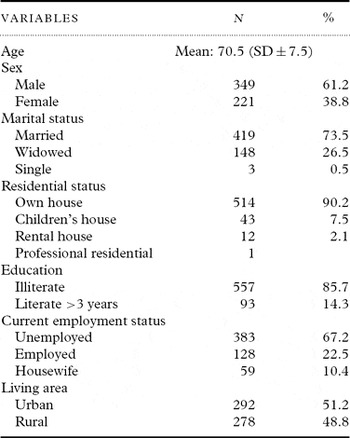
During the study period, 650 subjects were screened from major surgical wards (n = 188; 33.0%), general surgical wards (n = 186; 32.6%), minor surgical wards (n = 82; 14.4%), and internal medicine (n = 114; 20.0%). Eighty subjects were excluded: 38 had cognitive deficits, seven were too frail to cooperate, and 35 subjects were diagnosed with psychiatric disorders. The mean duration of hospital stay at the time of recruitment was 4.2 (SD ± 3.6) days. Sociodemographic variables are presented in Table 1.
Demographics of study sample

Psychosocial variables
At least one traumatic life event was reported by 173 (30.4%) subjects in the previous year. These events included the death of relatives (n = 87, 15.3%), financial problems (n = 27, 4.7%), family conflicts (n = 22, 3.9%), health problems other than the current medical illness (n = 34, 6%), and unpredictable situations (n = 3, 0.5%). The mean score for perceived social support was 49.0 (SD ± 10.6), with 18 (32%) perceiving minimum social support and 192 (33.7%) and 359 (63%) reporting moderate and good social support, respectively.
Clinical variables
The mean GDS score was 6.34 (SD ± 4.43) with 215 subjects (37.7%) scoring 8 or more. Thirty (5.3%) subjects reported regular opium use and 70 (12.3%) were cigarette smokers. The mean CIRS-G score for burden of medical conditions was 3.6 (SD ± 2.3). The medical conditions most frequently identified as having at least a moderate level of disability or morbidity were vascular disorders (25.9%), genito-urinary disorders (23.4%), musculoskeletal disorders (20.7%), and endocrine disorders (17.8%).
Suicidal and self-destructive behaviors
On the BSSI, 298 subjects (52.9%) “wished to die,” of whom 97 had a moderate to strong wish to die. “Passive suicidal desires” were expressed by 165 subjects (28.9%), 23 at a “moderate–strong” intensity. Thirteen subjects (2.3%) had active suicidal thoughts with three being expressed at “moderate–strong” intensity. Overall, the mean score on the BSSI was 1.69 (range = 0–16; SD = 2.25). There were 123 subjects (21.6%) who scored 4 or more on the BSSI and thus could be regarded as being at least at a low suicide risk.
On the HBS, 80 subjects were reported to have at least one self-destructive behavior (mean = 0.84, range = 0–15, SD = 2.43). Females (mean = 2.05, SD ± 2.41) had higher scores on the BSSI than males (mean = 1.47, SD ± 2.11; t = –2.94, p = 0.004), but there was no significance difference between female (mean = 1.0; SD ± 2.55) and male participants (mean = 0.72; SD ± 2.34) for self-destructive behavior (t = –1.33; p = 0.183). Univariate analyses showed that the HBS score was significantly correlated with the BSSI score (r = 0.481, p = 0.01).
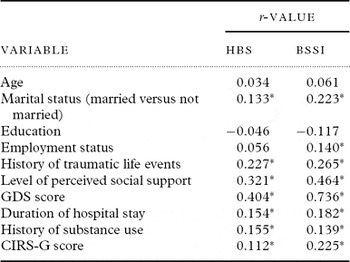
Duration of hospital stay, GDS score, burden of medical condition, marital status (married versus not married), substance use, and experience of a traumatic life event over the past year were positively correlated to both BSSI and HBS scores. Education and the level of perceived social support were negatively correlated to harmful behavior and suicide ideation; in other words, higher education and higher perceived social support were associated with lower suicidality (see Table 2).
Study variables and their correlation to HBS and BSSI

*p < 0.01.
HBS = Harmful Behavior Scale; BSSI = Beck Scale for Suicidal Ideation; GDS = Geriatric Depression Scale; CIRS-G = Cumulative Illness Rating Scale, Geriatric version.
Individuals who lived without a spouse reported more suicidal ideation (t = –4.9; p = 0.001) and harmful behaviors (t = –2.1; p = 0.035) than those living with a spouse. A history of opium use was also associated with more suicidal ideation. t-test analyses showed more suicidal ideation (t = –6.5; p = 0.001) and harmful behaviors (t = –4.8; p = 0.001) among those who experienced a traumatic life event than those without a traumatic life event.
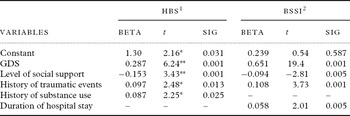
Regression analysis of the BSSI revealed that higher GDS score, history of life trauma, lower level of social support, and longer duration of hospital stay were predictors for suicidal ideation. Age, sex, education, medical burden, income, job, history of substance use, and marital status were not significant predictors. In the regression analysis for harmful behaviors on the HBS, higher GDS score, lower level of social support, history of life trauma, and substance use were predictors of harmful behaviors. Age, sex, education, burden of medical conditions, income, job, and marital status did not predict harmful behavior (see Table 3).
Regression analysis for HBS and BSSI

1 Variables included in the regression for the HBS and found to be insignificant: age, education, duration, burden of medical condition, employment status, sex, marital status.
2 Variables included in the regression for the BSSI and found to be insignificant: age, education, duration, burden of medical condition, employment status, history of substance use, sex, marital status.
*p < 0.05; **p < 0.01.
HBS = Harmful Behavior Scale; BSSI = Beck Scale for Suicidal Ideation; GDS = Geriatric Depression Scale.
Discussion
This is one of the few studies to investigate suicidal ideation and direct and indirect self-destructive behaviors among a large population of elderly, acute hospital inpatients (Shah et al., Reference Shah, Dighe-Deo and Chapman1998; 2000; Chan et al., Reference Chan, Draper and Banerjee2007). To the best of our knowledge, this is the first study in an Iranian elderly hospital population. As there is currently no specialized geriatric care in Iran for elderly patients, psychiatric problems such as suicidality might be easily underestimated. The main findings were that 21.6% of the elderly patients hospitalized for physical illnesses had at least a low suicide risk as rated by the BSSI and that 14.1% had evidence of self-destructive behavior in the previous month. Both were significantly associated with depressive symptoms, and with each other. Low levels of social support and a history of traumatic life events were significant predictors of both suicidal ideation and self-destructive behavior. Medical burden was not a significant predictor, with its influence being mediated by various clinical and psychosocial factors.
Comparison of suicidal ideation between older populations is hampered by the variety of measures used. One reason we chose the BSSI was that it has been previously used in elderly acute hospital inpatients in the UK (Shah et al., Reference Shah, Hoxey and Mayadunne2000). In that study, 36% of the subjects were noted to have suicidal ideation on the BSSI and this was not associated with severity of physical illness.
Hospitalized older patients might be at greater risk for suicidality due to a variety of factors including pain, discomfort, psychological reactions to bad news, depression, and demoralization (Draper, Reference Draper, Abou-Saleh, Katona and Kumar2010). In this study, what is striking is that even with the exclusion of potential subjects who had a severe psychiatric disorder there were still considerable rates of suicidal ideation and direct and indirect self-destructive behaviors. Findings from this study showed a higher prevalence of suicide ideation and behavior than in the general elderly population (Paykel et al., Reference Paykel, Myers and Lendenthal1974; Skoog et al., Reference Skoog1996; Forsell et al., Reference Forsell, Jorm and Winblad1997; Rao et al., Reference Rao, Dening, Brayne and Huppert1997). This was also true for DSH (De Leo et al., Reference De Leo, Padoani and Scocco2001; 2002; Chan et al., Reference Chan, Draper and Banerjee2007), although it should be noted that the HBS includes indirect self-destructive behavior in addition to the usual range of behaviors covered by the term DSH.
There is some evidence that DSH could be a predictor of subsequent suicide (Owens et al., Reference Owens, Horrocks and House2002; Joiner et al., Reference Joiner2005). Detecting self-harm behavior in elderly inpatients could create an opportunity to implement a suicide prevention strategy. Also, with the high rate of suicidality among older inpatients, it is crucial to understand its predictors and risk factors. It is important to note that depressive symptoms, as measured by the self-report GDS, was the strongest predictor of suicidal ideation and self-destructive behavior suggesting that depression screening of the hospitalized older population might detect potentially vulnerable individuals. A review of the use of the GDS in medical settings concluded that similar rates of depression were detected across hospital inpatients, hospital outpatients, and nursing homes, and that the four or five item versions were the most efficient to be used in a hospital setting (Mitchell et al., Reference Mitchell, Bird, Rizzo and Meader2010). Given that longer duration of hospital stay and lack of social support were other risk factors, depression screening on hospital admission alone would be inadequate. Repeat screening of long-stay patients along with interventions to reduce depression such as emotional support, pleasurable activities, and, where appropriate, antidepressant medication might be beneficial.
The main limitation for the current study was the high proportion of illiterate elderly for whom questionnaires had to be filled in with the assistance of the research assistant or a relative. We do not know whether this biased any of the findings. However, little research of this nature has been undertaken in such a population so this could also be viewed as a strength of the study. Second, the HBS was previously validated in an Australian nursing home population and has not been previously used in Iran or in an acute care setting. Third, we excluded potential subjects with major psychiatric disorder, resulting in conservative estimates of the level of suicidal behavior in this population.
In conclusion, high rates of suicidal ideation and self-destructive behavior were detected in an elderly Iranian hospital population. Subsyndromal depressive symptoms were the strongest correlate for these behaviors and suggest that depression screening followed by appropriate management of detected depressive syndromes might reduce suicidal behavior in this setting.
Conflict of interest
None.
Description of authors' roles
Dr Sahra Ekramzadeh collected the data. Dr Ali Javadpour and Professor Draper formulated the research idea, designed the study, and wrote the paper. Dr Adrienne Withall designed the statistical analysis. Dr Arash Mani did the analyses. Dr Ali Sahraian was nominated by the University as supervisor for research projects.