Introduction
Self-injurious behavior (SIB) is the intentional, self-directed act of injuring one's own body tissue. Both suicidal and non-suicidal self-injury (NSSI) often occur in the context of psychiatric conditions (such as depression), and are considered key features of the borderline personality disorder (BPD). The prevalence for NSSI in non-clinical samples according to a recent meta-analysis is 17.2% among adolescents, 13.4% among young adults, and 5.5% among adults (Swannell et al. Reference Swannell, Martin, Page, Hasking and St John2014). Although definitions do differ with regards to the self-injury's intent, both NSSI and deliberate self-harm (DSH) have a comparable prevalence (Muehlenkamp et al. Reference Muehlenkamp, Claes, Havertape and Plener2012).
Despite growing public and scientific interest in the phenomenon of human SIB, there is still little understanding of the developmental pathways leading to SIB. In Nock's integrative model alterations of pain processing are described as one potential risk factor for SIB (pain analgesia hypothesis) (Nock, Reference Nock2010). It is hypothesized, that individuals that are less sensitive to and without an aversion towards the anticipated pain and the ‘gruesome nature’ of SIB are less likely to experience a barrier towards SIB and are more likely to actually engage in SIB (Nock, Reference Nock2010). While the reasons to engage in SIB are manifold and so are the functions of the pain experience in SIB (Klonsky, Reference Klonsky2007), most often SIB is performed to alleviate negative affect. Recent studies suggest that SIB is associated with alterations of the endogenous opioid system: for example, individuals engaging in NSSI have lower resting levels of β-endorphin and enkephalins. Since these neurotransmitters are released by injuries to body tissue individuals engaging in SIB may be more sensitive to opioid-mediated reward that in turn may reduce negative affect (for a review see Bresin & Gordon, Reference Bresin and Gordon2013b ). Besides altered pain processing on the physiological level, dissociative states found in psychiatric disorders associated with SIB such as BPD are discussed as a potential antinociceptive mechanism in SIB (Ludäscher et al. Reference Ludäscher, Bohus, Lieb, Philipsen, Jochims and Schmahl2007, Reference Ludäscher, Valerius, Stiglmayr, Mauchnik, Lanius, Bohus and Schmahl2010). Indeed, the absence of pain during SIB has been related to high levels of dissociation (Russ et al. Reference Russ, Shearin, Clarkin, Harrison and Hull1993). Thus, the relieving effect of SIB in BPD might be related to a shift in attention (Niedtfeld et al. Reference Niedtfeld, Schulze, Kirsch, Herpertz, Bohus and Schmahl2010) caused by the experience of pain.
Many studies compared pain sensitivity in individuals with a history of SIB and healthy controls. However, results have been mixed with considerable variance across reported effect sizes, in particular with respect to the effect of co-morbid psychopathology such as BPD in SIB. The existing evidence has previously not been quantified taking a meta-analytical approach, addressing the issue of etiological differences in pain sensitivity in individuals engaging in SIB. A previous review on pain perception in psychiatric disorders (Lautenbacher & Krieg, Reference Lautenbacher and Krieg1994) from 1994 comprised only two studies in BPD. A narrative review on pain sensitivity in BPD was published in German in 2006 (Jochims et al. Reference Jochims, Ludäscher, Bohus, Treede and Schmahl2006). The aim of the present review and meta-analysis is to summarize the existing evidence and to quantify differences in the sensitivity to experimentally induced pain in individuals engaging in SIB compared to healthy controls, addressing potential covariates of pain sensitivity in SIB such as clinical etiology.
Method
Systematic search of the literature
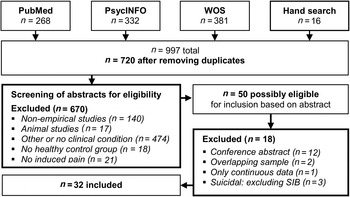
A systematic search of the literature, according to the Preferred Reporting Items for Systematic Reviews and Meta-Analyses (PRISMA) statement (Moher et al. Reference Moher, Liberati, Tetzlaff and Altman2009) was performed in November 2014. Based on reviewers’ comments, the search was updated and extended in October 2015. For clarity, results from the second search are presented (see online Appendix, for details on the two searches and search strategy by database). PubMed, PsycNET/PsycINFO, and Web of Science (WOS) databases were searched. In addition a hand search (i.e. Google, Google Scholar and online sources) was performed and reference lists of included studies were checked for studies eligible for inclusion. After removing duplicates, abstracts of all articles were screened by two independent reviewers based on pre-defined inclusion criteria. Differences to the initial search and selection for review were compared and deviations were re-screened until consensus on the disposition of each study under question was reached. Studies were included if they reported (i) an empirical investigation (excluding reviews, single-case studies etc.), in (ii) humans (excluding animal studies), including at least one sample of individuals engaging in (iii) SIB and a group of (iv) healthy controls, (v) receiving painful stimulation. All abstracts meeting these criteria were retrieved and reviewed in full text. The number of initial hits by database, abstracts/full texts meeting the pre-specified inclusion criteria, number of studies excluded, and reasons for exclusion were recorded and are presented in Fig. 1.
PRISMA search flow chart; WOS: Web of Science; see online Appendix for search strategy by database.

Extraction of dependent measures
Pain sensitivity was defined by three dependent measures: pain threshold, pain tolerance, and pain intensity. For experimental studies using a painful stimulus of constant stimulus intensity (i.e. temperature at a fixed degree for thermal stimuli), that used the exposure time (i.e. in seconds) until the onset of pain (pain threshold) or maximum endurance (pain tolerance) as dependent variable, the time in seconds was extracted. If studies used stimulation with a stimulus of increasing intensity (i.e. increase/decrease in temperature) to determine pain threshold or tolerance mean values (i.e. temperature) were extracted. In case mean temperatures for thermal cold pain stimulation were reported, values were inverted negative to maintain the direction of effect, as colder temperatures (lower values) reflect greater pain threshold (cold pain), and warmer temperatures (higher values) reflect greater pain threshold (heat pain). Pain intensity is commonly scored on numeric rating scales (NRS) or visual analog scales (VAS) and was extracted independent of the measurement applied. If studies changed stimulus intensity to achieve a fixed intensity rating (e.g. NRS of 40), e.g. the mean temperature was extracted. While the majority of protocols induced a single assessment of pain sensitivity, if studies used repetitive painful stimulation with the same stimulus and reported repeated measures on the outcomes of interest, data were extracted from the first assessment only to avoid introducing bias of habituation effects. All data were extracted and handled by the first author and checked multiple times for accuracy.
Meta-analysis and meta-regression
Meta-analysis was performed based on an available data basis. If available, means and standard deviations (s.d.) were extracted from included studies separately for the group of individuals engaging in SIB (symptom group) and healthy controls (controls). When multiple pain modalities were reported (e.g. heat and cold pain), data for each group were extracted for later meta-regression on differences by type of nociceptive stimulation. Studies that reported more than two groups (e.g. SIB v. blood-injection-injury phobics v. controls) were included as long as data were available from at least one SIB group against controls. Studies that compared different groups of SIB only, with no group of controls were excluded. When multiple groups of individuals engaging in SIB were reported (e.g. SIB with and without experience of pain during acts of SIB), data was pooled for all analysis. Similarly, for meta-analysis, data from studies reporting multiple modalities of painful stimulation (e.g. heat and cold pain) were combined across comparisons according to existing recommendations (Higgins & Green, Reference Higgins and Green2011; see chapter 7.7.3.8 Combining groups; and chapter 16.5.4 How to include multiple groups from one study) to avoid introducing bias or artificial inflation of the sample size (Scammacca et al. Reference Scammacca, Roberts and Stuebing2014).
In case the range instead of the s.d. was reported, s.d. was estimated based on existing recommendations (Higgins & Green, Reference Higgins and Green2011). In case only the standard error of the mean (s.e.m.) was reported, the s.d. was calculated by multiplying the s.e.m. by the square root of the sample size. If the median and interquartile range or 95% confidence interval (CI) was reported formulas proposed elsewhere (Hozo et al. Reference Hozo, Djulbegovic and Hozo2005; Wiebe et al. Reference Wiebe, Vandermeer, Platt, Klassen, Moher and Barrowman2006; Wan et al. Reference Wan, Wang, Liu and Tong2014) were used to impute the data pending on the sample size. If the mean and t statistics were reported the s.e.m. was calculated by dividing the difference in group means by the t value (Higgins & Green, Reference Higgins and Green2011). In case insufficient data on any dependent measure was reported (i.e. only graphical display of means and s.d.) the study was not included in the meta-analysis. True effect estimates were computed as adjusted standardized mean differences (SMD; Hedges’ g). We undertook meta-analyses using a random-effects model. Heterogeneity was tested with the standard I 2 index, and χ2 and τ 2 tests (Higgins & Thompson, Reference Higgins and Thompson2002). Heterogeneity was assumed if I 2 was >50%, indicating that 50% of the variability in the outcome cannot be explained by sampling variation. Publication bias was examined using a funnel plot of effect size against standard error for asymmetry. In subsequent sensitivity analysis, outliers were removed. All meta-analytic computations were performed using RevMan version 5.3.4 (The Nordic Cochrane Centre, Copenhagen, The Cochrane Collaboration, 2014).
Meta-regression was performed on the following covariates: age (continuous in years), sex (continuous percentage of female subjects in the SIB group), diagnosis/clinical etiology (factorial: BPD or NSSI), history of SIB (continuous in years), and modality of nociceptive stimulation (factorial: thermal, laser, mechanical/pressure, or electric). Studies using thermal stimulation were further subjected to meta-regression on modality of thermal stimulation (factorial: heat or cold). Computations for meta-regression were performed using the OpenMetaAnalyst software (Wallace et al. Reference Wallace, Dahabreh, Trikalinos, Lau, Trow and Schmid2012). Each covariate was tested using meta-regression with a single covariate at a time (Thompson & Higgins, Reference Thompson and Higgins2002; Knapp & Hartung, Reference Knapp and Hartung2003).
Results
Systematic search and included studies
The search revealed a total of 997 potential papers (Fig. 1). A total of 720 abstracts were screened, after 277 duplicates were removed. Fifty titles were considered eligible based on the abstract and were retrieved in full text. Twelve abstracts reporting conference/poster contributions with no full text (Basoglu et al. Reference Basoglu, Cetin, Ebrinc, Maden, Balibey and Baykiz2002; Ludäscher et al. Reference Ludäscher, Jochims, Bohus, Greffrath, Treede and Schmahl2005; Schmahl et al. Reference Schmahl, Bohus, Esposito, Treede, Di Salle, Greffrath, Ludäscher, Jochims, Lieb, Scheffler, Hennig and Seifritz2006, Reference Schmahl, Jochims, Valerius, Schulze, Rietschel, Skowronek, Smolka and Bohus2008a , Reference Schmahl, Klossika and Bohus b , Reference Schmahl, Klossika and Bohus c , Reference Schmahl, Meinzer, Zeuch, Fichter, Cebulla, Kleindienst, Ludäscher, Steil and Bohus2010; Jochims et al. Reference Jochims, Ludäscher, Bohus, Treede and Schmahl2006; Schönfeldt-Lecuona et al. Reference Schönfeldt-Lecuona, Cárdenas Morales, Wietasch and Kammer2008, Reference Schönfeldt-Lecuona, Connemann, Fladung, Kammer, Schmahl, Plener and Cárdenas-Morales2011; Klossika & Schmahl, Reference Klossika and Schmahl2010; Carpenter et al. Reference Carpenter, Wood and Trull2012; Bekrater-Bodmann et al. Reference Bekrater-Bodmann, Chung, Schmahl and Flor2014) were excluded. One study (Schmid et al. Reference Schmid, Freudenmann, Keterling, Cárdenas-Morales, Connemann, Gunst and Schönfeldt-Lecuona2011) reported an overlapping sample of which the earlier report was included (Cárdenas-Morales et al. Reference Cárdenas-Morales, Fladung, Kammer, Schmahl, Plener, Connemann and Schönfeldt-Lecuona2011). Another study was previously published as dissertation (St. Germain & Ann, Reference St. Germain2011). The journal paper published later was included (Hooley & St. Germain, Reference Hooley and St. Germain2013). One study reported insufficient data (no group differences, analysis on continuous measures only) on dependent variables and was excluded (Carpenter & Trull, Reference Carpenter and Trull2015). Three studies in suicidal subjects excluding individuals engaging in SIB were excluded (Orbach et al. Reference Orbach, Palgi, Stein, Har-Even, Lotem-Peleg, Asherov and Elizur1996a , Reference Orbach, Stein, Palgi, Asherov, Har-Even and Elizur b , Reference Orbach, Mikulincer, King, Cohen and Stein1997).
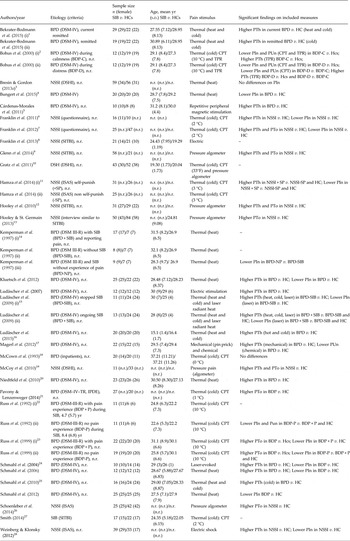
Finally, a total of 32 studies were included (Russ et al. Reference Russ, Roth, Lerman, Kakuma, Harrison, Shindledecker, Hull and Mattis1992, Reference Russ, Campbell, Kakuma, Harrison and Zanine1999; McCown et al. Reference McCown, Galina, Johnson, DeSimone and Posa1993; Kemperman et al. Reference Kemperman, Russ, Clark, Kakuma, Zanine and Harrison1997; Bohus et al. Reference Bohus, Limberger, Ebner, Glocker, Schwarz, Wernz and Lieb2000; Schmahl et al. Reference Schmahl, Greffrath, Baumgärtner, Schlereth, Magerl, Philipsen, Lieb, Bohus and Treede2004, Reference Schmahl, Bohus, Esposito, Treede, Di Salle, Greffrath, Ludäscher, Jochims, Lieb, Scheffler, Hennig and Seifritz2006, Reference Schmahl, Meinzer, Zeuch, Fichter, Cebulla, Kleindienst, Ludäscher, Steil and Bohus2010, Reference Schmahl, Ludäscher, Greffrath, Kraus, Valerius, Schulze, Treutlein, Rietschel, Smolka and Bohus2012; Ludäscher et al. Reference Ludäscher, Bohus, Lieb, Philipsen, Jochims and Schmahl2007, Reference Ludäscher, Greffrath, Schmahl, Kleindienst, Kraus, Baumgärtner, Magerl, Treede and Bohus2009, Reference Ludäscher, von Kalckreuth, Parzer, Kaess, Resch, Bohus, Schmahl and Brunner2015; Hooley et al. Reference Hooley, Ho, Slater and Lockshin2010; McCoy et al. Reference McCoy, Fremouw and McNeil2010; Niedtfeld et al. Reference Niedtfeld, Schulze, Kirsch, Herpertz, Bohus and Schmahl2010; Cárdenas-Morales et al. Reference Cárdenas-Morales, Fladung, Kammer, Schmahl, Plener, Connemann and Schönfeldt-Lecuona2011; Franklin et al. Reference Franklin, Hessel and Prinstein2011, Reference Franklin, Aaron, Arthur, Shorkey and Prinstein2012, Reference Franklin, Puzia, Lee, Lee, Hanna, Spring and Prinstein2013; Gratz et al. Reference Gratz, Hepworth, Tull, Paulson, Clarke, Remington and Lejuez2011; Weinberg & Klonsky, Reference Weinberg and Klonsky2011; Kluetsch et al. Reference Kluetsch, Schmahl, Niedtfeld, Densmore, Calhoun, Daniels, Kraus, Ludaescher, Bohus and Lanius2012; Magerl et al. Reference Magerl, Burkart, Fernandez, Schmidt and Treede2012; Bresin & Gordon, Reference Bresin and Gordon2013a ; Hooley & St. Germain, Reference Hooley and St. Germain2013; Pavony & Lenzenweger, Reference Pavony and Lenzenweger2013; Glenn et al. Reference Glenn, Michel, Franklin, Hooley and Nock2014; Hamza et al. Reference Hamza, Willoughby and Armiento2014; Schoenleber et al. Reference Schoenleber, Berenbaum and Motl2014; Smith, Reference Smith2014; Bekrater-Bodmann et al. Reference Bekrater-Bodmann, Chung, Richter, Wicking, Foell, Mancke, Schmahl and Flor2015; Bungert et al. Reference Bungert, Koppe, Niedtfeld, Vollstädt-Klein, Schmahl, Lis and Bohus2015). Sample and study characteristics of included studies, type of painful stimulation and main study findings are summarized in Table 1.
Sample characteristics and pain sensitivity related findings by authors in alphabetical order

BPD, Borderline personality disorder; CPT, Cold Pressor task; DSH, deliberate self-harm; DSHI, Deliberate Self-Harm Inventory; DSM, Diagnostic and Statistical Manual of Mental Disorders; HC, healthy controls; StIPDE, International Personality Disorder Examination; ISAS, Inventory of Statements about Self-injury; ISAS, Inventory of Statements about Self-Injury; n.r., not reported; NSSI, non-suicidal self-injury; PIn, pain intensity; PTh, pain threshold; PTo, pain tolerance; PUn, pain unpleasantness; SIB, self-injurious behavior; SP, self-punish; TPR, Tourniquet Pain Test; Sample size, The n refers to the total n of subjects in the respective group. The number in parentheses refers to the relative number of females.
1 Bekrater-Bodmann et al. (Reference Bekrater-Bodmann, Chung, Richter, Wicking, Foell, Mancke, Schmahl and Flor2015): for meta-analysis data only for current BPD patients was used; data from thermal pain threshold used (not thermal grill illusion); data on heat and cold pain pooled for meta-analysis [not pooled for meta-regression].
2 Bohus et al. (Reference Bohus, Limberger, Ebner, Glocker, Schwarz, Wernz and Lieb2000): data during calmness and during distress pooled for meta-analysis and meta-regression; no descriptive statistics on CPT reported, only data on TPR used, coded as mechanical/pressure pain for meta-regression on pain modality.
3 Bresin & Gordon (Reference Bresin and Gordon2013a ): median number of NSSI incidents and incidents during the past 12 months reported; mean age reported for the entire sample: 19.48 (2.53), used for meta-regression on age.
4 Bungert et al. (Reference Bungert, Koppe, Niedtfeld, Vollstädt-Klein, Schmahl, Lis and Bohus2015): data from control condition only used.
5 Cárdenas-Morales et al. (Reference Cárdenas-Morales, Fladung, Kammer, Schmahl, Plener, Connemann and Schönfeldt-Lecuona2011): NSSI at least once per week during the preceding 6 months.
6 Franklin et al. (Reference Franklin, Hessel and Prinstein2011): mean age reported for the entire sample recruited: 19.25 (2.07), used for meta-regression on age.
7 Franklin et al. (Reference Franklin, Aaron, Arthur, Shorkey and Prinstein2012): more than six acts of NSSI during the last year; 52 female, 20 male subjects in the entire sample, distribution of the entire sample used for meta-regression on sex; mean age reported for entire sample: 19.09 (1.3), used for meta-regression on age.
8 Franklin et al. (Reference Franklin, Puzia, Lee, Lee, Hanna, Spring and Prinstein2013): number of lifetime self-cutting episodes reported; the authors studied pain offset relief and none of the included dependent pain measures were reported, study therefore not included in meta-analysis.
9 Glenn et al. (Reference Glenn, Michel, Franklin, Hooley and Nock2014): average age of onset of NSSI reported (13.59± 2.64); estimate of history of SIB for meta-regression derived from mean age minus mean age of onset (3.75) [finally not used]; 63 female, 16 male subjects in the entire sample, distribution of the entire sample used for meta-regression on sex; mean age of entire sample 17.34 (1.79) years, used for meta-regression on age.
10 Gratz et al. (Reference Gratz, Hepworth, Tull, Paulson, Clarke, Remington and Lejuez2011): average time since the last incident of DSH reported; several manipulation interventions, data from the initial baseline pain assessment is reported; data on different nociceptive stimuli pooled for meta-analysis [not pooled for meta-regression]; the authors investigated pain differences under neutral and distress conditions; findings indicated heightened physical pain tolerance among self-harming individuals only under conditions of interpersonal distress.
11 Hamza et al. (Reference Hamza, Willoughby and Armiento2014): NSSI frequency reported; for meta-analysis and meta-regression data for NSSI self-punish and no self-punish was pooled; 69.5% female in the entire sample used for meta-regression on sex; mean age of the entire sample 21.52 years, used for meta-regression on age.
12 Hooley et al. (Reference Hooley, Ho, Slater and Lockshin2010): The authors report mean values on dependent pain related variables calculated from two repeated assessments that highly correlated; mean age of onset of SIB (16.8 years) reported. Estimate of history of SIB for meta-regression derived from mean age minus mean age of onset (14.2) [finally not used]; mean age reported for the entire sample (22.4 years (5.2)) including seven participants who reported serious and recurrent thoughts of self-injury but who had never actually engaged in NSSI, used for meta-regression on age.
13 Hooley & St. Germain (Reference Hooley and St. Germain2013): mean age only reported for controls and entire sample 24.09 (8.07) years, entire sample mean age used for meta-regression on age; neutral baseline condition, before intervention used for analysis.
14 Kemperman et al. (Reference Kemperman, Russ, Clark, Kakuma, Zanine and Harrison1997): for meta-analysis and meta-regression data for BPD patients with SIB (with or without pain during acts of SIB) was pooled, data on BPD patients without SIB not used.
15 Ludäscher et al. (Reference Ludäscher, Greffrath, Schmahl, Kleindienst, Kraus, Baumgärtner, Magerl, Treede and Bohus2009): mean time interval since the last SIB episode reported; for meta-analysis only data from patients with ongoing SIB included and pooled across pain modalities (heat, cold, laser) for meta-analysis [not pooled for meta-regression]; radiant heat pain thresholds from 21 controls and 22 patients (10 without and 12 with current SIB).
16 Ludäscher et al. (Reference Ludäscher, von Kalckreuth, Parzer, Kaess, Resch, Bohus, Schmahl and Brunner2015): frequency of NSSI within the past year reported; data on heat and cold pain pooled for meta-analysis [not pooled for meta-regression].
17 Magerl et al. (Reference Magerl, Burkart, Fernandez, Schmidt and Treede2012): history of SIB separately reported for female (15.4 ± 2.9 years) and male subjects (8.6 ± 2.0 years). mean of the means (12.0) used for meta regression on SIB history [finally not used]; sufficient data only reported for mechanical pain threshold.
18 McCown et al. (Reference McCown, Galina, Johnson, DeSimone and Posa1993): data from the non-borderline patient group not used/reported; the study design involved multiple trials of pain induction, data on the initial CPT is reported; BPD patients showed greater pain tolerance in the later trials but not in the initial CPT.
19 McCoy et al. (Reference McCoy, Fremouw and McNeil2010): 81.8% female for the entire sample and for the NSSI group, used for meta-regression on sex; mean age entire sample: 20.25 (4.30) years, used for meta-regression on age; the study design involved three trials, data from the first trial is reported.
20 Niedtfeld et al. (Reference Niedtfeld, Schulze, Kirsch, Herpertz, Bohus and Schmahl2010): SIB during the last year reported.
21 Pavony & Lenzenweger (2014): the PubMed reference reads 2013, the paper reads 2014; data from psychiatric controls not used/reported; two subjects dropped from later analysis, unclear group allocation, entire sample 79.1% female, used for meta-regression on sex; mean age of the entire sample, including a psychiatric control group reported 21.36 (5.284) years, used for meta-regression on age; derived from planned BPD specific contrasts, including a psychiatric control group in addition to HC.
22 Russ et al. (Reference Russ, Roth, Lerman, Kakuma, Harrison, Shindledecker, Hull and Mattis1992): for meta-analysis and meta-regression data from BPD with and with no pain experience during acts of SIB was pooled; three days of testing.
23 Russ et al. (Reference Russ, Roth, Lerman, Kakuma, Harrison, Shindledecker, Hull and Mattis1992) history of at least five episodes of SIB; for meta-analysis data from BPD with and with no pain experience during acts of SIB was pooled; data from clinical controls nut used.
24 Schmahl et al. (Reference Schmahl, Greffrath, Baumgärtner, Schlereth, Magerl, Philipsen, Lieb, Bohus and Treede2004): acts of SIB within the preceding 4 weeks reported.
25 Schmahl et al. (Reference Schmahl, Meinzer, Zeuch, Fichter, Cebulla, Kleindienst, Ludäscher, Steil and Bohus2010): heat and cold pain thresholds are given for baseline and stress conditions (means of both hands), baseline condition used for meta-analysis and data from heat and cold pain (inverted) pooled for meta-analysis [not pooled for meta-regression].
26 Schoenleber et al. (Reference Schoenleber, Berenbaum and Motl2014): reported having engaged in NSSI on two or more occasions in their lifetime; mean age across groups was 23.7 years (6.4), used for meta-regression on age.
27 Smith (Reference Smith2014): At least six incidences of self-injury during the past 12 months, coded as NSSI for meta-regression on etiology.
28 Weinberg & Klonsky (2012): the PubMed reference reads 2011, the paper itself reads 2012; age reported for the entire sample: 20.24 (2.22), used for meta-regression on age; significant group differences only in the low shock condition; both shock conditions (low and high) pooled for meta-analysis and meta-regression.
Meta-analysis
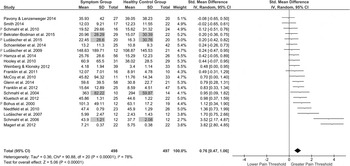
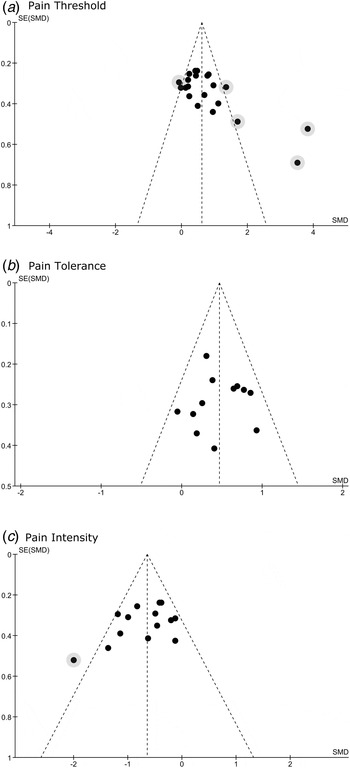
Twenty-one studies yielded a total of 33 comparisons on pain threshold. Analysis on pooled subgroups/comparisons (pooled k = 21) by study comprised a total of 995 participants (controls n = 497). SIB is associated with greater pain threshold (Z = 5.06, p < 0.0001; g = 0.76; 95% CI 0.47–1.06; k = 21), as illustrated in Fig. 2. Significant heterogeneity was present. Visual inspection of funnel plots (Fig. 5a ) revealed potential publication bias. Removing five outliers from analysis (Fig. 5a ), yielded a significant main effect (Z = 6.16, p < 0.0001; g = 0.49; 95% CI 0.33–0.65; k = 16) with no significant heterogeneity across reported effect sizes.
Random effect meta-analysis on pain threshold. CI, Confidence interval; s.d., standard deviation; grey-shaded values were imputed; P, analysis on pooled data from multiple subgroups/comparisons. Schmahl et al. (Reference Schmahl, Meinzer, Zeuch, Fichter, Cebulla, Kleindienst, Ludäscher, Steil and Bohus2010): baseline condition used for meta-analysis and data from heat and cold pain (inverted) pooled for meta-analysis (not pooled for meta-regression). Ludäscher et al. (Reference Ludäscher, Greffrath, Schmahl, Kleindienst, Kraus, Baumgärtner, Magerl, Treede and Bohus2009): only data from patients with ongoing SIB included and pooled across pain modalities [contact heat pain threshold, contact cold pain threshold (inverted) and laser pain threshold] for meta-analysis (lowest n reported used) (not pooled for meta-regression). Bekrater-Bodman et al. (Reference Bekrater-Bodmann, Chung, Richter, Wicking, Foell, Mancke, Schmahl and Flor2015): only data for current (not remitted) BPD patients used, heat and cold pain (inverted) thresholds pooled for analysis (not pooled for meta-regression); median and interquartile range (IQR) reported: median used and IQR divided by 1.35 as best estimate. Ludäscher et al. (Reference Ludäscher, von Kalckreuth, Parzer, Kaess, Resch, Bohus, Schmahl and Brunner2015): mean and 95% CI reported, data imputed based on Cochrane formula and specific divisor (2.09) based on sample size of n = 20; heat and cold pain (inverted) thresholds pooled for analysis (not pooled for meta-regression). Hamza et al. (Reference Hamza, Willoughby and Armiento2014): data for NSSI self-punish and no self-punish pooled. Schmahl et al. (Reference Schmahl, Greffrath, Baumgärtner, Schlereth, Magerl, Philipsen, Lieb, Bohus and Treede2004): s.d. imputed from s.e.m. Bohus et al. (Reference Bohus, Limberger, Ebner, Glocker, Schwarz, Wernz and Lieb2000): for BPD patients data during calmness and distress pooled. Schmahl et al. (Reference Schmahl, Bohus, Esposito, Treede, Di Salle, Greffrath, Ludäscher, Jochims, Lieb, Scheffler, Hennig and Seifritz2006): s.d. imputed from s.e.m.

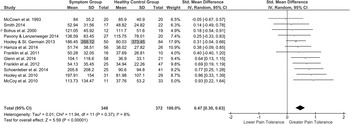
Twelve studies yielded a total of 14 comparisons (pooled k = 12) on pain tolerance. Analysis comprised a total of 720 participants (controls n = 372). SIB is associated with greater pain tolerance (Z = 5.59, p < 0.0001; g = 0.47; 95% CI 0.30–0.63; k = 12), as illustrated in Fig. 3. No significant heterogeneity was present. Visual inspection of funnel plots (Fig. 5b ) revealed little to no risk for publication bias.
Random effect meta-analysis on pain tolerance. CI, Confidence interval; s.d., standard deviation; P, analysis on pooled data from multiple sub-groups/comparisons. Bohus et al. (Reference Bohus, Limberger, Ebner, Glocker, Schwarz, Wernz and Lieb2000): for BPD patients data during calmness and distress pooled. Hooley & St. Germain (Reference Hooley and St. Germain2013): data imputed from t statistics. Hamza et al. (Reference Hamza, Willoughby and Armiento2014): data for NSSI self-punish and no self-punish pooled.

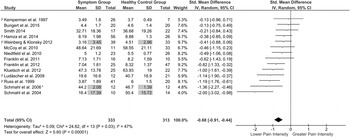
Fourteen of the included studies yielded 20 comparisons (pooled k = 14) on pain intensity. Analysis comprised a total of 646 participants (controls n = 313). SIB is associated with lower pain intensity (Z = 5.60, p < 0.0001; g = −0.68; 95% CI −0.91 to −0.44; k = 14), as illustrated in Fig. 4. Significant heterogeneity was present and visual inspection of funnel plots (Fig. 5c ) revealed potential publication bias. Removing one outlier from analysis (Fig. 5c ), yielded a significant main effect (Z = 5.76, p < 0.0001; g = −0.62; 95% CI −0.83 to −0.41; k = 13), with no significant heterogeneity across reported effect sizes.
Random effect meta-analysis on pain intensity. CI, Confidence interval; s.d., standard deviation; grey-shaded values were imputed; P, analysis on pooled data from multiple sub-groups/comparisons. Kemperman et al. (Reference Kemperman, Russ, Clark, Kakuma, Zanine and Harrison1997): only data for BPD patients with SIB used; data on BPD with and without pain experience during acts of SIB pooled. Hamza et al. (Reference Hamza, Willoughby and Armiento2014): data for NSSI self-punish and no self-punish pooled; pain intensity at tolerance. Weinberg & Klonsky (Reference Weinberg and Klonsky2011): s.d. imputed from s.e.m.; both shock conditions (low and high) pooled. Franklin et al. (Reference Franklin, Hessel and Prinstein2011): intensity at tolerance. Franklin et al. (Reference Franklin, Aaron, Arthur, Shorkey and Prinstein2012): intensity at tolerance. Ludäscher et al. (Reference Ludäscher, Greffrath, Schmahl, Kleindienst, Kraus, Baumgärtner, Magerl, Treede and Bohus2009): only data from patients with ongoing SIB included. Russ et al. (1992): data for BPD with and with no pain experience during acts of SIB pooled; Schmahl et al. Reference Schmahl, Bohus, Esposito, Treede, Di Salle, Greffrath, Ludäscher, Jochims, Lieb, Scheffler, Hennig and Seifritz2006: s.d. imputed from s.e.m.; Schmahl et al. Reference Schmahl, Greffrath, Baumgärtner, Schlereth, Magerl, Philipsen, Lieb, Bohus and Treede2004: s.d. imputed from s.e.m. * Mean temperature causing perceived pain intensity of NRS 40, inverted to keep direction of effect.

Funnel plots (a) pain threshold, (b) pain tolerance, (c) pain intensity; grey-shaded values were considered as outliers and removed from subsequent meta-analysis.

Meta-regression
Age was a significant covariate in meta-regression on pain tolerance [data (years): k = 12, mean = 23.31, range = 17.34–37.21; β = 0.038, 95% CI −0.073 to −0.004, s.e. = 0.017, p = 0.028], indicating that difference between individuals engaging in SIB and controls were more pronounced at younger age and decreased at older age. There were no significant effects of age as covariate in meta-regression on pain threshold [data (years): k = 26, mean = 23.69, range=15.1–30.00; β = −0.016, 95% CI −0.121 to 0.089, s.e. = 0.054, p = .766] or pain intensity [data (years): k = 14, mean = 24.91, range=19.09–30.5; β = −0.027, 95% CI −0.080 to 0.025, s.e. = 0.027, p = 0.310].
Sex was coded by relative percent of female subjects as continuous covariate (Table 1). Female sex was no significant covariate in meta-regression on pain threshold [data (%): k = 26, mean = 91.12, range=68.18–100; β = 0.022, 95% CI −0.021 to 0.066, s.e. = 0.022, p = 0.313], pain tolerance [data (%): k = 12, mean = 81.88; range= 68.75–100; β = 0.005, 95% CI −0.010 to 0.021, s.e. = 0.008, p = 0.502], or pain intensity [data (%): k = 14, mean = 88.30, range=68.75–100; β = −0.011, 95% CI −0.027 to 0.004, s.e. = 0.008, p = 0.157].
Random-effects meta-regression revealed a significant effect of clinical etiology on pain threshold. Individuals with NSSI significantly differed from those with BPD (β = −1.207, 95% CI −2.215 to −0.200, s.e. = 0.514, p = 0.019). Indicating greater pain threshold in BPD (k = 17) compared to NSSI (k = 9). Clinical etiology was also a significant covariate in random-effects meta-regression on pain tolerance. Individuals with NSSI significantly differed from those with BPD (β = 0.410, 95% CI 0.006–0.814, s.e. = 0.206, p = 0.047). Indicating greater pain tolerance in NSSI (k = 9) compared to BPD (k = 3). Meta-regression on clinical etiology and pain intensity missed the set level of significance (β = 0.367, 95% CI 0.020–0.755, s.e. = 0.198, p = 0.063), pointing towards greater pain intensity in NSSI (k = 6) compared to BPD (k = 8).
There were no significant effects for modality of nociceptive stimulation or thermal heat v. thermal cold pain (all p > 0.05). Only a few studies sufficiently reported history of SIB. Thus, meta-regression on SIB history was not performed.
Discussion
The present paper aimed to summarize and quantify the existing evidence on altered pain sensitivity in individuals engaging in SIB compared to healthy controls. Meta-analysis revealed significant main effects on pain threshold, pain tolerance, and ratings of pain intensity. Individuals engaging in SIB report greater pain threshold, greater pain tolerance, and lower pain intensity compared to controls – differences associated with medium to large effects Evidence is consistent across all published studies. Thus, the present analysis confirms that alterations in pain processing are important characteristics of individuals engaging in SIB and that those individuals are less sensitive to (experimentally induced) pain compared to their healthy counterparts with no history of SIB.
Several physiological mechanisms underlying these findings are discussed in the literature. On the level of the central nervous system, it has been shown, that affective and cognitive-motivational components of pain processing are altered in individuals with BPD. Patients with BPD show greater BOLD responses in the dorsolateral prefrontal cortex and reduced responses in the posterior parietal cortex to painful stimuli adjusted to subjective pain levels (Schmahl et al. Reference Schmahl, Jochims, Valerius, Schulze, Rietschel, Smolka and Bohus2006). Further, pain seems to lead to reduced activation of neural activity in the perigenual anterior cingulate gyrus and the amygdala in patients with BPD (Schmahl et al. Reference Schmahl, Jochims, Valerius, Schulze, Rietschel, Smolka and Bohus2006; Niedtfeld et al. Reference Niedtfeld, Schulze, Kirsch, Herpertz, Bohus and Schmahl2010), supporting its affect-regulating function. The analgesic effect of higher levels of endorphins following bodily injury has been discussed as potential mechanism of altered pain sensitivity, but findings are not well replicated (for a review see Nock, Reference Nock2010). While research provides evidence that pain sensitivity is dependent on state dependent physiological arousal, except for some studies (Bohus et al. Reference Bohus, Limberger, Ebner, Glocker, Schwarz, Wernz and Lieb2000; Smith, Reference Smith2014) research has not yet systematically addressed differences or the general involvement of the autonomic nervous system (ANS) or hypothalamic–pituitary–adrenal (HPA) axis response to experimentally induced pain in individuals engaging in SIB. Future research should rigorously address these issues within experimental designs using well-established paradigms to induce stress prior to nociceptive stimulation.
While the present meta-analysis provides consistent evidence for altered pain sensitivity in SIB, it adds to the existing literature by exploring a set of potential covariates using meta-regression. Among the covariates subjected to meta-regression, age and clinical etiology explained significant differences in the effect sizes observed. Findings from meta-regression on clinical etiology indicate that SIB alone only accounts for some of the effect found in SIB with co-morbid psychopathology such as BPD. Depersonalization and derealization (dissociative states), that are considered important diagnostic criteria for BPD, have previously been linked to altered physiological responding (Barnow et al. Reference Barnow, Limberg, Stopsack, Spitzer, Grabe, Freyberger and Hamm2012) and pain sensitivity (Ludäscher et al. Reference Ludäscher, Valerius, Stiglmayr, Mauchnik, Lanius, Bohus and Schmahl2010) in BPD. These and other disorder specific features may explain the observed variance between BPD and NSSI. While emotion dysregulation (i.e. affect instability and intense anger/aggression) only partially distinguishes NSSI from BPD (Bracken-Minor et al. Reference Bracken-Minor and McDevitt-Murphy2014; Brickman et al. Reference Brickman, Ammerman, Look, Berman and McCloskey2014), SIB seems to serve unique functions in BPD (i.e. anti-suicide, and anti-dissociation) (Bracken-Minor et al. Reference Bracken-Minor and McDevitt-Murphy2014). Since dissociation seems to be a strong candidate to explain the reported differences in pain sensitivity between BPD and NSSI, further research is warranted to unravel potential mechanisms, explaining differences in pain sensitivity between BPD and NSSI.
However, we cannot rule out the possibility, that BPD samples included more severely self-injuring participants. It is important to note that the percentage of individuals with a BPD diagnosis is not known in studies reporting on NSSI only; in turn limiting the potential to further investigate the differential relationship between BPD, SIB and alterations in pain sensitivity. However, effect sizes for pain tolerance also differed by clinical etiology. While we found significant difference in NSSI compared to controls, no such difference was present for BPD. Similar to pain threshold, one may speculate that differences in pain tolerance between NSSI and BPD related to clinical features (i.e. impulsivity), distinguishing the two groups. However, this finding should be interpreted with caution, given that existing research in BPD predominantly focused on pain threshold and evidence on pain tolerance in these subjects is relatively rare, with only three studies reporting pain tolerance in BPD (McCown et al. Reference McCown, Galina, Johnson, DeSimone and Posa1993; Bohus et al. Reference Bohus, Limberger, Ebner, Glocker, Schwarz, Wernz and Lieb2000; Pavony & Lenzenweger, Reference Pavony and Lenzenweger2013), it warrants further exploration in future research. Furthermore and as previously mentioned, data on the occurrence and the severity of SIB in studies on BPD samples and those with NSSI was not reported in sufficient detail, thus potential bias needs to be taken into account. Nonetheless, it is interesting that the differential pattern of pain sensitivity between BPD and NSSI seems opposite for pain tolerance and pain threshold/pain intensity.
Age was a significant covariate on pain tolerance, indicating that the reported effect size decreased in older samples compared to younger samples. This finding is counterintuitive, as older age is associated with reduced pain-modulatory capacity (Edwards et al. Reference Edwards, Fillingim and Ness2003; Gibson & Farrell, Reference Gibson and Farrell2004), that is associated with lower pain tolerance in greater age. Further, SIB is known to show a normative decline in prevalence from adolescence towards the end of the third decade of life (Moran et al. Reference Moran, Coffey, Romaniuk, Olsson, Borschmann, Carlin and Patton2012). Our findings of smaller differences in pain tolerance between SIB and healthy controls at older age are contradicting to this normative decline in the following ways: First, individuals who continue SIB during adulthood may be considered to present with a more severe form of SIB and related psychopathology resulting in more severe biological alterations. Second, given that alterations in pain processing have been discussed as potential consequences of long-lasting SIB, our findings do not fit such theory, indicating that history of SIB and pain sensitivity are closely associated. However, we were not able to perform a meta-regression on history of SIB to further explore this. Again, these findings only hold for analysis of pain tolerance, based on two studies including participants close to 30 years of age (McCown et al. Reference McCown, Galina, Johnson, DeSimone and Posa1993; Bohus et al. Reference Bohus, Limberger, Ebner, Glocker, Schwarz, Wernz and Lieb2000) and no effect was found for pain threshold that – as previously mentioned – is reported most frequently. Thus, given that the majority of included studies in the present analysis reported mid-aged samples of participants, the mediation of altered pain sensitivity by age in very young and very old individuals engaging in SIB needs further exploration in future studies.
While sex differences in the response to experimentally induced pain are well documented by previous reviews and meta-analysis (Racine et al. Reference Racine, Tousignant-Laflamme, Kloda, Dion, Dupuis and Choinière2012a , Reference Racine, Tousignant-Laflamme, Kloda, Dion, Dupuis and Choinière b ), sex was not a significant covariate in our meta-regression. Generally speaking, women exhibit greater pain sensitivity for most pain modalities compared to men (Riley et al. Reference Riley, Robinson, Wise, Myers and Fillingim1998; Fillingim et al. Reference Fillingim, King, Ribeiro-Dasilva, Rahim-Williams and Riley2009; Bartley & Fillingim, Reference Bartley and Fillingim2013) and show lower pain threshold and pain tolerance (Dao & LeResche, Reference Dao and LeResche2000; Rokyt & Yamamotová, Reference Rokyt and Yamamotová2013). These sex differences are already found for thermal pain in healthy children (Boerner et al. Reference Boerner, Birnie, Caes, Schinkel and Chambers2014). While several of the included papers addressed mixed samples, including male and female participants (Table 1), depended variables were not reported separately for men and women. Research on exclusively male subjects engaging in SIB is rare. While we addressed the relative percentage of females subjects as covariate in meta-regression, insufficient data exists on purely male samples and included samples were predominantly female (68.75–100%). While SIB is more prevalent in females than in males (Moran et al. Reference Moran, Coffey, Romaniuk, Olsson, Borschmann, Carlin and Patton2012; Brunner et al. Reference Brunner, Kaess, Parzer, Fischer, Carli, Hoven, Wasserman, Sarchiapone, Resch, Apter, Balazs, Barzilay, Bobes, Corcoran, Cosmanm, Haring, Iosuec, Kahn, Keeley, Meszaros, Nemes, Podlogar, Postuvan, Saiz, Sisask, Tubiana, Varnik and Wasserman2014), future studies controlling for sex differences in pain sensitivity related to SIB are encouraged, given the evidence on and the importance of sex-related differences in pain processing and sensitivity to experimentally induced pain in the general population.
In addition to age and sex, a further contributing factor to inter-individual differences in pain sensitivity is ethnicity (Rahim-Williams et al. Reference Rahim-Williams, Riley, Williams and Fillingim2012). Studies estimate the effect sizes to describe differences in pain sensitivity as a function of ethnicity as moderate to large for pain tolerance and small to moderate for pain threshold across multiple modalities of nociceptive stimulation. African Americans show decreased pain threshold and pain tolerance compared to non-Hispanic Whites. A recent study (Lu et al. Reference Lu, Zeltzer and Tsao2013) found ethnic differences in the pain experience of healthy children even when controlling for the two previously mentioned major covariates, age and sex. While several of the studies that were included in the present meta-analysis reported samples of mixed ethnicity (McCoy et al. Reference McCoy, Fremouw and McNeil2010; Franklin et al. Reference Franklin, Hessel and Prinstein2011, Reference Franklin, Puzia, Lee, Lee, Hanna, Spring and Prinstein2013, Reference Franklin, Aaron, Arthur, Shorkey and Prinstein2012; Weinberg & Klonsky, Reference Weinberg and Klonsky2011; Glenn et al. Reference Glenn, Michel, Franklin, Hooley and Nock2014) no study previously explicitly addressed ethnic differences in pain sensitivity among those engaging in SIB, presenting an avenue for future research. Finally, the modality of nociceptive stimulation was not a significant covariate in the present meta-regression.
The present paper has a number of additional limitations that need to be addressed. First, we did not include medication intake as a potential covariate for meta-regression. However, there is evidence that medication does not influence the effects reported across studies (Bohus et al. Reference Bohus, Limberger, Ebner, Glocker, Schwarz, Wernz and Lieb2000). Second, only studies with sufficient reporting of means and s.d. on pain-related variables or those where we were able to impute data were included in the meta-analysis. Studies only providing a graphical display were excluded. However, none of the excluded studies contradict the present findings. Further, we were not able to perform meta-regression on other covariates with clinical interest (i.e. duration, history, and severity of SIB). Beyond that, the present meta-analysis is the most comprehensive review of the existing literature on the topic.
Several directions for future research are suggested based on the present meta-analysis: Given our findings that demonstrate an impact of age and clinical diagnoses on pain sensitivity in individuals with SIB, these factors deserve further exploration. The investigation of pain sensitivity in different groups of patients with SIB (e.g. BPD patients with SIB v. individuals with NSSI only, according to section 3 of the DSM-5 (APA, 2013) can help to further elaborate distinct features of BPD and NSSI. In addition, it might be interesting to see whether BPD is associated with alterations in pain processing even in the absence of any form of current SIB, as suggest by one study (Ludäscher et al. Reference Ludäscher, Greffrath, Schmahl, Kleindienst, Kraus, Baumgärtner, Magerl, Treede and Bohus2009). As highlighted in the discussion, ethnicity should also be explored in future studies. Regarding the modality of nociceptive stimulation, our findings support that altered pain sensitivity in SIB is not specific to a particular modality of nociceptive stimulation. However, some studies using different painful stimuli (e.g. using heat and cold pain) in the same sample of participants (Ludäscher et al. Reference Ludäscher, von Kalckreuth, Parzer, Kaess, Resch, Bohus, Schmahl and Brunner2015) found differences in the size of the effects reported. Notably, to our knowledge, Schmahl et al. (Reference Schmahl, Greffrath, Baumgärtner, Schlereth, Magerl, Philipsen, Lieb, Bohus and Treede2004) were the first to highlight that experimentally induced pain is commonly inflicted by others (i.e. experimenter) whereas the patients themselves inflict pain resulting from SIB. Given the well-known experimenter effect in studies on experimentally induced pain (Kállai et al. Reference Kállai, Barke and Voss2004; Aslaksen et al. Reference Aslaksen, Myrbakk, Høifødt and Flaten2007), future research would do well to address differences in sensitivity to self-inflicted pain and pain inflicted by others.
Because previous research on altered pain processing does not allow conclusions on directionality and causality of the association between altered pain sensitivity and SIB, there is a need for future prospective studies, either investigating alterations of pain sensitivity before the onset of SIB or following-up on individuals after termination of SIB. The latter has recently been done in a study and revealed normalization of pain sensitivity in individuals with BPD who stopped harming themselves (Ludäscher et al. Reference Ludäscher, von Kalckreuth, Parzer, Kaess, Resch, Bohus, Schmahl and Brunner2015). Extending on these findings we would like to encourage research focusing on treatment effects, exploring sensitivity to experimentally induced pain as a clinical outcome in patients receiving standardized therapeutic treatment.
To conclude, the present meta-analysis provides strong evidence for differences in pain sensitivity comparing individuals engaging in SIB and healthy controls. Individuals engaging in SIB, show a later onset of pain sensation, are capable to endure experimentally induced pain longer, and experience pain as less intense compared to healthy controls. Research has yet to determine whether these differences emerge as a consequence of repetitive SIB or can be considered a risk factor of the development of such behavior.
Supplementary material
For supplementary material accompanying this paper visit http://dx.doi.org/10.1017/S0033291716000301.
Acknowledgements
We thank the women and men from the Interlibrary Services at The Ohio State University Libraries for their excellent service in providing full texts. We also thank Mrs Jo-Ella Marleen Dirks for help in screening abstracts. Finally, we thank the three anonymous reviewers for their comments.
J.K. acknowledges the financial support of a Boehringer Ingelheim Fonds Travel Grant and a Travel Grant provided by the GlaxoSmithKline Healthcare GmbH. J.K. is supported by a Physician-Scientist-Fellowship provided by the Medical Faculty of Heidelberg University.
Declaration of Interest
None.