INTRODUCTION
The bottlenose dolphin Tursiops truncatus is one of the best known cetacean species, with a cosmopolitan distribution in tropical and temperate waters. Reports on behaviour, population dynamics and population structure are easily found in the literature (for a review see Herman, Reference Herman1980; Shane et al., Reference Shane, Wells and Würsig1986; Leatherwood & Reeves, Reference Leatherwood and Reeves1990; Mann et al., Reference Mann, Connor, Tyack and Whitehead2000). Along the Argentine coasts, in the south-western South Atlantic, bottlenose dolphins can be easily found as far south as 46°S (Goodall et al., Reference Goodall, Marchesi, Pimper, Dellabianca, Benegas, Torres and Riccialdelli2011).
The information about the species in this area is scarce, probably because it is not affected by human activities as other dolphin species (e.g. Commerson's dolphins Cephalorhynchus commersonii or dusky dolphins Lagenorhynchus obscurus) (Crespo et al., Reference Crespo, García, Dans, Pedraza and Boltovskoy2008). Bottlenose dolphin is not an important target for dolphin watching (Coscarella et al., Reference Coscarella, Dans, Crespo and Pedraza2003), and up to the present only one individual was reported as incidentally caught by fisheries activities (Bastida & Bastida, Reference Bastida and Bastida1986). No abundance estimation is available, and only recently some information was reported regarding two distinct morphs based on the shape of the dorsal fins and other external characteristics (Vermeulen & Cammareri, Reference Vermeulen and Cammareri2009). Bastida & Rodríguez (Reference Bastida and Rodríguez2003) consider the presence of two potential stocks in the Argentine Sea, the northern stock including coastal bottlenose dolphins from Brazil, Uruguay and Buenos Aires Province; and a southern stock, distributed along the coast of the Chubut Province. There is no published or unpublished information regarding the possible existence of an off-shore population as reported in other parts of the world (Natoli et al., Reference Natoli, Peddemors and Hoelzel2003; Torres et al., Reference Torres, Rosel, D'Agrosa and Read2003).
The only thorough study of bottlenose dolphins groups along the Argentine coast was done on a community inhabiting Golfo San José, a 800 km2 closed bay at Península Valdés, by Bernd and Melany Würsig from 1974 to 1978 (Würsig, Reference Würsig1978; Würsig & Würsig, Reference Würsig and Würsig1977, Reference Würsig and Würsig1979). At that time, schools numbered between 8 and 20 animals and some of them showed strong social affiliations. These dolphins spent roughly 90% of their time swimming alongside the coast, in waters less than 10 m deep. Feeding was inferred to be related to the presence of rocky reefs, as they observed individuals feeding on Argentine sandperch (Pseudopersis semifasciata).
Some researchers that visited the area several years after Würsig's work suggested a decrease in the area usage by dolphins (Würsig & Harris, Reference Würsig, Harris, Leatherwood and Reeves1990). It was also suggested that dolphins can shift their home range southwards since some individuals were sighted 300 km following the coastline to the south of the study area but they never moved beyond 8 km northwards (Würsig & Harris, Reference Würsig, Harris, Leatherwood and Reeves1990).
Since that time, no effort was made in the area to review the status of these bottlenose dolphins, although there is agreement among the local marine mammalogists that the population has declined since the 1970s. At the same time this population was supposed to have declined, an emerging conservation policy was being formulated in Península Valdés promoting the creation of protected areas for marine mammals and seabird settlements. As part of that policy, Golfo San José was declared a ‘Provincial Marine Park’ in 1975, primarily because of the seasonal occurrence of the southern right whale Eubalaena australis (Rivarola et al., Reference Rivarola, Campagna and Tagliorette2001). Through the years, the status of the ‘Provincial Marine Park’ was modified, and now it is part of the Natural Protected Area of Península Valdés that was declared a Natural World Heritage Site in 1999 by UNESCO. It is expected that these conservation measures will contribute indirectly to the conservation of bottlenose dolphins in the region.
Our first objective was to assess the present use pattern of Golfo San José by bottlenose dolphins, exploring and comparing it with their occurrence pattern in adjacent areas, in order to evaluate a potential distribution shift. Secondly, we will discuss the usefulness of Marine Protected Areas (MPAs) for the conservation of long-lived and wide-ranging species like small cetaceans.
MATERIALS AND METHODS
Aerial surveys
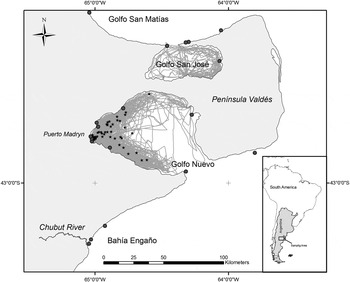
A strip of the coastal area between 42°S and 43.5°S, including Golfo San José, was periodically surveyed by aeroplane since 1999 during right whale censuses (Figure 1). Each flight was carried out every 40–45 days, totalling thirty-three flights, 12 during 1999–2000 and 21 during 2003–2007. The surveys were carried out using a high-wing single-engine aircraft CESSNA 182. Four people travelled on each flight: the pilot, one recorder gathering data with a GPS handheld and one observer on each side of the plane making observations by naked eye, recording species, group size, and behaviour when possible. Average speed of the aircraft was 166 km h−1 (90 knots) at a height of 152 m (500 feet) and a distance from the coastline between 500 and 700 m. A blind strip was left on each side below the plane because the flat windows of the aircraft did not allow the detection of animals under the plane. Flights were carried out under good weather and sea conditions (Beaufort 3 or less). On several occasions, declination angles to the group of dolphins were recorded in order to measure the strip width, although these records only comprised Commerson's dolphins, dusky dolphins and sea lions Otaria flavescens.
Study area. Aerial surveys covered an effective 624 m wide coastal strip from Chubut River to 42°S. Dots show the position of the bottlenose dolphin groups sighted in these surveys. Line patterns indicate transects performed on-board boats in Golfo Nuevo and Golfo San José. Stars represent the position where bottlenose dolphins were recorded on-board.

Boat surveys
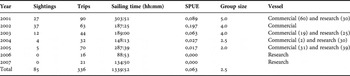
Boat surveys were carried out in Golfo San José (800 km2) and Golfo Nuevo (2500 km2) (Figure 1). These surveys covered almost the entire areas of these bays, therefore adding new data to that gathered by aerial surveys. In Golfo San José, 25 surveys were conducted from September 2004 to June 2007, which lasted 5 hours on average (ranging from 2:45 to 7 hours) using a fibreglass boat with a 105 HP outboard engine from 2003 to 2005, and an inflatable boat with a 90 HP outboard engine from 2006 to 2007. In Golfo Nuevo, 336 surveys were performed from January 2001 to December 2007, lasting 4 hours on average (ranging from 30 minutes to 9 hours). In this case research boats as well as commercial dolphin-watching boats were used (Table 1). Commercial boats only operated during summer (January–April). During winter, the survey effort was lower, mainly due to logistic problems. Surveys did not follow a predefined route or fixed points (random) (Garaffo et al., Reference Garaffo, Dans, Pedraza, Crespo and Degrati2007; Degrati et al., Reference Degrati, Dans, Pedraza, Crespo and Garaffo2008). Once a group of bottlenose dolphins was spotted the number of individuals and the behaviour of the group was recorded, resuming sailing shortly after. However, since these surveys were primarily conducted to study the behaviour of dusky dolphins, once a group of dusky dolphins was found, they were followed as long as possible (Garaffo et al., Reference Garaffo, Dans, Pedraza, Crespo and Degrati2007; Degrati et al., Reference Degrati, Dans, Pedraza, Crespo and Garaffo2008). Although we followed dusky dolphin movements thereafter, bottlenose dolphins were also recorded during these follows.
Number of trips, sightings, sighting per unit effort (SPUE) and group size per year from boat-based suryeys made in Golfo Nuevo.

Cliff-top observations
Between February 1999 and December 2002, records of bottlenose dolphins were collected in Bahía Engaño, the southernmost extreme of the study area (Figure 1). Cliff-top based observations were carried out from a vantage point located at about 3 km south of the Chubut River mouth (43°20′ S 65°02′ W; Figure 1). Cliff height was 21 m, and observations were done with a spotting-scope. The area was scanned north to south every 30 minutes noting the date, scan start time, Beaufort sea state, number of dolphins in the group, behavioural state of the dolphins, and scan finishing time (Coscarella et al., Reference Coscarella, Dans, Crespo and Pedraza2003). As with boat surveys, cliff-top based observations allowed covering further distances from shore than aerial surveys, but bottlenose dolphins were seen mostly very close to the shore (Coscarella & Crespo, Reference Coscarella and Crespo2010). A total of 1081 scans were performed during 81 days. Groups that were seen during the same day were considered as independent data points if a two-hour period passed since the last sighting (Bordino et al., Reference Bordino, Thompson and Iñíguez1999).
Data analysis
Abundance was estimated from aerial survey data by means of a strip transect methodology. Data were analysed using DISTANCE 5.0 software (Thomas et al., Reference Thomas, Laake, Strindberg, Marques, Buckland, Borchers, Anderson, Burnham, Hedley, Pollard, Bishop and Marques2005). Distance data were not recorded within the strip, so we made the assumption that detection probability was homogeneous across the whole strip. This assumption has already been tested during other aerial surveys, and was found to be satisfactory (Pollock et al., Reference Pollock, Marsh, Lawler and Alldredge2006). Visual inspection of the frequency distribution of the declination angles to animals or groups of dusky and Commerson's dolphins and sea lions allowed us to define an effective strip wide of 400 m to each side of the plane (data not shown), including a blind angle of 30°, which represented a blind strip of 88 m at each side from the transect line. This strip wide has already been used with this methodology for bottlenose dolphins population estimates (Barham et al., Reference Barham, Sweeney, Leatherwood, Begs and Barham1980). Only one abundance estimate was obtained since stratification was not possible due to the low number of observations (Buckland et al., Reference Buckland, Anderson, Burnham, Laake, Borchers and Thomas2001).
A relative abundance index defined as sighting per unit effort (SPUE) was calculated for aerial, boat and cliff-top surveys. For aerial surveys, the SPUE was the encounter rate, estimated as the number of groups sighted over the total distance surveyed. In the case of boat surveys, the SPUE was calculated as the number of groups recorded over the total time sailing looking for dolphins. For cliff-top based observations, the SPUE was measured as number of scans with dolphins over the total number of scans. For comparison purposes, the region was divided into Golfo San Matías (GSM), corresponding to the northernmost portion of the study area, Golfo San José (GSJ), outer ridge of Península Valdes (PV), Golfo Nuevo (GN) and Bahía Engaño (BE) corresponding to the southern extreme of the study area (Figure 1). Data were also grouped into seasons, defined as summer (January–March), autumn (April–June), winter (July–September) and spring (October–December). Within each site, differences among seasons were analysed by means of analysis of variance (ANOVA).
Variation in group size among seasons and time of the day was analysed by means of a Kruskal–Wallis (K-W) test. Observations were also clumped together into three-hour periods, starting at 08:00 h. Group composition was determined as adult, juveniles and calves.
RESULTS
Dolphin occurrence in Golfo San José
From aerial surveys 17 groups of bottlenose dolphins were observed. Only one group of 2 dolphins was sighted inside GSJ on 17 December 2005 (Figure 1). No bottlenose dolphin groups were recorded from boat-surveys.
Spatial and seasonal occurrence patterns in the surrounding area
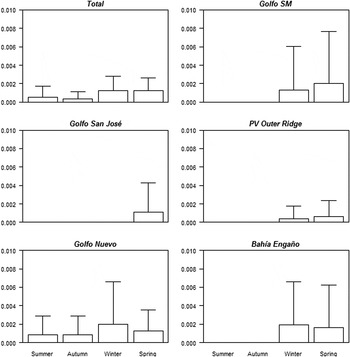
From aerial surveys, bottlenose dolphins were recorded in GN during the entire year, while their occurrence in the remaining areas was mostly during winter and spring (Figure 2). However the overall encounter rate did not differ among seasons (ANOVA, P = 0.17).
Sighting per unit effort (SPUE) and its standard error (bars) measured as the number of groups sighted per distance (km) from aerial surveys. Panels show the SPUE in each zone from north to south. From left upper panel to bottom right panel: total area surveyed, Golfo San Matías, Golfo San José, outer ridge of Península Valdés, Golfo Nuevo and Bahía Engaño.

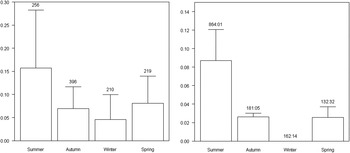
A total number of 85 sightings were recorded in GN from boat surveys. From that number of sightings, 55 were recorded near the harbour of Puerto Madryn (Almirante Storni pier 42°44′S 65°01′W; Figure 1). These records possibly involved the same group of individuals as indicated from some natural marks on dorsal fins (M. Degrati, personal observation). One group of three and one group of ten individuals was recorded with dusky dolphins in different days. The remaining sightings (N = 28) involved one bottlenose individual in apparent association with dusky dolphins. Bottlenose dolphins showed a difference in relative abundance among seasons (ANOVA, P = 0.01). Dolphin groups were sighted more frequently during summer. During winter no group was sighted even though sighting effort was similar to spring and autumn (Figure 3).
Sighting per unit effort (SPUE) and its standard error (bars) measured as the number of scans with bottlenose dolphins over the total number of scans performed in Bahía Engaño (left panel) and measured as number of groups sighted over the total time of sailing in Golfo Nuevo (right panel).

In BE, bottlenose dolphins sighted from cliff were recorded on 91 of 1081 scans. Dolphins were present throughout the year, and the SPUE did not differ among seasons (ANOVA, P = 0.39). Nevertheless, the mean SPUE was higher during the austral summer than any other season (Figure 3).
The SPUEs for each information source are not directly comparable among them but they give an idea of the overall distribution of sightings (Figures 2 & 3). For comparison purposes with the previous published information, we calculated a sighting rate of bottlenose dolphins measured as the number of days in which dolphins were present over the total days of observation. In BE it was 29.8%, in GN 15.51%, while for the entire area was 36.11%.
Abundance estimate
From aerial surveys data, the encounter rate for the entire area was 0.002 ind km−1. Density of animals estimated from a 312 m strip on each side of the plane was 0.0033 dolphins (km2)−1, estimating the population in 34 (22–51) individuals with a percentage coefficient of variation of 19.67%.
Group size
The mean size of the groups recorded from the plane for the entire study area was 2.47 individuals; while for GN the mean size of the groups was 2.75 individuals, and for BE it was 2.3 individuals.
The median group size for the entire area recorded from the plane was 2 with a maximum of nine dolphins sighted in one group, and no difference was observed among season (K-W, P = 0.48). In GN the median group size observed from the boat was 3.5 individuals, with a maximum of ten, without considering the individual in apparent association with dusky dolphins. This figure is larger for summer and autumn (K-W, P = 0.024) although this result should be taken with caution since only 2 out of the 55 groups were recorded during spring. The median group size recorded from the cliff in BE was 3 individuals, with a maximum of 12 dolphins seen on one occasion. There were no differences in the median number of dolphins per group among the seasons (K-W, P = 0.21). Group size did not differ among time blocks in GN neither in BE (K-WGN, P = 0.362; K-WBE, P = 0.247).
Also the group size declined along the years, at least in GN, from 5 to 2 individuals (ANOVA, P = 0.007, r2 = 93.75). Particularly, the group observed systematically near the harbour, involved 4 individuals in 2001 and 2002, while it involved only 2 individuals in 2005 (Table 1).
All groups were composed of adults and juveniles. Calves were never observed in the entire area, but a juvenile was regularly observed in BE (Coscarella & Crespo, Reference Coscarella and Crespo2010).
DISCUSSION
Würsig (Reference Würsig1978) reported the presence of this species throughout the year in GSJ, suggesting a four month cycle for the number of times that dolphins were sighted. Between 1974 and 1976, dolphins were present in the area on 44% of observation days. For the same area, by 1978 the number of sightings was drastically reduced to as little as 5%; although this figure was obtained from interviews of researchers working in the area with other species, and therefore no quantitative analysis was possible (Würsig & Harris, Reference Würsig, Harris, Leatherwood and Reeves1990). Comparison of these historical data with the results of our study should be done carefully. Nevertheless, we can confirm that the sighting rate of bottlenose dolphins decreased within GSJ. In addition to this, the sighting rate for the entire surveyed area is also lower than reported by Würsig (Reference Würsig1978).
Würsig & Würsig (Reference Würsig and Würsig1977) were able to identify 53 individuals and this can be regarded as the minimum population estimate for GSJ. Probably the population was larger, because at the same time groups of unidentified dolphins were sighted in the outer ridge of PV (B. Würsig, personal communication). The estimated number of dolphins for GSJ by Würsig & Würsig (Reference Würsig and Würsig1977) was bigger than the point estimate for the entire coastal area, but our estimates must be taken with caution and can only be regarded as indicative. Even so, there is a clear reduction in the number of dolphins considering that the area surveyed is much larger than Würsig's.
Würsig & Würsig (Reference Würsig and Würsig1979) found that bottlenose dolphins in GSJ sighted from cliff-top averaged 15 individuals per group. These groups were sighted almost exclusively within 1 km from the shore. In this work we estimated that there were around 2.5 dolphins per group regardless of the sampling method used. Some authors consider that the size of the group in bottlenose dolphins is related to water depth, finding smaller groups in closed and protected areas and larger groups in deeper waters (Würsig & Würsig, Reference Würsig and Würsig1979; Shane, Reference Shane, Leatherwood and Reeves1990). The sightings from aerial surveys and BE are restricted to shallow waters and the size of the groups is small. Nevertheless, GN and GSJ were surveyed in shallow and deeper waters and bottlenose dolphins were only seen in coastal areas in small groups. The size of the groups recorded in the present study is much smaller than reported by Würsig (Reference Würsig1978), and thus a decline in the number of dolphins comprising the groups could have occurred during the last 30 years.
Although there is no evidence that the dolphins sighted in GN are the same as those sighted in BE, the distance between locations is only about 200 km along the coastline. It is reasonable that the groups sighted in GN may be part of the same population usually recorded in BE. In other coastal populations bottlenose dolphins are known to move distances in excess of 400 km, with regular movements along the coastline between 50 and 250 km (Defran et al., Reference Defran, Weller, Kelly and Espinosa1999). Considering the range of movements this species is capable of, and the similar size of the groups sighted both in GN and BE, it is possible that the same dolphins are being sighted in the entire region, considering that there are records of dolphins from this group that were spotted 300 km south GSJ (Würsig & Harris, Reference Würsig, Harris, Leatherwood and Reeves1990). On the other hand, bottlenose dolphins did not shift their range towards the north, because almost no dolphins of this group were sighted in the northern portion of GSM using photo-identification methods (Vermeulen & Cammareri, Reference Vermeulen and Cammareri2009).
The decline of the sighting rate in GSJ can be regarded as a shift in its use, and additionally, considering the total population estimates and the reduction in group sizes, a possibly overall population decline could have occurred.
The bottlenose dolphin is not the only species that experienced changes in its distribution in the area. The southern right whale in the 1970s was distributed mainly in the outer ridge of PV and GSJ with few animals in GN, but during the 1980s a major shift in the preferred areas was observed (Rowntree et al., Reference Rowntree, Payne and Schell2001). By the 1990s whales abandoned the outer ridge of PV and moved into GN (also near Puerto Madryn city). The presence of whales in GSJ remained practically unchanged. Rowntree et al. (Reference Rowntree, Payne and Schell2001) concluded that probably changes in environmental conditions (not specified) are responsible for this shift, considering that human disturbance was of no importance.
The only available information regarding a shift in the environmental conditions in GSJ is the sea surface temperature (SST) from 1985 to 2006. Würsig (Reference Würsig1978) reported that waters near the study site were 10.5°C during July–August and 17–18°C for January–March. SST satellite data (available from http://poet.jpl.nasa.gov, date of last access 20 May 2008; monthly data, spatial resolution 4 km2) were analysed by means of a linear regression to detect any trend in the SST for the area adjacent to Würsig's 1974–1976 camp site (42°23′S 64°19′W). No change in SST was detected for either period (July–August, ANOVA, P = 0.124, r2 = 0.07; January–March, ANOVA, P = 0.767, r2 = 0.02). The mean estimated temperatures were 10.6°C and 16.8°C respectively indicating that no change in SST has occurred since the 1970s.
No direct causation can be attributed to the observed decline in bottlenose dolphin numbers as there are no reports of any outstanding mortality in the last 25 years in the region. Since 1990, regular surveys of the beaches accounted only for three bottlenose dolphins stranded in the area. Additionally, a high effort survey of the trawling fishing fleet operating in the Patagonian shelf during the 1990s never reported an entangled bottlenose dolphin (Crespo et al., Reference Crespo, Pedraza, Dans, Alonso, Reyes, García, Coscarella and Schiavini1997). This provides little support to the hypothesis of an increased mortality rate by natural or human induced causation.
Human activities can produce a displacement of bottlenose dolphin populations from their previous habitats (Bejder et al., 2006). Nevertheless, human activity in GSJ has remained practically unchanged since the 1970s. Some established MPAs allow commercial activities involving dolphins directly (i.e. boat based dolphin-watching) that in some cases showed to be non-sustainable (Lusseau et al., Reference Lusseau, Slooten and Currey2006). In the case of GSJ, dolphin-watching activities are forbidden. One activity that increased in GSJ during this period is the recreational and artisanal fishing for Argentine sandperch and other species of rocky reef fish. The scale of the impact of this activity is unknown, although the fish size and abundance had decreased since the 1970s (Venerus, Reference Venerus2006). Considering that Würsig & Würsig (Reference Würsig and Würsig1979) reported that dolphins use these rocky reef areas as feeding grounds, if the recreational fishing had an impact on the abundance of rocky fish consumed by bottlenose dolphins, this can be regarded as one of the possible reasons for the dolphins' displacement out of the area.
Marine Protected Areas are considered to be an effective management tool for protecting marine wildlife. In many cases the creation of a MPA is driven by a handful of charismatic species, but it is expected to protect several components of the ecosystem. It is well known that the creation of a MPA should also include a monitoring plan to regularly evaluate its performance (Kelleher, Reference Kelleher2001; Gerber et al., Reference Gerber, Botsford, Hastings, Possingham, Gaines, Palumbi and Andelman2003; Hoyt, Reference Hoyt and Hoyt2005). GSJ and later PV as a system performed fairly well in accomplishing its main objective: protecting the nursery grounds for the southern right whale (Rowntree et al., Reference Rowntree, Payne and Schell2001). Nevertheless, there are many other components in the MPA that must be surveyed periodically, and dolphin populations are one of them. Within the area, no efforts were directed towards these species until recently (Garaffo et al., Reference Garaffo, Dans, Pedraza, Crespo and Degrati2007; Degrati et al., Reference Degrati, Dans, Pedraza, Crespo and Garaffo2008), and this study is the first attempt to survey the bottlenose dolphin population. In light of the results of the present work, a research programme on the population dynamics of these bottlenose dolphins and studies of the putative physical factors and biological variables is an urgent need to implement protective measures.
ACKNOWLEDGEMENTS
The authors are indebted to many people and organizations for the institutional, logistical, and financial support given throughout this study. We thank the Centro Nacional Patagónico (CONICET), Fundación BBVA and Fundación Vida Silvestre Argentina. We also thank the Secretaría de Turismo de Chubut that granted the permits to carry out the studies. Nancy Mora, Alejandro Buren, Rocío Loizaga de Castro and Florencia Grandi helped to collect the data. Robert L. Brownell Jr made useful comments on an early version of the manuscript. We are grateful to Bernd Würsig for his feedback that improved the clarity of the paper. The procedures performed during this study comply with the current laws of Argentina. This work was supported by a CONICET Doctoral Fellowship (M.A.C., 1998), by funds granted by ANPCyT (E.A.C. grants numbers 4025, 4030, 11679 and 33934) and Project PNUD (E.A.C., grant number ARG- 02/018 (B-B27)).