

Introduction
During the last 20 years, one of the most discussed topics in the academic literature on political parties is that of the cartel party theory as described by Katz and Mair (Reference Katz1995, Reference Katz and Mair1996, 2009). While many articles have focussed on the possible shortcomings of the theory (among others, Koole, Reference Knapp1996; Kitschelt, Reference Kirchheimer2000; Pierre et al., Reference Pérez Francesch2000; Scarrow, Reference Scarrow2006), other authors have applied this grand theory to the party system level (Hopkin, Reference Hopkin2002; Sikk, Reference Sferza2003; Detterbeck, Reference Detterbeck2005, Reference Detterbeck2008; Krouwel, Reference Koß2012; Loomes, Reference Laurent2012; Vernardakis, Reference Van Biezen, Mair and Poguntke2012), to the political economy of the cartel party (Blyth and Katz, Reference Blyth and Katz2005), and to the organizational features of those parties (Carty, Reference Carty2004; Bolleyer, Reference Bolleyer2009).
Nonetheless, the evolution of party politics in Europe deserves more attention vis-à-vis the emergence of cartelized mainstream parties. The success of anti-establishment parties, in particular the populist radical right parties (Mudde, Reference Mölder2007), seems to show that ‘cartel parties have created […] their own internal contradictions’ (Katz and Mair, Reference Katz1995: 23). Moreover, the erosion of the ‘classical’ cleavages and the emergence of a European neo-liberal consensus (McNamara, Reference McAllister1998), should suggest a possible reinforcement of the cartel theory.
These phenomena, however, need to be tested in more depth at the party level Mair (Reference Mair1994). Rather than looking at the systemic conditions (Katz and Mair, 2009) that may have fostered the formation of cartels in European political systems, the analytical framework of this paper focusses on those features identified by the cartel party theory as indicators of the cartelization of a political party. This paper is intended to (partially) fill this gap by focussing on the transformations of three social-democratic parties in Europe: the Parti Socialiste (PS) in France, the Partido Socialista Obrero Español (PSOE) in Spain, and the Partito Democratico (PD) in Italy. Using a longitudinal analysis of c. 20 years, three facets of the evolution of the above parties will be tested: first, their reliance on public funding; second, their membership trends, and third, their convergence with the other mainstream parties in the national context [the Rassemblement pour la République (RPR) – Union pour un mouvement populaire (UMP) – in France, the Partido Popular in Spain, and Forza Italia (FI) – Il Popolo delle Libertà (PdL) – in Italy, respectively].
The main findings in this work show a slightly different picture with respect to the alleged cartelization of those political parties. Although some cartelizing features can be detected in all three cases, namely the convergence towards a pro-market and pro-EU stance, the reliance on public funding, and the choice of an unmediated selection of candidates through the primaries, other factors such as the overall membership of the parties and the reforms of public funding laws in favour of less generous schemes should suggest a more nuanced approach to the cartel party theory.
The cartel party theory: which level of analysis?
The cartel party can be defined as an ‘evolution’ of the catch-all party described by Kirchheimer (Reference Katz and Mair1966). In Kirchheimer’s theorization, catch-all parties converge ideologically and battle for the same electorate, while at the same time dissociating from the society. Katz and Mair (Reference Katz1995) observed a further transformation of catch-all parties into state agencies. Parties are ‘[n]o longer simple brokers between civil society and the state, the parties now become absorbed by the state’ (Katz and Mair, Reference Katz1995: 16). The consequence of this shift towards the state is intra-party collusion: the political competition is thus reduced to a matter of efficiency and effectiveness in the management of the government. Nonetheless, this metamorphosis does not imply the absence of electoral turnover: cartelized parties choose consciously to minimize the consequences of the loss, rather than competing to win against other cartelized parties. In a nutshell, cartelized parties move ‘toward maximizing the reasonably anticipated minimum pay-off (maximin) (italics in the text)’ (Katz and Mair, 2009: 758). For non-cartelized parties, on the other hand, the possibility of eradicating the cartel is lower than the chance of ‘governing’ parties winning the election. In order to collect evidence of the cartelization of both party systems and political parties, Katz and Mair (Reference Katz1995, Reference Katz and Mair1996, 2009) focussed on four general features: (1) the anchoring of political parties to the state through the introduction of public funding schemes, (2) decreasing party membership across Europe and the cheerleading role of members in selecting the leadership, (3) the reduction of competition between (mainstream) parties, and (4) the tendency towards a stratarchical organization.
This framework of analysis was criticized by Koole (Reference Knapp1996), who contends that the systemic property of the theory (cartelization) should not be used to describe individual (cartelized) parties; however, Katz and Mair replied (Reference Katz and Mair1996, 2009) that the cartelizing features can be ascribed not only to party systems as a whole, but also to political parties. Starting from a different level of analysis, Kitschelt (Reference Kirchheimer2000) targets the problem of micro-foundations in Katz and Mair’s theory; in particular, Kitschelt’s work stresses the bi-directional relation between party leaders and members. The divorce of the leader from the membership is all but automatic, since while members on one side may be satisfied with the leadership, on the other side, they can threaten or use the ‘exit’ option. According to Scarrow (Reference Scarrow2006), public party subsidies did not freeze new parties out of the political competition, since the balance of resources between membership fees and public funding was not altered by the introduction of public funding laws in the 1970s and 1980s. Finally, according to Detterbeck (Reference Detterbeck2005: 188) the ‘cartel party [theory] is overloaded with assumptions’, as other factors may be decisive for the formation of a cartel, namely electoral law, the level of political professionalization in each country, and the culture of political accommodation.
Cartelization within a political party
Despite the criticism, the cartel party theory is one of the most relevant frameworks of analysis for the evolution of political parties. From this perspective, the four features of political party cartelization discussed above deserve further exploration.
First, the state subvention is regarded as the main cause for parties to become agents of the state. As Katz and Mair (Reference Katz1995: 15) put it, precisely ‘because these subventions are often tied to prior party performance or position […] they help to ensure the maintenance of existing parties while at the same time posing barriers to the emergence of new groups’. The overall picture on western polyarchies (Dahl, Reference Dahl1972) shows that since the introduction of public funding laws (Alexander, 1989; Nassmacher, Reference Nassmacher1993; Nassmacher and Nassmacher (Reference Nassmacher and Nassmacher2001); Van Biezen and Kopecký, Reference Van Biezen and Kopecký2001; Scarrow, Reference Scarrow2007; Piccio, 2012; International Institute for Democracy and Electoral Assistance (IDEA), 2014), state subventions are the main source of funding for mainstream parties (Van Biezen, Reference Van Biezen2003; Koß, Reference Koole2010; Nassmacher, 2009; Van Biezen and Kopecký, Reference Van Biezen and Kopecký2014, Reference Van Biezen and Kopecký2015). Moreover, in their recent work, Van Biezen and Kopecký (Reference Van Biezen and Kopecký2015: 5) argue that ‘in nearly all countries [analysed] the share of public funds shows an upward trajectory and that of the membership fees a downward trend’ while ‘in 12 out of 17 countries, the relative share of the membership fees falls below 15 per cent’.
The second variable is the decline in party membership: on one side, cartelized parties are the forerunners of the professionalization of politics (Panebianco, Reference Nassmacher and Nassmacher1988); on the other side, those parties tend to privilege a capital-intensive approach to electoral campaigning, in contrast to their reliance on mixed labour- and capital-intensive approaches when in a catch-all context. Thus, rather than members, cartel parties need communication experts and access to all mainstream communication networks. The cartelization of political parties implies a situation of parties without partisans (Dalton and Wattenberg, Reference Dalton and Wattenberg2000). This is borne out by a constant reduction of the party membership and the relegation of members to a cheerleading role within a pattern of top-down decision-making (as opposed to bottom-up decision-making) (Katz and Mair, Reference Katz and Mair1992: 20). Even more radically, Van Biezen et al. (Reference Van Biezen and Kopecký2012) argue that the level of party membership is so marginal that it may no longer be a relevant indicator of the organizational capacity of parties. The declining membership is also accompanied by the empowerment of the party leadership. As acknowledged by Katz and Mair (Reference Katz1995), leaders are responsive to a wider electorate rather than to their members, and yet supporters and members are empowered through the possibility of selecting candidates for elections (Mair, Reference Mair1997; Katz, Reference Jahn2001). However, in this view, instruments such as primaries or mail-in ballots allow parties’ executives to control the most radical or vociferous components of the party, rather than ensuring ‘real’ participation. Third, the personalization/mediatization of politics (Mazzoleni and Schulz, Reference Mateos Crespo1999; Campus, Reference Campus2010; McAllister, Reference Mazzoleni and Schulz2007) and the increasing difficulty on the part of parties to provide public good in light of greater fiscal responsibility (Katz and Mair, 2009) should favour the policy-making (and ideological) convergence of the mainstream parties.
Finally, the fourth feature is the stratarchical organization of the parties (Carty, Reference Carty2004; Bardi et al., Reference Bardi, Ignazi and Massari2007; Bolleyer, Reference Bolleyer2011; Cross, Reference Cross2016). Despite centralization of the sources of power within the party, the party in public office needs the support of key figures on the ground. Moreover, once the party faces reduced capability in distributing material inducements (patronage), it is even more costly for leaders to maintain the support of the party on the ground. For that reason, in organizational terms the best option for a cartelized party is the stratarchy (Katz and Mair, 2009). In a stratarchical organization, central leadership tends to grant a higher degree of autonomy to local levels (regional, provincial, county) in exchange for support at the national level. Primaries in this context should serve the purpose of giving national (and local) leaders more room to manoeuvre (to the detriment of the members).
Methodology and case selection
Methodology
The aim of this paper is to test the consistency of the cartel party theory, focussing on the following three aspects of cartelization over the period 2005–15: (1) public funding, (2) membership, and (3) ideological convergence. The fourth cartel feature – the stratarchical organization – is beyond the scope of this analysis and would require another well-documented investigation comprising an in-depth study of the political system, the statutes of the parties, and the effective balance of power between different party levels. However, the literature on the organization of the parties being examined herein has shown a growing tendency towards stratarchization: the PSOE, despite its previous centralization (Hopkin, 1999; Méndez and Orte, 2005), conceded more autonomy to regional branches (Méndez Lago, Reference McNamara2006); the Democratici di Sinistra (Left Democrats)/PD also moved from a more hierarchical organization towards stratarchical organization (Pizzimenti and Calossi, Reference Pierre, Svåsand and Widfeldt2013); whereas the PS, according to Sferza (Reference Scarrow2002) and Sawicki (1998), shifted after the Epinay Congress (1971) from a territorial to a factional organization, in which divisions become more organized than before. Still, the presidentialization of the PS upon the introduction of primaries to elect a nominee for President of the Republic may be regarded as a major organizational innovation within the French party (Hegel and Sawicki, Reference Hegel and Sawicki2014). Notwithstanding the absence of the final feature (stratarchy), the other three features provide a generally accurate illustration of the evolution of the three parties.
First, as the reliance on public funding is imperative for cartel parties, the growth in the parties’ budget vis-à-vis the revenue from membership fees will indicate a first symptom of cartelization. Besides, the introduction of laws favouring greater support from the state for party budgets will strengthen this hypothesis.
Here, the data will be collected from that available in the literature, from the annual budget of the parties and from the national offices that supervise the finances of the parties (the Commission Nationale des Comptes de Campagne et des Financements Politiques in France, the Tribunal de Cuentas in Spain, and the Corte dei Conti in Italy).
Second, the overall decline of the membership should indicate that the membership is losing power relative to the two other facets (still, the cartel party theory does not theorize on the quality of this reduced membership). As for the three countries under analysis, the data provided by Mair and Van Biezen (Reference Mair2001) and by Van Biezen (Reference Van Biezen2013) show a (partial) countertendency with respect to other European countries as regards the change in ratio of party membership to electorate since 1990: a longitudinal analysis from the 1980s onward show negative trends for Italy (−4.09) and France (−3.20) and a positive trend for Spain (+3.16). Moreover, ‘plebiscitary’ forms of political participation within those parties, that is primaries, reveal the increasing marginalization of ‘old-fashioned’ members with respect to other forms of participation. New members and sympathisers are, on the other hand, should be less inclined to demand constant accountability through official party’s organs. With the precautions needed for the reliability of the data provided by the parties, the operationalization of this second part is divided into two parts: one is devoted to the analysis of membership, while the other is based on the analysis of primary elections held by the three parties.
Third, according to Katz and Mair, cartel parties prefer collusion to competition in order to minimize the cost of defeat: the ideological convergence among the mainstream parties is a core feature for collusion to occur. The Comparative Manifesto Project (CMP) provides an indicator of the right-left scale of the party manifestos (RILE). The RILE ‘has been constructed mainly deductively, relying on certain a priori assumptions about the meaning of “left” and “right”’ (Mölder, Reference Mjelde2013: 2); the index has 26 categories (divided into two sets, left and right) out of the 56 included in the coding scheme. Theoretically, the range of the variance is from −100 (‘left’) to +100 (‘right’). Still, the real range is more limited, since only half of the total set of the coded categories are included within ‘left’ and ‘right’. Despite some criticism (Franzmann and Kaiser, Reference Franzmann and Kaiser2006; Jahn, 2011), the RILE indicator can furnish a useful tool (Budge, Reference Budge2013) for enquiry into the ideological distance between different political parties in the same country. Second, since cartel parties in Europe should be more answerable to supranational institutions (EU), rather than responsive to the electorate, a convergence towards a pro-EU stance is to be expected. In the CMP, the category per108 inquires as to the recurrence of positive evaluations of the European Community/Union in the manifestos: what is hypothesized here is that cartelized parties’ positive mentions of the EU should converge with the positive mentions of the (other) parties within the cartel. Since ideological convergence may also occur in the policy-making field, the votes in parliament and position in the referenda campaigns of the parties under analysis in the five most recent EU treaties will be part of the analysis: the Treaty of Nice (2001), the referenda on the EU Constitution (2005) in France and Spain and its ratification in the Italian case, the Treaty of Lisbon (2008), the European Stability Mechanism (ESM) (2011), and the Fiscal Compact Treaty (2012). Third, a convergence between centre-left and centre-right cartelized parties should be expected for the markeco CPM indicator. The markeco indicator is composed by per401 category and per414 category, where the former refers to the free market economy and the latter to economic orthodoxy.Footnote 1 A convergence in the markeco indicator for all cartelized parties is to be expected. The data on per108, per401, and per414 can be found in the online Appendix of this paper.
An addendum is crucial: convergence is intended as a trend towards ideological similarity with other mainstream cartelized parties. Thus, the ideological ‘collusion’ will be examined in relation to the other member(s) of the cartel. The ideological shift of one party, though important, would be only partially indicative of the formation of a cartel. In effect, while social-democratic parties may shift towards lower values in the RILE indicator and higher values in the markeco indicator, other conservative parties can radicalize their ideological position too and move towards a greater protectionist stance. This opposing trend would impede convergence taking place. In comparative terms, thus, only the convergence between two (or more) cartelized parties can explain a possible cartelization, while the shift of a single social-democratic party towards the political ‘centre’ indicates merely a trend towards ‘moderate’ positions.
Case selection
The cases selected are the PS in France, the PSOE in Spain, and the PD in Italy in the last 20 years.
As in any temporal truncation, the choice suffers from a certain degree of arbitrariness; this because, for example, the PD was founded only in 2008. For that reason, the temporal limits should be considered as guidelines to restrict the breadth of the research. As far as the reasoning behind this selection, three main reasons can be put forth. First, all of the cases belong to the same party family [the European Socialist Party (ESP)] and, to some extent, their ideological background can be considered comparable. Party family is a crucial variable in the analysis of political parties (Mair and Mudde, 1998): since the three parties joined the ESP, albeit in different years, the starting point of the analysis is that all share common guiding principles related to the EU and to capitalism, that is the acceptance of property rights. Second, social-democratic parties, according to Blyth (Reference Blyth2003), belong to the party family that suffered the most from the depoliticization of monetary policy and the crisis of Keynesian expansive policies in the 1980s, and thus cartelization would have been a viable survival strategy.
Third, these parties can be considered as ‘governing’ parties (Katz and Mair, 2009): all of them experienced an absolute/relative majority in parliament and as such had ample incentives to cartelize with other mainstream centre-right parties in order maximize their payoff with respect to non-cartelized parties. In the last 20 years, the most long-lasting governing era was that of the PSOE under the leadership of José María Zapatero, while the PD joined two grand coalitions with centre-right parties in 2011 and 2013, while in 2014 it became the major shareholder of the coalition that sustains Matteo Renzi as prime minister. Finally, the French Socialist Party gained both the legislative and the presidential elections in 2012. Its last electoral victories dated back to 1997 (the so-called gauche plurielle era) in the legislative elections and to 1988 for the presidential elections.
Public funding
This part will be focussed on the three parties’ reliance on public funding, on the for/against vote expressed by those parties regarding the law on public funding in each national context, and on the reasoning behind the reforms of the public funding laws (Scarrow, Reference Sawicki2004; Casal Bértoa et al., Reference Casal Bértoa, Molenaar and Piccio2014).
Reliance on public funding
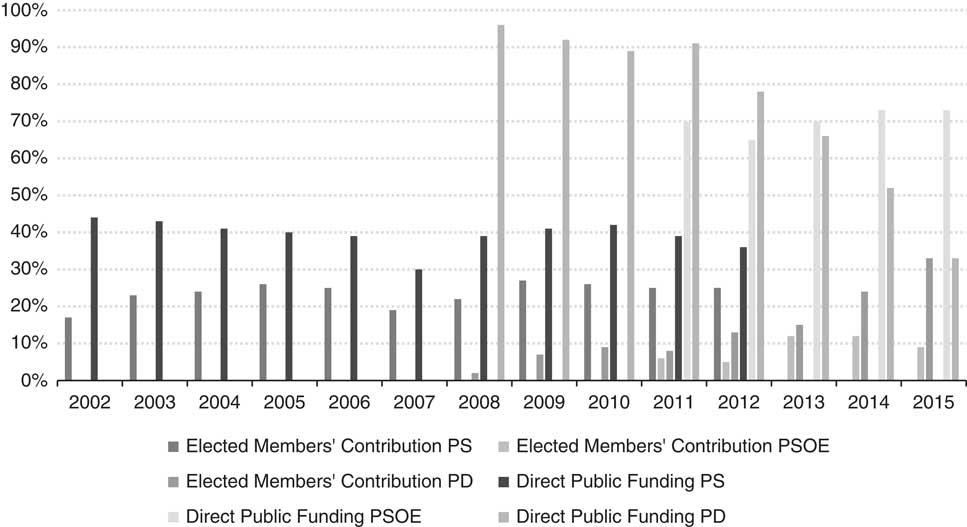
As Figure 1 shows, the PS relies on public funding and on contributions from the elected members for about two-thirds of its annual budget. The trend in the decade 2002–12 is stable, with the lowest peak reached in 2007 when the income derived from both public funding and contributions covered only 49% of the annual budget. Contrary to the PSOE and the PD, elected members’ contributions account for more than 20% of the PS budget: the mean for the period under analysis is 23.7%, while it is only 6.3 and 7.3% for the PSOE and the PD, respectively. However, being structured as federations, the PD and the PSOE leave more room for manoeuvring at the local level with regard to expenses: in the case of the PD, no affiliation quotas are inserted in the national annual budget from 2008 to 2011 and only a small part of them are included in the following years. Moreover, the quotas that potential voters pay for participating in the primaries (2€ at minimum) – except for the coalition primaries – are left to the provincial federations. In the case of the PD, for example, the contributions of the elected members in the lower institutional levels (regions, province, municipalities) remain in the federation to which the elected members belong; the same occurs with the federations that compose the PSOE. In the Spanish case, the Socialist Party of Catalonia had more than 9% of this annual budget in 2012 covered by the donations of the càrrecs (elected members).
Public funding in Parti Socialiste (PS), Partido Socialista Obrero Español (PSOE), Partito Democratico (PD). Source: Own elaboration from Commission Nationale des Comptes de Campagne et des Financements Politiques, Berruyer (Reference Berruyer2014), PSOE website, PD website. See also online Appendix.

Despite that the available data does not permit scrutiny of medium-term trends, the short-term trend in the PSOE indicates that the share of direct and indirect public funding is rising as a percentage of the annual budget (from 75% in 2011 to 82% in 2015).
Until 2012, as a percentage of the whole annual budget, the PD relied almost entirely on electoral reimbursement (between 97 and 99% from 2008 to 2011), while in the following 2 years the share decreased to 75%.
In the PD’s case, the funding decreased constantly year per year with a significant drop in 2009 (−98%) and 2014 (−76%). The PD had the largest budget in absolute terms in 2008 and 2009, while more recently PSOE overcame its Italian and French counterparts, except for the 2012 PS annual budget (about 63.5 million). The PS received the lowest quota from public funding, probably because of its opposition role in Parliament. With a proportional distribution of the public funding based on the electoral success in the previous elections (Gillespie, Reference Gillespie1998; Ariño Ortiz, Reference Ariño Ortiz2009; Pizzimenti and Ignazi, Reference Pizzimenti and Ignazi2011; García Ortiz, Reference Garcìa Ortiz2013; Mateos Crespo, 2014; Commission Nationale des Comptes de Campagne et des Financements Politiques, 2015), this is not surprising.
The laws on public funding
In France, the first codification of parties’ public funding dates back to 1988, during the first period of the so-called cohabitation. It was first reformed in 1990, when, on one side, limits were introduced on private donations and, on the other side, public funding was extended to parties that did not obtain parliamentary representation. The 1995 law – approved in the second period of cohabitation – forbids donations from a personne morale, while the limit for the personne physique was reduced to 7,500€: this reform was boosted by an illegal funding scandal during the electoral campaign of the former prime minister Édouard Balladur. The 2003 reform restricts the platform of the party eligible for the public funding to those that obtain at least 1% in at least 50 districts. The last reforms are dated back to 2013, during the Hollande presidency: the Lois relatives à la transparence de la vie publique changed the provisions on private citizens’ donations to political parties and created an independent authority for transparency in public affairs. In Spain, one of the latest versions of the Ley Orgánica de financiación de los partidos politicos (Law on Financing Political Parties) was approved in 2007 by the whole Congress with the exception of the Popular Party (PP); the previous version (1987), on the contrary, received cross-cutting support. Notwithstanding the elimination of anonymous donations and the imposition of 100,000€ as a limit for private donations (article 5), the 2007 law increases the total amount of public funding about 20% with respect to 2006 (Pérez Francesch, Reference Pérez Francesch2009). In order to avoid replicating the majoritarian distortion of the electoral law, public funding is divided into three parts: the first distributes the quota in accordance with seats obtained by each party in the election, while the other two distribute according to the votes gained by all parties that concurred in the elections. Other reforms were introduced with Ley Orgánica 5/2012 and Ley Orgánica 3/2015. In the first case, the reduction of public support received a transversal support. In the second case, despite the shared commitment of the major parties to enhanced transparency and greater control over the funding received by political parties, the PSOE voted against. As for the Italian case, a referendum abolished public funding (90.3% voted in favour of the abolition) in 1993; law 515, approved in the same year, transformed ‘public funding’ in ‘electoral reimbursement’ in order to overcome the proviso of the referendum. Other reforms broadened the possibilities for access to electoral reimbursement (1999, 2002, and 2006), while at the same time increasing the amount of the reimbursement. In 2014 the law decree proposed by the Letta Government abolished (effective from 2017) direct public funding to parties, while facilitating ‘liberal donations’ and allowing private citizens to donate 2×1000 of their annual income to parties. In all three cases corruption scandals regarding illegal funding schemes seemed to have favoured the reform of the law on public funding, especially with regards to private donations to parties or single members.
Membership
PS
The PS has never acquired a mass-party conformation, inasmuch as the membership was lower compared with other social-democratic parties (Knapp, Reference Kitschelt2002: 120). Apart from the National Front and the Greens – two notable exceptions – in the Fifth Republic affiliation to the parties sharply declined from the 1980s onwards, with a more moderate downturn from the late 1990s (Hale Williams, Reference Hale Williams2009). What is more striking with respect to the cartel theory is that both the RPR/UMP and the PS increased their membership in recent years (Hale Williams, Reference Hale Williams2009). In the case of the UMP this may be due to the boost given by the leadership of Nicolas Sarkozy, while in the case of PS the open primaries in 2011 boosted the overall affiliations immediately after the 2012 PS congress (De Luca, Reference De Luca2015).
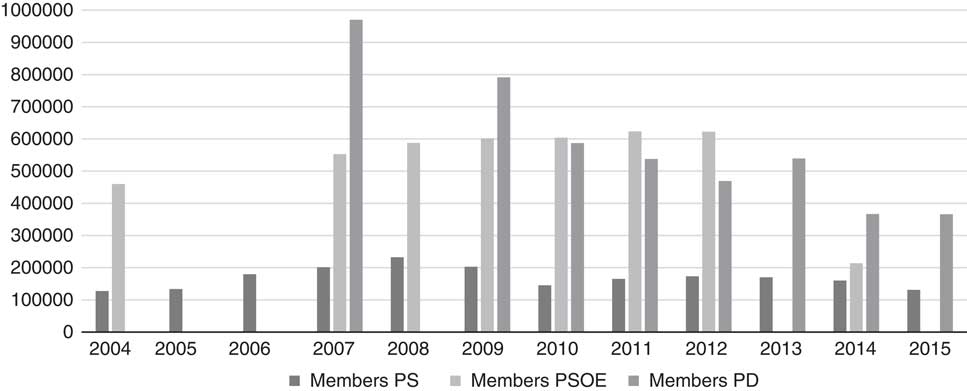
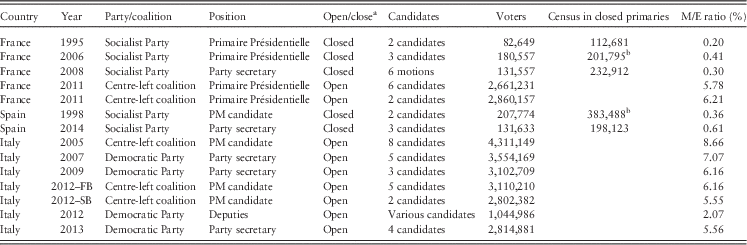
As Figure 2 shows, in the last 15 years, there is a positive balance in the absolute numbers of the PS members: in 2006, when Ségolène Royal won the nomination as the socialist candidate to the presidency, membership increased by a consistent 34.2%; along the same line, in 2011, the year of the first open primaries (called primaire citoyenne), membership growth was +13.6%. More recently, Lorriaux (Reference Loomes2015) highlighted the poor participation in the last congress in Poitiers with only 75,000 votes cast out of 130,000 members. After the shocking result of 2002, participation dropped the following year by −7.3%; the same downturn occurred in the 2009 and 2014 European elections (−28.4% in 2010 and −18.2% in 2015). Although membership was stable in the last 30 years, more ‘direct’ forms of participation, such as the open primaries (Table 1), have encouraged a direct relationship between the candidates and the whole electorate. Furthermore, primaries spread at different institutional levels. In 2014, the PS held six open primaries for the municipal elections (Aix-en-Provence, Marseille, Béziers, Boulogne-Billancourt, Le Havre, La Rochelle). Today, the primaire citoyenne for the nominee for President of the Republic is part of the statute of the party (articles 5.3.1, 5.3.2, and 5.3.3). Though primaries are becoming a central moment for candidate selections within the PS, the overall picture does not confirm the hypothesis of a sharp decline in the membership: according to Knapp (Reference Kitschelt2002), soon after the first presidential victory of a PS candidate (François Mitterrand) the estimated members were 180,000, only 20,000 more than 2014.
Party membership in Parti Socialiste (PS), Partido Socialista Obrero Español (PSOE), and Partito Democratico (PD). Source: Knapp (Reference Kitschelt2002), De Luca (Reference De Luca2015), Laurent (Reference Krouwel2015), French Socialist Party archive for the PS. Méndez Lago (Reference McNamara2006), López Alba (Reference López Alba2012), Barberá et al. (Reference Barberá, Baras, Barrio, Correa and Rodríguez-Teruel2014) for the PSOE. In the PSOE case, the sum of members and sympathizers is indicated in the years 2004, 2007, 2008, 2009, 2010, 2011, 2012. The members in 2014 are those entitled to vote for the party primaries. PD archive, Dominici and Damiani (Reference Dominici and Damiani2013), De Marchis (Reference De Marchis2009) for the PD. The year 2007 refers to the sum of Left Democrats and The Daisy (estimation), while for the year 2015, the amount is an estimation of the PD Organization Office.

Nationwide party primaries

M/E=member/electorate; PM=prime minister; FR = first round; SR=second round.
Source: own elaborations.
a The distinction between open and closed is drawn from Baras et al. (Reference Baras, Barberà, Barrio, Correa and Rodriguez-Teruel2015).
b This data has been deducted from the participation rate provided by Dolez and Laurent (Reference Dolez and Laurent2007) for the Parti Socialiste primaries and from El País (1998) for the Partido Socialista Obrero Español primaries.
PSOE
As a latecomer to democracy, Spain experienced a different path in party membership with respect to France and Italy. Despite a lower membership/electorate ratio compared with other Western European counterparts (Baras et al., Reference Baras, Barberà, Barrio, Correa and Rodriguez-Teruel2015), political parties experienced a considerable growth in absolute membership. Parties in Spain, soon after the democratic transition, focussed on the enrolment of new activists in order to institutionalize the party system: in 10 years (1986–96), parties’ total membership went from 421,497 to 911,817 members in 1996. Afterwards, the growth rate slowed down. In absolute terms, the total membership reached 1,127,073 units in 2005 (Bosco and Morlino, 2006) and 1,547,000 in 2015. As Baras et al. note,
[i]n a context of generalized party decline in most of Western Europe […] this growth shows a clearly deviant pattern. However, the growth of the overall party membership figures is less impressive when compared to the evolution of the Spanish electorate. The party member/electorate (M/E) ratio has slowly improved from 1.2% (1977) to 3.7% (2004) (Reference Baras, Barberà, Barrio, Correa and Rodriguez-Teruel2015: 24).
As for the PSOE, in the aftermath of the transition to democracy (1975) the active participation of the members in decision-making within the party was irrelevant (Mestre, Reference Méndez Lago2007). The main innovation, in this regard, was the creation of a new category of members, the so-called simpatizantes (sympathisers). The PSOE, alongside others parties from different ideological background (Baras et al., Reference Baras, Barberà, Barrio, Correa and Rodriguez-Teruel2015), introduced this new form of participation without any membership fee. The distinction between types of members came after the electoral defeat in 2000 and the election of José Luis Rodríguez Zapatero as PSOE’s secretary.
Thus, today, the PSOE has three kinds of participation: the militante (militant), the afiliados directos (directly affiliated members), and the simpatizante (sympathiser). The difference between the first and the second is that militants have a local affiliation within the federative structure of the PSOE, while the directly affiliated members are part of the federal organization without any link to local organizations. Contrary to the previous two figures, the sympathisers do not hold any voting rights within the party (with the exception of the open primaries).
The data on membership in the Spanish case is full of problems, mainly because of poor reliability; ‘lack of transparency and misinformation has reigned since the restoration of democracy. Neither public opinion nor academic pressure has been strong enough to change that’ argue Baras et al. (Reference Baras, Barberà, Barrio, Correa and Rodriguez-Teruel2015: 24). Thus, the data in Figure 2 must be considered far from definitive.
In 7 years (2000–07) the PSOE membership saw significant growth (+35.5%), while the M/E ratio peaked at 1.742 (2011) from 1.201 in the year 2000. Also, in a period of crisis for the country and for the socialist party, namely during and immediately after the second Zapatero mandate (2008–11), the membership was stable. Nonetheless, the primary elections held in 2014 for the choice of the new PSOE secretary and opened to members and sympathisers, showed that the data provided in the previous years were not completely reliable, unless a massive drop (−65.7%) in the overall membership occurred in just 2 years (2012–14).
Contrary to the PS and the PD cases, PSOE held only two closed primaries in 2000 and 2014 (Table 1). The party tried to call for primaries for the last election (2015), but Pedro Sánchez was the only candidate that reached the signature threshold required by statute. Contrary to the French and Italian cases, primaries are not encoded in the federal statute: it is the Executive Federal Commission that proposes primary elections to the Federal Committee. It is up to the Federal Committee to approve the primaries (article 36, letter V – PSOE Statute); for that reason, the ‘openness’ to civil society shown by the Italian and French counterparts is still in the works in the Spanish case.
PD
The Democratic Party (PD) was founded in 2008 from the merger of two centre-left parties, the Democratici di Sinistra – DS (Left Democrats) and La Margherita/Democrazia e Libertà (DL) (The Daisy). Both parties were heirs to the two dominant parties during the so-called First Republic, the Italian Communist Party (PCI) and the Christian Democracy (DC), respectively (Bordandini et al., Reference Bordandini, Di Virgilio and Raniolo2008). Both the PCI and DC, alongside the other main Italian parties, had a wide constituency in absolute terms: from 1946 onward the total membership of the Italian parties oscillated between 3.5 and 4 million members.Footnote 2
The decreasing trend in membership started soon after 1990 – when a wide schema of illegal financing of the most relevant parties, known as Tangentopoli (the city of bribes) was discovered in 1992. Despite the dissolution of the main parties (DC, PCI, and the socialist party), Italy had one of the highest M/E ratio (5.57%) in Europe (Van Biezen et al., Reference Van Biezen and Kopecký2012). The diffuse suspicion regarding the party system discouraged membership; the level of participation fell conspicuously in 1993 (−42.6%). The haemorrhage of members stopped only in 1997: in the following 6 years, a wavering growth in overall membership has been recorded. With respect to 1997, the percentage growth in the total membership in 2003 was +30.9% (see Appendix).
Since its genesis (2008), the PD has been unable to retain the members of its constituent parties (DS and DL); as Figure 2 shows, the tendency in the medium term is a slow but constant decrease in membership. Nonetheless, the introduction of primaries increased the participation of the centre-left electorate for the selection of different candidates. Some experimental primary elections preceded the birth of the PD, while the first nationwide open primaries of the centre-left coalition were held in 2005 for the nominee for prime minister. The downward trend of participation in the primary elections in the following years, though, seems to testify to the growing difficulties of the PD in mobilizing its electorate (Table 1).
The Statute of the Democratic Party contemplates primary elections for the nominee to the mayoral seat of the (main) Italian municipalities, the presidency of the Italian provinces and regions, and the candidate to the representative assemblies at all institutional level (articles 18 and 19). Yet, primaries are not automatic for any institutional level, since several factors (such as incumbency) may actually influence the choice of the party in this regard. The primaries for the nominee for prime minister can be held only in case of coalition primaries; otherwise the secretary is the candidate for the party. The secretary of the party is elected through primary elections, but in order to participate in the primaries, the candidatures need to be approved by the National Convention. The three most voted candidates in the Departmental Congresses (Congressi di Circolo) are allowed to participate in the open competition.
Ideological convergence
France
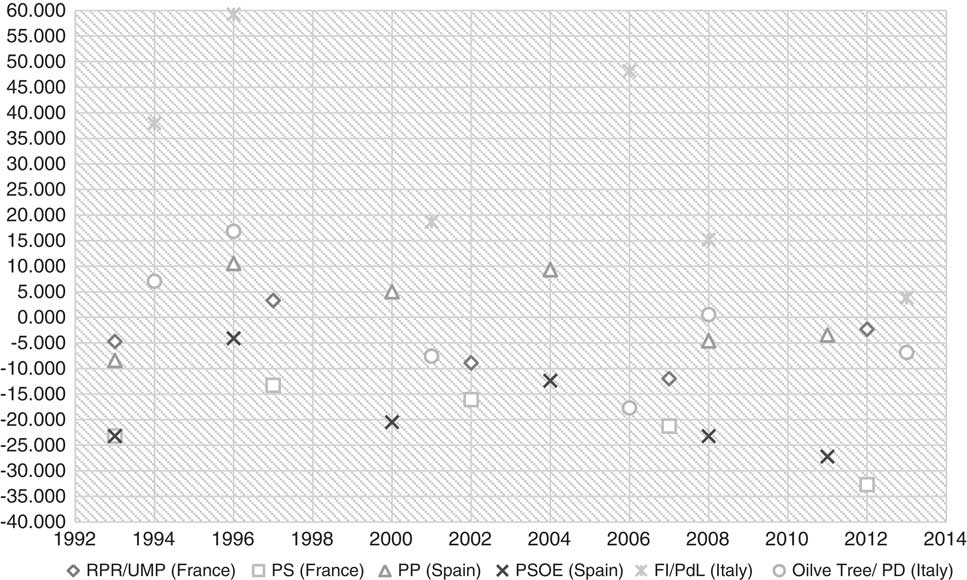
In the French case, five elections are analysed. The RILE indicator (Figure 3) shows a political convergence between 1993 and 2007; indeed, the smallest ideological distance between PS and UMP was recorded in 2002 (7172); yet, it increased in the last two rallies, particularly in 2012 (30,379). Convergence is more marked with regards to the markeco index (from 5487 to 1689), while it is less evident for the per108 category, where the difference between PS and UMP reached its peaks in 1997 and 2012 (see online Appendix).
Right-left scale of the party manifestos indicator for ‘cartelized’ parties in France [Union pour un mouvement populaire (UMP)/Rassemblement pour la République (RPR) and Parti Socialiste (PS)], Spain [Popular Party (PP) and Partido Socialista Obrero Español (PSOE)], and Italy [Forza Italia (FI)/Il Popolo delle Libertà (PdL) and Olive Tree/Partito Democratico (PD)] in five elections for each country. Source: Comparative Manifesto Project.

As explained in the methodology, convergence can be found not only in the programmatic manifestos, but also in the policy-making. In 2005, the three major political forces in France (UMP, PS, and UDF) campaigned for the Yes in the referendum on the European Constitution, although the PS was divided between the Yes side led by Hollande and the No side led by Fabius. The no side prevailed with 54.68%. Previously, the RPR and the PS ratified the Treaty of Nice in Parliament. Despite the internal divisions, the PS ratified the Treaty of Lisbon along with the UMP. The PS abstained from the ratification of the ESM, while both parties ratified the Fiscal Compact Treaty.
Spain
In the Spanish case, during the two PP governments (from 1996 to 2004), the ideological distance between PSOE and PP was accentuated with respect to the previous socialist government. Despite a reduction in the ideological distance in 2008, the difference increased again in 2011 (Figure 3). The markeco index, conversely, showed a path of convergence between 1993 and 2008 (see online Appendix). Along the same lines, the PP and the PSOE – two traditionally pro-European parties – had similar scores in the per108 category. In the policy-making field, the convergence of the two mainstream parties with regard to the European issues was long lasting. Both parties campaigned for the Yes in the referendum on the European Constitution, held in 2005. The ‘Yes’ obtained 81.65%. Both parties agreed upon the ratification of the Nice and Lisbon treaties and of the ESM and Fiscal Compact, as well as the modification of article 135 of the Spanish constitution regarding the deficit’s golden rule (estabilidad presupuestaria). The turn towards market liberalism was nothing new in Spanish social democracy after the rejection of the Marxist thesis in the 1980s, but still pro-market stances went side-by-side with the social-democratic values (Encarnación, Reference Encarnación2009: 413).
Italy
In the Italian case, the ideological distance between the PD (and its heirs) and FI/PdL in the RILE index was significant in four out of six elections (Figure 3). In the 17 elections under analysis, the three with the most relevant distance between centre-left and centre-right parties were recorded in Italy. Nonetheless, when the PD was born (2008), a clear-cut path towards convergence took place. Similarly, the markeco indicator shows a relevant distance between centre-right and centre-left parties from 1994 to 2006 (with the exception of 2011 elections), while from 2008 the gap diminished. With the exception of the 2008 elections, the per108 category displays a deviant path with respect to the other indexes: in this case, the difference grows gradually reaching its peak in 2013 (see online Appendix).
As in the previous case, a certain degree of convergence between the two mainstream parties can be found in the field of EU-related issues. While the FI/PdL was rhetorically ambivalent (at least) with regards to the relationship with European institutions, both parties (Ulivo/PD and FI/PdL) voted for the ratification of the main European treaties (Nice, Lisbon, and the EU Constitution), as well as the most relevant economic reforms (ESM and Fiscal Compact). The PD and the PdL formed two grand coalitions in 2011 (Prime Minister Mario Monti) and in 2013 (Prime Minister Enrico Letta). In the former case the coalition was broken after 7 months when the PdL was dissolved: a minority of the party led by Angelino Alfano gave confidence to Letta government, while the majority of the PdL, which was again renamed Forza Italia after the Alfano faction’s scission from the PdL, opposed the new pact signed by the PD and other centrist parties.
Conclusion
This paper was aimed at disentangling the puzzle of the cartelization of three social-democratic parties. Thus, rather than looking at cartelization at the systemic level, I focus my attention on the party level. Following the theoretical framework provided by Katz and Mair, cartelization should be analysed according to four elements: organization, the reliance on public funding, membership, and ideological convergence. Despite the fact that a tendency towards stratarchization did emerge in the literature for the three parties, the analysis of organizational features was beyond the scope of this paper and, thus, was left aside. As for public funding, the data provided a clear-cut conclusion regarding the reliance on public funding of all three parties. However, it is not possible to straightforwardly state that these parties increasingly rely on public funding to survive; in the Italian case, the PD approved the (almost complete) abolition of public funding, while in Spain the PSOE and the PP – despite their different votes in Congress – agreed on the reduction of public funding for political parties. Several reforms aimed at enhancing transparency in private donations have passed in the last years with the crucial contribution of the three social-democratic parties.
Membership decreases relevantly in the Italian case, while the PS and the PSOE show a higher degree of resilience, albeit in a context of stagnating growth in both cases: thus, members are not completely fading away from parties. The introduction of open primaries in the Italian and French cases (closed primaries in Spain) for the selection of candidates at different institutional levels do confirm that membership in itself may no longer be the crucial asset it used to be. Nonetheless, this tendency cannot be automatically equated to an alleged disappearance of members; nor it can be stated that members have no roles within the party. Indeed, the organization of primaries relies on the mobilization power of parties’ members and congresses are still important to decide the competitors in primary rallies (in the case of the PD for example); most of all, electoral campaigns still rely on grassroots activism to be effective (Mjelde, Reference Mestre2014).
Finally, as far as the ideological convergence is concerned, the RILE and markeco indicators show a wavering trend: since the foundation of the PD, the Italian case displays a more marked path towards convergence than France and Spain, where the ideological distance between mainstream parties increased in the last elections. Difference between centre-left and centre-right parties in the per108 category are relevant in France and Italy, while less important in Spain. Nonetheless, in all three cases the mainstream parties under analysis show a high degree of convergence with respect to EU treaties, even those related to the management of the economic crisis.
In conclusion, despite there being some signs of cartelization within the three social-democratic parties, the cartel party theory still cannot be confirmed in toto: (a) membership in the social-democratic parties is not disappearing; (b) and while they rely almost entirely on public subventions, political parties proved to be capable of reforming the public funding laws, increasing the transparency of donations and reducing the total amount of public subvention; (c) although convergence occurred in the EU-related issues, social-democratic parties still differ in some respect from centre-right parties. Cartelizing features, while relevant and somewhat consistent with the theorization proposed by Katz and Mair, are not fully institutionalized in the PS, the PSOE, and the PD.
Acknowledgements
I would like to thank the anonymous reviewers for their helpful comments on the first draft of the paper. I would also like to thank the Editors for their support during the review process.
Financial Support
This research received no grants from public, commercial, or non-profit funding agency.
Data
The replication data set is available at http://thedata.harvard.edu/dvn/dv/ipsr-risp
Supplementary material
To view supplementary material for this article, please visit https://doi.org/10.1017/ipo.2017.15