Introduction
Lebanon is located in the Middle East on the eastern coast of the Mediterranean Sea. It covers an area of 10,425 Km2 (1046 miles2). There are 4,224,000 inhabitants, with 87% living in urban areas.1 The health care system in Lebanon is predominantly for-profit and “only 12 % of hospitals and 10 % of beds are in the public sector.”Reference Kronfol2
Constant armed conflict in the region, in addition to the civil war from 1975 until 1991, shaped the development of emergency medical services (EMS) in Lebanon. Emergency medical services agencies have adopted an overall approach based on rapid transport to hospitals without providing prehospital medical care. Data suggest that only 20% of critical cases are transported by ambulances and the rest by private transportation. Transport is often by family members.Reference Pane3 The reasons for the current EMS status are related to limited human resources (both for high-level responders and medical oversight), insufficient technical resources (advanced equipment and supplies), scarce high-level management and system-thinking leadership, and gaps in public education efforts.
Overall Structure of the EMS in Lebanon
The two largest EMS agencies in Lebanon are the Lebanese Red Cross (LRC) and the Civil Defense (CD). The LRC is part of the International Federation of Red Cross and Red Crescent Societies, and since 1964 has been the officially mandated agency by the Ministry of Public Health (MOPH) to provide prehospital emergency care and transport.4 The CD is a fire department-based government agency that was created in 1967 to mitigate personal and property damages or losses resulting from wars or natural disasters, and is charged with urban search and rescue missions. In 2009, more than 70% of prehospital emergency transports were carried out by the LRC (75,673 emergency calls and transports by LRC EMS and 31,634 by the CD). Other small municipal and private EMS agencies play a minor role in emergency patient transport from the scene and between health care facilities.
The existing structure of the EMS system in Lebanon is fragmented with little evidence of partnership among different stakeholders. Current legislative authority does not identify a leading state agency that is statutorily charged with the comprehensive leadership, development, and regulation of the EMS system and its components. In addition, the EMS agencies involved in prehospital care report to different executive authorities; for example, LRC falls under the jurisdiction of the MOPH, and the CD and smaller municipal agencies fall under the jurisdiction of the Ministry of Interior rather than the MOPH.
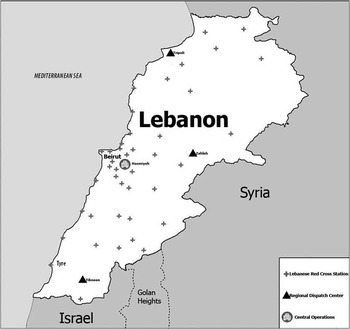
Due to the absence of overarching regulatory and legislative authority for EMS activities, the various EMS agencies implement independent and different EMS plans, internal regulations, and standards of operations. The geographic distribution of EMS stations and workforce is not driven by needs assessment, nor based on objective epidemiological data. The LRC service zone covers most of the country's territories with four dispatch centers and 44 stations (Figure 1). The CD is more widely available with over 210 stations in the different regions, however, the CD role is minimal when compared with that of the LRC EMS. Most geographic areas in Lebanon have an overlap in EMS coverage between the LRC and CD.
Distribution of Lebanese Red Cross Stations in Lebanon

Funding of EMS
There is no financial legislation to support the EMS systems in Lebanon. The financing of other Lebanese healthcare services comes from different government sources including the MOPH, the National Social Security Fund, the Cooperative of Civil Servants, the security forces through the Ministry of Defense and the Ministry of Interior, and from the private sector. Most of the government funds allocated to healthcare in Lebanon are spent on private hospitals. For example, more than 80% of the MOPH's annual budgetReference Pane3 goes to private hospitals covering in-patient cost for persons with no medical insurance (estimated to be 40% of the Lebanese population).Reference De Clercq5, Reference Schieber6
Some funding for LRC prehospital providers staffing ambulances operating during daytime hours (6 am -6 pm) in a few regions are provided by MOPH and by municipalities. Other funding is provided to the CD through the Ministry of Interior to support emergency equipment and salaries and benefits of providers. These salaried CD providers are fulltime employees, constituting a minority of the EMS workforce which is primarily volunteers. The LRC EMS, and to a lesser extent the CD, benefit from donor assistance such as grants and non-governmental organization support. Donations often include ambulances and emergency equipment or provider training grants. Neither the LRC EMS nor CD bill for prehospital services.
Public Access and Dispatch
Different emergency telephone numbers exist for the different EMS agencies. The three-digit medical emergency numbers are 140 for the LRC, 125 for the Civil Defense, and 175 for the fire brigade. There is a need for public education to increase awareness about these EMS access numbers. In an unpublished survey conducted in Southern Lebanon, it is estimated that 80% of the participants do not have these phone numbers memorized.Reference Bayram7
To add to the confusion, individual EMS stations have eight digit numbers that can receive calls directly from the public, bypassing the dispatch center. Direct calling to EMS stations is a frequent occurrence. For example, calling 125 for Civil Defense refers the caller automatically to the closest station bypassing centralized dispatch. The caller's location and phone number identification are not automatically available to dispatch centers.
EMS agencies have different dispatch centers with different phone numbers, therefore there is no centralized dispatch system in Lebanon. The LRC receives emergency calls at four different dispatch centers that transmit the call to the closest station or to the next geographically available station to dispatch an ambulance. Priority medical dispatch and emergency medical dispatch protocols are not used. The public safety answering points do not utilize emergency medical dispatch. A recent project to train dispatchers and develop medical dispatch protocols is in progress at the LRC.
Because of the absence of a single emergency access number for EMS and a unified dispatch center that coordinates EMS activities, the EMS system in Lebanon suffers from time delays in EMS responses and frequent redundancy of services with multiple ambulances from different agencies responding to the same scene.
Equipment and Supplies
Equipment type, quality, quantity, and placement differ largely among various ambulance agencies, and occasionally within the same agency. All ambulances are essentially basic life support equipped and staffed. The numbers of available ambulances in 2009 were 253 for LRC, and 120 for the CD. Most ambulances are equipped with ventilation and airway equipment (portable oxygen supply, bag valve mask, suction device), extrication devices (Kendrick extrication device), stretchers and chairs, immobilization devices (cervical collars, backboards, traction and immobilization devices), and basic trauma and burn kits (compression dressing, bandage, gauze, tourniquet and burn blanket).
At least 44 LRC ambulances (one per station) are equipped with Automated External Defibrillators (AEDs). Two-way communication VHF radios are also available on LRC ambulances for communication between prehospital EMS providers and dispatchers. Six ALS ambulances were donated in 2001 by the Italian government to the LRC, and are seldom utilized. There are few private for-profit ALS ambulances that employ physicians and registered nurses; they are used to transfer critical patients from one facility to another for a prepaid fee.
Training and Certification
The licensure and certification of health care workers in Lebanon are among the regulatory functions of the MOPH. There are no national standards for certification and licensure, nor is there a national database of EMS providers in Lebanon. Approximately 2,600 LRC volunteers and 4,700 combined CD paid and volunteer providers were active in 2009. The scope of practice for EMS providers is not defined due to the absence of regulations regarding standards for training, education, and skills of EMS personnel. The highest level of care provided in the prehospital setting by non-physician providers is at the Basic Life Support (BLS) level. In the absence of a national curriculum and national certification, different agencies have adopted nongovernmental certification for their providers. Prior to assignment to a station, LRC providers undergo an initial 120 hours training in first aid, cardiopulmonary resuscitation (CPR), AED use, urgent transport, and other basic life support skills. This is followed by ambulance ride-along training for a period of three to six months after assignment. Continuous training is also available for providers who remain active in EMS. Some of the CD workers (mainly the paid employee minority) undergo a 15-day basic initial training in scene safety, first aid, CPR, trauma care, and emergent transport. However, most of the CD providers function as emergency responders and staff the CD ambulances despite lack of structured training.
Medical Direction
No specific Lebanese government agency is charged with medical oversight of the EMS system. There are no standard medical operating procedures or prehospital medical treatment protocols. Because of an absence of regulations pertaining to the scope of medical practice of prehospital providers, prehospital interventions are limited to first aid, CPR, infrequent AED use (when available), and transport to the closest facility. The LRC has a historical affiliation with the “Hotel Dieu de France” hospital in Beirut, with a few physicians serving on the LRC EMS medical committee.
The concept of medical direction is absent in Lebanon with no direct, online or offline medical direction of EMS activities. At this time, there are no performance measure attributes that are implemented for when data is collected. Other than trauma care, little focus has been given to other EMS priority conditions such as out-of-hospital cardiac arrest, stroke, respiratory distress, and seizure. A pilot study was started in 2009 to introduce patient care report documentation to selected LRC stations. This may be a first step towards the initiation of quality review and management that may pave the way for medical direction for EMS activities in Lebanon.
EMS Interface with the Hospital-Based Emergency Care
In Lebanon, there are about 178 functioning hospitals. The accreditation process of these hospitals is part of the regulatory role of the MOPH. This process was revised in 1999, and hospitals underwent a new classification based on a new system linked to the quality of care, rather than structure and bed capacity.Reference Ammar, Wakim and Hajj8 The new categorization of hospitals did not take into account the capacities of these hospitals to function as emergency care facilities. Currently, the prehospital community is unable to determine if a receiving hospital emergency department (ED) is capable of caring for a patient being transported. Additionally, patients are transported by EMS agencies to an ED without prior communication or notification; communication with the receiving hospitals is required only in cases of inter-facility transport. The prehospital and hospital-based components of the Lebanon health system operate separately without adequate coordination.
Emergency Medicine specialization is recognized by the Lebanese order of physicians and the MOPH. However, the completion of formal residency training in Emergency Medicine is not required to be able to practice in the ED.Reference Bayram7 Therefore, most of the EDs are staffed by general practitioners, as the only qualification needed to work in the ED is a degree in Medicine. One hospital in Beirut, the American University of Beirut Medical Center (AUBMC), has Emergency Medicine residency-trained faculty staffing its ED. In an effort to advance emergency medicine and standardize emergency care in Lebanon, the AUBMC launched a formal academic residency program in Emergency Medicine in July 2012.
Future Prospects
The EMS system in Lebanon faces numerous challenges. The formation of a comprehensive system of emergency care is hindered by the absence of a lead agency that is statutorily charged with EMS oversight, planning, system assessment, policy development, and regulation. Categorization of existing hospitals as emergency care facilities and trauma centers is needed. National standards for training, licensure, and education of prehospital providers also need to be developed. The financial stability of the existing EMS agencies is fragile, with an overdependence on donor assistance, and an absence of a formal funding mechanism to sustain EMS operations and update emergency equipment, vehicles, and infrastructure. EMS agencies also face problems that are common among EMS volunteer systems, such as the recruitment and retention of prehospital providers and the recruitment of EMS medical directors.
The EMS system in Lebanon has been slowly improving with the implementation of small projects addressing the different components of the prehospital medical system. A plan to upgrade LRC providers is underway for training to the basic prehospital trauma care level as described in the World Health Organization 2005 report entitled Prehospital Trauma Care Systems.9 Selected providers will also participate in the Prehospital Trauma Life Support (PHTLS) course offered by the United States (US) National Association of Emergency Medical Technicians as part of a recent 2012 grant awarded the LRC. Hopefully, training and education initiatives along with the efforts of a motivated workforce within the EMS community will translate into quality improvements for prehospital emergency care in Lebanon.
Abbreviations
- ALS:
Advanced Life Support
- CD:
Civil Defense
- ED:
emergency department
- EMS:
emergency medical services
- LRC:
Lebanese Red Cross
- MOPH:
Ministry of Public Health
- VHF:
very high frequency