

Introduction
Ruminant rearing activities are at the spotlight for reducing greenhouse gas (GHG) emissions (Gerber et al., Reference Gerber, Steinfeld, Henderson, Mottet, Opio, Dijkman, Falucci and Tempio2013). In tropical regions, the culture of rearing ruminant herds in extensive pasture systems is usually associated with pristine forest degradation, which is another aggravating factor to climate change (Cohn et al., Reference Cohn, Mosnier, Havlik, Valin, Herrero, Schmid, O’Hare and Obersteiner2014). On the other hand, reducing GHG emissions from ruminants by decreasing herd size is unfeasible due to the continuous growth of human population, demand for food and assuming that current consumer behaviour and preference for meat and dairy products will persist in the future. One possible alternative to hamper GHG emissions from these systems is via optimisation, by, for instance, improving pasture quality. Better pastures will allow for improved productivity, and thus reduced enteric CH4 emissions per unit of produce (Hristov et al., Reference Hristov, Ott, Tricarico, Rotz, Waghorn, Adesogan and Dijkstra2013).
Albeit that most ruminants are reared in extensive or semi-extensive systems worldwide, little is known about quality of their pastures and their effects of weight gain and milk production. Expected influencing factors to pasture quality are soil physical, chemical and biological properties as well as soil nutrient balance, duration and intensity of the rainy season, temperature, pasture and herd management practices. Quantifying the effect of these pasture quality influencing factors on ruminant enteric CH4 emissions, would be advantageous to hamper emissions.
The aim of this research was to simulate enteric CH4 emissions from individual beef cattle, representative from tropical herds, and to evaluate the CH4 emission mitigation potential of improving pasture nutritional value.
Material and methods
The mechanistic model RUMINANT
The rumen dynamics model developed and described by Herrero et al. (Reference Herrero, Havlik, Notenbaert, Rufino, Thornton, Blümmel, Weiss, Grace and Obersteiner2013) (RUMINANT) is used for this study. A detailed description of the equations and coefficients embedded in the model of Herrero et al. (Reference Herrero, Havlik, Notenbaert, Rufino, Thornton, Blümmel, Weiss, Grace and Obersteiner2013) is provided in the studies of Illius and Gordon (Reference Illius and Gordon1991) and Sniffen et al. (Reference Sniffen, O’Connor, Van-Soest, Fox and Russel1992). Model input variables consists of current and target live body weights, maximum milk production and daily weight gain. Diet composition is picked from a built in library of 98 different types of feeds, classified as forages, concentrates and stovers. The main outputs of RUMINANT include daily faecal dry matter, urinal and nitrogen excretions, metabolisable energy above supply, supply above maintenance, potential milk production, live BW gain and enteric CH4 emissions.
The study-case farm
The characterisation of individual beef cattle used in the case of this study was made with information from Agri Benchmark database (Agri-Benchmark, 2016), the reference name of the farm is BR-400. This farm is physically located in the Brazilian state of Mato Grosso, at the edge of the Amazon forest. In order to define the amount of forage available to each individual cow, a herd of 1254 Nelore cows was considered. Animals graze year round at a pasture area of 2000 ha, yielding a stocking rate of 1.2 ha/cow. The standard diet consists of ad libitum foraging with brachiaria, supplemented with salt minerals.
Model calibration and the low CH4 emission scenarios
After calculations of manure production and enteric CH4 emissions for current feeding regimes (as described above), further simulations were conducted for different ‘low emission’ scenarios, aiming at reducing emissions by improving cattle diet quality.
Results and discussion
Model calibration
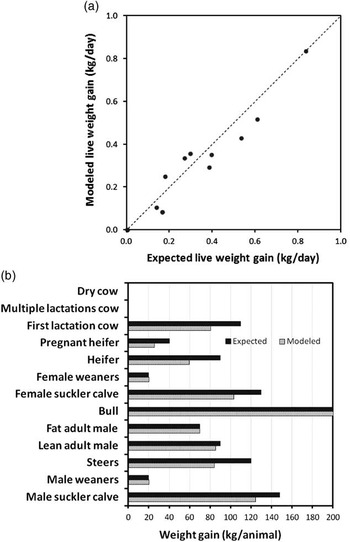
When paired together, the daily live weight gain (LWG) obtained from the model and that obtained for farm BR-400 fit to a linear model (Figure 1a). Linear regression analysis revealed that the data points presented a reasonable fit to the 45° slope line, suggesting that the modelled data agreed fairly well with the field collected data. Daily LWGs were added to give total gains over the total number of days that each animal remained at a specific category, the data are presented in Figure 1b. The differences in total LWG between modelled and experimental data observed were as high as 36% (pregnant heifers), followed by heifers (34%) and steers (30%). However, the majority of the herd comprises weaners, lean and fat adult males, which presented relatively small disagreement (0% to 17%).
Comparison of modelled v. expected live weight gain (LWG, kg/day), where each data point represents an animal per category of the herd (a). LWG (kg/animal) over the designated period per herd category (b).

Scenario analysis
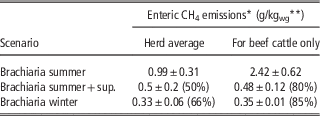
Three scenarios were taken into account and the results are presented in Table 1. In the first scenario, or baseline, brachiaria is the main diet of the animals. This first scenario takes the dry conditions of the long-lasting summer in the Brazilian state of Mato Grosso (6 to 8 months/year) into account, leading to pasture of poorer nutritional value.
Modelled enteric methane (CH4) emissions (mean±SE) at different scenarios of pasture quality pooled over the entire herd categories or considering beef cattle only

* The number between brackets is the percentage of reduction in relation to the scenario ‘brachiaria summer’.
** Per kg of live weight gained in a day.
The next scenario took the same summer pasture into account, but with giving the animals a small supplementation with corn silage, leading to a reduction of the enteric methane emissions of at least 50%, compared with the reference case. However, one must consider that supplementation is not the first option for the farmer when it comes to improvement of herd performance. The third scenario resulted of a reduction of enteric CH4 emissions of at least 66%, during the winter, which is characterised by more rain. Similar emission reductions as in scenario 3 could be obtained by improving pasture management, such as dividing the pasture into patches for successive utilisation by the herd, intercalated with pasture resting periods.
Acknowledgements
The authors would like to thank IIASA for providing the funding, and ‘agri benchmark’ for providing the data used in this study.