Introduction
The lichen genus Icmadophila Trevis. has most recently included five species with a green-algal photobiont and a crustose or small-foliose thallus: I. ericetorum (L.) Zahlbr. (the type species), I. aversa (Nyl.) Rambold & Hertel, I. japonica (Zahlbr.) Rambold & Hertel, I. splachnirima (Hook.f. & Taylor) D. J. Galloway emend. L. Ludw. and I. eucalypti Kantvilas.
Together with the genera Dibaeis Clem., Endocena Cromb. including Chirleja, following Fryday et al. (Reference Fryday, Schmitt and Pérez-Ortega2017), Pseudobaeomyces M. Satô, Siphula Fr., Thamnolia Ach. ex Schaer. and Siphulella Kantvilas et al., Icmadophila is classified in the family Icmadophilaceae Triebel (Rambold et al. Reference Rambold, Triebel and Hertel1993; Tehler & Wedin Reference Tehler, Wedin and Nash2008; Lendemer & Hodkinson Reference Lendemer and Hodkinson2012; Jaklitsch et al. Reference Jaklitsch, Baral, Lücking and Lumbsch2016).
Until 1993, Icmadophila contained the single species I. ericetorum, which has a Holarctic distribution but had also been reported from New Zealand (Galloway Reference Galloway1985, Reference Galloway2007), South Africa (Drège Reference Drège1843; Doidge Reference Doidge1950) and South America (Pereira et al. Reference Pereira, Müller and Valderrama2006). However, the presence of this species in New Zealand and South Africa is now considered highly doubtful (Ludwig Reference Ludwig2015). It grows mainly in heathland and bogs on damp peaty soil, plant debris, bryophytes or rotting bark and wood, and is characterized by a pale green, granular-crustose thallus with pink, sessile to shortly stalked, biatorine apothecia. Rambold et al. (Reference Rambold, Triebel and Hertel1993) synonymized Glossodium Nyl. with Icmadophila, and transferred G. aversum Nyl. and G. japonicum Zahlbr. into the genus on the basis of similarities in thallus morphology, secondary chemistry, substratum preference and ecology, as well as on spore and ascus characters. The main difference between I. ericetorum and Glossodium is the morphology of the ascomata, which are bisymmetrically tongue-shaped and distinctly stalked in the latter but discoid and usually sessile to subpedicillate in I. ericetorum. Icmadophila aversa is endemic to Central and South America (Wilk Reference Wilk2010) whereas I. japonica is known from Far East Russia and Japan (Ohmura Reference Ohmura2011), where it is sympatric with I. ericetorum.
The Australasian endemic lichen, Knightiella splachnirima (Hook.f. & Taylor) Gyelnik (see Ludwig (Reference Ludwig2016) for detailed distribution), was transferred to Icmadophila by Galloway (Reference Galloway2000), as had been previously suggested by Galloway (Reference Galloway1992), Gierl & Kalb (Reference Gierl and Kalb1993) and Rambold et al. (Reference Rambold, Triebel and Hertel1993). This view, however, was rejected by Stenroos et al. (Reference Stenroos, Myllys, Thell and Hyvönen2002), whose analysis of nuclear SSU rDNA sequences placed K. splachnirima in a sister relationship with all remaining members of Icmadophilaceae, considerably removed from I. ericetorum. Despite this, the genus Knightiella Müll. Arg. has been absent from subsequent checklists of Icmadophilaceae genera (e.g. Eriksson et al. Reference Eriksson, Baral, Currah, Hansen, Kurtzman, Rambold and Laessøe2003, Reference Eriksson, Baral, Currah, Hansen, Kurtzman, Rambold and Laessøe2004; Eriksson Reference Eriksson2005; Lumbsch & Huhndorf Reference Lumbsch and Huhndorf2007, Reference Lumbsch and Huhndorf2010; Tehler & Wedin Reference Tehler, Wedin and Nash2008; Lumbsch et al. Reference Lumbsch, Ahti, Altermann, Amo de Paz, Aptroot, Arup, Bárcenas Peña, Bawingan, Benatti and Betancourt2011; Jaklitsch et al. Reference Jaklitsch, Baral, Lücking and Lumbsch2016; Lücking et al. Reference Lücking, Hodkinson and Leavitt2017), and the combination I. splachnirima has remained in use throughout much of the Australasian lichenological literature (e.g. Galloway Reference Galloway2007, Reference Galloway and Nash2008; Ludwig Reference Ludwig2011; De Lange et al. Reference De Lange, Galloway, Blanchon, Knight, Rolfe, Crowcroft and Hitchmough2012; Knight Reference Knight2014; McCarthy Reference McCarthy2016), although Kantvilas (Reference Kantvilas2018) retained K. splachnirima in Knightiella. A sorediate and usually sterile form of K. splachnirima is considered to be a result of environmental plasticity rather than a separate taxon (Ludwig Reference Ludwig2011, Reference Ludwig2015).
A further Australasian species, Icmadophila eucalypti, was described from Tasmania by Kantvilas (in Lumbsch et al. Reference Lumbsch, Ahti, Altermann, Amo de Paz, Aptroot, Arup, Bárcenas Peña, Bawingan, Benatti and Betancourt2011) and transferred to Knightiella by Kantvilas (Reference Kantvilas2018) based on geographical and ecological factors, and on the small-squamulose thallus with an ecorticate, white lower surface that bears some resemblance to K. splachnirima. A third Knightiella species, K. queenslandica Kantvilas, has recently been described from Queensland, Australia, based on morphological similarities to K. eucalypti (Kantvilas) Kantvilas (Kantvilas Reference Kantvilas2018).
The present study explores the relationships between the five species of Icmadophila using a molecular phylogenetic approach. We aim to re-evaluate the circumscription of Icmadophila in relation to the genus Glossodium and the apparently Southern Hemisphere genus Knightiella. In addition, we aim to ascertain whether the rare, newly described K. queenslandica shows genetic affinities with other Knightiella species.
Materials and Methods
Specimens examined
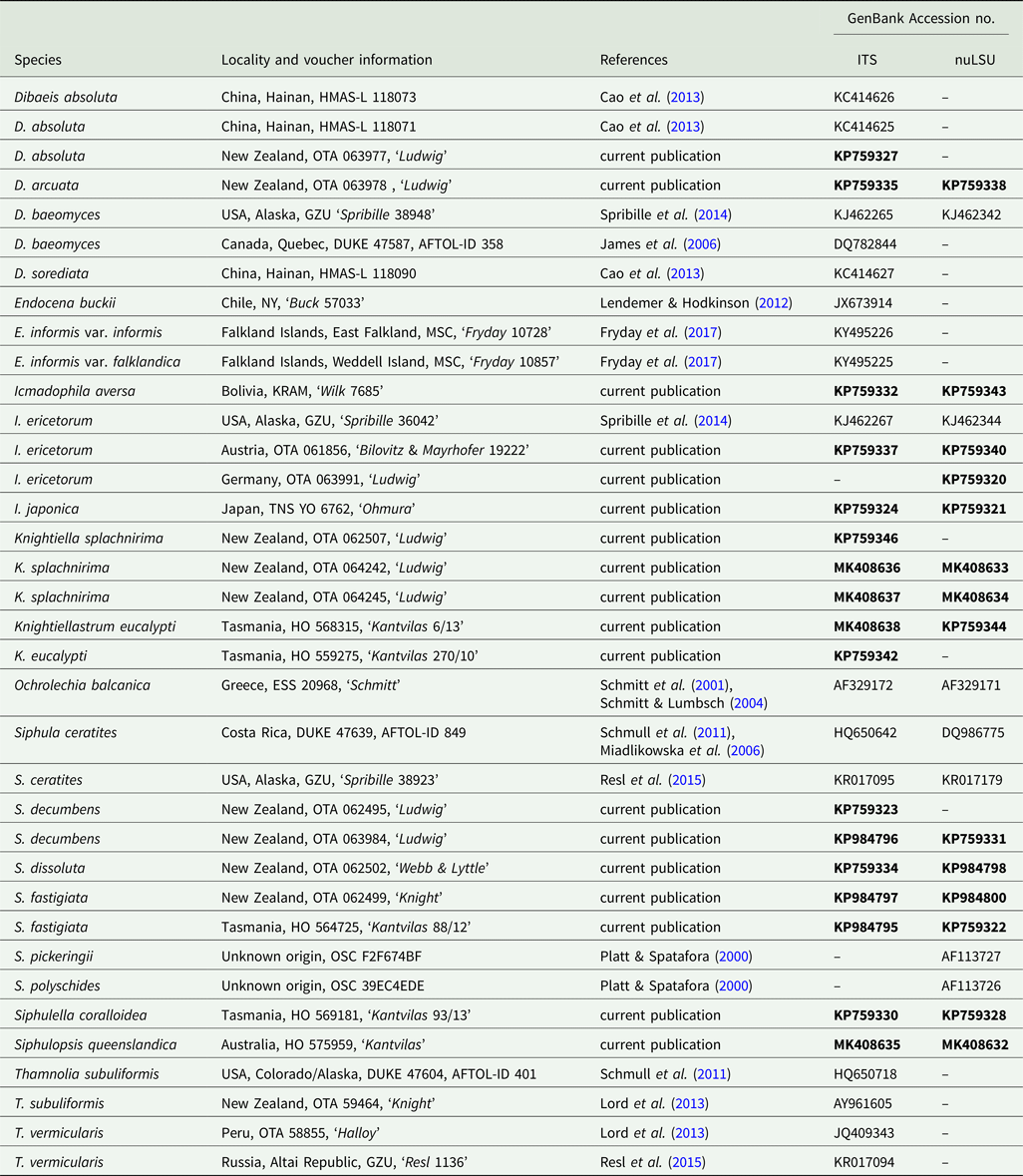
Specimens of all five described Icmadophila species were used in the analysis, along with K. queenslandica and additional species of Icmadophilaceae representing all currently recognized genera. The only exception was the monotypic genus Pseudobaeomyces which was not represented in online nucleotide databases, and specimens were not available to us at the time of the study. Voucher details of study specimens are given in Table 1.
Species information and sequences used in the current study. GenBank Accession numbers of newly generated sequences are in bold. Voucher information is given as herbarium code and herbarium voucher number if used, followed by (in quotes) collector and collector's reference if used, and in some cases the strain number.

DNA extraction, PCR and sequencing
DNA extraction was performed as described in Ludwig (Reference Ludwig2015) and Ludwig et al. (Reference Ludwig, Summerfield, Lord and Singh2017). Initially, a genomic DNA extract was obtained using a CTAB (cetyltrimethylammonium bromide) extraction protocol modified from Cubero et al. (Reference Cubero, Crespo, Fatehi and Bridge1999) and Summerfield (Reference Summerfield2003). This method involved cell disruption through grinding with liquid N2, and cell lysis in a CTAB extraction buffer followed by one chloroform extraction. Based on the approach of Ye et al. (Reference Ye, Ji, Parra, Zheng, Jiang, Zhao, Hu and Tu2004), the genomic DNA was purified using silica membrane spin columns (EconoSpin® All-In-One Mini Spin Columns, Epoch Life Sciences Inc., Missouri City, TX, USA).
We amplified the nuclear internal transcribed spacer (ITS) region (comprising ITS1, 5.8S rDNA and ITS2; c. 610 bp excluding insertions) as well as portions of the nuclear ribosomal large subunit (nuLSU; c. 890 bp excluding introns). Primer combinations used in this study were: ITS1-F (Gardes & Bruns Reference Gardes and Bruns1993) and ITS4 (White et al. Reference White, Bruns, Lee, Taylor, Innis, Gelfand, Sninsky and White1990) or ITS4A (D. L. Taylor in Kroken & Taylor (Reference Kroken and Taylor2001)) for the ITS region; LR0R (Cubeta et al. Reference Cubeta, Echandi, Abernethy and Vilgalys1991) and LR5 (modified from Vilgalys & Hester (Reference Vilgalys and Hester1990), following Vilgalys Lab website: https://sites.duke.edu/vilgalyslab/rdna_primers_for_fungi/) or LR16 (Moncalvo et al. Reference Moncalvo, Rehner and Vilgalys1993) for nuLSU.
Two kinds of commercial ready-to-use PCR master mix were used: 1.1 × ReddyMix PCR Master Mix (1.5 mM MgCl2) (Thermo Fisher Scientific) and 1.1 × ReddyMix PCR Master Mix (2.0 mM MgCl2) (Thermo Fisher Scientific). The PCR reaction contained 1 × ReddyMix PCR Master Mix, 5 pmol of each primer and 10–200 ng genomic DNA. For specimens older than three years, failed amplifications were successfully repeated with the addition of 0.04 units/μl of ‘FailSafeTM PCR Enzyme Mix’ (Epicentre®) to the reaction. All reactions were prepared on ice and PCR was performed using the Eppendorf Mastercycler® or Eppendorf Mastercycler® gradient.
For amplification of the ITS region, the following cycling conditions were used: initial denaturation at 95 °C for 5 min; followed by 36 cycles consisting of denaturation at 94 °C for 1 min (or 45 s), annealing at 45 °C for 1 min (or 45 s) and extension at 72 °C for 1 min (or 45 s or 90 s); followed by a final extension at 72 °C for 10 min (or 5 min). Cycling conditions for nuLSU were: 95 °C for 5 min; followed by 36 cycles consisting of 94 °C for 1 min, 42 °C for 1 min and 72 °C for 80 s; followed by a final extension at 72 °C for 5 min.
PCR products were initially purified using the PureLink® PCR Purification Kit (Invitrogen, Life TechnologiesTM, Carlsbad, CA, USA) and later using EconoSpin® columns. Sanger sequencing of purified PCR products was performed by the University of Otago Genetic Analysis Service using BigDye® Terminator v.3.1 Ready Reaction Cycle Sequencing Kit followed by capillary separation using the 3730xl DNA Analyzer (Applied Biosystems, Foster City, CA, USA).
Sequence alignments and phylogenetic analyses
Electropherograms were assembled and edited using Geneious R7-11.1 (Biomatters Ltd, http://www.geneious.com). Sequence quality was assessed according to the guidelines of Nilsson et al. (Reference Nilsson, Tedersoo, Abarenkov, Ryberg, Kristiansson, Hartmann, Schoch, Nylander, Bergsten and Porter2012). The newly generated rDNA sequences listed in Table 1 have been deposited in GenBank. Additional sequences from Icmadophilaceae were retrieved from GenBank. Ochrolechia balcanica Verseghy was used as the outgroup because Ochrolechiaceae R. C. Harris ex Lumbsch & I. Schmitt and Icmadophilaceae are both placed in the order Pertusariales M. Choisy ex D. Hawksw. & O. E. Erikss. (Tehler & Wedin Reference Tehler, Wedin and Nash2008), based on earlier molecular phylogenetic analyses (Miadlikowska & Lutzoni Reference Miadlikowska and Lutzoni2004; Wedin et al. Reference Wedin, Wiklund, Crewe, Döring, Ekman, Nyberg, Schmitt and Lumbsch2005; Miadlikowska et al. Reference Miadlikowska, Kauff, Hofstetter, Fraker, Grube, Hafellner, Reeb, Hodkinson, Kukwa and Lücking2006; Lumbsch et al. Reference Lumbsch, Schmitt, Lücking, Wiklund and Wedin2007). Sequences from each locus were aligned using MAFFT v.7.388 (Katoh & Standley Reference Katoh and Standley2013) and Geneious R7-11.1 and obvious misalignments were manually corrected. Large insertions between the ITS1F primer binding site and the end of the 18S subunit were removed before alignment from the following taxa: Icmadophila ericetorum, Siphula decumbens Nyl., S. dissoluta Nyl., S. fastigata (Nyl.) Nyl., S. ceratites (Wahlenb.) Fr. and Thamnolia vermicularis (Sw.) Schaer. The ITS and nuLSU alignments were concatenated yielding a length of 2134 bp.
The concatenated alignment was partitioned into the ITS and nuLSU regions. DNA substitution models for each region were determined by PartitionFinder2 using the ‘greedy’ algorithm (Guindon et al. Reference Guindon, Dufayard, Lefort, Anisimova, Hordijk and Gascuel2010; Lanfear et al. Reference Lanfear, Frandsen, Wright, Senfeld and Calcott2017). Selected models were: SYM + G for the ITS region and GTR + I + G for nuLSU. Bayesian inference (BI) was carried out using Markov chain Monte Carlo (MCMC) sampling in MrBayes 3.2.1 (Ronquist & Huelsenbeck Reference Ronquist and Huelsenbeck2003). Four independent Markov chains were run for ten million generations, sampling every 100 generations. The runs were determined to have converged when the average standard deviation of the split frequencies was less than 0.01. A Bayesian inference tree and the posterior probabilities (PP) were estimated from the samples after the first 25% of trees was discarded.
Maximum parsimony (MP) analysis was conducted using PAUP* 4.0a142 (Swofford Reference Swofford1991). Of the 2134 characters in the alignment, 432 were informative and 1702 were uninformative and excluded from the analysis. The most parsimonious trees were found by 1000 replicate heuristic searches using the tree bisection-reconnections algorithm, saving 100 trees per replicate with a maximum of 10 000 trees. Branch support was determined by 1000 bootstrap replicates, each replicate comprising five heuristic searches, saving ten trees per replicate. The resulting bootstrap support (BS) values were transferred onto the Bayesian inference phylogeny. Strongly supported nodes were defined as those with BS ≥ 70% in the MP analysis and ≥ 0.95 PP support in the BI analysis.
Phylograms were visualized and rooted on the branch leading to the outgroup species Ochrolechia balcanica in FigTree v.1.4.2 (Rambaut Reference Rambaut2014). The alignment and phylogenies are available on TreeBASE. Study Accession: http://purl.org/phylo/treebase/phylows/study/TB2:S24007.
Results and Discussion
Phylogenetic analyses
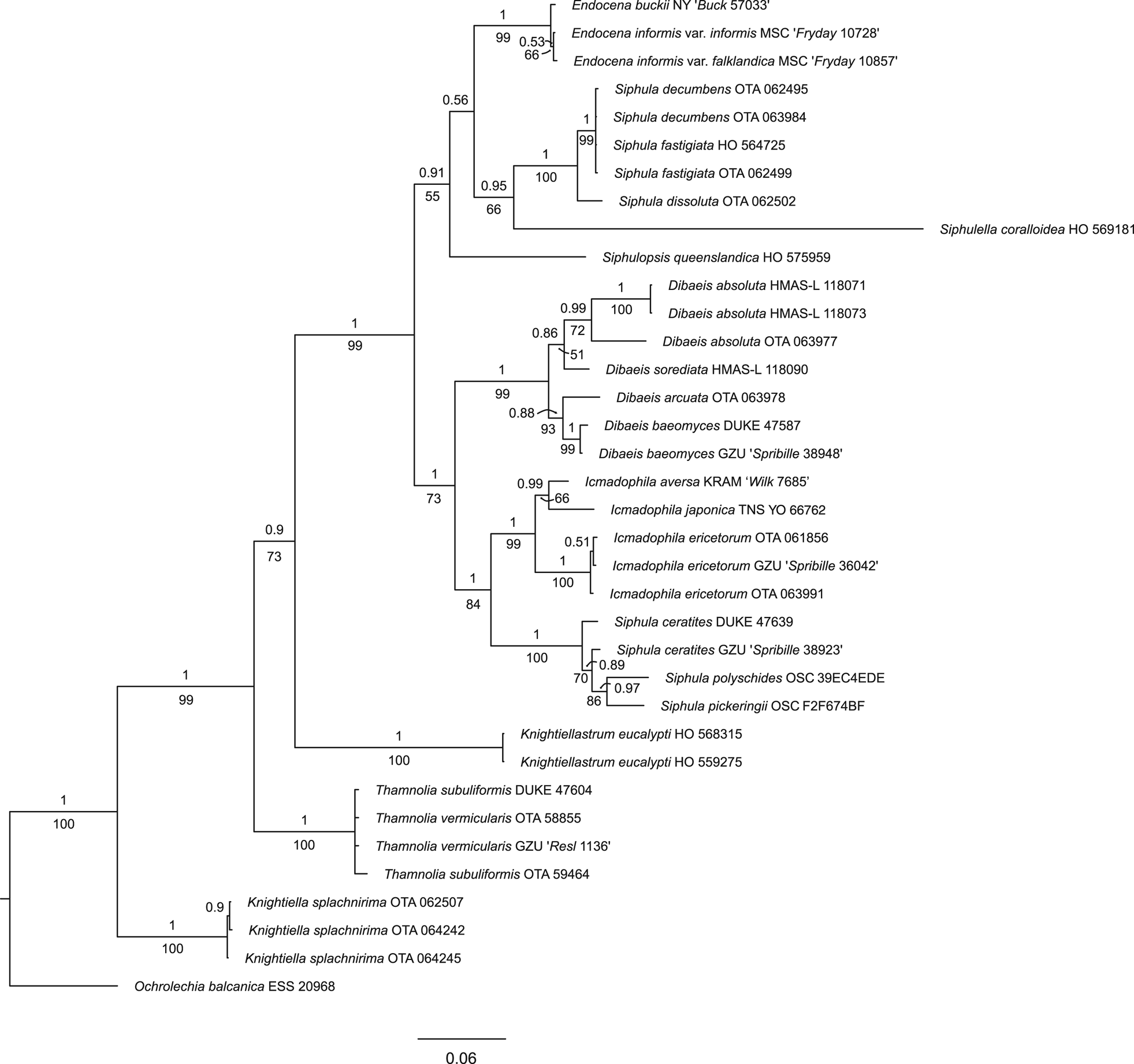
Bayesian inference and maximum parsimony analyses produced congruent topologies for the combined ITS + nuLSU phylogenetic analysis (Fig. 1) and indicated that Icmadophila as currently circumscribed is not monophyletic. The analyses provided consistent support for a core group that includes the type, I. ericetorum, together with I. aversa and I. japonica (PP = 1, BS = 99%). The sister relationship between I. aversa and I. japonica is strongly supported only by the Bayesian analysis (PP = 0.99). Icmadophila (hereafter Knightiellastrum) eucalypti and Icmadophila (hereafter Knightiella) splachnirima are distantly related to each other and to members of Icmadophila s. str. The new genus Knightiellastrum L. Ludw. & Kantvilas is therefore introduced below to accommodate K. eucalypti. Knightiella splachnirima has a well-supported sister relationship to all the remaining members of Icmadophilaceae (PP = 1, BS = 100%). Knightiellastrum eucalypti (Kantvilas) L. Ludw. & Kantvilas is sister to the large clade comprising Icmadophila s. str., Endocena, Dibaeis, Siphulella and Siphula s. lat. The latter is split into the S. ceratites group (S. ceratites, S. pickeringii Tuck. and S. polyschides Kremp.), which is closely related to Icmadophila s. str., and the S. decumbens group (S. decumbens, S. dissoluta and S. fastigiata), which is sister to Siphulella coralloidea Kantvilas. There is no support for a close relationship between Knightiellastrum eucalypti and the rare Australian species Knightiella (hereafter Siphulopsis) queenslandica. Consequently, the new genus Siphulopsis Kantvilas & A. R. Nilsen is introduced for the latter.
Icmadophilaceae phylogeny showing the positions of Icmadophila, Knightiella, Knightiellastrum and Siphulopsis species based on Bayesian inference analysis of the concatenated alignment (ITS + nuLSU). Bayesian posterior probability (PP) branch support values are given above the line and bootstrap (BS) values based on maximum parsimony are below the line. Collections are labelled with herbarium code and voucher number. When the herbarium voucher was unavailable, the collector's voucher was used instead (in quotation marks). Information for sequences used is in Table 1. Scale bar = nucleotide substitutions per site.

The circumscription of Icmadophila
The main aim of our study was to re-evaluate the circumscription of the genus Icmadophila. Our results indicate that, of the five species that have been placed in Icmadophila at various times, only three are closely related: I. ericetorum (the type), which is widely distributed in Eurasia and North America, I. aversa, which occurs in high tropical mountain areas in Central and South America (Wilk Reference Wilk2010), and I. japonica, which is restricted to Far East Russia and Japan (Ohmura Reference Ohmura2011). The last two species had been placed in the separate genus Glossodium. Although their apothecial morphology is distinctive, we found only partial support for a sister relationship between these two species, so the degree to which Glossodium and Icmadophila are distinct remains unclear. In contrast, the clade consisting of I. ericetorum, I. aversa and I. japonica is strongly supported phylogenetically and provides a better basis for delimiting the genus Icmadophila as it also accommodates the morphological similarities between the three species noted by Rambold et al. (Reference Rambold, Triebel and Hertel1993).
The distinctive Australasian species Knightiella splachnirima is distantly related to I. ericetorum, having a sister relationship to all other Icmadophilaceae, as previously indicated by the nuclear SSU phylogeny of Stenroos et al. (Reference Stenroos, Myllys, Thell and Hyvönen2002) and by Kantvilas (Reference Kantvilas2018). Therefore, the monophyletic genus Knightiella based on K. splachnirima is supported for this taxon, as previously suggested.
The Tasmanian endemic Knightiellastrum eucalypti, which was provisionally ascribed to Icmadophila by Kantvilas (in Lumbsch et al. Reference Lumbsch, Ahti, Altermann, Amo de Paz, Aptroot, Arup, Bárcenas Peña, Bawingan, Benatti and Betancourt2011: 73) and then to Knightiella by Kantvilas (Reference Kantvilas2018), is neither closely related to I. ericetorum nor to any other species studied here. In our analysis this taxon is distinctly different and sister to all other genera in the family apart from Thamnolia and Knightiella. The new genus Knightiellastrum is described below for this taxon.
Relationships among the remaining genera of Icmadophilaceae
Although our study was focused on Icmadophila, our analyses add to a growing understanding of relationships among genera within the family Icmadophilaceae, as well as its diversity in the Southern Hemisphere. Consistent with the topologies of the nuLSU phylogeny by Grube & Kantvilas (Reference Grube and Kantvilas2006) and the nuSSU analysis of Stenroos et al. (Reference Stenroos, Myllys, Thell and Hyvönen2002), our analyses recovered two distinct clades of Siphula, with the S. decumbens group being separate from the type species of Siphula, S. ceratites. This, together with reports of ascomata in S. decumbens and S. fastigiata, indicates that the S. decumbens group might warrant a genus of its own (Stenroos et al. Reference Stenroos, Myllys, Thell and Hyvönen2002; Ludwig Reference Ludwig2015; Ludwig et al. Reference Ludwig, Knight and Kantvilas2016). Such a decision cannot be made, however, without studies of further species of Siphula s. lat., particularly those from the Neotropics (Kantvilas & Elix Reference Kantvilas and Elix2002).
We also found a sister relationship between Endocena and the S. decumbens group, as previously suggested by the nuSSU analyses of Stenroos et al. (Reference Stenroos, Myllys, Thell and Hyvönen2002) and Fryday et al. (Reference Fryday, Schmitt and Pérez-Ortega2017), and a distinct Dibaeis clade, concurring with Kantvilas (Reference Kantvilas2018) and references therein.
The placement of Siphulella coralloidea in Icmadophilaceae by Rambold et al. (Reference Rambold, Triebel and Hertel1993) is supported here, with partial support (PP = 0.95) for a sister relationship with the Siphula decumbens group. However, even if this sister relationship receives further support in the future, this would not necessarily justify an inclusion of S. coralloidea in the S. decumbens group. Siphulella coralloidea has a highly distinctive chemistry (Kantvilas et al. Reference Kantvilas, Elix and James1992) and our analyses also indicate it is highly distinctive genetically, as evidenced by its terminal branch length.
Siphulopsis queenslandica (Kantvilas) Kantvilas & A. R. Nilsen, previously placed in Knightiella by Kantvilas (Reference Kantvilas2018), is another clearly distinct Australian entity, with partial support (PP = 0.91) in our analysis for a sister relationship with a clade containing the Siphula decumbens group, Siphulella and Endocena but distant from Knightiella and Knightiellastrum. To incorporate this species into a much more broadly circumscribed genus including Endocena, Siphula pro parte and Siphulella would be at odds with the genetic and morphological distinctiveness of these genera. Therefore, the new genus Siphulopsis, described below, is proposed for this distinctive species. Additional, still unidentified, recent collections from tropical Queensland and the Caribbean may prove to represent related taxa.
Lichen diversity is significantly underestimated worldwide, in part due to a paucity of taxonomists (Lücking et al. Reference Lücking, Dal-Forno, Sikaroodi, Gillevet, Bungartz, Moncada, Yánez-Ayabaca, Chaves, Coca and Lawrey2014), but also due to taxonomic classifications that mask local and regional diversification (Lumbsch et al. Reference Lumbsch, Ahti, Altermann, Amo de Paz, Aptroot, Arup, Bárcenas Peña, Bawingan, Benatti and Betancourt2011). Our analyses, which have led us to propose two new monotypic genera within the family, suggest that previous taxonomic arrangements have underestimated the diversity and distinctiveness of Icmadophilaceae in Australasia. While the taxonomic redundancy inherent in monotypic genera is undesirable, we believe that the alternative, amalgamating several distinctive genera within the family, is not helpful. Ongoing work, particularly in the Southern Hemisphere and tropical regions, may reveal additional species in the family Icmadophilaceae, enabling clarification of relationships among the genera in our phylogenetic framework.
Taxonomic Treatment
Knightiellastrum L. Ludw. & Kantvilas gen. nov.
MycoBank No.: MB 833780
Thallum parvum squamulosum sterilemque, rhizinas destitutum, acidum thamnolicum continentem praebens, ergo characteres aliquam Knightiellae Icmadophilaeque ostendens, sed his generibus genetice non affinis demonstratum.
Typus generis: Knightiellastrum eucalypti (Kantvilas) L. Ludw. & Kantvilas.
Knightiellastrum eucalypti (Kantvilas) L. Ludw. & Kantvilas comb. nov.
MycoBank No.: MB 833781
Knightiella eucalypti (Kantvilas) Kantvilas, Herzogia 31, 567 (2018).—Icmadophila eucalypti Kantvilas, Phytotaxa 18, 72 (2011); type: Australia, Tasmania, Hartz Road near the entrance to the National Park, 43°12′S, 146°47′E, 570 m, on moist trunks of old Eucalyptus obliqua in mixed forest, 25 July 2007, G. Kantvilas 285/07 (HO—holotypus!; BM!— isotypus).
Thallus squamulose, whitish to pale grey, erhizinate, in section with a pseudocortex 20–30 μm thick comprising randomly orientated, short-celled hyphae 3–5 μm wide, interspersed with occasional dead algal cells; lower surface white, ecorticate. Photobiont a unicellular green alga with globose cells 5–11 μm diam.
Ascomata and pycnidia not seen.
Secondary chemistry
Thamnolic acid.
Etymology
From Knightiella and the Latin suffix ‘-astrum’ indicating incomplete resemblance, because the thallus morphology of the type species is reminiscent of a small and infertile individual of Knightiella splachnirima.
Notes
The new genus comprises a single species that occurs on the soft, rotting wood or bark of mature trees in the wet forests of Tasmania. In the absence of reproductive or molecular characters, the initial placement of this lichen in Icmadophila was based entirely on morphological, anatomical, ecological and chemical evidence (Lumbsch et al. Reference Lumbsch, Ahti, Altermann, Amo de Paz, Aptroot, Arup, Bárcenas Peña, Bawingan, Benatti and Betancourt2011). A further character was the occasional occurrence of pinkish gall-like thickenings of unknown origin that resemble apothecial initials of Icmadophilaceae taxa such as Dibaeis and Siphulella. Subsequently, Kantvilas (Reference Kantvilas2018) transferred it to Knightiella, pending supporting molecular data but recognizing that it displayed closer morphological affinities to Knightiella than to Icmadophila. The new molecular data confirm the original family classification of this species, but also highlight that its differences from the other genera are sufficient to warrant generic status. An image of Knightiella eucalypti was published in Kantvilas (Reference Kantvilas2018).
Siphulopsis Kantvilas & A. R. Nilsen gen. nov.
MycoBank No.: MB 833782
Siphulae Fr. thallo fruticoso, acidum thamnolicum continenti aliquam similis sed rhizinas destituto et huic generi genetice non affino differt.
Typus generis: Siphulopsis queenslandica (Kantvilas) Kantvilas & A. R. Nilsen.
Siphulopsis queenslandica (Kantvilas) Kantvilas & A. R. Nilsen comb. nov.
MycoBank No.: MB 833795
Knightiella queenslandica Kantvilas, Herzogia 31, 567 (2018); type: Australia, Queensland, D'Aguilar Range, Westridge outlook, 27°21′48″S, 152°45′35″E, 510 m, on the butt of an old, partially charred eucalypt in open forest, 13 November 2014, G. Kantvilas 460/14 (HO—holotypus!; BM!, BRI!— isotypi).
Thallus at first squamulose, soon becoming fruticose and forming pulvinate clumps, whitish to pale ashen grey, erhizinate, in section with a pseudocortex 20–30 μm thick comprising poorly differentiated, short-celled hyphae c. 5 μm wide, interspersed with occasional dead algal cells. Photobiont a unicellular green alga with globose cells 6–10 μm diam.
Ascomata not seen.
Pycnidia immersed; conidia bacilliform.
Secondary chemistry
Thamnolic acid.
Etymology
From Siphula and the Greek suffix ‘-opsis’ indicating resemblance, because the thallus morphology of the type species is reminiscent of a species of that genus.
Notes
The new genus comprises a single species, Siphulopsis queenslandica, which is described, discussed and illustrated by Kantvilas (Reference Kantvilas2018). At first glance, it resembles a species of Siphula in its whitish, fruticose lobes that contain thamnolic acid, a commonly occurring metabolite in that genus. However, it differs from Siphula chiefly by lacking the basal rhizines characteristic of the genus. Consequently it was described, with some hesitation, as a species of Knightiella, seen at the time as a classification of ‘best fit’ and on account of some morphological similarities with Knightiella (now Knightiellastrum) eucalypti.
Acknowledgements
LRL was supported by a University of Otago Doctoral Scholarship, grants from the Miss E. L. Hellaby Indigenous Grasslands Research Trust, the Dunedin branch of Forest & Bird New Zealand, the British Lichen Society and a Diane Campbell-Hunt Memorial Award. Dr Regine Stordeur (Halle an der Saale, Germany), Peter Bilovitz and Professor Helmut Mayrhofer (Graz, Austria) supplied fresh material of I. ericetorum. Dr Allison Knight, Alf Webb and David Lyttle (all from Dunedin, New Zealand) provided specimens of Siphula fastigiata and S. dissoluta. The handling editor and two anonymous reviewers provided valuable feedback on an earlier version.