The history of US foreign policy is bound up in the history of ideas and ideologies. Discussions of US foreign policy in the twentieth century rarely occur without recourse to doctrines such as isolationism, realism, and anticommunism. Many scholars have written about the role that ideas play in policy making (see Campbell Reference Campbell2002). Mainstream approaches in the field of international political economy and international relations argue that ideas are used to “structure public opinion and the political agenda in other countries so as to determine what are legitimate and illegitimate policies and forms of political behavior” (Frieden and Lake Reference Frieden and Lake2000: 134). Ikenberry (Reference Ikenberry, Goldstein and Keohane1993), in his work on the emergence of Keynesian thought, argues that policy ideas “provide opportunities for elites to pursue their interests in more effective ways. This may be the most profound way in which ideas matter” (p. 84). Now, much of US foreign policy thought is produced, packaged, and disseminated by organizations, particularly think tanks (see McGann Reference McGann1992). In this analysis, I examine how foreign policy ideas are created within organizations like these.
The Council on Foreign Relations (CFR) is one such organization. I use evidence from its foreign policy study and discussion group program, the Program on Studies, from 1955 to 1972 to examine how ideas were developed within the organization. The CFR, composed largely of economic and political elites, was uniquely positioned to create a sense of which problems or issues should be attended to, especially among northeastern elites interested in and involved with foreign policy. Consequently, the organization shaped the contours of debate over post–World War II foreign policy. The CFR contributed to producing particular worldviews—paradigms that constrain perceptions of feasible options (Campbell Reference Campbell2002)—regarding what regions of the world were important and what types of issues were central to US foreign policy concerns. When topics like population growth, the role of culture in foreign policy, and food shortages were routinely excluded from serious inquiry as matters of foreign relations in the CFR study and discussion groups, those issues were marginalized in foreign policy discussions.
From evaluating cultural and academic production (Lamont Reference Lamont2009; Merriman Reference Merriman2015; Powell Reference Powell1985) to selecting students for admissions (Posselt Reference Posselt2016; Stevens Reference Stevens2009) to screening individuals for hiring (Fernandez and Weinberg Reference Fernandez and Weinberg1997; Rivera Reference Rivera2012), organizations constantly vet both ideas and individuals, and develop procedures for doing so. To examine how the CFR produced and legitimated these foreign policy ideas, I use qualitative and quantitative analysis of CFR archival records of proposed and selected study and discussion group topics. The internal memos, meeting minutes from on- and off-the-record meetings, correspondence, letters of applications, manuscript drafts, and organizational administrative documents contained in the CFR archives provide an ideal opportunity to examine the functioning of an elite organization that has been highly relevant to a key area of US political life by providing ideas and scholarship relevant to foreign policy. Archival materials provide insight into decision making within a type of organization that is often inaccessible to public examination.Footnote 1
Based on this evidence, I argue that the relative quality and prestige of proposers and proposals are insufficient for understanding the intellectual output of the CFR Studies Program. Instead, CFR Studies Program staff repeatedly made recourse, both explicitly and implicitly, to what they understood to be the organizational identity—members’ and stakeholders’ beliefs about the central, distinctive, enduring features of an organization (Scott and Lane Reference Scott and Lane2000)—of the CFR as a basis for making everyday decisions regarding the production of foreign policy knowledge. To argue that organizational identity is an important factor in idea adoption at the CFR, I use two forms of evidence: (1) the justifications used by CFR Studies Program staff to make their decisions and (2) the relationship between proposers’ recommendations and decision outcomes. I differentiate between the effect of positive recommendations from often-prominent individuals without close ties to the CFR Studies Program staff and recommendations from individuals with close affiliations with the CFR. In this case, knowledge production was tied to staff perceptions of the core identity concerns—its selective and elite membership—within the producing organization. This directs our attention toward organization-level characteristics, instead of toward individual-level characteristics, to understand how organizations vet ideas and people.
The study also contributes to what Camic and Gross (Reference Camic, Gross and Blau2001) call the new sociology of ideas, and of what Camic et al. (Reference Camic, Gross and Lamont2011) call social knowledge practices—the on-the-ground practices of making and spreading social knowledge. Through an account of social knowledge practices in CFR, I argue that staff use of and appeal to organizational identity played a central role in shaping social knowledge. I discuss the implications of this case for the study of organizations and knowledge production more broadly in the following text.
Foreign Policy Knowledge and the Council on Foreign Relations
The CFR, founded in 1921, was the first foreign policy research institute—now referred to as a think tank (see Medvetz Reference Camic, Gross and Lamont2012)—in the United States. Membership in the CFR is highly selective and based on recommendation and evaluation by existing members. The size of the membership grew steadily from 209 in 1922 until about 1990, when the rate of growth increased greatly. During the period that is the focus of this study, 1955–72, the CFR had between 1,000 and 1,500 members. The CFR now has more than 4,300 members, including three former presidents (presidents Carter, George H. W. Bush, and Clinton) and two current Supreme Court Justices (justices Breyer and Ginsberg). In addition to top government officials, the CFR brought together officers of banking, manufacturing, trading, and finance companies, as well as lawyers and scholars. Between 1921 and 1946, 55 officers and directors of the CFR held more than 74 corporate directorships including US Steel, AT&T, General Electric, General Motors, JP Morgan and Co., and Mutual Life Insurance Company of New York (Parmar Reference Parmar1995).
Central to any discussion of the CFR is the question of the extent to which the organization had power over and influence on American foreign policy. On this point there is discord, much of which hinges on theories of the relative power of state and nonstate actors. Some scholars assume that the CFR is one of the “most influential of modern American institutions” (ibid.: 73) and others argue that the CFR subverts democratic processes by exerting undue influence over the policy-making process (Domhoff Reference Domhoff1990; Shoup and Minter Reference Shoup and Minter1977). Others argue for a traditional pluralist account of the organization as interconnected with the state and reflecting varied interests coming together (Bundy Reference Bundy1994; Grose Reference Grose1996; Parmar Reference Parmar2001; Schulzinger Reference Schulzinger1984).
However, analysts agree that the CFR provided a forum for the coordination and distribution of beliefs and ideas among elites interested in foreign policy. Wala (Reference Wala1994) argues that the CFR did not exert direct influence in the sense of achieving their will against the preferences of policy makers, but instead served as a mechanism for promoting consensus among participants, primarily through informal conversation and discussion. The CFR produced consensus through a preference for ideas that reflected already-held beliefs: “Council figures have demonstrated partiality for conventional thinking and misgivings about the legitimacy of comments on foreign policy by people less well (or differently) informed than themselves” (Schulzinger Reference Schulzinger1984: p. xi). John Kenneth Galbraith put it less gently upon resigning from the CFR in 1970, when he said that the organization was the
seat of boredom…. Most of the proceedings involve a level of banality so deep that the only question they raise is whether one should sit through them…. It’s serviceable in one respect. If you want to know what the current cliché is, there’s no better place to find out. (quoted in ibid.: 209)
During this period, the CFR produced and reproduced mainstream, consensus foreign policy thought. In this article, I ask how organization staff made the decisions that shaped the nature of their intellectual output.
Generating Foreign Policy Knowledge
The Program on Studies (now the David Rockefeller Studies Program) began in 1922, shortly after the founding of the organization. It continues to be one of the main activities of the CFR. Study and discussion groups usually brought together 15 to 30 individuals, mainly CFR members (exclusively men until the early 1970s), with relevant areas of expertise and experience to discuss chosen topics across a series of meetings. In study groups, the expectation was that an appointed group member would produce a monograph on the topic. Discussion groups were not expected to produce a monograph. According to staff, study groups were a more important indication to CFR members and potential members of the contribution of the CFR to public discussion. Study group topic selection was designed to indicate the “professional quality” and uniqueness of the organization as a whole.
To assess how the CFR defined important foreign policy issues, I analyze the selection of certain topics for CFR study and discussion groups between 1955 and 1972.Footnote 2 During this period, the CFR conducted 91 unique study groups (an average of 4.79 per year), and 86 unique discussion groups (an average of 4.53 per year). Realized CFR study groups featured topics such as “The Atlantic Alliance,” resulting in a 1958 book by Benjamin T. Moore called NATO and the Future of Europe. Percy W. Bidwell chaired a study group on “National Policy on Raw Materials” from 1956 to 1957 and authored a book in 1958 called Raw Materials: A Study of American Policy. J. S. Badeau chaired a group called “The Middle East and Modern Islam” in 1958–59 and published a book in 1968 titled The American Approach to the Arab World. In response to proposals interested in the role of business interests and private investment abroad in foreign policy, the CFR held discussion group on “American Business Abroad” in 1963–64 and on “The Politics of Private Investment” in 1966–67. (For a complete list of the study and discussion groups carried out by the CFR during this period, see Appendix A in the supplementary materials.)
During the same time, the CFR Studies Program staff rejected topics for discussion or study groups on, for example, “The Role of Public Opinion in Foreign Policy Formation,” “Japan and Economic Opportunities on the West Coast of Latin America,” “Trends and Prospects of Iraq,” “Arab Refugees,” “Cultural Exchange as a Foreign Policy Tool,” “US Policy Toward North Africa,” “American Minorities and American Foreign Policy,” “International Cooperation for Housing, Urban Planning, Mass Transit and Community Facilities,” and “The Food Crisis.”
Decision-Making Procedures and Guidelines
The stated goal of CFR Studies Program staff was to produce high-quality, informative work. However, the standards for a successful study or discussion group were difficult to define. CFR Studies Program staff cared somewhat about circulation numbers for the books they published, but most books had very low circulation numbers, preventing that metric from being a consistent tool to guide future decisions.
Decision Makers
CFR Studies Program staff made decisions about the selection of study and discussion groups by assessing both topics and their proposers. The organizational structure of the CFR, once quite spare, became elaborated as the organization’s size and functions grew. The formalization of the Studies Program led to the creation of the position of Director of Studies in 1937. Initially, CFR members filled the part-time administrative positions within the CFR. Over time, there was greater differentiation among the committees governing CFR operations and the number of full-time staff positions in the CFR grew. Some of these full-time staff members were also CFR members, while other staff members were not CFR members. These full-time staff members played a role closer to career civil servants or bureaucrats, tasked with carrying out the goals of the organization that they served. In 1962, for example, the research department of the CFR directed the study and discussion group program with four male staff members, all CFR members, occupying research positions and two women, one economist and one administrative secretary, neither of whom were CFR members. By 1976, the Committee on Studies, dedicated to the study and discussion groups, was one of six standing CFR committees and had 10 staff members.
Observed Procedure
I use the selected archival documents and the trajectories of different proposals through the decision process to reconstruct common and uncommon procedures for decision making. This does not capture methods of decision making that did not leave an archival trace, such as informal conversations between staff and others that were not recorded as memos. The proposed topics from which to choose were already constrained by the highly selective process to gain entry into the CFR or into a network with CFR members. My analysis examines what happened to topics that did reach the CFR through established channels set up to solicit suggestions.Footnote 3
According to the archival evidence, the CFR Studies Program staff arrived at a set of topics for study each year by first collecting possible topics from existing CFR members, solicited in the annual report sent to all members, and from nonmembers who knew about the CFR and its programs. These topics were combined with previously suggested but unrealized topics and topics that had been proposed by CFR staff members. CFR Studies Program staff, usually within dedicated meetings, then selected topics and people—in practice, the Studies Program staff evaluated both the proposers and the topics they proposed—to promote to a small group of CFR directors who approved a set of topics. The criteria and process used to make this decision was not consistent. Studies Program staff solicited additional information from and about some proposers but not others. Some proposals went through multiple rounds of evaluations while others did not. In some cases, the topic proposer would lead the study group and serve as the author of the book produced from the study group, but not all the time.
Unlike study groups, discussion groups did not produce books. Because they had no specific output, they were less public and often less formal. Consequently, CFR Studies Program staff had more leeway to pursue experimental topics in discussion groups than in study groups.
Formal Decision Guidelines
Over the course of the Program on Studies, CFR staff wrote various memos and statements articulating evolving goals and guidelines for evaluating proposals. The guidelines predominantly focused on topic content and procedural issues, instead of the characteristics of individuals proposing topics or leading groups. They provided general principles instead of precise guidance on decision making. For example, an internal memo from 1945, “Present Status and Objectives of the Study Program,” noted that the CFR had two principle functions: to “discover new facts, and to re-appraise facts already known, regarding the relations of the US with foreign countries” and to “make these facts, and conclusions drawn from them, available to Council members, to government agencies, and to the public.” Selection criteria included privileging topics “in which the US has an interest, with respect to which US policy needs to be clarified, and which seem to lend themselves to group study.”
The formal criteria evolved over time. For example, “Criteria for Council Studies,” a document from the Committee on Studies Meeting in January 1965, specified nine guidelines for both the content and the form of the studies. The document noted the lack of hard and fast rules for making decisions, suggesting that the guidelines were not binding and the decision process difficult and unstandardized. According to this document, studies should deal with American foreign policy or with foreign policy issues with implications for the United States. “Studies do not have to be ‘researchable’ in any formal or fixed sense; they can be analytical or speculative with relatively little reference to research material” (p. 1). An occasional historical study was acceptable. According to these guidelines, over a number of years, the collection of topics should span important world areas, and studies should have importance over several years. The most valued topics were those that addressed the strengths and interests of the CFR’s members: most studies would examine political, economic, or strategic questions but other types of issues (e.g., scientific, cultural, social) could be explored.
For the form of the topics, the document stated that topics should not be too specialized or too focused, nor should they be too broad: “This criterion can only be applied subjectively, but it is crucial to a successful studies program.” Only one author should undertake a study, though there could be exceptions. No studies should require field research and studies must benefit from having a study group. And, finally, the document provided an account of the role of specific personnel: “On occasion, a subject will be chosen in part because an unusually capable author is available. In other cases, promising subjects may be deferred because it is impossible to locate an outstanding author.” From these examples of the formal selection criteria, we see that most criteria provided high-level principles but little specific guidance. Based on the conversations and meetings for which there are records in the archive, Studies Program staff often did not use these formal criteria when making decisions. I now turn to a discussion of two different sets of evaluative criteria that were used but that do not appear in these formal documents: the quality and prestige of proposers and how the topic and proposer aligned with the organization’s identity.
Decision Criteria in Practice: Quality and Prestige Versus Alignment with Organizational Identity
While the formal guidelines discussed the evaluation of topics rather than their proposers, in practice, the Studies Program staff evaluated both the proposers of topics and the topics. Based on the evidence about Studies Program staff decision making from the archive, decision making was a dual task of vetting both people and ideas. Indeed, the CFR Studies Program staff referred to the qualifications of proposers in 40 percent of a randomly selected subset of 80 proposal discussions, and this was the most discussed topic during decision making. They referred to the topic in only 26 percent of those 80 cases. This indicates that, despite being absent from the formal criteria represented in the documents, Studies Program staff were specifically interested in the characteristics of proposers. I consider two possible dimensions by which Studies Program staff could evaluate proposers: (1) by using signals of proposer quality and prestige and (2) by considering the alignment of a topic and proposer with the organization’s identity. The first approach to proposer vetting is one open to ideas from individuals who have been vetted through established network ties and previous institutional affiliations, both of which can be signals of quality or prestige. In contrast, the second approach requires CFR gatekeepers (staff, directors, close associates) to do the vetting, evaluating proposers specifically in terms of their alignment with organizational identity. Both of these routes to selection rely on elite, closed networks of referrals, but the latter draws the boundaries of this network even more narrowly. To be sure, the CFR staff likely used some combination of formal principles, practical decision constraints, concern with quality and prestige, and organizational identity to make decisions. My goal is to demonstrate the plausibility of an account that includes staff concern with organizational identity as an important factor in the selection and elevation of some foreign policy ideas over others.
Quality and Prestige
Organizations frequently need to evaluate whether a person, idea, or project should be admitted or incorporated into the organization, as in routine matters of hiring or in deciding what opportunities to pursue. This, however, is difficult because signals of quality are noisy. A robust literature on hiring in organizations focuses on how employers screen employees and what types of signals they use as indications of the merit of applicants, and of their potential contributions to the organization. Traditional economic accounts of employer screening highlight the importance of detecting applicants’ human capital, or the skills they would bring to the organization (Becker Reference Becker1964). Sociologists have amply illustrated that the underlying “quality” of applicants does not sufficiently explain hiring practices (see Bills Reference Bills2003). Instead, employees may use signals that are widely believed to be valuable, regardless of their actual relationship quality, such as elite credentials (see Rivera Reference Rivera2011), cultural capital (see Lamont and Lareau Reference Lamont and Lareau1988), network referrals (see Fernandez and Weinberg Reference Fernandez and Weinberg1997), or the matching between the cultural activities of applicants and evaluators (Rivera Reference Rivera2012, Reference Rivera2016).
Other scholarship illustrates how organizational actors assess the quality of ideas and projects. In the absence of strong practical constraints on decision making, interactions between decision makers may drive the process of evaluation of cultural products (see Merriman Reference Merriman2015). In academic publishing companies, the credentials of authors and the social networks in which authors and editors are enmeshed play an important role in determining which books get published and which do not (Powell Reference Powell1985). In the case of the Studies Program, I assume that high-quality ideas would be those that conform to the principles set out in the guidelines, and high-quality people would be those with training, experience, or specific expertise on a topic; new ideas or perspectives; and the ability to communicate ideas to others and grapple with existing ways of thinking among the CFR’s target audience.
Organizations may be interested not only in the quality of applicants or ideas but also in the relative prestige of applicants’ backgrounds. For example, in the case of elite organizations such as the CFR, incorporating high-prestige individuals, such as those with connections to select institutions or a positive reputation, may be equally valuable to the organization as a criterion for optimizing decisions. Rivera (Reference Rivera2016) found that elite employers assess applications using various signals of prestige. This process may be intentional and deliberate, or it may occur without deliberate selection on proposer prestige.
Alignment with Organizational Identity
I contrast a focus on signals of the quality and prestige of applicants and ideas with a focus on decisions that align with the identity of the organization. Amidst debate about the optimal definition of organizational identity (see Whetten Reference Whetten2006), I adopt a definition of organizational identity as organizational members’ and stakeholders’ beliefs about the central, distinctive, and enduring characteristics of an organization (Scott and Lane Reference Scott and Lane2000). Scholarship focuses on how organizations use and reconceptualize organizational identity in times of change (see Dutton and Dukerich Reference Dutton and Dukerich1991; Johnson Reference Johnson2012; Ravasi and Schultz Reference Ravasi and Schultz2006). Here, I focus on the role that organizational identity plays in everyday decision making.
In the case of the CFR, the elite composition of the membership, often with specialized or industry-specific knowledge and often occupying high-ranking positions, was a key feature of the identity of the organization.Footnote 4 By virtue of including elites from several institutional domains, the individuals and organizations on which the CFR depended for resources, such as foundations, and for legitimacy, such as policy makers, were often members of the CFR or represented by CFR members.Footnote 5 The main audience of the CFR during this period was the CFR membership. Notes from a CFR-wide staff conference held in November 1968 regarding the effect of domestic political changes—specifically anti-Vietnam War protests and the civil rights movement—argued that
The continuing significance of the Council will depend on … whether the Council succeeds in taking maximum advantage of the attributes in which it has a comparative advantage with respect to most other organizations, particularly the high level and diversity of its membership, the active participation of many members in its work, the confidence they have in the Council’s off-the-record tradition, and the comparatively small size of the Council [around 1,500 members at the time], which makes this confidence possible. (Summary Report of Major Conclusions of Staff Conference, October 23–25, 1968)
Studies Program staff also referred to this conception of the unique qualities of the organization, in particular the nature of the membership, as the foundation for specific guidelines regarding topic selection for study and discussion groups. For example, a November 1964 memo on the process of topic selection noted the importance of work on topics where the CFR can “compose the right kind of group,” indicating a focus on the particular expertise of the CFR membership.
CFR Studies Program staff were centrally concerned with maintaining the organization’s image among the existing members and among potential members, many of whom occupied positions relevant to the concerns of the CFR in government, academic, industry, finance, and law. In practice in the CFR, decision making oriented toward the organization’s identity appeared as repeatedly referencing the group’s membership composition, being preoccupied with securing the approval of members and potential members, and prioritizing not offending those same individuals. I now turn to the evidence for this claim.
The Role of Organizational Identity: Justifications
I first examine the justifications used by CFR Studies Program staff to make their decisions. Again and again, in reviewing proposals, CFR Studies Program staff referred to the importance of approaching a topic in a “Council [on Foreign Relations] kind of way.” In their discussions and memos on proposed topics, Studies Program staff repeatedly brought up the relationship between the study groups and the unique characteristics of the CFR as a whole as justification for the selection or rejection of proposals. They said things like: “One of the things the Council does best is to bring together a diverse group of men of affairs to discuss fairly concrete analyses and proposals”; “the nature of the Council membership … affects the kind of issues on which they can make a genuine contribution in a study group”; or, there is “little the Council can contribute to such a study.” These statements reflect the Studies Program staff’s central concern with the central and unique character of the CFR.
The justifications that Studies Program staff used to argue for and defend particular decisions may indicate post-hoc rationalizations instead of motivating decision factors. However, the line between justifications as motivating forces and rationalizing forces in decision making is often blurry (see Shafir et al. Reference Shafir, Simonson and Tversky1993). At the minimum, these justifications indicate the available and acceptable discourse about decision criteria used by staff. Even if Studies Program staff intentionally wanted others to register, and the historical record to reflect, their concern with the identity of the organization in the form of the elite composition of the membership (which was outside the formal criteria in the guideline documents), the constant articulation of the criteria could not but create a shared understanding among staff that this was an appropriate decision-making basis.
Case Study: The Insufficiency of Topic Quality and Proposer Prestige
A case study on the proposed topic of population growth illustrates how Studies Program staff used their conception of the identity of the CFR to make or rationalize decisions about individual proposals, regardless of the topic’s quality or the proper’s prestige. Between 1954 and 1969, the CFR received multiple letters and supporting pamphlets, books, and newspaper clippings urging them to examine the issue of population growth and its relationship to foreign policy issues. Many of the writers of these letters were prominent: they came from the State Department, the business world (including John D. Rockefeller III), the Foreign Policy Association, a slew of population-related organizations, and from some CFR staff. A series of letters written from 1968 to 1969 suggest some type of organized campaign to get the CFR to pursue the topic in detail. The writers advanced elaborate, well-reasoned arguments for the essential importance of the topic to current and future foreign policy issues: for example, “overpopulation is today, and will be tomorrow, the root cause of political instability and war.” They referred to new centers devoted to the issue of population in the federal government and to attention from international organizations and aid donors to the issue. The writers proposed ways of examining the issue and what types of organizations should be included in the analysis.
The CFR response was muted; they held a discussion group in 1961–62 called “Population Problems and Foreign Policy,” which resulted in an article in Foreign Affairs by Irene Taeuber entitled “Japan’s Population: Miracle, Model or Case Study?”Footnote 6 Additionally, the CFR did arrange three population meetings with prominent demographers including Ansley Coale (a professor and director of the Office of Population Research from 1959 to 1975 at Princeton University) and Frank Notestein (the first director of the UN population division, and founding director of the Office for Population Research at Princeton University). Staff outlined concerns about the topic in memos and responses, one of which included the prod that “I can’t see how the Council can escape its responsibility in this matter.” The CFR Studies Program staff noted that they wanted to address the topic and realized its importance, but “haven’t figured out the right [CFR-relevant] angle yet.”
The CFR did not put together a more sustained analysis of overpopulation in the face of eloquent, highly justified, near pleading by prominent individuals with close ties to the organization because they could not find a way to do so that fit into their idea of what CFR products should look like. CFR Studies Program staff used their vision of what CFR products and identity were to guide or justify decision making; in this case, in the service of declining to address the topic. Topic quality and importance, coupled with proposer prestige, was insufficient to propel Studies Program staff toward forming a study group on population growth.
The Role of Organizational Identity: Recommendations
The way that Studies Program staff interpreted and used recommendations of the individuals proposing various topics for study and discussion groups suggests that they used CFR identity as a basis for decision making about proposals. Organizations often use recommendations from trusted sources to provide information about applicants (see Fernandez and Weinberg Reference Fernandez and Weinberg1997). The use of recommendations to assess the quality of proposers and ideas is a common practice across various culture industries; in book publishing, movie production, and fiction journals, cultural producers use network ties to evaluate work (Faulkner and Anderson Reference Faulkner and Anderson1987; Franssen and Kuipers Reference Franssen and Kuipers2013; Powell Reference Powell1985). Referrals and social ties are not only conduits of information, but they are also a way in which others make inferences about the status or prestige of an actor and of the information or goods the actor provides (Podolny Reference Podolny2001, Reference Podolny2005). Consequently, in cases in which organizations value the prestige of applicants, organizational actors may use recommendations from others as signals of the status, in addition to signals of quality.
Here, I examine how recommendations of individuals submitting proposals served two purposes: they conveyed information about quality and prestige by providing information about individuals with unknown capabilities and capacities, and they served as a way to check whether engaging a particular individual might be detrimental to how elite stakeholders in the CFR perceived the CFR and its products. I first provide a case study that suggests the use of recommendations in this latter sense. In this case, despite a proposal on an admittedly important topic by a known person who had produced high-quality work for the CFR previously, the Studies Program staff rejected a proposal. I then turn to quantitative evidence to analyze the difference in how positive recommendations were used in decision making by CFR staff depending on whether the proposer was an (often-prominent) individual without close ties to the staff or an individual with close ties to the CFR.
Case Study: CFR Affiliate Recommendations Sink a Proposal on a Quality Topic
The rejection of a proposal to study US-Argentine relations within the CFR illustrates how recommendations were used to establish the acceptance of the proposer by the organization’s membership and stakeholders, with the goal of preserving the core organizational asset of the good favor of the elite members. In 1957, Edwin Lieuwen, a professor of history at the University of New Mexico, participated in a study group with the CFR on the role of the military in Latin America. The group discussions resulted in a CFR book entitled Arms and Politics in Latin America (1960), which was considered an important intervention in the historiography of Latin America (McAlister Reference McAlister1960) and immediately “recognized as a tour de force” (Meyer Reference Meyer1989); it continues to be widely cited. In December 1967, Lieuwen proposed a study on US-Argentine relations with Martin Needler, an associate professor of political science at the University of New Mexico at the time. The letter included a three-page outline of the proposed study and a list of relevant books, and argued for a thorough examination by the CFR of the exogenous factors influencing the “Latin American problem” “because we believe this [working at the CFR] would give us the highest and best type of criticism we could possibly receive.” Lieuwen suggested a number of possible members for the study group, something few other proposers did because few had repeated experience with CFR study groups. The research would be funded by a Ford Foundation grant to Lieuwen—indicating institutional support for both Lieuwen and the project—and thus there would be no financial cost to the CFR. Lieuwen had proposed the study in a conversation with a Studies Program staff member in November 1967. The staff member noted, “The subject is clearly of interest and it may well be that it has not been adequately done by anyone else.” This staff member then sought feedback about Lieuwen from others.
One reference, who had been involved in publishing Lieuwen’s earlier work, said he “would be glad to have another book from him.” Although he was “not ecstatic about Lieuwen,” he “apparently looks upon him as a good, competent person.” Another reference said that “he thought Lieuwen was conscientious and would deliver on what he said he would do.” But, Lincoln Gordon, a longtime CFR member, former ambassador to Brazil (where he was involved in supporting the opposition in a US-supported and allegedly planned coup), and then president of Johns Hopkins University, was “very dubious about Lieuwen…. He said he thought he was distinctly second-rate and very cliché-ridden in his thinking.” Another reference thought Lieuwen to be “very rigid on the role of the military” and was “down on him for this reason.” A final letter between a former staff member and a current staff member sealed the fate of Lieuwen’s project.
While it is possible to read these recommendations as assessments of the quality of Lieuwen, the CFR staff were not making this decision in a vacuum of information about Lieuwen’s analytical and communicative skills. The proposer was a known quantity who had produced a successful and respected book for the CFR, there was no reference to previous suboptimal performance, and the topic was “undoubtedly a good one.” While we cannot establish this definitively because close CFR associates, such as Gordon, who did not approve of Lieuwen would have been unlikely to provide feedback other than that based on his work and thinking, we might then read these references as an attempt by Studies Program staff to assess Lieuwen’s current reputation among the membership.Footnote 7 Lieuwen had demonstrated that he could produce influential scholarly works and proposed a topic already vetted by the Ford Foundation and in which the CFR staff were interested, and yet his proposal was rejected. This suggests that CFR Studies Program staff used recommendations at least in part to check on the reputation of its authors among its members and constituents, demonstrating an overriding interest in gauging the effect of choosing particular people on the CFR’s ability to preserve its unique membership composition by not alienating these very members. This concern with preserving the favor of the elite members reflects Studies Program staff concern with a central feature organizational identity.
Quantitative Evidence: The Role of Recommendations
CFR staff likely accounted for topic quality and proposer prestige when making decisions, but they also used evidence of whether the proposal or proposer would lead to preservation of the elite composition of the organization, the central feature of organizational identity. In the following analysis, I consider the relative influence of signals of quality and prestige versus concern with preserving organizational identity.
I assess this argument by distinguishing between the effect of positive recommendations from different types of sources: generally trusted and high prestige, but not closely affiliated individuals and closely affiliated individuals. If CFR Studies Program staff were primarily concerned with vetting individuals based on their underlying quality, then proposals coming from individuals who have positive recommendations from generally trusted sources should be more likely to be chosen for a study group than individuals without those positive recommendations. In contrast, if organizational identity—the elite membership of the CFR in this case—matters for the intellectual production of an organization, signals of quality like positive recommendations might be insufficient. In that case, recommendations from closely affiliated others would be more valuable because they would provide feedback about whether an individual and their proposed topic would be acceptable to the stakeholders of the organization, and, thus, whether selecting that topic and proposer would preserve the identity of the organization as a closed, expert group of elites. In this sense,
Organizational Identity Hypothesis A: If recommendations serve as a check on the possible reception of a proposer among CFR members, then positive recommendations from close associates should matter more to selection than positive recommendations from other sources, even if high prestige.
The differences between study groups, which were more public and geared toward representing the CFR, and discussion groups, which were more private and less publicized, provide a further way of testing how organizational identity played a role in intellectual production. Because the discussion groups were less formal and did not produce books, staff felt less pressure in that discussion groups were less important to the organization’s identity than were study groups. We would thus expect that,
Organizational Identity Hypothesis B: CFR Studies Program staff would rely on recommendations from close associates to select study group topics more than to select discussion group topics.
It might have been that Studies Program staff were largely concerned with finding high prestige proposers and found that recommendations from close associates served as a better method for assessing prestige of proposers than would recommendations from others. If prestige of proposers was the goal, then we might expect other indicators of prestige to also be related to study group selection. If, however, the use of positive recommendations from close associates was a way of assessing the potential impact of a proposer or proposal on the members’ reactions, with the goal of not alienating the very elites who anchored the basis of the organization’s identity, rather than of assessing prestige, then
Organizational Identity Hypothesis C: Recommendations from close associates should be positively associated with proposer and topic selection while signals of the prestige of the proposer should be unrelated to selection.
I examine these hypotheses while accounting for the role of organizational procedures and rules, which include what Lamont (Reference Lamont2009) refers to as formal constraints, using three measures: conformity with stated organizational decision rules, whether the proposal facilitated the creation of a group by suggesting a group leader, and the extent of load on the organizational decision-making apparatus as assessed by the number of proposals submitted around the same time. I selected these measures because they vary across proposals and based on their relative prevalence in the archive compared to other characteristics related to organizational procedure. These measures serve as proxies for the effect of organizational procedures and rules on decisions about foreign policy topics.
Data and Methods
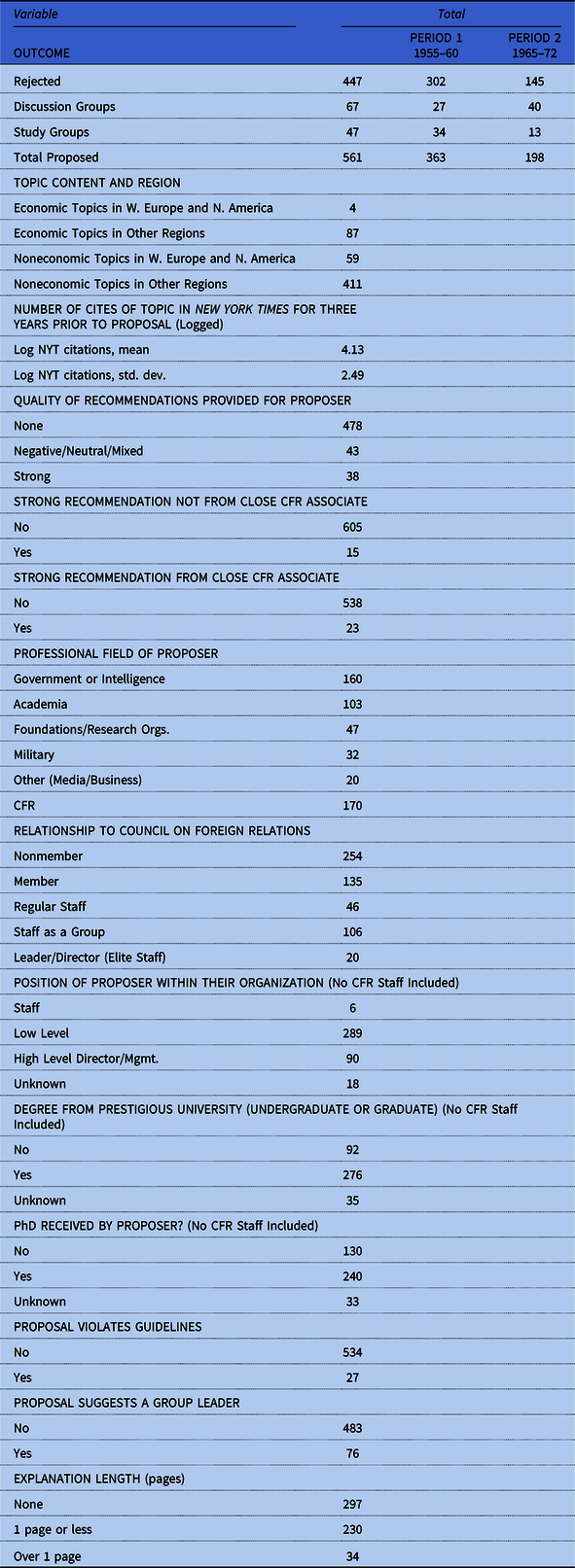
I use the portion of the CFR archives dedicated to the Studies Program for this analysis. The CFR recorded both proposed and actual study and discussion group topics. Using the archival records, I constructed a data set containing all documents dealing with topics suggested to the CFR (N = 561 proposed topics). I coded each case and rechecked a selection of the cases for coding consistency. A research assistant also checked a selection of cases for intercoder reliability, which was high. Given that the data is based on all available archival materials, I am unsure whether I have the complete written record, an incomplete record where documents were selectively excluded, or an incomplete record where documents are missing at random. Because I cannot know for sure which is the case, I used standard regression assumptions based on a sample. (For information on coding decisions, see Appendix B in supplementary materials.) See table 1 for codes and counts.
Variable counts by period

Dependent Variable
I constructed a variable indicating whether a topic proposed during the years under consideration was rejected, selected as a discussion group within five years of being proposed, or selected as a study group within five years of being proposed. This wide window is based on the empirical observation that it would often take several years for proposed topics to come to fruition as discussion or study groups.
Independent Variables
I examine the role of two main types of independent variables related to the theories discussed in the preceding text: the characteristics and credentials of topic proposers and the recommendations for proposers. I account for the content of the proposed topics and proposal characteristics relevant to organizational procedures.
Recommendations for Proposers
For each proposal, I recorded the presence, strength (positive, neutral, negative), and source of recommendations for the proposer (close CFR associate or other). I included neutral, negative, and mixed recommendations together because of the relatively small number of those recommendations—a category I refer to as nonpositive recommendations. I then created four binary variables for whether the proposer received: a positive recommendation from close associates of the CFR; a positive recommendation from others; a nonpositive recommendation from close associates of the CFR; or a nonpositive recommendation from others. Close CFR associates included CFR staff or directors, and especially prominent individuals close to the CFR staff, many of whom had participated in CFR research programs at some point, who appeared repeatedly in the archives as a source of recommendations (see Appendix B for more details in supplementary materials). Nonclose associates were often well-known and respected individuals—often established academics with some connection to government—but they were not as integrated into the CFR as were the close associates. Examples of these prominent but nonclose associates who provided recommendations include Yale Law School professors, a prominent MIT economist who worked in the CIA, the director of the Institute for Current World Affairs, and the Secretary General of the United Nations. These variables were drawn exclusively from the archival records, given that this was the only way I could be sure the CFR Studies Program staff were aware of a proposer’s relationships. I include recommendations from CFR staff or directors in the close associates measure under the assumption that their recommendations take into account the impact of the proposal or proposer on the identity of the organization.
Characteristics and Credentials of Proposers
I categorized each proposer according to their relationship with the CFR: member, nonmember, or CFR staff member (both Studies Program staff and staff outside of the Studies Program). For proposers who were not CFR staff members, I recorded a variety of information including professional field (e.g., academia, government, military, business, media); job position (a binary variable indicating whether the proposer was in a leadership position in an organization, as opposed to a regular staff member); any degree from a prestigious college or university (I used the eight Ivy League universities plus Stanford University and the Massachusetts Institute of Technology); and whether the proposer received a PhD. This information came from numerous sources such as the online database “Who’s Who,” newspaper obituaries, and publicly available curricula vitae.
Content of Proposed Topics
I coded each proposed topic for the type of issue addressed and for the main world region involved (see codes in Appendix B in supplementary materials). I collapsed the codes into four categories indicating whether the topic primarily addressed: (1) economic issues in North America/Western Europe, (2) noneconomic issues in North America/Western Europe, (3) economic issues in regions other than North America/Western Europe, and (4) noneconomic issues in regions other than North America/Western Europe. I use noneconomic topics on North America or Western Europe as the reference category.
A variable for the number of mentions of the topic, identified through keywords, in The New York Times for three years prior to the proposal date provided a control for media attention to the topic. This variable was logged.
Proposal Characteristics
I recorded information about the available characteristics of each proposal bearing on issues of organizational procedures and rules. I record whether the proposal violated some guideline regarding established procedure for conducting study or discussion groups based on staff noting a violation. These included guidelines such as the group leader had to relocate to New York to head the group, projects should be structured around benefitting from a group as opposed to an independent research project, the proposal should not include field research, the book produced should not be a textbook, and the book produced should have one author.
A binary variable represents whether a potential leader for the group was included in the proposal. I include a binary variable for the period during which each proposal was submitted (1955–60 or 1965–72) and tally the number of submitted proposals in each period as an indication of the load on the organization. The first period, from 1955 to 1960, had an average of 60.5 proposals per year while the second period, from 1965 to 1972, had an average of 24.75 proposals per year. Seventeen percent of proposals were accepted in the first period compared to 27 percent of proposals in the second period.
Finally, I also include a variable indicating whether the proposal was more than one page long as a proxy for the degree of elaboration of the proposal. If CFR Studies Program staff made decisions based on assessments of some objective quality of the proposal, then presumably proposals that are more elaborated and thus longer should be more likely to be selected.
Analyses
I first analyze the correlates of topic selection using a multinomial logistic regression with three outcomes—topic rejection (the default outcome) compared to topic selection as a discussion group and topic selection as a study group (N = 561).Footnote 8 In this analysis, I assess the relative impact of positive recommendations from any source compared to the impact of positive recommendations from close associates. Some proposers suggested multiple topics across these periods so I use standard errors that allow for clustering by proposer to allow for intraproposer correlation. There were a total of 262 unique proposers and, thus, 262 clusters. I use Wald tests to compare coefficients related to study group and discussion group selection.
I conduct a subsequent multinomial logistic regression with the same three-category dependent variable—topic rejection compared to selection as a discussion group, and to selection as a study group—including only proposals from individuals who were not CFR staff members (N = 408 proposals). In this analysis, I use an expanded set of measures of signals of proposer quality or traditional proposer prestige—proposer’s profession, whether they had a degree from an Ivy League university, whether they held a leadership position in their current job, and whether they had a PhD—to assess the role of these signals in topic selection compared to the impact of recommendations from close CFR associates.
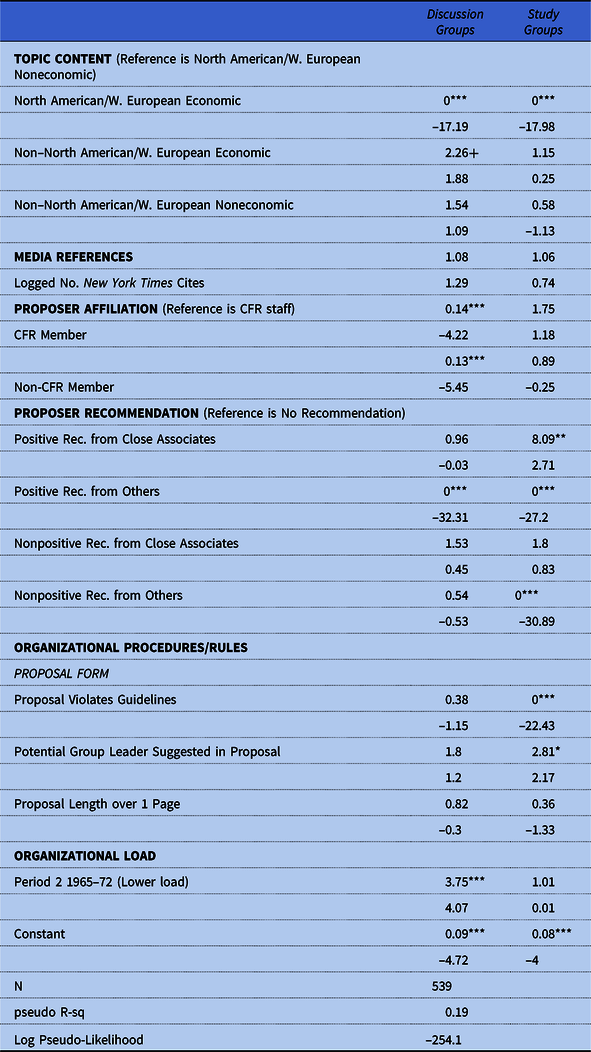
I consider the evidence regarding Studies Program staff use of recommendations as a signal of proposer quality or as an opportunity to vet the impact of the proposer and proposal on the CFR’s organizational identity. I first compare the relative role of signals of quality from recommendations compared to the source of recommendations in topic selection. The results of the multinomial logistic regression are found in table 2. Coefficients represent relative risk ratios.
Multinomial logistic regression predicting realization of study and discussion groups, relative risk compared to topic rejection

Note: Exponentiated coefficients; t statistics below coefficients.
+ p < 0.1; * p < 0.05; ** p < 0.01; *** p<.001.
Results
Study Groups
The relative risk of becoming a study group increases 8.09 times compared to being rejected for proposals advanced by individuals who come with positive recommendations from close and highly trusted individuals (e.g., CFR Studies Program staff, CFR directors, or close CFR associates). Importantly, proposers receiving a positive recommendation from someone other than close associates have greatly reduced risk of their topic being selected compared to proposers with no recommendation. While there is no significant difference between proposals coming with a nonpositive recommendation from close CFR associates and proposals with no recommendation, there is a greatly reduced risk of selection if nonpositive recommendations come from someone who is not a close CFR associate.
Topics dealing with economic issues in North America or Western Europe have a reduced risk of being selected for study groups relative to noneconomic topics in North America or Western Europe. No other topic content was related to study group selection.
Proposals that violated rules regarding the form that groups should take were at a greatly reduced risk of being selected. Finally, proposals that suggested a group leader, thus facilitating the work of the Studies Program staff, have an increased risk of selection as study groups compared to proposals that did not suggest a group leader. The length of the proposal is unrelated to topic selection.
Discussion Groups
Proposals from either CFR members or non-CFR members had a reduced risk of selection as a discussion group compared to proposals from CFR staff, suggesting that discussion group topics were especially driven by staff action. Proposers receiving a positive recommendation from someone other than a close CFR associate have a reduced risk of their topic being selected compared to proposers who had no recommendation. Any other type of recommendation is not related to discussion topic selection.
Topic content proved more relevant to discussion group selection than study group selection: topics dealing with North America and Western Europe on economic issues had reduced risk of being selected for discussion groups while topics dealing with economic issues in non–North American or Western European regions had an increased risk of being selected.
The only indication of the role of organizational procedures and rules in the selection of discussion groups has to do with organizational load: proposals in the second period, where there were significantly fewer proposals submitted, had a higher relative risk of becoming a discussion group.
Comparison between Study and Discussion Groups
I use Wald tests to assess whether the coefficients differ between predictors of study and discussion group selection. Hypothesis B posits that Studies Program staff would rely on recommendations from known and respected sources to select study group topics more than to select discussion group topics. I find support for this hypothesis: study group selection has larger coefficients, indicating a greater relative risk of selection compared to discussion group selection, for proposals coming from individuals who received positive recommendations from close CFR associates. There was also a lower risk of study group selection for proposals with nonpositive recommendations coming from people other than close CFR associates, compared to selection as discussion groups.
The other significant differences between predictors of discussion group and study group selection demonstrate that topic content is more important for discussion group selection than study group selection, and proposals from CFR staff, compared to CFR members or nonmembers, are more important for discussion group selection. Organizational load has a greater impact on discussion group selection than on study group selection. Finally, proposals that violated rules regarding the form that groups should take were at a greatly reduced risk of being selected for study groups, though this was to be expected as most of the guidelines specifically focus on study groups.
Summary
This model provides an initial indication that Studies Program staff used recommendations from close CFR associates differently than recommendations from others for choosing study groups. While positive recommendations from close associates led to an increased risk of realization that a proposal would become a study group, positive recommendations from others reduced the risk of a proposal becoming a study group. This suggests that CFR staff may have been more concerned with organizational identity than with signals of quality. One might argue, though, that close associate feedback was more trusted and thus seen as a more accurate source of information about proposer quality. However, nonclose associate recommenders were often high-prestige, well-established individuals whom CFR staff presumably could have trusted for accurate information about reputation and prestige. Instead, a positive recommendation from one of these individuals was not just less valuable, but instead a liability in topic selection. Additionally, as suggested in Organizational Identity Hypothesis B, recommendations from close associates were related to study group realization but not discussion group realization. Both of these findings suggest that organizational identity rather than quality was a central decision factor.
An alternative explanation for the reliance on positive recommendations from close associates is that Studies Program staff were concerned with finding high-prestige proposers rather than vetting potential impact on organizational identity. If so, recommendations from close associates might have served as a better method for finding high-prestige proposers than recommendations from others. If this were the case, then we might also expect other indicators of prestige to be related to study group selection. Thus, I turn to a model that provides a more robust assessment of the role of signals of prestige compared to concern with preserving organizational identity.
Signals of Vetting for Prestige Versus Organizational Identity
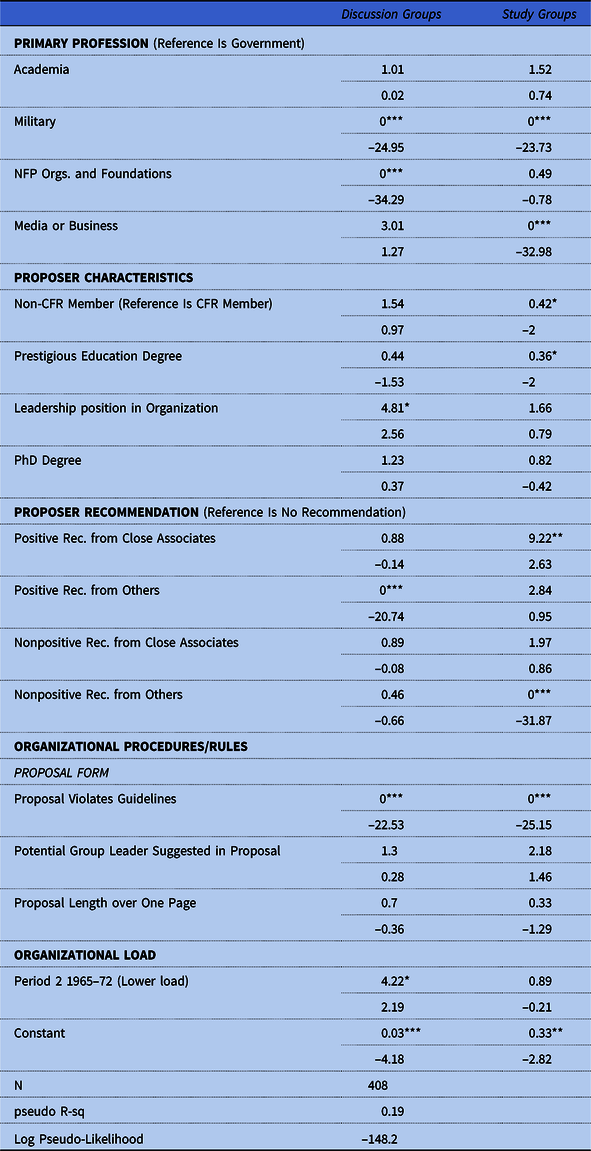
I examine proposals coming only from nonstaff members (who are already known quantities in terms of prestige) to directly assess the importance of signals of prestige relative to means of vetting the impact on organizational identity in selecting discussion and study groups. Results of a multinomial logistic regression using the same outcome variable—topic rejection, selection as a discussion group, and selection as a study group—but restricted to proposals submitted by non-CFR staff members are presented in table 3.
Multinomial logistic regression predicting realization of study and discussion groups for non-CFR staff, relative risk compared to topic rejection

Note: Exponentiated coefficients; t statistics below coefficients.
+ p < 0.1; * p < 0.05; ** p < 0.01; *** p < .001.
Even accounting for other signals of quality or prestige, positive recommendations from close CFR associates increase the risk of study group selection 9.22 times. Nonpositive recommendations from others are associated with a greatly reduced risk of study group realization. There is no significant difference between positive recommendations from others, nonpositive recommendations from close associates, and receiving no recommendations.
In contrast, traditional signals of quality or prestige are unrelated or negatively related to study group realization. Individuals with degrees from prestigious universities have a reduced risk of topic selection for study groups. There is no significant effect for having a PhD degree or being in a leadership position in an organization. Proposals from CFR members are preferred in study group selection, indicating a preference for organizational insiders.
It is possible that, even if staff used recommendations from close associates predominantly to assess the prestige of applicants, we might not expect them to use other signals of prestige. To account for this possibility, I reran the model without the recommendation variables and found that signals of prestige are still unrelated or negatively related to study group realization.
For both discussion groups and study groups, proposers in professions other than government or academia, especially proposers in the military, have a reduced risk of being selected. As in the previous analysis, positive recommendations from close CFR associates are unrelated to discussion group selection; positive recommendations from others are associated with a reduced risk of discussion group selection.
If Studies Program staff weighted signals of prestige among proposers, then we would expect that other prestige measures would also be positively related to study group selection. Instead, I find that elite credentials are negatively related to study group selection, while positive recommendations from close associates continue to be importantly related to study group topic selection. Taken together, these analyses suggest more support for a concern with organizational identity as a central factor in topic selection.
DISCUSSION
Organizational Identity and Organizational Output
An analysis of the factors shaping the intellectual output of the CFR provides a unique lens into the process of decision making within an organization involved in establishing what were worthy and important topics related to US foreign policy in the post–World War II, Cold War period. The findings suggest that scholars might pay more attention to the role of organization-level characteristics, as opposed to individual-level characteristics, in understanding how organizations conduct their evaluations of ideas and people (cf. Zuckerman et al. Reference Zuckerman, Kim, Ukanwa and von Rittman2003). CFR Studies Program staff’s concern with and constant reference to the particular identity of the CFR—predominantly the expertise and elite character of its membership—shaped its intellectual output. This focus on organizational identity may not have been conscious or born out of a deliberate goal of preserving elite interests. Positive recommendations from close CFR associates were strongly related to topic selection for study groups, while positive recommendations from others, many of whom were high prestige, were negatively related to topic selection, indicating that quality in the absence of organizational vetting was insufficient. As another indication of the role of concern with organizational identity, positive recommendations from close CFR associates were unrelated to selection for the less formal discussion groups. Concern with organizational identity also outweighed measures of prestige or quality, like academic credentials. Analyses of these internal documents illustrate that staff concerns about preserving the identity of the organization by vetting potential authors among existing membership played a strong role in shaping decisions about intellectual production.
These findings do not indicate that the organization was wholly unconcerned with the merit of individuals and their ideas. Rather, I focus on the sometimes-overlooked organization-level concerns that also shape decision making. Concerns about an organization-level characteristic, the elite organizational identity, superseded concerns about characteristics of individual applicants or proposals. This concern with preserving the elite identity of the organization served as a conservative force during decision making, constraining the development of more novel contributions.
As with any argument based on archival material, it is important to consider the possible effects of systematic biases in what information is recorded in the archive and how actors were concerned with portraying themselves in formal documents, meetings, and conversations recorded in memos. Given the lack of access to informal conversations or documents that were not preserved for the archive, we cannot definitively estimate the relative importance of concerns with organizational identity compared to other decision factors. Additionally, we cannot assess the degree to which CFR Studies Program staff were deliberately crafting arguments for formal records, which could have obscured their other considerations for decision making. What we can say is that the factors staff discussed across a range of situations that were preserved in the archive did not align well with their formally stated criteria for decision making.
While the case of the CFR is particular, this study may have general lessons for organizations that are particularly inwardly focused or that draw on a relatively constrained network of contributors. A major distinguishing feature of the CFR during this period—the insularity of its membership—may not be as unique as it may seem. As inequality in the nature of educational credentials grows, organizations may draw on an increasingly small set of schools that signal prestige (see Rivera Reference Rivera2016). This may be the case in select industries as well, which could have implications for organizational behavior. For example, Rider (Reference Rider2012) finds that venture capital and private equity firms are more likely to make interorganizational ties with organizations with similar educational and previous employment affiliations, creating inertia in interorganizational networks that reinforces the network and limits change. While Rider discusses how this process reinforces inequality between organizations and employees, this same process might constrain idea diversity and creativity within organizations.
Organizational Implications for US Foreign Policy
The CFR can be considered part of an institutional infrastructure for smoothing disagreements and dissent about foreign policy issues, and for building consensus. The organization was designed to create an apolitical environment for foreign policy discussions. However, in a crucial moment, the organization truncated heated debate by deciding not to hold study groups on Vietnam during the Vietnam War. A fierce internal conflict developed over the appointment of William P. Bundy to the editorship of Foreign Affairs, the CFR’s journal. Members disagreed about Bundy’s involvement in decisions about Vietnam while he was a member of both the Kennedy and Johnson administrations. Among members of the organization, however, the continuity of civilized, dispassionate discussion was paramount.
An important element of the story of the intellectual production of the CFR is that the organization did not, in large part, produce especially novel ideas about foreign policy or the US role in the world. Even when the goal was to create bold, new thinking, as it was in a project the CFR pursued in the 1970s, the CFR continued to use similar strategies for selecting personnel and for shaping the content those participants created. Yet, a lack of innovative or especially relevant output did not prevent the continued esteem and prominence of the organization. In practice, CFR Studies Program staff’s constant concern with the identity of the organization likely led toward producing consensus among elites instead of producing new knowledge and insight.
Acknowledgments
I am grateful for advice and feedback on this project from Paul DiMaggio, Martin Ruef, King-to Yeung, Kim Lane Scheppele, Robert Wuthnow, Miguel Centeno, Paul McLean, Emily Marshall, Amy Kate Bailey, Latonya Trotter, Christine Percheski, and Sharon Bzostek. Jessica Wright, Lindsay Stevens, and Lauren Senesac provided editing or research assistance. I thank the staff of the Seeley G. Mudd Manuscript Library at Princeton University for their assistance. I received support from the National Science Foundation Graduate Research Fellowship and the Fellowship of Woodrow Wilson Scholars while collecting the data on which this project is based. Direct correspondence to hshepherd@sociology.rutgers.edu.
Supplementary material
To view supplementary material for this article, please visit https://doi.org/10.1017/ssh.2020.30