

Since the late twentieth century, Afro-descendant activists and civil society groups across Latin America have led transnational social movements and public awareness campaigns to reform official data collection. This push for statistical visibility calls for the inclusion of questions in national censuses to measure inequality and fully acknowledge the region’s ethno-racial diversity (Lennox and Minott Reference Lennox and Minott2011; Telles and Project Ethnicity and Race in Latin America Reference Telles2014; Telles and Paschel Reference Telles and Paschel2014; Dixon and Caldwell Reference Dixon, Lilly Caldwell and Federico2023; Hooker Reference Hooker2008; Loveman Reference Loveman2014). The synergy between grassroots mobilization and multiorganizational coalitions has significantly contributed to the development of contemporary policies on disaggregated data and enhanced the visibility of historically undercounted and uncounted Afro-descendant populations.
While numerous studies have examined the statistical representation of Afro-descendants in the region using historiographic (Nobles Reference Nobles2000; Loveman Reference Loveman2014), ethnographic (Curtis Reference Curtis2012; Paschel Reference Paschel2018), and quantitative approaches (Villarreal and Bailey Reference Villarreal and Bailey2020; Torre-Cantalapiedra and Sánchez-Soto Reference Torre-Cantalapiedra and Sánchez-Soto2020), few scholars have yet to engage with the most recent census rounds. This is striking, as the 2010 and 2020 rounds marked the first time in the region’s postcolonial history that all states included at least one ethno-racial question targeting Afro-descendants (Loveman Reference Loveman, Bartl, Suter and Veira-Ramos2024). The inclusion of these ethno-racial questions, however, was not without methodological limitations (Lennox and Minott Reference Lennox and Minott2011). Specifically, the taxonomies and categorical frameworks that national statistical offices (NSOs) used to identify Afro-descendants across these rounds raise questions about how they conceptualize and measure ethnicity and race amid the region’s institutional shift toward multicultural constitutions (Van Cott Reference Van Cott, Banting and Kymlicka2006; Loveman Reference Loveman2014; Rahier Reference Rahier2020).
Recent evidence suggests that many NSOs across the region identify Afro-descendant populations through ethnic-based criteria linked to ancestry, cultural customs, and feelings of belonging (Van Cott Reference Van Cott, Banting and Kymlicka2006; Loveman Reference Loveman2014; Paixão Reference Paixão and Rosero-Labbé2016). These criteria may not align with how all Afro-descendants understand their identity, particularly in urban settings, where a nationalist narrative prevails among the grass roots, although Afro-descendants often face discrimination due to their socioeconomic condition and physical appearance (Andrews Reference Andrews2004; Telles and PERLA Reference Telles2014; Paschel Reference Paschel2018; Rahier Reference Rahier2020). Moreover, Latin American NSOs often struggle to determine which ethno-racial categories to include, given the enduring influence of mestizaje ideology and the tendency among many Afro-descendants to avoid labels they perceive as stigmatizing or derogatory (Popolo and Schkolnik Reference Popolo, Schkolnik, Fernando, Ferrández and Kradolfer2012). Nevertheless, the increase of nearly 40 million Latin Americans who self-identify as Afro-descendant since the 2000 census (Table 1) reflects the growing statistical visibility of Afro-descendant populations across the region, driven both by new approaches to enumeration and by broader demographic, sociocultural, and political factors (Lennox Reference Lennox2009; Flores et al. Reference Flores, Loría and Martínez Casas2023).
Trends in Afro-Descendant Population Reporting in Latin America, 1980s–2020s

Table 1. Long description
A table showing Afro-descendant population counts and percentages across census decades (1980-89, 1990-99, 2000-09, 2010-19, 2020-29) for 20 Latin American and Caribbean countries: Argentina, Bolivia, Brazil, Chile, Colombia, Costa Rica, Cuba, Dominican Republic, Ecuador, El Salvador, Guatemala, Honduras, Mexico, Nicaragua, Panama, Paraguay, Peru, Uruguay, and Venezuela. For each country, multiple self-identification categories are listed (e.g., ‘Negra(o)’, ‘Mulata(o)’, ‘Afrodescendiente’, ‘Parda(o)’, ‘Garifuna’, ‘Morena(o)’, ‘Miskito’), each with population count and percentage of national population, followed by a subtotal row per decade. Many cells are marked ‘Out of sample,’ ‘No census,’ ‘Not yet scheduled,’ ‘Pending release,’ or ‘Scheduled for 2025’ where data wasn’t collected. Brazil consistently reports the largest Afro-descendant population, exceeding 100 million by 2020-29 (55.5%), with its ‘Preto(a)’ and ‘Pardo(a)’ categories together dominating regional totals. The table ends with three summary rows: total Afro-descendant population across all countries by decade (rising from about 56.6 million in 1980-89 to about 124.5 million in 2020-29), the percentage of pretos and pardos from Brazil relative to the regional total (ranging roughly 78-99% across decades), and the percentage this Afro-descendant total represents of the average Latin American population per decade (rising from about 14.9% to about 19.7-20.8%).
Sources: ECLAC-CELADE (N.d); REDATAM online, complemented by Demographic Census dataset from Honduras (1988), Cuba (2002), Ecuador (2000), El Salvador (2007), Guatemala (2002), Honduras (2001), Mexico (2020), Nicaragua (2005) and all national census questionnaires downloaded from IPUMS International (Ruggles et al. Reference Ruggles, Cleveland, Lovaton, Sarkar, Sobek, Burk, Ehrlich, Lee and Merrill2025). Complementary information from Paixão (Reference Paixão and Rosero-Labbé2016, p. 63), Sá et al. (Reference Sá, Santos and Silva2024), World Bank (2024), Chile, Instituto Nacional de Estadística (2018). Colombia, Departamento Nacional de Estadísticas DANE, (N.d.), Cuba, Oficina Nacional del Censo (1981), Dominican Republic, Oficina Nacional de Estadísticas (2022), El Salvador, Banco Central de Reserva (2025), Paraguay, Secretaría Nacional de Cultura (2021), República Bolivariana de Venezuela, Instituto Nacional de Estadística (2014), Uruguay, Instituto Nacional de Estadística (2026). More detailed information about the sources can be obtained from the authors. a The category did not have a closed option for Afro-Chileans who answered for that in an open-ended format. b The inclusion of this category as “Afro descendant” may be controversial among scholars. For the controversies around Dominican Republic’s census definition for Afro-descendant see Wheeler (2022). c Two different categories, but the authors were unable to find disaggregated data for them. d The enumerated population corresponds to the total number of national inhabitants counted by the national census, which included a category for Afro descendants. e The share of Latin American Afro-descendants in the total population is based on the average population for the region in the corresponding decades.
This article undertakes a comparative examination of the taxonomies and categorical frameworks used in ethno-racial questions to identify Afro-descendant Latin Americans across the 2010 and 2020 census rounds, and to examine their consequences for that population counting. We also attend to the key social, state, and supranational actors shaping this process.
Ultimately, we find that most NSOs across the region seek to elicit responses from Afro-descendants through what is called here multiculturalist approaches to enumeration. These approaches include nonracial, ethnic-based formulations consistent with those sometimes used to enumerate and identify Indigenous populations. However, we also observe conceptual mismatches in ethnic-based question formulations that classify Afro-descendant populations using racial categories, such as negro, mulato, and moreno. Footnote 1
The findings suggest that the growing statistical visibility of Afro-descendants in the region is partly shaped by negotiations between their organizations and NSOs over categories that render Afro-descendant populations statistically visible to the state and society through ethno-racial identity. These negotiations pose significant implications in a region where census classifications often serve as a basis for securing identity-based collective rights and legal protections under a “new Latin American constitutionalism” (Rahier Reference Rahier, Reiter and Sánchez2023), in which Afro-descendants seemingly must rearticulate their relationships with the state from “a rubric of race to one of ethnicity” (Ng’weno Reference Ng’weno2007).
Background
From a deconstructivist perspective, we understand ethnicity and race as socially constructed phenomena immersed in an asymmetric power relationship (Omi and Winant Reference Omi and Winant2015; Hall Reference Hall2018), in which identity and alterity evolve historically through collective perceptions of boundaries between “inward” and “outward” groups (Barth Reference Barth1998; Lamont et al. Reference Lamont, Guetzkow and Herzog2016). Wade (Reference Wade2010) discusses critically the social science tradition that conceptualizes race as a composite of physical appearance, paralleled by assumptions about ancestry, while ethnicity is an amalgam of interacting cultural phenomena, including language, nationality, origin, and class status. Indeed, across Latin America, many Afro-descendant populations live at the intersection of these overlapping delineations (Gordon Reference Gordon1998; Ruiz-Linares et al. Reference Ruiz-Linares2014; Morrison et al. Reference Morrison, Ratzlaff, Rojas, Jaramillo, Lins and Olga Peña2017; Wade Reference Wade2010, Reference Wade2022). To fully convey these multiple and intersecting ethnic and racial dimensions, we follow Loveman (Reference Loveman2014) in using the term ethno-racial as an umbrella descriptor to refer more inclusively to Latin American Afro-descendants, as well as to the conceptual approaches and categories through which NSOs elicit responses from Afro-descendant populations in national censuses.
The disciplinary power of population censuses has long functioned as a central site for the official conception and formation of ethno-racial identities (Nobles Reference Nobles2000; Loveman Reference Loveman2014). The assumption that censuses are purely administrative or scientific instruments overlooks how states in the region have historically used ethno-racial data to advance demographic and political-nationalist agendas (Stepan Reference Stepan1991; Skidmore Reference Skidmore1993; Zuberi Reference Zuberi2001; Hernández Reference Hernández2013; Loveman Reference Loveman2014; Angosto-Ferrández, Reference Angosto-Ferrández2014). Historically, the dynamics of Latin American colonization situated whites and light-skinned mestizos at the upper tiers of a pigmentocratic social hierarchy that enabled darker-skinned individuals to evade the stigmatizing effects of black and Indigenous classifications through intermediate denominations (Andrews Reference Andrews2004; Telles and PERLA Reference Telles2014). This historical legacy continues to pose methodological challenges for ethno-racial measurement and enumeration well into the twenty-first century (Graubart Reference Graubart, Eiman and Charusheela2004).
In the wake of World War II, the global condemnation of the Nazis’ racial supremacism led to a consensus in the international sphere that culture was more appropriate than race for the study of human diversity (Stavenhagen Reference Stavenhagen and Sieder2002). Consequently, most countries in the region fostered sentiments of national belonging among their citizens through the ideology of mestizaje, with implications for dark-skinned and Afro-descendant Latin Americans (Andrews Reference Andrews2004; Alberto Reference Alberto2011). This ideological project gave rise to state-sponsored conceptions of racial democracy and mestizo nationalism, which ultimately rendered race and racism irrelevant to the national imaginary (Laó-Montes Reference Laó-Montes2005; Wade Reference Wade2010; Telles and PERLA Reference Telles2014). Accordingly, the latter half of the twentieth century ushered in a period of statistical invisibility for Afro-descendants (Loveman Reference Loveman2014). By the 1970s census round, no NSO in the region attempted to enumerate its respective Afro-descendant population (Loveman Reference Loveman2014), aside from Cuba’s Oficina Nacional de Estadística e Información (ONEI), which never published that data (De La Fuente Reference De La Fuente1995, 164).
More broadly, the reemergence of ethno-racial census questions targeting Afro-descendant populations occurred in the late twentieth and early twenty-first centuries, following the end of the Cold War and the onset of political openings that succeeded military dictatorships across the region (Valdivia Reference Valdivia Vargas2011). During this period, the advent of “multicultural constitutionalism” substantially shaped ethno-racial politics (Rahier Reference Rahier, Reiter and Sánchez2023). Between the 1980s and the 1990s, fifteen of nineteen Latin American nations adopted multicultural constitutions (Castillo Reference Castillo G.2007) or implemented policies granting rights and privileges to minority groups based on distinct ethnic and/or cultural recognition (Van Cott Reference Van Cott, Banting and Kymlicka2006).Footnote 2
The multiculturalist approaches to enumeration emerged from a consensus among several multilateral institutions in the post–Cold War context, such as the World Bank and the Interamerican Development Bank (IDB), primarily focused on the recognition of Indigenous cultural rights, which also included statistical visibility (Valdivia Reference Valdivia Vargas2011). Converging with that understanding, the UN’s Latin American and Caribbean Demographic Centre (ECLAC-CELADE) has played a particularly prominent role in increasing Afro-descendant statistical visibility in Latin America by leveraging its influence over NSOs, providing sustained technical assistance, and developing census guidelines, methodological workshops, and data banks to standardize and strengthen ethno-racial measurement across the region. Their efforts have also included regional conferences and capacity-building programs, as well as the 2013 Montevideo Consensus, which has been integral to the inclusion of Afro-descendant and Indigenous voices in regional policy agendas focused on ethno-racial data collection (Loveman Reference Loveman2014).
In parallel, the first decades of the twenty-first century have thus far witnessed a growing transnational mobilization for Afro-descendant statistical visibility (Lennox Reference Lennox2009; Lennox and Minott Reference Lennox and Minott2011), following the 2001 World Conference Against Racism (WCAR) in Durban and its follow-up, the 2009 Durban Review Conference in Geneva (Lennox Reference Lennox2009; Lennox and Minott Reference Lennox and Minott2011).
Against this backdrop, there is a broad consensus among Afro-descendant representatives and international agencies that enumerating Afro-descendants in ethno-racial census questions is an essential first step toward promoting cultural recognition, equity, and collective rights across the region. This exploratory study discusses the complexity of these methodologies and their potential influence on the statistical visibility of Afro-descendants in contemporary Latin America.
Methodology
This article examines the evolution of ethno-racial census questions targeting Afro-descendant populations across the 2010 and 2020 census rounds. To analyze these differences, we reviewed census questionnaires for nineteen countries in the region, including Argentina, Bolivia, Brazil, Chile, Colombia, Costa Rica, Cuba, the Dominican Republic, Ecuador, El Salvador, Guatemala, Honduras, Mexico, Nicaragua, Panama, Paraguay, Peru, Uruguay, and Venezuela. These countries represent Latin America’s Iberian-colonial legacy and its shared historical experience with racial ideology and nation making (Andrews Reference Andrews2004; Loveman Reference Loveman2014). Notwithstanding, we omitted the US commonwealth of Puerto Rico because the US Census Bureau has determined the question design and ethno-racial categories for the island since its acquisition in 1898 (Godreau and Bonilla Reference Godreau and Bonilla2021), which we believe warrants a separate analysis.
Notably, three countries in the region have yet to administer population censuses in the 2020 rounds. Colombia and Guatemala conducted censuses in 2018, just two years before the 2020 cycle, and are not expected to resume operations until 2030 (Muñoz Reference Muñoz2023) and 2028 (Instituto Nacional de Estadística, INE, Guatemala 2024), respectively. In contrast, Cuba postponed its 2020 census rounds because of ongoing economic and fiscal constraints (Palop Reference Palop2024). To address this gap, we compared ethno-racial questions from each country’s 2010s round with those from its preceding 2000s round. For Nicaragua (2024) and El Salvador (2024), which did not conduct censuses in the 2010s cycle, we compared their most recent ethno-racial questions with those from their 2000 census rounds. Comparisons for the Dominican Republic and Paraguay were not possible because only one of the two census rounds in each country included an ethno-racial question on Afro-descendants. Further, we could not locate the 2024 Venezuelan census questionnaire. In these three cases, we provide independent assessments of each country’s ethno-racial question design. For all other countries of interest, we were able to secure questionnaires for their 2010 and 2020 census rounds. In total, we collected eighteen of nineteen possible questionnaires for the 2010 round, compared with sixteen of nineteen for the 2020 round.
To examine the various enumerative approaches used to capture Afro-descendant populations across the region, we used a similar taxonomy deployed by Loveman (Reference Loveman2014) in her historiographical assessment of ethno-racial queries in Latin American censuses between 1980 and 2010. This taxonomy distinguishes six concepts used in ethno-racial questions to elicit responses from Afro-descendant populations:
-
• Ancestry: ancestry, ancestral origin, or lineage (antepasados, ascendencia, origen)
-
• Customs: cultural customs and traditions (costumbres)
-
• Individual identity: self-identification (e.g., se autoidentifica, se considera, se reconoce)
-
• Group membership/sense of belonging: group membership or sense of belonging (pertenece), in some cases alongside Indigenous identity
-
• Phenotype/physical appearance: the physical features (rasgos) or phenotypic characteristics such as skin color (color de piel)
-
• Race: race or racial identity
Many NSOs in the region deploy ethno-racial questions that integrate multiple concepts, leading to the total number of identified taxonomies across all questions (forty-six) exceeding the number of countries analyzed.
To assess whether pathways to Afro-descendant identification have expanded or become more restricted over time, we also compared response options across census questionnaires. We analyzed five dimensions:
-
• Afro-nationality: Categories that combine the afro- prefix with a nationality marker (e.g., afroboliviano, afroperuano) or cultural description (e.g., afrocolonial, afroantillano)
-
• Afro-descendant: Categories that explicitly mention the label “afrodescendiente”
-
• Autochthonous: Afro-descendant categories presented as ethnic affiliations comparable to those of Indigenous groups
-
• Mixed race/color: Categories that represent mixed-race identities or signify a skin color (e.g., moreno or pardo as in Brazil) phenotype
-
• Negra(o)/preta(o): Categories that explicitly use the term negra(o) (preta(o) in Brazil).
In some of the questionnaires we reviewed, NSOs used these categories interchangeably. For instance, Colombia’s Departamento Administrativo Nacional de Estadística (DANE) sought to capture Afro-descendant identity by combining negro, mulato, afrodescendiente, and afrocolombiano into a single response option. In such cases, we classified each term according to its corresponding taxonomic group outlined earlier.
Results
Approaches to question formulation for Afro-descendant enumeration
In line with recommendations from ECLAC-CELADE, NSOs collecting ethno-racial data across Latin America should uphold individuals’ right to self-identification (ECLAC 2021). This normative yet nonprescriptive suggestion carries significant implications for how NSOs design census questions to elicit ethno-racial responses effectively (Morrison et al. Reference Morrison, Ratzlaff, Rojas, Jaramillo, Lins and Olga Peña2017).
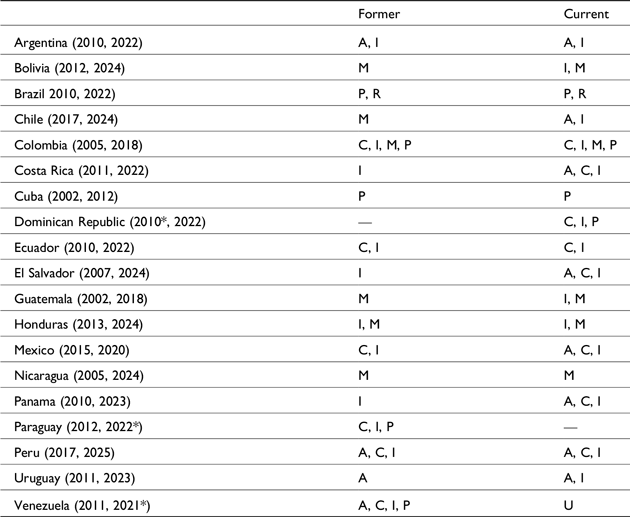
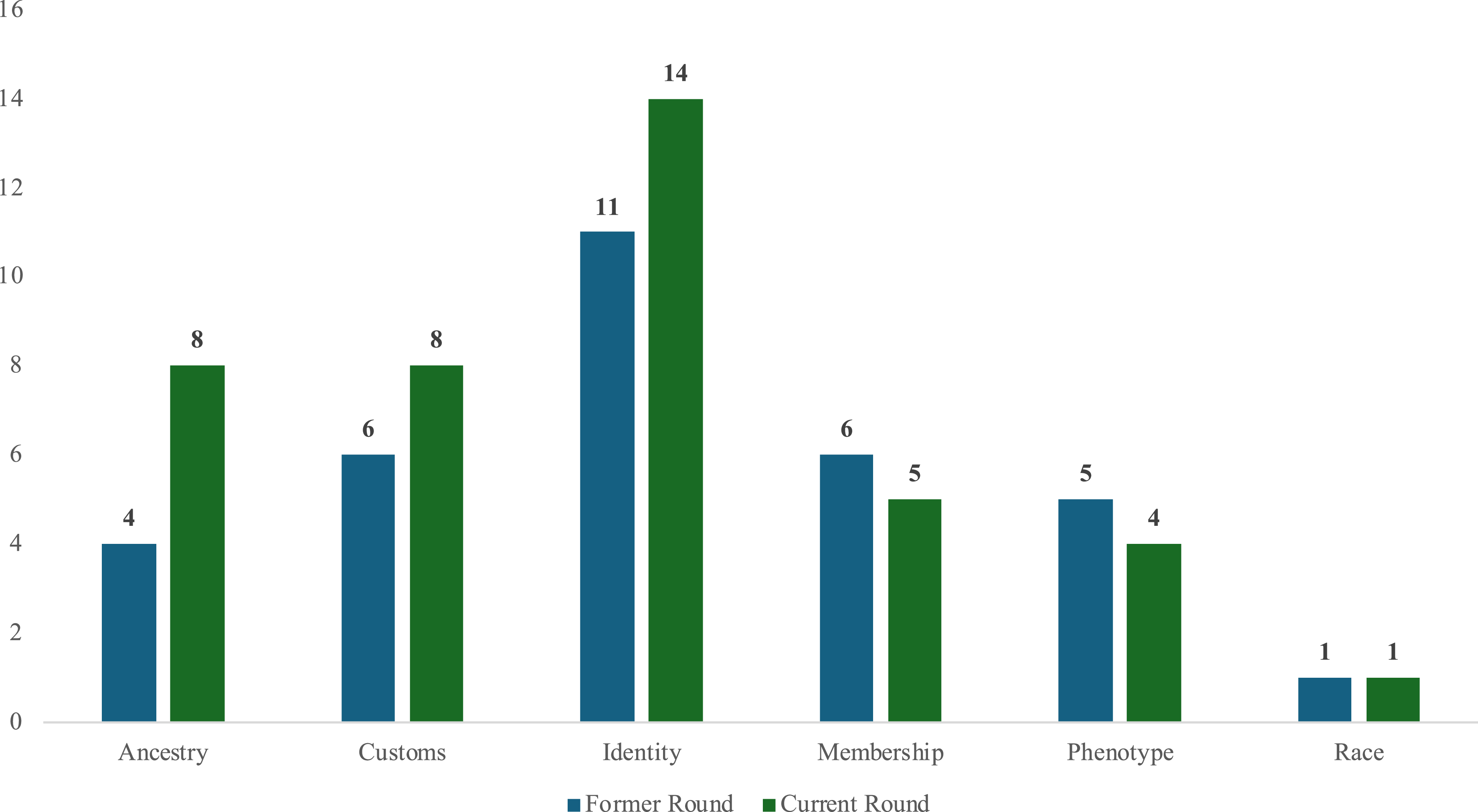
Our review of formulative approaches used to identify Afro-descendant populations shows that most NSOs adhere to this self-classification recommendation. In the 2010 round, more than 60 percent (eleven of eighteen) of NSOs phrased ethno-racial questions to ask whether respondents considered (se considera), recognized (se reconoce), or identified (se autoidentifica) themselves as Afro-descendant. Four of the seven NSOs that chose not to employ this approach later adopted similar phrasing in the 2020 round (Table 2). Taken together, nearly 82 percent (fourteen of sixteen) of NSOs in the 2020 census round elicited Afro-descendant responses in this way (Figure 1).
Conceptual Approaches for Identifying Afro-Descendant Populations Across Census Rounds

Table 2. Long description
A table comparing former and current approaches for identifying Afro-descendant populations across countries. The table has 18 rows and 3 columns. The columns are labeled ‘Country (Year)’, ‘Former’, and ‘Current’. Each row lists a country along with the years of the census rounds, followed by the former and current approaches used to identify Afro-descendant populations. The approaches are represented by letters: A for Autoidentifica, C for Considers, I for Identifies, M for Multiracial, P for Parental lineage, R for Racial categories, and U for Unknown. Row 1: Argentina (2010, 2022), Former: A, I, Current: A, I. Row 2: Bolivia (2012, 2024), Former: M, Current: I, M. Row 3: Brazil (2010, 2022), Former: P, R, Current: P, R. Row 4: Chile (2017, 2024), Former: M, Current: A, I. Row 5: Colombia (2005, 2018), Former: C, I, M, P, Current: C, I, M, P. Row 6: Costa Rica (2011, 2022), Former: I, Current: A, C, I. Row 7: Cuba (2002, 2012), Former: P, Current: P. Row 8: Dominican Republic (2010*, 2022), Former: —, Current: C, I, P. Row 9: Ecuador (2010, 2022), Former: C, I, Current: C, I. Row 10: El Salvador (2007, 2024), Former: I, Current: A, C, I. Row 11: Guatemala (2002, 2018), Former: M, Current: I, M. Row 12: Honduras (2013, 2024), Former: I, M, Current: I, M. Row 13: Mexico (2015, 2020), Former: C, I, Current: A, C, I. Row 14: Nicaragua (2005, 2024), Former: M, Current: M. Row 15: Panama (2010, 2023), Former: I, Current: A, C, I. Row 16: Paraguay (2012, 2022*), Former: C, I, P, Current: —. Row 17: Peru (2017, 2025), Former: A, C, I, Current: A, C, I. Row 18: Uruguay (2011, 2023), Former: A, Current: A, I. Row 19: Venezuela (2011, 2021*), Former: A, C, I, P, Current: U.
Notes. This table updates Mara Loveman’s table “Approaches to Enumerating Afrodescendant and Indigenous Peoples in Latin American Censuses, 1980s–2010s,” in National Colors. Letters indicate the concepts used to elicit Afro-descendant responses in question text(s) across census rounds: A = Ancestry, C = Customs, I = Identity, M = Membership, P = Phenotype/physical, R = Race, U = Unknown or not yet conducted. Multiple codes in a single cell indicate that several concepts are provided in that query. Census years with an asterisk indicate that an ethno-racial question was not provided for Afro-descendants.
Frequency of Conceptual Approaches for Identifying Afro-descendant Populations in Ethno-racial Questions Across Census Rounds

An important caveat to this identity-based approach, however, is that it rarely functions as a stand-alone taxonomic dimension. To be sure, only Costa Rica, El Salvador, and Panama posed census queries exclusively focused on identity in their previous rounds. The prevailing trend among NSOs, aside from Cuba (2012) and Nicaragua (2024), is to incorporate this dimension alongside distal identity criteria such as ancestry, cultural customs, and/or group belonging. Given the significance of self-classification as an individual and collective right in most state-based multiculturalist constitutions, we interpret this trend to be indicative of a multiculturalist approach to enumeration. Our results suggest that this approach manifests in at least three ways.
First, the growing reliance on multiculturalist approaches to identify Afro-descendant populations is particularly evident in the rephrasing of ethno-racial questions from generic, unidimensional formulations of self-identification (e.g., ¿Cómo se autoidentifica?) to more expansive approaches that incorporate criteria related to ancestry (antepasados, ascendencia, origen) and/or cultural customs (cultura, tradiciones, costumbres). This trend is particularly evident in some Central American nations, namely Costa Rica, El Salvador, Guatemala, and Honduras.
Second, beyond the combined and independent effects of the ancestry, customs, and individual identity dimensions, several NSOs appear to adopt a multiculturalist approach to enumeration by incorporating a collective identity-based dimension into questions about group membership or sense of belonging (pertenecer). This constitutes the second most common approach observed in recent census rounds and was particularly reflected in the questionnaires of Bolivia (2024), Colombia (2018), Costa Rica (2022), Guatemala (2018), and Honduras (2024). These countries occupy a central position in the multiculturalist framework, given their new constitutional commitments to the legal, political, and territorial rights of their respective Indigenous populations (Castillo 2007).
The group membership dimension signifies the cultural and social legitimacy of autochthonous peoples. In practice, however, ethno-racial questions incorporating this dimension are targeted only toward Afro-descendant populations when in conjunction with Indigenous categories. For example, Bolivia posed an open-ended question in both rounds asking whether respondents “belong to any Indigenous nation or people, or to the Afro-Bolivian community.” In contrast, Chile moved from a 2017 autochthonous-focused query that relegated Afro-descendant responses to an open-ended “other” category to a 2024 question exclusively targeted at Afro-descendants. This revised question, however, omitted the group membership dimension entirely, emphasizing ancestry instead (see Appendix A). These two findings point to a broader dilemma within the multiculturalist approach to enumeration: that notions of belonging to a distinct ethnic collectivity seem reserved for Afro-descendants only in the context of Indigenous classifications.
The third and final trend observed concerns the use of language reflecting race and phenotype. Historically, most Latin American NSOs framed ethno-racial questions around one or both dimensions before embracing the ideological narratives of mestizaje and racial democracy (Loveman Reference Loveman2014). In contemporary multicultural frameworks, however, NSOs often treat race and phenotype as less legitimate bases for Afro-descendant groups to assert a distinct collective identity (Hooker Reference Hooker2005; Loveman Reference Loveman2014; Paschel Reference Paschel2018).
We find that few NSOs in the region elicit Afro-descendant responses through race and phenotype dimensions, except for countries with a long-standing history of doing so. Brazil, for example, has consistently elicited Afro-descendant identity through both dimensions (i.e., What is your color or race?) since the 1990s rounds. Cuba has also historically framed their ethno-racial questions exclusively on the latter dimension of phenotype (i.e., What is your skin color?) since the nineteenth century (de la Fuente 1999). Although some social actors criticized the ethno-racial categories in the 1993 Colombian census for prioritizing “ethnic aspects of identity” over racial dimensions (Lennox and Minott Reference Lennox and Minott2011), census officials later incorporated a phenotype dimension (rasgos físicos) in their 2005 and 2018 questionnaires, albeit alongside a range of other expansive identity criteria relating to customs, individual identity, and group membership. Paraguay (2012) and Venezuela (2011) used similar approaches in the 2010 round, and the Dominican Republic (2022) did so in the 2020 round.
Ultimately, the racial dimension stands alone as the only one with minimal interactions with other dimensions, highlighting its specificity to the Brazilian context. Ironically, the Instituto Brasileiro de Geografia e Estatística (IBGE) began to question interviewees’ “race,” alongside “color,” only in its surveys after the 1991 census added an Indigenous category to distinguish people from this category from the parda(o) category, where they had previously been grouped (Petruccelli Reference Petruccelli2007).
Categorization of Afro-descendant identities
The second phase of analysis focuses on the use of Afro-descendant categories and their evolution between the 2010 and 2020 census rounds. Our review of these taxonomic categories reveals at least four broad methodological trends.
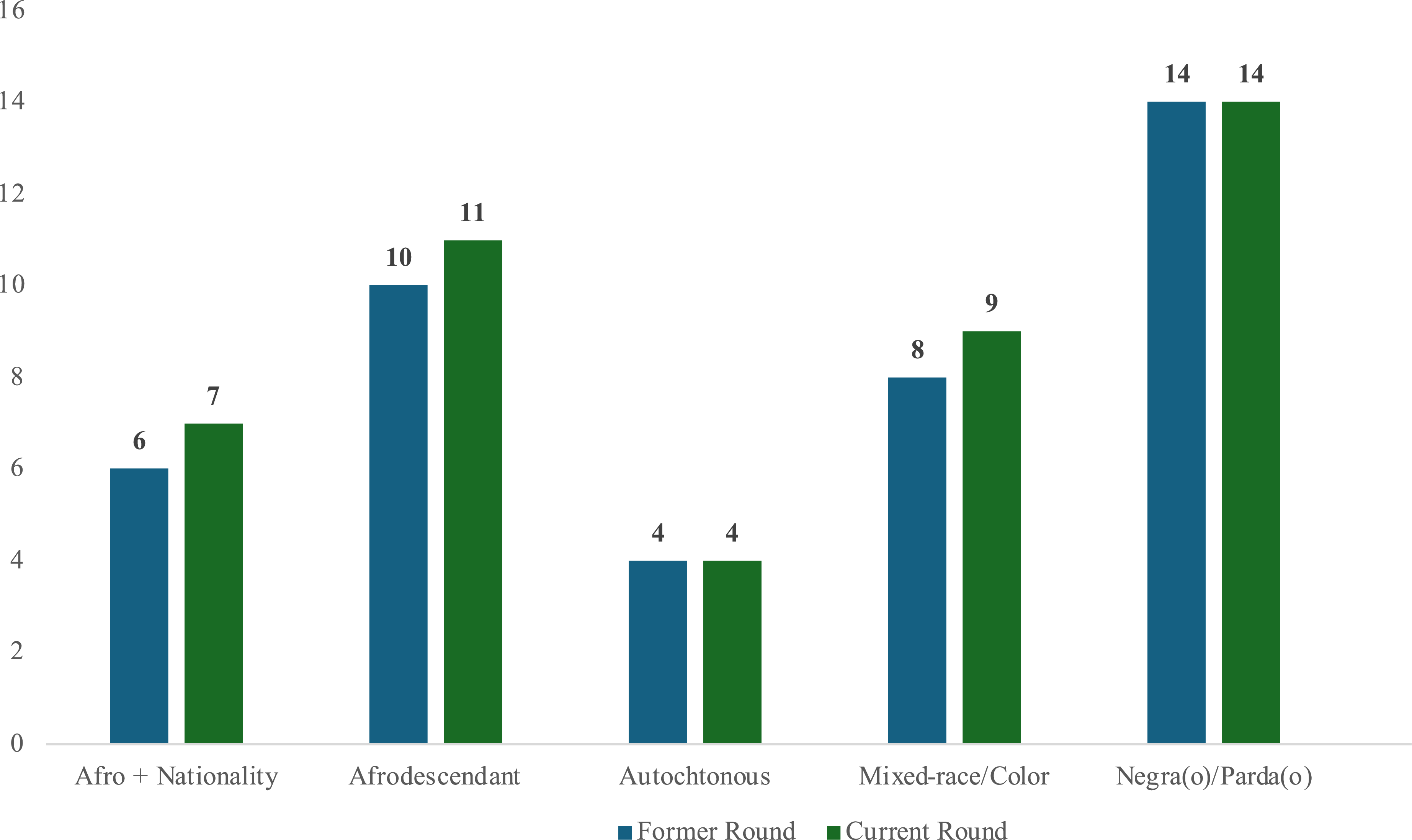
First, we find that the terms negra(o) and afrodescendiente appear most frequently and consistently across all questionnaires. To be sure, 82 percent (fourteen of sixteen) of NSOs included a term referencing negra(o) (preta(o) in Brazil) in the 2020 round, while 69 percent (eleven of sixteen) referenced afrodescendiente (Figure 2). This finding is especially notable considering that a little more than half of NSOs included categories related to mixed-race and color terms (nine of sixteen), which reflect classifications that are directly or indirectly tied to racial frameworks. On the other hand, the heavy reliance on the term afrodescendiente is less surprising, given that NSOs and Afro-descendant activists generally interpret it to encompass a broader, diverse range of peoples of African descent with shared histories of colonialism, diaspora, and sociopolitical struggle (Popolo and Schkolnik Reference Popolo, Schkolnik, Fernando, Ferrández and Kradolfer2012; Magallanes-Blanco Reference Magallanes-Blanco2022).
Frequency of Afro-Descendant Taxonomic Categories Across Census Rounds

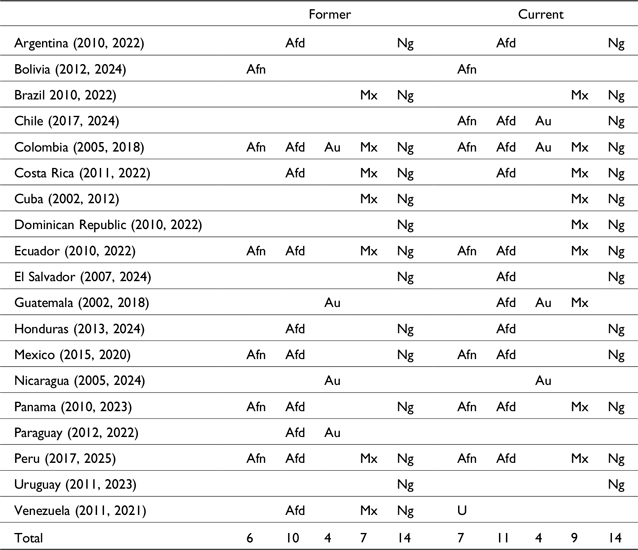
It is noteworthy that fewer NSOs included Afro-nationality (seven of sixteen) and autochthonous identities (four of sixteen). Figure 3 illustrates the country-level geographic distribution of Afro-descendant taxonomic categories across census rounds.
Geographic Distribution of Afro-Descendant Taxonomic Categories Across Census Rounds

Second, many NSOs employ multiple ethno-racial categories either as single selectable response options or by combining them into a single category. Table 3 illustrates this trend, where categories marked with dashed-line borders indicate a merger with one or more other categories, or the inclusion of multiple intracategorical terms (e.g., mulato, moreno) within a single response option.Footnote 3 Notably, 75 percent (twelve of sixteen) of NSOs in the 2020 round consolidated Afro-descendant categories in this way, compared to 61 percent (eleven of eighteen) in the 2010 round.
Taxonomic Afro-descendant Categories Across Census Rounds

Table 3. Long description
A table comparing Afro-descendant categories across different census rounds in various countries. The table has 19 rows and 6 columns, including headers. The columns are labeled ‘Former’ and ‘Current’, with sub-columns for specific categories. The rows are labeled with country names and the years of the census rounds. Each cell contains abbreviations representing different Afro-descendant categories. Row 1: Argentina (2010, 2022), Former: Afd, Ng, Current: Afd, Ng. Row 2: Bolivia (2012, 2024), Former: Afn, Current: Afn. Row 3: Brazil (2010, 2022), Former: Mx, Ng, Current: Mx, Ng. Row 4: Chile (2017, 2024), Former: (empty), Current: Afn, Afd, Au, Ng. Row 5: Colombia (2005, 2018), Former: Afn, Afd, Au, Mx, Ng, Current: Afn, Afd, Au, Mx, Ng. Row 6: Costa Rica (2011, 2022), Former: Afd, Mx, Ng, Current: Afd, Mx, Ng. Row 7: Cuba (2002, 2012), Former: Mx, Ng, Current: Mx, Ng. Row 8: Dominican Republic (2010, 2022), Former: Ng, Current: Mx, Ng. Row 9: Ecuador (2010, 2022), Former: Afn, Afd, Mx, Ng, Current: Afn, Afd, Mx, Ng. Row 10: El Salvador (2007, 2024), Former: Ng, Current: Afd, Ng. Row 11: Guatemala (2002, 2018), Former: Au, Current: Afd, Au, Mx. Row 12: Honduras (2013, 2024), Former: Afd, Ng, Current: Afd, Ng. Row 13: Mexico (2015, 2020), Former: Afn, Afd, Ng, Current: Afn, Afd, Ng. Row 14: Nicaragua (2005, 2024), Former: Au, Current: Au. Row 15: Panama (2010, 2023), Former: Afn, Afd, Ng, Current: Afn, Afd, Mx, Ng. Row 16: Paraguay (2012, 2022), Former: Afd, Au, Current: (empty). Row 17: Peru (2017, 2025), Former: Afn, Afd, Mx, Ng, Current: Afn, Afd, Mx, Ng. Row 18: Uruguay (2011, 2023), Former: Ng, Current: Ng. Row 19: Venezuela (2011, 2021), Former: Afd, Mx, Ng, Current: U. The table also includes a ‘Total’ row summarizing the counts of each category across the census rounds.
Notes. Letter codes indicate categories used to classify Afro-descendant across census rounds: Afd = Afro-descendant, Afn = Afro + Nationality, Au = Autochthonous, Mx = Mixed-race/Color, Ng = Negra/o and/or Preta/o. Categories marked with dashed-line borders indicate aggregated categories, or the aggregation of two or more intra-categorical terms (e.g. mulato and moreno) within a single response option.
In a region still shaped by eugenic whitening ideology and stigmatizing perceptions of Blackness and Indigeneity (Wade Reference Wade2010, Reference Wade2022; Popolo and Schkolnik Reference Popolo, Schkolnik, Fernando, Ferrández and Kradolfer2012; Stepan Reference Stepan1991), it is reasonable to hypothesize that consolidating multiple categories into a single or combined response option has considerable methodological and practical implications. In some cases, for example, NSOs present categories next to each other that carry different stigmatic connotations. In the cases of Colombia and Peru, mixed-race categories, which often function as “escape hatches” (Degler Reference Degler1970) from negra(o) (Hernández Reference Hernández2021), were nonetheless appended with this category and various other “hyphenated expressions” (Laó-Montes Reference Laó-Montes2005) of Afro-descendant identity. In Colombia, this composite category included negra(o), mulata(o), afrodescendiente, afrocolombiana(o). In contrast, Peru combined the categories negra(o), morena(o), zamba(o), mulata(o)/pueblo afroperuana(o) o afrodescendiente. As another point of comparison, Ecuador listed negra(o) and mulata(o) as independent categories, but combined afroecuatoriana(o) and afrodescendiente into one category. Taken together, these differing classificatory approaches raise important empirical questions about the effectiveness of eliciting Afro-descendant responses through varied configurations of mutually exclusive and overlapping response options.
We also find that, in some cases, the designation of separate Afro-descendant categories across the region reflects cultural, linguistic, and/or territorial distinctions associated with autochthonous status (Huerzo and Oslender Reference Huerzo, Oslender, Reiter and Antón Sánchez2023; Hooker Reference Hooker2005). Notably, Colombia designates a distinct response option for the palenqueros and raizales, as do Nicaragua and Honduras for their garífuna and miskitu populations. Guatemala’s recent census also set up a category for garífuna. However, this latter combined various Afro-descendant terms (afrodescendiente, creole o afromestizo) into a single category, effectively treating its English-speaking, Afro-Caribbean creole population (Opie Reference Opie2009; Johnson Reference Johnson2021) as indistinguishable from its afromestizo population. Several other Central American NSOs dedicate distinct categories for their English-speaking Afro-descendant populations, including the kriols (creoles) of Nicaragua (Gordon Reference Gordon1998), negros de habla inglesa (English-speaking Blacks) of Honduras (Chambers Reference Chambers2010), and afroantillanos of Panama (Andrews Reference Andrews2016; Paixão and Rossetto Reference Paixão, Rossetto, Dixon and Ollie2019; Corinealdi Reference Corinealdi2022).
Last, we observe a marked expansion in the number of Afro-descendant categories across census rounds, most of which now appear as mutually exclusive response options. Since the dawn of the twenty-first century, Afro-descendant categories in ethno-racial census questions increased from nineteen in the 2000 rounds to seventy-seven by the 2010 and 2020 cycles (see Table 1).
As two representative examples, in the 2020 round, Chile included five mutually exclusive categories for Afro-descendant populations: afrodescendiente, afrochilena(o), negra(o), del pueblo tribal, morena(o) de azapa, and negra(o) de la chimba (Instituto Nacional de Estadísticas (INE) Chile 2024). Similarly, Panama introduced several mutually exclusive Afro-descendant categories, which encompassed three hyphenated identifiers (e.g., afrocolonial, afroantillana(o), afropanameña(o)), a racial term (negra(o)), a phenotypic category (morena(o)), and the term afrodescendiente. An additional category, otro grupo, aggregated several culturally relevant geographic and phenotypic descriptors into one response option, including canela, carabalí, costeña(o), culisa(o), morena(o), and trigueña(o).
In different Latin American societies, negro functions as a strategic and sociopolitical reclamation of Blackness and, among many activists, as a deliberate contestation of the stigma historically attached to racial identity (Gordon and Anderson Reference Gordon and Anderson1999; Wade Reference Wade2010). Hence, the overall tendency of some NSOs to expand the number of categories used to elicit responses from Afro-descendants by importing racial categories into multicultural frameworks signals ongoing negotiations between NSOs and Afro-descendant activists, addressing a widespread suspicion of statistical undercounting of Afro-descendants in previous decennial censuses in several Latin American countries. This expansion seems to encourage these institutions, whether they use these categories individually or in combination, to offer a range of salient terms that reflect the diversity of their Afro-descendant populations.
Therefore, although most NSOs have generally refrained from incorporating racial categories into their question formulations, their willingness to treat them as an enumerable category suggests they are concerned with gaining legitimacy not only for employed categories but also for census results in general. This could lead NSOs to engage more regularly with social movement activists and become more open or permeable to their claims for the employment of categories otherwise rebuffed.
Afro-descendant statistical visibility in Latin America
This section examines country-specific shifts in Afro-descendant populations across consecutive census rounds. Importantly, we do not attempt to infer a causal relationship between the design of ethno-racial questions and corresponding population shifts. Rather, we aim to identify plausible associations and interpretive patterns in Afro-descendant counts across the region while acknowledging the broader social, political, and demographic dynamics that motivate these shifts. Given the reemergence of ethno-racial questions at the dawn of the multiculturalist era in Latin America, we examine changes in Afro-descendant populations from 1980 to the present.
Table 1 shows Afro-descendant counts and population shares by country across five decennial census periods. Over this period, the number of Afro-descendants in the region surged by nearly 120 percent, reaching at least 124.5 million people by the 2020 round. Even discounting the positive population growth during that period, this figure is conservative because it excludes countries whose NSOs have yet to enumerate or publicly release data from their 2020 census rounds, including Colombia, Cuba, Costa Rica, Guatemala, Honduras, Nicaragua, Peru, and Venezuela. In terms of population share, Afro-descendants accounted for roughly 15 percent of the total Latin American population in the 1980 census rounds and approximately 23 percent by the 2020s. Accounting for the disproportionate weight of Afro-Brazilians among Afro–Latin Americans further sharpens the interpretation of these trends. In the 1990s round, for example, Afro-Brazilians accounted for nearly all Afro-descendants enumerated across the region. By the 2010s, however, this share had declined to about 78 percent, reflecting the relative increase in the statistical visibility of Afro-descendant populations outside Brazil.
We also find that there are select cases in which shifts in the reported population appear to correlate with intercensal revisions to ethno-racial question formulations and categorical response options. For example, in most Latin American countries where cross-census comparisons are possible, NSOs estimated substantially lower Afro-descendant populations in earlier rounds than in the most recent ones. Chile and Panama are the clearest examples of this trend. In absolute terms, the Afro-descendant population in Chile rose by approximately 164,000 between 2017 and 2024, whereas in Panama it increased by more than 970,000 between 2010 and 2023. In earlier rounds, both countries moved away from unidimensional question formulations that incorporated distal identity criteria (e.g., ancestry) and, as noted previously, expanded the set of categorical response options related to Afro-descendant identity, combining multiculturalist approaches with those on “racial” grounds. Central American countries, including El Salvador, Guatemala, and Honduras, display similar trends.
Argentina and Mexico illustrate experiences with changes in the design of ethno-racial questions, leading to more people self-identifying as Afro-descendants. In Argentina, a more straightforward question formulation for the category afrodescendiente may have contributed to an increase of 153,000 people in 2022 compared to 2010. Similarly, Mexico’s 2015 intercensal survey, which included a negra(o) afromexicana(o) and afrodescendiente category with four response options (i.e., sí; sí, parcialmente; no; no sabe), may have contributed to lower estimates than in the subsequent round, after the Instituto Nacional de Estadística, Geografía e Informática (INEGI) simplified the question for two response categories (“sí” and “no”). As a result, in the 2020 census, Mexico’s Afro-descendant population exhibited a surge of more than 603,000 responses. These patterns suggest that ethno-racial questions, especially when introduced after long gaps in enumeration or for the first time in a country’s postcolonial history, tend to be tentative, as their effectiveness in capturing Afro-descendant populations often improves only after subsequent census rounds. These implications are particularly significant for countries like the Dominican Republic and Paraguay, which have not yet undertaken successive enumeration of their Afro-descendant populations.
Although it is challenging to isolate demographic effects and grassroots activism aimed at strengthening Black political consciousness (Clealand Reference Clealand2022), it is not far-fetched to assume that changes in question wording and the adoption of more culturally relevant Afro-descendant categories exerted at least some influence on shifts in Afro-descendant populations in these countries.
Another notable trend is the likely role of mixed-race or color categories in driving growth in the Afro-descendant population. Categories such as pardo in Brazil, mulato in Costa Rica, moreno, mestizo, mulato, and indio in the Dominican Republic, and moreno in Venezuela accounted for more than 80 percent of all Afro-descendant respondents in these countries. In Panama, nearly half of observed Afro-descendant population growth in 2023 came from respondents choosing “escape-hatch” categories (Degler Reference Degler1970) such as morena(o) and otro grupo afrodescendiente, which combined multiple phenotypic identities into a single response. In Costa Rica, the addition of the mulato category produced an estimated 291,000 respondents in the 2011 census, a figure that, by itself, exceeds the total number of Afro-descendant Costa Ricans enumerated about ten years earlier.
Although we posit that changes in the design of ethno-racial questions exert at least a small influence on Afro-descendant population shifts in national contexts, there are clear cases where this is unlikely. Brazil is one such example. Between 2010 and 2022, the country’s Afro-descendant population grew by approximately 15.6 million people, rising from 44.7 percent to 55.5 percent of the total population. We cannot attribute this shift to changes in question design or categorical response options, as Brazil has consistently used the same ethno-racial question for the past four decades. Instead, some scholars attribute this increase to the expansion of affirmative action policies aimed at improving Afro-Brazilians’ access to higher education beginning in the 2000s (Freeman et al. Reference Freeman, Telles and Goldberg2025; Soares Reference Soares and Theodoro2008).
Colombia and Ecuador, for example, stand out as the only cases in the region where the Afro-descendant population declined, even though both countries employed identical question designs across census rounds. To be sure, the Afro-descendant populations shrank by 1.34 million between 2005 and 2018 (from 10.5 percent to 6.8 percent) in Colombia and by roughly 224,000 between 2010 and 2022 (from 7.2 percent to 4.8 percent) in Ecuador. Contrary to optimistic assessments suggesting a growing preference among Afro-Ecuadorians for the afroecuatoriano or afrodescendiente categories (Anthón-Sanchez Reference Anthón-Sanchez and Bar2013), the data indicate that only the negro category increased its relative share, while responses identifying as afroecuatoriano or afrodescendiente declined sharply, contributing to a still-unexplained drop in the Afro-descendant population.
Discussion
The role of Afro-descendant activists and civil society groups
Across Latin America, the struggle for Afro-descendant statistical visibility has advanced through coordinated efforts by various social and state actors, driven primarily by the sustained activism of Afro-descendant organizations and their civil society organizations (CSOs). A cursory review of each stakeholder’s role is essential for understanding their respective contributions, constraints, contradictions, and responsibilities in shaping the designs of the aforementioned census questions over recent decades and for strengthening the case for statistical visibility of Afro-descendant populations across the region.
One of the earliest expressions of the struggle for statistical visibility emerged in Brazil during the country’s transition to political openness in the late 1970s. Following the removal of a skin-color variable from the Brazilian census during the authoritarian regime, Black movement organizations (BMOs) successfully lobbied IBGE to reinstate it (Oliveira Reference Oliveira2003; Nobles Reference Nobles2000). By the 1991 census, the same organizations held public awareness campaigns such as “Não deixe sua cor passar em branco, responda com bom c/senso” (“Don’t let your color pass white; respond with good “sensus”), to encourage darker-skinned Brazilians to reject eugenic-mestizo ideologies and embrace pardo or preto identifications (Nobles Reference Nobles2000). These efforts would become a benchmark for other BMOs and reverberate across the region, whether by pressuring NSOs to incorporate Afro-descendant categories into their respective ethno-racial census queries or launching public awareness campaigns encouraging constituencies to embrace these categories (Loveman Reference Loveman2014).
Prominent examples of this widespread phenomenon include the Ser Negra/oes Hermoso campaign in Colombia (Freelon Reference Freelon2016), Argentina es Afro in Argentina (Nazareno and Núñez Iglesias 2013), Afroidentifícate in Chile (Polo Reference Polo2024), and various comparable campaigns in Costa Rica, Dominican Republic, Honduras, Panama, and Uruguay (Campbell Bar Reference Campbell Bar2013, Reference Campbell Bar2014; Paixão and Rossetto Reference Paixão, Rossetto, Dixon and Ollie2019). Circling back to Colombia, the disappointing results of the 2018 census led a coalition of Afro-Colombian BMOs to open a litigation against the country’s statistical office (Ilex Acción Jurídica v. DANE, Tutela T-276, 2022), amid what they explicitly define as a “statistical genocide” (Hernández Reference Hernández2025). These cases reinforce our previous point that NSOs must actively negotiate with Afro-descendant activists and their CSOs to incorporate categories that challenge or go beyond the conventional logic of multiculturalist approaches to enumeration.
Exemplifying the regular concern of Afro-descendant representatives across the region (Campbell Bar Reference Campbell Bar2014), in both the 2010 Panama and the 2017 Chile censuses, activists and CSOs criticized estimates of Afro-descendant populations for undercounting and omitting relevant categories (Watson 2012; Lowe Reference Lowe2023; Mardones Marshall et al. 2025). As observed earlier, after the corresponding NSOs reformulated the question wording and introduced new categories, the number of Afro-descendants rose by more than four times in Panama and by seventeen times in Chile.
As we commented in the previous sections, political openness and the new hegemonic multiculturalism in the international sphere made national NSOs more agreeable to Afro-descendants’ statistical visibility. Alternatively, although that trend crossed ideological lines, the Pink Tide of the 2000s and 2010s (Feierherd et al. Reference Feierherd, Larroulet, Long and Lustig2023), headed by a political coalition theoretically open to historically marginalized groups, provided another political venue for the inclusion of Afro-descendant categories in censuses. So, it seems more than a coincidence that census reforms occurred during the presidencies of South American leaders Kirchner (Argentina 2010), Morales (Bolivia 2011), Boric (Chile 2024), Lugo (Paraguay 2012), Mujica (Uruguay 2011), and Chávez (Venezuela 2011), all aligned with the left wing.Footnote 4 Conversely, the future of Afro-descendants’ statistical visibility in countries that opened the door to that policy during the Pink Tide is uncertain.
In the intercensal interregnum, the former Paraguayan president Lugo faced impeachment, and more traditional parties reclaimed power. Was that why Paraguay did not enumerate Afro-descendants in the 2020 census round? To be sure, what happened in Paraguay did not repeat during Bolsonaro’s term in Brazil (2019–2022); on the contrary, the last Brazilian census was the first to include a variable for Quilombo people. Nevertheless, we can ask what might happen with the ethno-racial statistical visibility in other countries where the NSOs have less autonomy, if a new political arrangement emerges, particularly if led by a xenophobic far-right coalition, usually at odds not only with a leftist but also with the multicultural agenda.
Since the beginning of the twenty-first century, Afro-Latin American academics and social activists have deepened intraregional collaborations to drive change at scale. Notably, in 2009, leading Afro-descendant scholars and activists from nine countries in the region founded the Working Group on Afro–Latin American Data Disaggregation, led by Epsy Campbell Bar, later vice president of Costa Rica (2018–2022). This group successfully lobbied for the inclusion or continuation of Afro-descendant categories in the 2010s census rounds of Argentina, Chile, Costa Rica, the Dominican Republic, Ecuador, Uruguay, and Venezuela (Campbell Bar Reference Campbell Bar2013). These achievements exemplify that the initial inclusion of measures to capture Afro-descendant populations in Latin American censuses was primarily driven by sustained advocacy from Afro-descendant activists and CSOs, which strategically leveraged favorable political openings to push for institutional change.
The role of supranational actors
As noted earlier, the recent movement toward greater statistical visibility in Latin America advanced through multiculturalist approaches to enumeration. Therefore, given the recent evolution in the enumeration of Afro-descendants across Latin America, we can assess the ECLAC-CELADE recommendations as a success. Yet the movement toward statistical visibility in that region went beyond the strict logic of the multicultural framework. Hence, especially when we consider the Afro-descendants’ mobilization for statistical visibility, we can say that their current demographical enumeration emerged from a mediation among different players over question wordings and categories. Also, though influential, ECLAC-CELADE’s approach was not unanimous, which renders the dissection of its proposal for counting Afro-descendants a necessary step of our analysis.
In line with international standards, ECLAC-CELADE endorses the principle of self-identification (CEPAL 2021; Popolo et al. Reference Popolo, Oyarce, Schkolnik and Velasco2009), reflecting international efforts to rectify past NSO practices that used hetero-classification to exert demographic or political control over marginalized groups (Seltzer and Anderson Reference Seltzer and Anderson2001). Still, the agency defines self-recognition, emphasizing “consciousness of membership, common origin, culture, and territoriality,” primarily specifying Afro-descendants categories in terms of Indigenous and/or tribal identity (Popolo and Schkolnik Reference Popolo, Schkolnik, Fernando, Ferrández and Kradolfer2012). Furthermore, their concern about not hindering the Indigenous count has led to resistance among ECLAC–CELADE officers to the use of Afro-descendant mestiza(o) terms in census questionnaires (Popolo and Schkolnik Reference Popolo, Schkolnik, Fernando, Ferrández and Kradolfer2012). Finally, ECLAC–CELADE openly discourages the inclusion of “racial” categories such as blanca(o)/branca(o) and mestiza(o), arguing that they can undermine the primary purpose of identifying specific ethnic groups. At the same time, it does not recommend using the category negro, which it considers stigmatizing (Popolo and Schkolnik Reference Popolo, Schkolnik, Fernando, Ferrández and Kradolfer2012).
As Table 1 shows, the evolution of demographic enumerations across Latin America confirms that multicultural categories referring to ancestry, cultural customs, and origins received a positive response from a significant contingent of Afro-descendants across the region, regardless of whether NSOs, in several cases, combined them with complementary frameworks relating to feelings of membership in a similar way for Indigenous counting. We doubt, though, whether the best translation of multiculturalism across Latin America is “tribal identity,” regardless of the particular national-sociological contexts (Popolo and Schkolnik Reference Popolo, Schkolnik, Fernando, Ferrández and Kradolfer2012). There is substantial research on contemporary Latin America indicating that a primary aspiration of Afro-descendant Latin Americans, particularly in urban areas, is their desire to be recognized as part of the national polity amid a socioeconomic pigmentocratic reality (Telles and PERLA Reference Telles2014) that makes them second-class citizens due to their physical appearance (Andrews Reference Andrews2004; Alberto Reference Alberto2011; Paschel Reference Paschel2018; Rahier Reference Rahier2020). While there is regularly concern that taxonomies such as negro might stigmatize, and thus drive away, Afro-descendants from statistical visibility, ECLAC-CELADE’s understanding of Afro-descendants as an Indigenous-like “tribal identity,” regardless of the vicissitudes of each nation, might not necessarily be less stigmatizing for contingents more exposed to narratives of national identity through the educational system and media, as well as regular contact with state bureaucracy and militaries, mainly in urban sites (Andrews Reference Andrews2004).
Empirical evidence shows that the choice of census category affects the final enumeration of Afro-descendants and Indigenous peoples (Telles and PERLA Reference Telles2014). In contrast, as Table 1 shows, in countries like Brazil, Costa Rica, Dominican Republic, and Venezuela, eight in every ten Afro-descendants defined themselves to census takers with categories such as pardo, mulata(o), moreno, and indio. In Brazil, for example, a late-1990s survey found that, for most Brazilians, skin color is the primary descriptor of their self-definition of color or race (Telles and Paschel Reference Telles and Paschel2014; IBGE 2011; Dominican Republic, Oficina Nacional de Estadística 2022). Simultaneously, only 2 percent of Brazilians identified as afrodescendiente (Schwartzman Reference Schwartzman1999; Petruccelli Reference Petruccelli2007; Paixão et al. Reference Paixão, Rossetto, Montovanele and Carvano2011). This finding may also explain Ecuador’s plunge in responses for afroecuatoriana(o) o afrodescendiente, which occurred alongside the peculiar surge in respondents identifying as negra(o) between the 2010 and 2022 censuses.
Naturally, NSOs must take measures to avoid undercounting Indigenous peoples, as has occurred in Brazil (Popolo and Schkolnik Reference Popolo, Schkolnik, Fernando, Ferrández and Kradolfer2012) and Ecuador, where the issue intensified following the inclusion of the category montubio by the Instituto Nacional de Estadísticas y Censos (INEC) in the 2010 census (Anthón-Sanchez Reference Anthón-Sanchez and Bar2013). Project Ethnicity and Race in Latin America showed that, in countries like Peru and Mexico, several Indigenous respondents were dark-skinned (as assigned by the interviewer using a color palette; Telles and PERLA Reference Telles2014; Silva and Paixão Reference Silva, Paixão and Telles2014), and it is reasonable to assume that the same is true across other countries in the region. Statistically, the absence of categories that reflect this reality will negatively affect the enumeration of the Indigenous population.
Conversely, Hooker (Reference Hooker2005, Reference Hooker2008) contends that many states routinely discriminate against Afro-descendants because they fail to prioritize addressing the anti-Black racism that renders these populations politically invisible in Latin America. Consequently, most Afro-descendant populations across the region are eligible for collective and territorial rights only when they can assert an indigenous-like, autochthonous identity. Would Hooker’s approach apply to the current debate? In any case, “the difficult art of counting” seems to call for an additional endeavor to develop methodologies that could strengthen statistical visibility for all historically disadvantaged people.
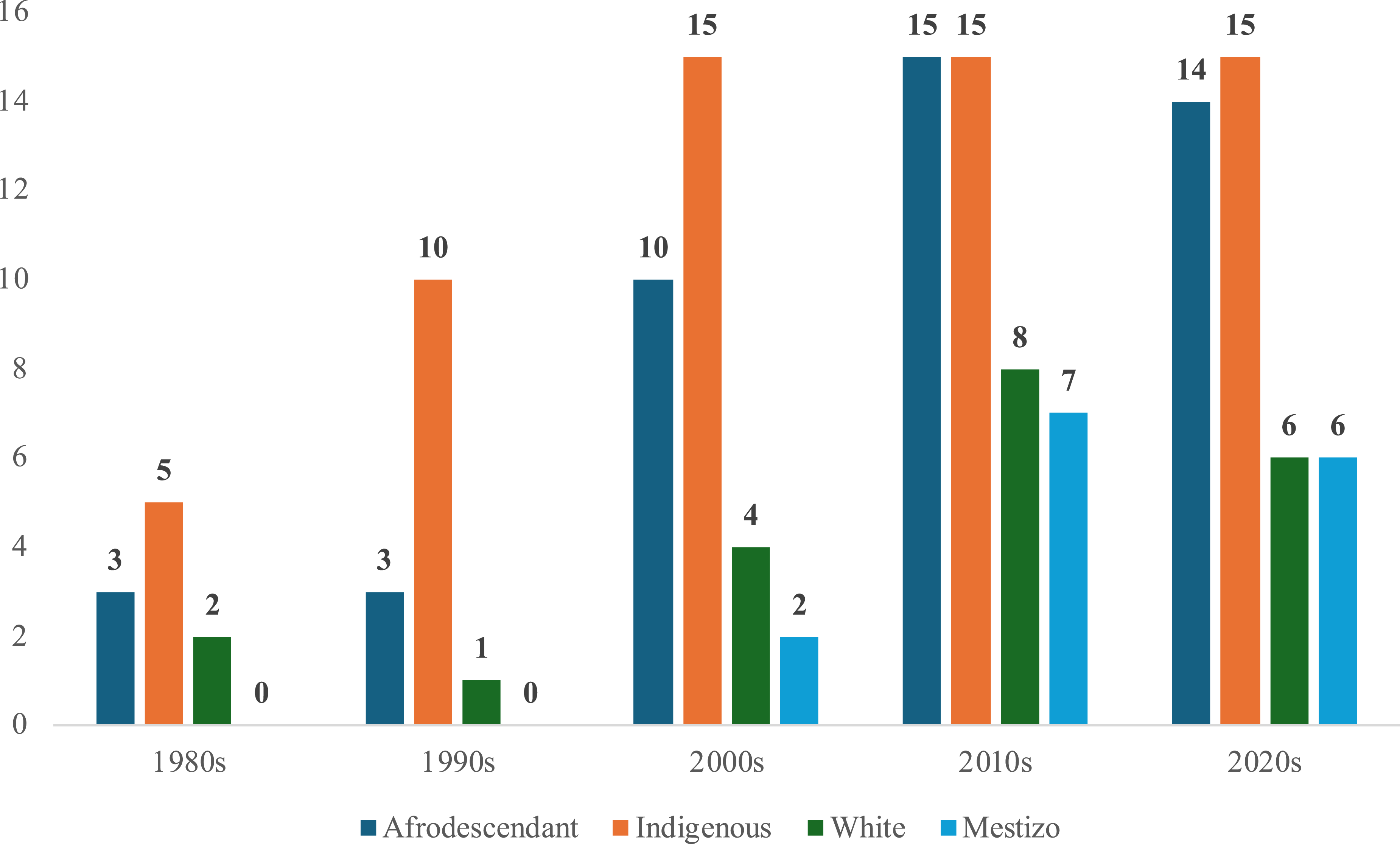
Finally, our cursory analysis of ethno-racial census questions shows that, between the 2010s and 2020s census rounds, only nine Latin American countries included a white category (ladinos in Guatemala), hinting at the influence of ECLAC-CELADE orientation on this direction (Figure 4). Yet the literature suggests that white- and white-mestizo-identifying Latin Americans occupy a hegemonic status marked by privilege and superiority (Bento Reference Bento2022), which in itself underscores their importance as a plausible reference group or category for statistical comparison. A key concern is whether maintaining the statistical invisibility of socially privileged groups is analytically justified. Moreover, given that whitening and eugenic ideologies have historically discouraged Afro-descendant and Indigenous populations from self-identifying as such, the exclusive use of categories targeting these groups, as opposed to the entire population, may itself introduce stigma and contribute to further statistical invisibilization.
Frequency of ethno-racial categories included in Latin American Census Rounds, 1980s–2020s

As mentioned, ECLAC-CELADE made a fundamental contribution to advancing the statistical visibility of Afro-descendants in the region through multicultural approaches to enumeration. Given its influence over the region’s statistical process, the observations we made in this section can help highlight central controversies and the complexity currently surrounding Afro-descendant statistical visibility, as well as the antinomy that national NSOs must address in order to ensure that society validates their statistics.
Conclusion
The results of this study suggest that, between the 2010 and 2020 census rounds, most Latin American NSOs widened the scope of Afro-descendant identification by adopting what we refer to as multiculturalist approaches to enumeration. That is, most NSOs elicited Afro-descendant responses in their respective 2020 census rounds through various expressions of identity, including ancestry, cultural customs, and, to a lesser extent, group belonging. This expansion of pathways to Afro-descendant identity poses several implications for how the population is rendered statistically visible across the region.
Extending Loveman’s (Reference Loveman2014) analysis, we argue that the implications of Afro-descendant categories depend not only on their inclusion but also on whether they are framed in ethnic or racial terms. Our findings highlight a paradox between the formulation of ethno-racial questions and the categories NSOs use to classify Afro-descendant populations. To be sure, many NSOs frame their ethno-racial questions through multiculturalist logics, while omitting expressions of identity rooted in “visible” or externally imposed ascriptions of Blackness, such as phenotype or race. On the surface, these formulations place less emphasis on physical features by prioritizing other relevant processes of Black identity formation (Gordon and Anderson Reference Gordon and Anderson1999). At the same time, most of the taxonomic categories listed under these question formulations are innately racial or phenotypical, including the mestizo categories that Latin American societies usually use to refer to Afro-descendants. The term negra(o), for instance, is the most used Afro-descendant category across both the 2010 and 2020 census rounds, while nearly half of NSOs folded mixed-race or color categories into their most recent ethno-racial question designs. This paradox raises questions about the relative “fit” of race-based taxonomic categories within a multicultural framework ostensibly designed to identify distinct ethnic groups.
On this point, we consider this paradox reflective of ongoing negotiations between NSOs and social actors over best practices for rendering Afro-descendant populations statistically visible. While many NSOs make a point to frame their ethno-racial question formulations around multiculturalist dimensions, they also express a willingness to validate and legitimate the census process among their stakeholders, particularly regarding relevant categories. In this sense, the official use of racial or phenotypic terms as selectable categories in these question designs signals negotiations between Afro-descendant organizations and NSOs over terms that carry social and/or political relevance among social movement actors and other stakeholders.
Considering these findings, it is important to outline plausible directions for future research. One pressing empirical question is whether the use of various ethno-racial categories to capture the full diversity of Afro-descendants can be aggregated in a way that reflects a collective, unitary black identity. As argued by Gordon and Anderson (Reference Gordon and Anderson1999), many members of the African diaspora articulate their membership (or lack thereof) in complex and at times contradictory ways. These contradictions raise empirical questions that complementary ethnographic inquiry could also address.
Another empirical issue involves the tendency for NSOs to present various Afro-descendant categories as combined response options. It is unclear, for example, whether this strategy affects individual decisions to identify as Afro-descendant. It is also unclear whether Afro-descendant organizations preferred that NSOs use combined categories rather than separate, individual ones. In either sense, presenting stigmatized categories alongside less stigmatized options may inevitably shape identity choices. This plausibility calls for experimental survey designs that test how respondents interpret and respond to different categorical options (Telles and PERLA Reference Telles2014). Such an assessment can also open avenues for research into how the conflation between ethnic-based question formulations and race-based categories may ultimately shape how respondents identify as Afro-descendant.
In summary, the 2010 and 2020 census rounds ultimately reveal that Afro-descendants across Latin America are moving closer to achieving statistical visibility. Approximately 125 million Afro-descendants were enumerated and represented in official statistics during the 2020s, a substantial increase from previous census periods. This is quite an achievement, given that, throughout most of the twentieth century, Afro-descendants struggled to be part of the national politics of Latin America amid state-driven projects ideologically grounded in mestizaje, hybridism, and racial democracy (Andrews Reference Andrews2004; Loveman Reference Loveman2014). Still, this turn toward statistical recognition prompts us to question how national censuses in the region help not only visibilize Afro-descendants as multicultural subjects (Ng’weno Reference Ng’weno2007; Rahier Reference Rahier, Reiter and Sánchez2023) but also entitle them to collective rights amid persistent anti-Black racism across the region (Wade Reference Wade2010; Telles and PERLA Reference Telles2014; Paschel Reference Paschel2018). This is especially relevant for those Afro-descendants who endlessly strive to express the importance of race and racial discrimination within the contemporary framework of “race-blind” multiculturalist policies.
Supplementary material
To view supplementary material for this article, please visit https://doi.org/10.1017/lar.2026.10153
Acknowledgment
This research was supported by grant P2CHD042849, Population Research Center, awarded to the Population Research Center at The University of Texas at Austin by the Eunice Kennedy Shriver National Institute of Child Health and Human Development. The content is solely the responsibility of the authors and does not necessarily represent the official views of the National Institutes of Health. This research was also supported with postdoctoral funding from the Department of African and African Diaspora Studies at the University of Texas at Austin. Dr. Paixão thanks CAPES Foundation, Brazil, for the financial support (6122-12-4) received during his sabbatical at Princeton University. Dr. Paixão and Dr. Lowe Jr. are also grateful to Carlos Viáfara López, David Sulmont, Edmund T. Gordon, Edward Telles, Irene Rossetto, Jessica Bratter, José Luis Suarez, Melva Lowe de Goodin, Tanya Katerí Hernández, Danielle Clealand, Audwin Anderson (in memoriam) and the five anonymous LARR reviewers for their generous support in sharing research materials and comments on a previous version of this paper. This article features equal authorship.




 Open access

