



Pathological health anxiety is characterised by the persistent and excessive fear of, or preoccupation with, having or acquiring a serious health condition. Reference Asmundson and Fergus1 Individuals with this condition often misinterpret normal bodily sensations as signs of severe illness and frequently seek medical reassurance excessively. In the healthcare system, patients with pathological health anxiety generally meet the diagnostic criteria for ICD-10/11 hypochondriasis, DSM-5 illness anxiety disorder, or DSM-5 somatic symptom disorder. Reference Newby, Hobbs, Mahoney, Wong and Andrews2–Reference Weck, Richtberg and Neng4 A national survey in Australia found that pathological health anxiety had a point prevalence of approximately 3.4% in the adult population. Reference Sunderland, Newby and Andrews5 In the healthcare system, the prevalence is believed to be higher. For example, in a widely cited study from the UK, 19.8% of patients attending medical clinics were found to have pathological health anxiety as based on a cut-off on the Health Anxiety Inventory (HAI). Reference Tyrer, Cooper, Crawford, Dupont, Green and Murphy6
Both pharmacological and psychological treatments have proven effective for managing pathological health anxiety. Reference Tyrer7 Evidence suggests that patients may prefer psychological treatments, possibly due to concerns about the common side-effects associated with medication. Reference Walker, Vincent, Furer, Cox and Kjernisted8 A variety of psychological interventions have been explored in randomised controlled trials (RCTs), such as cognitive–behavioural therapy (CBT), acceptance and commitment therapy (ACT), and behavioural stress management (BSM). Reference Maass, Kühne, Maas, Unverdross and Weck9 However, there is limited research evidence on the relative efficacy of these different therapies.
CBT is the most extensively researched psychotherapy for health anxiety and has been demonstrated to have substantial effects, as confirmed by several meta-analyses. Reference Olatunji, Kauffman, Meltzer, Davis, Smits and Powers10–Reference Axelsson and Hedman-Lagerlöf12 CBT integrates techniques from both behavioural and cognitive therapies, laying the foundation for understanding the interconnectedness of thoughts, behaviours, and emotions. Reference Tolin13 The third-wave CBT was augmented by concepts such as mindfulness, acceptance, value, goals and meta-cognition. Reference Hayes and Hofmann14 New models and interventions, including ACT, mindfulness-based cognitive therapy (MBCT), metacognitive therapy (MCT), among others, emerged. Reference Brown, Gaudiano and Miller15 Despite these novel approaches, evidence from multiple meta-analyses indicates that the effect sizes for third-wave CBT treatments are comparable to those of traditional CBT for anxiety disorders. Reference Arch, Eifert, Davies, Vilardaga, Rose and Craske16,Reference Butler, Chapman, Forman and Beck17
To inform clinical recommendations effectively, it is essential to clarify the comparative efficacy of various psychological interventions, including different forms of CBT, in managing health anxiety. Reference Hedman-Lagerlöf and Axelsson18 A notable limitation of existing meta-analyses is their focus solely on direct pairwise comparisons, which has left the relative efficacy of various active psychological interventions largely unexplored. Reference Olatunji, Kauffman, Meltzer, Davis, Smits and Powers10–Reference Axelsson and Hedman-Lagerlöf12 Furthermore, treating CBT as a monolithic approach has obscured the comparative effectiveness of its diverse types and the specific components designed for health anxiety. Reference Hedman-Lagerlöf and Axelsson18
While traditional pairwise meta-analysis methods can assess comparative efficacy between two interventions, they may not effectively capture the broader efficacy landscape among multiple interventions as network meta-analysis (NMA) does. NMA facilitates the synthesis of both direct and indirect comparisons, enabling the comparison and ranking of psychological interventions, even when they have not been directly contrasted within the same randomised controlled trial (RCT). Reference Higgins and Welton19 More recently, component network meta-analysis (CNMA) has been developed to estimate the additive contributions of components within complex interventions. Reference Welton, Caldwell, Adamopoulos and Vedhara20 This innovative approach enables meaningful conclusions about the effectiveness of individual components while addressing challenges associated with connected networks and the low precision often encountered in standard NMA. Reference Higgins and Welton19,Reference Rücker, Petropoulou and Schwarzer21 The application of CNMA in psychological interventions has been demonstrated previously and holds the potential to address specific research questions regarding the efficacy of various components within complex interventions. Reference Freeman, Scott, Powell, Johnston, Sutton and Cooper22–Reference Miklowitz, Efthimiou, Furukawa, Scott, McLaren, Geddes and et al24
The current study aimed to conduct a comprehensive systematic review of RCTs that focus on psychological interventions for conditions characterised by pathological health anxiety. To compare the effectiveness of various psychological interventions and assess the incremental effects of individual components, both NMA and CNMA methodologies were employed.
Method
This study was conducted in accordance with the Preferred Reporting Items for Systematic Reviews and Meta-Analyses (PRISMA) guidelines Reference Moher, Liberati, Tetzlaff and Altman25 and its extension for network meta-analysis, Reference Hutton, Salanti, Caldwell, Chaimani, Schmid and Cameron26 as detailed in Supplementary materials A available at https://doi.org/10.1192/bjp.2026.10647. The study was preregistered in PROSPERO (CRD42022341210).
Search strategy
We conducted comprehensive searches of PubMed, Embase, PsycINFO, Web of Science, Scopus and the Cochrane Central Register of Controlled Trials, with the most recent search completed on 16 January 2025. No language restrictions on the search were imposed. Full search terms are reported in Supplementary materials B. We also examined the reference list of existing pertinent systematic reviews and meta-analyses Reference Tyrer7,Reference Maass, Kühne, Maas, Unverdross and Weck9–Reference Axelsson and Hedman-Lagerlöf12,Reference Fineberg, Pellegrini, Clarke, Perera, Drummond and Albert27,Reference Petricone-Westwood, Jones, Mutsaers, Leclair, Tomei and Trudel28 to identify potentially relevant articles.
Selection criteria
Only RCTs that assessed psychological interventions either against each other or against non-active control groups in adult populations with pathological health anxiety were included. Pathological health anxiety was defined as either (a) scoring above a credible cut-off on a validated health anxiety instrument (e.g. Health Anxiety Inventory ≥ 20), Reference Salkovskis, Rimes, Warwick and Clark29 (b) a clear-cut prototypical diagnosis such as hypochondriasis or illness anxiety disorder, 30–32 or (c) somatic symptom disorder with recruitment clearly focusing on pathological health anxiety. Reference Barsky and Ahern33 Studies employing alternative definitions of health anxiety, such as those including cancer patients without specifically recruiting based on the presence of health anxiety, Reference Lichtenthal, Corner, Slivjak, Roberts, Li and Breitbart34 were excluded to ensure diagnostic consistency. Trials were independently screened by two researchers (L.L. and Y. Liu) in two stages: first by abstract/title, then by full-text. Discrepancies were resolved through discussion with a third researcher.
Data extraction and quality assessment
For this study, the outcome was the efficacy of health anxiety. When studies employed duplicate, overlapping or multiple measurement tools, we selected the tool that was most appropriate based on its content validity and its prevalence of use within the field. We extracted raw outcome data – including sample sizes (N), means and s.d. – as well as any reported change-from-baseline values at each relevant time point for each planned comparison. Additionally, we meticulously gathered information regarding the study design, including diagnoses of participants, sample demographics and characteristics of the treatments.
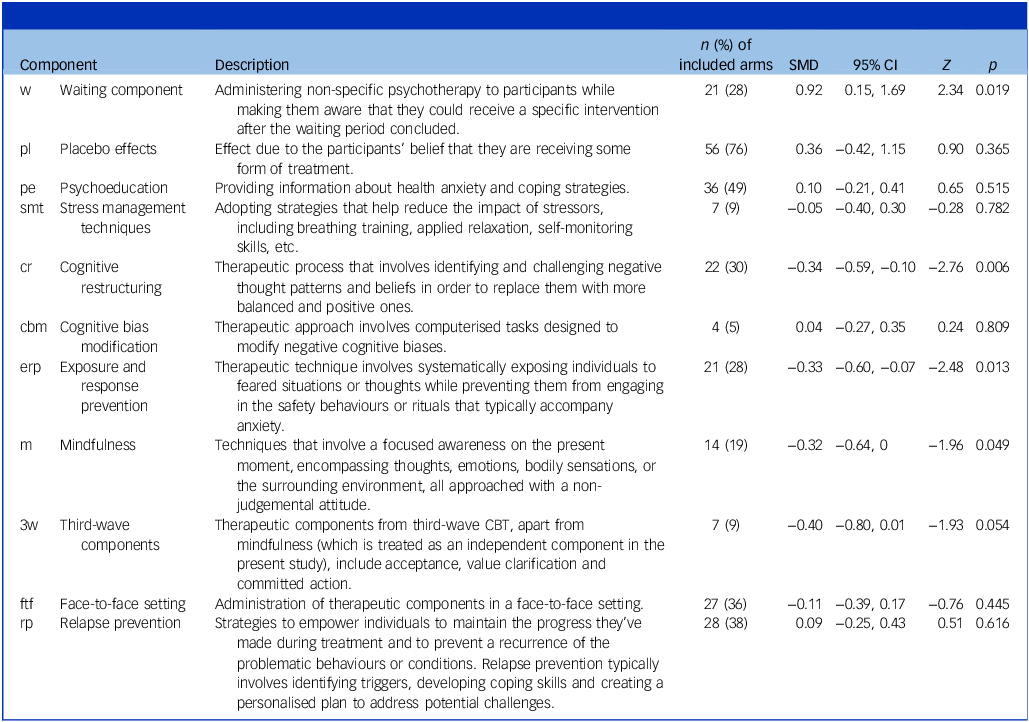
Two researchers (Y. Liu and Y. Lu) independently extracted relevant information from the included studies using a predefined data extraction sheet and independently assessed risk of bias using the revised Cochrane Risk of Bias tool (ROB 2.0). Reference Eldridge, Campbell, Campbell, Drahota-Towns, Giraudeau and Higgins35 The first data extraction was performed on 5 November 2023, and was updated on 26 January 2025. Table 1 presents the 12 different components of interest and their definition. Interventions which were regarded as a combination of these components were analysed by employing a CNMA.
List of included components

SMD, standardised mean difference; CBT, cognitive–behavioural therapy.
Risk of bias (ROB) was assessed with the revised Cochrane tool (RoB 2.0). Reference Higgins, Savović, Page and Sterne36 The following five domains were used in the assessment: (a) Randomisation process; (b) deviations from intended interventions; (c) missing outcome data; (d) outcome measurement; and (e) reported result selection. The certainty of evidence was evaluated using the Confidence in Network Meta Analysis framework (CINeMA). Reference Nikolakopoulou, Higgins, Papakonstantinou, Chaimani, Del Giovane and Egger37 For a comprehensive description of the methodology, please refer to Supplementary material G. Any discrepancies in data extraction and risk of bias assessment were resolved through consensus and discussion with a third researcher.
Network meta-analysis strategy
We contacted study authors to obtain missing or unclear data. For continuous outcome data, we applied the data handling methods used in the original studies, typically employing mixed model repeated measures or the last observation carried forward. If neither of these methods was reported, we only included data from participants who completed the study. In cases where s.d. were missing, we calculated them from available p-values, t-values, or s.e.s, or imputed the missing values using a validated method. Reference Furukawa, Barbui, Cipriani, Brambilla and Watanabe38
A random-effects NMA was conducted within a frequentist framework using the R package netmeta (version 2.9-0; R statistical environment, version 4.3.2; Windows; R Foundation for Statistical Computing, Vienna, Austria; https://www.r-project.org). Reference Balduzzi, Rücker, Nikolakopoulou, Papakonstantinou, Salanti and Efthimiou39,Reference Salanti, Ades and Ioannidis40 A network diagram of eligible treatments was created. In choosing the nodes of the network, we explored both a ‘splitting’ and a ‘lumping’ approach to the classification of psychological treatments, so as to find a balance between clinical and statistical considerations. First, the splitting approach was evaluated where we differentiated between specific treatment types. Second, the lumping approach involved forming several broad classifications of CBT based on intervention theories and modelling interventions as ‘class-effects’, assuming similarity within the same class. The lumping approach has the statistical advantage of increased power and more accurate effect-sizes estimation, while the splitting method enhances the clinical interpretability of utility by focusing on individual interventions.
Standard mean differences (SMDs) were used as effect sizes. SMDs with an absolute value around 0.2 were interpreted as small, 0.5 as moderate and 0.8 as large. Heterogeneity was evaluated using the I 2, Cochran’s Q, and tau2 statistics. Reference Turner, Davey, Clarke, Thompson and Higgins41 The tau2 represents the between-study variance, while the I 2 represents the proportion of variance due to true inter-study variance rather than sampling error. A small proportion is usually considered 25%, a moderate proportion is 50% and a large proportion is 75%. Reference Higgins, Thompson, Deeks and Altman42
The transitivity assumption refers to the similarity of study characteristics that allows for indirect effect comparisons in NMA. Reference Bowler, Mackintosh, Dunn, Mathews, Dalgleish and Hoppitt43 To evaluate transitivity, we compared the distribution of key study characteristics across studies grouped by comparison. Moreover, a meta-regression analysis investigating the impact of potential covariates such as publication year, age, diagnosis, baseline health anxiety, risk of bias and culture, was conducted. Additionally, consistency is the statistical extension of transitivity. Reference Watt, Del Giovane, Evangelou and Veroniki44 We assessed the consistency of the network through both local and global inconsistency tests. Global inconsistency was evaluated using the global Wald test, Reference White, Barrett, Jackson and Higgins45 and local inconsistency was analysed using the node-splitting method that examined the significance of the difference between direct and indirect evidence for paired comparisons. Reference Dias, Welton, Caldwell and Ades46 To rank treatment effectiveness for each outcome, the surface under the cumulative ranking curve (SUCRA) and P-score were used. Reference Rücker and Schwarzer47 Comparison-adjusted funnel plots were visually inspected, and we used Egger’s test to address the threat of publication bias. Reference Pustejovsky and Rodgers48
To explore the effectiveness of therapeutic components, an additive CNMA was conducted. This model is an extension of the standard NMA model, where the effect of each composite intervention is dismantled after modelling the component-specific effects. Reference Welton, Caldwell, Adamopoulos and Vedhara20 The CNMA assumes that the total effect of an intervention is equal to the sum of the component effects.
Results
Search results and study characteristics
The study selection procedure is illustrated in Supplementary material C. A total of 8023 articles were identified through database and reference list searches and 35 RCTs met the inclusion and exclusion criteria. See Table 2 for a summary of study characteristics. Participants had a mean age of 37 years (s.d. = 6) and 67% (2186/3263) were female. The overall risk of bias was considered low in five trials (14%), high in sixteen trials (46%) and the remaining trials were assessed as having some concerns (40%). Detailed information of the risk of bias is provided in Supplementary material D.
The characteristics of included studies

ACT, acceptance and commitment therapy; BIB-CBT, cognitive–behavioural bibliotherapy; BRT, Benson relaxation technique; BSM, behaviour stress management; CBM, cognitive bias modification; CT, cognitive therapy; ET, exposure therapy; FTF-CBT, face-to-face cognitive–behavioural therapy; I-CBT, internet-based cognitive–behavioural therapy; IT, imagery therapy; MBCT, mindfulness-based cognitive therapy; MCT, metacognitive therapy; STPP, short-term psychodynamic psychotherapy; TAU, treatment-as-usual; WLC, wait-list control; SHAI, Short Health Anxiety Inventory; HAI, Health Anxiety Inventory; GIAS, Groningen Illness Attitude Scales; WI, Whitely Index; VAS, Visual Analogue Scale; Y-HBOCS, Yale–Brown Obsessive Compulsive Scale for Hypochondriasis; MIHT, Multidimensional Inventory of Hypochondriacal Traits; cbm, cognitive bias modification; cr, cognitive restructuring; erp, exposure and response prevention; ftf, face-to-face setting; m, mindfulness; pe, psychoeducation; pl, placebo effect; smt, stress management strategies; 3w, third-wave components; w, waiting component; rp, relapse prevention.
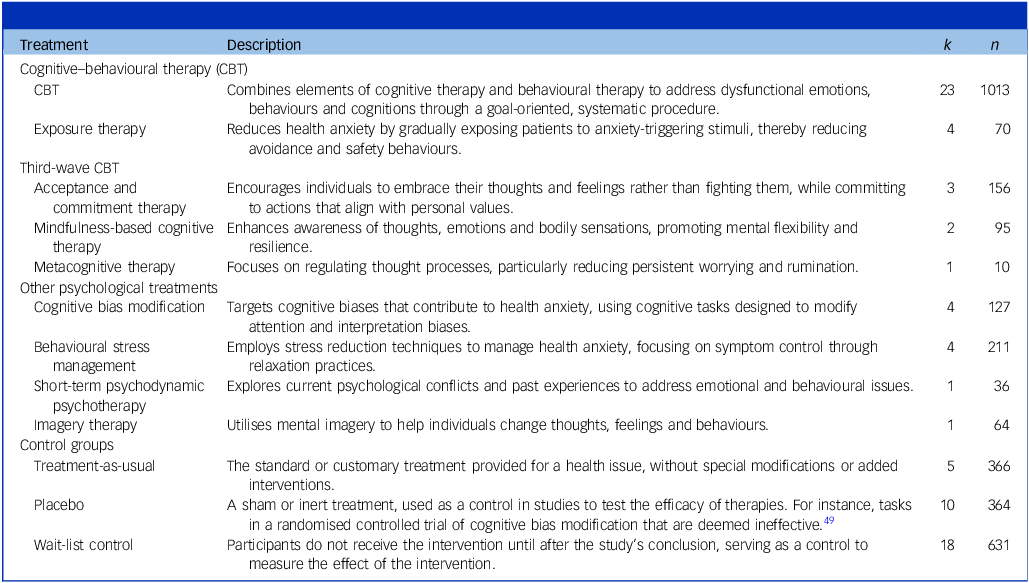
A total of nine treatment types and three control group variants were included (see Table 3). Among them, the trials on cognitive and/or behavioural therapies were the most numerous. To compare the relative effects of CBT, third-wave CBT and non-CBT interventions, a ‘lumping’ approach was employed, whereby some therapies were consolidated into broader categories. Specifically, the treatments were organised into three main categories: CBT, third-wave CBT and non-CBT interventions. Notably, in this study, exposure therapy (k = 4, where ‘k’ denotes the number of trials) was classified under the CBT category. Additionally, the study analysed several RCTs focusing on third-wave CBT. Three RCTs assessed ACT, two trials examined MBCT (MBCT, k = 2), and one trial evaluated the efficacy of MCT. Non-CBT interventions studied included cognitive bias modification (CBM, k = 4), imagery therapy (k = 1) and short-term psychodynamic psychotherapy (STPP, k = 1). Control groups comprised treatment-as-usual (TAU, k = 5), placebo (where participants receive a level of support similar to the main interventions but without the active components, k = 10), and a wait-list control group (WLC, k = 18).
Treatments included in the systematic review

k, the number of trials; n, the number of participants.
NMA results
Network plots are depicted in Fig. 1, which illustrates the treatment and control group nodes included in our study. Initially, the efficacy of 12 groups – CBT, exposure therapy, BSM, CBM, MCT, MBCT, STPP, imagery therapy, ACT, TAU, placebo, and WLC – was assessed at post-treatment using a splitting approach. Subsequently, we compared the efficacy of CBT, third-wave CBT, non-CBT interventions and control groups using a lumping approach. Due to a limited number of trials, the long-term efficacy of these treatments at 6- and 12-month follow-ups was not analysed.
(a) Network meta-analysis of eligible comparisons for splitting treatments. (b) Network meta-analysis of eligible comparisons for lumping treatments. (c) Network meta-analysis of eligible comparisons for component combinations. CBT, cognitive–behavioural therapy; ET, exposure therapy; CBM, cognitive bias modification; IT, imagery therapy; BSM, behavioural stress management; MBCT, mindfulness-based cognitive therapy; ACT, acceptance and commitment therapy; MCT, metacognitive therapy; WLC, wait-list control; TAU, treatment-as-usual; STPP, short-term psychodynamic psychotherapy; pl, placebo effects; m, mindfulness; 3w, third-wave components; rp, relapse prevention; ftf, face-to-face; erp, exposure and response prevention; cr, cognitive restructuring; pe, psychoeducation; smt, stress management techniques.

The distribution of potential covariates and the meta-regression analysis of potential effect modifiers indicated that these potential effect modifiers showed no significant association with the NMA outcomes, providing no evidence to challenge the transitivity assumption (Supplementary material E). Outcomes with regard to heterogeneity and consistency under the frequentist framework are listed in Supplementary material E. Heterogeneity was moderate for splitting treatments (tau2 = 0.19; I 2 = 63.50%; Q: p < 0.001) and for lumping treatments (tau2 = 0.12; I 2 = 72.40%; Q: ps < 0.001). Global inconsistency was not significant, and there was no evidence for disagreement between direct and indirect evidence as based on the node-splitting tests. Funnel plots of all results were symmetrical and Egger’s tests were not significant (Supplementary material F.1).
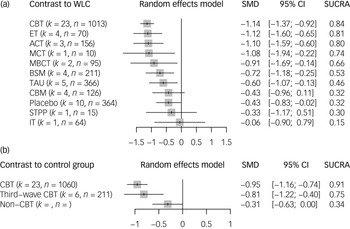
Pooled efficacy estimates versus the wait-list control group are depicted in Fig. 2. Based on the ‘splitting’ approach (treatment subcategories), CBT had significant waitlist-controlled effect at post-treatment (SMD = −1.14, p < 0.001, 95% CI: −1.37, −0.92). Exposure therapy (SMD = −1.12, p < 0.001, 95% CI: −1.60, −0.65), ACT (SMD = −1.10, p < 0.001, 95% CI: −1.59, −0.60), MCT (SMD.= −1.08, p < 0.001, 95% CI: −1.94, −0.22), MBCT (SMD = −0.91, p < 0.001, 95% CI: −1.69, −0.14), BSM (SMD = −0.72, p < 0.01, 95% CI: −1.18, −0.25), TAU (SMD = −0.59, p < 0.05, 95% CI: −1.06, −0.12) and placebo (SMD = −0.43, p < 0.05, 95% CI: −0.83, −0.02) also demonstrated significant waitlist-controlled effect sizes on health anxiety at post-treatment. However, STPP, CBM and imagery therapy were not significantly different with the wait-list group. The comparable efficacy of treatment types is illustrated in league tables (see eTable F.2.2).
(a) Effect sizes based on the ‘splitting’ approach where overarching treatment classes are compared with the control groups at post-treatment. (b) Effect sizes based on the ‘lumping’ approach versus wait-list controls at post-treatment. k, the number of trials; N, the number of participants. WLC, wait-list control; SMD, standard mean differences; SUCRA, surface under the cumulative ranking curve; CBT, cognitive–behavioural therapy; ET, exposure therapy; ACT, acceptance and commitment therapy; MCT, metacognitive therapy; MBCT, mindfulness-based cognitive therapy; BSM, behavioural stress management; TAU, treatment-as-usual; CBM, cognitive bias modification; STPP, short-term psychodynamic psychotherapy; IT, imagery therapy.

Using the ‘lumping’ approach as defined in the overarching categories of Table 3, second-wave CBT demonstrated the largest effect size compared with combined control groups at post-treatment (SMD = −0.95, p < 0.001, 95% CI: −1.16, −0.74), followed by third-wave CBT (SMD = −0.81, p < 0.05, 95% CI: −1.22, −0.40) and non-CBT interventions (SMD = −0.31, p < 0.05, 95% CI: −0.63, 0). The effects of both CBT and third-wave CBT were significantly greater than those of non-CBT interventions. Treatment rankings, as outlined in Supplementary material F.3, reveal that among all psychological treatments studied, CBT was ranked highest based on P-score and SUCRA at post-treatment.
The certainty of evidence for the outcomes of the NMA, as evaluated using the CINeMA, varied from high to very low. High certainty was assigned to comparisons between CBT and either WLC, placebo or combined control groups, as well as between ACT and exposure therapy with WLC. Moderate certainty was noted for comparisons between ACT and the placebo, as well as between third-wave CBT and combined control groups. The certainty of evidence for comparisons among other groups were rated as low or very low. Detailed information on the CINeMA assessments is available in Supplementary material G.
CNMA results
Results from the additive CNMA model for change in health anxiety are displayed in Table 1. The effects for components are interpreted as the additional effects for interventions that contain the effect modifier (adjusted for all other effect modifiers). Exposure and response prevention demonstrated significant additive effects (SMD = −0.33, 95% CI: −0.60, −0.07, p < 0.01), along with cognitive restructuring (SMD = −0.34, 95% CI: −0.59, −0.10, p < 0.05). Additionally, mindfulness exhibited significant additive effects (SMD = −0.32, 95% CI: −0.04, 0, p < 0.05). Waiting component was associated with opposite effects (SMD = 0.92, 95% CI: 0.15, 1.69, p < 0.05).
Discussion
The present NMA provides a comprehensive synthesis of available data on psychological interventions for pathological health anxiety. The study analysed various psychological interventions that have been evaluated in RCTs. The unique contribution of this meta-analysis is that we could evaluate the relative efficacy of several psychological treatments for pathological health anxiety in the same analysis. Based on the ‘splitting’ approach to analysis, we found CBT to be the best-ranked treatment for improving health anxiety, followed by exposure therapy, ACT, MCT, MBCT, BSM and TAU. These treatments showed medium to large effect sizes compared to the WLC. The CINeMA analysis provided moderate to high evidence supporting the effectiveness of CBT, ACT and exposure therapy when compared with wait-list controls or placebo. This robust evidence underscores the reliability of these treatments within clinical settings, emphasising their value particularly in scenarios where making evidence-based choices is crucial. These findings highlight the critical role these therapies play in clinical practice, offering effective options for managing conditions that benefit from evidence-supported interventions.
In contrast, STPP, CBM and imagery therapy were found to have no significant effects compared with the WLC. Previous research has suggested that CBM has a medium effect on cognitive biases but a small-to-null effect on anxiety and depressive symptoms. Reference Cristea, Kok and Cuijpers83 The limited effectiveness of CBM in treating health anxiety may be due to several factors, such as the limited number of training sessions and paradigms employed. Reference Hallion and Ruscio84 Although further research is needed to fully understand the value of CBM, based on the present study, CBM should not be the first-line intervention for pathological health anxiety. For STPP and imagery therapy, only one empirical study each was included, indicating a need for more research to validate their effectiveness.
The majority of included interventions were variations on CBT that demonstrated medium to large effects versus the control groups at post-treatment. Using a lumping approach, we found no significant differences in effectiveness between CBT and third-wave CBT. Moreover, the effects of CBT and third-wave CBT were significantly greater than those observed with non-CBT interventions. These results are consistent with previous meta-analyses, Reference Maass, Kühne, Maas, Unverdross and Weck9,Reference Cooper, Gregory, Walker, Lambe and Salkovskis11,Reference Axelsson and Hedman-Lagerlöf12 and suggest that CBT is a valuable treatment option for pathological health anxiety. Overall, the findings of this NMA indicate that multiple psychological interventions can be beneficial for treating pathological health anxiety, with varying levels of pooled mean efficacy.
CBT interventions are intricate and, currently, there is limited understanding of which components are most effective in addressing health anxiety. Reference Hedman-Lagerlöf and Axelsson18 We conducted a CNMA of RCTs examining the effectiveness of a broad spectrum of CBT interventions. Several crucial components, including exposure and response prevention, cognitive restructuring and mindfulness, emerged from our analysis. Our findings align with a previous study that conducted CNMA on CBT for panic disorder, revealing associations between cognitive restructuring, interoceptive exposure and improved treatment outcomes. Reference Pompoli, Furukawa, Efthimiou, Imai, Tajika and Salanti85 However, CNMA results of CBT for depression indicated that non-specific treatment effects and behavioural activation may have beneficial effects, while cognitive restructuring had no additive effect. Reference Furukawa, Suganuma, Ostinelli, Andersson, Beevers and Shumake86 The findings suggest that the effectiveness of CBT components may vary when addressing depression and anxiety-related disorders. As a result, future research could emphasise personalised combinations of CBT strategies tailored to specific psychological concerns.
This study was the first NMA of psychological treatments for pathological health anxiety, going one step further to suggest which particular components, within the broad class of cognitive or behavioural approaches for health anxiety. Our findings provide valuable insights into interventions for the reduction of health anxiety, a psychological problem that has received increased attention in light of the COVID-19 pandemic. Reference Tyrer87 However, several limitations should be noted. First, according to assessments using ROB 2.0 and CINeMA, many trials exhibited a high risk of bias, and numerous comparisons demonstrated limited confidence. These factors may constrain the interpretation of the results. Second, the number of studies included in the analysis, particularly during the follow-up period, was limited. Comparisons between many active treatments relied on indirect evidence and were based on the untestable consistency assumption, which might have limited the reliability of the results. Reference Thorlund and Mills88 Therefore, further future research is needed, particularly regarding the direct comparisons between various psychological therapies. Third, while we employed the ‘lumping’ approach to enhance statistical power, the limited variety of therapies grouped together and inherent differences between them may render the resulting categories less representative or accurate. For instance, we categorised exposure therapy under ‘CBT,’ despite the fact that exposure therapy is commonly considered an integral component of CBT. Reference Kendall, Robin, Hedtke, Suveg, Flannery-Schroeder and Gosch89 Fourth, the methodological aspects (i.e. outcome measurements, therapy duration, treatment preferences etc.) of included trials were variable, leading to moderate heterogeneity between studies. We found no indication that the transitivity assumption was violated in this study, but it is important to conduct more research on the differences between groups of patients. Further investigation of potential confounding and moderating variables is necessary. We found no indication that the transitivity assumption was violated in this study, but it is important to conduct more research on the differences between groups of patients. Another limitation of this NMA is the high risk of bias identified in many of the included studies. This could potentially impact the reliability of the results. Future research should focus on conducting high-quality studies with robust methodologies to minimise bias. Additionally, in our CNMA analysis, we assessed components as either present or absent according to the descriptions provided in each study. However, in reality, the contents and implementation levels of these components may have varied among studies. Due to the limited number of trials, we assumed the additivity of component effects and disregarded interactions between components. This approach may overlook potential relationships between the components.
In summary, several forms of cognitive and behavioural therapy, including traditional CBT and third-wave CBT, appear to be effective treatments for pathological health anxiety. In contrast, our findings suggest that CBM, imagery therapy and STPP may be less effective. Among various CBT strategies, exposure and response prevention, cognitive restructuring and mindfulness demonstrated significant effectiveness in reducing health anxiety. These findings have important implications for clinical practice, highlighting the potential value of targeting specific therapeutic components. Future research should further investigate the comparative effectiveness of these components and explore their long-term outcomes.
Supplementary material
The supplementary material is available online at https://doi.org/10.1192/bjp.2026.10647
Data availability
The data that support the findings of this study are available from the corresponding author, Z.R., upon reasonable request.
Author contributions
L.L. and Z.R had full access to all of the data in the study and take responsibility for the integrity of the data and the accuracy of the data analysis. Concept and design: L.L., E.A., Z.R. Drafting of the manuscript: L.L., Y. Lu. Acquisition, analysis, or interpretation of data: L.L., Y. Liu, E.A., P.T., Y. Li, Y. Lu, C.S., Z.R. Critical review of the manuscript for important intellectual content: all authors. Final approval of the version to be published: all authors. Administrative, technical and material support: all authors. Obtaining funding: Z.R.
Funding
This work was supported by the National Key Research and Development Program of China (grant no. 2024YFC3308400), the Major Programme of the National Social Science Foundation of China (grant no. 22&ZD187) and the Hubei Provincial Natural Science Foundation of China (grant no. 2025AFD507). The funding sources had no role in the design and conduct of the study; collection, management, analysis and interpretation of the data; preparation, review and approval of the manuscript; and the decision to submit the manuscript for publication.
Declaration of interest
E.A. has co-authored a self-help book for pathological health anxiety that is available in the public marketplace. E.A. has contributed to the development and evaluation of exposure-based cognitive–behaviour therapy for pathological health anxiety and has co-authored primary publications for three randomised controlled trials of various delivery formats. The other authors declare no competing interests.






eLetters
No eLetters have been published for this article.