Introduction
The genus Acacia Miller sensu lato (Fabaceae, Mimosoideae; hereafter, Acacia s.l.) is very diverse, comprising more than 1400 species (Maslin et al., Reference Maslin, Miller and Seigler2003a,Reference Maslin, Orchard and Westb), which are distributed in the subtropics of Australia (c.1010 species), Asia (c.60 species), the Americas (c.185 species) and Africa (c.150 species). Owing to this rich diversity, Acacia s.l. has undergone multiple taxonomic revisions based mainly on cladistic analyses of chloroplast genes and internal or external transcribed spacer regions of DNA (Maslin et al., Reference Maslin, Miller and Seigler2003a,Reference Maslin, Orchard and Westb; Murphy et al., Reference Murphy, Miller, Bayer and Ladiges2003; Orchard & Maslin, Reference Orchard and Maslin2003; Maslin & Orchard, Reference Maslin and Orchard2004; Walker & Simpson, Reference Walker and Simpson2004; Orchard & Maslin, Reference Orchard and Maslin2005; Maslin, Reference Maslin2006; Seigler et al., Reference Seigler, Ebinger and Miller2006; Smith et al., Reference Smith, van Wyk, Luckow and Schrire2006; Maslin & Orchard, Reference Maslin and Orchard2009; Miller & Seigler, Reference Miller and Seigler2012; Kyalangalilwa et al., Reference Kyalangalilwa, Boatwright, Daru, Maurin and van der Bank2013). Phenotypic similarities between closely related Acacia species make taxonomic distinction quite difficult, especially when species distributions overlap, as is the case in the Middle East and the Arabian Peninsula. Furthermore, there is a paucity of morphological characteristics available, these being subject to environmental modifications resulting in phenotypic plasticity, further complicating classification of related taxa (Hebert et al., Reference Hebert, Cywinska, Ball and DeWaard2003). The use of genetic markers, which are not subject to environmental variations, can aid in the process of identification of cultivars or clones (Rahman & Rajora, Reference Rahman and Rajora2002), subspecies (Fredua-Agyeman et al., Reference Fredua-Agyeman, Adamski, Liao, Morden and Borthakur2008) and species (Zietkiewicz et al., Reference Zietkiewicz, Rafalski and Labuda1994), as well as in parentage and kinship (Blouin, Reference Blouin2003) analyses.
Boulos (Reference Boulos1995) described a complex of Acacia species that are distributed in the Middle East, including A. johnwoodii Boulos, A. elatior Brenan, A. yemenensis Boulos, A. hockii De Wild., A. oerfota (Forssk.) Schweinf., A. pachyceras O.Schwartz and A. tortilis (Forssk.) Hayne. Other Acacia species described from the region include A. asak (Forssk.) Willd., A. ehrenbergiana Hayne, A. tortilis subsp. spirocarpa (Hochst. ex A.Rich.) Brenan, and A. iraqensis Rech.f. (Abdulfatih, Reference Abdulfatih1981). Chaudhary (Reference Chaudhary1999) reported that Acacia gerrardii Benth. subsp. negevensis Zohary is found in Saudi Arabia, and mentioned that A. iraqensis and A. pachyceras sensu Boulos, Reference Boulos1995 non Schwartz, Reference Schwartz1939, are synonyms of A. gerrardii. However, Boulos (Reference Boulos1995) has named this species as Acacia pachyceras. Evidence from these studies indicates that the taxonomy of Acacia tortilis, A. gerrardii and A. pachyceras in the Middle East and the Arabian Peninsula is still controversial, and indeed the Plant List (no date) lists Acacia pachyceras as an unresolved name.
Confusion surrounding the naming of Acacia species in the Middle East is exacerbated by the ongoing debate on the generic taxonomy of Acacia s.l., owing to the polyphyletic nature of the genus (Miller & Bayer, Reference Miller and Bayer2003; Miller et al., Reference Miller, Andrew and Bayer2003a,Reference Miller, Grimes, Murphy, Bayer and Ladigesb; Luckow et al., Reference Luckow, Hughes, Schrire, Winter, Fagg, Fortunato, Hurter, Rico, Breteler, Bruneau, Caccavari, Craven, Crisp, Delgado, Demissew, Doyle, Grether, Harris, Herendeen, Hernández, Hirsch, Jobson, Klitgaard, Labat, Lock, MacKinder, Pfeil, Simpson, Smith, Sousa, Timberlake, van der Maesen, Van Wyk, Vorster, Willis, Wieringa and Wojciechowski2005; Murphy et al., Reference Murphy, Brown, Miller and Ladiges2010; Moore et al., Reference Moore, Smith, Figueiredo, Demissew, Lewis, Schrire, Rico and van Wyk2011; Miller & Seigler, Reference Miller and Seigler2012; Kyalangalilwa et al., Reference Kyalangalilwa, Boatwright, Daru, Maurin and van der Bank2013). Indeed, at least five segregate genera for Acacia s.l. have been advocated: Acacia sensu stricto (s.s. hereafter, formerly Acacia subgenus Phyllodineae), Vachellia Wight & Arn. (formerly Acacia subgenus Acacia), Senegalia Raf. (formerly Acacia subgenus Aculeiferum section Aculeiferum), Acaciella Britton & Rose (formerly Acacia Aculeiferum section Filicinae) and Mariosousa Seigler & Ebinger (including the species belonging to the Acacia coulteri group) (Kyalingalilwa et al., Reference Kyalangalilwa, Boatwright, Daru, Maurin and van der Bank2013). Under this taxonomy, Acacia gerrardii and A. tortilis become Vachellia gerrardii (Benth.) P.J.H.Hurter and Vachellia tortilis (Forssk.) Galasso & Banfi, respectively.
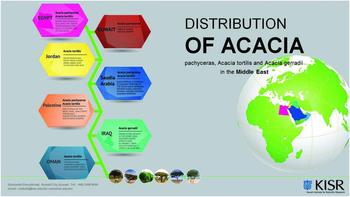
Taxonomic identification of the only remaining native Acacia s.l. tree in Kuwait, known as the Lonely Tree (Fig. 1), has proven difficult. This tree survives in the Talha area of Sabah Al-Ahmed Natural Reserve in Kuwait (29°34.909′N, 47°47.734′E). The age of the Lonely Tree was estimated at between 80 and 100 years in 2014. Moreover, it is considered to be the only native tree in Kuwait. Conservation and restoration of this emblematic tree is clearly of national importance. According to the extant literature, identification of the Lonely Tree is controversial (see, among others, Dickson, Reference Dickson1955; Boulos & Al-Dosari, Reference Boulos and Al-Dosari1994; Boulos, Reference Boulos1995; Shuaib, Reference Shuaib1995; Chaudhary, Reference Chaudhary1999). Dickson (Reference Dickson1955), Boulos & Al-Dosari (Reference Boulos and Al-Dosari1994) and Dannin (Reference Dannin2000) identified the tree as Acacia pachyceras, whereas Shuaib (Reference Shuaib1995) believed it to be A. gerrardii. Therefore, further research on the genetics of both Vachellia gerrardii (≡ A. gerrardii) and V. pachyceras (≡ A. pachyceras) collected from various sources is needed to delineate cryptic Acacia taxa in the Middle East, determine the identity of the Lonely Tree and standardise methods for its propagation. The distribution ranges of Vachellia pachyceras, V. tortilis (≡ A. tortilis) and V. gerrardii in the Middle East are illustrated in Figure 2.
The Lonely Tree, the remaining native Acacia s.l. tree at the Sabah Al-Ahmed Natural Reserve (29°34.909′N, 47°47.734′E) in Kuwait in 2012.

Distribution of Vachellia pachyceras, Vachellia tortilis and Vachellia gerrardii in the Middle East.

DNA barcoding is a diagnostic technique for species identification that relies on a comparison of DNA sequences from a small fragment of the genome, and is particularly useful when traditional taxonomic characters lack discriminatory power. It has proven to be a powerful tool for delineation of cryptic species within Acacia (Newmaster & Ragupathy, Reference Newmaster and Ragupathy2009; Collins & Cruickshank, Reference Collins and Cruickshank2013; Ndlovu et al., Reference Ndlovu, Richardson, Wilson, O'Leary and Le Roux2013; Nevill et al., Reference Nevill, Wallace, Miller and Krauss2013), with both chloroplast DNA markers (hereafter cpDNA; Newmaster & Ragupathy, Reference Newmaster and Ragupathy2009; Ndlovu et al., Reference Ndlovu, Richardson, Wilson, O'Leary and Le Roux2013; Nevill et al., Reference Nevill, Wallace, Miller and Krauss2013) and nuclear DNA regions (Ndlovu et al., Reference Ndlovu, Richardson, Wilson, O'Leary and Le Roux2013) having been used. The cpDNA regions have included complete or partial sequences of the matK and rbcL genes, the psaB–rsp14 region, and non-coding regions associated with the tRNA-Leu (trnL), tRNA-Phe (trnF) and tRNA-Lys (trnK) genes, and statistical methods for discriminating taxa have included single- and multilocus analyses (Sites & Marshall, Reference Sites and Marshall2004; Dupuis et al., Reference Dupuis, Roe and Sperling2012; Fujita et al., Reference Fujita, Leaché, Burbrink, McGuire and Moritz2012; Nevill et al., Reference Nevill, Wallace, Miller and Krauss2013). However, single locus analyses for species discovery most often use broad sampling (Nevill et al., Reference Nevill, Wallace, Miller and Krauss2013), and can be misleading for species identification (Dupuis et al., Reference Dupuis, Roe and Sperling2012; Collins & Cruickshank, Reference Collins and Cruickshank2013).
Bouchenak-Khelladi et al. (Reference Bouchenak-Khelladi, Maurin, Hurter and van der Bank2010) examined phylogenetic relationships among the five recognised genera of Acacia, using the most comprehensive sampling to date, with an emphasis on African species. The study reconstructed the evolutionary history of Mimosoideae in Africa, including Acacia s.l., using sequences of the trnL intergenic spacer, matK and trnH–psbA from 152 Mimosoideae and nine Caesalpiniodeae species (Bouchenak-Khelladi et al., Reference Bouchenak-Khelladi, Maurin, Hurter and van der Bank2010). Similarly, in the Hawaiian Islands, rich with diverse Acacia ecotypes, microsatellite markers were used for population differentiation of A. koa A.Gray individuals (Fredua-Agyeman et al., Reference Fredua-Agyeman, Adamski, Liao, Morden and Borthakur2008), and for discrimination of A. koa, A. koaia Hillibr. and their intermediate forms (Adamski et al., Reference Adamski, Dudley, Morden and Borthakur2012). The geographical disjunctions within Acacia remain unexplained (Sprent, Reference Sprent2007), therefore a study of phylogenetic relationships between Acacia species from different continents would shed light on the evolutionary history of the Mimosoideae. The present study focuses on using multilocus cpDNA sequence analyses to: 1) test the species concepts of Vachellia pachyceras from the Middle East and V. tortilis and V. gerrardii from Kenya, as well as to investigate species divergence times; and 2) identify and discriminate the only remaining native Acacia s.l. tree in Kuwait (the Lonely Tree) and other unidentified Acacia s.l. specimens in cultivation.
Materials and Methods
Plant material and DNA extraction
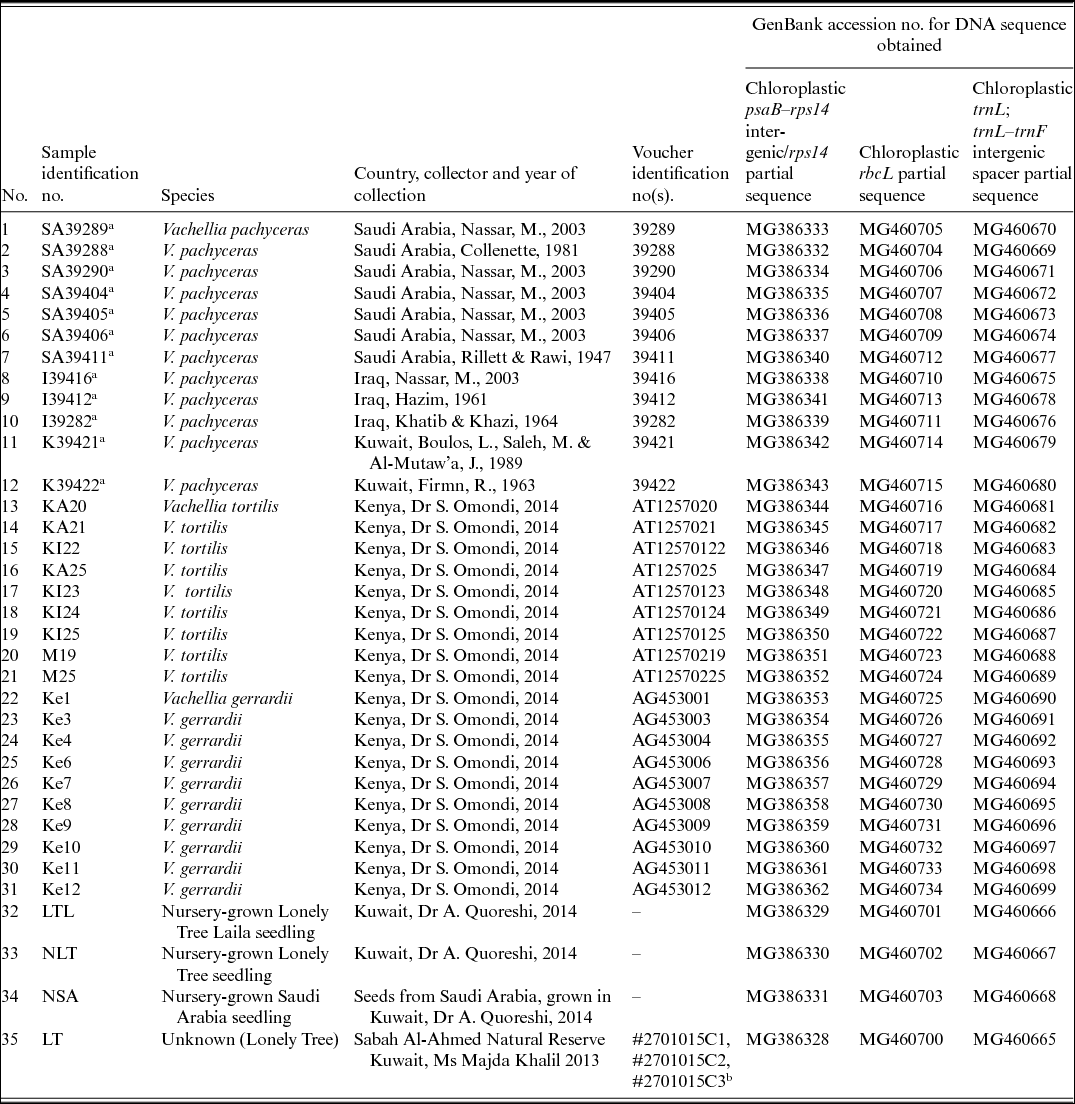
Twelve Vachellia pachyceras DNA samples from herbarium specimens were received from the Royal Botanic Gardens, Kew, and total DNA was extracted from leaf material of the Lonely Tree in Kuwait and from nine V. tortilis and ten V. gerrardii trees from the Kenyan Forest Research Institute (KEFRI, Nairobi, Kenya) (Table 1), using the DNeasy Plant Maxi Kit (Qiagen, Mississauga, Ontario, Canada). Total DNA was also extracted from three nursery-grown unknown Acacia seedlings from Kuwait (putative Lonely Tree Laila, and nursery-grown Lonely Tree), and one nursery-grown Saudi Arabian seedling (see Table 1).
DNA sample identification numbers, species names and voucher information for specimens used in this study, and GenBank accession numbers for the sequences obtained

trnF, tRNA-Phe; trnL, tRNA-Leu.
a DNA samples (registered as Acacia pachyceras) from herbarium specimens were received from the Royal Botanic Gardens, Kew. Specimen vouchers for numbers 11–31 are deposited in the Kenya Forestry Research Institute (KEFRI) herbarium.
b Kuwait Institute for Scientific Research (KISR) herbarium specimen voucher identification numbers for the Lonely Tree. All DNA samples and sequences are available at the microbial and genomic collection of the Centre for Forest Research at Université Laval, Québec, Canada.
Polymerase chain reactions
Three chloroplast regions (Table 2) were amplified using DNA samples extracted from 0.3 g of silica gel–dried Vachellia leaf material.
Locus and primer sequences used in the present study

The polymerase chain reaction (PCR) reaction mixture for amplifying the locus psaB–rps14 using the primers psaB–rps14-1 and psaB–rps14-2 (Gómez-Acevedo et al., Reference Gómez-Acevedo, Arce, Salinas, Magallón and Eguiarte2010; see Table 2) consisted of 3 µL of a 10 × PCR buffer, 1.8 µL of 25 mM magnesium chloride, 0.125 µL of a 10 mM dNTP solution in equimolar ratio, 0.3 µL for each primer at 25 µM, 1 U Taq polymerase (Sigma-Aldrich, St Louis, Missouri, USA), 65 ng of template DNA and additional double-distilled H2O, for a total volume of 30 µl. Amplification was carried out with an initial denaturation step of 95°C for 10 min, followed by 40 cycles of a 94°C for 30 s, 55°C for 1 min and 72°C for 1 min, with a final extension period of 72°C for 10 min.
Amplification of the trnL–trnF locus was performed using the primers trnL–F and B49317 (Taberlet et al., Reference Taberlet, Gielly, Patou and Bouvet1991; see Table 2). The PCR reaction mixture consisted of 3 µl of a 10 × PCR buffer, 1.8 µL of 25 mM magnesium chloride, 0.125 µL of a 10 mM dNTP solution in equimolar ratio, 0.3 µL for each primer at 25 µM, 1.5 U Taq polymerase (Sigma-Aldrich) and 65 ng DNA in a total volume of 30 µL. Amplification was carried out with an initial denaturation step of 94°C for 5 min, followed by 36 cycles of 94°C for 1 min, 55°C for 1 min and 72°C for 2 min, with a final extension period of 72°C for 10 min.
The PCR reaction mixture for amplifying the rbcL gene (partial sequence) using the primers rbcL–aF and Ajf634R (Newmaster & Ragupathy, Reference Newmaster and Ragupathy2009; see Table 2) consisted of 2 µL of a 10 × PCR buffer, 2 µL of 25 mM magnesium chloride, 0.1 µL of a 10 mM dNTP solution in equimolar ratio, 0.08 µL for each primer at 25 µM, 1 U Taq polymerase (Sigma-Aldrich) and 65 ng DNA in a total volume of 20 µL. The PCR cycling conditions were as follows: an initial denaturation step of 94°C for 5 min, followed by 31 cycles of a 94°C for 50 s, 52°C for 1 min and 72°C for 1 min, with a final extension period of 72°C for 10 min.
The PCR products were electrophoresed in 1% agarose gel buffer and stained with ethidium bromide (10 mg/mL).
Molecular systematics
Before alignment, each sequence was tested for correspondence with forward and reverse primer sequences in BioEdit, version 7.2.4 (Hall, Reference Hall1999), using the Reverse Complement function. There were 924 positions in total in the data set of 36 sequences: positions 1–212, 213–574 and 575–924 corresponded to the psaB–rsp14, trnL–trnF and rbcL regions, respectively. Sequences were manually edited using BioEdit, and aligned using ClustalW multiple alignment in BioEdit. The multilocus sequence data set was analysed using maximum likelihood (ML) based on the HKY model, using MEGA6 (Tamura et al., Reference Tamura, Battistuzzi, Billing-Ross, Murillo, Filipski and Kumar2012, Reference Tamura, Stecher, Peterson, Filipski and Kumar2013). Initial tree(s) for the heuristic search were obtained automatically by applying Neighbor-Joining and BioNJ algorithms to a matrix of pairwise distances estimated using the maximum composite likelihood approach, and then selecting the topology with the superior log-likelihood value. Support for internal nodes was assessed by bootstrap analysis using 1000 bootstrap replications.
Bayesian inference of phylogeny was performed on the multilocus data set with MrBayes, version 3.2.5 (Ronquist et al., Reference Ronquist, Teslenko, van der Mark, Ayres, Darling, Höhna, Larget, Liu, Suchard and Huelsenbeck2012; Huelsenbeck et al., no date), assuming an HKY model and with the transition to transversion rate ratio fixed to 1.82. Analyses were based on two runs of four Markov chain Monte Carlo analyses, each of 5,000,000 generations, a burn-in fraction of 0.25 and sampling every 100 generations for a total of 50,001 generated trees.
The ML tree constructed in MEGA was then used to estimate relative times of divergence for branching points using the RelTime method in MEGA6 (Tamura et al., Reference Tamura, Battistuzzi, Billing-Ross, Murillo, Filipski and Kumar2012, Reference Tamura, Stecher, Peterson, Filipski and Kumar2013). The calibration constraint of approximately 10 Mya between Vachellia tortilis and V. gerrardii was taken from Bouchenak-Khelladi et al. (Reference Bouchenak-Khelladi, Maurin, Hurter and van der Bank2010). Sequences of the three-locus combinations from all species were analysed using Mariosousa centralis (Britton & Rose) Seigler & Ebinger (≡ Acacia centralis (Britton & Rose) Lundell; HM020781), as an outgroup.
Results
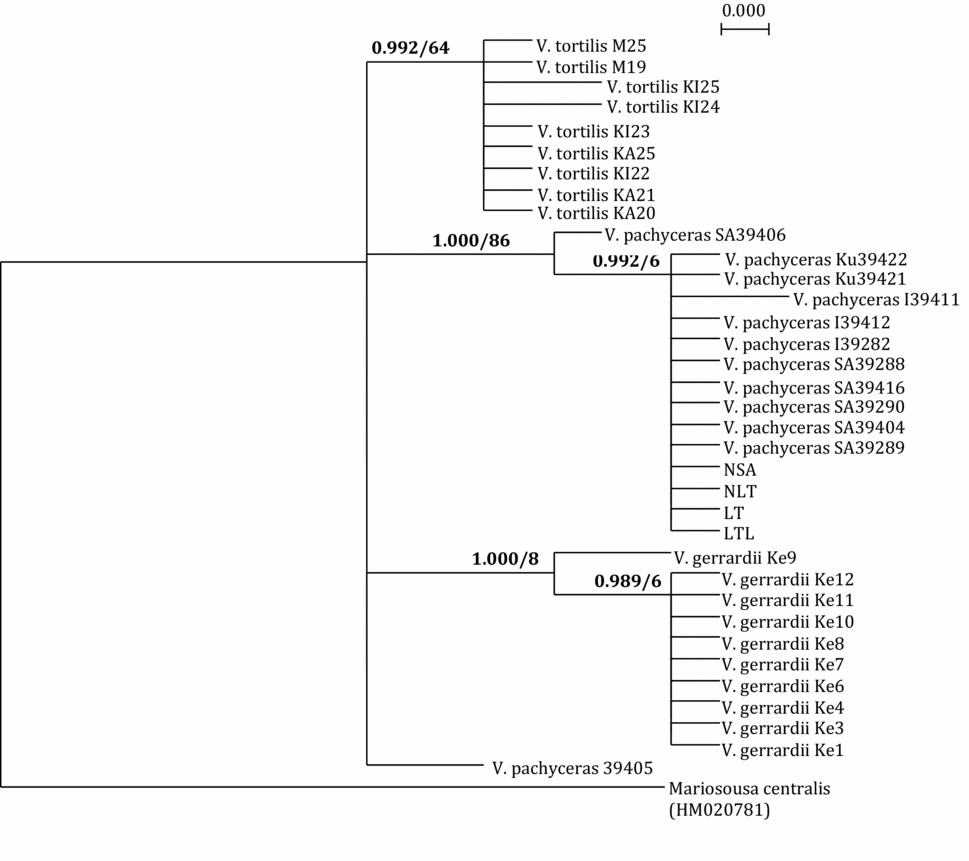
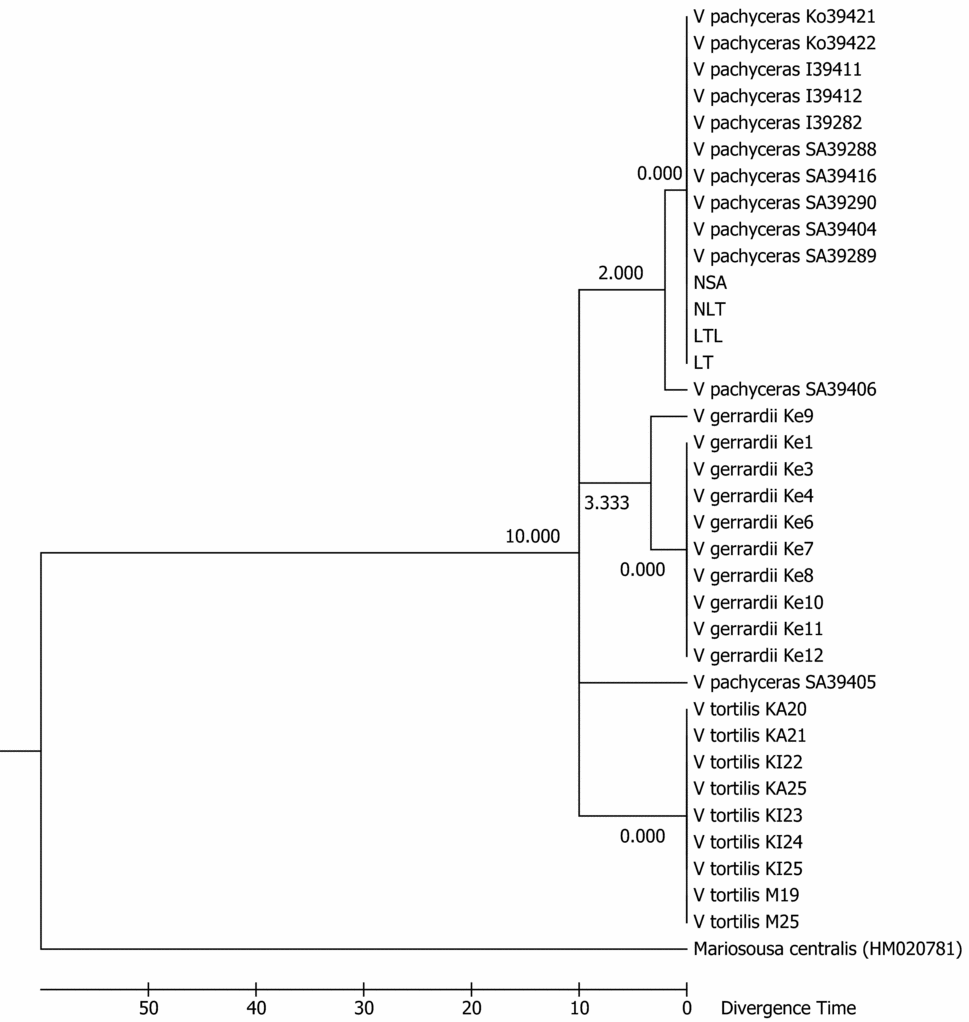
The potential scale reduction factor (Gelman & Rubin, Reference Gelman and Rubin1992) for the Bayesian analysis was equal to 1.000 for all the 36 branch lengths of the phylogeny (results not shown), and average and maximum standard deviations of split frequencies were equal to 0.003 and 0.01, respectively. Phylogenies estimated with MrBayes and MEGA were summarised in a single tree because their topologies were similar, although not identical (Fig. 3). The tree presented is the majority consensus from the Bayesian analysis, with bootstrap values from the ML analysis added next to posterior probability values. The Bayesian and ML tree topologies clearly differentiated Vachellia pachyceras, V. gerrardii and V. tortilis, with high probabilities and bootstrap values (see Fig. 3). Despite an unresolved polytomy between the species-level clades, most individual specimens were grouped with their expected species, and Vachellia pachyceras was resolved as distinct from both V. tortilis and V. gerrardii. By using the constraint of 10 Mya (Miocene) for the divergence time between Vachellia tortilis and V. gerrardii (Bouchenak-Khelladi et al., Reference Bouchenak-Khelladi, Maurin, Hurter and van der Bank2010), we estimated divergence times using the RelTime analysis in MEGA (Fig. 4). According to the ML divergence time estimates, Vachellia gerrardii evolved from common ancestor no later than 3.3 Mya in the Pliocene, whereas V. pachyceras originated no later than 2.0 Mya (Pliocene; see Fig. 4).
Bayesian majority consensus tree based on analysis of the combined psaB–rsp14, trnL–trnF and rbcL sequences. Numbers on branches are Bayesian posterior probabilities (left) and ML bootstrap values (right). Mariosousa centralis was used as an outgroup.

Chronogram generated using the RelTime method. Divergence times were calculated using the maximum likelihood method based on the Hasegawa–Kishino–Yano model (Hasegawa et al., Reference Hasegawa, Kishino and Yano1985). Optimised relative times (shown next to branches) were based on a calibration constraint of 10 Mya for the divergence between Vachellia tortilis and Vachellia gerrardii (Bouchenak-Khelladi et al., Reference Bouchenak-Khelladi, Maurin, Hurter and van der Bank2010).

The Bayesian and ML analyses also identified the Lonely Tree, the Lonely Tree seedlings (putative Lonely Tree Laila, and nursery-grown Lonely Tree) and the nursery-grown Saudi Arabian seedling as Vachellia pachyceras (0.992 posterior probability and 64% bootstrap support, respectively; see Fig. 3). As in the ML analysis, species clades were mostly well-resolved in the Bayesian analysis, except for the Vachellia pachyceras SA39405 sample, which had an unresolved position. Vachellia pachyceras SA39406 grouped with the other V. pachyceras specimens but seems quite distinct (see Fig. 3). Similarly, specimen Vachellia gerrardii Ke9 grouped with the V. gerrardii clade but is clearly distinct from the other exemplars of the species.
Discussion
Recent studies agree that Acacia s.l. is polyphyletic (Luckow et al., Reference Luckow, Hughes, Schrire, Winter, Fagg, Fortunato, Hurter, Rico, Breteler, Bruneau, Caccavari, Craven, Crisp, Delgado, Demissew, Doyle, Grether, Harris, Herendeen, Hernández, Hirsch, Jobson, Klitgaard, Labat, Lock, MacKinder, Pfeil, Simpson, Smith, Sousa, Timberlake, van der Maesen, Van Wyk, Vorster, Willis, Wieringa and Wojciechowski2005; Seigler et al., Reference Seigler, Ebinger and Miller2006; Gómez-Acevedo et al., Reference Gómez-Acevedo, Arce, Salinas, Magallón and Eguiarte2010; Murphy et al., Reference Murphy, Brown, Miller and Ladiges2010; Moore et al., Reference Moore, Smith, Figueiredo, Demissew, Lewis, Schrire, Rico and van Wyk2011; Kyalingalilwa et al., Reference Kyalangalilwa, Boatwright, Daru, Maurin and van der Bank2013), and this has been used as the basis for segregation of the genus (Seigler et al., Reference Seigler, Ebinger and Miller2006; Murphy et al., Reference Murphy, Brown, Miller and Ladiges2010; Kyalangalilwa et al., Reference Kyalangalilwa, Boatwright, Daru, Maurin and van der Bank2013). The new taxonomy is congruent with the grouping of Acacia s.l. species as described by Gómez-Acevedo et al. (Reference Gómez-Acevedo, Arce, Salinas, Magallón and Eguiarte2010) in the New World, Miller & Bayer (Reference Miller and Bayer2001) in Australia, and Kyalangalilwa et al. (Reference Kyalangalilwa, Boatwright, Daru, Maurin and van der Bank2013) in Africa, and supports pleas for generic splitting, with each clade being considered as a new genus (Kyalangalilwa et al., Reference Kyalangalilwa, Boatwright, Daru, Maurin and van der Bank2013). Bouchenak-Khelladi et al. (Reference Bouchenak-Khelladi, Maurin, Hurter and van der Bank2010) described the evolutionary history of Southern African Acacia and related species; however, the study did not cover Middle Eastern and Arabian species such as Vachellia pachyceras, or investigate intraspecific evolutionary relationships between subgroups of the studied species. Very little systematic work has been done on the closely related species Vachellia pachyceras, V. tortilis and V. gerrardii in the Middle East and on the Arabian Peninsula (Boulos, Reference Boulos1995; Dannin, Reference Dannin2000). The results of our study show that Vachellia pachyceras is clearly distinct from both V. tortilis and V. gerrardii.
Results from Bouchenak-Khelladi et al. (Reference Bouchenak-Khelladi, Maurin, Hurter and van der Bank2010) suggest that the lineages represented by the extant Vachellia tortilis and V. gerrardii diverged in the Miocene, around 10 Mya ago. Our results indicate a divergence time no later than 3.3 Mya (Pliocene) for sampled representatives of Vachellia gerrardii, and no later than 2.0 Mya for our V. pachyceras exemplars. Odee et al. (Reference Odee, Telford, Wilson, Gaye and Cavers2012), using internal transcribed spacer sequences, found that dispersal of Acacia to West Africa and across to the Arabian Peninsula and the Indian subcontinent from source populations located in the East African region, might have occurred during Plio-Pleistocene climate oscillations (from c.5 Mya), resulting in speciation (deMenocal, Reference deMenocal1995; Byrne, Reference Byrne2008; Odee et al., Reference Odee, Telford, Wilson, Gaye and Cavers2012). A hypothesis of continuous speciation of plants since the late Eocene/early Oligocene has been suggested by Rull (Reference Rull2008). This was rooted in a review of literature on molecular DNA data of Neotropical species, and further studies using both molecular DNA and calibration times are needed to validate it, because molecular sequence data often fail to disentangle times from evolutionary trees (Sanderson et al., Reference Sanderson, Thorne, Wikström and Bremer2004). Because of the unresolved polytomy in our phylogenetic results, more comprehensive sampling of Vachellia species, as well as the use of different molecular-based approaches and calibration points to date divergence times, is required (Gómez-Acevedo et al., Reference Gómez-Acevedo, Arce, Salinas, Magallón and Eguiarte2010; Perez et al., Reference Perez, Tejedor, Novo and Aristide2013).
By definition, cryptic species are problematic to differentiate and identify using morphological characters. Barcoding techniques using cpDNA regions, including rbcL, have proven successful in discriminating sister species of Acacia (Newmaster & Ragupathy, Reference Newmaster and Ragupathy2009; Nevill et al., Reference Nevill, Wallace, Miller and Krauss2013). Also, molecular DNA barcoding has successfully confirmed the origin of ambiguously labelled seed collections (Nevill et al., Reference Nevill, Wallace, Miller and Krauss2013). The practical application of DNA barcoding using cpDNA regions is once more illustrated in this study, with the Lonely Tree and seedlings of unknown Acacia species having been successfully identified. The Bayesian and ML topologies were unable to group Vachellia pachyceras SA39405 within the clade containing the other exemplars of the species, and V. pachyceras SA39406 grouped with the V. pachyceras clade with high statistical support but distinct from it. This may suggest that more than one distinct group exists in the species, in conformity with Boulos (Reference Boulos1995). Kyalangalilwa et al. (Reference Kyalangalilwa, Boatwright, Daru, Maurin and van der Bank2013) described three subspecies of Vachellia gerrardii from Africa, including V. gerrardii var. latisiliqua (Brenan) Kyal. & Boatwr., found in Kenya. The Vachellia gerrardii trees that were sampled in this study formed a clade that is clearly distinct from V. tortilis, although a single V. gerrardii sample, Ke9, was clearly distinct from the other exemplars of the species. In our study, there is a single clade for Vachellia tortilis with no internal resolution. Considering that Kyalangalilwa et al. (Reference Kyalangalilwa, Boatwright, Daru, Maurin and van der Bank2013) identified three subspecies, it is possible that all specimens in this study were from the same subspecies, either Vachellia tortilis subsp. raddiana (Savi) Kyal. & Boatwr. or V. tortilis subsp. spirocarpa (both are present in Kenya; Brenan, Reference Brenan1983).
Because subspecies are often subgroups naturally occurring in specific areas, a thorough and fine-scale phylogenetic study of Vachellia pachyceras, V. tortilis and V. gerrardii populations across the natural distribution range of the species is needed to clarify taxonomic delineation. Such a study should also target all Acacia species found in the Middle East and the Arabian Peninsula, to discriminate closely related species in the genus. Molecular barcoding techniques using rbcL, psaB–rps14 and trnL–trnF markers could be used for such a study, because these have proven successful in discriminating Vachellia species here. This is a significant contribution that addresses in part the recommendation of Bafeel et al. (Reference Bafeel, Arif and Bakir2012) that further studies should be carried out to develop protocols to extend barcoding to cover a broader range of some arid plant species.
According to the Plant List (no date), Acacia pachyceras is an unresolved name, indicating that there is a need to determine whether it should be ‘accepted’ or regarded as a synonym. This could be done by delineating Acacia pachyceras using DNA-barcoding techniques (Newmaster & Ragupathy, Reference Newmaster and Ragupathy2009; Murphy et al., Reference Murphy, Brown, Miller and Ladiges2010; Nevill et al., Reference Nevill, Wallace, Miller and Krauss2013). Results from this study are consistent with Vachellia pachyceras being a distinct species rather than a synonym of V. gerrardii (Townsend, Reference Townsend1967; Boulos, Reference Boulos1995). Indeed, Boulos (Reference Boulos1995), drawing heavily on Schwartz (Reference Schwartz1939) and on species’ spatial distributions, described two varieties of Vachellia pachyceras, namely var. pachyceras and var. najdensis, and two subspecies, V. iraqensis and V. gerrardii. Our results suggest that Vachellia pachyceras could have more than one subspecies (see Fig. 4). Because the systematics of Acacia s.l. based on molecular sequence data is a ‘hot topic’, efforts are needed to describe phylogenetic relationships between all populations of Vachellia pachyceras in the Middle East and the Arabian Peninsula. To ensure maximum coverage of intraspecific diversity, a thorough sampling of Vachellia pachyceras populations in the Middle East and Arabian Peninsula, and investigation of their geographical structure using the cpDNA markers that were used in this study, would yield robust data useful for resolution of species (Reference Wyler and NaciriWyler & Naciri, Reference Wyler and Naciri2016).
Finally, the Bayesian and ML tree topologies in this study clearly indicate that the Lonely Tree, the nursery-grown Lonely Tree seedlings (putative Lonely Tree Laila, and nursery-grown Lonely Tree) and the nursery-grown Saudi Arabia seedling are all members of the Vachellia pachyceras clade, because their sequences were identical. These results confirm the identification of Dickson (Reference Dickson1955) and Boulos & Al-Dosari (Reference Boulos and Al-Dosari1994) of the Lonely Tree in the Talha area of Sabah Al-Ahmed Natural Reserve in Kuwait as Vachellia pachyceras. Further investigation would be needed, using highly variable genetic fingerprint markers such as microsatellites, if we are to determine whether the Lonely Tree, putative Lonely Tree Laila, nursery-grown Lonely Tree and nursery-grown Saudi Arabian seedling belong to the same genetic population, and if it is threatened (Khasa et al., Reference Khasa, Jaramillo-Correa, Jaquish and Bousquet2006; Fredua-Agyeman et al., Reference Fredua-Agyeman, Adamski, Liao, Morden and Borthakur2008).
In summary, these results represent a contribution to ongoing taxonomic studies of Acacia s.l. based on phylogenetics (Murphy et al., Reference Murphy, Brown, Miller and Ladiges2010) and DNA barcoding (Newmaster & Ragupathy, Reference Newmaster and Ragupathy2009). The application of DNA barcoding in this study has been effective in discriminating poorly differentiated Acacia groupings in the Middle East. Furthermore, molecular marker analyses have successfully identified the single remaining native representative of Acacia s.l. in Kuwait. The next step should be towards sampling native Acacia species in the Middle East, the Arabian Peninsula, and West, East and North Africa, and investigating their relationships using both morphometric and molecular characters. DNA barcoding and divergence time studies may help to resolve taxonomic uncertainties in complex species, but there is a need to reliably calibrate dating studies (e.g. with fossil evidence), to test the hypothesis of continuous speciation (Rull, Reference Rull2008). The discrimination of species in complex plant groups will gain precision if the origin of lineages in time can be quantified.
Acknowledgements
The authors would like to thank Dr Damase Khasa's research team at the Université Laval, Québec, Canada, and more specifically Mrs Marie-Ève Beaulieu, for technical and data analysis assistance in this project, and both Marie-Ève Beaulieu and Dr Alain René Atangana (Université Laval) for their comments on an earlier version of the manuscript. The authors are also thankful to Royal Botanic Gardens, Kew, and the Kenyan Forest Research Institute for providing DNA and plant samples, respectively. Last but not least, we extend our thanks to the editor-in-chief and anonymous reviewers for their thorough review, which helped to improve the manuscript as a whole.