Introduction
Current care models in long-term institutional care for people with dementia increasingly promote resident-directed care and quality of life. Important characteristics of these models include a focus on supporting residents’ autonomy and dignity, enabling residents to make their own choices, and encouraging social interaction and participation in meaningful activities. Traditionally, institutional care is based on a medical model of care with an emphasis on basic custodial care, safety, uniformity, and medical issues (White-Chu et al., Reference White-Chu, Graves, Godfrey, Bonner and Sloane2009). Both chemical and physical restraints are consequently still highly prevalent in nursing homes, and residents with dementia are particularly at risk (Karlsson et al., Reference Karlsson, Bucht, Eriksson and Sandman2001; Hamers and Huizing, Reference Hamers and Huizing2005). Restraints are still a common response to behavioral and psychological symptoms (BPSD) in dementia, although evidence of their ineffectiveness and adverse effects is accumulating (Hamers and Huizing, Reference Hamers and Huizing2005; Guthrie et al., Reference Guthrie, Clark and McCowan2010; Mohler et al., Reference Mohler, Richter, Kopke and Meyer2011).
Several new care models have been developed to implement a process of cultural change, by adapting the physical, social, and organizational environment (Verbeek et al., Reference Verbeek, van Rossum, Zwakhalen, Ambergen, Kempen and Hamers2009a). One of these models focuses on small-scale, home-like care environments, in which the normalization of daily life is emphasized. This model has been implemented in various countries, such as group living in Sweden, group homes in Japan, the Green House® model in the USA, shared housing arrangements in Germany, and small-scale living in the Netherlands (Verbeek et al., Reference Verbeek, van Rossum, Zwakhalen, Kempen and Hamers2009b). In some countries, governmental policies encourage the development of small-scale, home-like care environments, making them a substantial part of long-term institutional care. For example, estimations indicate that currently in the Netherlands approximately 25% of all institutional dementia care is arranged in small-scale living facilities.
Despite these developments, little evidence is available on the effects of small-scale environments on residents. Some promising results have been reported, for example, related to residents’ functional status (te Boekhorst et al., Reference te Boekhorst, Depla, de Lange, Pot and Eefsting2009). Effects on quality of life are contradictory, with some studies reporting positive effects on specific domains (Kane et al., Reference Kane, Lum, Cutler, Degenholtz and Yu2007), while others find no effects on overall quality of life (Verbeek et al., Reference Verbeek, Zwakhalen, van Rossum, Ambergen, Kempen and Hamers2010; de Rooij et al., Reference de Rooij, Luijkx, Schaafsma, Declercq, Emmerink and Schols2012b). Furthermore, more behavioral problems for residents have also been found (Onishi et al., Reference Onishi2006).
Since the number of people with dementia is increasing exponentially worldwide (Ferri et al., Reference Ferri2005) and long-term dementia care is increasingly directed towards small-scale home-like environments, more knowledge on the effects on residents is required. This information is necessary for planning and policy purposes in order to facilitate design of evidence-based dementia care settings. The current study aims to examine the effects of small-scale living facilities on residents’ behavior, especially focusing on neuropsychiatric symptoms, (levels of) social engagement, and the use of physical restraints and psychotropic drugs. As it is expected that the extent to which facilities adhere to the principles of small-scale home-like care influence outcome measures, subgroup analyses are conducted in the current study based on a proxy measure of organizational culture, a questionnaire specifically designed to measure adherence to principles of small-scale, home-like care. In these subgroup analyses, the most typical small-scale living facilities (i.e. those houses that adhere the most to the principles of small-scale living) are compared with the most typical traditional wards (i.e. those wards which adhere the least to principles of small-scale living facilities).
Methods
Design
A quasi-experimental study was conducted in the Netherlands, in which residents living in two types of long-term institutional dementia care were included: small-scale living facilities (experimental group) and traditional psychogeriatric wards in nursing homes (control group). Three measurements were conducted: at baseline and follow-up after six and 12 months. A detailed report of the rationale and study design was published elsewhere (Verbeek et al., Reference Verbeek, van Rossum, Zwakhalen, Ambergen, Kempen and Hamers2009a).
Setting
Nursing home care in the Netherlands is mainly provided for people with dementia, chronic physical diseases, and people who require rehabilitation care. They are cared for in separate wards, i.e. specialized psychogeriatric, somatic, or rehabilitation wards respectively. This level of care is determined by a standardized assessment procedure, carried out by a government agency. The current study was conducted solely at psychogeriatric wards. Admission to a nursing home facility, either a small-scale living facility or traditional wards, is based on this assessment and in accordance with the residents’ family or legal guardian. Both types of settings in this study housed residents requiring a similar level of nursing care. All dementia care settings in this study were funded by the government.
The experimental group consisted of 28 houses in small-scale living facilities. These facilities were selected based on the following six characteristics (Verbeek et al., Reference Verbeek, van Rossum, Zwakhalen, Ambergen, Kempen and Hamers2009a): (1) eight residents per house or unit at most; (2) daily household duties were centered around activities of daily life; e.g. all meals were prepared in the unit's kitchen by nursing staff together with the residents and/or their family caregivers; (3) staff performed integrated tasks: alongside medical and personal care, they also carried out household chores and organized activities; (4) a small consistent team of staff took care of the residents; (5) daily life was largely determined by the residents, family caregivers, and nursing staff; and (6) the physical environment resembled an archetypal house.
Twenty-one traditional wards in nursing homes were included as the control group. These wards were selected on the following criteria: (1) at least 20 residents or more per ward; (2) staff had specialized tasks and focused on the medical and personal care of residents; (3) daily life was mainly organized by the routines of the nursing home with little influence by the residents, their family caregivers, and staff. Furthermore, nursing homes were located in similar geographical areas as the small-scale living facilities. All houses were located in the southern part of the Netherlands.
Participants
Residents were eligible for the study if they had had a diagnosis of dementia according to the criteria of the Diagnostic and Statistical Manual of Mental Diseases, fourth edition (American Psychiatric Association, 1994) and had resided in the facility for at least one month. To increase comparability of groups at baseline, residents in traditional wards were matched to residents in small-scale living facilities based on their cognitive and functional status (Verbeek et al., Reference Verbeek, van Rossum, Zwakhalen, Ambergen, Kempen and Hamers2009a). All residents were screened using two subscales of the Resident Assessment Instrument Minimum Data Set (RAI-MDS): the Cognitive Performance Scale (CPS; Morris et al., Reference Morris1994) and the Activities of Daily Life – Hierarchy scale (ADL-H; Morris et al., Reference Morris, Fries and Morris1999). The total score of both scales ranges theoretically from 0 to 6, with higher scores indicating a worse status. A profile was constructed for every resident, by dichtomizing the total scores. The three highest cognition scores (4–6) and four highest ADL scores (3–6) were combined as a relatively “low” status of functioning; the remaining scores (cognition: 0–3 and ADL: 0–2) were combined as a relatively “high” status of functioning (Mor et al., Reference Mor1995). Residents living in traditional wards were eligible if their combined cognitive/ADL profile matched those of residents living in small-scale living facilities. Written informed consent was obtained for all eligible residents by their legal guardian.
Measures
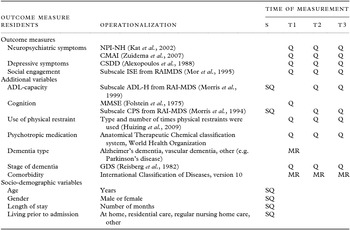
Table 1 presents all information on all measures, instruments, and time points. Neuropsychiatric symptoms were measured using the neuropsychiatric inventory – nursing home version (NPI-NH), a scale specifically developed for assessment by professional caregivers in institutional care (Kat et al., Reference Kat, De Jonghe, Aalten, Kalisvaart, Dröes and Verhey2002). The NPI-NH assesses 12 domains: delusions, hallucinations, aggression/agitation, depression, anxiety, euphoria, apathy, disinhibition, irritability, aberrant motor behavior, sleep, and eating disturbances. For each domain, the frequency (F) and severity (S) of symptoms are rated on a four-point (1–4) and three-point (1–3) scale, respectively, and a total score is calculated by multiplying the frequency and severity scores (F × S score). The F × S score ranges from 0 to 12 for each symptom, with higher scores indicating more severe symptoms.
Measurements

CMAI = Cohen-Mansfield Agitation Inventory; CSDD = Cornell Scale for Depression in Dementia; ISE = Index of Social Engagement; RAI-MDS = Resident Assessment Instrument – Minimum Data Set; ADL = activities of daily life; ADL-H = activities of daily life – hierarchy; MMSE = Mini-Mental State Examination; CPS = Cognitive Performance Scale; GDS = Global Deterioration Scale; S = Screening, approximately one week prior to baseline measurement; T1 = Baseline measurement; T2 = Follow-up after 6 months; T3 = Follow-up after 12 months; Q = Questionnaire; SQ = Screening Questionnaire; MR = Medical Record.
Agitation was assessed using the Cohen-Mansfield agitation inventory (CMAI). The CMAI assesses the frequency (ranging from never, 1, to several times an hour, 7) of 29 agitated behaviors during the previous two weeks. Symptoms can be classified into three types of agitation (Zuidema et al., Reference Zuidema, de Jonghe, Verhey and Koopmans2007): physically non-aggressive behavior (e.g. pacing/aimless wandering, hiding things, hoarding things, trying to get to a different place, handling things inappropriately, general restlessness, and inappropriate dressing/disrobing; total score range: 7–49); physically aggressive behavior (hitting, pushing, scratching, cursing/verbal agitation, grabbing, screaming, spitting, and making strange noises; total score range: 8–56); and verbally agitated behavior (constant unwarranted requests for attention/help, complaining, repetitive sentences/questions; and negativism; total score range: 4–28).
Depressive symptoms were assessed using the Cornell Scale for Depression in Dementia (CSDD; Alexopoulos et al., Reference Alexopoulos, Abrams, Young and Shamoian1988). This is a 19-item scale, specifically designed to assess symptoms of depression in people with dementia. The severity of each symptom is graded on a three-point scale, ranging from absent (0), mild or intermittent (1), to severe (2). The total score ranges from 0 to 38, with higher scores indicating more depressive symptoms. A cut-off point of 10 is generally indicative of major depressive symptoms.
Social engagement was measured using the Index of Social Engagement (ISE), a subscale of the RAI-MDS, which reflects both social involvement and autonomy (Mor et al., Reference Mor1995). This subscale consists of six dichotomously scored (present or absent) items, with a total score ranging from 0 (lowest level of social engagement) to 6 (highest level of social engagement).
Five types of physical restraints were measured in this study: belts (in bed and/or chair), (wheel)chair with a locked table or chair on a board, deep or overturned/reclined (wheel)chair (i.e. chair preventing from raising), sleep suits, and bilateral, fully enclosed bedrails. The presence or absence of these devices during the week of assessment was measured using a questionnaire.
Psychotropic drugs were classified according to the Anatomical Therapeutic Chemical (ATC) classification (World Health Organization) into five types: anti-psychotics (N05A), anxiolytics (N05B), sedatives (N05C), anti-depressants (N06A), and anti-dementia drugs (N06D). Prescriptions were assessed as present (including incidental use, i.e. “pro re nata (PRN)”) or absent during the week of assessment.
Socio-demographic variables of age, gender, length of stay, and living condition prior to admission were assessed. Furthermore, dementia severity, cognitive and functional status, type of dementia, and comorbid diseases were measured. Dementia severity was assessed at all time points using the Global Deterioration Scale (GDS), ranging from 1 to 7, with a higher score indicating more severe dementia (Reisberg et al., Reference Reisberg, Ferris, de Leon and Crook1982). Baseline cognitive status was assessed using the Mini-Mental State Examination (MMSE; Folstein et al., Reference Folstein, Folstein and Mchugh1975). Scores range from 0 to 30, with higher scores indicating less cognitive impairment. Furthermore, the CPS was used at all three measurement time points (Morris et al., Reference Morris1994). Functional status was assessed at all moments with the ADL-H (Morris et al., Reference Morris, Fries and Morris1999). The type of dementia (as established by an expert physician such as neurologist, psychiatrist, or geriatrician) was categorized into Alzheimer's disease, vascular dementia, or other. Comorbid diseases were classified according to the International Classification of Diseases (ICD), version 10.
A questionnaire was developed based on the literature and previous studies on small-scale living facilities to measure the degree of adherence to principles of small-scale home-like care, as a proxy measure of organizational culture (Verbeek et al., Reference Verbeek, van Rossum, Zwakhalen, Ambergen, Kempen and Hamers2009a; te Boekhorst et al., Reference te Boekhorst, Depla, Pot, de Lange and Eefsting2011). It contained 18 items which assessed aspects of physical, social, and organizational environment on a five-point Likert scale, ranging from 1 “not at all” to 5 “completely” (range = 18–90). Higher scores indicated greater adherence to small-scale living. An example item is “To what extent is the staff part of the household?” as nursing staff in small-scale, home-like care facilities have usually integrated tasks not only focusing on personal care (e.g. assistance in ADL activities) but also performing household chores and activities. Every ward (either a traditional ward or a house in small-scale living) was independently rated by two observers (authors HV and SMGZ) using this scale.
Procedures
The study was approved by the Medical Ethics Committee of the University Hospital Maastricht/Maastricht University. Furthermore, local ethical committees of participating facilities and their boards gave consent for the study. Data were collected from April 2008 to January 2010.
All measures regarding behavior (i.e. NPI-NH, CMAI, CSDD, and ISE) and physical restraints were assessed by registered nurses (RN) or certified nursing assistants (CNA), who were in charge of the residents and were most involved in their care, specifically for this study's purposes. Psychotropic drugs, type of dementia, and comorbid diseases were derived directly from the medical chart by the first author. The MMSE and dementia severity were assessed by a psychologist or nursing home physician.
Statistical analysis
An a priori sample was taken, based on the primary outcome measure of the study of quality of life as measured with the Qualidem (Verbeek et al., Reference Verbeek, Zwakhalen, van Rossum, Ambergen, Kempen and Hamers2010). For calculation, an effect size (δ) of 0.33 was used, together with a significance level α of 0.05 and power (1–β) of 0.90. Using statistical software (Stata, StataCorp) based on repeated measures it was calculated that in both groups 84 residents were needed. Based on a previous study, the drop-out in small-scale living facilities was expected to be approximately 1/7 and in regular wards 1/5 per half year (te Boekhorst et al., Reference te Boekhorst, Depla, de Lange, Pot and Eefsting2009). Taking these drop-out rates into account, the final sample to be recruited was 120 in small-scale living facilities and 140 in traditional wards.
Differences in residents’ characteristics at baseline were tested with χ 2-tests for categorical variables, two sample t-tests for normally distributed continuous variables and Kruskal–Wallis tests for continuous variables with skewed distributions. First, descriptive results analyzing unadjusted mean scores per group (small-scale vs. traditional) were calculated. Second, study hypotheses on all behavior outcomes were analyzed using hierarchical mixed-model multi-level analyses, according to the intention-to-treat principle. The first level in the analyses were assessment times, nested within residents (Level 2), who were nested within the wards (Level 3). All residents with a baseline measurement were included in the analyses, regardless of availability of data at the follow-up, since multi-level analyses are robust for missing values for the outcome variables. Several variables were included as covariates in the analyses: age, gender, length of stay, living condition prior to admission, functional status, cognitive status as measured with the CPS, dementia severity, number of comorbid disease, and psychotropic drug use. Missing data for these covariates only were imputed using multiple imputations using the Fully Conditional Specification (FCS) method and ten imputation data sets. Proportion of missing data was comparable for both groups.
First, fixed effects regarding group by time interactions were tested for significance. If these interactions were not significant, they were removed from the model and only fixed effects for group and time were tested. All analyses used a significance level α of 0.05. Since data for two outcome measures (agitation and neuropsychiatric symptoms) were skewed (skewness statistic >2.5), log transformations were performed in order to analyze these measures. Analyses of continuous outcome measures (i.e. all measures of behavior) were conducted using Predictive Analytics SoftWare (PASW), version 17, from SPSS (SPSS Inc.). For the dichotomous outcome measures (use of physical restraints and psychotropic drugs) generalized estimating equations (GEE) was used, as it was not possible to do a full hierarchical mixed effect modeling due to convergence problems with our data structure. These analyses were conducted in Stata 11 (StataCorp). For the connection between the dichotomous dependent variables for the three measurements and the independent variables, the logit link was used.
Subgroups analyses were performed, in which two groups were created based on their median scores on the questionnaire measuring the degree of adherence to principles of small-scale home-like care. Contrast Group 1 consisted of the 14 highest scoring houses in small-scale living facilities, all with total scores above the group median (>66); Group 2 consisted of the ten lowest scoring traditional wards, all with total scores below the group median (<40). These subgroup analyses allow for investigation of effects comparing the most typical small-scale living facilities with most typical traditional wards (i.e. comparison of most and least adherence to principles of small-scale living facilities).
Results
Sample characteristics and descriptive results
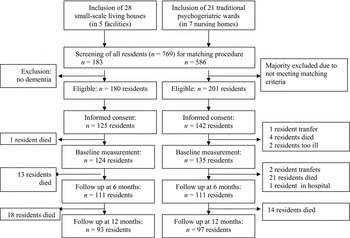
In total, 259 residents were included: 124 in small-scale living facilities and 135 in traditional wards. Figure 1 describes the number of residents per group at each measurement. For subgroup analyses based on the contrast questionnaire, 134 residents were included in total: 70 in most typical small-scale living facilities (highest scoring on adherence to principles of small-scale living) and 64 in most typical traditional wards (lowest scoring on adherence to principles of small-scale living).
Flowchart of study design.

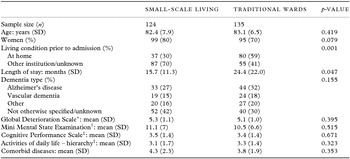
Table 2 shows residents’ baseline characteristics. Two significant differences were found; residents in small-scale living facilities were less often admitted directly from home and had a shorter length of stay compared with residents in traditional wards.
Characteristics of residents at baseline

*Range 1–7; a higher score indicates more severe dementia.
†Range 0–30; a higher score indicates a better cognitive status.
‡ Range 0–6; a higher score indicates poorer functioning.
Note: Data are mean (SD) or number (%). SD = standard deviation.
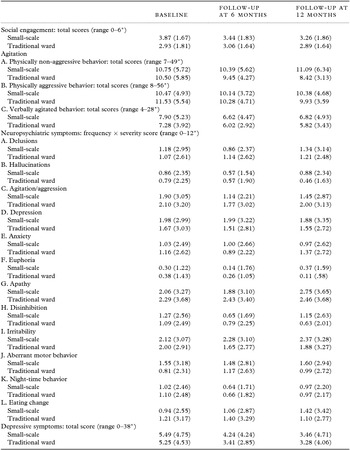
Unadjusted means for each group (small-scale vs. traditional) are presented in Table 3 per time point. Regarding neuropsychiatric symptoms, total scores (i.e. F × S) are highest for apathy and irritability in both settings, followed by depression and agitation/aggression. Mean CSDD scores were relatively low (<6) in both groups (Table 2).
Residents’ behavior: social engagement, agitation, and neuropsychiatric and depressive symptoms

*A higher score indicates more social engagement, agitation, and neuropsychiatric and depressive symptoms.
Note: Data are unadjusted scores (SD). SD = standard deviation.
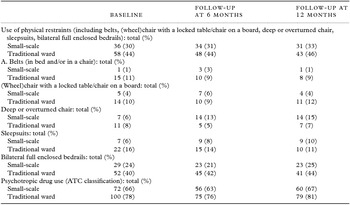
Table 4 presents unadjusted mean scores for each group per time point for physical restraints and psychotropic drug use. Differences between settings on use of physical restraints and psychotropic drugs appear to be large, varying between 12% and 14%.
Prevalence of use of physical restraints and psychotropic drug use

Note: Data are unadjusted numbers (%). ATC = Anatomical Therapeutic Chemical.
Effect on residents’ behavior
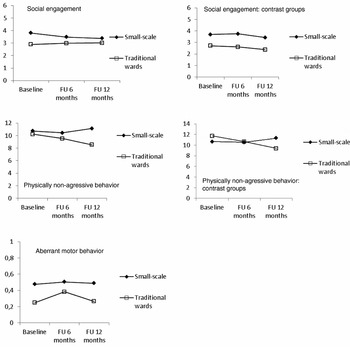
A significant group by time interaction was found for social engagement in the total group. Residents in small-scale living facilities were significantly more engaged at baseline (adjusted mean difference = 0.93; 95% Confidence Interval (CI) = 0.48–1.38; p < 0.001) and after six months (adjusted mean difference = 0.50; 95% CI = 0.03–0.98; p = 0.038) compared with residents in traditional wards. After 12 months, no significant differences were found (see Figure 2). In subgroup analyses using contrast groups, however, residents in small-scale living facilities were more engaged at all three measurements than residents in traditional wards (adjusted mean difference for the group effect = 1.04; 95% CI = 0.50–1.59; p < 0.001).
Adjusted mean scores (based on hierarchical multilevel analyses) for outcomes on behavior.

Furthermore, a significant group by time interaction was found for the agitation subscale physically non-aggressive behavior (see Figure 2). After 12 months, residents in small-scale living facilities displayed significantly more physically non-aggressive behavior as measured with the CMAI than residents in traditional wards (adjusted mean difference = 2.58; 95% CI = 1.00–4.17; p = 0.001). This difference after 12 months was slightly smaller between groups in the sub-group analysis using contrast groups and did not reach significance (adjusted mean difference = 1.90; 95% CI = 0.53–4.33; p = 0.126). No effects were found on the other subscales of agitation.
A group effect was found for one domain of neuropsychiatric symptoms (see Figure 2). Residents in small-scale living facilities showed more aberrant motor behavior as measured with the NPI-NH than residents in traditional wards (adjusted mean difference = 0.19, 95% CI = 0.02–0.35; p = 0.020). No other significant effects were found for neuropsychiatric or depressive symptoms.
Effect on use of physical restraints and psychotropic drugs
A significant group effect was found for the total use of physical restraints. In small-scale living facilities, significantly fewer physical restraints were used for all three measurements compared with traditional wards (adjusted OR = 0.40; 95% CI = 0.22–0.73; p = 0.003). The following three out of five devices were used significantly lesser in small-scale living facilities compared with traditional wards: belts (in chair and/or in bed; adjusted OR = 0.08; 95% CI = 0.02–0.34; p = 0.001), (wheel)chair with a locked table/chair on a board (adjusted OR = 0.23; 95% CI = 0.08–0.68; p = 0.008), and bilateral enclosed bedrails (adjusted OR = 0.28; 95% CI = 0.15–0.51; p < 0.001).
A significant group effect was found for psychotropic drug use. Residents in small-scale living facilities used significantly fewer psychotropic drugs compared with residents in traditional wards for all three measurements (adjusted OR = 0.50; 95% CI = 0.28–0.91; p = 0.023).
Discussion
This study examined the effects of small-scale living facilities on residents. The results show that fewer physical restraints and psychotropic drugs were used in small-scale living facilities compared with traditional wards for all three measurements. Effects on behavior were mixed and suggest more social engagement for residents in small-scale living facilities, although this effect disappeared over time in the total group of residents. Furthermore, physically non-aggressive behavior (such as aimless wandering) was more present after 12 months, and more aberrant motor behavior (e.g. repetitive behaviors such as picking, handling buttons, and wrapping strings) was found for all measurements in small-scale living facilities compared with traditional wards. No effects were found for the other neuropsychiatric or depressive symptoms.
Some limitations regarding this study must be addressed. Residents could not randomly be assigned to a dementia care facility due to ethical and practical drawbacks. This may have biased our sample and results. For example, previous research has shown that residents in small-scale living facilities had a better cognitive and functional status. These characteristics are highly related to severity of the dementia disease and can potentially influence outcome measures such as neuropsychiatric symptoms and social engagement. Such differences between the experimental and control group limit causal interpretation of results: are the observed differences between care settings caused by the care environment or due to differences in their target population? In order to increase the comparability of groups, residents were matched at baseline. This is a major strength over the previously conducted studies (Verbeek et al., Reference Verbeek, van Rossum, Zwakhalen, Ambergen, Kempen and Hamers2009a). Residents in the current study were similar with respect to many important characteristics such as cognitive and functional status and dementia severity. Nevertheless, the sample differed in terms of length of stay and living condition prior to admission, which we corrected for in the analyses. Furthermore, it would have been preferable to include only newly admitted residents, although this would have increased the recruitment period substantially. Since some differences in our outcome measures (e.g. physical restraints and psychotropic drug use) already existed at baseline, causal interpretation is limited. Differences at baseline could be caused by differences in care environment, which may imply that small-scale living facilities have a positive influence. On the other hand however, these differences could have already been present at baseline, which might imply selection of residents for specific settings. Finally, measurement of physical restraints was based on nurses’ self-reports instead of independent observers, which may have increased the risk of underreporting. This is, however, unlikely, since prevalence rates of the use of physical restraints in the current study are comparable to those reported in international literature (Hamers and Huizing, Reference Hamers and Huizing2005).
An important finding from this study is that fewer physical restraints and psychotropic drugs were used in small-scale living facilities compared with traditional wards. Differences in the organizational culture may account for these positive effects of small-scale living facilities. Previous studies pointed out that besides federal legislation and residents’ characteristics (such as dementia severity, and functional and cognitive status), differences at organizational level related to institutional policy and staff attitudes among facilities are important predictors of the use of physical restraints and psychotropic drug use (Karlsson et al., Reference Karlsson, Bucht, Eriksson and Sandman2001; Rochon et al., Reference Rochon2007). Since in the current study legislation and residents’ characteristics related to disease severity did not differ between groups, the results suggest that differences in organizational differences related to cultural change and staff attitudes could have accounted for the positive effects of small-scale living facilities on use of physical restraints and psychotropic drug use. A resident-oriented culture, emphasizing individualized and psychosocial care was shown to decrease psychotropic drug use (Svarstad et al., Reference Svarstad, Mount and Bigelow2001).
The effects on behavior in this study were mixed. Our results suggest positive effects of small-scale living facilities on social engagement, although even after 12 months these were only present in a subgroup of small-scale living units which adhered at most to the small-scale criteria. These results are in line with recent studies emphasizing that environmental stimuli can influence social engagement, especially when related to real-world tasks (Cohen-Mansfield et al., Reference Cohen-Mansfield, Marx, Dakheel-Ali, Regier and Thein2010). A recent study conducted in the Netherlands also showed that residents in facilities with more characteristics of small-scale, home-like care were more involved in overall, preferred and diverse activities (Smit et al., Reference Smit, de Lange, Willemse and Pot2012). Small-scale living facilities may offer a more attractive environment for people with dementia to encounter meaningful stimuli, thereby enhancing social engagement. Other studies also reported more social engagement for residents in small-scale, home-like environments (Kane et al., Reference Kane, Lum, Cutler, Degenholtz and Yu2007; te Boekhorst et al., Reference te Boekhorst, Depla, de Lange, Pot and Eefsting2009).
On the other hand, this study also found more physically non-aggressive behavior (such as aimless wandering) and aberrant motor behavior for residents in small-scale living facilities compared with those in traditional wards. This is consistent with previous literature which suggested more restlessness for people residing in non-institutional environments (Day et al., Reference Day, Carreon and Stump2000). This could be related to several factors. Since small-scale living facilities are based on a different care concept, emphasizing normalization of daily life, encouraging residents’ participation and autonomy, and a more person-centered attitude towards care, it could be that “aberrant” motor behavior is more accepted. Perhaps nursing staff do not perceive it as aberrant motor behavior or as agitation (especially since it is physically non-aggressive) but as a way of normal acting of the residents which should be respected. In traditional wards, where care is more based on a medical model of care, emphasizing safety, this could be more often be perceived as deviant or problem behavior which should be restricted. However, evidence suggests that especially physically non-aggressive behaviors could be a result of residents’ need for stimulation (Scherder et al., Reference Scherder, Bogen, Eggermont, Hamers and Swaab2010). This could be actively fulfilled, for example by walking or activity programs, or passively, such as seeing, hearing, and smelling activities. Small-scale living facilities are possibly at risk in providing not enough opportunity for residents to be actively involved, for example, due to the small unit size. Especially active stimulation was missed by some family caregivers in small-scale living facilities, as findings from the process evaluation showed (Verbeek et al., Reference Verbeek, Zwakhalen, van Rossum, Kempen and Hamers2012).
Small-scale living facilities for people with dementia differ on various levels from traditional wards in nursing homes. The physical, social, and organizational environment of institutional care has changed tremendously, aimed at deinstitutionalization. This has far-reaching consequences for daily practice in dementia care. Changes do not only affect residents, but also their families, nursing staff, and managing directors. Roles are changing, with integrated tasks for staff, emphasizing skills such as flexibility and creativity. Many policies are aimed at providing small-scale and home-like care, although the effects of small-scale living facilities on residents, family caregivers, and nursing staff remain unclear. For example, small-scale living facilities are suggested to have a positive effect on certain job characteristics such as job autonomy, but effects on burnout symptoms are mixed with both more and less symptoms reported compared with traditional wards (te Boekhorst et al., Reference te Boekhorst, Willemse, Depla, Eefsting and Pot2008b; de Rooij et al., Reference de Rooij, Luijkx, Declercq, Emmerink and Schols2012a). Also, effects on family caregivers are mixed, reporting less caregiver burden (Verbeek et al., Reference Verbeek, Zwakhalen, van Rossum, Ambergen, Kempen and Hamers2010) or no effects (te Boekhorst et al., Reference te Boekhorst, Pot, Depla, Smit, de Lange and Eefsting2008a). Healthcare professionals should carefully consider how to optimally design nursing home environments and should not blindly focus on one model. More research is therefore imperative in order to identify the interplay between environmental elements (physical, social, and organizational) and their effects on resident-related and caregivers’ outcomes. Studies need to determine which elements of small-scale living facilities are essential for improving outcome measures and how they work together.
Conflict of interest
None.
Description of author's roles
Hilde Verbeek drafted the paper. All authors critically reviewed, read, and approved the final paper. Hilde Verbeek, Sandra Zwakhalen, Erik van Rossum, Gertrudis Kempen, and Jan Hamers were involved in the study's concept and design, acquisition of participants, the analysis and interpretation of data, and preparation of paper. Ton Ambergen was involved in statistical analysis and interpretation of results.
Acknowledgments
This study was funded by Maastricht University, Limburg, and five healthcare organizations (MeanderGroep Zuid-Limburg, Orbis Medisch en Zorgconcern, Sevagram, Vivre, and De Zorggroep).