

Introduction
European welfare states have experienced a surge of reforms ever since the 1980s. In the new millennium, the notion of “social investment” gained purchase as a reform compass for demographic ageing, low fertility, and the rise of the knowledge economy (Morel et al., Reference Morel, Palier and Palme2012; Hemerijck, Reference Hemerijck2013; Vaalavuo, Reference Vaalavuo2013). Beyond generous and inclusive social security buffers, particularly with respect to minimum income social assistance, what exemplifies social investment is its service intensity. In many countries, family policies have been strengthened to reconcile work–family balance and promote maternal employment by investing in early childhood education and care (ECEC) and expanding parental leave schemes (Nygård et al., Reference Nygård, Kuisma, Krüger, Campbell-Barr, Korkut, Mahendra, Bucken-Knapp and Cox2015). Also, working careers have been lengthened through flexible retirement options, active ageing policies, and the expansion of long-term care (Sowa-Kofta et al., Reference Sowa-Kofta, Marcinkowska, Ruzik-Sierdzińska and Mackevičiūtė2021). These policy reforms both centre around providing care for families and older people and are found to have positive complementarities on employment and other objective well-being measures (Plavgo and Hemerijck, Reference Plavgo and Hemerijck2020; Nieuwenhuis, Reference Nieuwenhuis2022), but less focus is put on subjective well-being outcomes. Therefore, the principal objective of this article is to test whether positive subjective well-being returns to social investment can be observed by examining the policy complementarities between income protection and social care services on life satisfaction.
Welfare state literature often distinguishes social protection transfers, such as unemployment benefits, pensions, and sickness coverage, distinct from social investment services, in the areas of active labour market policy, early childhood care, and long-term care. The critics of social investment accused its protagonists of favouring in-kind capacitation over benefit transfer compensation (Cantillon and Van Lancker, Reference Cantillon and Van Lancker2013; Nolan, Reference Nolan2013). Nevertheless, one of the earliest academic endorsements of the social investment paradigm by Esping-Andersen vouched that “the precondition to any effective social investment strategy is a strong safety net” (Esping-Andersen, Reference Esping-Andersen and Esping-Andersen2002: 5). More empirically, Hemerijck (Reference Hemerijck2013) showed that both compensating and capacitating policy efforts are strongly correlated and underscored that adequate social protection buffers are a fundamental background condition for the effectiveness of human capital stock development and the smoothing of work–life balance flows across labour market and life-course transitions. In other words, social investment policies operate through mechanisms that are configurationally constituted rather than independently expressed (Hemerijck et al., Reference Hemerijck, Ronchi and Plavgo2023). A parental leave flow policy does not produce its effects through a freestanding leave mechanism; it produces effects through the interaction of leave provisions with childcare stock provision. When the configuration of stock, flow, and buffer policy provisions operates in interconnected ways, the effects of one policy vary depending on other policies in place. As such, social protection and welfare services, as stand-alone interventions, may influence individual well-being, but they work best in complementarity (Vandenbroucke and Vleminckx, Reference Vandenbroucke and Vleminckx2011; Hemerijck et al., Reference Hemerijck, Bagadirov, Puertas Roig, Yerkes and Bal2022; Nieuwenhuis, Reference Nieuwenhuis2022; Pöyliö, Reference Pöyliö2026). Therefore, the policy predicament is to find the right goodness-of-fit between social protection and social capacitation.
By now, there is ample research on how and to what extent social investment welfare provision – through policy complementarities – reinforces employment participation, alleviates poverty, and fosters a skilled and productive active workforce, using both macro- and microdata, showing that such joint effects vary by risk group and national context (Plavgo and Hemerijck, Reference Plavgo and Hemerijck2020; Bakker and Van Vliet, Reference Bakker and Van Vliet2022; Nieuwenhuis, Reference Nieuwenhuis2022; Lehmus-Sun, Reference Lehmus-Sun2025; Pöyliö, Reference Pöyliö2026). We are interested in how social investment policy complementarities, beyond positive material returns, interact to promote subjective well-being across groups and age cohorts in the population. In this respect, it is important to emphasise that social investment rests on a distinctive, often overlooked, normative underpinning: welfare provision is not to blindly push people onto the labour market for economic gain, but to capacitate people to reap life chances and well-being opportunities (Bagadirov et al., Reference Bagadirov, Hemerijck and Puertas Roig2025; Wagner et al., Reference Wagner, Pöyliö and Hemerijck2025). Notwithstanding social investment reform progress in Europe, comparative welfare state research has thus far shied away from investigating questions of subjective well-being.
Leaning on the provision of “secure capabilities” coined by the political philosophers Wolff and de-Shalit (Reference Wolff and de-Shalit2007), who emphasise that policies should promote agency and mitigate risks, strengthening individual capabilities to fulfil life goals. Hence, the more service-oriented social investment welfare provision is “capabilitarian,” giving citizens the necessary “stepping-stones” to navigate the life-course and to participate in today’s society and economy (Bagadirov et al., Reference Bagadirov, Hemerijck and Puertas Roig2025). Consequently, social investment services are expected to shore up subjective well-being. (Wagner et al., Reference Wagner, Pöyliö and Hemerijck2025). While financial hardship can grind down important capabilities, such as learning a new skill or obtaining better employment opportunities, social protection buffers bring income relief and therefore less stress to benefit recipients. As such, income protection does not merely compensate for social risks ex post but, by effectively reducing people’s worries about money, also ex ante empowers individuals and households to make the best of capacitating services, such as education and training. Considering that countries with high levels of capacitating service provision most often feature strong social protection buffers (Hemerijck, Reference Hemerijck2013), it is crucial to investigate subjective well-being returns produced by such policy complementarities. We thus conjecture that where and when buffers are adequate and capacitating services are readily available, they should, through direct use of policies, by signalling prospective future support or as a diffusive element among those with secondary exposure, influence positively subjective well-being, by providing income stability, thus reducing stress, whilst strengthening agency and autonomy on account of capacitating services.
The important element of a social investment welfare state is the ability to help individuals and families navigate critical life-course transitions, such as entering the labour market, starting a family, losing a job, and moving into retirement – periods when resilience and life satisfaction are put to the test. Because each individual and household is confronted with different social risks across their life courses, dependent on their demographic and social situation, each life stage may require varying time-specific policy supports to enhance capabilities. Given that social investment policies are designed to operate on particular populations at particular life-course moments, distinguishing between target groups and non-recipients is important. ECEC operates at specific developmental and employment moments of the children and parents. Active labour market policies occur at specific career and age transitions. Pension policies are structured for old age. A social investment policy that claims to promote maternal employment, child outcomes, or long-run pension sustainability operates through life-course-specific mechanisms, not through a uniform effect.
Many policies in service-intensive welfare states centre around family life and old age. In societies with strong social investment policies, the care of children and older people is often carried out by public services to alleviate the care responsibilities of immediate and extended family members, mostly women, who would otherwise provide this care (Lewis, Reference Lewis1992; Orloff, Reference Orloff1993; Abbing et al., Reference Abbing, Suanet and van Groenou2021). Hence, the influence of social investment service provision is expected to be particularly prevalent across these two life-course situations and positively associated with the subjective well-being of family members who are directly and indirectly influenced by care provision. This contribution seeks to clarify theoretically and empirically how capacitating services and income protection benefits interact to promote subjective well-being and to shed new light on the mechanisms behind observed policy complementarity across the life course for different social groups.
Subjective well-being and the capacitating welfare state
Simultaneous to, but perhaps independent of, the social investment reforms across Europe, a greater consideration regarding a good life and the quality of society beyond traditional economic indicators has arisen. Measurements of welfare state progress and development also emphasise the quality of life, with subjective well-being indicators such as life satisfaction, agency, and solidarity, as key metrics (Stiglitz et al., Reference Stiglitz, Fitoussi and Durand2018; European Commission, 2024; OECD, 2024). This change reflects the ongoing trend to rethink individual well-being in ageing societies and knowledge economies and thus requires a more comprehensive framework based on what it means to live in successful societies. The parallelism of the drive to assess societal success in terms of a wider understanding of human flourishing, on the one hand, and social investment reform, on the other, however unintended, creates a fertile breeding ground to explore subjective well-being returns to social investment.
Our understanding of how subjective well-being is central to social investment returns is critically entwined with the idea of a “capabilitarian” welfare state (Bagadirov et al., Reference Bagadirov, Hemerijck and Puertas Roig2025). Inspired by the “capabilities approach” of Amartya Sen (Reference Sen1999) and Martha Nussbaum (Reference Nussbaum2011), it emphasises the positive freedoms to fulfil life goals and achieve well-being shaped by capabilities. Wolff and de-Shalit (Reference Wolff and de-Shalit2007) extended this philosophy, arguing that by securing so-called “fertile functionings” for individuals, policies provide capabilities, which in turn can interrupt the accumulation of disadvantages across the life-course. The idea of “fertile functionings” suggests that policies promote agency and mitigate risks and henceforth secure the capabilities that reinforce fertile functionings. In this respect, social investment policies aim to provide capabilities and a freedom to act based on individual preferences, aspirations, and values. It therefore follows that we expect social investment policies to positively influence individual life satisfaction even when they are not directly related to specific welfare policies.
Both compensatory (income protection) and capacitating (services) policy categories, although traditionally analysed separately, on various individual outcomes (e.g. Hemerijck, Reference Hemerijck2013; Kuitto, Reference Kuitto2016; Bakker and Van Vliet, Reference Bakker and Van Vliet2022), are found to increase one’s resilience across critical life-course transitions in a manner that promotes subjective well-being (Böhnke, Reference Böhnke2008; Wulfgramm, Reference Wulfgramm2014; Aassve et al., Reference Aassve, Mencarini and Sironi2015; Glass et al., Reference Glass, Simon and Andersson2016). To the extent that the income protection buffer can fulfil basic material needs, giving people more control over their environment, it also positively improves the leverage of capacitating services to further expand autonomy, opportunity, and life chances, and, by implication, reinforce life satisfaction through policy complementarities. In other words, for positive and stable subjective well-being, it is necessary to have both strong buffers enabling the livelihood with income protection and capacitating services to enhance capabilities, resilience, and agency. Individual capabilities and the freedom to exercise them can be assumed to be reflected in one’s perceptions of one’s life situation (Wagner et al., Reference Wagner, Pöyliö and Hemerijck2025). As such, this study considers the policy complementarities between care service provision and income protection, beyond their independent influence, to promote life satisfaction.
Hence, our first research question addresses the policy complementarities and enquires:
RQ1: Are capacitating policy complementarities between care services and income protection on individual life satisfaction conditional on adequate income protection?
Within the European Union, this complementary understanding of social policy synergies as springboards to navigate life-course transitions, both to improve individual and family well-being and to promote macro-level economic resilience, is gaining purchase (European Commission, 2021). At the macro level of the economy, we expect that when integrated social investment policy repertoires sustain well-being that increases individual and household resilience, they will then also strengthen the fiscal sustainability and carrying capacity of the welfare state (Hemerijck et al., Reference Hemerijck, Ronchi and Plavgo2023).
Life-course perspective on life satisfaction and care services
Individual life-course situations, possibilities, and well-being are strongly linked to the needs, risks, and capabilities they possess, and these vary largely both across individuals and across life stages. As individual economic and social conditions influence one’s life satisfaction to a large extent (Clark, Reference Clark2018), one’s confidence in welfare state policies to ease critical life-course transitions can be expected to influence subjective well-being (Böhnke, Reference Böhnke2008). This calls for life-course sensitive policies that can effectively address current and future risks in the life course and provide timely compensating and capacitating support across vulnerable life stages.
A principal objective of social investment reform has been to buttress the strength of the economy by increasing the labour market opportunities for outsiders at different life stages. Expansion of childcare availability and advancements in employment-protected paid family leaves have enabled greater numbers of mothers to participate in less precarious employment relations, whereas improvements in active ageing policies and postponed retirement have steered older workers to pursue longer careers (Fernandes and Hemerijck, Reference Fernandes, Hemerijck, Bokhorst and Hemerijck2026). Considering that both life stages often involve informal care, i.e., childcare and old-age care, the experience of such life stages impacts personal perceptions of subjective well-being and life satisfaction (Lehmus-Sun, Reference Lehmus-Sun2025). The joint element of care alleviation of these policies makes a valuable case to examine the policy complementarities on subjective well-being, contributing to the social investment literature beyond education and employment.
Beyond the direct users and beneficiaries of care services and social benefits, welfare state provision may also signal prospective support in future life situations, such as those planning family formation or near retirement age. Welfare policies enable individuals to pursue their desired life plans, knowing that income protection and social service provision can be expected to support risky transitions in the future. As a result, these policies can influence one’s life satisfaction, independently of the immediate recipiency of such policies. Further, due to the intergenerationality of informal care of children and older people, in an ideal context, social investment care services alleviate these care responsibilities of family members. While public childcare enables parental employment, it also enhances the freedom of grandparents to devote “quality time” to their grandchildren. Similarly, old-age care services relieve the informal care burden of partners but also of offspring, with the positive effect of enjoying “quality time” with older parents.
Barbara Hobson, Jane Lewis, and Ann Orloff were among the first to highlight the gendered nature of “new social risks” and the need for childcare, long-term care, parental leave, and targeted support for lone parents, mostly women, to help navigate gendered post-industrial life-course dynamics (Hobson, Reference Hobson1990; Lewis, Reference Lewis1992; Orloff, Reference Orloff1993). While parenthood is found to reduce subjective well-being, particularly among mothers compared to fathers, this is mitigated in contexts with strong work–family policies, such as childcare and parental leave (Glass et al., Reference Glass, Simon and Andersson2016; Pollmann-Schult, Reference Pollmann-Schult2018; Nomaguchi and Milkie, Reference Nomaguchi and Milkie2020; Lehmus-Sun, Reference Lehmus-Sun2025). The more family responsibilities are felt to interfere with paid work, the stronger the negative impact is on parents’ life satisfaction (Matysiak et al., Reference Matysiak, Mencarini and Vignoli2016). More recently, the dilemma of low fertility in countries with extensive family support, such as the Nordic welfare states, has raised interest in more comprehensive support structures of families’ and women’s well-being under conditions of adverse demography (Rotkirch, Reference Rotkirch2024). As such, the policy provision signals support mechanisms for prospective or future parents, enhancing the subjective well-being of non-parents as well (Glass et al., Reference Glass, Simon and Andersson2016). Many scholars highlight that policies that support fertility aspirations and intentions are intimately linked to women’s subjective well-being (Aassve et al., Reference Aassve, Mencarini and Sironi2015; Rotkirch, Reference Rotkirch2024). Since family services are aimed at reducing these conflicts, we assume they are associated with positive returns to subjective well-being among parents, but also among those with aspirations of becoming a parent.
Grandparental childcare is a central part of many families with varying magnitude and frequency, and providing care for grandchildren is generally associated positively with life satisfaction (Danielsbacka et al., Reference Danielsbacka, Křenková and Tanskanen2022; Zanasi et al., Reference Zanasi, Arpino, Bordone and Hank2023), but when the care investment is intense and prolonged, because of suboptimal access to public childcare, the positive returns are most prominent among widowed grandparents (Rotkirch et al., Reference Rotkirch, Hägglund, Tanskanen and Danielsbacka2024). Again, this points to a dichotomy in levels of grandchild care that are of grandparents’ own choosing or due to a lack of affordable formal childcare opportunities. Considering that freedom of choice and control are positively linked to life satisfaction and happiness (Chua et al., Reference Chua, Churchill, Koestner, Churchill, Farrell and Appau2020), increasing this freedom with greater provision of services for families can be assumed to also be positively associated with the life satisfaction of grandparents.
Considering the care element of family support discussed above, both related to financial aid and care services, we expect the policy complementarities to operate differently across diverse demographic groups:
RQ2: Do capacitating policy complementarities between family care services and income protection influence life satisfaction among parents with small children (first-order direct effect), young adults without children (second-order signalling effect) and grandparents (third-order diffusion effect)?
The second life stage where well-being is closely linked to caregiving, and as such to care policies, both financial and service-related, is older age. The transition from paid work to retirement includes a shift both in freedom of time and fulfilment from work. If the timing of retirement is voluntary, life satisfaction returns to augmented free time are positive, whereas involuntary retirement will be experienced as negative (Bonsang and Klein, Reference Bonsang and Klein2012; Richardson et al., Reference Richardson, Carr, Netuveli and Sacker2019). Active ageing policies and services for older people can increase control and agency over one’s life, and thus promote higher subjective well-being (Richardson et al., Reference Richardson, Carr, Netuveli and Sacker2019; Lehmus-Sun, Reference Lehmus-Sun2025). Correctly timed long-term care for older people is associated with higher reported subjective well-being compared to those unable to access such services (Böckermann et al., Reference Böckerman, Johansson and Saarni2012).
The association between old-age care and well-being is not straightforward: groups with lower socio-economic status are more reliant on public and informal care services, whereas groups with high socio-economic status can more easily access private care (Abbing et al., Reference Abbing, Suanet and van Groenou2021). In addition, women are on the whole more disadvantaged in benefiting from active ageing due to the already unequal distribution of labour market engagement and more burdensome informal care responsibilities (Zaidi et al., Reference Zaidi, Gasior, Zolyomi, Schmidt, Rodrigues and Marin2017). While the need for care for older people is increasing in rapidly ageing societies, many active ageing policies in Europe still strongly promote prolonged economic participation through later retirement, although increases in service provision are slowly taking place. Later retirement may also postpone access to care while holding economic responsibilities and activity requirements of the society; higher availability of care services to use in the future may have a positive signalling effect on well-being among those not yet retired.
The subjective burden of providing informal care by adult children is well known. There is an observable trend of augmented informal care of older people, which burdens partners and offspring (Abbing et al., Reference Abbing, Suanet and van Groenou2021). However, professional care and generous long-term care resources are found to mediate the negative association between informal care and subjective well-being (Verbakel, Reference Verbakel2014; Oldenkamp et al., Reference Oldenkamp, Hagedoorn, Slaets, Stolk, Wittek and Smidt2016). Women, or daughters, providing informal care more often to their parents and in-laws, are forced to make tough trade-offs between paid work, leisure time, and informal care (Stanfors et al., Reference Stanfors, Jacobs and Neilson2019), which constrains their freedoms and functionings. A parent’s ill health is another important stressor, which can be alleviated with available and accessible services, whether adult children provide informal care or not. All in all, in line with social investment’s emphasis on active ageing, more generous old-age care provision is expected to be positively associated with offspring’s subjective well-being. To conclude, in relation to how old-age care is associated with subjective well-being among different social groups, we examine:
RQ3: Do capacitating policy complementarities between old-age care services and income protection influence life satisfaction among retired persons (first-order direct effect), non-retired older individuals (second-order signalling effect) and offspring (third-order diffusion effect)?
Data and methods
Sources and sample
The study benefits from comparative cross-sectional micro-level data from the European Social Survey (ESS) rounds 1–9Footnote 1 (2002–2019) to analyse life satisfaction over time and across multiple welfare states. The sample consists of 23 countries: Austria, Belgium, Czechia, Denmark, Estonia, Finland, France, Germany, Great Britain, Greece, Hungary, Ireland, Italy, Lithuania, the Netherlands, Norway, Poland, Portugal, Slovakia, Slovenia, Spain, Sweden, and Switzerland. Data from OECD (2025a, 2025b) and Eurostat (2025) are used to measure policy provision of services and buffers. See Table A1.1 in Supplementary Appendix 1 for detailed information on the observation years of each country based on ESS, OECD, and Eurostat data availability.Footnote 2 The total sample consists of over 330,000 individuals. This analytical sample is used for the descriptive results on life satisfaction across age groups (Figure 1) and for RQ1 to analyse the association between life satisfaction, overall service provision, and income protection (Figure 3). Thereafter, the analyses focus on the three target populations set out in research questions 2 and 3. Both samples consist of over 210,000 individuals. Supplementary Appendix 1 presents sample details and descriptive statistics for all variables.
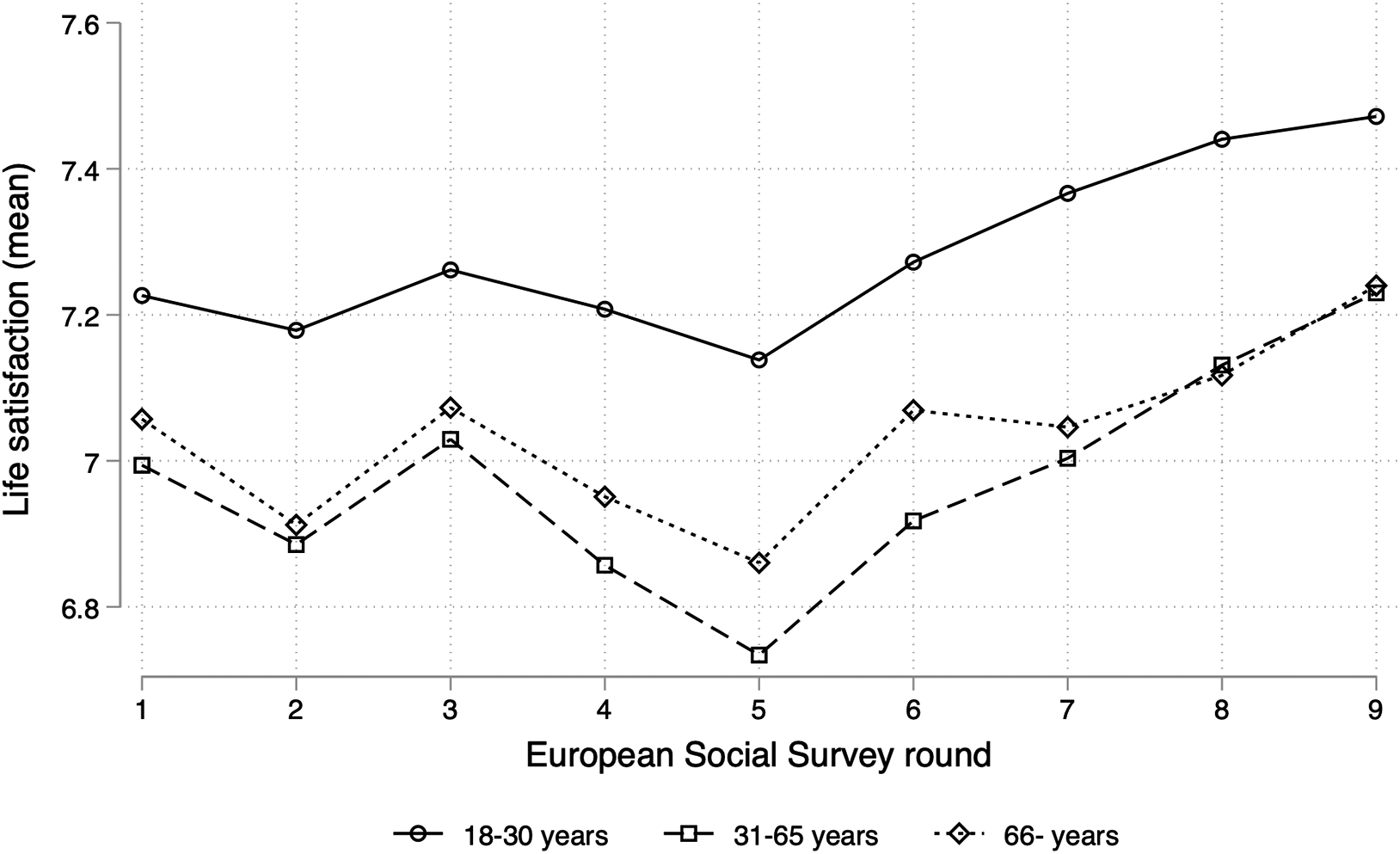
Life satisfaction across different age groups over the observation period.

Figure 1. Long description
The Y-axis is labeled Life satisfaction (mean) with a scale from 6.8 to 7.6. The X-axis is labeled European Social Survey round with discrete points from 1 to 9. Three data series are plotted.
* The top series (solid line with circles) represents the 18-30 years age group. It starts at approximately 7.2 in round 1, fluctuates slightly, reaches a low of 7.15 in round 5, and then shows a steady upward trend to nearly 7.5 by round 9.
* The middle series (dotted line with diamonds) represents the 66- years age group. It starts at 7.05, drops to 6.9 in round 2, peaks at 7.08 in round 3, drops to a low of 6.85 in round 5, and then rises to approximately 7.25 by round 9.
* The bottom series (dashed line with squares) represents the 31-65 years age group. It follows a similar trajectory to the 66- years group but generally sits lower. It starts at 7.0, reaches its lowest point of approximately 6.75 in round 5, and rises to meet the 66- years group at approximately 7.25 in round 9.
All three groups show a notable dip in round 5 followed by a consistent increase through round 9.
Individual-level variables
The main dependent variable measures the overall life satisfaction with an 11-point scale, examined in the ESS survey with the question: “All things considered, how satisfied are you with your life as a whole nowadays? Please answer using this card, where 0 means extremely dissatisfied and 10 means extremely satisfied.” Despite the scaling of the variable, it is treated as linear for analytical purposes.
The main individual-level independent variables measure the target groups that analyse the mechanisms of policy influence on life satisfaction: first-order direct effect, second-order signalling effect, and third-order diffusion effect. Despite the wording, the analyses are of a correlative nature and “effect” is used to describe theoretical mechanisms. In family care analyses (RQ2) individuals under 50 years of age and with children aged 0–5 in the household represent “the direct group,” under 50-year-old individuals without underaged children “the signalling group,” and over 50-year-old individuals who have had children living in the household at some point, as a proxy for a grandparent, since grandchild information is available only for ESS rounds 3 and 9, represent the “diffusion group.” In old-age care analyses (RQ3), retired or disabled over 50-year-olds represent “the direct group,” not retired over 50-year-olds “the signalling group” and individuals of 31–50 years, i.e. the offspring,Footnote 3 are considered “the diffusion group.” Although we do not measure whether the individual is exposed to the policy per se, we consider the main target population for the particular care services as the most likely user of such services.
Control variables include gender, educational attainment (basic, secondary, tertiary), relationship status (partnered, single), and main activity (employed, unemployed, retired, education/military, housework, disabled). These are all found to relate to subjective well-being (Clark, Reference Clark2018). Descriptive statistics of all individual-level variables can be found in Table A1.2 in Supplementary Appendix 1.
Policy variables
To analyse the policy complementarities of the service provision and income protection on subjective well-being, we use two sets of policy measures. First, the OECD Social Expenditure Database (SOCX) (OECD, 2025a) on public in-kind social spending as a percentage of GDP, separately for total (RQ1, Figure 3), family (RQ2, Figure 5), and old-age policies (RQ3, Figure 7), is used to measure service provision. Family services include ECEC, home help, and other benefits in kind, and old-age services comprise day care, home assistance, residential care, and other benefits in kind (OECD, 2019; Eurostat, 2026). While spending indicators are criticised for being too vague, here they are considered to be valuable in providing a comprehensive measure of welfare state efforts on services, particularly as the services are related to care-intensive life stages.
Second, we expect capacitating services to influence individual life satisfaction if the income protection sufficiently reduces financial stress, either directly or as a signalling influence for the future in case unfortunate situations arise. Hence, the sufficiency of income compensation for total population is measured with data on the adequacy of minimum income benefits as the percentage of median disposable income in the country for a single person without children to reflect overall income protection (Figure 3) and for a jobless couple with two children for the family sample (Figure 5) (OECD, 2025b). If minimum income benefits are at least 50 per cent of the median income in a given year, they are considered adequate, as that reflects compensation above the poverty line. This is expected to reflect the income protection system more comprehensively than specific compensatory measures such as unemployment benefits and is a more robust indicator to compare across countries with varying social protection systems. The adequacy of pensions and other benefits in retirement to provide sufficient livelihoods is measured by old-age poverty rates, namely the percentage of individuals over 65 years old who are in poverty (Figure 7; Eurostat, 2025, available from 2003 onwards). This indicator provides again a more comprehensive measure of the sufficiency of income protection for older people than pension indicators alone could. The poverty rate is matched based on gender, considering the poverty risk of older men and women is very different in many country contexts. Hence, women are much more often in the “high poverty risk” category when the variable is coded into a dichotomous high/low measure with a cut-off point at 20 percentage points (USDA, 2022, used as a guideline on low and high poverty rate categories).
The annual policy variables are matched with the individuals based on their interview year. Because each survey round has been conducted over various years, a variable indicating the time of the interview is used to match the annual macro-level data. See Supplementary Appendix 1 for a detailed description and sources of the policy variables.
Methods
The associations between life satisfaction, individual socio-demographic factors, and social policies are analysed with linear regression models. Models include country-fixed effects to examine the within-country variation of these associations, which addresses the issues of diverse policy systems between countries. Cluster-robust standard errors are used to acknowledge that the individual observations are clustered by countries. With this approach, we can benefit from the time-varying nature of both individual-level covariates and macro-level policy variables, analysing changes in the association within each country. Linear regression, compared to multilevelFootnote 4 modelling, allows applying post-stratified design weights. These operate as analysis weights in cross-country analyses to reduce sampling error and non-response bias (Kaminska, Reference Kaminska2020).
The analyses are divided into three sections, covering each of the three principal research questions. First, the policy complementarities between service provision and income protection on life satisfaction (RQ1) are analysed by examining the interaction between the total social spending on services and adequacy of minimum income protection on individual life satisfaction across different age groups (Figure 3). Second, the policy complementarities of family care on life satisfaction (RQ2) are analysed with a model including an interaction between the social in-kind spending on families, adequacy of minimum income protection, and the three target groups: parents of small children, individuals without children and grandparents (Figure 5). Individuals who have never had children living in the household are not included in the grandparent group. Third, the policy complementarities of old-age care on life satisfaction (RQ3) are examined with an interaction between the social in-kind spending on old-age, old-age poverty risk, and the three target groups: retired, not retired and offspring (Figure 7). All three models include all control variables, except in Figure 7, the main activity is not included, as it is used to determine the retirement status of the target groups.
The results are presented as predictive margins of life satisfaction at certain levels of in-kind social spending and income compensation for each target group category. Supplementary Appendix 3 includes the full interaction results of all regression models. Although informal care responsibilities affect women to a larger extent, the results between men and women are not very different (see Supplementary Appendix 4 for separate graphs by gender), hence we present the results for both genders together.
Results
Life satisfaction returns to service increase (RQ1)
Life satisfaction alternates across the life course and over time. Figure 1 presents the average life satisfaction in different age groups across the observation period in all 23 European countries. Young adults seem to have the highest life satisfaction at any time point, whereas over-66-year-olds have the lowest, although quite similar to working-age populations. While these differences have remained mostly stable in the 2000s (ESS rounds 1–4), ESS round 5 (years 2010–11) does show a dip in life satisfaction, particularly among older persons, reflecting the financial crisis of 2009. After this, life satisfaction in all age groups has increased.
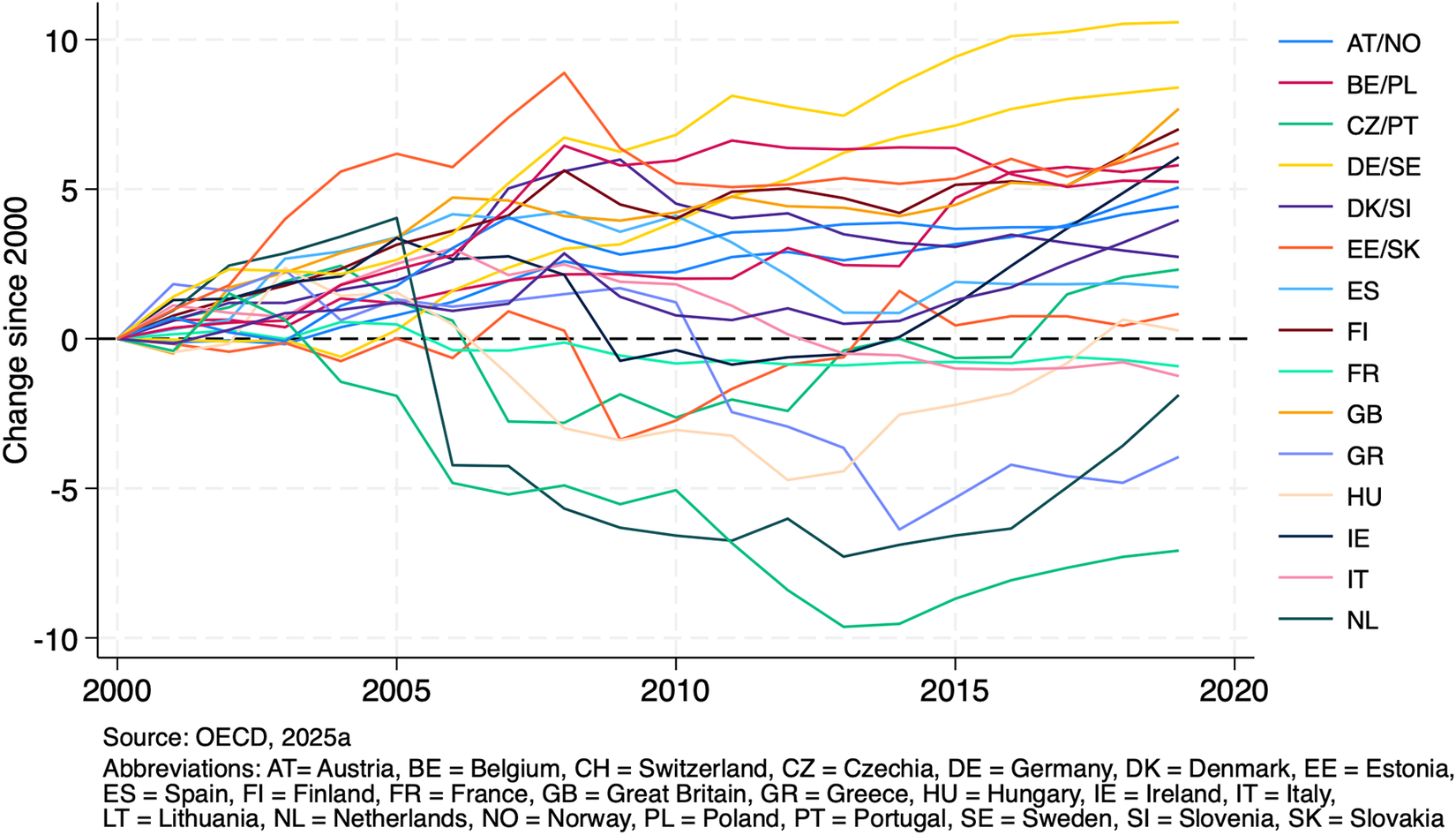
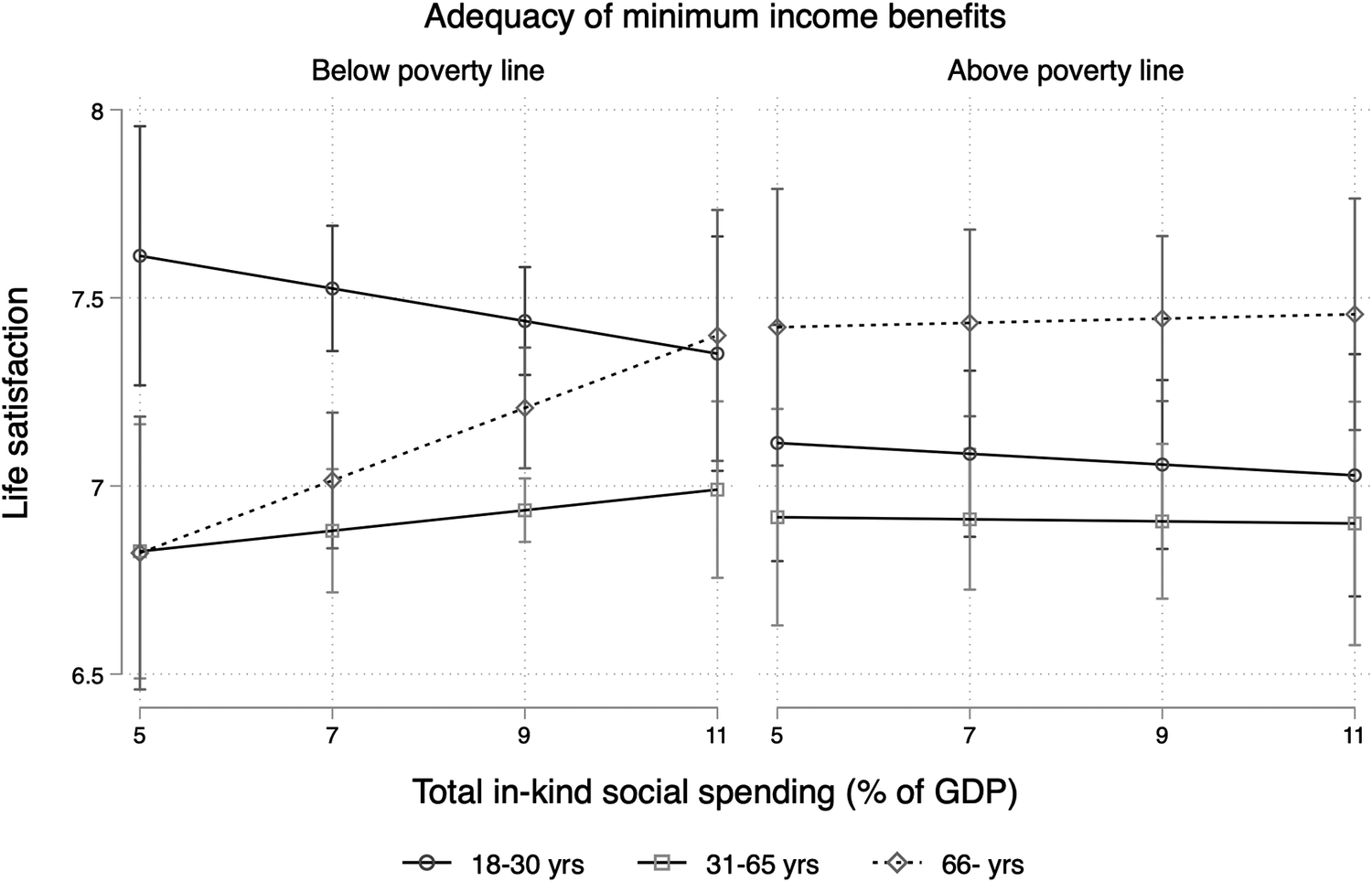
Figure 2 shows the over-time trend in service provision across the 21st century. It demonstrates that the share of in-kind social spending from the total social spending since 2000 has increased in most European countries, particularly after the mid-2000s.Footnote 5 Turning to analyse how these changes in service provision are associated with life satisfaction in settings with adequate or inadequate income protection is analysed in Figure 3. It presents the country-fixed linear regression results as predicted probabilities of life satisfaction in different age groups and at different degrees of total in-kind social spending. The results show that the shift towards higher public social expenditure is positively associated with life satisfaction among older populations when the adequacy of income protection is low, reaching the level of life satisfaction at only the highest service provision levels. This indicates a compensatory mechanism of services. The association is found to be almost neutral among the working-age population, and negative among young adults if income protection is inadequate. In contexts of minimum income benefits above the poverty line, higher levels of service provision seem to have little influence on the life satisfaction of the total population. However, all associations are statistically weak (see Table A3.1 in Supplementary Appendix 3 for full results of the model). The weak negative association between higher service provision and life satisfaction among young adults in contexts with minimum income protection provision below poverty line, may reflect that income protection is more important than service provision for young adults with weak labour market attachment.
Change since 2000 in the share of total social expenditure on in-kind provision.

Figure 2. Long description
The x-axis represents years from 2000 to 2020 in five-year increments. The y-axis represents Change since 2000, ranging from negative 10 to positive 10. All data lines originate at 0 in the year 2000.
* Upper Cluster (Positive Change): A majority of the lines trend upward. The highest growth is seen in G B (Great Britain), reaching above 10 by 2020. Other high-growth lines include D E / S E (Germany and Sweden) and E E / S K (Estonia and Slovakia), which peak between 5 and 10.
* Middle Cluster (Stable to Moderate Change): Several lines, including A T / N O (Austria and Norway), F I (Finland), and E S (Spain), fluctuate between 0 and 5.
* Lower Cluster (Negative Change): A few lines show a distinct downward trend starting around 2005. N L (Netherlands) and C Z / P T (Czechia and Portugal) show the most significant declines, dropping to between negative 7 and negative 10 by 2015 before slightly recovering. G R (Greece) also shows a notable dip starting after 2008, ending near negative 4.
A legend on the right lists country codes: A T / N O, B E / P L, C Z / P T, D E / S E, D K / S I, E E / S K, E S, F I, F R, G B, G R, H U, I E, I T, and N L. A source note at the bottom attributes the data to O E C D, 2025a.
The association between services and life satisfaction in high and low minimum income benefit contexts.

Figure 3. Long description
The graph consists of two side-by-side panels titled Below poverty line and Above poverty line. The Y-axis represents Life satisfaction ranging from 6.5 to 8. The X-axis represents Total in-kind social spending as a percentage of G D P, with values at 5, 7, 9, and 11. Three age groups are tracked: 18-30 yrs (solid line with circles), 31-65 yrs (solid line with squares), and 66- yrs (dashed line with diamonds).
In the Below poverty line panel:
* The 18-30 yrs group shows a downward trend, starting at approximately 7.6 and ending near 7.35.
* The 31-65 yrs group shows a slight upward trend, starting at 6.8 and ending at 7.0.
* The 66- yrs group shows a significant upward trend, starting at 6.8 and rising to meet the 18-30 yrs group at approximately 7.4.
In the Above poverty line panel:
* The 66- yrs group remains the highest and most stable, hovering around 7.4 to 7.5.
* The 18-30 yrs group shows a slight decline from 7.1 to 7.0.
* The 31-65 yrs group is the lowest, remaining nearly flat at approximately 6.9.
All data points include vertical error bars indicating confidence intervals.
Policy complementarities of family care policies on life satisfaction (RQ2)
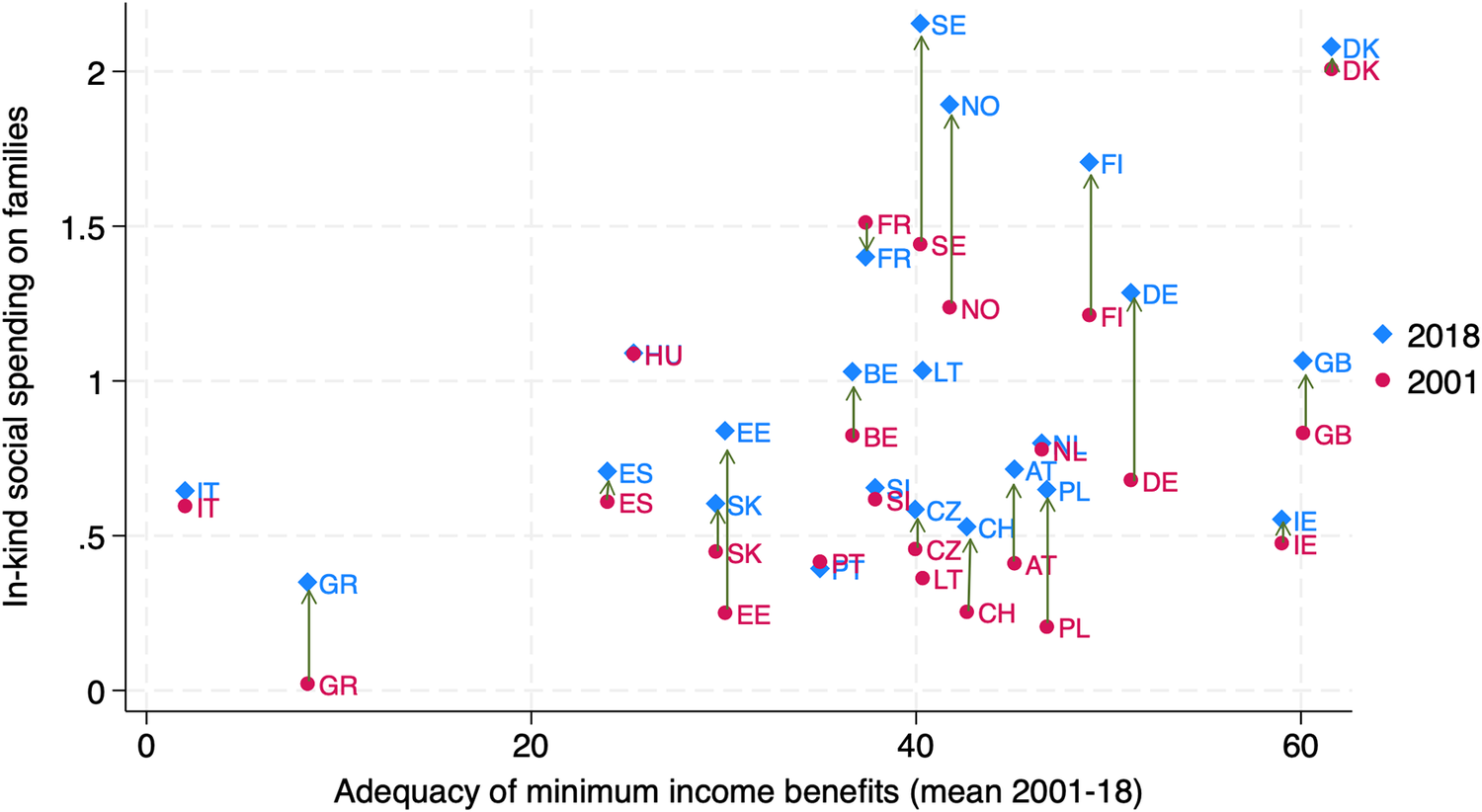
To understand the policy context for families, Figure 4 presents the change in service provision between 2001 and 2018 and the average adequacy of minimum income benefits for families with children for each country in our sample for the years 2001–2018 (see Supplementary Appendix 2 for country-specific over-time trends in in-kind spending). Almost all countries have increased their in-kind social expenditure on families since 2001, with the Nordic countries, Poland, Estonia, and Greece having the highest increases. While minimum income benefits cover, on average, 30 to 50 per cent of the median income in most countries, those that have expanded family services have also provided higher minimum income benefits.
In-kind social spending for families in 2001 and 2018 by the overall adequacy of minimum income benefits.

Figure 4. Long description
A scatter plot with the x-axis labeled Adequacy of minimum income benefits (mean 2001-18) ranging from 0 to 60, and the y-axis labeled In-kind social spending on families ranging from 0 to 2. A legend on the right indicates blue diamonds for 2018 and pink dots for 2001. Green arrows connect the 2001 and 2018 data points for each country, indicating the direction of change.
Moving from left to right along the x-axis:
* I T: Minimal change, both points near x=2, y=0.6.
* G R: Significant increase from y=0 to y=0.35 at x=8.
* E S: Slight increase at x=24.
* H U: Single point for 2001 at x=25, y=1.1.
* S K: Increase from y=0.45 to y=0.6 at x=30.
* E E: Large increase from y=0.25 to y=0.85 at x=31.
* P T: Slight decrease at x=35.
* B E: Increase from y=0.8 to y=1.0 at x=36.
* S I: Slight increase at x=38.
* F R: Slight decrease from y=1.5 to y=1.4 at x=38.
* S E: Large increase from y=1.45 to y=2.15 at x=40.
* C Z: Increase from y=0.45 to y=0.6 at x=40.
* L T: Large increase from y=0.35 to y=1.05 at x=40.
* N O: Large increase from y=1.25 to y=1.9 at x=41.
* C H: Increase from y=0.25 to y=0.5 at x=43.
* A T: Increase from y=0.4 to y=0.7 at x=45.
* N L: Single point for 2018 at x=46, y=0.8.
* P L: Increase from y=0.2 to y=0.65 at x=47.
* F I: Increase from y=1.2 to y=1.7 at x=49.
* D E: Increase from y=0.7 to y=1.3 at x=51.
* I E: Slight increase at x=59.
* G B: Increase from y=0.85 to y=1.05 at x=60.
* D K: Slight increase from y=2.0 to y=2.1 at x=62.
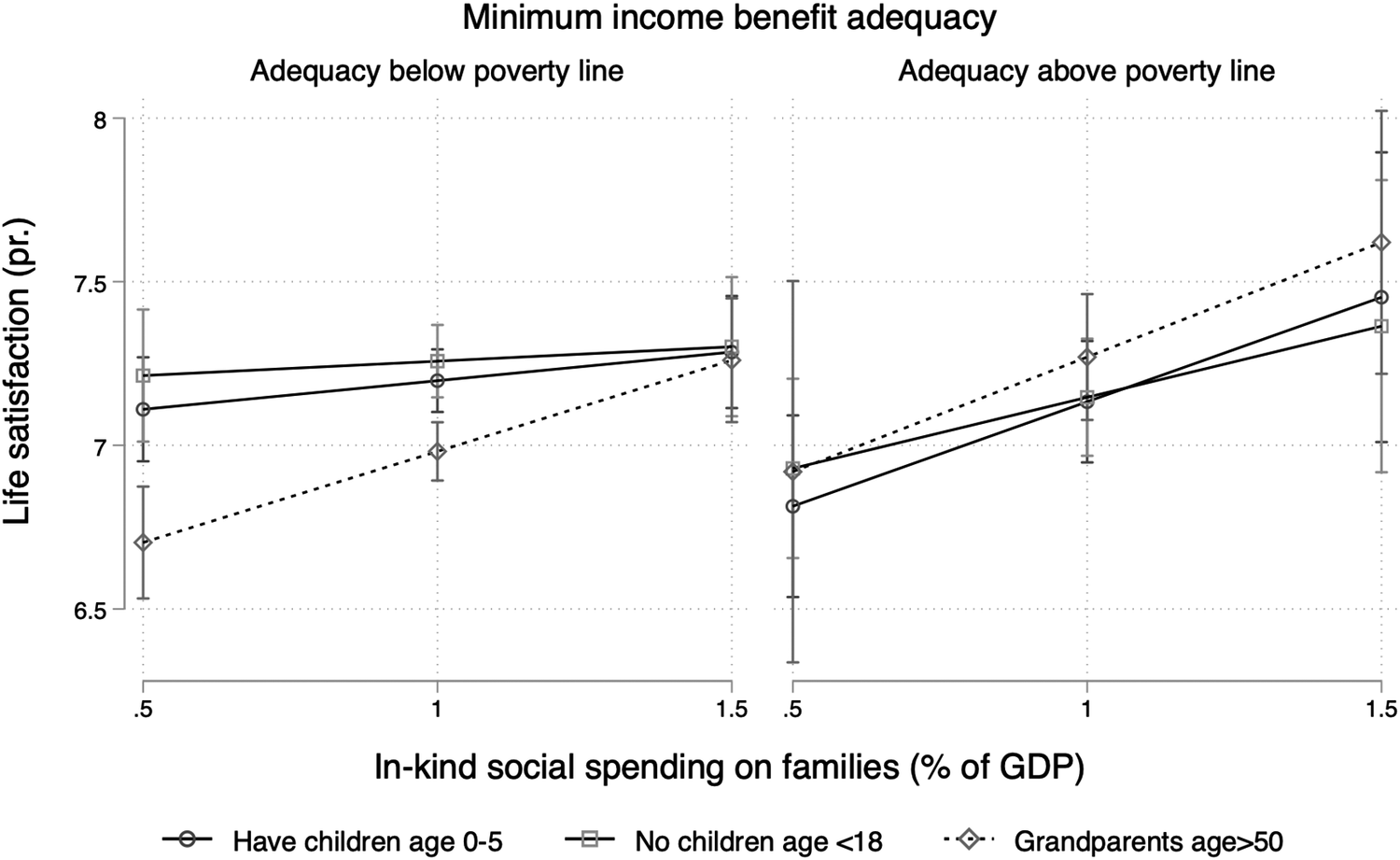
Using the time-varying annual information on the policies, Figure 5 shows how the volume of in-kind social expenditure on families is associated with life satisfaction among different target groups, based on whether the adequacy of minimum income benefits for families is below or above the poverty line. The results demonstrate that higher spending on family services has a stronger positive association with life satisfaction when and where minimum income benefits are sufficient to sustain livelihoods. This seems to apply to all target populations: parents of small children, young adults without children, and grandparents, indicating positive policy complementarities on life satisfaction returns more generally. Hence, direct signalling and diffusion mechanisms are found in relation to how family care policies influence subjective well-being. In contexts of insufficient minimum income protection, only grandparent life satisfaction is positively associated with higher family service provision, suggesting that the third-order diffusion effect of childcare services alone is alleviating care responsibilities and, in turn, also promoting greater life satisfaction of grandparents.
The association between family services and life satisfaction across family populations, by adequacy of minimum income benefits.

Figure 5. Long description
The graph consists of two side-by-side panels sharing a Y-axis of Life satisfaction (pr.) ranging from 6.5 to 8, and an X-axis of In-kind social spending on families (% of G D P) with values at .5, 1, and 1.5.
Left Panel: Adequacy below poverty line.
* Have children age 0-5 (circle marker): Starts at 7.1 and shows a slight linear increase to 7.3.
* No children age < 18 (square marker): Starts at 7.2 and remains relatively flat, ending at 7.3.
* Grandparents age > 50 (diamond marker, dashed line): Starts lowest at 6.7 and shows a steep linear increase to 7.25, converging with the other groups at the 1.5 spending level.
Right Panel: Adequacy above poverty line.
* Have children age 0-5: Starts at 6.8 and increases to 7.45.
* No children age < 18: Starts at 6.9 and increases to 7.35.
* Grandparents age > 50: Starts at 6.9 and shows the steepest increase, ending highest at 7.6.
All data points include vertical error bars. In both panels, higher social spending correlates with higher life satisfaction, with the most pronounced positive trend seen in the Grandparents group.
Policy complementarities of old-age care policies on life satisfaction (RQ3)
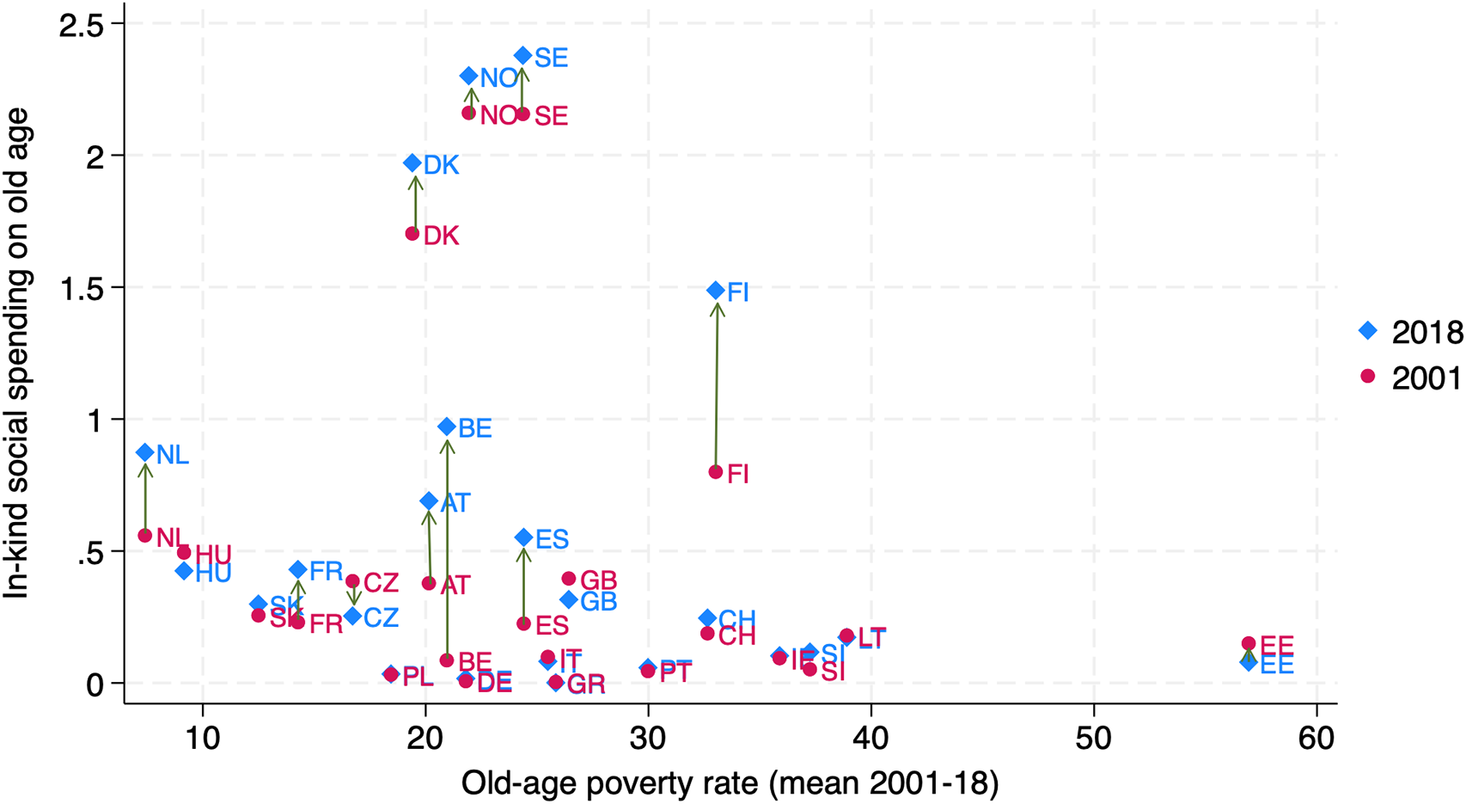
Next, we analyse the policy complementarities of old-age care on life satisfaction. Figure 6 displays the change in in-kind social spending on old age from 2001 to 2018 and the average old-age poverty rate (reflecting the sufficiency of pension systems) across countries (see Supplementary Appendix 2 for country-specific over-time trends in in-kind spending). Alarmingly, many countries have a high average poverty risk among older persons across our observation period. As in the case of family services, Nordic countries are in the lead in in-kind spending in 2001 and have further expanded them thereafter, but Austria and Belgium have also experienced noteworthy expansions in old-age service spending.
In-kind social spending for old age in 2001 and 2018 by the overall poverty rate among the older population.

Figure 6. Long description
A scatter plot with the x-axis representing the Old-age poverty rate mean 2001-18, ranging from 10 to 60. The y-axis represents In-kind social spending on old age, ranging from 0 to 2.5. Data points are marked with red circles for 2001 and blue diamonds for 2018. Green arrows indicate the direction of change between the two years.
* At the far left, N L shows an increase in spending from approximately 0.6 to 0.9 while poverty remains low around 8.
* D K shows a significant increase in spending from 1.7 to 2.0 with poverty around 19.
* N O and S E are clustered at the top, with spending increasing from 2.2 to 2.4 and poverty rates between 22 and 25.
* F I shows a sharp vertical increase in spending from 0.8 to 1.5 with a poverty rate near 33.
* B E and A T show moderate increases in spending from near 0.1 and 0.4 respectively to 1.0 and 0.7, with poverty rates around 20-22.
* E S shows an increase from 0.2 to 0.5 with poverty near 25.
* Several countries including H U, S K, F R, C Z, P L, D E, G B, I T, G R, P T, C H, I E, S I, L T, and E E are clustered at the bottom of the graph with spending levels below 0.5 across the entire poverty rate spectrum from 10 to 58.
* E E has the highest poverty rate at approximately 57 with spending remaining near zero.
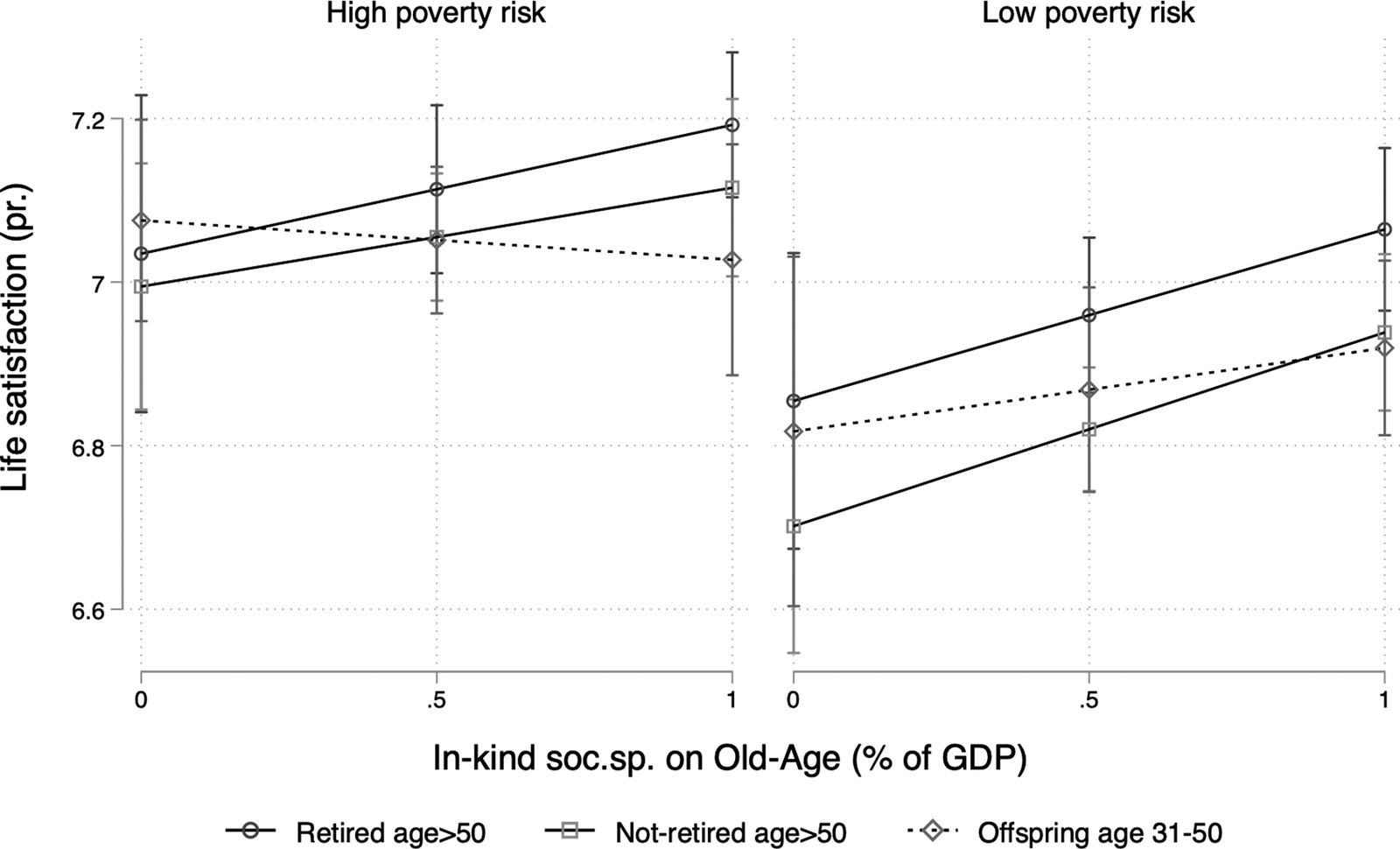
Figure 7 presents the results on the association between old-age services and life satisfaction between retired, not retired, and offspring in contexts (country-years) with high (over 20 per cent at a single time point; USDA, 2022) and low old-age poverty risk. The results show that higher spending on in-kind old-age services is positively associated with life satisfaction among all individuals over 50 years of age, independent of the old-age poverty risk. This indicates that capacitating old-age services can promote individual life satisfaction both through first-order direct influence and second-order signalling mechanisms. The positive association is also found among offspring, but only in low poverty contexts, suggesting that the third-order diffusion effect of old-age services may occur once the financial situation of their parents is secured. While the result of higher predicted life satisfaction in contexts of high poverty risk may initially seem strange, this may be because, on average, women have higher life satisfaction, and women’s old-age poverty rate is much higher than that of older men. Therefore, the “high poverty context” may predominantly refer to older women, who also have higher life satisfaction.
The association between old-age services and life satisfaction among different demographic groups in high and low old-age poverty risk contexts.

Figure 7. Long description
The graph consists of two side-by-side panels. The Y-axis represents Life satisfaction (pr.) ranging from 6.6 to 7.2. The X-axis represents In-kind soc.sp. on Old-Age (% of G D P) with values at 0, .5, and 1. A legend at the bottom identifies three groups: Retired age > 50 (solid line with circles), Not-retired age > 50 (solid line with squares), and Offspring age 31-50 (dashed line with diamonds).
* Left Panel (High poverty risk): The Retired age > 50 group shows a linear increase from approximately 7.03 to 7.19. The Not-retired age > 50 group shows a linear increase from 7.0 to 7.12. The Offspring age 31-50 group shows a slight downward trend from 7.08 to 7.03.
* Right Panel (Low poverty risk): All three groups show a positive linear correlation. The Retired age > 50 group increases from 6.85 to 7.07. The Not-retired age > 50 group increases from 6.7 to 6.94. The Offspring age 31-50 group increases from 6.82 to 6.92.
Vertical error bars are present for every data point across both panels.
Conclusions
This paper studies how social investment policies are associated with subjective well-being across European welfare states. By examining the policy complementarities of in-kind social spending and adequacy of income protection buffers on life satisfaction, this paper provides ample empirical evidence on the capacitating portent of social investment. In particular, our results demonstrate that, overall, the higher investments in capacitating services are found to promote individual life satisfaction to a greater extent where and when income protection is at sufficient levels.
By focusing on critical life stages where care services are crucial for well-being, namely family life and old age, we have also been able to infer that exemplary social investment services, childcare and old-age care, positively influence well-being beyond financial support for families and pension provision. As capacitating services also signal possible future support mechanisms, they are found to be associated with higher life satisfaction among prospective parents and older people yet to be retired. In addition, due to the services alleviating the informal care burden of other family members, they also incur a wider well-being influence outside these target groups, particularly of grandparents.
Family support is found to have a general positive influence on individuals’ life satisfaction across different demographic groups. The results demonstrate that the capacitating influence of family services on subjective well-being seems to be contingent on the adequacy of minimum income protection in regard to both the first-order direct effect among parents with small children and the second-order signalling effect among young adults without underage children. This is in line with findings on fertility aspirations, that uncertainty about available service provision and economic expectations matter in family formation decision-making (Vignoli et al., Reference Vignoli, Bazzani, Guetto, Minello, Pirani and Schoen2020). With the long-term orientation of social investment policies enhancing the resilience and capabilities of individuals, the positive influence of family support on those with no children (although in fertile age and thus possibly putting at risk the transition to family formation) can be seen in terms of mitigating such uncertainties. However, this positive second-order signalling effect for future fertility transitions is weak if income protection for families is insufficient. Furthermore, family support intensity also seems to harbour positive life satisfaction returns among grandparents. This positive influence of family services, as a third-order diffusion effect, among grandparents, seems to operate, in addition to a complementary influence between in-kind provision and income protection, also as a compensatory element on grandparents’ subjective well-being in contexts where minimum income benefits for families are insufficient.
Old-age policies are also found to be associated with positive subjective well-being returns to in-kind policy spending and pension adequacy. The main positive policy complementarities are found among older individuals, both retired and non-retired individuals. This positive association is found independent of whether the general adequacy of pensions is able to alleviate poverty at the societal level. In other words, higher old-age in-kind social policy spending also in contexts of low old-age poverty risks does yield positive life satisfaction among all older people, providing support for our theoretical mechanisms of first-order direct effect and second-order signalling effect of policies. The intergenerational care alleviation through elderly care provision, on the other hand, does not seem to be associated with positive subjective well-being of younger cohorts to the same extent. Only a weak association with higher in-kind old-age provision is observed among offspring in settings where old-age poverty is low. The weak third-order diffusion effect among offspring can be due to prevailing public discourses on the adequacy of pensions as the main provider of well-being for older people, while the debate on active ageing and elderly care has yet to become salient. Active ageing policies today largely focus on flexible retirement instead of services, and access to old-age care services is still very dependent on the financial resources of the older person in many countries (Abbing et al., Reference Abbing, Suanet and van Groenou2021).
All in all, given that spending on in-kind family policies is threefold compared to in-kind old-age spending, our findings indicate a strong and positive connection to family care provision and a positive but slightly smaller association with old-age care services. More significantly, we find that greater provision of public childcare elevates the subjective well-being of all demographic groups beyond the principal target population. A common feature across these two life stages surely is the presence of positive policy complementarities between services and income protection. Throughout, our results thus vindicate Esping-Andersen’s, Reference Esping-Andersen and Esping-Andersen2002 inference that effective social investment is contingent on strong safety nets, underscoring, once more, that compensating social protection and capacitating social services work best in tandem across twenty-first-century European welfare states.
In a life-course perspective, the overall objective of social investment policy complementarities between stocks, flows, and buffers is to make the critical life-course transitions effectively less risky and consequently less stressful. Most research on social investment has focused on how policy complementarities affect material conditions of employment, poverty, and fiscal sustainability at the macro-level (Plavgo and Hemerijck, Reference Plavgo and Hemerijck2020; Bakker and Van Vliet, Reference Bakker and Van Vliet2022). Our findings support the expectation that effective social investment complementarities, incorporating both services and income protection, also garner positive subjective well-being and life satisfaction. Apparently, even indirect exposure to social investment policies, outside of the population for whom the policy is designed, given their life-course situation, seems appreciative of social investment policy provision. This finding should give pause to policy-makers wishing to improve trust in advanced European democracies in times of growing political polarisation.
With the deliberate intent of social investment to enhance capacities, agency and control across important life-course transitions, our study highlights the subjective well-being outcomes as a result of successfully supporting people to navigate critical life-course transitions, beyond the material outcomes.
Supplementary material
The supplementary material for this article can be found at http://doi.org/10.1017/ics.2026.10100.
Acknowledgements
The authors thank the members of the WellSIre project for discussions and support. The authors send gratitude to the participants who provided fruitful comments and feedback for the earlier versions of this article in the European Population Conference 2024, the INVEST Conference 2024, and the Social Investment Working Group at the European University Institute.
Funding statement
This research was funded by the WellSIre project (European Research Council under the European Union’s Horizon 2020 research and innovation programme, grant agreement No 882276) and the INVEST Research Flagship Centre (Research Council of Finland, decision number: 345546).
Competing interests
The authors declare none.


 Open access

