Introduction
In contrast to the wealth of literature on workplace bullying, relatively little research has investigated the newer issue of cyberbullying in the workplace. Initial investigations of the topic have focused primarily on establishing prevalence rates, which varies considerably from approximately 3% (Gardner et al., Reference Gardner, O'Driscoll, Cooper-Thomas, Roche, Bentley, Catley and Trenberth2016) up to 46% when accounting for single instances (Farley, Coyne, Sprigg, Axtell, & Subramanian, Reference Farley, Coyne, Sprigg, Axtell and Subramanian2015). However, with notable exceptions (see, e.g., Blizard, Reference Blizard2015; D'Cruz & Noronha, Reference D'Cruz and Noronha2013, Reference D'Cruz and Noronha2014) in-depth target experiences of workplace cyberbullying remains comparatively under-researched. Thus, while there is some understanding of its magnitude, relatively little is known about the context and dynamics of cyberbullying and its impact on those who experience it. Such a gap will also have implications for the further development of theoretical frameworks to advance evidence-based preventative practices.
The need for context-specific research has long been recognised by scholars as valuable in providing significant insights for theory and practice, for both novel and existing issues (Galvin, Reference Galvin2014). Since workplace bullying and cyberbullying are social phenomena (Festl, Scharkow, & Quandt, Reference Festl, Scharkow and Quandt2014; Gaffney, Demarco, Hofmeyer, Vessey, & Budin, Reference Gaffney, Demarco, Hofmeyer, Vessey and Budin2012), understanding the social context within which cyberbullying occurs remains key in developing effective prevention and intervention programmes (Crosslin & Golman, Reference Crosslin and Golman2014; Machackova & Görzig, Reference Machackova and Görzig2015), especially since the two forms of bullying often co-occur (Privitera & Campbell, Reference Privitera and Campbell2009). This overlap between workplace bullying and cyberbullying becomes particularly important in industries and professions that already report high rates of workplace bullying, such as nursing (Bentley, Catley, Cooper-Thomas, Gardner, O'Driscoll, & Trenberth, Reference Bentley, Catley, Thomas, Gardner, Driscoll and Trenberth2009; Spector, Zhou, & Xin Xuan, Reference Spector, Zhou and Xin Xuan2014).
We believe the nursing profession presents a unique and compelling context to examine the issue of workplace cyberbullying. Firstly, the ethical and professional values of care and nonmaleficence (Gaffney et al., Reference Gaffney, Demarco, Hofmeyer, Vessey and Budin2012; Matt, Reference Matt2012) underpinning nursing contrast starkly to the high rates of workplace bullying reported in the profession compared to other healthcare workers (Bentley et al., Reference Bentley, Catley, Thomas, Gardner, Driscoll and Trenberth2009; Quine, Reference Quine2001). Second, reported rates of workplace bullying are particularly high for graduate nurses and new entrants into the workforce (Berry, Gillespie, Gates, & Schafer, Reference Berry, Gillespie, Gates and Schafer2012; Gaffney et al., Reference Gaffney, Demarco, Hofmeyer, Vessey and Budin2012). With an increase in nurses under the age of 30 entering the workforce (New Zealand Nurses Organisation [NZNO], 2016), this group may therefore be at an elevated risk of experiencing and perpetuating workplace cyberbullying, since current and future cohorts may already be engaging with online social media cultures and behaviours that pose potential risks to organisations and the profession more generally. Indeed, a review of the cyberbullying literature (Watts, Wagner, Velasquez, & Behrens, Reference Watts, Wagner, Velasquez and Behrens2017) has indicated a trend of cybervictimisation and perpetration occurring throughout a person's lifetime, with the authors arguing that young adults may continue these behaviours into the workplace. Given the negative outcomes associated with workplace bullying more broadly, and the estimated £2.281 billion cost per annum of bullying and harassment to the United Kingdom's National Health Service (Kline & Lewis, Reference Kline and Lewis2019), the issue of workplace cyberbullying in nursing warrants urgent addressing for ethical and business reasons, in order to develop a healthy and sustainable workforce in a profession crucial to the wellbeing of the wider community (Stanley, Reference Stanley2010).
In this paper, we extend research on cyberbullying by proving an in-depth examination of eight cases of cyberbullying within the nursing profession. In doing so, we provide a detailed account of the context and dynamics drawn from the experiences of individuals from a key sector of the workforce. Our paper therefore aims to make two contributions: (1) a specific contribution to the growing workplace cyberbullying literature by focusing on nurses' experiences of cyberbullying; (2) a theoretical contribution via the development of a typology of cyberbullying on the basis of its perceived source. Our hope is that the provision of such a typology will drive further theory development and empirical research on this issue.
Literature Review
Workplace cyberbullying
Although the literature remains divided on whether workplace cyberbullying is simply an electronic extension of ‘traditional’ or ‘face-to-face’ bullying behaviours (Beran & Li, Reference Beran and Li2005; Kowalski & Limber, Reference Kowalski and Limber2013) or a unique phenomenon (Dooley, Cross, & Pyżalski, Reference Dooley, Cross and Pyżalski2009), it has been argued that a context-specific definition of workplace cyberbullying may be more helpful than striving for a universally-applicable one (D’Souza, Forsyth, Tappin, & Catley, Reference D'Souza, Forsyth, Tappin and Catley2018). Central to this argument is the notion that meanings of social phenomena are not fixed and different groups may share different understandings of workplace bullying (Lewis, Reference Lewis2006). Indeed, Lewis (Reference Lewis2006) notes that even within a specific professional group like nursing, nurses' and managers' definitions may vary. Further, lay definitions of workplace cyberbullying often differ from academic ones (Nocentini, Calmaestra, Schultze-Krumbholz, Scheithauer, Ortega, & Menesini, Reference Nocentini, Calmaestra, Schultze-Krumbholz, Scheithauer, Ortega and Menesini2010). Therefore, the following nursing-specific definition of workplace cyberbullying (D'Souza et al., Reference D'Souza, Forsyth, Tappin and Catley2018: 847) is used for this study: ‘workplace cyberbullying involves perceived unwanted or aggressive behaviour(s) perpetrated at any time through electronic media, that may harm, threaten, or demoralize the intended target(s) of this behaviour(s)’. Consistent with the literature on workplace bullying and cyberbullying, we use the term ‘targets’ to indicate that bullying behaviours are directed towards an individual, and to avoid the passive and helpless connotations often associated with the term ‘victim’ (Branch, Ramsay, & Barker, Reference Branch, Ramsay and Barker2013).
The extant research on workplace cyberbullying indicates a range of harmful impacts for targets. Compared to nontargets, targets experience: impaired psychological health (Ford, Reference Ford2013); increased mental strain (Coyne, Farley, Axtell, Sprigg, Best, & Kwok, Reference Coyne, Farley, Axtell, Sprigg, Best and Kwok2016); diminished affect, mood, and quality of social interactions (Kopecký & Szotkowski, Reference Kopecký and Szotkowski2017); more physical illnesses and sleep disorders, and poorer immune systems (Kopecký & Szotkowski, Reference Kopecký and Szotkowski2017). There may also be a gendered component to these outcomes, with women reporting worse physiological and psychological outcomes than men (Gardner et al., Reference Gardner, O'Driscoll, Cooper-Thomas, Roche, Bentley, Catley and Trenberth2016). As with workplace bullying, cyberbullying is also associated with negative organisational outcomes including diminished organisational performance (Lawrence, Reference Lawrence2015) through reduced employee productivity (Borstorff & Graham, Reference Borstorff and Graham2006; Van Gramberg, Teicher, & O'Rourke, Reference Van Gramberg, Teicher and O'Rourke2014) and job satisfaction (Baruch, Reference Baruch2005; Coyne et al., Reference Coyne, Farley, Axtell, Sprigg, Best and Kwok2016), increases in job stress (Lawrence, Reference Lawrence2015), and turnover intentions (Baruch, Reference Baruch2005; Jönsson, Forssell, Bäckström, & Muhonen, Reference Jönsson, Forssell, Bäckström and Muhonen2017). Beyond the organisational costs associated with reduced productivity and turnover, workplace cyberbullying poses risks for the organisation via negative publicity (Borstorff & Graham, Reference Borstorff and Graham2006; Cain, Reference Cain2011; Privitera & Campbell, Reference Privitera and Campbell2009), litigation, and recompense (Van Gramberg, Teicher, & O'Rourke, Reference Van Gramberg, Teicher and O'Rourke2014). Thus, workplace cyberbullying presents a serious threat to the health of both workers and the organisation.
Despite workplace cyberbullying prevalence rates being comparatively lower than those for traditional forms of bullying (Gardner et al., Reference Gardner, O'Driscoll, Cooper-Thomas, Roche, Bentley, Catley and Trenberth2016; Privitera & Campbell, Reference Privitera and Campbell2009), scholars continue to assert that certain dynamics of cyberbullying may have a more harmful and permanent impact on targets than traditional bullying (Bauman & Newman, Reference Bauman and Newman2013; Patchin & Hinduja, Reference Patchin and Hinduja2015; Tokunaga, Reference Tokunaga2010). This is largely due to cyber-specific factors such as the power dynamics associated with anonymity (Barlett, Gentile, & Chew, Reference Barlett, Gentile and Chew2014), the invasion of spatio-temporal boundaries (D'Cruz & Noronha, Reference D'Cruz and Noronha2013), and the permanence of digital content that serves to increase the scale and duration of harm to targets (Dooley, Cross, & Pyżalski, Reference Dooley, Cross and Pyżalski2009). This amplification of harm becomes even more pertinent in light of scholars' predictions that instances of workplace cyberbullying are likely to increase (D'Cruz & Noronha, Reference D'Cruz and Noronha2013; Privitera & Campbell, Reference Privitera and Campbell2009) in the absence of effective prevention and intervention efforts.
Given the recency of this workplace psychosocial hazard, it is unsurprising that the field of workplace cyberbullying has received little theoretical development (Tokunaga, Reference Tokunaga2010). While the issue has been theorised utilising models of stress responses and coping (Gardner et al., Reference Gardner, O'Driscoll, Cooper-Thomas, Roche, Bentley, Catley and Trenberth2016; Vranjes, Baillien, Vandebosch, Erreygers, & De Witte, Reference Vranjes, Baillien, Vandebosch, Erreygers and De Witte2017), and power-related concepts such as Foucault's power relations theory (Blizard, Reference Blizard2015), the power and control model (Cassidy, Jackson, & Faucher, Reference Cassidy, Jackson, Faucher, Navarro, Yubero and Larrañaga2016) and dysempowerment theory (Coyne et al., Reference Coyne, Farley, Axtell, Sprigg, Best and Kwok2016), little attention has been given to causal factors in the workplace or broader industry. Theoretical frameworks of power are particularly relevant to the nursing context since the profession remains ‘doubly oppressed through gender and medical dominance’ (Hutchinson, Vickers, Jackson, & Wilkes, Reference Hutchinson, Vickers, Jackson and Wilkes2006: 120). However, these frameworks in workplace cyberbullying research have typically been used to explain imbalances in power dynamics at the individual and dyadic level (e.g., research by Blizard [Reference Blizard2015]), rather than being applied in a more critical manner to uncover issues of power inherent in the structure and organisation of work, the nursing profession, or healthcare more broadly.
The design, organisation, and management of work are widely understood to be an influential source of potential harm and ill-treatment in the workplace (Leka, Cox, & Zwetsloot, Reference Leka, Cox, Zwetsloot, Leka and Cox2008). From this perspective, organisational factors such as leadership, job design, workloads, role clarity, and resourcing (Einarsen, Raknes, & Matthiesen, Reference Einarsen, Raknes and Matthiesen1994; Fox & Cowan, Reference Fox and Cowan2015; Leymann, Reference Leymann1996) play an important role in the manifestation of workplace bullying. This ‘work environment’ perspective has received empirical support (e.g., Bowling & Beehr, Reference Bowling and Beehr2006; Cooper-Thomas, Gardner, O'Driscoll, Catley, Bentley, & Trenberth, Reference Cooper-Thomas, Gardner, O'Driscoll, Catley, Bentley and Trenberth2013; Einarsen, Raknes, & Matthiesen, Reference Einarsen, Raknes and Matthiesen1994) and has proved a useful framework to explore workplace cyberbullying (D'Souza, Forsyth, Tappin, & Catley, Reference D'Souza, Forsyth, Tappin and Catley2017). Adopting this theoretical position, we would contend that the content and context of work is crucial to understanding workplace cyberbullying.
In light of the negative outcomes of workplace cyberbullying, and predictions of its increase, there have been calls for more qualitative context-specific investigations of this workplace hazard (Crosslin & Golman, Reference Crosslin and Golman2014; Forssell, Reference Forssell2016) to enrich the evidence base and drive theory and intervention development (Forssell, Reference Forssell2016; Gaffney et al., Reference Gaffney, Demarco, Hofmeyer, Vessey and Budin2012). While a small number of qualitative studies have provided target accounts of cyberbullying within occupational settings such as the IT industry (D'Cruz & Noronha, Reference D'Cruz and Noronha2013), call-centres (D'Cruz & Noronha, Reference D'Cruz and Noronha2014), and the tertiary education sector (Blizard, Reference Blizard2015), in-depth explorations of cyberbullying that take into consideration the specific work context remain notably under-researched. Yet, successful prevention and intervention strategies are contingent on a thorough understanding of the social context within which bullying (Hodgins, MacCurtain, & Mannix-McNamara, Reference Hodgins, MacCurtain and Mannix-McNamara2014) and cyberbullying occur (Crosslin & Golman, Reference Crosslin and Golman2014). Accordingly, the present study aims to address this gap through an exploration of the experiences of cyberbullying targets within a specific work context: the nursing profession in New Zealand. Additionally, a secondary contribution of this research is to examine the utility of the work environment perspective in understanding the dynamics of workplace cyberbullying. Since this research prioritises the social context, we provide a brief background to the nursing context before detailing the methodology.
The nursing context
Workplace bullying appears endemic in nursing, with higher-than-average prevalence rates reported within this profession both internationally (Gaffney et al., Reference Gaffney, Demarco, Hofmeyer, Vessey and Budin2012; Quine, Reference Quine2001) and in New Zealand (Blackwood, Bentley, Catley, & Edwards, Reference Blackwood, Bentley, Catley and Edwards2017; McKenna, Smith, Poole, & Coverdale, Reference McKenna, Smith, Poole and Coverdale2003). Several contextual factors that may contribute to the elevated risk of bullying in nursing have been identified. Many authors note the profession's roots in a traditionally male-dominated and hierarchy-bound medical field (e.g., Daly, Speedy, & Jackson, Reference Daly, Speedy and Jackson2014; Wright & Khatri, Reference Wright and Khatri2015; Youn Ju, Bernstein, Mihyoung, & Nokes, Reference Youn Ju, Bernstein, Mihyoung and Nokes2014). The gendered history of the profession is also noted, with the workforce being predominantly female (Stanley, Martin, Michel, Welton, & Nemeth, Reference Stanley, Martin, Michel, Welton and Nemeth2007). As a result, Hutchinson, Wilkes, Jackson, and Vickers (Reference Hutchinson, Wilkes, Jackson and Vickers2010) argue nurses have been socialised to expect and tolerate abuse from those in positions of power – such as physicians or more senior ranking nurses – within the healthcare hierarchy. In addition, organisational features of healthcare systems such as high workloads (Wright & Khatri, Reference Wright and Khatri2015), ‘tough’ cultures (Katrinli, Atabay, Gunay, & Guneri Cangarli, Reference Katrinli, Atabay, Gunay and Guneri Cangarli2010), funding shortages (Hutchinson et al., Reference Hutchinson, Wilkes, Jackson and Vickers2010), and authoritarian leadership styles (Wright & Khatri, Reference Wright and Khatri2015) may facilitate workplace environments that tolerate and perpetuate bullying, and likely, cyberbullying.
Method
Research design
This study used a qualitative semistructured interview approach to reflect the ethical considerations and exploratory nature of the research. Interviews allowed the researcher to establish a rapport with the respondent and to provide personal reassurance around issues of confidentiality and anonymity when discussing what is a personal, sensitive, and potentially distressing topic (Smithson, Reference Smithson2000). Personal interviews also mitigated any potential issues of power dynamics acting to silence target perspectives that may have occurred in a focus group setting (Smithson, Reference Smithson2000). The study design and interview guide were peer-reviewed by colleagues who had expertise in the area of workplace bullying and was further refined following feedback from a paper presented at the 10th International Conference on Workplace Bullying and Harassment in 2016. Ethical approval for the study was granted from the authors' institution.
Recruitment strategy
The study interviewed nurses in New Zealand who self-identified as targets of workplace cyberbullying after being presented with the following definition of workplace cyberbullying: ‘workplace cyberbullying involves perceived unwanted or aggressive behaviour(s) perpetrated at any time through electronic media, that may harm, threaten, or demoralize the intended target(s) of this behaviour(s)’ (D'Souza et al., Reference D'Souza, Forsyth, Tappin and Catley2018: 847). Potential participants were recruited via a flyer distributed on the authors' behalf by the New Zealand Nurses Organisation (NZNO), Nursing Council of New Zealand, College of Nurses Aotearoa and the industry publication, Nursing Review. Invitations to participate and to approve the recruitment of participants were also sought from several District Health Boards (DHBs) across New Zealand, who are typically the largest employers of nurses. Electronic flyers were distributed via mailing lists and websites, while physical copies were posted on noticeboards in participating hospitals and clinics to ensure a wide range of potential participants were reached.
Participants
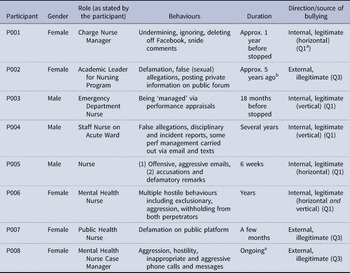
Eight nurses (three males, five females) were recruited who self-identified as having experienced workplace cyberbullying and who had been working within the profession for at least 6 months. Each nurse provided a rich and in-depth account of their experience that we have labelled a ‘case’. The term ‘case’ is used in this sense to refer to the participant's collective cyberbullying experience, with each case representing a rich and detailed source of information. The sample reflected a range of nursing roles and captured a diverse range of behaviours experienced as workplace cyberbullying (see Table 1). Further, the sample was reflective of the wider nursing workforce in New Zealand (Nursing Council of New Zealand, 2018) with most participants (n = 7) being over 30 years of age. With the exception of one participant who was engaged in an academic role, participants were direct care nurses in a variety of settings including hospitals, emergency departments, mental health services, and public health. Participants were also geographically spread across the country.
Participant experiences of workplace cyberbullying

a Source of cyberbullying is mapped onto quadrants based on typology depicted in Figure 1.
b Timeframes are provided in reference to the time at conducting the interview.
Data collection procedure
Interviews were conducted predominantly via Skype or phone calls, at the convenience of participants. This data collection strategy reflected the particularly sensitive nature of the topic, while further protecting participants' privacy, as well as facilitating a wider range of geographical access for the researchers (Oltmann, Reference Oltmann2016). Interviews were audio recorded with participants' consent and ranged from half an hour to 40 min. Participants were asked an initial open-ended question: ‘tell me about your experience of workplace cyberbullying’ which allowed participants to narrate their experiences idiosyncratically, starting at a point they believed most relevant. Follow-up questions around the features of the cyberbullying, the perpetrator(s), target and organisational response(s), and the (lack of) resolution of the incidents were asked if participants did not already provide this information. At the end of the interview, participants were given the opportunity to provide any further information they believed to be relevant to the study. A summary of the findings was later disseminated to all interviewees.
Approach to data analysis
The Framework Method of data analysis developed by Ritchie and Spencer (Reference Ritchie and Spencer2002) was utilised. This enabled an exploration of the depth and detail of each case, while simultaneously being able to extract themes across the data in the absence of making claims around saturation. The main benefit of this approach is that individual context is retained thus overcoming a key limitation of thematic analysis (Brooks, McCluskey, King, & Turley, Reference Brooks, McCluskey, King and Turley2015). Since findings are heavily grounded in the participants' original accounts, ‘any strategy or recommendations made by the researcher echo the true attitudes, beliefs, and values of the participants’ (Srivastava & Thomson, Reference Srivastava and Thomson2009: 76), enhancing the credibility of findings (Smith & Firth, Reference Smith and Firth2011) and allowing us to demonstrate methodological integrity (Levitt, Bamberg, Creswell, Frost, Josselson, & Suárez-Orozco, Reference Levitt, Bamberg, Creswell, Frost, Josselson and Suárez-Orozco2018). Using NVivo software, transcripts were analysed using procedures outlined by Ritchie and Spencer (Reference Ritchie and Spencer2002), which produced an initial analytic framework of 81 codes. The codes along with analytic memos jointly informed the development of the thematic framework (Ritchie & Spencer, Reference Ritchie and Spencer2002) reported below.
Findings and Discussion
This paper reports on three interrelated top-level themes directly relevant to the research aim of exploring nurses' experiences of workplace cyberbullying. These are: (1) targets' experiences and perceptions of workplace cyberbullying as a pattern of behaviour; (2) the wider scope of harm experienced as a result of workplace cyberbullying; and (3) the unique challenges associated with different sources of workplace cyberbullying. These themes are discussed below, followed by a section on the theoretical and practical implications of the findings. An overview of themes is presented below in Table 2.
Overview of thematic findings

Theme 1: Pattern of behaviour
This theme comprised two distinct but related subthemes relating to the nature of the participants' experiences of workplace cyberbullying within a broader pattern of bullying behaviour: (1) the co-occurrence of traditional and cyberbullying resulting in multiple victimisation for targets; (2) bullying behaviours as indicative of more widespread bullying within the organisation.
Co-occurrence of traditional bullying-type behaviours
Six of the eight participants reported the co-occurrence of both traditional bullying behaviours and cyberbullying. These behaviours ranged from being shouted at; undermined in front of other staff and within their professional networks; and receiving aggressive or rude emails and voicemails (see Table 1). However, certain behavioural patterns are worth noting.
First, exclusionary and ostracism behaviours predominantly occurred ‘offline’ through traditional interpersonal methods. In these instances, perpetrators would consistently ignore the target's presence in the workplace or behave curtly. Withholding behaviours were also common, with one participant recalling being excluded from leadership roles and additional responsibilities as well as requests for study-related leave being unreasonably denied (P06). Only one participant (P01) reported being ignored both in the physical workplace and online via ‘unfriending’ on Facebook. Furthermore, these exclusionary behaviours were often carried out indirectly or covertly and participants noted that they only found out about its occurrence ‘third-hand from other emails that [the perpetrator] sent to other people’ (P05), or through ‘the email trail’ (P01). Unfortunately, by the time the targets had become aware of this type of cyberbullying, their reputation and standing in social and professional networks had already been damaged, with the target often left feeling isolated. Experiences of isolation may be particularly intensified in team-settings – as is common in nursing – and can lead to expulsion from work life and the workplace, more generally (Glambek, Skogstad, & Einarsen, Reference Glambek, Skogstad and Einarsen2014). Participant P01, for example, recounted an experience during an interorganisational meeting: ‘I don't know if it's paranoia, but I sort of felt that people were going [disrespectful look] and I felt “well what?!”’.
Secondly, beyond the negative content of these communications, several participants recalled being informed of work-related information and disciplinary warnings via inappropriate communication channels such as text messages. Previous research has found that nurses often perceive the use of texts to communicate work-related information as highly inappropriate (D'Souza et al., Reference D'Souza, Forsyth, Tappin and Catley2018), preferring instead that work-related issues, particularly around performance, are communicated in-person. It is possible that nurses prefer a more rigid separation between their work and personal lives, in which case any perceived invasion of these boundaries is likely to result in work–life conflict and possibly lead to burnout (Wright et al., Reference Wright, Abendschein, Wombacher, O'Connor, Hoffman, Dempsey and Shelton2014). A related subtheme ‘invasion of boundaries’ (theme 2) further discusses the harm resulting from such cyberbullying behaviours.
Lastly, it was noted that electronic performance record systems were often misused to create and build a file against targets based on their (apparent) errors and wrong doings. In these cases, targets believed that this was covert cyberbullying occurring under the guise of performance management, and that electronic systems facilitated the ease of this. Participant P03 detailed:
‘It was a sort of wider thing with the appraisal… it sort of was being put on an electronic file, because of what I was doing and what I wasn't doing, and how I wasn't doing it right, and you know, I was never gonna please [perpetrator]’.
Another participant described how the perpetrators had ‘concocted untrue stories about me and made me go to a disciplinary, and now I've got a disciplinary against me’ (P04). Distinguishing between bullying and legitimate performance management continues to remain a challenge within the nursing profession and elsewhere generally, particularly when performance management practices can frequently be misused to condone bullying behaviours (Hutchinson, Vickers, Jackson, & Wilkes, Reference Hutchinson, Vickers, Jackson and Wilkes2015).
Thus, paradoxically, although ‘digital evidence’ can be helpful in reporting cyberbullying (D'Cruz & Noronha, Reference D'Cruz and Noronha2013), this same ‘evidence’ can also be misused by perpetrators exploiting their position in organisational ‘hierarchies of power’ and hiding ‘their abusive behaviour and activities within legitimate organisational routines and processes’ (Hutchinson et al., Reference Hutchinson, Vickers, Jackson and Wilkes2006: 122). In this way, bullying can be used as a tool to ‘manage out’ employees (Hutchinson et al., Reference Hutchinson, Vickers, Jackson and Wilkes2006; Salin, Reference Salin2003a). Much has also been written about management colluding – intentionally or unintentionally – with perpetrators (Jackson, Clare, & Mannix, Reference Jackson, Clare and Mannix2002; Leymann, Reference Leymann1996) thereby creating further harm for targets (Lutgen-Sandvik, Reference Lutgen-Sandvik2003) through organisational sequestering (Thirlwall, Reference Thirlwall2015) or secondary victimisation (Halder & Jaishankar, Reference Halder and Jaishankar2011). Organisational sequestering refers to the ways in which management inaction can further perpetuate bullying (Thirlwall, Reference Thirlwall2015), thus prolonging the process of victimisation (secondary victimisation) and trauma for targets (Halder & Jaishankar, Reference Halder and Jaishankar2011).
Overall, this finding reinforces what is frequently reported in the cyberbullying literature that a target is likely to be experiencing both forms of traditional and cyberbullying behaviours (Coyne et al., Reference Coyne, Farley, Axtell, Sprigg, Best and Kwok2016; Gardner et al., Reference Gardner, O'Driscoll, Cooper-Thomas, Roche, Bentley, Catley and Trenberth2016; Privitera & Campbell, Reference Privitera and Campbell2009). Multiple victimisation (Raskauskas, Reference Raskauskas2010) creates an increased risk of harm for individuals, and previous research on polyvictimisation in children (Finkelhor, Ormrod, & Turner, Reference Finkelhor, Ormrod and Turner2007; Mishna, Reference Mishna2012) indicates the negative effects may be cumulative. The finding also highlights the complexities in demarcating and labelling experiences of workplace bullying from cyberbullying for both targets and those involved in its management and intervention. Raskauskas (Reference Raskauskas2010), for instance asks: do most of the bullying need to occur via Information and Communication Technologies and Devices (ICTDs) to be labelled as cyberbullying? Stoll and Block (Reference Stoll and Block2015) highlight the fact that gender, race, and sexuality can interact in dynamic ways for cyberbullying; hence the risk and experience of cyber victimisation may be largely dependent on intersectionality across different demographic groups (Mishna, Reference Mishna2012).
While such questions have practical and theoretical implications, they also pose legal challenges. In New Zealand, harassment is covered by the Harassment Act (1997), Human Rights Act (1993), and Employment Relations Act, No 24 (2000); the Harmful Digital Communications Act, No 63 (2015) addresses cyberbullying, whilst traditional workplace bullying remains largely covered under the blanket requirement for employers to minimise hazards at work (Health and Safety at Work Act, No 70, 2015). Legal options include both civil and criminal proceedings with each piece of legislation having different requirements, burdens of proof, remedies, and punishments. This finding therefore opens up further lines of inquiry for future research.
Other targets involved
Across all eight cases, participants not only noted the presence of other targets within the organisation(s), but that the perpetrator(s) often had a history of engaging in hostile or abusive behaviours. This perceived pattern was evident for cyberbullying perpetrated from sources both within and external to the organisation, indicative of the idea that experiences of workplace cyberbullying are embedded in a broader pattern of bullying behaviours. Most commonly, other targets included the participants' coworkers (nurses) who were in a similar role and position, with the perpetrator in a more senior role with greater positional power or authority. Participant P03 mentioned that, in their organisation, bullying was occurring to ‘probably two-thirds of nurses’ as well as to clerical staff, and that the perpetrator – the participant's manager – was also ‘in cahoots with her manager’. Participant P06 also alluded to medical dominance, often noted in the nursing literature (Jackson, Clare, & Mannix, Reference Jackson, Clare and Mannix2002; Youn Ju et al., Reference Youn Ju, Bernstein, Mihyoung and Nokes2014):
‘It [bullying] is still going on. Even the doctors still try to rule out what nurses say and have their say first and … there's still a bit of that happening. Maybe there's less of it now, than what there used to be’.
That participants were aware of workplace cyberbullying and bullying being a wider issue within their organisation speaks to the ‘normalisation’ of such behaviour within the nursing profession and broader healthcare sector (Hutchinson et al., Reference Hutchinson, Wilkes, Jackson and Vickers2010), as well as the ineffective prevention and management of the issue by organisations. P06 continued: ‘they have policies [but] they're not true to them, if you know what I mean. They're just there verbally, but the bullying's still happening’. Similarly, participant P04 alleged several members of the senior management team as being complicit in the bullying and cyberbullying they were experiencing, echoing the notion of endemic bullying in nursing (Hutchinson et al., Reference Hutchinson, Vickers, Jackson and Wilkes2006, Reference Hutchinson, Vickers, Jackson and Wilkes2015).
An organisational culture tolerant of bullying can also encourage witnesses to engage in similar behaviours to function and get ahead in the workplace, or to turn a blind eye in order to avoid being targeted themselves (Paull, Omari, & Standen, Reference Paull, Omari and Standen2012). In fact, although participant P03 was aware of bullying occurring within the organisation, they only became a target once they decided to intervene on behalf of three other nurses who were being bullied and had approached them for help. Reflecting on this experience, the participant (P03) noted that in the future they would support targets but not necessarily speak up on their behalf. Thus, such work environments can disincentivise and prevent witnesses from intervening (Cleary, Hunt, & Horsfall, Reference Cleary, Hunt and Horsfall2010), which further perpetuates a culture of bullying (Paull, Omari, & Standen, Reference Paull, Omari and Standen2012).
Together, the broader pattern of bullying behaviour and the presence of other targets are symptomatic of organisational factors that facilitate workplace bullying. In fact, research by Hutchinson et al. (Reference Hutchinson, Wilkes, Jackson and Vickers2010) directly links organisational factors and the high rates of traditional workplace bullying within nursing, suggesting that individual-level factors related to perpetrator disposition may be less relevant. In this way, our findings provide some support for the fact that workplace cyberbullying – like traditional bullying – should be examined as an issue with the broader work system itself, rather than as an interpersonal problem. Aside from the harmful impacts on the target and organisation, witnesses of such bullying may also experience similar negative outcomes (Cooper-Thomas, Bentley, Catley, Gardner, O'Driscoll, & Trenberth, Reference Cooper-Thomas, Bentley, Catley, Gardner, O'Driscoll and Trenberth2014; Hoel & Cooper, Reference Hoel and Cooper2000) and perceive a poor work environment (Skogstad, Torsheim, Einarsen, & Hauge, Reference Skogstad, Torsheim, Einarsen and Hauge2011). This is particularly concerning with workplace cyberbullying, given the ease and breadth with which online content can be shared.
Theme 2: Wider scope of harm
This second theme reflects the potentially broader and more harmful impact of workplace cyberbullying. The impact of the cyberbullying itself varied with the nature and severity of the behaviours, reflecting academic notions of bullying (Lutgen-Sandvik, Tracy, & Alberts, Reference Lutgen-Sandvik, Tracy and Alberts2007) and cyberbullying (Langos, Reference Langos2014) as a continuum. Unsurprisingly, those participants who experienced less severe behaviours tended to describe milder feelings of irritation and annoyance, while those experiencing more severe behaviours tended to be impacted more profoundly. With the latter, respondents described: ‘the sadness of having people not talk back to you’ (P06); feeling increasingly ‘paranoid towards the end’ (P01); ruminating over the cyberbullying to the point where it was ‘destroying’ them (P03); and ‘trying to escape’ (P04). Although most targets experienced a combination of cyberbullying and traditional bullying behaviours – making it impossible to isolate the effects of each form of bullying in this study – two key features of cyberbullying were consistently perceived to be more harmful for both targets and organisations involved – (1) an invasion of boundaries and (2) public notoriety.
Invasion of boundaries
Cyberbullying that resulted in a breaking of work–home boundaries tended to have a particularly profound and negative impact on targets. Participant P01 expressed frustration at the intrusive nature of cyberbullying, while another (P05) recounted their annoyance at not being able to take immediate action upon receiving an intrusive email:
‘I had that email for about three days as it was over a holiday weekend, so I wasn't able to talk to my manager ‘cause she's off duty and so am I. And so it was very frustrating because I couldn't express and get that off my chest, because you're carrying that on board with you. So needless to say, you bring your work home, and those sort of issues, which isn't really helping, you know’.
At the more severe end, participant P06 recalled being afraid to come to work ‘particularly because there was two of them [perpetrators] at the same time, it was like you didn't know which room to get into to get away’, as well as being fearful of turning on their computer at home because of the abusive emails they would receive. In this way, the participant explained how cyberbullying ‘becomes your whole life… you live and breathe it right past working hours, right into your personal life’ (P06). Over a prolonged period, bullying can have harmful effects particularly on targets' coping abilities and resources (Zapf & Gross, Reference Zapf and Gross2001). Here, the participant's experience of prolonged and relentless bullying from two perpetrators simultaneously set off depression to the point where they were experiencing suicidal ideation (P06). While previous research has indicated that after-hours work-related ICTD use is associated with increased work–life conflict and burnout (Wright et al., Reference Wright, Abendschein, Wombacher, O'Connor, Hoffman, Dempsey and Shelton2014), here the breaking of work–home boundaries and the rumination becomes an added stressor on top of experiencing cyberbullying, providing further support for the argument that cyberbullying can potentially be more harmful than traditional bullying (D'Cruz & Noronha, Reference D'Cruz and Noronha2013).
Publicity of incidents
Workplace cyberbullying was particularly distressing for targets when it played out in a relatively public domain. Participant P02 recalled how their identity and contact details had been posted on a public forum falsely advertising them as a sex worker. The participant was understandably upset upon subsequently being contacted by a member of the public who had attempted to solicit them: ‘it was really distressing to think that sort of information was out there and you know, that was my name and my reputation … it can feel quite powerless to have that happen to you’ (P02). They were also distressed at the thought of their children finding out about the incidents, and concerned about the social and professional ramifications should this information come to light. This case also represented a concerning overlap between workplace cyberbullying and gender harassment, whereby women's gender and sexuality are used against them in ways that can interfere with their ‘agency, livelihood, identity, dignity, and well-being’ (Citron, Reference Citron2009: 384). Thus, aside from potentially harming their career, dignity, and well-being, posting the target's personal contact details in cyberspace creates a very real threat to their physical safety.
In addition to the harm experienced by the target, public cases of workplace cyberbullying can also have repercussions for the organisation. Public ‘naming and shaming’ poses a major risk to the organisation's reputation; particularly in smaller communities, where individual targets and businesses may be easily identifiable. Furthermore, in the case of participant P07 – a public health nurse working in a rural setting – incidents of defamatory cyberbullying on Facebook not only damaged the organisation's and the target's reputation, but also potentially jeopardised the provision of services for other schools within the community.
Overall, workplace cyberbullying appears to invade targets' work–life boundaries more profoundly and insidiously than traditional bullying, thus preventing them from escaping (D'Cruz & Noronha, Reference D'Cruz and Noronha2013) or renewing their coping resources (Hinduja & Patchin, Reference Hinduja and Patchin2008). Further, when cyberbullying occurs on a public platform, this increases the audience and consequently amplifies the harm experienced (Dooley, Cross, & Pyżalski, Reference Dooley, Cross and Pyżalski2009; Nocentini & Menesini, Reference Nocentini and Menesini2009). Unfortunately, there are also often little, or no, consequences for the perpetrator, particularly in the case of anonymous cyberbullying which can make cases difficult to resolve. This finding underscores how the wider scope of potential harm from workplace cyberbullying presents an additional challenge for organisational and legal intervention.
Theme 3: Dealing with workplace cyberbullying
The third theme explores the challenges faced by targets and organisations when trying to deal with workplace cyberbullying. Based on the analysis of the cases, we present a typology of workplace cyberbullying derived from the intersection of two key dimensions related to the perpetrator and the nature of their relationship to the organisation: (1) does the perpetrator have a ‘working’ relationship or a ‘business’ relationship with the organisation and (2) is the relationship with the organisation legitimate or illegitimate? The former dimension indicates whether the perpetrator is within or external to the organisation, while the latter reflects the extent to which the nature of the relationship is a legitimate organisational one (i.e., the interaction occurs because of the nature of the target's organisational role or there is no expected organisational reason for an interaction). This typology – depicted in Figure 1 – extends the California Occupational Health and Safety Administration's (CAL/OSHA, 1995) classification system for types of workplace violence by (a) applying it to the issue of workplace cyberbullying and (b) further distinguishing between sources within and external to the organisation. Our contention is that this typology helps to draw attention to the challenges faced by both targets and managers in trying to manage and resolve workplace cyberbullying behaviours.
Typology of workplace cyberbullying based on perpetrator's relationship (legitimate/illegitimate) and position (internal/external) within the organisation. Each ‘quadrant’ (Q1–4) refers to different sources of workplace cyberbullying

Three participants in this study experienced workplace cyberbullying from external sources with no legitimate relationship with the organisation (Q3) – a former student (P02) and relatives of clients (P07, P08). The research on workplace bullying is predominantly focused on perpetrators with a legitimate relationship (Q1 and Q2) with the organisation (Hutchinson et al., Reference Hutchinson, Wilkes, Jackson and Vickers2010), and even within this, there is less of a focus on external (Q2) perpetrators (Vessey, DeMarco, Gaffney, & Budin, Reference Vessey, DeMarco, Gaffney and Budin2009). The few studies examining abusive or aggressive behaviours from patients, clients, and customers (Q2) often label this form of ill-treatment under the broader category of patient aggression (Jackson, Clare, & Mannix, Reference Jackson, Clare and Mannix2002) or consumer-related violence (Bowie, Reference Bowie, Gill, Fisher and Bowie2002; Fevre, Lewis, Robinson, & Jones, Reference Fevre, Lewis, Robinson and Jones2012). Further, in historically female-dominated professions, women are more likely to accept negative behaviours directed towards them as ‘part of the job’ (Salin, Reference Salin2003b). Additionally, since workplace bullying involves systematic and repeated exposure to negative behaviours rather than isolated incidents (Einarsen, Hoel, Zapf, & Cooper, Reference Einarsen, Hoel, Zapf and Cooper2010), external perpetrators generally lie beyond the scope of existing organisational bullying interventions. Yet, with workplace cyberbullying, targets can be reached well beyond the physical work premises or working time, with the behaviours evident on more public platforms. It should be noted that with all cases of external workplace cyberbullying in this study, the behaviours were repeated by the same perpetrator rather than one-off incidents, with one case (P02) spanning a period of 5 years (see Table 1).
This finding highlights the susceptibility of nurses – and those in public-facing roles – to forms of workplace cyberbullying by individuals outside the organisation (Q2 and Q3). Indeed, nurses remain one of the occupational groups most at risk of experiencing violence from patients and members of the public (Bentley, Catley, Forsyth, & Tappin, Reference Bentley, Catley, Forsyth and Tappin2014; Fevre et al., Reference Fevre, Lewis, Robinson and Jones2012). While traditional approaches such as trespass notices, restraining orders, and physical safety systems may be useful in preventing face-to-face abuse, the use of ICTDs transcends traditional physical and temporal boundaries, enabling the cyberbullying of workers in complex ways. Previous research by D'Cruz and Noronha (Reference D'Cruz and Noronha2014) has shed some light on customer cyberbullying among call centre workers in India. While interactions with customers within this setting tended to be one-offs, the authors argued that the cumulative effect of being subjected to ongoing abuse could be conceptualised and experienced as repetition (D'Cruz & Noronha, Reference D'Cruz and Noronha2014). However, unlike with call centre employees, the perpetrators in this study were more familiar with the target's personal details and had substantially more contact with them due to the nature of the health services (and educational, for P02) relationship. Thus, abuse from a member of the public is likely experienced differently in one-off transactions versus when there is an ongoing relationship (Hansen, Hogh, Persson, Karlson, Garde, & Ørbæk, Reference Hansen, Hogh, Persson, Karlson, Garde and Ørbæk2006) with the potential for perpetrators to inflict a wider degree of harm on targets' careers, reputation, and personal safety. In this way, our proposed typology may offer a useful framework in understanding the differential impacts of varying sources of cyberbullying. It is also worth highlighting the transitory nature of perpetrator roles. For instance, in the case of participant P02, the workplace cyberbullying may have been more straightforward to deal with when the perpetrator was a current (Q2) rather than former student (Q3). Anonymity can also add another layer of complexity, making it difficult for the organisation to intervene effectively or hold the perpetrator accountable, while being experienced as more harmful by targets (Staude-Müller, Hansen, & Voss, Reference Staude-Müller, Hansen and Voss2012).
This finding makes a unique contribution to the literature by extending our knowledge around the complexities associated with workplace cyberbullying from external sources. Traditional approaches in classifying abusive behaviours from external sources as ‘patient aggression’ or ‘customer violence’ allow organisations to attribute such behaviour to individual-level factors such as customer personality. While such dispositional factors no doubt play a role in facilitating aggression and bullying, as indicated in theme 1, workplace cyberbullying is likely to be symptomatic of broader issues with the work system and its design (Einarsen, Raknes, & Matthiesen, Reference Einarsen, Raknes and Matthiesen1994; Leymann, Reference Leymann1996). However, patient- and customer-centred labels detract from a work system focus, and may permit organisations to absolve themselves of responsibility in managing such issues, as was common in this study. Interestingly, although healthcare organisations and the nursing profession have a number of employee guidelines for social media use, few outline pathways and resources for employees who experience cyberbullying or cyber abuse from outside the organisation.
Thus, although abusive behaviours from external sources is not a new issue for front-line staff (Fevre et al., Reference Fevre, Lewis, Robinson and Jones2012) the unique challenges associated with workplace cyberbullying – namely, constant accessibility, publicity, and anonymity – represent additional vulnerabilities for nurses and other public-facing roles. Understandably many organisations still remain unfamiliar with how to best manage and intervene this ‘unknown thing’ (P02). Unfortunately, ad hoc approaches such as attempting to placate the perpetrator financially, as in the case of participant P02, are generally unsuccessful. Likewise, organisations may also face challenges in being able to control or remove harmful content in cases of external workplace cyberbullying, particularly in light of the often tepid and delayed response from social media platforms (Lawson, Reference Lawson2018), such with Facebook's delay in taking down livestreams of the recent tragic events in Christchurch (Satherley & Wilkins, Reference Satherley and Wilkins2019). The lack of resolution around such incidents can also leave targets feeling particularly uncertain and anxious about the future. Participants noted ‘you sort of wonder what might come next’ (P07), and that they ‘wouldn't be surprised’ (P08) if the cyberbullying continued. Similar concerns about future incidents have also been highlighted among adult targets of cyberbullying (D'Cruz & Noronha, Reference D'Cruz and Noronha2013; Ford, Reference Ford2013; Rivituso, Reference Rivituso2014).
This finding also underscores the fact that cyberbullying may be more problematic ‘across organisational boundaries’ than within (Gardner et al., Reference Gardner, O'Driscoll, Cooper-Thomas, Roche, Bentley, Catley and Trenberth2016: 9). Thus, not only does external workplace cyberbullying presents yet another complicated challenge for organisations to contend with when there is a ‘legitimate’ target–perpetrator relationship (Q2), workplace cyberbullying from ‘illegitimate’ sources (Q3) – such as in this study – may provide further practical and legal challenges to timely and effective organisational intervention. Further, targets themselves may be hesitant to report such cases of cyberbullying due to perceptions of these behaviours as being either ‘part of the job’ (D'Cruz & Noronha, Reference D'Cruz and Noronha2014; Fevre et al., Reference Fevre, Lewis, Robinson and Jones2012; Salin, Reference Salin2003b) or beyond the jurisdiction of workplace procedures (Fevre et al., Reference Fevre, Lewis, Robinson and Jones2012) and therefore not of organisational concern. Nonetheless, the limited research exploring cyberbullying from external sources indicates that targets still experience similar negative outcomes such as emotional and physiological disturbances, to say nothing of the emotional labour required to subsequently continue their work and meet organisational demands (D'Cruz & Noronha, Reference D'Cruz and Noronha2014). Similarly, based on the violence literature, we can expect that target exposure to domestic cyberbullying will also likely have broader effects on the organisation through absenteeism and turnover (Fevre et al., Reference Fevre, Lewis, Robinson and Jones2012; Swanberg, Logan, & Macke, Reference Swanberg, Logan and Macke2005) as well as reduced productivity and performance resulting from job interference tactics and on-the-job harassment (Swanberg, Logan, & Macke, Reference Swanberg, Logan and Macke2005). Since workers bring their whole selves to work, existing stressors such as (domestic) cyberbullying can interact with other workplace psychosocial risks resulting in cumulative, detrimental effects (Leka, Cox, & Zwetsloot, Reference Leka, Cox, Zwetsloot, Leka and Cox2008). Thus, beyond ethical considerations, there is a strong case to be made for timely and effective organisational intervention in all forms of workplace cyberbullying (Q1–Q4). However, organisations' lack of preparedness on how to deal with such cases and the challenges with intervening effectively can have a detrimental impact on the organisation and can further contribute to the secondary victimisation of targets (Citron, Reference Citron2009; Halder & Jaishankar, Reference Halder and Jaishankar2011), while also inadvertently signalling a poor organisational climate to witnesses.
Conclusion
This study explored nurses' experiences of workplace cyberbullying in New Zealand, with a view to furthering our theoretical development and future interventions in this area. This research not only extends previous lines of enquiry around workplace bullying and nursing (Hutchinson et al., Reference Hutchinson, Vickers, Jackson and Wilkes2015), but adds to the growing knowledge around workplace cyberbullying. The findings – while situated in the nursing context – extend the existing body of evidence that workplace cyberbullying is often coexperienced with other traditional forms of bullying and indicate that such incidents are generally indicative of a wider issue of bullying within the organisation. Further, this cyberbullying can occur from sources within and external to the workplace and from those who may or may not have a ‘legitimate’ relationship with the organisation resulting in a potentially wider and more detrimental impact for targets as well as the organisations involved. The negative impact may be exacerbated by cyberbullying more readily transcending work–home boundaries or the private–public domain.
The finding that workplace cyberbullying occurs within a broader pattern of bullying behaviour suggests that factors in the workplace, and possibly the wider industry, likely contribute to the occurrence of workplace cyberbullying. This is the first study to our knowledge on workplace cyberbullying to provide empirical support for the work environment perspective (Leymann, Reference Leymann1996), and indicates similar organisational-level causal or antecedent factors for both traditional and cyber bullying in the workplace. Additionally, we also draw further attention to the compounding harm experienced by targets of polyvictimisation (Finkelhor, Ormrod, & Turner, Reference Finkelhor, Ormrod and Turner2007) and highlight the need for future research to explore whether targets of cyberbullying may experience other forms of cyber abuse concurrently. We also note the importance of using context-specific definitions of workplace cyberbullying, and suggest that future research examine the utility of the current definition used in this study with other populations and professional groups.
A key theoretical contribution of our study is our typology of the sources of workplace cyberbullying, highlighting the organisational challenges in responding effectively. In particular, continued cyberbullying from external and/or illegitimate sources is a complexity that organisations may have to contend with. Thus, such a typology may be useful in understanding the differential impacts of harm experienced as a function of the source of cyberbullying, with the implication that each type (or quadrant) may rely on different intervention strategies. Future research is required to further explore the utility and applicability of this typology across various organisational contexts.
Finally, we draw attention to the practical implications of the findings. The co-occurrence of bullying behaviours presents practical challenges around the labelling of targets' experiences of ‘workplace cyberbullying’ and ‘workplace bullying’. Whether these experiences need to be distinguished when occurring jointly may be a function of the particular legislative guidelines that pertain to these issues. In the interim, it is strongly recommended that organisations also include forms of cyberbullying into existing bullying and harassment policies and reporting channels (West, Foster, Levin, Edmison, & Robibero, Reference West, Foster, Levin, Edmison and Robibero2014). The need to include cyberbullying becomes even more apparent in light of the organisational inaction evident in this study. Although further research is required to inform effective prevention and intervention strategies; at the very least addressing cyberbullying in workplace policies acknowledges that cyberbullying is an organisational concern, regardless of whether the perpetrator is external to and/or has a legitimate relationship with the institution. While some care should be taken in transferring findings across different occupational contexts – particularly due to the smaller sample size – this study further emphasises the vulnerability of public-facing professions like nursing, while also highlighting the need for researchers and practitioners to address this growing psychosocial hazard with urgency.