

The fair allocation of provisions and supports is critical for students with disability to demonstrate their skills, knowledge, and learning during school examinations. This equitable access to educational opportunities is a requirement under the United Nations Universal Declaration of Human Rights (1948), and more recently encapsulated in the United Nations Convention on the Rights of Persons With Disability (United Nations, 2006) to which Australia is a signatory. In Australia, this human right is upheld in the Disability Discrimination Act (Commonwealth of Australia, 1992) and the associated Disability Standards for Education (Commonwealth of Australia, 2005).
Statutory bodies such as the NSW Education Standards Authority (NESA) oversee public exams (e.g., in New South Wales, the Higher School Certificate or HSC). NESA has a standardised application process that requires candidates with a disability to apply for provisions so they can participate in exams and demonstrate their understanding of content and their skills on the same basis as their peers without disability. To do this, students must provide evidence of their disability (e.g., medical documents, assessment of literacy knowledge and skills) and the way in which it affects their performance (NESA, 2014).
Provisions provided by NESA to support students with disability vary according to the students’ demonstrated and imputed needs. These provisions may include additional time, rest breaks, and readers and/or writers. The objective of these provisions is to provide an opportunity for students with disability to participate in public examinations on the same basis as their peers without a disability as required under the Disability Discrimination Act (Commonwealth of Australia, 1992) and associated Disability Standards for Education 2005 (Commonwealth of Australia, 2005). It also upholds the obligation that Australia has made as part of international declarations.
There has been growing controversy in media reports over this process. This growth in concerns has emerged in some part due to the increase in the number of students identifying with a disability in schools and progressing to the HSC. There is a perception some schools appear to use these provisions more frequently than others, and hence an inequitable allocation of resources (Arlington & Stevenson, Reference Arlington and Stevenson2011). Examples have been put forward that appear to show students who do not have the ‘right’ documentation cannot access special provisions despite school-based documentation indicating that a student with disability cannot participate on the same basis as students without disability without special provisions. In contrast, there are claims some students with limited impairment, and the ‘right’ documentation, are accessing special provisions (Bita, Reference Bita2016).
The case study reported in this paper was undertaken as part of the school’s ongoing development of processes for accessing support. Informed consent to report on this case study was obtained in writing from the school executive and from the student’s family inclusive of the student. This case study examines the impact of a physical impairment resulting from cerebral palsy on an individual’s opportunities to access an assessment and show their learning and knowledge. It demonstrates one school’s approach to collect functional evidence of the impact of cerebral palsy, and secure fair examination concessions for the student to complete the end-of-school examination (i.e., New South Wales HSC). This case study aims to assist other teachers to gain fair and equitable access to supports and provisions. This ensures that students with disability are provided with the human right to be part of their society’s educational practices and processes on the same basis as their peers without disability.
Cerebral Palsy
Cerebral palsy is a neurological impairment caused by early damage to motor control centres of the brain that affect muscle usage, tone, and coordination (Ashman, Reference Ashman2015; Bonnechère, Omelina, Jansen, & Jan, Reference Bonnechère, Omelina, Jansen and Jan2017). This often manifests as ataxia, spasticity during fine-motor tasks, and difficulties walking (Cerebral Palsy World, 2011). Cerebral palsy has been shown to negatively impact handwriting compared with those without cerebral palsy (Bumin & Kavak, Reference Bumin and Kavak2008).
Fatigue is also a major problem for individuals with cerebral palsy. It has been estimated that people with cerebral palsy use 3 to 5 times more energy than someone without cerebral palsy when performing the same task (Cerebral Palsy World, 2011) and that pain and fatigue affect them throughout the day (Malone & Vogtle, Reference Malone and Vogtle2010; Russchen et al., Reference Russchen, Slaman, Stam, van Markus-Doornbosch, van den Berg-Emons and Roebroeck2014). This was supported by a critical review of studies conducted by Brunton and Rice (Reference Brunton and Rice2012) who examined the effects of cerebral palsy. The authors concluded that cerebral palsy resulted in higher energy expenditure to complete a task compared with those who did not have cerebral palsy. Berrin et al. (Reference Berrin, Malcarne, Varni, Burwinkle, Sherman, Artavia and Chambers2007) also found that increased pain and/or fatigue significantly and negatively impacted on the school functionality of those with cerebral palsy.
Throughout their schooling, students with cerebral palsy in Australian schools may require access to reasonable adjustments so they may participate in their education on the same basis as their peers. Within the parameters of the Nationally Consistent Collection of Data on School Students With Disability (NCCD; Australian Government Department of Education, 2019), these adjustments may be established by teachers as supplementary, substantial, or extensive. These adjustments are best designed to address the functional impact a disability may have on the student participating in their education. Schools must record evidence of the adjustment for at least 10 weeks over the previous 12 months of schooling and keep data on record for at least 7 years (Australian Government Department of Education, 2019).
All students, including those with cerebral palsy, access and participate in differing national and state assessments throughout their school career (e.g., National Assessment Program – Literacy and Numeracy; end of Year 12 exams). In order for them to equitably access these assessments, provisions (e.g., additional time) need to be made to address the unique impact of their disability. In New South Wales (NSW), Australia, applications can be made for special provisions that enable students with disability to sit final secondary school examinations, the HSC, in a manner that makes the process equitable for all students. Applications for extra time and special provisions (e.g., readers, writers, toilet breaks, the ability to take food and drinks into the examination room, and rest breaks) are extensive and detailed.
Case Study
Context
The student was enrolled in a secondary school and undertaking study to complete the HSC. All adjustments to support the student’s access to assessments were recorded by the school and developed in conjunction with the student and family representative. In preparation for undertaking the Year 12 exams, the school applied for special provisions (e.g., additional time) in all formal assessments to address the functional implications of ongoing movement patterns associated with the student’s cerebral palsy (e.g., fatigue). This application included submissions from teachers, a report from a general practitioner, speech pathologist, occupational therapist, and results of the York Assessment of Reading for Comprehension – Australian Edition (GL Assessments, 2012) and South Australian Spelling Test (Westwood, Reference Westwood2005).
Despite an ongoing record of the adjustments that were made for the student over a period of more than 18 months, and the supporting documentation of differing professionals, this application for special provisions was not fully supported by NESA officers. The school, while disappointed with this decision, designed a small case study that would allow them to provide audiovisual evidence of the functional impact of the student’s disability on their ability to participate equitably in assessments. This was also not accepted by NESA as all submissions had to be written (i.e., not audiovisual in nature). The school applied behavioural observation and analysis to the audiovisual data to convert the information collected into a quantitative format.
Design
A case study design was used to investigate the impact of the target student’s impairment on their access to and participation in an examination. In using a case study design, the school was able to provide a contextualised insight into the impact of the student’s impairment on their participation in the exam (Yin, Reference Yin2018). The case was focused around the target student within one examination session. Using three randomly selected 1-minute slices of time from the 80-minute examination, the school undertook an intensive examination of the student’s behaviour. The purpose of this examination was to record valid and reliable data on the overt manifestations of their disability and draw conclusions about the impact on her test-taking behaviour.
Participant
The focus student was a 17-year-old female student with spastic/dystonic, right side hemiplegic cerebral palsy. This student had been assessed by an occupational therapist and found to experience severe spasticity, which affected her balance and walking and impaired upper limb function (i.e., reducing motor planning and coordination, muscle endurance and bilateral ability, as well as fluctuating tone in the right upper arm). It also resulted in compromised postural control and higher rates of fatigue. Anecdotally, teachers reported that this condition negatively impacted on her ability to reflect her knowledge and understanding during examinations.
Data collection and analysis
Video footage was collected showing the student undertaking an English examination. An existing adjustment in the school was for her to take examinations in a separate room to other students due to her irregular movements and tics. This student was undertaking the examination with the assistance of a school learning support officer (SLSO; teaching assistant), who wrote the answers as the student dictated her response.
This footage was retrospectively studied at three randomly selected time periods (i.e., 4 minutes into the examination, and again at 20 and 78 minutes). Each of the three clips was 1 minute in length. Two people independently examined this footage and the number of tics (i.e., the involuntary head nods and spasms of the arm) recorded. Both observers also counted the numbers of words dictated by the student during the 1-minute period. The volume of the recording was also analysed using a digital decibel reader (i.e., Decibel Meter Version 1.6) from the App Store. Eight decibel readings were taken from each 1-minute period at random intervals while the student was speaking. Inter-observer reliability, established using Pearson’s correlation coefficient, was high on the number of tics (r = 0.99) and words spoken (r = 0.83).
Discussion of Results
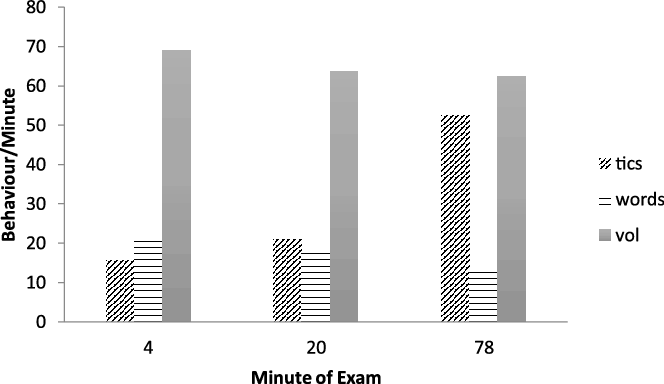
The results for each of the three measures were tabulated and the number of tics tallied. Figure 1 shows that the number of tics increased across the three 1-minute time periods. The number of tics at minute 4 had increased by more than 300% by minute 78, just prior to the end of the examination.
Mean Number of Behaviours per Minute 4, 20, and 78 Minutes Into the Examination.

The data for words per minute dictated, volume of speech at each period of time, and number of tics per minute provided evidence of the three sets of data being interrelated. The increased number of tics was associated with a corresponding decrease in the number of words translated and volume of speech.
Data collected showed that the number of words dictated decreased over the course of the examination. This trend may be found with many students with and without disability. In this context, the fatigue experienced by the student due to her impairment contributed to a reduced dictation speed limiting opportunity to participate on the same basis as her peers. The student had reduced opportunity to demonstrate her English skills and knowledge; the use of a reasonable adjustment (e.g., additional time, exam breaks) may have assisted the student in participating on the same basis as her peers.
The loss of volume was problematic, as information delivered more quietly could lead to the SLSO misunderstanding what was said, thereby negatively impacting the quality of the responses. Similarly, if the student needed to repeat the information to the SLSO due to not being heard, additional time on the task may have been lost.
The increasing numbers of tics displayed by the student throughout the examination were of concern to staff. These tics indicated fatigue (Lundy-Ekman, Reference Lundy-Ekman2013), and as the student struggled to control them, it resulted in further fatigue (Malone & Vogtle, Reference Malone and Vogtle2010; Russchen et al., Reference Russchen, Slaman, Stam, van Markus-Doornbosch, van den Berg-Emons and Roebroeck2014). The tics also constituted a major personal distraction for the student, and anecdotal evidence showed she struggled to control her movements and maintain her train of thought (Panteliadis, Reference Panteliadis2011).
This case study showed that the physical impairment (i.e., cerebral palsy) during this examination contributed to a decrease in the amount of information being dictated, the information dictated became harder to hear, and the physical effort to control muscle spasms possibly resulted in fatigue over the 80-minute period of the exam (Berrin et al., Reference Berrin, Malcarne, Varni, Burwinkle, Sherman, Artavia and Chambers2007; Russchen et al., Reference Russchen, Slaman, Stam, van Markus-Doornbosch, van den Berg-Emons and Roebroeck2014). Adjustments to the exam conditions (e.g., self-determined breaks) could assist the student to manage the demands of her impairment (e.g., tics and resulting spasms), and subsequently lower the stress created through having to complete the exam in the standard 80-minute period.
The use of video-based data provided objective data to support the position of staff that the student needed additional time compared to other students in order to participate in the assessment task. The effects of the physical impairment appeared to compound during the task with the number of tics displayed increasing over time. Resulting stress can lead to associated changes in muscle tone, which can also contribute to fatigue. Similarly, dictation skills also deteriorated. Consequently, the additional time required by the student to undertake tasks needed to be calculated in a way to accommodate the continuing deterioration of the condition rather than basing it on her rested state/condition alone.
Although a diagnosis such as cerebral palsy should not mean additional time, a much stronger process for demonstrating eligibility for special provisions in state and national examinations is needed. The context of examinations (e.g., common room for taking exams, timed conditions, the requirement to write a response) place barriers for students with impairments. Some of these contextual conditions are addressed for ‘commonly’ occurring impairments (e.g., separate room for students requiring rest breaks to address fatigue). The allocation of these special provisions or adjustments are typically based on broad and general eligibility criteria and do not take into account the unique needs of a student. In this example, the nature of the tics and its interaction with atypical movement patterns in a timed examination context requiring a written response created a complex set of needs that standardised eligibility processes could not address in an equitable manner.
The application of simple behavioural analysis of targeted behaviours shown in this case study is a process that can be applied by other schools with relative ease. Simple display of data showed conclusively the impact of the disability on those targeted behaviours, and NESA found the evidence compelling whereas declarations from healthcare professionals had been found to be insufficient. This approach could be considered for use by other schools experiencing difficulties accessing appropriate provisions for students with difficulties in formal examinations.
Collecting data on the type and level of adjustment in the Australian context is part of the NCCD (Australian Government Department of Education, 2019). Many schools may find the level of data collection and analysis used in this study beyond their means in terms of time and cost. Further school-based case studies like the one reported in this paper, however, would assist to provide educators with greater insight into how valid and reliable decisions can be made around the impact of differing adjustments across learners with a diversity of needs. It could also assist to identify an evidence base around the efficacy of differing adjustments and practices (Torres, Farley, & Cook, Reference Torres, Farley and Cook2014).
This case study highlights the importance of focusing on the functional aspects of behaviour and ongoing collection of evidence. These data, and support for adjustments, in the Australian context should be available through ongoing claims within the NCCD collection process (NSW Department of Education, 2019), and this evidence over time can contribute to the decisions being made by state and territory examination authorities to address the unique needs of students. This focus on function is in line with the principles of the United Nations Convention on the Rights of Persons With Disability (Hollenweger, Reference Hollenweger2011), and upholds the student’s right to an education set out in the United Nations Universal Declaration of Human Rights (1948).
Postscript
The functional results of this case study were added to the information submitted to the examination authority and assisted in their decision to grant the maximum time allowance (30 minutes extra per 30 minutes of examination time including rest and toilet breaks) and additional provisions (reader, writer, separate supervision, and the ability to bring in food and drink into the examination room) for all the student’s examinations. Where previous submissions, with all other information, were found to have insufficient evidence to justify the allowance of the highest levels of support in the examination, the addition of these data secured the requested allocation of provisions.
Acknowledgements
We would like to thank the student involved in this study for her involvement, and her family and the school for allowing their story to be shared. Specific thanks goes to Nic Lutton for assisting in the data collection.