


%20--%3e%3c!DOCTYPE%20svg%20PUBLIC%20'-//W3C//DTD%20SVG%201.0//EN'%20'http://www.w3.org/TR/2001/REC-SVG-20010904/DTD/svg10.dtd'%3e%3csvg%20version='1.0'%20id='Layer_1'%20xmlns='http://www.w3.org/2000/svg'%20xmlns:xlink='http://www.w3.org/1999/xlink'%20x='0px'%20y='0px'%20width='64px'%20height='64px'%20viewBox='5.5%20-3.5%2064%2064'%20enable-background='new%205.5%20-3.5%2064%2064'%20xml:space='preserve'%3e%3cg%3e%3ccircle%20fill='%23FFFFFF'%20fill-opacity='0'%20cx='37.785'%20cy='28.501'%20r='28.836'/%3e%3cpath%20fill='%23595959'%20d='M37.441-3.5c8.951,0,16.572,3.125,22.857,9.372c3.008,3.009,5.295,6.448,6.857,10.314%20c1.561,3.867,2.344,7.971,2.344,12.314c0,4.381-0.773,8.486-2.314,12.313c-1.543,3.828-3.82,7.21-6.828,10.143%20c-3.123,3.085-6.666,5.448-10.629,7.086c-3.961,1.638-8.057,2.457-12.285,2.457s-8.276-0.808-12.143-2.429%20c-3.866-1.618-7.333-3.961-10.4-7.027c-3.067-3.066-5.4-6.524-7-10.372S5.5,32.767,5.5,28.5c0-4.229,0.809-8.295,2.428-12.2%20c1.619-3.905,3.972-7.4,7.057-10.486C21.08-0.394,28.565-3.5,37.441-3.5z%20M37.557,2.272c-7.314,0-13.467,2.553-18.458,7.657%20c-2.515,2.553-4.448,5.419-5.8,8.6c-1.354,3.181-2.029,6.505-2.029,9.972c0,3.429,0.675,6.734,2.029,9.913%20c1.353,3.183,3.285,6.021,5.8,8.516c2.514,2.496,5.351,4.399,8.515,5.715c3.161,1.314,6.476,1.971,9.943,1.971%20c3.428,0,6.75-0.665,9.973-1.999c3.219-1.335,6.121-3.257,8.713-5.771c4.99-4.876,7.484-10.99,7.484-18.344%20c0-3.543-0.648-6.895-1.943-10.057c-1.293-3.162-3.18-5.98-5.654-8.458C50.984,4.844,44.795,2.272,37.557,2.272z%20M37.156,23.187%20l-4.287,2.229c-0.458-0.951-1.019-1.619-1.685-2c-0.667-0.38-1.286-0.571-1.858-0.571c-2.856,0-4.286,1.885-4.286,5.657%20c0,1.714,0.362,3.084,1.085,4.113c0.724,1.029,1.791,1.544,3.201,1.544c1.867,0,3.181-0.915,3.944-2.743l3.942,2%20c-0.838,1.563-2,2.791-3.486,3.686c-1.484,0.896-3.123,1.343-4.914,1.343c-2.857,0-5.163-0.875-6.915-2.629%20c-1.752-1.752-2.628-4.19-2.628-7.313c0-3.048,0.886-5.466,2.657-7.257c1.771-1.79,4.009-2.686,6.715-2.686%20C32.604,18.558,35.441,20.101,37.156,23.187z%20M55.613,23.187l-4.229,2.229c-0.457-0.951-1.02-1.619-1.686-2%20c-0.668-0.38-1.307-0.571-1.914-0.571c-2.857,0-4.287,1.885-4.287,5.657c0,1.714,0.363,3.084,1.086,4.113%20c0.723,1.029,1.789,1.544,3.201,1.544c1.865,0,3.18-0.915,3.941-2.743l4,2c-0.875,1.563-2.057,2.791-3.541,3.686%20c-1.486,0.896-3.105,1.343-4.857,1.343c-2.896,0-5.209-0.875-6.941-2.629c-1.736-1.752-2.602-4.19-2.602-7.313%20c0-3.048,0.885-5.466,2.658-7.257c1.77-1.79,4.008-2.686,6.713-2.686C51.117,18.558,53.938,20.101,55.613,23.187z'/%3e%3c/g%3e%3c/svg%3e)
%20--%3e%3c!DOCTYPE%20svg%20PUBLIC%20'-//W3C//DTD%20SVG%201.0//EN'%20'http://www.w3.org/TR/2001/REC-SVG-20010904/DTD/svg10.dtd'%3e%3csvg%20version='1.0'%20id='Layer_1'%20xmlns='http://www.w3.org/2000/svg'%20xmlns:xlink='http://www.w3.org/1999/xlink'%20x='0px'%20y='0px'%20width='64px'%20height='64px'%20viewBox='5.5%20-3.5%2064%2064'%20enable-background='new%205.5%20-3.5%2064%2064'%20xml:space='preserve'%3e%3cg%3e%3ccircle%20fill='%23FFFFFF'%20fill-opacity='0'%20cx='37.637'%20cy='28.806'%20r='28.276'/%3e%3cg%3e%3cpath%20fill='%23595959'%20d='M37.443-3.5c8.988,0,16.57,3.085,22.742,9.257C66.393,11.967,69.5,19.548,69.5,28.5c0,8.991-3.049,16.476-9.145,22.456%20C53.879,57.319,46.242,60.5,37.443,60.5c-8.649,0-16.153-3.144-22.514-9.43C8.644,44.784,5.5,37.262,5.5,28.5%20c0-8.761,3.144-16.342,9.429-22.742C21.101-0.415,28.604-3.5,37.443-3.5z%20M37.557,2.272c-7.276,0-13.428,2.553-18.457,7.657%20c-5.22,5.334-7.829,11.525-7.829,18.572c0,7.086,2.59,13.22,7.77,18.398c5.181,5.182,11.352,7.771,18.514,7.771%20c7.123,0,13.334-2.607,18.629-7.828c5.029-4.838,7.543-10.952,7.543-18.343c0-7.276-2.553-13.465-7.656-18.571%20C50.967,4.824,44.795,2.272,37.557,2.272z%20M46.129,20.557v13.085h-3.656v15.542h-9.944V33.643h-3.656V20.557%20c0-0.572,0.2-1.057,0.599-1.457c0.401-0.399,0.887-0.6,1.457-0.6h13.144c0.533,0,1.01,0.2,1.428,0.6%20C45.918,19.5,46.129,19.986,46.129,20.557z%20M33.042,12.329c0-3.008,1.485-4.514,4.458-4.514s4.457,1.504,4.457,4.514%20c0,2.971-1.486,4.457-4.457,4.457S33.042,15.3,33.042,12.329z'/%3e%3c/g%3e%3c/g%3e%3c/svg%3e)
In 1820, several U.S. periodicals reprinted a letter described by the National Recorder as an “interesting account of the fondness for music of an artist born deaf,” excerpted below.
Some years back, probably five or six, a young gentleman of the name of Arrowsmith … came down into this country, and resided some months in Warrington. … He was quite deaf, so as to be entirely dumb.… It will scarcely be credited, that a person thus circumstanced should be fond of music, but this was the fact in the case of Mr. Arrowsmith. He was at a gentleman's glee club … and as the glees were sung, he would place himself near some articles of wooden furniture … and would fix the extreme ends of his finger nails, which he kept rather long, upon the edge of the wood or some projecting part of it and there remain, until the piece under performance was finished, all the while expressing, by the most significant gestures, the pleasure he experienced from his perception of the musical sounds. He was not so much pleased with a solo, as with a pretty full clash of harmony; and if the music was not very good, or, I should rather say, if it was not correctly executed, he would show no sensation of pleasure. But the most extraordinary circumstance in this case is, that he was most evidently delighted with those passages in which the composer displayed his science in modulating his different keys. When such passages happened to be executed with precision, he could scarcely repress the emotions of pleasure he received within any bounds; for the delight he evinced seemed to border on ecstasy.Footnote 1
The letter, written by an Englishman named G. Chippendale and originally printed in the Bath and Cheltenham Gazette in 1818, describes how Mr. Arrowsmith enjoyed musical experiences by placing his fingernails upon objects in order to experience vibrations. Not only that, but according to Chippendale's interpretation of events (and unfortunately we do not have access to Mr. Arrowsmith's own thoughts on the matter), Arrowsmith demonstrated a sensitive and discerning understanding of the music that he was experiencing, preferring full harmonies over solos, correct execution over performances with mistakes, and modulations over single-key pieces. If printed today, Chippendale's anecdote might seem nearly as novel as it did in 1820. Why, nearly 200 years later, might the idea of deaf musical experiences remain foreign or surprising, in spite of accounts like Chippendale's?
A sampling of media headlines from the last decade on the topic of music and deafness might suggest to the average reader that DeafFootnote 2 people have only recently discovered music. For example, the following three articles were written about one man, Austin Chapman, who received new hearing aids: “What It's Like for a Deaf Person to Hear Music for the First Time,” “We Spoke to a Man Who's Been Deaf His Whole Life About Hearing Music for The First Time,” and “Deaf filmmaker truly hears music for the first time.”Footnote 3 All three articles frame Chapman's experience of music as novel, unprecedented, and achieved only through his new hearing aids. None of the interviewers asked about Chapman's musical experiences before he had his new hearing aids, or mentioned sign language music at all. An article about a woman named Jo Milne who received a cochlear implant, entitled “Formerly deaf woman hears music for the first time in 40 years—watch,” similarly frames music as something that can only be accessed through audible sound, transmitted through the technological innovation of the cochlear implant.Footnote 4
Even sign language music is often framed in terms of hearing interpreters who bring music to the Deaf community through their interpretations. Sign language interpreters like Amber Galloway Gallego, Holly Maniatty, and Linsday Rothschild-Cross have each gone “viral” for their live interpretations at concerts, where they provide a valuable and essential service for deaf concert-goers. At the same time, Deaf artists have been making music in sign language since at least 1902. Reports on sign language music interpreting often tell only part of the story of signed music and how it has developed within Deaf culture over the past century or more.Footnote 5
Members of the Deaf community have been singing, playing, signing, composing, and otherwise engaging with music for at least two centuries. Today, Deaf musicians and artists like Sean Forbes, Wawa, Signmark, Rosa Lee Timm, Jason Listman, Christine Sun Kim, Janis Cripps, Pamela Witcher, and many others are currently producing original signed hip hop, sign language interpretations of pop songs, and original signed music and sound art.Footnote 6 The contradiction between the evidence of these historical and ongoing musical traditions and the idea that deafness is “the deepest imaginable antithesis to music” begs further analysis.Footnote 7 Where did the notion that music is transmitted from hearing knowers to deaf non-knowers originate?
I argue that Deaf musical knowledge became epistemically excluded from systems of musical thought as the result of a battle between two competing philosophies of deaf education in the nineteenth century: the manualist school and the oralist school. Ideas about morality, authenticity, and technology also colored U.S. views of deaf musicality, shaping the reception of deaf music-making throughout the twentieth century until today. By reviewing present-day Deaf musical practices and linking them with their historical antecedents in the nineteenth and twentieth centuries, this article tells the story of how Deaf music-making came to be forgotten and rediscovered, again and again, in the U.S. consciousness.
Deaf Musical Practices Today
Signed music and Deaf music-making have been the subject of some recent interest in the fields of music theory and analysis, music and disability studies, musicology, ethnomusicology, performance studies, sound studies, and Deaf studies, where scholars have pushed back against the audist idea that deafness precludes musical understanding and experience and have highlighted the wide variety of musical practices among Deaf and hard-of-hearing individuals.Footnote 8
Signed music presents one facet of the Deaf musical experience and tradition. Performers of signed music use signs from a signed language—such as American Sign Language (ASL)—within a musical context. The broader genre of signed songs encompasses a variety of subgenres, including what Bahan has termed percussion signing (a highly rhythmic form of musical signing that does not necessarily include any sounding elements), purely signed music that involves no spoken-language lyrics, and translated songs, in which a pre-existing song is interpreted in sign language.Footnote 9 In my article “Musical Expression Among Deaf and Hearing Song Signers” I have further distinguished between types of translated songs, including live music interpretation by ASL interpreters, live performances by song-signing artists, videos featuring original signed songs, and videos featuring an interpretation of a pre-existing song.Footnote 10
The notion of “signed music” encompasses a wide variety of musical practices, each of which exists in a particular relationship to both Deaf and hearing cultures. Sometimes these relationships are fraught, and many are in a state of flux. Several authors have noted that feelings on music are mixed within the Deaf community; as these authors note, however, music continues to play an important and often-overlooked role in Deaf culture, through translated songs, rap, songs purely in ASL, and instrumental music.Footnote 11 When asked whether music is “common in the deaf community,” deaf rapper Sean Forbes enthusiastically replied “Yeah! There are a lot of deaf people who love playing music in their cars while driving. Mostly they play music that's dominated by drums and bass, like rap music and techno, because they can feel the pulse.”Footnote 12 While this sentiment does not reflect the views of all Deaf individuals, it does support the idea that some Deaf people enjoy music and consider it a part of their lives. Jessica Holmes has further investigated the many expert ways in which Deaf individuals listen to music, using first-person accounts from members of Deaf culture, hearing aid users, cochlear implant recipients, and people who have experienced music-induced hearing loss.Footnote 13
Types of sign language music that exist today include traditional percussion songs, translated songs that involve interpreting a preexisting song in sign language, original songs created in sign language, and signed music that involves no signed words. The category of translated signed songs includes live music interpretation services or performances by signed song artists, videos featuring the performance of an original signed song or of a preexisting song translated into ASL, and what Cripps et al. call “signed music video performances,” which involve “highly abstract meanings and encourage artistic interpretation.”Footnote 14 Listman, Loeffler, and Timm also point out that there is a range of translation types in translated signed songs “from literal, word-for-word translations, to translations where modifications were made for ASL, to more loose, creative translations.”Footnote 15 I have also presented an analytical approach to translated signed songs, revealing how hearing song signer Stephen Torrence “portrays musical elements like rhythm, pitch, phrasing, and timbre through productive musical signs and non-linguistic gestures.”Footnote 16
The rich body of scholarship that has emerged in the last decade on Deaf musical practices engages with Deaf musical practices and signed music across disciplinary boundaries. That the dominant hearing community has only very recently recognized the musical practices of deaf persons today, in spite of the abundance of examples of deaf musicians and music enthusiasts, suggests that our model of knowledge for music has been constructed to exclude deaf persons as producers of musical knowledge. To understand why signed music was not the subject of academic writing on music for the better part of two centuries, we must understand how and why deaf musical practices came to be excluded from our collective epistemic resources.
Epistemic Exclusion
Music scholarship is a social system. Within this social framework, a guiding epistemology determines how and what knowledge is “accumulated within, acknowledged by, and disseminated through” musical discourse.Footnote 17 There is no isolated “knower” within a social epistemology; in order for a person to perceive and describe her experience, she needs epistemic tools that she draws from a community's shared epistemic resources, including language, concepts, procedures, and standards.Footnote 18
Epistemic exclusion occurs when certain knowledge is not accepted into the shared epistemic resources of a community. This exclusion is not always harmful. As Scully points out, some kinds of knowledge may “simply be irrelevant,” or they may be “considered too harmful, corrupting, or psychologically damaging.”Footnote 19 Epistemic exclusion may, however, also lead to what Miranda Fricker has termed epistemic injustice, “a wrong done to someone specifically in their capacity as a knower.”Footnote 20
Fricker defines two types of epistemic injustice: testimonial injustice, in which someone is wronged in their capacity as a giver of knowledge; and hermeneutical injustice, in which someone is wronged in their capacity as a subject of social understanding.Footnote 21 In the first type, testimonial injustice, a prejudice causes “a hearer to give a deflated level of credibility to a speaker's word”—in other words, the speaker is not seen as someone who gives credible knowledge.Footnote 22 The second type, hermeneutical injustice, begins before an interaction, when some gap in our collective epistemic resources makes it difficult or impossible for a person to make sense of their experiences.Footnote 23 In this way, the persons affected by hermeneutical injustice are excluded from what Fricker calls “the pooling of knowledge”—our collective pool of knowledge from which we can, for example, draw tools for understanding a passage of music.
Gaile Pohlaus, Jr. addresses a limitation of Fricker's approach to hermeneutical injustice, which is that dominant knowers may willfully “misunderstand and misinterpret the world” even while marginalized knowers “actively resist epistemic domination” within their communities.Footnote 24 When that “willful hermeneutical ignorance,” as Pohlhaus calls it, leads a perceiver to continue to ignore the knowledge and experiences of marginalized knowers, this results in a third kind of injustice: a “contributory injustice.”Footnote 25
The idea of epistemic exclusion, and the three types of epistemic injustices to which this exclusion leads, can be a productive frame for understanding how some knowledge is valued and disseminated in the musical discourses of music theory and musicology, while other knowledge is marginalized, ignored, and rejected from our dominant musical paradigms. Epistemic exclusion can lead to specific epistemic harms, such as the loss of epistemic confidence or self-esteem and pre-emptive testimonial silencing, in which the subject does not share information because she is perceived, in advance, to have no credibility.Footnote 26
In the three sections that follow, I trace the history of deaf musical practices in the nineteenth and early twentieth centuries to reveal how knowledge about music came to exclude deafness as a critical concept.
Music and Manualism
To understand how deaf musical knowledge came to be epistemically excluded from modern musical discourse, we must understand how music was framed by the two dominant strains of deaf education in the nineteenth and twentieth centuries: manualism and oralism. By understanding how oralist educators and thinkers explicitly framed deaf persons as non-knowers of music, we can trace how the epistemic injustices still faced by Deaf music-makers today came to be established as normal and unmarked in musical discourse. In this section, I explore the framing of deafness and musicality by manualist and oralist educators, as well as by deaf knowers, as expressed in prominent deaf journals and other publications of the nineteenth and early twentieth centuries.
In 1817, Thomas Hopkins Gallaudet, with the help of Laurent Clerc, founded the first school for deaf students in the United States. The school, which was named the American Asylum for the Education of the Deaf and Dumb, largely employed manual methods of instruction, using sign language rather than teaching the speech and lipreading of the oralist schools in England.Footnote 27 R.A.R. Edwards has suggested that there was some debate about manualism and oralism already in the early nineteenth century.Footnote 28 An 1807 article that compared a presentation of an orally trained deaf girl with the presentations of Abbé Sicard, the French pioneer in the instruction of the deaf using sign language, reveals that some found the use of speech among the deaf unnatural or even uncanny: “There was something in her voice extremely distressing, without being absolutely discordant; a plaintive monotonous sound, rather tending to excite melancholy than pleasure.”Footnote 29
Ideas about sign language and speech were thus already bound up with ideas about naturalness, artificiality, and the automatic in the United States even before the founding of the nation's first deaf school in 1817. As Douglas Baynton has observed, the manualist method was the product of the Evangelical Protestant reform movement during the Second Great Awakening, which emphasized moral regeneration and salvation.Footnote 30 Baynton argues that manualists in the early nineteenth century saw “the language of signs” as natural, in comparison to the artifice of spoken languages. Benjamin D. Pettingill, a teacher at the Pennsylvania Institution, wrote that “all artificial languages are destitute of any life or meaning in themselves. They are based upon a natural language, and derive their significance from it. This natural language consists chiefly of expressions of the countenance, gestures, and involuntary muscular movements; the varied intonations of the voice; the actions which accompany words spoken or written, and pictures, whether made in the air or on paper, or otherwise.”Footnote 31 Sign language, the “natural language of the deaf,” was thus framed in opposition to the “automatic,” which was caught up, as Douglas Baynton writes, “in the nineteenth-century debate over materialism and the question of whether human life was inspired by more than mere mechanical impulse.”Footnote 32 And since Evangelical Protestants saw God as the author of nature, for manualists, sign language was nature's—and therefore God's—remedy for deafness.Footnote 33
Early nineteenth-century religious instructors of the deaf therefore took an active interest in the moral education of their students. For Edward Miner Gallaudet, son of T.H. Gallaudet and leader of the late nineteenth-century manualist movement, religious and moral advancement was in fact the primary goal of deaf education. In 1875 he wrote that the manualists’ compassion for the deaf was “not more called forth by the consideration that their ears are closed to all the sweet harmonies of sound, their tongues useless … than by the reflection that their minds are dwarfed, their sensibilities undeveloped, their social natures warped and soured, their moral perceptions nebulous, and their religious feelings unawakened.”Footnote 34 In this passage, Gallaudet insists that deaf-mutism goes beyond the “merely physical” and towards a “deplorable” moral condition when the deaf individual does not receive an education: what Gallaudet calls “mental deaf-mutism.”Footnote 35
Music, of course, has long been employed in religious education. However, the idea that music could also be used in the moral education of the deaf was one that intrigued early nineteenth-century writers. Mr. Arrowsmith, the subject of Chippendale's 1820 letter, provides one example of how music was tied to morality in the early nineteenth century understanding of deaf education. Arrowsmith's brother, who reprinted the same letter in his own book on instructing the deaf, framed Arrowsmith's musical experience as a means of aiding religious education. Arrowsmith instructed parents to allow their deaf children to sit close to the organ in church, so that they could experience the same enjoyment of music as his brother.Footnote 36
In 1847, the American Asylum began publishing the American Annals of the Deaf and Dumb, which allowed educators to discuss matters pertaining to the instruction of the deaf in a public forum. The topic of music arose frequently in the first volumes of the Annals. The manualist educators who contributed to the Annals were deeply concerned with the moral condition of the deaf, which they saw exemplified in the deaf person's seeming inability to experience music. Henry Camp, for example, argues that “it is the moral condition of this class of persons, which, more than all besides, should enlist our sympathy in their behalf.”Footnote 37 The unfortunate moral state in which uneducated deaf people found themselves was, according to Camp, caused by the deaf being cut off from two “chief sources of enjoyment”: the ability to hear “the pleasant voices of friends, the songs of birds, [and] the melody of musical instruments, [which] afford exquisite pleasure to the ear of man,” and the ability to “utter articulate sounds.”Footnote 38
William E. Tyler echoed this sentiment in 1856, writing that, “before education,” the “deaf-mute” has “no knowledge of God or a future state. The treasures of history and science are closed to him. The music of nature, of art and of song can never thrill his soul or attune his heart to praise.”Footnote 39 In other words, manualists saw the deaf as cut off from an important source of moral and intellectual betterment due to their inability to perceive music. This lack could be remedied by finding ways to instruct the deaf in musical matters. Tyler goes on to write that if the “deaf-mute” “is so fortunate as to meet with a skillful teacher who can bear the torch before him, he must still stumble for some time in the gloom, before he can reach the perfect light of day,” reflecting the attitude that manualist educators acted as the moral saviors of their deaf pupils.Footnote 40 William Wolcott Turner, principal of the American Asylum for the Deaf, and David Ely Bartlett, who taught at the New York School for the Deaf and the American Asylum, further argued for the inclusion of music in deaf education:
If the question be raised, “Cui bono?”—what possible benefit can result from teaching music to the deaf or from exercising them in musical performances when learned?—it may be answered: What benefit is ever derived from teaching music? It is a source of intellectual gratification. It is a means of intellectual cultivation.Footnote 41
Bartlett suggests that the deaf derive pleasure from the “rhythmical character of the movement, which can be perceived by the sense of sight alone, and yet more perfectly by sight and feeling together.” He also notes that another source of musical pleasure for deaf is “the pleasurable effect of vibrations gently exciting the nerves. This kind of sensation, although far inferior to that of perfect tune acting upon the perfect ear, is nevertheless in a degree a pleasurable one.”Footnote 42
Manualists thus acknowledged, at least in part, that there was value to including music in deaf education, and that deaf students could indeed experience music in some pleasurable way through vision and touch. Deaf musical practices were, in other words, accepted as ways of knowing about music, and through these established ways of knowing deaf pupils could be taught morals and religious principles.
In the next volume of the Annals, though, skepticism began to arise about deaf knowledge of music. J.A. Ayres describes a piano performance by a girl who was deafened in infancy, in which he asserts that she exhibited “expression, accuracy and skill” in the performance:
No one hearing it would have dreamed for a moment that the performer was destitute of the sense of sound, or unable to drink in with a full soul the harmony which she was, in a measure, unconsciously creating. It is true this was, to a great extent, only a display of mechanical skill; yet as an effort, under great disadvantages, to take one step further in the world of acquisition, it was an exhibition full of both wonder and interest.Footnote 43
Ayres’ description reveals an underlying current of skepticism about the status of deaf persons with respect to musical knowledge. The notion that deaf people could have musical knowledge that would allow them to perform musically and indeed authentically on a musical instrument was a potential source of anxiety even for manualists who encouraged deaf musical knowledge production for its potential to lead to moral and intellectual betterment.
Whence did this anxiety originate? As I have noted, manualists were particularly interested in preserving the natural, or Godly, in deaf education, as opposed to the artificial or mechanical. Manualists were thus concerned about any display that encouraged the “unnatural” in a populace they saw as “innocent” and “less corrupted than hearing people.”Footnote 44 Using speech and, it seems, performing music were seen by manualists as unnatural, going against the mode of expression that God had deemed appropriate for the deaf. Attitudes towards mechanical music-making and musical automata had also undergone a shift at the beginning of the nineteenth century. We can understand fears and anxieties about mechanical music-making in the context of a shift away from the android forms of musical automata of the eighteenth century. While Enlightenment thinkers on music like D'Alembert and Diderot embraced automata and musical machines, Carolyn Abbate notes that by 1800, animated musical objects had become terrible, the stuff of nightmares.Footnote 45 Thus, the performance of a young deaf girl on the piano became a locus for broader cultural anxieties about the unnaturalness of speech and music for the deaf, the authenticity of mechanical reproductions of music, fears about machines and technology, and anxieties about the mechanical man who “robs us of a prize, our soul.”Footnote 46
Deaf music-making was thus inextricably bound up with ideas about authenticity and the mechanical even in the early part of the nineteenth century. At the same time, manualists expressed the notion that the moral state of the deaf can and should be improved through music. Most importantly, manualist thinkers tentatively agreed music could be experienced by means other than hearing sounds.
The Oralist Method, Music, and Technology
In 1880, the Second International Congress on the Education of the Deaf, commonly known as the Milan Congress, dealt a heavy blow to sign language education. The Milan Congress passed a resolution to ban the use of sign language in educating the deaf in favor of the oral method already popular in German deaf education and in many private U.S. institutions. Supporters of the oral method had campaigned since the 1860s to eliminate sign language in classrooms, replacing it with the exclusive use of lip-reading and speech. Baynton argues that oralism was the result of an altered reform atmosphere after the Civil War, in which the emphasis shifted from the individual reform of the Second Great Awakening to the creation of natural unity.Footnote 47 In keeping with that goal, the primary objective of oralism was the assimilation of the deaf into the hearing world, and its champions believed that an oral education would lead to greater assimilation. While oralist schools did not completely discourage the deaf student's acquisition of language skills or their pursuit of other academic achievements, these were given substantially less emphasis than the teaching of speech and lip-reading. As Winefield has noted, “oralists advocated integration as the primary desired outcome. While not eschewing language skills and other academic attainments, they saw these more as a means to an end, that end being assimilation.”Footnote 48
Under the oralist regime, deaf education had what Linton calls a “taming function.” Its aim was to contain, to control, “to civilize creatures seen as not quite human.”Footnote 49 The leader of the oralist movement in the late nineteenth century was inventor and eugenics advocate Alexander Graham Bell, who “thought it best for the race that all people be able to hear and, short of that, that all people at least be able to understand speech and communicate orally.”Footnote 50 For oralists like Bell, the word “natural” had a different meaning, one that aligned more closely with the nineteenth-century ideas of the “normal” or “average.”Footnote 51 In 1884, Bell captured this new understanding of the “natural” in his reply to a question about whether teachers should vocalize while teaching deaf students:
I think we should aim to be as natural as we can. I think we should get accustomed to treat our deaf children as if they could hear, and if we get into the habit of articulating to deaf children without voice in this way we make a distinction between them and hearing persons. We should try ourselves to forget that they are deaf. We should teach them to forget that they are deaf. We should speak to them naturally and with the same voice that we speak to other people, and avoid unnatural movements of the mouth or anything that would mark them out as different from others.Footnote 52
The advancement of normality as the goal of oral instruction was tied up with ideas about eugenics and the ideal human, ideas promoted by Bell. In November 1883, Bell famously delivered the paper “Memoir upon the Formation of a Deaf Variety of the Human Race” to a meeting of the National Academy of Sciences at Yale University. In the lecture, he carefully documented the marriages and familial relations of the deaf in the United States, revealing intense anxiety about the intermarriage of deaf individuals, which he imagined would lead to the establishment of a “deaf variety” of the human race, weakening U.S. society and requiring a remedy: the assimilation of deaf people into a “normal” educational environment.Footnote 53
For oralists—who saw the deaf as requiring assimilation into the hearing world lest they form a separate culture of their own—music could not have the same educational and cultural function as it did for manualist instructors. Manualists acknowledged that deaf people experienced music in a variety of ways—including through touch and sight—and accepted the experiences of deaf knowers as valid. This view of deaf musicality was not compatible with the version of deafness constructed by the oralist movement. Oralists wanted deaf people to experience music in only one way: through auditory hearing. For oralists, “only the normal behaved naturally”Footnote 54 (emphasis original), and since those with “normal” hearing understood sound to be fundamental to musical participation, the only natural way for the deaf to experience music would be through the sense of hearing; other ways of experiencing music were both abnormal and unnatural. If a deaf person could be made to hear music in the same way as a hearing person, then that would be a truly remarkable sign of their assimilation into what oralists saw as “normal,” hearing culture. For this to happen, deaf persons could not be framed as having any musical knowledge outside of this “normal” experience of music, through the mechanism of the ear. The ongoing musical experiences of deaf individuals therefore needed to be obscured from our collective understanding of musical knowledge.
A representative example of the oralist attitude towards music can be found in Arthur Hartmann's 1881 oralist publication Deafmutism and the Education of Deaf-Mutes by Lipreading and Articulation. Hartmann describes a “totally deaf girl in the Royal Deaf and Dumb Institution” who had “received at home pianoforte lessons for several years and had acquired such skill that she learned to play pieces not only from music but also by heart.”Footnote 55 Hartmann goes on to describe this type of instruction as “useless” for the deaf child. Since, Hartmann opines, “every care has to be taken with the intellectual education of a deaf-mute, […] it seems injudicious and disadvantageous to employ the time and attention of a deaf-mute child with such a purely mechanical and useless occupation.”Footnote 56 Hartmann does, however, acknowledge that “a not inconsiderable amount of deaf-mutes are able to hear music, and […] these are passionately fond of it.”Footnote 57 In these quotations, Hartmann largely dismisses the deaf experience of music as useless. He speaks of music as an exclusively “heard” experience, rather than a phenomenon that can be experienced through sight or touch. Although he acknowledges that some deaf people are “passionately fond” of music, he does not recognize that the primary means by which these deaf people experienced music may have been visual, tactile, or kinesthetic.
Hartmann's portrayal of deaf music-making as “mechanical” for the deaf child resonates with J.A. Ayres’ account of the deaf pianist's “display of mechanical skill” in 1848, and with the report on a deaf girl's display of speech in 1807. For Ayres and the anonymous reporter, the mechanical or artificial displays of speech and music were understood as going against the natural, God-given use of gestures for deaf expression and communication. However in 1881, only two years before Francis Galton coined the term “eugenics” and Alexander Graham Bell cautioned against the formation of a deaf race, the idea of the mechanical takes on more ominous resonances. It calls to mind the idea of disability as spectacle, as other, as a threat to the normal bodily state, and even as monstrous.Footnote 58 It also creates a link between deafness and the concept of the human as machine—which, like the metaphor of the human as animal, is designed to dehumanize. As Scott Selisker observes, “the automaton, mannequin, or robot, and its attendant dilemma, became central to a wide range of representations of subhumanity in the twentieth century.”Footnote 59 Colleen Lye has explored how instigators of the “Yellow Peril” in the early twentieth century likened Asian Americans to machines: “the brute is typically a kind of ‘wild man,’ desire incarnate loosed from social control, denoting the figure of primitivism within modernity. The coolie signifies a different kind of monstrous presence, not the ambivalent pleasure of the body's libidinal release, but, on the contrary, the prospect of its mechanical abstraction.”Footnote 60 All of these resonances are at play in the characterization of deaf music-making as mechanical by oralist thinkers, whose notions of normalcy and assimilation were grounded in eugenic modes of thought—what Rosemarie Garland-Thomson calls eugenic logic.Footnote 61
The characterization of music as existing beyond the reach of the deaf—who could only hope to reproduce it mechanically—would become dominant among oralists by the turn of the century as they established the primacy of speech and lip-reading, and encouraged the use of technology to facilitate what they saw as a more normal, “heard” experience of music. In 1897, the publication of an article by Harvey Lincoln entitled “Music for the Deaf and Dumb” goes one step further, arguing that the deaf can only experience music—and thus become more like the typically-hearing majority—through technological interventions. In this passage, Lincoln describes a new technology that would enable the deaf to hear music:
There is music for the deaf! Professor McKendrick, of Glasgow, is its discoverer. He is to the ear-drum what Koch is to the lungs.… The restorer of the normal condition! With the aid of Professor McKendrick's invention deaf persons can attend the opera and occupy their boxes in any part of the house, however remote. They can dress as others dress, converse as others converse, do as others do, with nothing conspicuous about them.… This applies to all deaf people and especially to the deaf and dumb who will, for the first time, enjoy musical rhythm and hear the notes of human warblers.Footnote 62
John McKendrick's invention used a combination of a phonograph, telegraph, and electric battery to allow the user to “hear as well as though he were in possession of normal aural organs.”Footnote 63 Lincoln even ventures that the apparatus allows the deaf person to “hear an opera better than a person with good ears.”Footnote 64 A large phonograph is placed as near to the stage as possible, and connected via electric wires to seats where deaf people are located. Then the deaf person places his hands in a saline solution, into which the wires are passed. The result, claims Lincoln, is sound. He even describes the deaf person's total focus on the music while using the device as an advantage, since he will not hear the interruptions of people speaking to him. Ultimately, he concludes that even though the device is highly expensive, “it is a great invention … and will relieve a large class of men and women who suffer a slow martyrdom of sound.”Footnote 65
Lincoln characterizes the deaf population as having been wholly bereft of musical experiences before the invention of a specific technology. Normal hearing, provided by modern technology, is positioned as an essential element of musical enjoyment. Other musical activities that had previously been mentioned by manualist writers, such as feeling vibrations or seeing rhythmic patterns, are completely absent from the author's conception of music. An important element of Lincoln's account is the notion of assimilation; he advertises McKendrick's invention as a means for deaf people to pass as hearing, with “nothing conspicuous about them.”Footnote 66 The idea that deaf people could pass perfectly as hearing was common among oralists. In 1884, Alexander Graham Bell encouraged other oralist educators to teach their students “to forget that they are deaf” and to avoid anything “that would mark them out as different from others.”Footnote 67
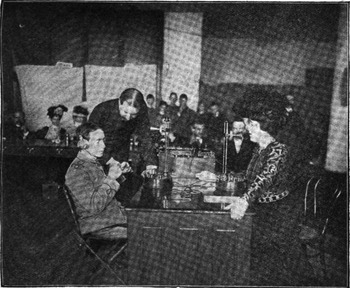
Concurrently with McKendrick, Miller Reese Hutchison was engaged in the invention of the first electrical hearing aid, the Akoulathon. He soon refined the hearing aid into the first model of the Acousticon, a portable, battery-powered hearing aid. A flurry of articles emerged in 1903 in The National Magazine, World Today, and Scientific American advertising Hutchison's Acousticon, using music as a prime example of the invention's powers. In The National Magazine, Bennett Chapple describes the visit of the Metropolitan Opera's Suzanne Adams to the home of the Akouphone Manufacturing Company. A photo accompanying the article, reproduced as Figure 1, shows Adams “singing to the hearts and souls of those who have never before heard music—music, the language of hearts,” through a related instrument called the Akoulalion.Footnote 68 The photo is captioned: “The engraving shows Mme. Susanne Adams, the famous grand opera soprano, singing to the blind, deaf and dumb boy Orris Benson, through the Akoulalion. Thus was the magic of great music conveyed to the eager soul of this thrice unfortunate boy, past the barricaded avenues of his natural senses.”Footnote 69 Chapple positions technology as part of a musical cure, in which the child's deafblindness is a barrier to musical understanding, to be overcome by the power of the Akoulalion.
Susanne Adams singing to Orris Benson, a deafblind child, through the Akoulalion.

Suzanne Adams was not the only opera singer called upon to demonstrate the abilities of devices like the Acousticon. In 1903, A.L. Griffith tells of six pupils of the New York Institute who tested the hearing aid by going to the opera, where they were “particularly impressed and delighted with the voice of Mme. Sembrich.” Three deafblind children, he writes, also “heard Sousa's marches played on a piano and then heard a phonograph repeat the sounds.”Footnote 70 These public tests or experiments were common in the early days of the Acousticon and were often conducted on children and young adults from deaf schools, with music used as the ultimate tool in assessing the new technology's effectiveness on these musical non-knowers. The claims of miraculous musical recoveries made possible by Hutchison's technology rely on the foundation of hermeneutic injustice. An article appearing in Scientific American titled “New Instruments for Enabling the Deaf to Hear” describes how the Acousticon allowed a young woman who had lost her sight and hearing at age six to “listen rapturously to the sounds of musical instruments and the human voice, conveyed to her for the first time since her affliction, by the new instruments.”Footnote 71 The author also points out that there exist modifications of the Acousticon, one of which he calls the “opera outfit.”Footnote 72 This version is contained within a small box for greater portability and ease of disguise, so that the previously mentioned girl “was able to enjoy the music at the opera in New York City, as if she had never been stricken.”Footnote 73 Once again, the central function of the device is to restore “normal” hearing for the purpose of positioning deaf persons as musical non-knowers, who can only gain an epistemic foothold as knowers through becoming assimilated into the paradigm of “normal” hearing.
New technologies like the Acousticon, which were advertised across the United States and which quickly found a place in deaf classrooms nationwide, were meant to improve the condition of the deaf through assimilation.Footnote 74 The ultimate proof of that assimilation was the ability of the deaf technology user to hear music normally. The desire for the deaf to integrate into hearing culture so seamlessly that they could pass as hearing, and the use of music as proof of that integration, contrasts sharply with manualists’ fears about the use of music as a tool for “passing.” At the same time, oralists still feared what they saw as the mechanical aspects of deaf music-making and questioned the morality of instructing the deaf in musical matters.
Although music was no longer used for the moral and religious education of the deaf by the latter half of the nineteenth century in the United States, the participation of the deaf in musical activities was certainly viewed as morally problematic by oralist educators. Hartmann, for example, viewed music performed by deaf children as “purely mechanical and useless.”Footnote 75 In fact, music was used specifically as a means of dehumanizing the deaf and heightening their comparison to emotionless machines: a 1903 article from The Association Review on the proceedings of the Department of Special Education of the National Education Association characterizes the deaf as “less emotional, less sympathetic, less altruistic than the blind or the normal,” because “music and the voice, by which the feelings are best expressed, do not appear in the world of the deaf.”Footnote 76
Three years later, in 1906, a report by the Italian G. Ferreri on the state of American institutions for the deaf includes similar language that associates deaf music-making with automata and machines. Ferreri is highly critical in his assessment of a display at the Chicago school, where children were “not only exhibited to give proof of their ability in speech (and in this there was no harm done) but also in choral singing and dancing.”Footnote 77 In the following passage, he attributes this musical event to the deaf person's ability to execute rhythmic movements mechanically, without actually understanding or experiencing music:
The facility of the execution is owing principally to the mathematical element of the rythm [sic]. … The deaf-mute is capable of following and of executing himself a succession of rythmic [sic] movements, whether with the voice, arms, or legs. … Now when these movements are accompanied by sound, the illusion is an easy one, and it seems to the public that the deaf-mute moves himself, dances, and sings from musical impulse.Footnote 78
For Ferreri, the most harmful demonstration the children made was not of speaking, but of singing and dancing. To “pretend” to experience music in any way as a deaf person was the most pernicious kind of deception, one that could trick the audience into thinking that the deaf could participate in musical culture without any technological mediation. Although oralists certainly wanted deaf persons to pass as hearing, and used music as a yardstick for assessing their passing, they also did not seem to believe that musical experience and enjoyment was possible without the use of technology. In other words, hearing music “normally” through technological intervention was the only morally acceptable way to experience music for oralists, and other forms of musical enjoyment were morally suspect.
Proponents of manualism and oralism, although they disagreed about how music should be used in educating the deaf, shared the fear that the music produced by deaf people was mechanical, and thus in some way deceitful and immoral. The oralists’ fears were, however, exacerbated by the influence of the eugenics movement on oralist thought. In an example of eugenic logic, oralists specifically associated deaf music-making with metaphors of the mechanical and automatic, capitalizing on eugenicists’ anxieties about humans as machines in order to eliminate culturally Deaf modes of musical thought in favor of technologically “normalized” music-making. The idea, promoted by Alexander Graham Bell, that the deaf could and would form a culture separate from that of mainstream U.S. society was not acceptable to late nineteenth- and twentieth-century supporters of eugenics. The concept of a deaf race presented an epistemic threat to musical knowledge as well, in that it would take deaf persons outside of the realm of hearing musical knowledge structures and into a culture that Bell feared would have its own language, literature, and artistic practices.Footnote 79 The elimination of specifically deaf ways of knowing and thinking about music was, therefore, one of the unspoken aims of the American oralist program.
Music and Deaf Education After 1900
Although the Milan Congress of 1880 dealt a severe blow to deaf U.S. citizens, sign language certainly did not disappear from their lives or even their educations. The National Association of the Deaf, founded in the same year as the Milan Congress took place, fought against oralist pedagogy and defended sign language against its attackers. At certain schools for the deaf, particularly those that still employed deaf teachers, deaf culture thrived in spite of the Milan decision. Deaf journals like The Silent Worker and The Deaf-Mutes Journal, launched in the 1870s and 1880s, quickly became popular sources of news and gossip for deaf Americans, providing a sense of community that spanned the nation. In these journals, we can observe rare traces of the musical culture in deaf spaces.Footnote 80 However, these musical cultures were shaped as well by oralist pedagogical techniques involving rhythm and pitch as aids for speech production, as Abby Lloyd documents. Lloyd recounts how the use of rhythm and pitch exercises at the piano, as well as the formation of deaf and hard of hearing bands, is directly tied to oralist thought and technique.Footnote 81 At the same time, though, deaf persons did derive pleasure and satisfaction from these musical experiences, per their accounts.
Articles published in The Silent Worker reveal an abundance of musical events at U.S. and Canadian schools for the deaf. These events included the singing and signing of hymns, solo performances on musical instruments such as the piano or percussion, and performances by deaf bands. Music acted as a source of entertainment, an amusing pastime, an educational or therapeutic tool in the context of oral schools, and a source of income for the deaf people described in these articles. In 1905, for example, Herbert Roberts described a tradition, begun by Professor Samuel T. Greene at the Ontario School for the Deaf and Dumb in Belleville, of “training the deaf scholars in the art of signing hymns.” Since Greene began this practice, Roberts writes, “almost every female graduate of that school is an expert in the art of hymn reciting, and the more they practice the more grace and charm is observed as they sweetly warble off their melodies in the quietest and most fascinating way imaginable.”Footnote 82 Outside of this particular school for the deaf, there are several documented instances of hymns being signed by both deaf and hearing individuals.Footnote 83
One of these instances involved the signing of the hymn “Nearer, My God, to Thee,” by a young girl named Marion Ballin. This was the daughter of Albert Ballin, advocate for sign language education and author of The Deaf Mute Howls. Ballin recounts the story of how his daughter came to sign the hymn:
By the time my oldest child reached her eighth year, I had taught her to sing in signs the hymn “Nearer, My God to Thee,” using the sign method that I had worked out. I made her blend one gesture into another until every verse resembled what we might call “visible music.” It was not dissimilar to the rhythm of Greek dancing.Footnote 84
In this passage, Ballin describes how he taught his daughter his own system of sign language singing, which she then performed for church audiences. Despite developing the system for singing in signs, however, Ballin has his hearing daughter perform in his stead—perhaps because she is young and thus more entertaining, or perhaps because hearing audiences will be more accepting of a hearing child's musical performance in signs.
The earliest examples of signed songs captured on film originate from the early twentieth century as well, the oldest known recording being a performance by a deaf woman of “The Star Spangled Banner” in 1902. Charles Krauel, as filmed in Ted Supalla's documentary Charles Krauel: A Profile of a Deaf Filmmaker, identifies ASL performers as “singers” who create music with sign language.Footnote 85 Some of the music identified by Krauel are signed interpretations of songs like “The Star Spangled Banner” or “Yankee Doodle,” but he notes that others were entirely conceptualized in sign language, such as “Voices of Animals.” Supalla's documentary shows several examples of these popular sign language songs from Krauel's films of the early twentieth century. Cripps et al. observe that this signed musical practice continued in theatrical performance in the United States through the National Theatre of the Deaf, which “produced ‘My Third Eye’ for both the stage and television during the 1970s. Both translated songs (i.e., ‘Three Blind Mice’) and singing in an ensemble format are found in this production.”Footnote 86
Several schools for the deaf developed musical curricula in the early twentieth century, including the New Jersey and New York Schools for the Deaf. Lloyd lists four such band programs: the Illinois School for the Deaf, the New York Institution for the Deaf, the Tennessee State Deaf School, and the Minnesota School for the Deaf. As Lloyd observes, “The bands were formed as extensions of rhythm programs already in place at the schools for the deaf and/or as extensions of military marching programs at schools that embraced military traditions.”Footnote 87
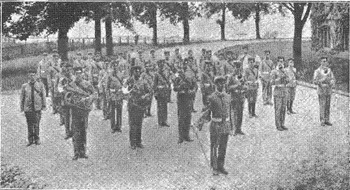
In 1914, The Literary Digest reports that the principal of the New York Institution, a military school for the deaf, saw the boys banging on walls and other solid objects and decided to introduce them to the drum, and later the fife, bugle, and other instruments, so that by 1913 a “forty to fifty member band, entirely made up of students, was achieved.” Another article adds that the band was “invited to participate in high-grade concerts given by hearing musicians in New York City.”Footnote 88 The New York band is pictured in Figure 2. Multiple sources reported that the band was also invited to participate in concerts given by hearing musicians. The audience for this deaf music, in other words, was not limited to members of the deaf community.
The Deaf Band at the New York Institution for the Instruction of the Deaf.

In 1917, an article titled “Rhythm Work in the New Jersey School for the Deaf” describes the practice of using musical rhythm in schools for the deaf, specifically in the case of a drum band.Footnote 89 The author depicts how, when their “‘orchestra’ of drums starts up at one of the Saturday evening parties, … [the] youngsters gather round and fairly gorge themselves like gluttons with the vibrations.” The students feel the drums, the author writes, “in every bone and muscle and fiber of their beings.”Footnote 90
The band at the New York Institution for the Deaf also inspired the formation of other deaf bands, like the Illinois School for the Deaf Band.Footnote 91 In her discussion of the history and formation of the Illinois School for the Deaf Band, Deborah Sheldon quotes the words of the school's students on the benefits of musical participation:
Many people ask this question: “What is the use of having such a band at a state school for the deaf?” The answer [sic] to this question are given below:
(1) It develops the cultural side of life.
(2) It teaches team work (or co-operation) by ensemble playing.
(3) It develops the dormant remnant of hearing that is found in a certain percentage of children in every school for the deaf.
(4) It makes the band boys more alert in their other studies and removes that feeling of hopelessness which arises at every seemingly different problem.
(5) No one can call the study of music a waste of time. Each band boy spends at least five hours a week at it.
(6) It puts not only the band boys, but the entire school more in touch with the outside world, in that it appeals to the public in a way which the regular school work does not.Footnote 92
It is evident from the preceding quotation that the deaf students who were a part of the band or who witnessed them performing found pleasure in this musical experience and framed it in terms of their culture, their community, their personal development, and their relationship with the hearing world. Given that they spent a large part of their lives participating in this musical activity, it is clear that these students had a great deal of musical knowledge and expertise, of which they felt proud.
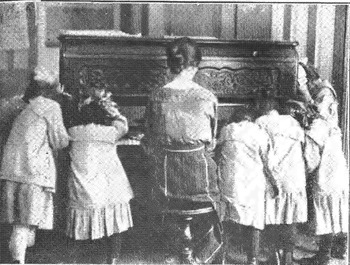
The practice of using the piano in deaf education continued as well, mostly in the form of rhythm training, as Lloyd documents.Footnote 93 At the New Jersey School, as at many other schools for the deaf, the piano was used therapeutically to help the children with their speech. Figure 3 shows a picture of deaf students around the piano at the New Jersey School, where they “used the piano as a means of aiding the children to change the pitch of their voices,” but also for rhythm work.Footnote 94 Lena Herschleifer, a pupil at the New York School for the Deaf, writes the following testimony about her own experiences of music:
We, the deaf, are often asked if we hear the tones of the piano or the voices of people. We don't hear sound vibrations, we only feel the thrill of the music—but hearing persons appear not to understand our sense of feeling.
“A Class in Rhythm at the Piano,” printed in The Silent Worker.

Sometimes we happen to feel some great sound which makes us start, and people think we hear it.
We can feel the vibrations pass from our feet to our head when the piano is played or a person is singing or if we hold a paper or sit at a distance.Footnote 95
Herschleifer's words reveal her awareness of the epistemic gap between deaf and hearing knowers in the musical realm. Her explanation of how she experiences vibrations, and how hearing persons do not understand her experience of music, reveals that deaf persons were thinking about their own musical experiences in different terms than were hearing persons of the same time. Although oralist educators promoted music as a therapeutic tool for improving speech production for deaf students, it is possible that this understanding of music and rhythm work presents a contributory injustice: while oralist educators only attended to the possible effect of rhythm work on speech, deaf students may have been conceptualizing their musical experiences in other ways.
For some deaf students, the piano could also be a tool for musical artistry. A 1918 article in The Silent Worker describes Leah Wenger's talents at the piano: “Although the beauty of the notes produced on the piano by her nimble fingers falls on unreceptive ears, Miss Wenger appreciates the various works of the great composers through her sense of rhythm and imagination. … ‘Piano playing,’ she declared, ‘is nothing more than dancing with the fingers and feeling the time and rhythm.”Footnote 96 For Wenger, music is fundamentally movement: she sees rhythm and meter as the foundations of her musical experience and practice.
The Silent Worker ceased publication in 1929, when superintendent Alvin Pope dismissed its editor, George Porter, an influential figure in the American deaf community. A staunch supporter of oralism, Alvin Pope censored the debate over oralist and manualist methods by systematically dismissing deaf teachers, like Porter, who spoke out against oralism. With Pope's takeover of The Silent Worker, the newspaper's coverage of music education for the deaf became overwhelmingly focused on speech development at the expense of fostering musical enjoyment and understanding. By the late 1930s and 1940s, the epistemic exclusion of deaf knowers from the realm of musical knowledge, at least in the mainstream hearing narrative, seemed complete. In the Music Educators Journal, for example, Karl Wecker writes:
Children classed as totally deaf do not possess even the rudiments of music. They have had no experience with speech rhythms, thus they lack even that natural relationship of music and language which every normal child entering an elementary school has unconsciously absorbed. They have never heard musical sounds and are unequipped mentally to orientate pitches, timbre and other qualities of sound.
Faced with these facts, Frederick Lewis, supervisor of the Federal Music Project at Lansing, Michigan, recently initiated experiments in cooperation with the Lansing public schools, to determine whether the completely deaf child could be brought to an appreciation of music, and, through appreciation, to a self expression in music somewhat approximating that of the normal child.Footnote 97
By positioning musical knowing as exclusively belonging to the “normally” hearing child, Wecker and Lewis reveal a fully oralist approach to music instruction for deaf students and deny the possibility that deaf children could experience music in ways other than through sound alone. They further call for the assimilation of the deaf child into “normal” modes of appreciating and understanding music.
Throughout the twentieth century, other hearing educators of the deaf continued the oralist program of assimilation using music. In 1965, for example, Lois Birkenshaw writes that the goal of teaching music is, ultimately, assimilation: “in teaching music to deaf children one must always remember that music is only a means to an end, never the end in itself. The end is the satisfactory adjustment of the child in a hearing society and this adjustment is accomplished, for the most part, through the development of clear, understandable speech.”Footnote 98 The tenacious thread of deaf musicality, stretching all the way back to the first days of Gallaudet's American Asylum, was by the mid-twentieth century irrevocably tangled in a web of oralism, assimilationism, speech therapy, eugenics, cure propaganda, hearing aids, and, later in the century, cochlear implants. It should not come as a surprise that towards the end of the twentieth century many members of the Deaf community came to pre-emptively reject music, characterizing it as a “hearing thing” that had little to do with Deaf culture and uniquely Deaf modes of expression. In an interview with Spin magazine, for example, Deaf rapper Warren “Wawa” Snipe tells the story of his reception in culturally Deaf spaces in the early 1990s when he first attempted to rap in ASL. “I was heckled big time,” he says; “I was labeled ‘hearing-minded’ or ‘trying to be hearing.’ It was a huge slap in the face.”Footnote 99 The framing of music as exclusively belonging to the domain of the “normally” hearing has thus caused epistemic harm that resonates across centuries.
Conclusion
The story of music and deafness is one of rediscovery. Over and over again, hearing commentators have discovered “music for the deaf,” shaping and reshaping their definition of that music according to their belief in manualist or oralist philosophies and ideals. I have argued that the result of the oralist school's redefinition of music as belonging exclusively to the domain of audible sound and “normal” hearing—or hearing “normalized” through technology—has led to the lasting exclusion of deaf ways of thinking and knowing about music from our collective epistemic resources.
Who can estimate the musical insight we might have gained had oralists attended to the musical knowledge of the deaf community in the late nineteenth century—seeing deaf listeners as “expert listeners,” as Jessica Holmes puts it? Fortunately, deaf musical practices have persisted in many forms, although some may not have survived to be transmitted to the present day. As Holmes observes, the present-day testimony from musicians who are deaf and hard-of-hearing “amounts to a diverse record of musical experiences that fall squarely within the full spectrum of listening.”Footnote 100 We now have the opportunity to deepen our knowledge of the kinds of musical understanding and expression that come from Deaf knowers, and in doing so, come to a more expansive understanding of the possibilities for musical knowledge. In order to accomplish this, we must reconsider the very definition of what it means to possess musical knowledge. By understanding how our collective epistemic resources have been shaped by the historical exclusion of deaf knowers, we can continue to foster an inclusive musicology.
One way to begin fostering a more inclusive musicology is to center deaf people's epistemologies, as outlined in the work of Hauser and colleagues, Thomas Holcomb, Margery Miller, Michele Friedner, Octavian Robinson and Jonathan Henner, and Peter Paul and Donal Moores.Footnote 101 As Robinson and Henner write,
Embracing deaf epistemology means the inclusion of deaf people in research and policy-making, acknowledging deaf people's epistemic authority, producing theories treating deafness as a gain rather than as an impairment, rendering deaf gain and deaf people's participation in society visible, and producing knowledge that benefits deaf people. Deaf epistemology provides the opportunity to generate new questions, theories, and methods in scientific and academic inquiry while contributing to emancipatory movements for deaf people. The benefits of deaf epistemology are not limited to deaf people; it lends itself to the joint knowledge of other marginalized groups such as women and other disabled groups.Footnote 102
Careful attention to what deaf epistemologies bring to music studies—an understanding of what H-Dirksen L. Bauman and Joseph Murray call “deaf gain”Footnote 103—may lead us to focus on deaf perspectives on, for example, the visuality and collectiveness or music, and to highlight the sophisticated sonic expertise that emerges from deaf ways of knowing.Footnote 104

 Open access

