


Introduction
Animal welfare science has shifted from being focused predominantly on alleviating suffering through the understanding and assessment of negative affective states, towards a broader focus including pleasant experiences through the understanding, assessment and promotion of positive affective states (Boissy et al. Reference Boissy, Manteuffel, Jensen, Moe, Spruijt, Keeling, Winckler, Forkman, Dimitrov, Langbein, Bakken, Veissier and Aubert2007; Webb & Jensen Reference Webb and Jensen2024; Rault et al. Reference Rault, Bateson, Boissy, Forkman, Grinde, Gygax, Harfeld, Hintze, Keeling, Kostal, Lawrence, Mendl, Miele, Newberry, Sandoe, Špinka, Taylor, Webb, Whalin and Jensen2025). To achieve progress in this newer area of interest requires us to identify markers of positive affect, and in this paper, we search the human literature for cognitive indicators that could potentially be translated to non-human animals (hereafter animals). We start by briefly introducing relevant concepts in affective science, with a particular focus on positive states.
Affective state is used here as an umbrella term for valenced mental states (those that are positive/negative, rewarding/punishing, pleasant/unpleasant etc, see below) and includes short-term emotions and longer-term moods. In humans, these states comprise behavioural, physiological, cognitive, and conscious components (Paul et al. Reference Paul, Harding and Mendl2005; Mendl et al. Reference Mendl, Burman and Paul2010; Mendl & Paul Reference Mendl and Paul2020). In non-human animals, it is not yet clear whether and which species experience the conscious component (subjective feelings), although there is growing support for the view that such experiences occur in mammals, birds, other vertebrates, and even some invertebrates (Cambridge Declaration on Consciousness: Low Reference Low2012; New York Declaration on Animal Consciousness: Andrews et al. Reference Andrews, Birch and and2024). Despite this lack of certainty, affect can be inferred from behavioural, physiological, and cognitive markers in other species.
Building on Darwin’s consideration of the potential functions of expressive postures and behaviour, and focusing on human facial expressions, Ekman (Reference Ekman2009) developed his theory of Basic or Discrete Emotions identifying six ‘basic’ emotions (joy, sadness, anger, fear, disgust, and surprise) that were proposed as genetically determined products of human evolution and distinguishable in terms of their distinctive features of behaviour, physiology and brain activity (Ekman & Friesen Reference Ekman and Friesen1971; Colombetti Reference Colombetti2009). An alternative perspective was presented by dimensional theorists, such as Russell and colleagues (Reference Russell, Weiss and Mendelsohn1989) who proposed that affect could be separated and categorised along a limited number of underlying dimensions. Russell’s (Reference Russell2003) ‘core affect’ model identified arousal and valence as key dimensions. Arousal represents organismal ‘activation’ during affective states — the higher the arousal, the more (physiologically) activated the individual is — and ranges from sleep to high excitement (Cudo et al. Reference Cudo, Francuz, Augustynowicz and Stróżak2018; Gable & Dreisbach Reference Gable and Dreisbach2021). Valence represents the pleasantness or unpleasantness of the affective state. Examples of different discrete emotional states that are positively valenced include joy, excitement, serenity or relief (Russell Reference Russell2003; see also: Mendl et al. Reference Mendl, Burman and Paul2010).
A related dimension, sometimes mentioned in affective science and relevant to positive states, is approach motivation, defined as the “impetus to move towards or the drive to approach” (Gable & Dreisbach Reference Gable and Dreisbach2021). Approach motivation is connected to valence and arousal but is not the same (Cudo et al. Reference Cudo, Francuz, Augustynowicz and Stróżak2018; Gable & Dreisbach Reference Gable and Dreisbach2021). While approach motivation is generally linked to positive affect, and avoidance motivation to negative affect, different positive states are linked to varying intensities of approach motivation (low to high), and certain negative states, e.g. anger, are also linked to high approach motivation (Gable & Dreisbach Reference Gable and Dreisbach2021; but see also Campbell et al. Reference Campbell, Dawel, Edwards and Goodhew2021). Regarding arousal, Cudo and colleagues (Reference Cudo, Francuz, Augustynowicz and Stróżak2018) state “Arousal is a state of physiological alertness and readiness for action in response to the emergence of an affective stimulus, whereas approach motivation is associated with the action of a person to an affective stimulus (Gable & Harmon-Jones Reference Gable and Harmon-Jones2008, Reference Gable and Harmon-Jones2010). For example, if a person sees a beautiful landscape, such an affective stimulus could generate a low level of arousal but a high motivation to approach it.” This distinction was also demonstrated empirically (Cudo et al. Reference Cudo, Francuz, Augustynowicz and Stróżak2018; Campbell et al. Reference Campbell, Dawel, Edwards and Goodhew2021).
Positive affective states may thus be characterised by positive valence and approach motivation, and Shiota et al. (Reference Shiota, Sauter and Desmet2021) attempt to integrate these in their definition of positive emotions as “complex, at least partly innate [multi-component] responses to certain kinds of prototypical resources and opportunities to enhance one’s adaptive fitness, such as high-quality food, desirable mates, young kin requiring one’s care, chances to increase one’s social status, and novel information". They suggest that there are “three main ways in which positivity has been conceptualised in the affective science literature: the valence of subjective feelings; the direction of motivation; and the desirability or goal-conduciveness of an emotion-eliciting situation.” For this review, we will use the general term ‘positive affect’ to denote any emotion or mood that is positive in valence. However, it is important to keep this variety of definitions in mind when comparing the outcomes of different studies.
Russell (Reference Russell2003) recognised that personal interpretations of events influence short-term emotions, and modern constructionist theorists propose that emotional experiences arise out of a combination of core affect and individually specific contextual interpretation rather than being discrete, modular ‘natural kinds’ (e.g. Barrett Reference Barrett2017). While there is no consensus about the exact processes underpinning the generation of human short-term affect, appraisal theorists posit that incoming event-related information is appraised via a series of stimulus checks influenced by event relevance and implications for the individual, ability to cope and normative significance (e.g. Scherer’s component process model; Sander et al. Reference Sander, Grandjean and Scherer2005). Such dynamic and recursive processes may be mediated by cognitive functions implemented through coordinated activity in the prefrontal cortex and other cortical and subcortical brain regions, including the amygdala (Arnsten Reference Arnsten2009; Pessoa Reference Pessoa2010).
Cognitive processes may thus play an important role in the generation of affective states and can be defined broadly as those involved with the acquisition, storage and manipulation of information (Shettleworth Reference Shettleworth1998) and are often, in contrast to affective processes, not valenced. Thus, a psychological distinction between cognitive and affective processes can be made, allowing them to be conceptually separated in studies. Such studies indicate that some brain areas are more specialised in affective processing (e.g. amygdala) — this may include ‘older’ brain areas (some argue that affective processes evolved prior to cognitive ones: e.g. Berridge Reference Berridge2018) — but many/most brain regions (such as the prefrontal cortex) are likely involved in both cognitive and affective functions, and affective processes have been suggested to influence and interfere with cognition (e.g. Pessoa Reference Pessoa2008).
The interplay between cognitive and affective processes can be studied by inducing an affective state and comparing cognitive performance before and after the affect induction, or comparing different treatment groups. Changes in cognitive performance can then serve as indicators of the induced affective state. In humans, the effect of affective state on attentional breadth is a widely studied example (e.g. Gable & Harmon-Jones Reference Gable and Harmon-Jones2008). Negative affect can narrow the scope of attention, making us more focused on the target stimulus (Fredrickson Reference Fredrickson1998). Meanwhile, certain types of positive affect may lead to broader information processing, thereby increasing creativity (e.g. Fredrickson & Branigan Reference Fredrickson and Branigan2005) — but also distractibility (Wenzel et al. Reference Wenzel, Conner and Kubiak2013). In animals, currently proposed cognitive methods to assess animal affect include judgment (e.g. Harding et al. Reference Harding, Paul and Mendl2004), attention (e.g. Lee et al. Reference Lee, Verbeek, Doyle and Bateson2016), and memory (e.g. Paré Reference Paré1996) bias tests, attentional breadth (Hamlaoui et al. Reference Hamlaoui, Keeling, Burman and Verbeek2022; Neave et al. Reference Neave, Rault, Bateson, Jensen and Jensen2023) and sensitivity to reward loss (Burman et al. Reference Burman, Parker, Paul and Mendl2008), although some of these have mainly been applied to the assessment of negative states, e.g. attention bias tests (Monk et al. Reference Monk, Lee, Dickson and Campbell2020, Reference Monk, Campbell and Lee2023).
Our aim here is to review links between positive affect and human cognition with the goal of gaining inspiration for potential cognitive markers of positive affect that could be explored in non-human animals in the future. Whilst experimental studies are the only ones that can help establish a causal link, correlational/observational studies may produce additional valuable information and were also included in this scoping review, though to a lesser extent.
Materials and methods
This study constitutes a scoping review based on human psychology literature.
Inclusion and exclusion criteria
Prior to the start of the search process, the inclusion and exclusion criteria were defined to ensure a relevant selection of studies. First, only papers studying humans were included, prompting the exclusion of non-human animal species. To focus on healthy populations, studies addressing psychopathology (such as depression, anxiety, schizophrenia, and dementia) were omitted. The presence of such disorders can adversely affect cognitive performance (Chavez-Baldini et al. Reference Chavez-Baldini, Nieman, Keestra, Lok, Mocking, de Koning, Krzhizhanovskaya, CLH, van Rooijen, DJA, Sutterland, KJH, van Wingen, JTW, Vulink and Denys2021) and thus lead to conclusions regarding the relationship between affective states and cognition that may be specific to affective disorders and not generalisable to the wider population. Furthermore, papers were required to clearly distinguish between the effects of positive, negative, and neutral affective states, even if positive affect was not the sole focus. As this review concentrates on indicators specific to positive affect, a lack of differentiation between positive and negative affective valence would likely confound the results. In addition, to avoid including papers that investigated personality traits rather than affective states, a clear differentiation between states and traits was required. Hence, studies focusing on personality were excluded. Studies relating to long-term, overall happiness and quality of life were excluded. Additionally, the studies had to employ cognitive tests, with sufficient methodological details provided, to ensure that the tests found could be later repeated and/ or adapted for animals. Only empirical studies were considered, encompassing experimental and observational (including longitudinal), while review articles were used for snowballing. All articles had to be written in English.
Search strategy
The literature search commenced with the application of different keyword strings in the scientific search engine Scopus (Figure 1). The search results were screened for relevance in a multi-step procedure. First, all the titles of the search were evaluated based on the predefined inclusion criteria, and the abstracts of the non-excluded papers were screened based on the same criteria. Only those abstracts that met the inclusion criteria proceeded to the full-text analysis. In addition, reviews and meta-analyses identified from the keyword searches were added to the database if they included references to relevant empirical work. Based on their reference list, seven relevant review papers were chosen to be utilised for snowballing (the review articles are not in the database except as source material for the empirical studies). During snowballing, possible relevant references were examined further with the same selection methodology: an evaluation based on the title, followed by the abstract, and then the full text. At the beginning of the scoping process, before the search strategy was finalised, six articles were obtained from studies via unintentional snowballing (i.e. when reading the full texts of papers in the database, these studies looked relevant to the topic). After the procedural details were decided, further snowballing was constrained to the reviews in the database (Figure 1). During the data analysis, a paper focusing on happiness was excluded, as it related to general life satisfaction instead of a short- or medium-term affective state.
Diagram of the search process used in the scoping review targeted at identifying cognitive indicators of positive affect in humans.

Figure 1. Long description
The flowchart is organized into three vertical sections.
Top Section: Keyword searches in Scopus. Six distinct search strings are shown at the top, each with a specific goal such as looking for indicators or excluding animals. Below each string is a vertical tally of results.
1. cognitive test* AND positive emotion*: 18 results, 1 experimental.
2. cognitive task* OR cognitive test* AND positive emotion* AND indicator*: 2 results, 1 experimental.
3. positive affect* OR positive emotion* AND cogniti* AND systematic review: 90 results, 3 reviews.
4. judgment bias* OR judgement bias* AND positive emotion* OR positive affect* OR wellbeing: 29 results, 1 experimental.
5. neuroscience AND cogniti* AND positive emotion* OR positive affect* AND NOT animal* OR non-human: 91 results, 2 experimental, 9 reviews.
6. cognitive test* OR cognitive task* AND positive emotion* OR positive affect* AND NOT animal* AND NOT disease* AND NOT trait*: 97 results, 9 experimental, 3 reviews, 5 observational.
Middle Section: Initial Synthesis. The results from the first section, plus unintentional snowballing, lead to a central box containing 17 experimental studies, 5 observational studies, and 18 reviews. From these, 7 reviews were selected for snowballing.
Bottom Section: Snowballing from 7 reviews. Seven specific review titles are listed horizontally, each with a vertical tally of references screened.
1. Effects of positive affect and positive emotions on executive functions: 13 experimental, 3 reviews.
2. Positive psychological constructs and cognitive function: 3 reviews.
3. The power of negative and positive episodic memories: 7 experimental, 3 reviews, 1 observational.
4. A developmental neuroscience perspective on affect-biased attention: 1 experimental, 3 reviews.
5. The influence of affective states varying in motivational intensity on cognitive scope: 7 experimental, 1 review.
6. Implicit affective cues and attentional tuning: 3 experimental, 1 review.
7. The influence of emotional cues on prospective memory: 2 experimental, 3 reviews.
Final Tally: These results lead to a box with 33 experimental, 4 observational, and 14 reviews. After excluding 1 observational study, the final database contains 50 experimental studies, 8 observational studies, and 32 reviews.
Output
The primary outcome of the review procedure is a comprehensive database (Supplementary material 1), containing all empirical papers (the full text was available for all papers). Data were extracted from the papers according to the aspects outlined in Supplementary material 2. As some papers included multiple experiments and employed multiple cognitive tests, the organisation of papers was based on individual cognitive functions/tests within experiments, with each test used in one experiment in a separate row in the database.
After finalisation of the database, the experimental and observational studies (Supplementary material 1) were analysed in greater detail to address the research question. The columns ‘positive affect’, ‘cognitive function’, and ‘link between cognition and positive affect’ were used to explore the relationship between different types of cognition and positive affect. Due to the diversity in measures/indicators and study methods reported per cognitive function (where more than one experiment was identified), a meta-analysis was not possible here. Instead, we used the alternative method of ‘vote counting based on direction of effect’ (McKenzie & Brennan Reference McKenzie and Brennan2019; Section 12.2.1.3). We first identified per experiment whether a positive, negative or ‘not useful’ relationship between positive affect and each cognitive function was found (based on comparison with a neutral affective state). A positive relationship was one where positive affect was associated with a stronger expression of the cognitive function as defined in Tables 1–8. As recommended for ‘vote counting based on direction of effect’, this analysis was based purely on numerical comparison of means between groups experiencing positive and neutral affect induction treatments (McKenzie & Brennan Reference McKenzie and Brennan2019). Experiments were classified as ‘not useful’ when: (1) authors reported a confound of arousal, whereby the experimental treatments differed in both valence and arousal; (2) means between the positive and neutral treatments were exactly the same; (3) the induction of positive affect failed; (4) both the positive and negative treatments differed from the neutral treatment in the same direction (note that not all studies included a negative treatment). The number of experiments falling under these three categories: positive, negative and not useful classification of the direction of effect are tallied in Table 9. For information only, the number of studies showing positive or negative relationships that were statistically significant is shown in brackets in Table 9. The results presented in Table 9 are summarised visually in Figure 3. Following recommendations for ‘vote counting based on the direction of effect’ (McKenzie & Brennan), we used sign tests to determine whether the number of studies in which the direction of the effect estimate indicated that positive affect was associated with stronger expression of the cognitive function (positive link) was different to the number of studies showing the opposite relationship (negative link). We focused on those measures highlighted in blue in Table 9 where there were at least four studies showing either a positive or negative link (unless it is specified in the table that the cognitive function was not discussed further; reason(s) given in the table).
Definitions of human cognitive functions categorised as part of Attention

Table 1. Long description
The table consists of three columns: Cognitive function, Definition, and Reference.
* Alerting: Defined as the ability to make use of a temporally informative cue during a selective attention task. Reference: Bruyneel et al. 2013.
* Attentional breadth: Defined as the variation of attentional focus in its spatial extent (broad versus narrow). Reference: Rowe et al. 2007.
* Attentional control: Defined as top-down (equals intentional) regulation of attention. Reference: Karreman and Riem 2020.
* Orienting: Defined as the ability to make use of a spatially informative cue above and beyond a temporally informative cue during a selective attention task. Reference: Bruyneel et al. 2013.
* Concentration: Defined as focusing attention on the relevant stimulus and ignoring the distractors. Reference: Bless et al. 1996.
* Selective attention: Defined as recognizing a target stimulus among others; selectively attending to a central target and ignoring irrelevant flanking distractors. Reference: Balconi and Fronda 2021; Rowe et al. 2007.
The cognitive functions examined in the papers were sorted into eight categories: Attention, Cognitive control, Complex cognition, Judgment, Language, Memory, Problem solving, and Processing. Although these classifications are not discrete due to intersecting cognitive functions (e.g. cognitive control and processing), they were organised in this manner for convenience to facilitate data management. Several papers used general terms such as positive mood state, positive emotion or positive affect. However, based on the affect induction described in the paper, in some cases, it was clear that a discrete emotion was studied (e.g. joy, amusement, mirth). The database includes the name of the positive affect used in the paper.
Results and Discussion
This scoping review led to the identification and analysis of 50 experimental and eight observational papers. The analysis of these papers involved the extraction of 35 components (Supplementary material 2), the results of which were compiled in a database (Supplementary material 1). In total, 33 cognitive functions assessed via 63 cognitive tests were identified. Tables 1–8 contain the definitions of cognitive functions within each of the eight cognitive categories (Attention, Cognitive control, Complex cognition, Judgment, Language, Memory, Problem solving, and Processing) that were identified during the scoping review. The definitions were derived from the studies in the database or their referenced sources. The definitions that were taken directly from the papers are within quotation marks. When the cognitive function was not explicitly defined, the table explains what was assessed by the cognitive test employed in the study.
We categorised the methods used to induce positive affect into 13 categories and found that the use of videos or asking participants to remember or write about an event were the two most used induction methods (23% of experiments; Figure 2). We classified the type(s) of positive affect induced as low- or high-approach motivation (intensity) positive affect, as these seemed to differentially affect cognition in some cases (for details, see Table 9). This categorisation was based on additional literature searches in the psychology literature to determine which discreet emotions or specific affect induction techniques are thought to be linked to low- or high-approach motivation, or what the authors stated. In some cases, the articles did not provide sufficient detail to allow this categorisation, and we instead used the category ‘unknown’. Note that studies used two types of methods to induce low- or high-approach positive affect: induction prior to the test (e.g. funny video) or induction during the test (e.g. reward system during a test). Only four studies were found to use the second method (in attention, language and memory). Both were treated by authors of the studies as similarly inducing either low- or high-approach affect and results appear to be similar, which is why we did not distinguish between these two induction methods further. We observed a predominance of low-approach positive affect being induced (72% of experiments) vs high-approach positive affect (20% of experiments), with 13% of experiments specifically inducing both types of positive affect (for the remaining 21% of experiments it was unclear to us whether the affect induced was low or high approach). This is a key point when translating the present findings to animal studies which may tend to induce high-approach positive affect, for example when requiring animals to work for food rewards or access to a young or peer. In addition, two different time categories were identified for affect. All experimental studies used an induction method and therefore appeared to study the current affective state of the subjects (short-term affect). In contrast, the observational studies studied mood over the past several days or weeks (medium/long-term affect), assessing affect balance (eight studies). This distinction is specified in Table 9. These observational studies mostly focused on various types of memory, while one assessed selective attention and another assessed global cognitive ability. Memory decline (2 studies) was only investigated in relation to long-term positive affect. It is unlikely that removing these studies from the present study would have changed any of the findings.
Methods of induction of positive affect in humans classified by percentage of experiments using them.

Figure 2. Long description
The pie chart breaks down induction methods by percentage as follows:
* Video: 23 percent
* Remember/write positive event: 23 percent
* Pictures: 12 percent
* None: 9 percent
* Music: 8 percent
* Words: 6 percent
* Positive feedback: 5 percent
* Text: 4 percent
* Monetary incentive: 3 percent
* Gift: 3 percent
* Smile plus posture: 2 percent
* Winning a match: 1 percent
* Listen to story: 1 percent
The key findings from the database are summarised in Table 9, with the most interesting cognitive functions being highlighted in blue.
Each cognitive function in Table 9 was tested in at least one of the included papers, and its association with a positive affective state was investigated. Out of the 58 studies, 16 inspected discrete emotions (e.g. amusement), 40 focused on more general positive states (e.g. positive affect), and two studies included both discrete and general affect.
Low-approach positive affective states appear to broaden attention, boost selective attention towards rewarding items (Table 1), increase cognitive flexibility where unusual items are presented (Table 2), promote creativity in various tasks (Table 3), enhance memory for peripheral or unusual details (Table 6), and finally seems to facilitate problem-solving capabilities (Table 7). Binomial sign tests demonstrated that findings for selective attention (P = 0.040), creativity (P = 0.031) and problem solving (P = 0.07) reached significance or tendency, while all other functions in Table 9 indicated in blue (i.e. cognitive functions for which ≥4 experiments showed either a positive or negative link) did not reach significance (P > 0.1). Although other measures in blue in Table 9 did not yield significant differences, possibly due to small numbers of studies, we nevertheless discuss these since the purpose of the paper is to indicate potentially valuable new measures that could be studied in animals.
Definitions of human cognitive functions categorised as part of Cognitive control

Table 2. Long description
The table consists of three columns: Cognitive function, Definition, and Reference.
Row 1: Cognitive control is defined as including inhibition, patience, and low impulsivity, or the ability to direct thoughts rather than act on impulse. References include Ramirez et al. 2024, Martin and Kerns 2011, Phillips et al. 2002, and Lempert et al. 2017.
Row 2: Conflict adaptation is defined as increased cognitive control upon detection of conflict. Reference is Schuch et al. 2017.
Row 3: Cognitive flexibility is defined as increased sensitivity for irrelevant information or alternative response options. Reference is Dreisbach and Goschke 2004.
Definitions of human cognitive functions categorised as part of Complex cognition

Table 3. Long description
The table consists of three columns: Cognitive function, Definition, and Reference.
* Row 1: Creativity is defined as seeing potential relations not usually noticed between elements of the stimulus materials. Reference: Isen et al. 1985.
* Row 2: Fluid intelligence is defined as the ability to reason and solve new problems independently of previously acquired knowledge. Reference: Cavanaugh et al. 2011.
* Row 3: Global cognitive ability is defined as tested by the mini mental state examination, which assesses a combination of orientation, attention, recall, and language, to screen for dementia. Reference: Tani et al. 2022 and Galea and Woodward 2005.
* Row 4: Metacognition is defined as the ability to think about and monitor one’s own cognitive processes. Reference: Molenberghs et al. 2016.
Low-approach positive affect, such as amusement and contentment, biases attention towards rewarding stimuli, in other words it increases the salience of desirable information (e.g. Tamir & Robinson Reference Tamir and Robinson2007), while negative affect has instead been shown to bias attention towards threatening information (e.g. Lonigan & Vasey Reference Lonigan and Vasey2009). Since the purpose of selective attention is to help prioritise the processing of relevant (goal-related) stimuli, this in line with expectations (Tamir & Robinson Reference Tamir and Robinson2007). Creativity and problem-solving are intertwined. Creativity is a difficult concept to define: a complex, multifaceted cognitive product and process that is likely domain-specific and based upon less-complex cognitive functions, such as cognitive control, attention and memory (Beaty & Kenett Reference Beaty and Kenett2023; Green et al. Reference Green, Beaty, Kenett and Kaufman2024). As a product, creativity has been defined as original/novel and effective/useful thoughts, while as a process creativity has been defined as attention directed inwards linked to a ‘generative goal’ (Green et al. Reference Green, Beaty, Kenett and Kaufman2024). Creativity involves associative thinking, which itself is linked to semantic and episodic memory, with more creative people displaying greater mental exploration, more switching between categories and making more distant/unusual associations (Beaty & Kenett Reference Beaty and Kenett2023). Taken together, creativity can be described as a high-level cognitive function dependent on multiple other cognitive functions, which is likely involved in many problem-solving contexts. Problem-solving is a basic and key aspect of animal life and intelligence, which involves searching for a solution towards a specific goal. It can be divided into simple and complex problem-solving, whereby simple problem-solving involves reconstructing knowledge towards creative ingenuity (Spering et al. Reference Spering, Wagener and Funke2005). In contrast complex problem-solving comes closer to real-life problems and involves multiple goals, dynamic evolution, non-transparency and complex connections between variables (Spering et al. Reference Spering, Wagener and Funke2005). Selective attention was not studied in relation to high-approach positive affect in the articles included in this review. Creativity seems to be both increased and decreased by high-approach positive affect, which may point to different types of discrete emotions affecting creativity differently . For problem-solving, only one study included in this review considered high-approach positive affect and found similar improvements in problem-solving compared with low-approach positive affect (Isen et al. Reference Isen, Daubman and Nowicki1987).
Low-approach positive affect appears furthermore to broaden attention (Fredrickson & Branigan Reference Fredrickson and Branigan2005; Rowe et al. Reference Rowe, Hirsh and Anderson2007; Gable & Harmon-Jones Reference Gable and Harmon-Jones2008, Reference Gable and Harmon-Jones2011; Moriya & Nittoro Reference Moriya and Nittono2011), broaden the thought-action repertoire (Fredrickson & Branigan Reference Fredrickson and Branigan2005), broaden the scope of categorisation (Price & Harmon-Jones Reference Price and Harmon-Jones2010), increase the ability for unusual associations (Isen et al. Reference Isen, Johnson, Mertz and Robinson1985; Phillips et al. Reference Phillips, Bull, Adams and Fraser2002). By widening the scope of information processing, low-approach positive affect supports a wider availability of cognitive functions, increasing performance where flexibility (e.g. tasks in which unusual or conflicting items are presented) is required (Dreisbach & Goschke Reference Dreisbach and Goschke2004). Low-approach positive affect seemed to however impair inhibition and increase distractibility (Phillips et al. Reference Phillips, Bull, Adams and Fraser2002; Dreisbach & Goschke Reference Dreisbach and Goschke2004; Dreisbach Reference Dreisbach2006; Wenzel et al. Reference Wenzel, Conner and Kubiak2013). Moreover, recognition memory was improved by positive affect due to an increased reliance on existing knowledge structures (Bless et al. Reference Bless, Clore, Schwarz, Golisano, Rabe and Wölk1996), although note that awe was found to reduce reliance on internal knowledge (Danvers & Shiota Reference Danvers and Shiota2017), which may free up cognitive ‘space’ and allow for, and explain, enhanced cognitive flexibility. Taken together, these processes show interesting links between all of the main cognitive functions identified in Table 9 and Figure 3: it is proposed that low-approach positive affect shifts information processing by expanding attention via a loosening of inhibitory control, generating broader internal and external exploration leading to greater skills in creative problem solving (Rowe et al. Reference Rowe, Hirsh and Anderson2007).
Visual summary of the main results presented in Table 9 and relevant for animal research. The results are summarised to show how low- and high-approach motivation positive states lead to differences in cognitive processes relative to a ‘neutral’ state.

Figure 3. Long description
At the top of the diagram are illustrations of three faces with neutral to positive expressions and a multi-colored brain. Below these, a central yellow box is titled from Neutral state to.... This central box contains six horizontal rows, each listing a cognitive process in a colored bar on the left and its category on the right.
* Attentional breadth (ATTENTION)
* Selective attention towards reward (ATTENTION)
* Cognitive flexibility (COGNITIVE CONTROL)
* Creativity (COMPLEX COGNITION)
* Memory for peripheral/central details (MEMORY)
* Problem solving (PROBLEM SOLVING)
Two arrows point outward from the central box to side columns.
The left column, titled Low approach positive affect, lists the following outcomes:
* Broader
* Increase
* Increase when expectations are hurt or conflicts present
* Increase
* Better for peripheral details
* Increase
The right column, titled High approach positive affect, lists the following outcomes:
* Narrower
* Unknown
* Unknown
* Unclear/ambiguous
* Better for central details
* Increase (few studies)
In contrast, high-approach positive affect appears to lead to narrower attention breadth and improved memory for central details. It would seem logical that emotions that drive high approach would also focus the attention and subsequent memory of the event to the central object linked to the high motivation to approach. However, these contrasts within the positive-affect continuum in terms of effects on cognitive functions may create certain risks in animal studies, and these are discussed in the general discussion below. Note that the low to medium-approach positive affect of ‘hope’ seems to follow some of the findings for low-approach positive affect, leading to greater mental exploration improving creativity and fluid intelligence (Cavanaugh et al. Reference Cavanaugh, Cutright, Luce and Bettman2011).
The results regarding memory (Table 6) are a little conflicting. The overall picture suggests that positive affect may impair memory. It is often unclear where the boundary lies between short-term and working memory (Cowan Reference Cowan2008): One study might refer to a function as ‘short-term’ memory, while another might call the same function ‘working’ memory. Accordingly, the distinction in the present study is based solely on the definition used by the authors (Cowan Reference Cowan2008). It is important to note here that this sort of problem may underlie why there is disagreement between findings within some of our eight categories of cognition. It may be that the measures grouped under each category are not really related in terms of their underlying mechanisms and this could then lead to a disparate set of associations with affective state. In a similar way, different types of (discrete) positive affective states may have different functions, and these may also differ from any functions of valence/arousal (this is the case when comparing low- and high-approach positive affect, for example). In both cases, this could underlie why they have different relationships with/effects on cognition. To complicate this matter further, many distinct cognitive functions are inter-related within the memory category: e.g. attention influences memory function, with both attentional breadth and control contributing to memory (Cowan et al. Reference Cowan, Elliott, Scott Saults, Morey, Mattox, Hismjatullina and Conway2005). Attention acts as a selection mechanism, filtering information, ensuring only relevant data reaches memory (Oberauer Reference Oberauer2019). Therefore, it is difficult to draw conclusions about memory without considering the effects of attention.
Within the cognitive control category (Table 2), positive affect may improve patience but also increases impulsivity and distractibility, with some authors suggesting that positive affect impairs inhibition (all studies induced low-approach positive affect, except for one which did not give enough detail for us to determine the approach motivation type). Positive affect was indeed found to impede functions such as conflict-driven control, and conflict adaptation. “Cognitive control enables successful goal-directed behaviour by resolving a conflict between opposing action tendencies” (Zinchenko et al. Reference Zinchenko, Obermeier, Kanske, Schröger and Kotz2017). According to Dreisbach (Reference Dreisbach2006), conflict resolution requires a balance between maintenance/stability (“maintain intentions and goals over time and shield them against distraction”) and flexibility (“switching from one thought or action to another whenever significant changes occur”). As mentioned earlier, positive affect can increase cognitive flexibility; however, this comes at the expense of maintenance. Reduced stability leads to higher distractibility (Dreisbach & Goschke Reference Dreisbach and Goschke2004), which impairs cognitive control and consequently, conflict adaptation (Wenzel et al. Reference Wenzel, Conner and Kubiak2013; Schuch et al. Reference Schuch, Zweerings, Hirsch and Koch2017). Motivation (to complete a test well) and the potential of a reward can considerably affect executive functions by engaging brain areas that are responsible for handling cognitive conflict (Pessoa Reference Pessoa2009). If the incentive is deemed significant, elevated motivation can result in better cognitive control. Braver et al. (Reference Braver, Krug, Chiew, Kool, Westbrook, Clement, Adcock, Barch, Botvinick, Carver, Cools, Custers, Dickinson, Dweck, Fishbach, Gollwitzer, Hess, Isaacowitz, Mather, Murayama, Pessoa, Samanez-Larkin and Somerville2014) describe how motivation can impact cognitive performance in several other areas of cognition, for instance long-term memory formation, selective attention, and decision-making. Consequently, it would be beneficial to distinguish between the motivational levels of participants after affect induction and investigate whether there is a relationship between these levels and their performance in executive control tests. Additionally, Fruchtman-Steinbok et al. (Reference Fruchtman-Steinbok, Salzer, Henik and Cohen2017) found that the relationship between negative affect and executive control might be modality-dependent (i.e. tactile stimuli enhanced affective processing compared to a visual task). Although they did not explore the same interaction for positive affect, it is likely that modality also plays a role in the affect-cognition connection.
In the judgment (Table 4), language (Table 5; less relevant for animals) and processing (Table 8) categories, there were no contradictions within individual cognitive functions in the studies identified in this scoping review, simply because we found only one experiment per cognitive function (Table 9), suggesting we should be extra cautious about any inferences. Both ‘too low’ and ‘too high’ arousal (the exact levels of which are likely heavily based on individual differences and context) limit cognitive capacity and promote reliance on simpler strategies, such as heuristic processing (Bodenhausen Reference Bodenhausen1993). For instance, heightened arousal reduces the complexity of judgments by polarising evaluations of social targets (Paulhus & Lim Reference Paulhus and Lim1994). This suggests that while a low-arousal negative state might lead to narrow attentional scope, a focus on details, and a slow processing of these details (Chaisilprungraung et al. Reference Chaisilprungraung, Kaewbuapan, Intrachooto, Pongsuwan and Itthipuripat2024), a high-arousal negative state, which would likely occur in conditions that are threatening to survival, might instead lead to a narrow scope and little (yet much faster) processing (Robinson et al. Reference Robinson, Storbeck, Meier and Kirkeby2004). This makes sense where urgent threats require automatic and fast responses. The question is: why do certain positive states lead to faster processing (short-cuts) and hence possibly faster actions also, when positive states are potentially less linked to immediate survival? This may be because at least some positive states are important for short-term survival, e.g. the high-arousal excitement of catching prey before it escapes, especially in a predator close to starvation.
Definitions of human cognitive functions categorised as part of Judgment

Table 4. Long description
The table consists of three columns: Cognitive function, Definition, and Reference.
Row 1: Anchoring effect. Defined as judgment affected by a specific value appearing before the judgment, causing estimates to assimilate to the anchor. Reference: Jin et al. 2023.
Row 2: Choice blindness. Defined as a person’s failure to notice a mismatch between one’s preference and task decision. Reference: Huangfu et al. 2019.
Row 3: Deontological moral judgment. Defined as judging an action based on its adherence to purportedly universal moral rules. Reference: Cummins and Cummins 2012.
Row 4: Utilitarian moral judgment. Defined as judging the moral acceptability of an action based on its consequences. Reference: Cummins and Cummins 2012.
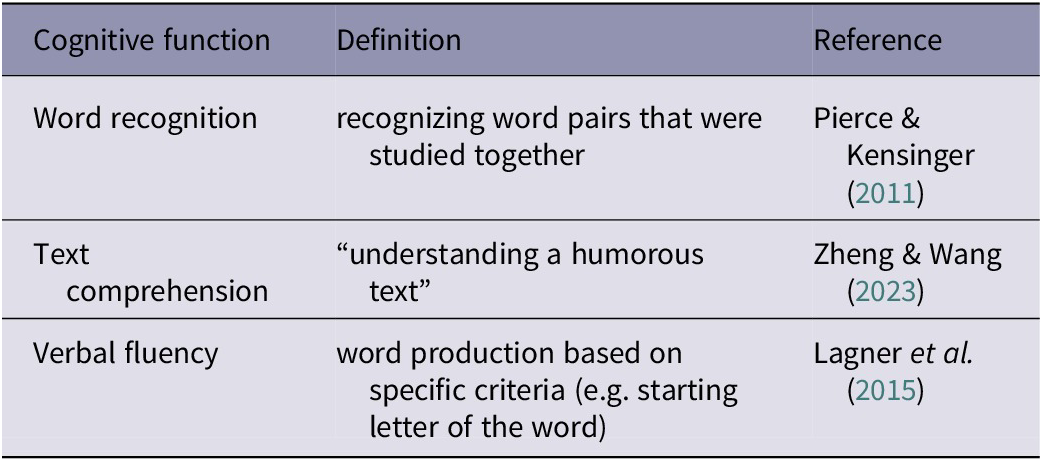
Definitions of human cognitive functions categorised as part of Language

Table 5. Long description
The table consists of three columns: Cognitive function, Definition, and Reference.
Row 1: Cognitive function is Word recognition. Definition is recognizing word pairs that were studied together. Reference is Pierce and Kensinger 2011.
Row 2: Cognitive function is Text comprehension. Definition is understanding a humorous text. Reference is Zheng and Wang 2023.
Row 3: Cognitive function is Verbal fluency. Definition is word production based on specific criteria, for example starting letter of the word. Reference is Lagner et al. 2014.
Definitions of human cognitive functions categorized as part of Memory. We found it hard to distinguish between episodic memory (short and long-term), autobiographical memory and ‘memory of (peripheral/central) details’, so we combined these into one cognitive function

Table 6. Long description
The table consists of three columns: Cognitive function, Definition, and Reference.
* Associative memory: defined as the ability to connect the people, places, and objects comprising an event into a coherent memory. Reference: Pierce and Kensinger 2011.
* Memory decline: defined as the impairment of memory functioning over time. Reference: Hittner et al. 2020.
* Episodic memory and memory for details: defined as recalling script-relevant items from a story and recognising script-irrelevant items, or recalling peripherally or centrally presented details of a story or event, including autobiographical memory. Reference: Danvers and Shiota 2017.
* Prospective memory: defined as remembering to do something at a particular moment or time period in the future. Reference: Ballhausen et al. 2015.
* Short-term memory: defined as the ability to recall information such as details of an event after a short delay. Reference: Crosswell et al. 2021.
* Recognition memory: defined as recalling typical, atypical or unrelated details in a story. Reference: Bless et al. 1996.
* Working memory: defined as the capacity of the mind to store and work on information that a person is currently thinking of. Reference: Au and Tang 2019.
Definitions of the human cognitive functions categorized as part of Problem solving. These are further in the article grouped together under the umbrella term of problem solving as similar tasks were used for all these types of problem-solving

Table 7. Long description
The table consists of three columns titled Cognitive function, Definition, and Reference.
Row 1: Abstract visual problem solving. Definition: solving tasks that involve spatial analysis and manipulation. Reference: Rader and Hughes 2005.
Row 2: Complex problem solving. Definition: acquisition and integration of information, the elaboration and attainment of goals, action-planning, decision-making, and self-management. Reference: Spering et al. 2005.
Row 3: Creative problem solving. Definition: bringing together apparently disparate material in a useful or reasonable but unaccustomed way. Reference: Isen et al. 1987.
Definitions of human cognitive functions categorised as part of Processing

Table 8. Long description
The table consists of three columns: Cognitive function, Definition, and Reference.
* Cognitive conflict processing: defined as processing opposing information sources in the realm of cognition. Reference: Zinchenko et al. 2017.
* Emotional conflict processing: defined as processing opposing information sources in the realm of emotion. Reference: Zinchenko et al. 2017.
* Global-local processing: defined as focusing on global = general features of a stimulus versus focusing on local features = details of a stimulus. Reference: Gasper and Clore 2002.
* Heuristic processing: defined as using heuristics = mental shortcuts for processing information or making judgments. Reference: Griskevicius et al. 2010.
* Self-referential processing: defined as attention to and processing of self-relevant messages; here specifically: openness to viewing negative feedback about weaknesses. Reference: Growney and Hess 2019.
Number of experiments showing positive or negative links between positive affect and the cognitive functions in humans, in comparison to a neutral state. The number of experiments for which this relationship was significant are indicated in brackets. ‘Not useful’ is used for studies for which a direction of effect could not be extracted, with reasons for this provided as superscript letters. Rows in blue reflect cognitive functions deemed most interesting to study in animals (≥4 experiments showing either a positive or negative relationship). The detailed extraction of the scoping review are provided in Supplementary material 1

Table 9. Long description
The table is organized into eight main categories of cognitive functions. Each row lists the function, the number of experiments showing a positive link (with significant results in brackets), the number showing a negative link (with significant results in brackets), and a ‘Not useful’ column for inconclusive data.
* ATTENTION: Includes Alerting (1 positive, 1 negative), Attentional control (1 positive), Attentional breadth (3 positive, 4 negative), Concentration (2 positive), Orienting (1 negative), and Selective attention (8 positive, 1 negative).
* COGNITIVE CONTROL: Includes Cognitive control (3 positive, 3 negative), Cognitive flexibility (6 positive, 1 negative), and Conflict adaptation (3 negative).
* COMPLEX COGNITION: Includes Creativity (6 positive), Fluid intelligence (1 not useful), Global cognitive ability (1 positive), and Metacognition (1 negative).
* JUDGMENT: Includes Anchoring effect (1 negative), Choice blindness (1 negative), Deontological judgment (1 positive), and Utilitarian judgment (1 negative).
* LANGUAGE: Includes Text comprehension (1 positive), Verbal fluency (1 positive, 1 negative), and Word recognition (1 positive).
* MEMORY: Includes Associative memory (1 positive, 1 negative), Episodic memory (6 positive, 4 negative), Memory decline (2 negative), Prospective memory (4 negative), Short-term memory (1 positive, 3 negative), Recognition memory (3 negative), and Working memory (3 positive, 4 negative).
* PROBLEM SOLVING: Problem solving (7 positive, 1 negative).
* PROCESSING: Includes Cognitive conflict processing (1 negative), Emotional conflict processing (1 positive), Global-local processing (2 positive), Heuristic processing (2 not useful), and Self-referential processing (2 positive).
Rows for Selective attention, Cognitive flexibility, Creativity, Episodic memory, and Problem solving are highlighted in blue, indicating they are deemed most interesting for animal studies due to having 4 or more experiments showing a directional relationship.
a ambiguous results; b confound of arousal; c depends on type of positive affect; d depends on age; e affect induction failed; f no means provided from which the direction of the effect could be extracted; g the means of the positive and neutral/control treatments are exactly equal; h the direction of the effect relative to the control treatment is the same for both the positive and negative affect treatment.
General discussion
The purpose of this scoping review was to explore the relationship between positive affect and cognition in humans, as measured by cognitive tests, with the hope of identifying promising avenues for future research into cognitive indicators of positive affect in other species. We identified and defined 33 cognitive functions, which we categorised into eight cognitive groups for ease of reporting, and which were assessed using 63 different cognitive tests, which reflects the diversity in cognitive studies in the human literature (for the detailed cognitive tests, see Supplementary material 1).
Overall, the most promising cognitive functions to further explore in animals in the context of positive affect based on this scoping review seem to be: selective attention for rewarding stimuli, creativity and problem-solving. Other promising cognitive functions include attentional breadth, cognitive flexibility, and memory for central/peripheral details. Some of these cognitive functions can be conceptualised as connected to one another, with a broadening of the thought-action repertoire and perspective paired with an increased reliance on existing knowledge freeing up cognitive space and a loosening of inhibitory control, leading to an increase in flexibility, creativity and ability to problem solve. This is what is suggested by the Broaden-and-Build Theory introduced by Fredrickson (2001). This theory stipulates that positive affect broadens the scope of our thought-action repertoire thereby promoting the building of personal resources such as strong social relationships, competences and resilience (although we have shown above that some of these processes may be specifically linked to low-approach positive affect, and not high-approach positive affect).
Incongruent outcomes were observed between studies for some of the cognitive functions. These discrepancies may be derived from the methodological limitations of the review process. When comparing the results of papers, factors contributing to inter-study variability, such as sample size, population, age of the participants, and the reliability of affect induction in experimental studies were not considered. The latter is of particular significance because establishing a cause-effect relationship, which is possible only in experimental studies, is dependent on the successful manipulation of the variable: here, emotional valence. In studies where positive affect was not assessed following the affect induction, it is uncertain whether a change in positive affect was successfully achieved, and which discrete positive affect was induced. As the diversity in induction methods of positive affect was large, consistent use of these procedures may help support comparisons across studies investigating the same cognitive function.
As less than half of the studies examined discrete emotions, another limitation stems from the lack of a clear definition in studies investigating “positive affect”. Affect can vary across valence, arousal and approach motivation, and studies using this dimensional framework must clarify their position within the core affective space. Positive affect of low- versus high-arousal could have very different consequences for cognition (Russell Reference Russell2003), just like what was observed with low- and high-approach motivation (see above). Many studies provided incomplete descriptions of the target affective state, which further exacerbates the variability between studies and the uncertainty as to which factor is exactly causing this variability. There is also an overlap in the cognitive functions in the sense that they rarely exist without supporting mechanisms. For this reason, it is nearly impossible to design a task that purely measures a single cognitive function alone. Moreover, even though affective states are partially associated with physiological changes (Pace-Schott et al. Reference Pace-Schott, Amole, Aue, Balconi, Bylsma, Critchley, Demaree, Friedman, Gooding, Gosseries, Jovanovic, Kirby, Kozlowska, Laureys, Lowe, Magee, Marin, Merner, Robinson, Smith, Spangler, Van Overveld and VanElzakker2019), they are also dependent on personal interpretations and appraisal processes (Russell Reference Russell2003). Thus, even if all studies tested the same cognitive functions using identical methods, the affective state induced in the participants could be interpreted in ways that are personal to those specific people.
Several knowledge gaps are direct consequences of the exclusion criteria established at the beginning of the search process. By focusing on healthy individuals, studies involving diseases were systematically excluded. This restricts the generalisability of the findings to the broader human population. According to the World Health Organisation (WHO 2022), approximately 970 million people were living with a mental disorder in 2019 worldwide, with anxiety and depression having the highest prevalence. Psychiatric disorders, especially depression and anxiety, have been shown to cause cognitive dysfunction (Chavez-Baldini et al. Reference Chavez-Baldini, Nieman, Keestra, Lok, Mocking, de Koning, Krzhizhanovskaya, CLH, van Rooijen, DJA, Sutterland, KJH, van Wingen, JTW, Vulink and Denys2021). A meta-analysis by Rock et al. (Reference Rock, Roiser, Riedel and Blackwell2014) revealed that cognitive impairment is commonly associated with depression. A study involving 122 students demonstrated that healthy participants significantly outperformed their depressed, anxious, or stressed peers in terms of cognitive control and decision-making; but not attention (Ajilchi & Nejati Reference Ajilchi and Nejati2017). In another study by Fujii et al. (Reference Fujii, Kitagawa, Shimizu, Mitsui, Toyomaki, Hashimoto, Kako, Tanaka, Asakura, Koyama and Kusumi2013), the executive functioning of patients with social anxiety was worse than that of healthy subjects, and their performance correlated with the severity of symptoms. Apart from mental health issues, neurodegenerative diseases are also characterised by cognitive decline. Cognitive impairments can manifest as early as 5 to 9 years before diagnosis (Swaddiwudhipong et al. Reference Swaddiwudhipong, Whiteside, Hezemans, Street, Rowe and Rittman2023). Interestingly, positive affect was found to mitigate neurodegeneration in Alzheimer’s disease when combined with cognitive training (Anthony et al. Reference Anthony, Turnbull, Tadin and Lin2024). Cognitive training activates neuroplasticity mechanisms to delay cognitive decline (Rebok et al. Reference Rebok, Ball, Guey, Jones, Kim, King, Marsiske, Morris, Tennstedt, Unverzagt and Willis2014), and affective stability aids this process. As some symptoms of mental illnesses, such as depressive-like behaviours, can also be observed in several mammalian species (Ilmer & Smoleń Reference Ilmer and Smoleń2025), the presence of such diseases can affect cognitive studies conducted on animals. Even though examining these effects is beyond the scope of this review, it is crucial to consider the presence of mental and neurological disorders as confounding factors when using cognitive methods to test the presence of positive affect, both in humans and other animals.
There has long been a distinction between affective states and traits, where the former refers to feelings at a particular moment, while the latter represents longer-lasting, relatively stable emotional and behavioural dispositions, such as personality traits (Levine et al. Reference Levine, Xu, Yang, Ispas, Pitariu, Bian, Ding, Capotescu, Che and Musat2011; Zhu et al. Reference Zhu, Zheng, Ratner, Li, Estevez and Burrow2024). Although short-term affective states already have the power to alter cognitive functions (as seen from the results of this study), traits also exert a substantial impact. The personality traits of openness, conscientiousness, extraversion, and neuroticism were shown to be associated with specific cognitive abilities in two large samples of 971 participants overall (Simon et al. Reference Simon, Lee and Stern2020). Openness had the largest effect, being positively associated with most cognitive measures. This suggests that higher levels of openness are linked to enhanced general cognitive ability, reasoning, language, and memory. In the same way, studies regarding well-being have been excluded from this review. As well-being “encompasses quality of life and the ability of people and societies to contribute to the world with a sense of meaning and purpose” (World Health Organisation undated) it refers to a longer time-frame than momentary and transient affect. However, in a longitudinal ageing study of 11,234 participants, higher psychological well-being was correlated with better cognitive function across all cognitive domains (time orientation, verbal memory, prospective memory, verbal fluency, numerical ability, cognitive speed and attention) (Llewellyn et al. Reference Llewellyn, Lang, Langa and Huppert2008). Conducting a review to investigate the link between long-term positive affective experience, namely hedonic well-being, and cognition could shed light on the longitudinal implications of personality traits and well-being on cognitive abilities. As demonstrated in past studies, taking personality traits into account in cognitive research on animals is important (e.g. Carere & Locurto Reference Carere and Locurto2011; Dougherty & Guillette Reference Dougherty and Guillette2018).
Can these findings be useful to research in non-human animals? In the human studies investigated in the present review, the interest is in investigating how positive affect influences cognitive function. In the context of animal welfare science, however, the aim would be to find valid cognitive indicators of positive affect in animals (or to use cognitive tasks as enrichment that promotes positive affect). Nevertheless, validation steps would need to investigate whether contexts expected to induce positive affect in animals also cause changes in cognition as predicted from the human literature (Mason et al. Reference Mason, Nielsen and Mendl2026). Judgment (Harding et al. Reference Harding, Paul and Mendl2004), attention (Lee et al. Reference Lee, Verbeek, Doyle and Bateson2016) and memory (Burman & Mendl Reference Burman and Mendl2018) biases have been investigated in the context of animal affect, with judgment bias being arguably one of the most applied and accepted cognitive method currently available to assess positive affect in animals (Mendl et al. Reference Mendl, Burman, RMA and Paul2009; Lagisz et al. Reference Lagisz, Zidar, Nakagawa, Neville, Sorato, Paul, Bateson, Mendl and Løvlie2020). A broadening of the thought-action repertoire has also been researched under the construct of ‘behavioural diversity’, proposed as a promising indicator of positive animal welfare (Miller et al. Reference Miller, Vicino, Sheftel and Lauderdale2020). Creativity and problem-solving have been studied in the context of animal behaviour, animal cognition and comparative psychology, and are seeing increasing interest in the field of animal welfare (Meehan & Mench Reference Meehan and Mench2007; Veissier et al. Reference Veissier, Lesimple, Brunet, Aube and Botreau2024, Reference Veissier, Terlouw, Botreau, Deiss and Cowie2026). The state of flow, i.e. intense engagement balancing skill and challenge, has now received some attention in the animal welfare literature (Hintze & Lee Reference Hintze and Yee2023), and has in humans been proposed to be linked to ‘creative performance’ (Kaufman & Kaufman Reference Kaufman and Kaufman2004). Creativity in animals has been described as intricately linked to curiosity, which can itself be connected to a bold personality and information-seeking, as well as play, which has itself been linked to creating novel experiences (Kuczaj Reference Kuczaj2017) and proposed as preparation for the unexpected (Špinka et al. Reference Špinka, Newberry and Bekoff2001; Ahloy-Dallaire et al. Reference Ahloy-Dallaire, Espinosa and Mason2018). Information-seeking and acquisition have been described in animals for example under the concepts of ‘contra-freeloading’ (Inglis et al. Reference Inglis, Langton, Forkman and Lazarus2001) or enrichment (Veissier et al. Reference Veissier, Lesimple, Brunet, Aube and Botreau2024). Contra-freeloading is the process by which animals choose to work for food that is simultaneously freely accessible. Problem-solving has been studied in the field of animal cognition (e.g. Nawroth et al. Reference Nawroth, Baciadonna and McElligott2016) and has been suggested as a means to improve the welfare of captive animals through the provision of enrichment (Meehan & Mench Reference Meehan and Mench2007). Problem-solving links to promoting competence development (Rault et al. Reference Rault, Bateson, Boissy, Forkman, Grinde, Gygax, Harfeld, Hintze, Keeling, Kostal, Lawrence, Mendl, Miele, Newberry, Sandoe, Špinka, Taylor, Webb, Whalin and Jensen2025) and agency (Špinka Reference Špinka2023) in animals, two increasingly important topics of research in animal welfare science. Agency can be defined as the ability to engage with one’s environment to achieve goals, through choice and voluntary control (Špinka Reference Špinka2023). Research into using creativity and problem-solving measures to assess positive affect in animals will hopefully be further stimulated by the present review. Attentional breadth/scope or selective attention have been studied in dogs (Hamlaoui et al. Reference Hamlaoui, Keeling, Burman and Verbeek2022) and dairy cows (Neave et al. Reference Neave, Rault, Bateson, Jensen and Jensen2023) in the context of affect and welfare. However, we are not aware of work comparing selective attention towards reward-related or non-reward-related stimuli. One very important finding from this scoping review is that certain cognitive functions, e.g. attentional breadth, creativity and memory, are differentially affected by low- and high-approach positive affect. Moreover, two of the other three cognitive functions identified as interesting to translate to animals, i.e. cognitive flexibility and selective attention, were only tested using low-approach positive affect in the human studies we found and explored. Since many animal studies will make use of food rewards and peers as motivators to work in a cognitive task or to induce positive affect, which likely promotes high- rather than low-approach positive affect, this is an important consideration to explore in animal studies. In humans, it was found that when low- and high-approach positive affect differ in their influence on cognition, high-approach positive affect tends to have similar effects as negative affect. Hence, further work needs to dive into cognitive indicators of positive affect in animals, making sure to distinguish low- and high-approach positive affect, to confirm that similar processes are found in humans and other species, before these indicators can be used for the assessment of animal welfare.
The aim of this study was not to do in-depth literature searches for every cognitive function but rather identify as broad as possible a dataset of different cognitive functions studied in the context of positive affect in humans. This means that any translational work towards other species, will need to start with a follow-up in-depth literature search into the cognitive function of interest in humans. Following confirmation that the cognitive indicator does indeed seem to reflect changes in positive affect, the primary concern is whether the cognitive tests used for humans can be modified for animal studies (keeping in mind that each species may require a different test paradigm) or whether novel tests could be devised for animals. Here, a translational approach can prove to be useful, modifying non-verbal cognitive tests from human studies, for example, ones involving young children (Bildiren et al. Reference Bildiren, Bıkmaz Bilgen and Korkmaz2021).
Another challenge that arises from comparing animal and human studies is the evaluation of discrete emotions. There have been arguments about whether human affective concepts, indicators and contexts can be translated to other species (Mendl et al. Reference Mendl, Neville and Paul2022). Some researchers have proposed frameworks to investigate positive states in animals, such as a long-term happiness-like state (Webb et al. Reference Webb, Veenhoven, Harfeld and Jensen2019) and a flow-like state (Hintze & Yee Reference Hintze and Yee2023). Specific behavioural indicators can be used to identify joy-like states in non-human animals (Nelson et al. Reference Nelson, Taylor, Cartmill, Lyn, Robinson, Janik and Allen2023). Knutson et al. (Reference Knutson, Burgdorf and Panksepp1998) observed ultrasonic vocalisations in juvenile rats (Rattus norvegicus) as a sign of anticipating play, a behaviour that is theorised to be analogous to human laughter (Panksepp & Burgdorf Reference Panksepp and Burgdorf2003). In line with this finding, novel methods have the potential to measure specific affective states rather than just general positive affect. One challenge is that discrete emotions are more easily distinguished using verbal questionnaires, as done in human studies. Mendl et al. (Reference Mendl, Burman and Paul2010) offer an integrative framework to categorise discrete (animal) emotions inside the arousal-valence dimensional space. Rooted in human research, this approach can be a valuable tool when aiming to compare human and animal affective states. Neuroscience methods, such as brain-imaging techniques, also provide useful tools to bridge human and other animals’ (at least mammals’) affective experiences (e.g. Berridge & Kringelbach Reference Berridge and Kringelbach2008; Zablocki-Thomas et al. Reference Zablocki-Thomas, Rogers and Bales2022).
Animal welfare implications
This work aims to inspire future research aimed at validating novel cognitive indicators of positive affective states in non-human animals. These future valid indicators could help enhance research into which resources and animal characteristics (e.g. personality traits) are linked to (more frequent) positive affective states in various species, may help validate other types of indicators (e.g. physiological indicators), and may in theory also be used to assess animal welfare in captivity, for example on farms or in zoos. Of course, this type of assessment method would benefit from complementary indicators from behaviour and potentially also from physiology (where these are available in a non-intrusive manner) including indicators of both positive and negative affect which can be collected repeatedly over time to come to a more complete picture of animal welfare.
Conclusion
The aim of the present review was to provide an overview of the relationship between positive affect and cognition in humans, as well as identify a broad variety of cognitive tests to assess various cognitive functions. Overall, 33 cognitive functions and 63 tests were found, and the outcome varies between the cognition groups. Using ‘vote counting based on the direction of effect’, we identified promising links between (low-approach) positive affect and attentional breadth, selective attention, cognitive flexibility, creativity, memory for peripheral vs central details, and problem-solving. Being an exploratory study, definite conclusions cannot be drawn from the above-mentioned results. The synthesising approach used did not consider the magnitude of effect sizes or study sample size (McKenzie & Brennan Reference McKenzie and Brennan2019). It is also possible that the conflicts found within certain cognitive functions may not represent the overall trend due to the small sample size of papers reviewed. Furthermore, publishing bias might skew the perceived significance of the results.
Future research should take several key factors into account. Addressing the importance of arousal, motivation, and intensity of the valence would broaden the understanding of how affective states influence cognition in experimental studies. Another aspect worth exploring is the duration of states induced through various methods, and what this duration is linked to. We moreover identified an important distinction between low- and high-approach positive affect, which should be a key consideration when translating these findings to animals. Additionally, providing precise definitions for affect terms and validating the affect induction methods would strengthen the reliability of testing positive affect using cognitive tests. This exploratory review enabled the identification of a broad range of cognitive functions and tests that could potentially provide indicators of positive states in animals, offering a useful library for future applied ethology research.
Supplementary material
The supplementary material for this article can be found at http://doi.org/10.1017/awf.2026.10135.
Acknowledgements
This work was co-funded by the European Union’s Horizon Europe Project 101136346 EUPAHW. Views and opinions expressed are those of the author(s) only and do not necessarily reflect those of the European Union or the European Research Executive Agency. Neither the European Union nor the granting authority can be held responsible for them. This work as conducted as part of the Joint Internal Project “Assessment of positive welfare defining animal-based measures (SOA13)”. This work is linked to work from the COST Action CA21124 (LIFT: Lifting farm animal lives – laying the foundations for positive animal welfare; https://LIFTanimalwelfare.eu/), supported by COST (European Cooperation in Science and Technology; www.cost.eu). We would specifically like to thank the members of task 1 in the set of activity 13 (positive animal welfare) of the EUPAHW, including the wonderful chair, Prof Margit Bak Jensen, who is also chair of the Cost action LIFT. A previous version of this work was kindly reviewed by Dr Liz Paul (University of Bristol), Dr Liesbeth Bolhuis, Dr Inonge Reimert and Dr Allyson Ipema (Wageningen University and Research), whom we thank warmly.
Competing interests
None.




 Open access

