CHD represents approximately one-third of all major congenital anomalies, with an estimated 1.35 million newborns affected every year.Reference Van Der Linde, Konings and Slager1 Cardiovascular malformations account for about 50% of the deaths due to birth defects in the first year of life.Reference Yang, Chen and Correa2 Approximately 25% of infants with CHD require immediate intervention such as surgery with cardiopulmonary bypass.Reference Moller, Taubert and Allen3 Acute kidney injury is a common complication of paediatric cardiac surgery, occurring in 42% of patients in a multicentre prospective study.Reference Li, Krawczeski and Zappitelli4 In that series, patients with acute kidney injury were more likely to remain on mechanical ventilation for a longer period of time and had longer ICU and overall hospital stays.Reference Li, Krawczeski and Zappitelli4 Beyond the initial morbidity and mortality associated with acute kidney injury following cardiac surgery, studies have demonstrated an association between acute kidney injury and the development of chronic kidney disease.Reference Shaw, Brocklebank and Dickinson5,Reference Greenberg, Coca and Parikh6
Significant advances have been made in the identification of circulating molecules that reflect end-organ injury and function, but more research is needed to identify specific biomarkers and their individual correlations. Determining the relationships between biomarkers and signs of end-organ damage after cardiopulmonary bypass will better allow clinicians to identify patients at risk for adverse secondary outcomes and potentially guide post-operative management to better accommodate these risks. In particular, the association between acute kidney injury and brain injury is important because it could help identify patients at an increased risk of adverse neurodevelopmental outcomes and guide additional developmental interventions for this population. The biomarkers in this study were chosen based on previous research showing correlations with cardiac or end-organ injury after cardiopulmonary bypass in children.
Glial fibrillary acidic protein is an astrocyte intermediate filament protein that is upregulated in settings of central nervous system injuryReference Panickar and Noremberg7 and has been shown to be predictive of neurologic injury in various clinical settings, including after acute strokeReference Herrmann, Vos and Wunderlich8 and cardiac arrest.Reference Kaneko, Kasaoka and Miyauchi9 In neonatal cardiac surgery with cardiopulmonary bypass, elevated post-operative glial fibrillary acidic protein was associated with a worse neurodevelopmental outcome at 12 months of age,Reference Graham, Martin and Atz11,Reference Bembea, Savage and Strouse12 and in paediatric intensive care patients undergoing extracorporeal membrane oxygenation, high serum glial fibrillary acidic protein levels have been associated with acute brain injury and death.Reference Bembea, Savage and Strouse12
Galectin 3 is a β-Galactoside-binding lectin that plays a role in tissue inflammation and fibrosis.Reference Frunza, Russo and Saxena13 Plasma Galectin 3 levels are markedly elevated in patients with heart failureReference van Kimmenade, Januzzi and Ellinor14 and have been associated with long-term mortality in adults.Reference Lok, Lok and De La Porte15 Elevated post-operative Galectin 3 levels have also been shown to improve clinical models for predicting post-operative acute kidney injury in adults undergoing cardiac surgery.Reference Ballmoos, Likosky and Rezaee16
Soluble suppression of tumorgenicity 2 is a member of the interleukin-1 receptor family. It is induced in mechanically overloaded cardiac myoctyesReference Ciccone, Cortese and Gesualdo17 and can protect cardiac function in response to pressure overload.Reference Sanada, Hakuno and Higgins18 In patients with symptomatic heart failure, soluble suppression of tumorgenicity 2 levels correlates with disease severity and can predict the onset of symptomatic heart failure in patients with acute myocardial infarction.Reference Januzzi19 Post-operative soluble suppression of tumorgenicity 2 levels has also been showed to be associated with post-operative risk of acute kidney injury in adults after coronary artery bypass graft surgery.Reference Lobdell, Parker and Likosky20
N-terminal pro b-type natriuretic peptide is the amino-terminal fragment of B-type natriuretic peptide, which is a neuro-hormone secreted by cardiac myocytes in response to wall stress.Reference Januzzi, Van Kimmenade and Lainchbury21 In a previous study examining adults undergoing cardiac surgery, higher pre-operative B-type natriuretic peptide levels were associated with an increased risk of post-operative acute kidney injury,Reference Patel, Garg and Krumholz22 and similar studies in children have identified additional biomarkers associated with an increased risk of post-operative acute kidney injury.Reference Bucholz, Whitlock and Zappitelli23
The present investigation is a single-centre, prospective, observational study examining the relationship of four biomarkers (glial fibrillary acidic protein, Galectin-3, soluble suppression of tumorgenicity 2, and B-type natriuretic peptide) with post-operative acute kidney injury in children undergoing cardiopulmonary bypass.
Materials and methods
Children less than 18 years old undergoing cardiac surgery with cardiopulmonary bypass at Johns Hopkins Hospital were enrolled between July 2011 and July 2014. No patients were excluded. This study was performed with an Institutional Review Board approved waiver of consent.
Heparinised blood samples were collected pre-cardiopulmonary bypass in the operating room and in the post-operative period immediately after decannulation and prior to transfer from the operating room. Glial fibrillary acidic protein was measured as described previously by enzyme-linked immunosorbent assay.Reference Petzold, Keir and Green24–Reference Hori, Everett and Lee29 An electrochemiluminescent immunosorbent assay was developed to measure B-type natriuretic peptide, Galectin-3, and soluble suppression of tumorgenicity 2 on the 96-well plate Meso Scale Discovery platform (N75YA-1; Meso Scale Discovery, Gaithersburg, Maryland, United States of America). Capture antibody-coated plates were blocked with 5% bovine serum albumin-phosphate-buffered saline complemented with 0.05% TWEEN (Croda International PLC, Snaith, UK; PBS-T) and incubated at room temperature on an orbital shaker (500 rpm) for 60 minutes. Calibrators for B-type natriuretic peptide (MSD C01XX-1), Galectin-3 (R&D 840355), and soluble suppression of tumorgenicity 2 (R&D 840760) were produced using commercially provided diluent (MSD R51BB-3) with concentration ranges of 5000–1.22, 4000–0.98, and 8300–2.03 pg/ml, respectively. Samples were diluted 15× in commercially provided diluent (MSD R51BB-3). Calibrators and 15×-diluted samples were added to the plate and incubated for 2 hours on an orbital shaker (500 rpm) at room temperature and washed three times with 150 μl/well with 1× PBS-T. The detection antibody cocktail for B-type natriuretic peptide (MSD D21JK-1), Galectin-3 (R&D 842759), and soluble suppression of tumorgenicity 2 (R&D 840354) was prepared to 1×, 25 ng/ml, and 200 ng/ml, respectively, in commercially provided diluent (MSD R51BA-5) and supplemented with 0.5 µg/ml SA-Sulfo-tag (MSD R32AD-5). Detection cocktail was added to the plates and incubated at room temperature on an orbital shaker (500 rpm) for 60 minutes, protected from light, and then washed three times with 150 µl of 1× PBS-T to remove unbound detection antibodies. Finally, 150 µl of 1× commercially provided read buffer (MSD R92TC-1) was applied, and the plate was promptly read in an MSD Sector Imager 2400. Inter-plate percent coefficient of variation for seven plates was glial fibrillary acidic protein 11%, Gal-3 13%, B-type natriuretic peptide 13.1%, and soluble suppression of tumorgenicity 2 11.2% using an interassay control.
The main outcome analysed in this study was any acute kidney injury, defined as a rise of serum creatinine ≥50% or 0.3 mg/dl from pre-operative baseline within 7 days after surgery.Reference Molitoris, Levin and Warnock30 Surgical complexity was categorised using The Society of Thoracic Surgeons-European Association for Cardio-Thoracic Surgery scores.Reference Jacobs, Mayer and Mavroudis31 The acute kidney injury versus non-acute kidney injury groups were compared for need for post-operative dialysis, ICU length of stay, hospital length of stay, mortality, complication rate, and reoperation rate using Pearson’s chi-square test for dichotomous characteristics and Student’s t-test for continuous variables. Biomarker levels were compared via univariate logistic regressions and a multivariate logistic regression adjusted for age (in days), weight (kg), and The Society of Thoracic Surgeons-European Association for Cardio-Thoracic Surgery category. Statistical analysis was completed with Stata Version 14.2 (StataCorp LLC, College Station, TX, USA).
Results
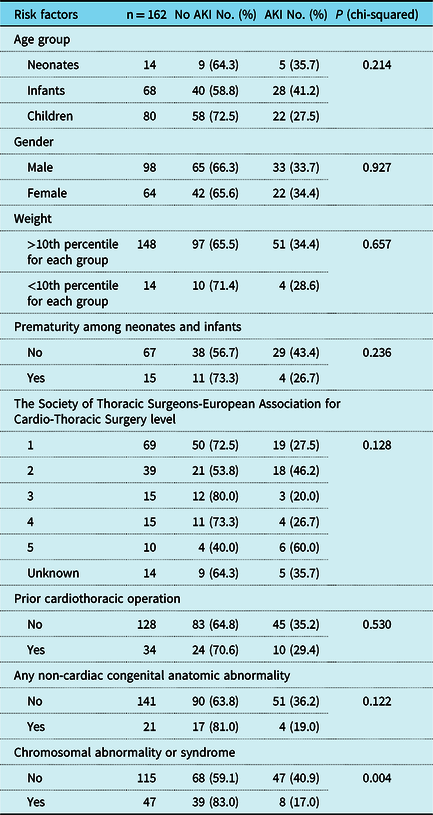
As shown in Table 1, 162 patients with a mean (±sd) age 4.05 years (±5.28 years) were enrolled over 3 years. Ninety-eight (60%) of the patients were male. Cardiac surgery STAT (The Society of Thoracic Surgeons-European Association for Cardio-Thoracic Surgery) levels were 1–2 in 108 children (67%) and 3–5 in 40 children (25%), 159 with 14 (9%) unknown. Out of the 162 patients enrolled, 55 (34%) patients developed acute kidney injury. On univariate analysis, development of acute kidney injury was not associated with age (p = 0.214), gender (p = 0.927), or weight less than the 10th percentile for age (p = 0.657).
Patient characteristics by AKI status

AKI = acute kidney injury.
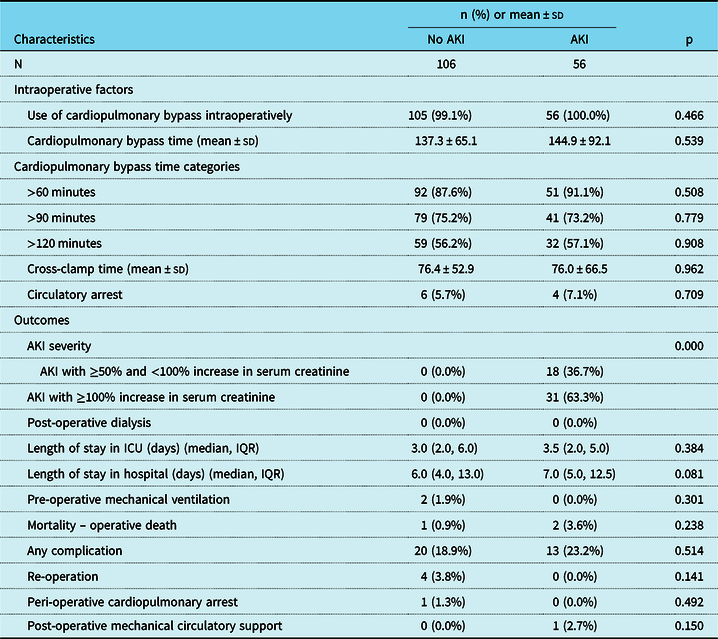
The relationship between intraoperative factors and outcomes by acute kidney injury status is shown in Table 2. The developmental of acute kidney injury was not associated with cardiopulmonary bypass time (p = 0.539), cross clamp time (p = 0.962), or circulatory arrest time (p = 0.709). None of the included patients required dialysis. Patients with acute kidney injury on average had a longer length of hospital stay (p = 0.081) and ICU stay (p = 0.384), but neither result reached statistical significance. There were three operative deaths: two in the acute kidney injury group and one without acute kidney injury. Rates of complications, re-operations, peri-operative cardiopulmonary arrest, and post-operative mechanical circulatory support were not significantly different between the two groups.
Intraoperative factors and outcomes by AKI status

AKI = acute kidney injury; IQR = inter-quartile range; sd = standard deviation.
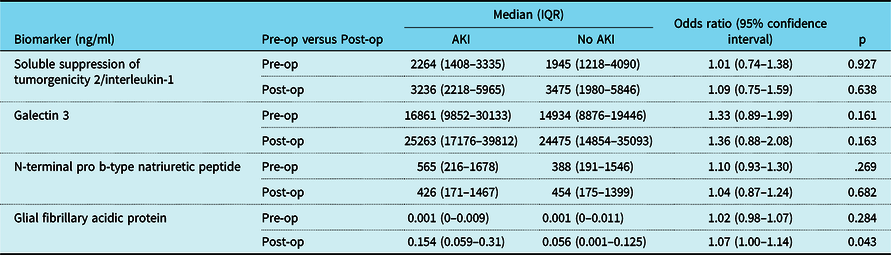
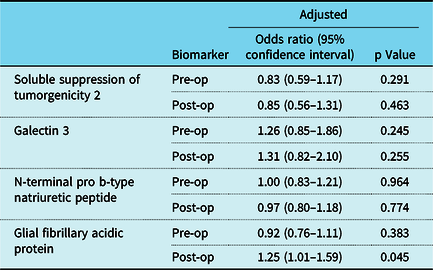
Table 3 shows median and inter-quartile ranges for all biomarkers, separated by acute kidney injury status. Post-operative glial fibrillary acidic protein levels were significantly higher in patients with acute kidney injury (median 0.154 (inter-quartile range, 0.059–0.31) ng/ml) compared to those without acute kidney injury (median 0.056 (inter-quartile range, 0.001–0.125) ng/ml) (p = 0.043). Pre-operative and post-operative Galectin-3, soluble suppression of tumorgenicity 2, and B-type natriuretic peptide did not significantly differ between patients with and without acute kidney injury. To determine if circulating cardiac and brain biomarkers have a relationship with acute kidney injury, we explored pre- and post-operative biomarker values stratified by acute kidney injury status. Using univariate biomarker regressions with any acute kidney injury as the outcome, elevation in post-operative glial fibrillary acidic protein was significantly associated with subsequent acute kidney injury (odds ratio, 1.07; 95% confidence interval 1.00–1.14). There was no significant association between elevation in pre-operative glial fibrillary acidic protein and subsequent acute kidney injury (odds ratio 1.02; 95% confidence interval 0.98–1.07). Pre- and post-operative levels of galectin 3, soluble suppression of tumorgenicity 2, and B-type natriuretic peptide were not significantly associated with post-operative acute kidney injury. Biomarker associations with acute kidney injury status were also adjusted for the clinically relevant covariates of age (in days), weight (kg), and The Society of Thoracic Surgeons-European Association for Cardio-Thoracic Surgery category (Table 4). All biomarkers are listed in log-continuous form. In this adjusted model, post-operative glial fibrillary acidic protein remained significantly associated with acute kidney injury (odds ratio 1.25; 95% confidence interval 1.01–1.59). Soluble suppression of tumorgenicity 2, Galectin3, B-type natriuretic peptide, and pre-operative glial fibrillary acidic protein again did not reach statistical significance.
Median and IQR biomarker levels by AKI status

AKI = acute kidney injury; IQR = inter-quartile range.
Biomarkers associations with acute kidney injury adjusted for age (in days), weight (kg), and The Society of Thoracic Surgeons-European Association for Cardio-Thoracic Surgery category

IQR = inter-quartile range; kg = kilogram.
Discussion
Our study sought to explore the association between pre- and post-operative levels of four brain and heart biomarkers with acute kidney injury in children undergoing cardiac surgery with cardiopulmonary bypass. Of the biomarkers tested, we found post-operative glial fibrillary acidic protein levels to be associated with subsequent development of acute kidney injury.
Abnormal neurodevelopmental outcomes are common in children with CHD,Reference Limperopoulos, Majnemer and Shevell32 and neurodevelopmental disability is the most common morbidity for survivors of CHD surgery.Reference Gaynor, Stopp and Wypij33 Significant effort has been spent attempting to identify the mechanisms for cerebral injury after undergoing bypass. Similar to the causes of cerebral injury after bypass surgery, a wide range of mechanisms have been identified as potential causes of acute kidney injury. Mechanisms for cardiac surgery associated acute kidney injury include peri-operative renal ischaemia and reperfusion injury as well as emboli secondary to aortic cannulation and cross-clamping. Cardiopulmonary bypass can also lead to haemolysis and pigment nephropathy, oxidative stress, and inflammation.Reference O’Neal, Shaw and Billings34–Reference Billings, Yu and Byrne36 The kidneys are particularly vulnerable to the systemic inflammation seen during bypass, and previous research has linked elevations in post-operative inflammatory cytokines with both a subsequent diagnosis of acute kidney injury and increased mortality.Reference Zhang, Garg and Coca37 The overall rate of acute kidney injury in our cohort (34%) was consistent with previously published prospective, observations studies of post-cardiac surgery kidney injury.Reference Li, Krawczeski and Zappitelli4 The rate of acute kidney injury did not reach significance across The Society of Thoracic Surgeons-European Association for Cardio-Thoracic Surgery levels.
We demonstrate that higher post-operative plasma glial fibrillary acidic protein was significantly associated with an increased risk of acute kidney injury. The association of glial fibrillary acidic protein levels in the immediate post-operative period and subsequent acute kidney injury reveals multi-organ injury in the presence of acute kidney injury with possibly a common mechanism of injury. Elevations in glial fibrillary acidic protein were present immediately after decannulation and occurred prior to changes in creatinine in the setting of kidney injury. The elevated glial fibrillary acidic protein levels in our cohort suggest the presence of neurologic injury in the intraoperative periodReference Vedovelli, Padalino and Suppiej10,Reference Graham, Martin and Atz11 with long-term neurodevelopmental consequences.
The brain and the kidneys are both vulnerable to injury during cardiopulmonary bypass, and there are several common physiologic pathways to explain why damage to these organ systems might occur simultaneously. Both organs are sensitive to the hypoxic damage secondary to systemic hypotension that is commonly seen in the intraoperative and immediate post-operative period. Prolonged low oximetry numbers obtained during cardiac surgery via renal near-infrared spectroscopy have been shown to correlate with subsequent acute kidney injury in infants.Reference Ruf, Bonelli and Balling38 Vascular beds in the brain and the kidneys are similarly susceptible to injury from emboli, as aortic cross-clamping will typically occur proximately to the blood supply to both. Other systemic insults with the potential to injure both the brain and the kidney include hyperglycaemia and the diffuse inflammatory response associated with surgery in general and the bypass circuit in particular. The correlation between elevated glial fibrillary acidic protein levels and acute kidney injury in our cohort highlights the presence of multi-organ dysfunction in children after undergoing cardiopulmonary bypass operations and could have important clinical implications regarding the likelihood of additional adverse outcomes.
No statistically significant association was found between pre- or post-operative levels of Galectin 3, soluble suppression of tumorgenicity 2, or B-type natriuretic peptide with acute kidney injury. The odds ratios for pre- and post-operative galectin 3 were 1.33 and 1.36, respectively, but did not reach statistical significance. B-type natriuretic peptide, Galectin-3, and soluble suppression of tumorgenicity 2 have all been associated with severity of heart failure,Reference Lok, Lok and De La Porte15,Reference Ky, French and Mccloskey39,Reference Bayes-genis, Pascual-figal and Januzzi40 and B-type natriuretic peptide has additionally been shown to correlate with mortality after cardiac surgery.Reference Schachner, Wiedemann and Fetz41 The lack of significant association between these biomarkers and subsequent acute kidney injury could suggest that the mechanism of kidney dysfunction is independent of both cardiac stress during bypass and heart failure after bypass. It is also possible that the blood samples were obtained prior to the point at which acute markers of cardiac stress would be most elevated. Galectin-3 in particular plays an important role in cardiac fibrosis and remodellingReference Cohn, Ferrari and Sharpe42 and may not reflect the acute cardiovascular changes that occur in the immediate pre- and post-operative periods. Another potential explanation for the lack of significance is that our study was under-powered to detect this association with acute kidney injury.
Our study has several limitations. Our cohort consisted of patients undergoing surgery at a single location, which does not account for practice variations across multiple centres or regional differences in patient population. Our study did not include information about neurological injuries noted in the post-operative period, which could be useful clinical information given the noted elevation in glial fibrillary acidic protein. Further studies are needed to evaluate the clinical relevance and potential neurodevelopmental sequelae associated with elevated glial fibrillary acidic protein levels, especially in non-neonatal cardiac surgery.
In summary, we found that post-operative glial fibrillary acidic protein elevation immediately after children undergo cardiopulmonary bypass is associated with subsequent acute kidney injury. This suggests sub-clinical intraoperative brain injury which may occur in the context of acute kidney injury-associated end-organ dysfunction. In addition to post-operative glial fibrillary acidic protein elevation serving as a potentially useful predictor of subsequent acute kidney injury, the presence of acute kidney injury could also serve as a sign of concurrent brain injury and help guide future neurodevelopmental follow-up. Future studies should investigate the role of glial fibrillary acidic protein at later time points after cardiac surgery to study the associations with short- and long-term neurological outcomes.
Acknowledgements
None.
Financial Support
This research received no specific grant from any funding agency, commercial or not-for-profit sectors.
Conflicts of Interest
None.
Ethical Standards
The authors assert that all procedures contributing to this work comply with the ethical standards of the relevant national guidelines on human experimentation and with the Helsinki Declaration of 1975, as revised in 2008, and has been approved by the institutional committees (Johns Hopkins Institutional Review Board).