INTRODUCTION AND RESEARCH QUESTION
Did politically active financial institutions receive better terms from the US Department of the Treasury (“Treasury”) in the administration of the Troubled Assets Relief Program (TARP)? Although previous studies have suggested that political connections and activity affected the US government's intervention into the private sector throughout the financial crisis of 2007–2009, this study concludes the opposite. That is, financial institutions' political activities cannot explain any variance in the price Treasury received as a percentage of market value for warrants (a type of financial asset) acquired through the Capital Purchase Program (CPP), a key element of TARP. Additionally, Treasury is more likely to auction the warrants of politically active firms. This is significant: a systematic application of discounts to politically active firms would cost taxpayers billions of dollars.Footnote 1
TARP INITIATION
On September 15, 2008, the global financial community was shaken to the core by the news that Lehman Brothers had declared Chapter 11 bankruptcy and that Merrill Lynch had only been saved from doing so itself by a last-minute fire sale to Bank of America. AIG, the largest insurer in the world, and Washington Mutual, the country's largest savings-and-loan institution, were also in the process of collapsing. In response to this historic news, secretary of the treasury Henry Paulson requested and, although initially declined, ultimately granted up to $700 billion from Congress to create TARP. His initial plan was to purchase financial institutions' “illiquid mortgage assets” (Paulson Reference Paulson2008).
However, less than two weeks after Paulson was granted this money, Treasury announced it would instead directly recapitalize financial institutions (i.e., provide them with cash injections) through the CPP. In exchange for providing financial institutions with cumulatively up to $250 billion in direct injections of capital, Treasury would receive preferred stock entitling it to a dividend (i.e., interest payment) of 5% of the principal per year for the first five years and 9% thereafter.Footnote 2 Financial institutions also typically gave Treasury warrants (the focus of this study), which are akin to call options enabling Treasury to purchase the institution's common stock at any point within a 10-year window. The purchase price for these shares is equal to the 20-day trailing average of the firm's common stock trading price at the time of the deal, and its overall initial value was equal to 15% of the total capital injection (equal to the principal of the preferred stock investment). The warrants were explicitly included in the deal to ensure Treasury (and taxpayers) gained from any appreciation in the financial institution's market value.
WHAT IS A WARRANT?
To conceptualize the value of warrants, let us examine the valuation of the Goldman Sachs' warrants. After injecting $1.1 billion on October 28, 2010, Treasury received the right to buy 12,205,045 shares of Goldman Sachs common stock at $122.90 per share. After Goldman Sachs paid back Treasury the $1.1 billion, it began negotiations to repurchase its warrants. On July 21, 2009, when an agreement on the warrant repurchase was reached, the company's stock closed at the price of $159.80 per share. This price made the Treasury warrants worth $450,366,161 if exercised that day ([159.80 − 122.90] * 12,205,045 shares). However, the warrants were valid for another 9 years, enabling the holder to buy the company's stock at $122.90 at any point before October 28, 2018. Thus, the purchase price reflected a belief that the stock would rise as high as exactly $213.03 in that time frame (more on this deal in the case study below).
WHO REPURCHASES THE WARRANTS?
According to Treasury, about 8,400 total institutions could have participated in the CPP, including 1,800 publicly traded entities and 3,475 financial institutions with private with institutional shareholders. Ultimately, 707 institutions decided to participate and 273 exchanged preferred stock and warrants for Treasury capital.Footnote 3 Of the 273 participating firms that exchanged warrants, 99 financial institutions have redeemed their preferred stock (i.e., paid back Treasury's capital). And Treasury has sold or auctioned 80 of those firms' warrants.Footnote 4
HOW DOES TREASURY ADMINISTER WARRANT SALES?
Within 15 days of a financial institution redeeming the preferred stock held by Treasury, it must submit a bid to repurchase its warrants. Treasury has 10 days to accept or reject the offer, but does not produce a counter offer. The Office of Financial Stability's Warrant Committee evaluates financial institutions' bids, comparing the bid submitted to their own estimate of the market value along with that of their consultant. Then the committee makes a recommendation to the Assistant Secretary for Financial Stability, who formally decides to accept or reject the offer.Footnote 5 If a financial institution decides not to repurchase its warrants or Treasury and the financial institution cannot agree to a price for the assets, Treasury has the option to auction them or sell them to a third party. Although this offers a greater chance for Treasury to receive fair market value, the costs of conducting an auction are significant: the higher of $150,000 or 1.5% of the auction's proceeds.Footnote 6
IS THERE PREFERENTIAL TREATMENT FOR POLITICALLY ACTIVE FIRMS?
Scholarship on the ability of private sector actors to influence bureaucrats has been a recent area of emphasis for both political scientists and economists. This literature generally indicates that political connections are important in developing countries in which political institutions are not robust enough to prevent nepotism and corruption (Fisman Reference Fisman2001; Khwaja and Mian Reference Khwaja and Mian2004; and Krueger Reference Krueger1974). Conversely, most research that focuses on the United States suggests that the connections between firms and policy makers typically do not lead to a substantively important market advantage (Beck Reference Beck1991; Fisman et al. Reference Fisman, Fisman, Galef and Khurana2006; and Rich Reference Rich1989). Still, others do acknowledge that interest groups can influence the bureaucracy (Carpenter Reference Carpenter2004; Gormley Reference Gormley1983; Jayachandran Reference Jayachandran2006; Lowi Reference Lowi1979; Roberts Reference Roberts1990; Scholz, Twombly, and Headrick Reference Scholz, Twombly and Headrick1991), especially if they come from the constituencies they serve (Carpenter Reference Carpenter2001).
More recently, however, scholars have suggested that the typical neutralizing effect of American governmental institutions on political influence has been diminished during the response to the financial crisis. Jacobs and King (Reference Jacobs and King2009) suggest “the American state's weak administrative capacity … hobbled the efficacy of [their] attempts to rescue and constitute the financial sector moving into the future” (280). Several authors provide empirical evidence consistent with these claims. Acemoglu et al. (Reference Acemoglu, Johnson, Kermani, Kwak and Mitton2010) show that investors perceived that connections between financial institutions and President-elect Obama's nominee for secretary of the treasury, Timothy Geithner, would enable those firms to receive preferential treatment in the administration of TARP. Veronesi and Zingales (Reference Veronesi and Zingales2010) maintain that the earliest and biggest recipients of CPP funding received disproportionate benefits from their participation. Similarly, Duchin and Sosyura (Reference Duchin and Sosyuraforthcoming) contend that financial institutions' political influence led to a greater probability of receiving CPP funds.
In the context of the warrant disposition process, however, several factors point to Treasury being impartial. First, Congress engaged in robust oversight of sales of the CPP warrants through the Congressional Oversight Panel (COP), an entity created at the same time as TARP and charged with examining Treasury's administration of TARP. The COP has been vocal in its opposition to deals in which its members believe the Treasury was insufficiently aggressive in negotiating. The panel's July 2009 report clearly expressed such displeasure, as did its members in their public statements on this issue. They believe this has had an impact: COP chair Elizabeth Warren (Reference Warren2009) testified, “Since our report was published, Treasury seems to have begun conducting its warrant negotiations more aggressively.”Footnote 7 This is consistent with McCubbins and Schwartz (Reference McCubbins and Schwartz1984), who suggest Congress can engage in effective expost oversight of the bureaucracy.
Congresspersons have also been providing direct oversight on their own, holding committee hearings and issuing pointed public statements. Reflecting the sentiments of many policy makers, congressman John Klein (D-FL) remarked, “taxpayers [should] receive the maximum return for the risk that they took” (“TARP Oversight” 2009). Similarly, congresswoman Judy Biggert (R-IL) noted her “concerns that taxpayers may not be getting the best possible return” and that “Treasury [may] lack the internal controls needed to measure whether a high enough price was set for warrant repurchases or sales” (“TARP Oversight” 2010). Oversight of Treasury in congressional committee hearings having an impact on the deals would not be unprecedented (Kaufman Reference Kaufman1981; Wood and Waterman Reference Wood and Waterman1994).
Moreover, as Congress often does (McCubbins, Noll, and Weingast Reference McCubbins, Noll and Weingast1987), it has used its legislative powers to force Treasury to change its approach to the warrant sales. After the public learned of the warrant repurchase deal between Treasury and Old National Bancorp on May 8, 2009, in which Old National Bancorp may have received up to an 80% discount, senator Jack Reed (Reference Reed2009) successfully introduced an amendment that mandated Treasury “sell or exercise the warrants at [its] discretion … to ensure the best return for taxpayers.” Put simply, Treasury's actions were not independent of Congress (Weingast and Moran Reference Weingast and Moran1983).
Treasury itself is responsive to President Obama (Howell Reference Howell2003; Lewis Reference Lewis2007; Moe Reference Moe, Chubb and Peterson1985; Moe and Lewis Reference Moe, Lewis and Nelson2009), who is concerned with public sentiment regarding the generally unpopular TARP. Taking cues from Obama, Secretary Geithner (Reference Geithner2009) stated Treasury wanted “to see the capital base of our financial system return to private hands as quickly as possible,” while also obtaining a “positive return from the government's investments in banks.” In addition, the officials helping the assistant secretary make the decision on the warrant deals are skilled economists and financiers with strong professional norms and incentives that reward them for impartiality (Wilson Reference Wilson1989). Finally, the conjecture that the media's attention on TARP has affected the warrant deals is consistent with Wood and Waterman (Reference Wood and Waterman1994). Overall, the literature leaves us with an open question: did political influence affect Treasury's disposition of the CPP warrants?
DEPENDENT VARIABLE
For my dependent variable, I measure the price that Treasury received for the warrants as a percentage of their estimated market value (“deviant payment”). Theoretically, the mean of deviant payment should be statistically indistinguishable from one. If it is greater than one, Treasury received a surplus for the warrant, whereas a deviant payment less than one implies Treasury received less than it should have.
The first source of the estimates of market value is from the COP, which has estimates of market value for the 72 deals completed prior to March 2011 (Congressional Oversight Panel 2011). Second, Treasury officials have used their own model to calculate the fair market value of the 57 warrants that were sold directly back to the issuing financial institution. For the 20 warrants that were auctioned, I also include a value for Treasury's estimate of deviant payment.Footnote 8 Because financial institutions prefer to pay the least amount possible for the warrants, it can be assumed that the net profit Treasury receives from the auction is perceived to be at least the lower bound it would accept through bilateral negotiations.Footnote 9 Finally, I use the estimate of warrants' market value from the third party consultants hired by Treasury to help it evaluate the 57 bilateral deals. Although the Treasury and the third party use a binomial model adjusted for American style options and the COP uses a Black-Scholes model, each has been professionally certified as valid (COP 2009; Jarrow Reference Jarrow2009). The main substantive difference in the models, other than differing expectations of the future, is the use of liquidity discounts for smaller firms whose shares are not traded on a deep market.Footnote 10 The third party experts apply liquidity discounts to fewer warrants than Treasury, while the COP never uses them in its model.
The COP's estimate of deviant payment suggests that Treasury is typically getting less than it should, although there is large variance (see table 1). Meanwhile, it appears that Treasury has made its decisions on accepting offers for warrants based on its own numbers rather than those of the third party, hence the median and mean of its estimate of deviant payment being just above 1 while the third party's are slightly lower. On this note, each deal Treasury accepted bilaterally was at least above its low estimate of the value, but not always above the third party's low estimate.
Dependent Variable Summary Statistics

INDEPENDENT VARIABLES
My hypothesis is that Treasury officials accept lower prices for warrants from financial institutions that are politically active. To measure political activity, I first account for campaign contributions from employees of financial institutions participating in the CPP to President Obama's 2008 campaign.Footnote 11 Although this is an admittedly blunt measure, contributions have been shown to be a fairly effective proxy for political influence (Cooper, Gulen, and Ovtchinnikov Reference Cooper, Gulen and Ovtchinnikov2010; Ovtchinnikov and Pantaleoni Reference Ovtchinnikov and Pantaleoni2011) and have been used by other authors studying the CPP (Duchin and Sosyura forthcoming). Data on individual contributions were collected from the Sunlight Foundation's Transparencydata.com. Second, I include a variable to account for firms' lobbying expenditures on TARP. I collected this data using the Lobbying Disclosure Act Database published on the Senate website. In my data, I only include lobbying expenditures that were completed in or before the quarter of the warrant repurchase or auction.
I also measure the number of personal relationships that exist between representatives of financial institutions and Secretary Geithner. Acemoglu et al. (Reference Acemoglu, Johnson, Kermani, Kwak and Mitton2010) provide these data, which they originally collected from Muckety.com. They define this variable as “known connections between Geithner and an individual or potential connections in that Geithner and the individual are associated with the same organization” (Ibid, 68). This variable is also highly collinear (correlation of 0.97) with the number of formal appointments between Secretary Geithner and financial institutions' representatives between January 2009 and March 2010 (“Data Sets” 2010).
Throughout its administration of the CPP Treasury has been determined to not only end its investments in financial institutions quickly but also to attain profitability for the program. With more capital outstanding, Treasury is expected to accept lower offers for the warrants to get more money back. As it receives more of its invested capital back, Treasury may lose this sense of desperation and focus on receiving higher prices. Thus, I have calculated the amount of capital outstanding on the day before each deal using Treasury's TARP Transaction Report (2011), subtracting capital injections into financial institutions (from zero), and then adding back the repaid principal, dividends, and proceeds from the warrant dispositions.
Public pressure has also seemingly affected Treasury's decisions. Therefore, I measure the press coverage of a given warrant sale, calculating the number of articles that come up in a search for “financial institution name” + “warrants” + “TARP” in the Lexis Nexis database (there is a cap of 1,000 in these searches that is reached six times).Footnote 12 I also account for the number of Google searches for “TARP” in the week of the repurchase using Google Trends (fixed scale). Both of these measures are expected to positively correlate with deviant payment.
I also account for the possibility that the level of pressure Congress exerts on Treasury has affected the nature of the warrant deals. I measure ties between members with possible influence over TARP and the financial institutions participating by adding a dummy variable for banks that are headquartered in relevant congresspersons' districts. I define “relevant” congresspersons as members of the House's leadership, Financial Services Committee, or the Oversight and Government Reform Committee's Subcommittee on TARP, Financial Services, and Bailouts of Public and Private Programs. I also include a dummy for deals completed prior to the COP's July 10, 2009, report on the warrant deals to see if this report and the subsequent increase in public attention had an impact. Finally, for the sake of robustness, I include a dummy for financial institutions with representatives who are members of the Democratic Party.
CONTROLS
Regarding firm-specific data, I include measures of profitability, leverage, and log of total assets. These financial data were collected from the Wharton Research Data Services' COMPUSTAT database using the most recent SEC disclosure prior to the warrant deal. I also include a dummy variable for nonbank financial institutions. Finally, I account for the state of the equity market with regards to firms in the financial sector by including data from Yahoo! Finance on the trading price of XLF, a SPDR (a type of exchange traded fund) that tracks the performance of financial services stocks. I used the closing price of XLF on the day before the warrant deal. Summary statistics for all independent and control variables are available in Section A of the online appendix on the author's website (http://stanford.edu/~lpuente/Lucas_Puente/Data_files/Online_Data_Appendix.pdf), along with bivariate scatter plots.
DATA ANALYSIS
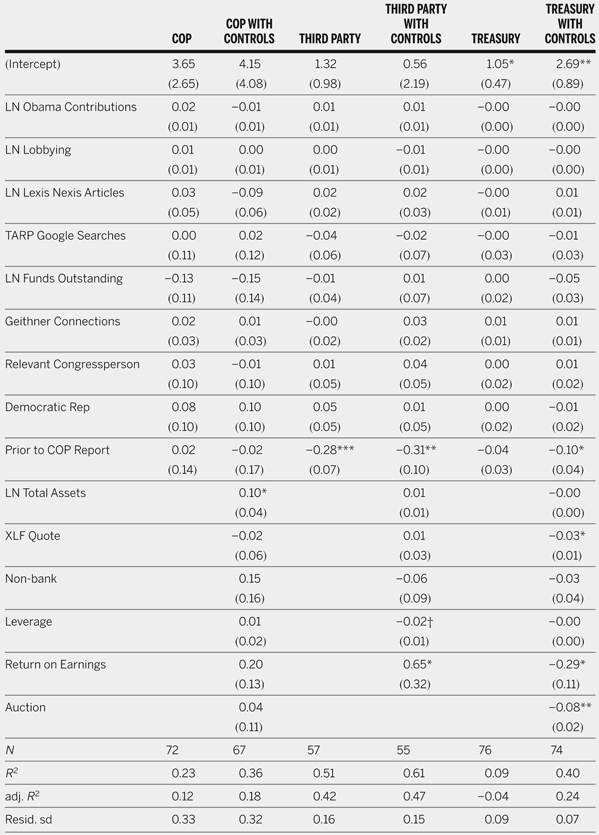
My OLS regressions are remarkable for their lack of findings. If political activities mattered, the coefficients for the contributions, lobbying, connections, articles, and searches variables should be statistically significant and positive. However, none of the independent variables are ever significant, regardless of which estimate of deviant payment is used.
On the control variables, the specification of the dependent variable produces two substantively interesting differences. First, when using the COP's estimate of deviant payment (columns 1, 2 in table 2), the only variable that is significant at conventional levels is the log of total assets: this finding indicates larger banks paid higher prices. This finding goes away when using the estimates from this third party and the Treasury (columns 3–6 of table 2). This is not surprising given that the COP's model did not use a liquidity discount, whereas the other two models did. Second, evidence indicates that the warrant deals that occurred prior to the July 2009 COP report were systematically discounted. This is not unexpected, as qualitative evidence presented earlier suggested Treasury became more assertive after this report was released.
DV: Deviant Payment

Standard errors in parentheses.
† Significant at p < .10;
* p < .05;
** p < .01;
*** p < .001
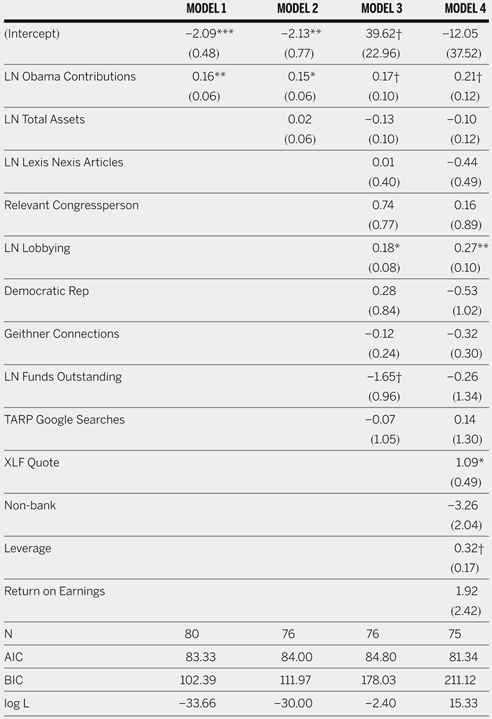
The final step of my empirical analysis was to investigate the conditions under which Treasury auctioned warrants. Logistic regressions (see table 3) demonstrate conclusively that political variables were important: the coefficients for contributions to President Obama's campaign and lobbying expenditures on TARP are both consistently positive and statistically significant. This indicates Treasury was more likely to auction off the warrants of the most politically active firms. Also, the positive XLF quote coefficient suggests auctions were more likely when financial institutions' stocks were doing well.
DV: Auction (Y/N)

Standard errors in parentheses.
† Significant at p < .10;
* p < .05;
** p < .01;
*** p < .001
By selling these firms' warrants in auctions, Treasury deliberately chose not to engage in or complete negotiations with firms behind closed doors. Ostensibly, Treasury officials understood that selling the warrants of politically active firms in the open marketplace would preempt allegations by watchdogs that it was engaging in preferential treatment or impropriety. Furthermore, auctions have been marked by “robust competition between a large number of bidders” and have consistently yielded “fair market value” for the warrants (US Treasury 2010). Correspondingly, according to the COP, auctioned warrants have a statistically significantly higher mean than nonauctioned warrants, although there is no difference when using the third party's estimate (see box plots in the online appendix).Footnote 13 Put simply, this finding provides more evidence that is inconsistent with the conjecture that politically active firms received preferential treatment in TARP.
A CASE STUDY
Perhaps the most politically well-connected financial institution that participated in the CPP is Goldman Sachs. Henry Paulson was the CEO of Goldman Sachs before coming to Treasury and Neel Kashkari was previously a vice president. Goldman Sachs' ties to the Obama administration were also extensive: alumni include Secretary Geithner's chief of staff, Mark Patterson; Gary Gensler, the Obama-appointed chairman of the US Commodity Futures Trading Commission; Diana Farrell, a deputy director of the National Economic Council; and David N. Miller, who served as the chief investment officer of TARP. Moreover, Goldman Sachs' employees and PAC gave the second most amount of money to President Obama's 2008 campaign and gave four times more to Obama than to Senator McCain (Yoon Reference Yoon2010). In addition, its representatives had the second most meetings of any institution with Geithner between January 2009 and March 2010.
Such connections prompted Lawrence Jacobs, professor of political science at the University of Minnesota to comment, “almost everything that the White House has done has been haunted by the personnel and the money of Goldman … as well as the suspicion that the White House, particularly early on, was pulling its punches out of deference to Goldman and its war chest” (Gordon Reference Gordon2010). Similarly, columnist David Brooks (Reference Brooks2008) wrote, “people from Goldman Sachs have assumed control over large parts of the federal government.” Even Rush Limbaugh (Reference Limbaugh2010) claimed that the company is “in bed with the Obama administration.”
Despite the close connections between the administration and Goldman Sachs, Treasury did not exhibit any favoritism in evaluating the company's bids for its warrants. Treasury declined Goldman's first two offers of $600 million and $900 million, despite the latter amount being just below Treasury's estimate of the warrants' value of $902 million. Treasury ultimately accepted a bid of $1.1 billion, an amount far above its estimate of fair market value as well as that of the third party. The COP's estimated deviant payment amount for this deal of 0.975 is still above the 75th percentile of deals. Thus, despite extensive connections with the Obama administration, Goldman Sachs did not receive preferential treatment from Treasury. As one of their spokesmen put it, “We're proud of our alumni, but frankly, when they work in the public sector, their presence is more of a negative than a positive for us” (Creswell and White Reference Creswell and White2008).
CONCLUSION
Contrary to what would be predicted by much of the recent literature investigating the role of political influence in the administration of TARP, political variables cannot explain variance in the price that Treasury received for financial institutions' warrants. In fact, it seems as if Treasury acted impartially and transparently in this context; they were more likely to auction the warrants of politically active firms. These results for the political variables lend support to earlier authors, who argue that American institutions are able to sufficiently neutralize direct and indirect attempts by government officials to favor their friends (e.g., Fisman et al. Reference Fisman, Fisman, Galef and Khurana2006). Beyond the academic community, this finding should reassure many Americans who believe that our nation's financial institutions have recently been beneficiaries of political favoritism by members of both parties. So the next time you hear about the “takeover of Washington by Wall Street” (Johnson and Kwak Reference Johnson and Kwak2010) be assured that, in this case, this has not happened.
ACKNOWLEDGMENTS
I would like to thank Stephen Haber, John Kendall, David Laitin, Terry Moe, Jonathan Wand, Nan Zhang, and participants in the Methods in Comparative Politics seminar and International Relations Workshop at Stanford University for helpful comments. The author, of course, assumes all responsibility for any errors.