Introduction
Timing of seed germination is essential in the life cycle of plants to ensure that seeds germinate at the most favourable period for seedling establishment (Fenner and Thompson, Reference Fenner and Thompson2005). In temperate regions, with severe winters and possible frost damage, seedlings of many plants emerge mainly in spring (Baskin and Baskin, Reference Baskin and Baskin1988; Masuda and Washitani, Reference Masuda and Washitani1990). Seedling emergence is restricted to spring because a number of environmental signals are required to break dormancy and/or to induce germination. Sometimes seeds dispersed in autumn are non-dormant or conditionally dormant, but they do not germinate until spring because winter temperatures are too low for germination (Washitani and Masuda, Reference Washitani and Masuda1990). In many species with dormant seeds, a cold stratification can alleviate dormancy, but an additional environmental signal, e.g. light or an increased daily mean temperature or temperature amplitude, is needed to induce germination (Derkx and Karssen, Reference Derkx and Karssen1993; Van Assche et al., Reference Van Assche, Debucquoy and Rommens2003).
There are different ways to break dormancy, often depending on seed morphology. In many species, the embryo has to grow to a critical length before seeds can germinate (Baskin and Baskin, Reference Baskin and Baskin2004). In this case, i.e. when no other mechanism causing dormancy of the seeds is present, seeds are classified as morphologically dormant (MD) (Nikolaeva, Reference Nikolaeva and Khan1977). In most species with an underdeveloped embryo, an additional physiological mechanism causing seed dormancy exists, and these seeds are classified as morphophysiologically dormant (MPD) (Nikolaeva, Reference Nikolaeva and Khan1977). Eight different types of MPD have been defined so far, according to the temperature conditions for breaking seed dormancy, the temperature required for embryo growth, and the ability of gibberellic acid (GA3) to break dormancy (Baskin and Baskin, Reference Baskin and Baskin1998).
Ripe seeds of most Apiaceae typically contain an embryo that is not fully developed (Martin, Reference Martin1946). Requirements for embryo growth and germination have been well studied in a number of Apiaceae growing in a northern temperate climate. Apium graveolens (Pressman et al., Reference Pressman, Negbi, Sachs and Jacobsen1977), Conium maculatum (Baskin and Baskin, Reference Baskin and Baskin1990a) and Pastinaca sativa (Baskin and Baskin, Reference Baskin and Baskin1979) are species with MD seeds. Embryo growth and germination can start immediately, when seeds of these species are placed in appropriate conditions of temperature, moisture and light.
In addition to MD, three types of MPD have also been recorded in Apiaceae. Embryo growth may be delayed until loss of physiological dormancy is completed, as is the case in the winter annuals, Chaerophyllum procumbens and C. tainturieri. Seeds of these species germinate after a period of high summer temperatures, which breaks physiological dormancy, and are classified as non-deep simple MPD (Baskin and Baskin, Reference Baskin and Baskin1990b; Baskin et al., Reference Baskin, Hawkins and Baskin2004). Spring-germinating Apiaceae studied so far were classified as either non-deep complex MPD (Baskin and Baskin, Reference Baskin and Baskin1984; Baskin and Baskin, Reference Baskin and Baskin1991) or deep complex MPD (Baskin et al., Reference Baskin, Chester and Baskin1992, Reference Baskin, Meyer and Baskin1995, Reference Baskin, Milberg, Andersson and Baskin2000; Walck and Hidayati, Reference Walck and Hidayati2004; Vandelook et al., Reference Vandelook, Bolle and Van Assche2007), depending on the necessity of a period of high temperatures before cold stratification. In non-deep and deep complex MPD, loss of physiological dormancy and growth of the embryo occur simultaneously during cold stratification. Deep complex MPD has been well studied in Heracleum sphondylium seeds, which contain an embryo that grows during incubation at low temperature. In this species, low temperatures are required for the endosperm to be broken down, and then available food material is transferred to the embryo, allowing it to grow (Stokes, Reference Stokes1952a, Reference Stokesb).
Although many European Apiaceae germinate in spring, dormancy characteristics have been studied extensively in only a few species. In this study, dormancy breaking and germination requirements of two Apiaceae, Angelica sylvestris L. and Selinum carvifolia (L.) L., were examined. These species were chosen because they occur in rather similar habitat types throughout Europe and are known to germinate in spring (Roberts, Reference Roberts1979; Kotorova and Leps, Reference Kotorova and Leps1999). Moreover, it has been suggested that the conditions for germination of these species are different from the stratification conditions (Grime et al., Reference Grime, Mason, Curtis, Rodman, Band, Mowforth, Neal and Shaw1981; Lovett Doust and Lovett Doust, Reference Lovett Doust and Lovett Doust1982). The fact that conditions for stratification differ from germination conditions suggests that they do not have a complex type of MPD, as was found in many spring-germinating North American Apiaceae (Baskin and Baskin, Reference Baskin and Baskin1998). A more extensive study on dormancy breaking and germination requirements of these species was performed to test this hypothesis. The specific aim of the present study was to investigate the conditions required for breaking physiological dormancy, for embryo growth and germination in A. sylvestris and S. carvifolia. The results are interpreted in an ecological context.
Materials and methods
Study species and seed collection
Angelica sylvestris L. and Selinum carvifolia (L.) L. are perennials and are distributed throughout much of Europe, up to the Ural mountains and western Siberia, respectively (Tutin, Reference Tutin1968). Both species have been introduced into North America, but have not become widespread over that continent (Hultén and Fries, Reference Hultén and Fries1986). In Europe, they both grow primarily in wet grasslands, meadows and on river banks, but they also can occur in lightly shaded places, such as open forests and forest edges (Hegi, Reference Hegi1975; Spackova et al., Reference Spackova, Kotorova and Leps1998).
Ripe seeds (mericarps) of A. sylvestris were collected from natural populations in a moist open woodland near Diest, Belgium (50°48′N, 5°3′E) and those of S. carvifolia in a wet grassland near Tongeren, Belgium (50°48′N, 5°23′E). Seeds of both species collected in late September 2005 were used in the experiments on the phenology of seedling emergence and embryo growth. A second batch of seeds of both species was collected in September 2006 and used in laboratory experiments. Unless otherwise stated, experiments started within 2 weeks after seed harvest. If not used immediately, seeds were dry stored at room temperature (c. 20 °C) until needed.
Phenology of seedling emergence and embryo growth
In late September 2005, three replicates of 50 seeds of each species were sown 1 cm deep in plastic pots filled with potting soil. These pots were buried at ground level in an experimental garden near Leuven, Belgium (50°51′N, 4°41′E). A molluscicide was applied regularly to prevent seedling damage, and the pots were covered with a net to avoid disturbance by birds. Seedlings were counted and removed weekly for 1 year. Daily minimum and maximum soil temperatures at a depth of 1 cm were recorded at an open area in the vicinity of Leuven, and were used to calculate mean weekly minimum and maximum soil temperatures.
Embryo growth was studied by burying seeds outdoors and exhuming them at fixed time intervals. Each of 20 nylon bags was filled with 30 seeds and c. 10 g of white sand. All bags were buried at a depth of 5 cm in soil in plastic pots in the experimental garden, as described above. Every 14 d, a nylon bag was exhumed, and 20 intact seeds were selected randomly. Embryo length to seed length ratio (E:S ratio) was then determined by cutting seeds in half under a dissecting microscope, and measuring length of the embryo and seed with an ocular micrometer. The critical E:S ratio, i.e. the E:S ratio at the moment of germination, was determined as the average E:S ratio of 20 seeds with a split seed coat, but no radicle protrusion. In this and all further experiments on embryo growth, the critical E:S ratio was recorded when the seed had germinated.
Temperature and light requirements for seed germination
For all germination tests, three replicates of 50 seeds were placed in 10 cm Petri dishes on filter paper (Schleicher & Schuell No. 2282) and moistened with 10 ml of distilled water. Requirements for germination were tested by subjecting the seeds to a pre-treatment period of variable duration to break dormancy, followed by an incubation period of 2 weeks to test for germination. All pre-treatments were performed in total darkness, but seeds were regularly exposed to green safe-light during moistening. A large number of the seeds used in the germination tests were empty. Therefore, at the end of each experiment, the seeds were pinched with forceps, and firm seeds were considered as viable. Only these viable seeds were taken into account in the germination tests.
In a preliminary experiment, seeds of the studied species responded well to cold stratification. To test for the duration of the cold stratification required to break dormancy, seeds were stored at 5°C for 0, 4, 8, 12 and 16 weeks in Petri dishes on a moist filter paper. For the subsequent germination tests, seeds were moved into incubators. Various temperature regimes were evaluated: constant temperatures of 10°C and 23°C, and daily alternating temperature regimes of 20/10°C and 15/6°C (12/12 h). Seeds were incubated either in complete darkness, in a light-tight wooden box, or under a 12-h photoperiod, where light (PAR = 36 μmol m− 2 s− 1) was provided by fluorescent tubes (Philips TLD 80) during the high-temperature part of the daily cycle. After 2 weeks, the percentage of germinated seeds was determined.
In some species, a period at high temperature before cold stratification can enhance germination (e.g. Baskin and Baskin, Reference Baskin and Baskin1991). Therefore, after a period of 4 or 8 weeks at 23°C followed by 12 weeks of cold stratification, seeds were incubated under the conditions described above.
In two controls, we determined the percentage of germinated seeds after 12 weeks of warm stratification (23°C) and after 24 weeks of dry storage at room temperature (c. 20°C). After stratification treatment(s), all seeds were transferred to incubators to test for germination under the conditions described above.
Temperature and light requirements for embryo growth
In an initial experiment, the increase in embryo length during moist storage at different temperature conditions was determined. Seeds were stored at continuously low (5°C) or high (23°C) temperature for 20 weeks. Another batch of seeds was stored at 23°C for 12 weeks and then transferred to 5°C for another 12 weeks. Every 14 d, 20 seeds were selected randomly and the E:S ratio was determined as described above.
Since seeds of S. carvifolia and A. sylvestris germinate in spring, it is possible that the embryo only starts to grow at spring temperatures. Before exposing the seeds to spring conditions, seeds of S. carvifolia and A. sylvestris were cold stratified in total darkness at 5°C for 8 and 12 weeks, respectively. The length of this stratification period was based on preliminary experiments, indicating that these stratification periods were sufficiently long for dormancy break. After stratification, seeds were incubated in the light and in darkness at 20/10°C and at 23°C for 15 d. The average E:S ratio of 20 randomly selected seeds was determined every 2 or 3 d.
Effect of GA3 on dormancy break
To test if GA3 can overcome dormancy in seeds of S. carvifolia and A. sylvestris, three different GA3 concentrations (10, 100 and 1000 mg l− 1) and a control (distilled water) were applied. For each concentration, three replicates of 50 seeds were tested at 23°C in a 12-h photoperiod. The seeds were moistened with 10 ml of a GA3 solution or with distilled water at the beginning of the experiment. During the following weeks, filter papers were kept moist with distilled water. The experiment lasted for 12 weeks, and germinated seeds were counted and discarded every 2 weeks.
Statistical analysis
A non-parametric Kruskal–Wallis test with multiple comparisons was used to test for effects of duration of cold stratification and duration of warm stratification before cold stratification on subsequent germination in each germination condition. The Scheirer–Ray–Hare extension of the Kruskal–Wallis test was used to test for effects of incubation temperature and light on germination after each cold stratification condition. The effect of GA3 on germination at 23°C also was analysed non-parametrically using a Kruskal–Wallis test. Germination percentages presented in the text are average germination percentages followed by median values between brackets.
Results
Phenology of seedling emergence and embryo growth
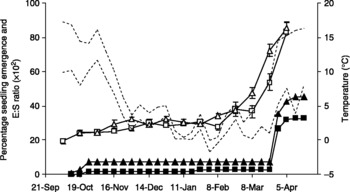
An average of 7% (median 4%) of A. sylvestris and 1% (2%) of S. carvifolia seeds emerged during the autumn of burial (Fig. 1). A peak of emerged seedlings was recorded in spring on 22 March 2006, when mean maximum and minimum temperatures in the preceding week were 8.5°C and 1.0°C, respectively. By the end of the first spring after sowing, 33% (34%) of S. carvifolia and 45% (44%) of A. sylvestris seeds sown had produced seedlings. No more seedlings emerged during the following summer and autumn.
Phenology of embryo growth and seedling emergence of Selinum carvifolia (squares) and Angelica sylvestris (triangles). Open symbols: average E:S ratio (n = 20); closed symbols: cumulative seedling emergence (n = 3); dotted lines: mean weekly minimum and maximum soil temperature at 1 cm depth. Vertical bars represent SE for embryo growth.

At the time of dispersal, seeds of A. sylvestris had an E:S ratio of 0.24 ± 0.02 (mean ± SE), while those of S. carvifolia had an E:S ratio of 0.19 ± 0.01. Before seeds of A. sylvestris and S. carvifolia could germinate, embryos had to grow to a critical E:S ratio of 0.85 ± 0.01 and 0.91 ± 0.01, respectively. Little increase in E:S ratio of either species was recorded until temperatures started rising in early spring (Fig. 1). In seeds of S. carvifolia, the first significant increase in embryo length was recorded on 22 February 2006, when mean maximum and minimum temperatures in the preceding week were 5.2°C and 3.0°C. By 5 April 2006, 90% of the seeds buried in the nylon bags had germinated. In seeds of A. sylvestris, the first increase in E:S ratio was noticed on 8 February 2006, but the largest increase was observed from 8 March 2006 onwards. In the nylon bag that was exhumed on 22 March 2006, about half of the A. sylvestris seeds had germinated.
Temperature and light requirements for seed germination
In a prolonged germination experiment, 37% (34%) of S. carvifolia seeds had germinated during 36 weeks at 5°C with a 12 h photoperiod. At all other test temperatures (10°C, 23°C, 15/6°C, 20/10°C), less than 9% (8%) of the seeds had germinated after 36 weeks. Seeds of A. sylvestris were incubated under the same temperature and light conditions, but no more than 14% (10%) germination was recorded in any condition after 36 weeks. After 24 weeks of dry storage at room temperature (c. 20°C), germination was negligible in S. carvifolia and A. sylvestris for seeds incubated for 2 weeks at 23°C, 10°C, 15/6°C and 20/10°C. Seeds of S. carvifolia and A. sylvestris, stratified for 12 weeks at 23°C, germinated only when they were transferred to 20/10°C [11.3% (12%) and 27.3% (26%), respectively].
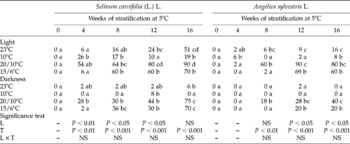
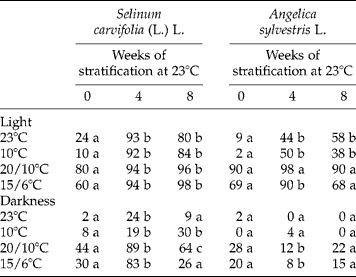
Increasing the length of cold stratification significantly enhanced germination in seeds of S. carvifolia and A. sylvestris. The incubation temperature after cold stratification also had a highly significant effect on germination percentages of seeds of both species (Table 1). In most cold stratification conditions, a significant increase in germination was recorded when seeds were incubated in light. In both light and darkness, seeds of S. carvifolia germinate best at alternating temperatures of 15/6°C and 20/10°C (Table 1). Very few seeds of S. carvifolia germinated during incubation in darkness at constant temperatures of 10°C and 23°C. However, after 16 weeks of cold stratification, up to 49.1% (51%) of the seeds germinated in light at 23°C. A significant interaction effect between light and temperature was not found in S. carvifolia. Subjecting seeds of S. carvifolia to a warm stratification before a 12-week cold stratification significantly influenced subsequent germination. In almost all incubation conditions, more seeds germinated after a combined warm and cold stratification than after a 12-week cold stratification alone (Table 2).
Median germination percentages of Selinum carvifolia and Angelica sylvestris seeds incubated under different temperature (T) and light (L) conditions after cold stratification

Medians followed by the same letter within each germination condition are not significantly different at the P < 0.05 level (Kruskal–Wallis test with multiple comparisons). Effects of incubation temperature and light were tested using a Kruskal–Wallis test with a Scheirer–Ray–Hare extension. n = 3.
Median germination percentages of Selinum carvifolia and Angelica sylvestris seeds incubated under different temperature and light conditions, after warm stratification followed by 12 weeks of cold stratification
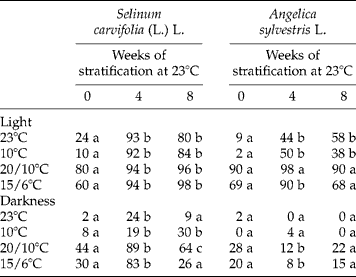
Medians followed by the same letter within each germination condition are not significantly different at the P < 0.05 level (Kruskal–Wallis test with multiple comparisons). n = 3.
Cold stratified seeds of A. sylvestris germinated best when they were incubated at daily alternating temperatures of 15/6°C and 20/10°C (Table 1). Low germination percentages ( < 12%) were recorded when A. sylvestris seeds were incubated at constant temperatures, both in light and in darkness. When a period of 4 or 8 weeks at 23°C preceded a 12-week cold stratification, seeds incubated at constant temperatures in the light reached germination percentages between 38% (38%) and 51% (58%) (Table 2). However, in general, a warm stratification preceding a 12-week cold stratification did not have a significant effect on subsequent germination of A. sylvestris seeds.
Temperature and light requirements for embryo growth
Seeds of A. sylvestris had average E:S ratios of 0.29 ± 0.01 and 0.39 ± 0.02 after 20 weeks of incubation at 23°C and 5°C, respectively. At the end of an incubation period of 12 weeks at 23°C followed by 12 weeks at 5°C, the average E:S ratio was 0.36 ± 0.02. These ratios are well below the critical E:S ratio of 0.85 ± 0.01 required to germinate. Similar results were found in seeds of S. carvifolia. After 20 weeks at 23°C and 5°C, E:S ratios of 0.34 ± 0.01 and 0.31 ± 0.03 were recorded, respectively. The average E:S ratio of 0.58 ± 0.04 after warm plus cold stratification was also well below the critical E:S ratio (0.91 ± 0.01).
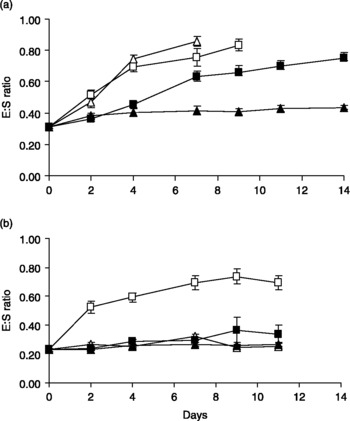
The E:S ratio in seeds of A. sylvestris, transferred to 20/10°C in light after 12 weeks of cold stratification, increased from 0.23 ± 0.01 at the time of transfer to 0.69 ± 0.05 after 11 d of incubation (Fig. 2). The increase of the E:S ratio was very small in seeds transferred to 23°C in light and darkness and to 20/10°C in darkness. Embryos in most seeds of S. carvifolia, transferred to 20/10°C and 23°C in light, elongated to the critical E:S ratio within 9 d after transfer (Fig. 2). Embryos of S. carvifolia seeds transferred to 20/10°C in darkness did not grow as fast. However, in 75% of these seeds, the critical E:S ratio was reached after 14 d of incubation. No embryo growth was observed in seeds placed at 23°C in darkness.
Embryo growth of Selinum carvifolia (A) and Angelica sylvestris (B) during incubation in the light (open symbols) and darkness (closed symbols) at 20/10°C (squares) and 23°C (triangles) after 8 and 12 weeks of cold stratification, respectively. Vertical bars represent SE; n = 20.

Effect of GA3 on dormancy break
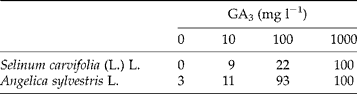
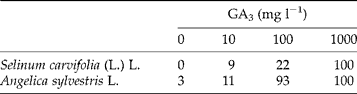
The application of GA3 significantly increased the final germination percentage of both S. carvifolia and A. sylvestris after 12 weeks at 23°C (P < 0.05). For S. carvifolia, no germination was observed during 12 weeks of incubation in the control condition (Table 3). When seeds were moistened with 1000 mg l− 1 GA3, all of them germinated in the first 2 weeks of incubation. Seeds moistened with 10 mg l− 1 and 100 mg l− 1 GA3 also germinated within the first 4 weeks of incubation, but final germination percentages were considerably lower with 10 mg l− 1 than with 100 mg l− 1 GA3 [7% (9%) and 22% (22%), respectively]. Seeds of A. sylvestris moistened with 100 mg l− 1 and 1000 mg l− 1 GA3 had germinated to 83% (93%) and 100% after 4 weeks of incubation. The final germination percentages in the control and 10 mg l− 1 condition were < 12% after 12 weeks.
Median germination percentages (n=3) of Selinum carvifolia and Angelica sylvestris seeds incubated at 23°C for 12 weeks during treatment with GA3
Discussion
Few seeds of both S. carvifolia and A. sylvestris germinated during 36 weeks of incubation at 5°C, 10°C, 23°C, 15/6°C or 20/10°C. Increased germination percentages were recorded when seeds were transferred to higher temperature conditions after cold stratification at 5°C. In general, germination percentages increased with increasing length of cold stratification (Table 1). The requirement for cold stratification to break dormancy in seeds of A. sylvestris confirms a study of Grime et al. (Reference Grime, Mason, Curtis, Rodman, Band, Mowforth, Neal and Shaw1981). Three months of cold stratification at 5°C significantly improved subsequent germination at 20/15°C in seeds of A. sylvestris collected in the Sheffield region. However, seeds of S. carvifolia collected in southern Germany (Patzelt et al., Reference Patzelt, Wild and Pfadenhauer2001), germinated to 82.0% at 25/10°C without first being subjected to a cold stratification. Seeds of S. carvifolia collected in the Czech Republic (Kotorova and Leps, Reference Kotorova and Leps1999) germinated to a lower percentage after being exposed to 4°C than in the control condition. In the same study, a small increase in germination percentage of A. sylvestris seeds after chilling was observed. These contrasting results can probably be explained by the fact that Kotorova and Leps (Reference Kotorova and Leps1999) cold-treated unimbibed seeds in a dry condition.
Seeds of S. carvifolia germinated to high percentages when incubated at fluctuating temperatures of 20/10°C and 15/6°C in both light and darkness. The fact that daily fluctuating temperatures stimulate seed germination in S. carvifolia and A. sylvestris has been reported previously. Lovett Doust and Lovett Doust (Reference Lovett Doust and Lovett Doust1982) found that seeds of A. sylvestris germinated in a fluctuating temperature regime (20/10°C), but not at constant temperatures (10°C, 15°C and 20°C). Seeds of S. carvifolia collected in southern Germany did not germinate at constant temperatures between 3°C and 35°C, but they did germinate up to 82% when incubated at 25/10°C for 42 d (Patzelt et al., Reference Patzelt, Wild and Pfadenhauer2001).
Identification of the dormancy type of seeds with MPD in the classification system proposed by Baskin and Baskin (Reference Baskin and Baskin1998) requires knowledge of the temperature conditions required for embryo growth. We found that embryos in seeds of A. sylvestris and S. carvifolia incubated at 23°C and 5°C for 20 weeks did not elongate to the critical E:S ratio required for germination. However, embryos of both species elongated rapidly after seeds were transferred to warmer temperature conditions following 8 or 12 weeks of cold stratification (Fig. 2). This means that seeds of these species have a physiological dormancy that needs to be broken before the embryo can elongate. Embryo growth at 23°C after cold stratification implies that seeds of both species have a simple type of MPD (Baskin and Baskin, Reference Baskin and Baskin1998).
Simple MPD is subdivided in three categories based on temperature requirements for germination and the ability of GA3 to substitute for stratification. Seeds with non-deep simple MPD can germinate after either a warm or a cold stratification, while dormancy in seeds with intermediate and deep simple MPD is broken by warm followed by cold stratification. Additionally, GA3 substitutes for warm or cold stratification in seeds with non-deep and intermediate simple MPD, but not in those with deep simple MPD (Baskin and Baskin, Reference Baskin and Baskin1998). In seeds of A. sylvestris and S. carvifolia, cold stratification is sufficient to break dormancy. A warm stratification prior to cold stratification improves germination, but is not necessary to break dormancy. High concentrations of GA3 could substitute for cold stratification in seeds of both studied species. Thus, it can be concluded that seeds of A. sylvestris and S. carvifolia have non-deep simple MPD that is broken by cold stratification. This type of dormancy has been recorded before in representatives of other plant families, e.g. Thalictrum mirabile (Ranunculaceae) and Chamaelirium luteum (Liliaceae) (Walck et al., Reference Walck, Baskin and Baskin1999; Baskin et al., Reference Baskin, Baskin and Chester2001).
Requirements for breaking of dormancy and triggering germination have been well studied in a number of North American and European Apiaceae. Non-deep simple MPD, where physiological dormancy is broken by warm stratification, has been recorded in the winter annual Apiaceae: Chaerophyllum tainturieri, C. procumbens and Ptilimnium nuttalli (Baskin and Baskin, Reference Baskin and Baskin1990b; Baskin et al., Reference Baskin, Baskin and Chester1999, Reference Baskin, Hawkins and Baskin2004). Studies screening for seed germination in large numbers of species indicate that seeds of many Apiaceae germinate in spring after cold stratification during winter (Grime et al., Reference Grime, Mason, Curtis, Rodman, Band, Mowforth, Neal and Shaw1981; Baskin and Baskin, Reference Baskin and Baskin1988). In almost all spring-germinating Apiaceae that have been studied, breaking of physiological dormancy and growth of the embryo occurs simultaneously at low temperatures. These species have seeds with either non-deep or deep complex MPD (e.g. Baskin et al., Reference Baskin, Meyer and Baskin1995, Reference Baskin, Milberg, Andersson and Baskin2000; Walck et al., Reference Walck, Hidayati and Okagami2002). Prior to the present study, non-deep simple MPD broken by cold stratification has not been reported as a dormancy type in Apiaceae, and has only been rarely reported in other species. The spring-germinating Sanicula europaea was listed as having non-deep simple MPD by Nikolaeva et al. (Reference Nikolaeva, Rasumova and Gladkova1985). However, some preliminary experiments on timing of embryo growth in seeds of S. europaea indicate that it exhibits a complex type of MPD (personal observation). Roberts and Boddrell (Reference Roberts and Boddrell1985) observed a cyclic change in dormancy status in seeds of the spring germinating Aethusa cynapium. A cyclic change in the level of dormancy provides a strong indication for non-deep simple MPD broken by cold stratification in this weed.
The occurrence of non-deep MPD in both S. carvifolia and A. sylvestris may be linked to the fact that they both grow mainly in wet grasslands. In an extensive study on germination requirements of species growing in a moist, tall grassland in Japan, Washitani and Masuda (Reference Washitani and Masuda1990) distinguished between two germination strategies allowing species to delay seedling emergence until spring. Seeds dispersed early in the growing season, during spring and summer, have a strict primary dormancy that is broken by cold stratification. A second strategy consists of a high temperature requirement for germination in seeds that are dispersed in autumn, at the end of the growing season. Our data indicate that these two strategies are combined in seeds of S. carvifolia and A. sylvestris. Physiological dormancy is broken by low temperatures during winter (Fig. 1). In early spring, both the mean daily temperature and the difference between daily minimum and maximum temperature rise. This change in temperature conditions acts as a signal for embryo growth and germination in seeds of S. carvifolia and A. sylvestris. A consequence of these two signals (i.e. cold stratification and high fluctuating temperatures regulating germination) is that seedlings of both species emerge in a very short time interval in late March to early April. A narrow peak in seedling emergence also was recorded in seeds of S. carvifolia sown in the Czech Republic (Kotorova and Leps, Reference Kotorova and Leps1999). Most seedlings emerged in late April and early May, probably due to the more continental climatic conditions. Seedling emergence of A. sylvestris sown in Warwickshire, UK, was also restricted mainly to March and April (Roberts, Reference Roberts1979).
Daily fluctuating temperatures and light can act as signals, providing seeds with information about their environment, such as depth of burial, the presence of canopy gaps or seasonality (Van Assche and Vanlerberghe, Reference Van Assche and Vanlerberghe1989). In our opinion, daily fluctuating temperatures act mainly as a season-sensing mechanism in seeds of S. carvifolia and A. sylvestris. Germination in response to fluctuating temperature in the light is a common strategy in species growing in wetlands (Thompson and Grime, Reference Thompson and Grime1983). In wetland habitats, the amplitude of daily fluctuating temperatures becomes large in spring, due to an increasing irradiance and a lowering of the water table. The role of fluctuating temperatures as a gap-detecting mechanism is probably of minor importance in the germination strategy of S. carvifolia. However, a study by Spackova et al. (Reference Spackova, Kotorova and Leps1998) indicated that more S. carvifolia seedlings emerged in plots that were mown and in plots where moss had been removed.
Multiple environmental cues acting together in regulating dormancy and germination are common in species that form a persistent soil seed-bank (Bouwmeester and Karssen, Reference Bouwmeester and Karssen1993; Van Assche et al., Reference Van Assche, Debucquoy and Rommens2003). In species adapted to a temperate climate, the dormancy status of long-lived seeds is often regulated by seasonally changing temperature conditions, so that the dormancy level is low in the most favourable season for germination. This cyclic change in dormancy status does not apply to seeds of S. carvifolia and A. sylvestris, since they are probably short lived. In a preliminary experiment, we buried 500 seeds of S. carvifolia in a nylon bag to a depth of 5 cm in the field. After 9 months, the bag was exhumed, and only 5% of the seeds were still intact and had not germinated. Also, very few seedlings of A. sylvestris emerged in the second and following years after sowing in a phenology experiment performed by Roberts (Reference Roberts1979). Therefore, the requirement of multiple environmental signals to break dormancy acts primarily as a mechanism for an accurate timing of seedling emergence in the first year after dispersal. A cold stratification requirement prevents seeds from germinating in autumn, while the requirement of high and fluctuating temperatures after cold stratification prevents seeds from germinating too early in winter.