Introduction
The parasitic mite Varroa destructor Anderson and Trueman (Mesostigmata: Varroidae; hereafter varroa) is considered the most important parasite of western honey bees, Apis mellifera Linnaeus (Hymenoptera: Apidae; hereafter honey bees). Varroa may feed on fatty tissues and is an important vector for several debilitating viruses, together causing considerable negative impacts to honey bee health (Levin et al. Reference Levin, Sela and Chejanovsky2016; DeGrandi-Hoffman et al. Reference DeGrandi-Hoffman, Ahumada and Graham2017; Ramsey et al. Reference Ramsey, Ochoa, Bauchan, Gulbronson, Mowery and Cohen2019). As early as 2001, resistance to commonly used synthetic pesticides resulted in implementation of more labour-intensive integrated approaches to manage varroa infestations (Currie et al. Reference Currie, Pernal and Guzmán-Novoa2010; Ferland et al. Reference Ferland, Nasr, Wilson, Jordan, Kempers and Kozak2017). The close association of varroa’s life cycle with honey bee development poses additional challenges in developing management strategies that do not collaterally affect colony dynamics and honey bee health (Plettner et al. Reference Plettner, Eliash, Singh, Pinnelli and Soroker2017).
Plant essential oils contain volatile secondary metabolites. Essential oils play important roles in protecting plants against viruses, bacteria, fungi, insects, and vertebrates (Isman et al. Reference Isman, Miresmailli and MacHial2011; Regnault-Roger et al. Reference Regnault-Roger, Vincent and Arnason2012; Isman Reference Isman2020). In previous studies, plant essential oils have been examined and applied as alternatives to synthetic pesticides for varroa management (Rosenkranz et al. Reference Rosenkranz, Aumeier and Ziegelmann2010; Plettner et al. Reference Plettner, Eliash, Singh, Pinnelli and Soroker2017). For instance, essential oil from thyme, Thymus caucasicus or T. vulgaris Linnaeus (Lamiaceae), is a registered treatment for varroa infestations, killing up to 95% of varroa in a colony environment (Calderone Reference Calderone1999; Rosenkranz et al. Reference Rosenkranz, Aumeier and Ziegelmann2010; Rahimi et al. Reference Rahimi, Del and Moradpour2017). Other research has explored using essential oils for varroa management, and these include oils from neem (Azadirachta indica Adrien-Henri de Jussieu) (Meliaceae)), canola (Brassica napus Linnaeus) (Brassicaceae)), and essential oil mixtures (Sophora flavescens Aiton (Fabaceae), Ginkgo biloba Linnaeus (Ginkgoaceae), Gleditsia chinensis Lamarck (Fabaceae), and Teucrium chamaedrys Linnaeus (Lamiaceae)). Effectiveness of these essential oils in managing varroa infestations has been variable (Kraus et al. Reference Kraus, Koeniger and Fuchs1994; Melathopoulos et al. Reference Melathopoulos, Winston, Whittington, Higo and Le Doux2000; Eguaras et al. Reference Eguaras, Fuselli, Gende, Fritz, Ruffinengo and Clemente2005; González-Gómez et al. Reference González-Gómez, Otero-Colina, Villanueva-Jiménez, Pérez-Amaro and Soto-Hernández2006; Stanimirović et al. Reference Stanimirović, Glavinić, Lakić, Radović, Ristanić, Tarić and Stevanović2017). Improved varroa treatment alternatives are needed to maintain effectiveness of current integrated approaches (Ferland et al. Reference Ferland, Nasr, Wilson, Jordan, Kempers and Kozak2017).
Historically, common yarrow, Achillea millefolium Linnaeus (Asteraceae; hereafter, yarrow), was used as a medicinal herb in Europe, where it was commonly applied as a poultice to wounds (Chandler et al. Reference Chandler, Hooper and Harvey1982). Terpenoids within yarrow plants have antiseptic, analgesic (e.g., eugenol, menthol), antipyretic (e.g., chamazulene), antispasmodic (e.g., some flavonoids), haemostatic (e.g., achilleine), anti-inflammatory (e.g., some azulene-like compounds), and antibacterial properties (e.g., α-terpineol) (Chandler et al. Reference Chandler, Hooper and Harvey1982; Mitich Reference Mitich1990; Kotan et al. Reference Kotan, Cakir, Dadasoglu, Aydin, Cakmakci and Ozer2010; Lakshmi et al. Reference Lakshmi, Geetha, Roy and Aravind Kumar2011). In addition to these medically relevant components, other chemicals in yarrow essential oil have insecticidal, acaricidal, and repellent properties (Supplementary material, Table S1; Jaenson et al. Reference Jaenson, Pålsson and Borg-Karlson2006; Shutler and Campbell Reference Shutler and Campbell2007). These represent a potential source of active ingredients for the development of novel varroa management strategies.
Some volatile compounds in plant essential oils can be detected by arthropods through olfaction (Conchou et al. Reference Conchou, Lucas, Meslin, Proffit, Staudt and Renou2019). Although several studies report essential oil detection by insects through their olfactory system (Enan Reference Enan2001; Blenau et al. Reference Blenau, Rademacher and Baumann2012), little is known about electrophysiological detection of essential oils and essential oil components by acarines (Soroker et al. Reference Soroker, Singh, Eliash and Plettner2019).
Previous work carried out by our research group focussed on the development of alternative approaches for varroa electrophysiology (Hanes Reference Hanes2015; Light Reference Light2019). These allowed us to investigate varroa responses towards individual odourants in increasing concentrations. Preliminary testing of yarrow essential oil via stimulus cartridges indicated responses at 0.1% v/v, but the active components responsible for the observed electrophysiological activity remain unknown (Light Reference Light2019). To investigate electrophysiological responses of varroa mites to yarrow essential oil and to identify active chemicals, we developed a new approach based on gas chromatography paired with electrotarsal detection, as described in Light (Reference Light2019).
Methods
Honey bees and varroa
Honey bees and varroa mites were collected from three queenright Langstroth colonies located in Berwick, Nova Scotia, Canada (45° 05’ N, 64° 41’ W) from May to August 2018. Maintenance of honey bees and varroa followed protocols adapted for apicultural research (Dietemann et al. Reference Dietemann, Nazzi, Martin, Anderson, Locke and Delaplane2013; Human et al. Reference Human, Brodschneider, Dietemann, Dively, Ellis and Forsgren2013). Briefly, adult female varroa in the phoretic stage were collected from infested honey bee drones and workers maintained in an environmentally controlled chamber (1.3 m × 1.3 m × 1.8 m; 32 °C ± 2 °C, and 65–70% relative humidity; Model E-16, Conviron Controlled Environments Ltd., Winnipeg, Manitoba, Canada) located at Acadia University, Wolfville, Nova Scotia, Canada. From 10 to 15 varroa were collected using a moistened paintbrush and placed into 50-mL plastic FalconTM tubes (Thermo Fisher Scientific, New York, New York, United States of America) with a moist piece (2 mm × 4 mm) of filter paper before being used for repellency assays.
Plant material
Yarrow plants were identified using Newcomb (Reference Newcomb1989) and collected in Wolfville. All collections were made between July and August 2017 from disturbed habitats (i.e., access roads, agricultural areas) supporting growth of yarrow (Warwick and Black Reference Warwick and Black1982). Plants were collected in full bloom, because this stage presents a higher concentration of essential oil relative to immature leafy stages (Rohloff et al. Reference Rohloff, Skagen, Steen and Iversen2000). Plants were hand-collected and separated immediately into ~1.0 kg of umbels and ~4.0 kg of green leaf material; stems, roots, and dry leaves were discarded. Separated material was placed into freezer bags and frozen at –20 °C until processed for essential oil extraction. Freshly harvested plants were not frozen immediately in the field, leading to the possibility that some plant secondary compounds might have degraded before freezing in the laboratory.
Essential oil extraction and analyses
Hydrodistillation was conducted at Dalhousie Agricultural Campus, Truro, Nova Scotia, Canada, using a Clevenger-type apparatus. Approximately 2.0 kg of green leaf material and 1.0 kg of floral umbels were extracted separately. Essential oils were collected in 4-mL vials and subsequently diluted from stock oil with high-performance liquid chromatography-grade hexane (Sigma-Aldrich, Saint Louis, Missouri, United States of America) to 0.1% v/v.
Essential oil composition was analysed using a Scion 456 Gas Chromatograph–Single Quad (SCION Instruments, Livingston, United Kingdom). A nonpolar capillary column Rxi®-5sil ms (30 m × 0.25 mm Ø; 0.25 µm; Chromatographic Specialties Inc., Brockville, Ontario, Canada) linked to a Bruker mass spectrometer (Bruker Daltonics Ltd., Coventry, United Kingdom) was used for analysis. Oven temperature was held at 50 °C for 5 minutes, increased to 200 °C at 5 °C/minute, then up to 280 °C at 25 °C/minute, which was then maintained as the holding temperature for 5 minutes. One microlitre of essential oil dilution (0.01% v/v) was manually injected at 250 °C in split-less mode with the split closed for 1 minute. Helium was used as a carrier gas at a flow rate of 1.2 mL/minute. Essential oil component quantification was performed using the following chromatogram integration parameters: peak width = 4.0 seconds; slope sensitivity = 10; tangent = 10%; peak size reject = 2000; using RMS noise calculation; mean three-point smoothing; and a spike threshold factor of 10. Quantification was performed using nonyl acetate (Sigma-Aldrich) as an internal standard at a concentration of 3 ng/μL. Components were identified based on a comparison of their relative retention times and mass spectra with those of the United States National Institute of Standards and Technology (NIST) library, comparison with published data, and Kovats retention index calculated using the equation for temperature-programmed chromatography (Ettre Reference Ettre1993). When available, chemical standards were used to confirm identities by comparing retention times and mass spectra (see Supplementary material, Table S2). All putative compound identities were made based on a high NIST reverse match (700–900) and matching retention and published Kovats index values; compound identities not meeting these requirements were subsequently left “blank” or unknown (Stein et al. Reference Stein, Mikaia, White, Zaikin, Zhu and Sparkman2011).
Gas chromatography–electrotarsal detection assays
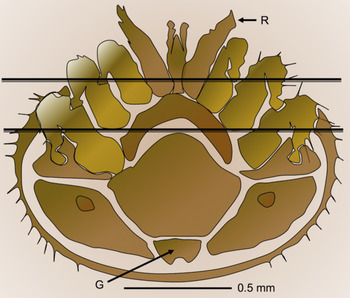
Electrophysiology bioassays with varroa were performed using methods previously described by Light (Reference Light2019). A single live adult female varroa mite was chilled at 4 °C for 2–3 seconds, then fixed to a glass microscope slide coated with dental wax (Electron Microscopy Sciences, Hatfield, Pennsylvania, United States of America). The mite was held in place on its dorsum using two minuten pins crossing the mite horizontally and in parallel (pins from ENTO SPHINX, Černá za Bory, Czech Republic; see Fig. 1). Electrode gel (SIGNAGEL, Parker Laboratories Inc., Fairfield, New Jersey, United States of America) was placed on the prepared mite across three pairs of tarsi not involved in signal-recording to reduce mechanical noise associated with mite movement. Sharpened (approximately 1-µm) tungsten electrodes were used to measure changes in electrical potential across varroa mite preparations, with the recording electrode inserted below the apotele of either the left or right foretarsi and the ground electrode inserted into the mite anus. A Syntech Intelligent Data Acquisition Controller-2 (IDAC-2) system was used to collect and amplify changes in electrical potential (low cut-off: 0.05 Hz, offset: 0, ext amp: 10; Ockenfels Syntech GmbH, Buchenbach, Germany).
Electrotarsography-mounting set-up of a Varroa destructor female immobilised on a dental wax base by two metal insect pins (illustrated by double lines crossing mite in parallel). G, grounding electrode; R, recording electrode.

Gas chromatography–electrotarsography recordings were performed using a Varian 450-GC (Varian Inc., Lake Forest, California, United States of America) fitted with a flame ionisation detector equipped with Varian CIP SIL8-CB (30 m, 0.25 mm Ø, 25 μm) nonpolar column. The same oven-temperature specifications used in the essential oil analysis were used to compare peak retention times with gas chromatography–electrotarsal detection output. Helium was used as a carrier gas at a rate of 1.2 L/minute. The gas chromatography column was split with a sample ratio of 50:50 to deliver equal amounts of sample to a heated transfer line held at 280 °C (Syntech Temperature Controller TC-02; Syntech, Kirchzarten, Germany) and to a carbon-filtered, humidified airstream at 0.5 L/minute blown over mite preparations. One microlitre of essential oil dilution at 0.01% v/v was manually injected at 250 °C. Differences in retention times between gas chromatography–mass spectrometry and gas chromatography–electrotarsal detection due to slight differences in column length and manufacturer specifications were accounted for using hydrocarbon standard series.
Statistical analysis
Analyses were performed using R statistical software, Version 01.0.136 (R Core Team 2018). Varroa destructor electrotarsographic responses (expressed in mV) to yarrow essential oil components were compared to mite responses to a 3-ng/µL nonyl acetate internal standard by calculating proportional response relative to the internal standard (equation (1)). Similarly, the peak area of each electrophysiologically active component of the yarrow essential oil was compared to the peak area of a 3-ng/µL nonyl acetate internal standard by calculating proportional area (equation (2)) (Raguso and Pellmyr Reference Raguso and Pellmyr1998; Carroll and Duehl Reference Carroll and Duehl2012; Torto et al. Reference Torto, Carroll, Duehl, Fombong, Gozansky and Nazzi2013). Proportional response was then divided by proportional peak area to provide an indication of presumed electrophysiologically important essential oil components(i.e., those with a high response threshold when compared to the concentration of essential oil components; equation (3)).
 $${\rm{\;Proportional\;Response\;}}\left( {{\rm{mV}}} \right)=\; \frac{{{{\rm{Response\;to\;Analyte\;}}\left( {{\rm{mV}}} \right)}}\over{{{\rm{Response\;to\;Internal\;Standard\;}}\left( {{\rm{mV}}} \right)}}}$$
 $${\rm{Proportional\;Peak\;Area\;}} = {\rm{\;}}\frac{{{{\rm{Peak\;Area\;of\;Analyte}}}}\over{{{\rm{Peak\;Area\;of\;Internal\;Standard}}}}}$$
 $${\rm{\;Relative\;Response\;}} = \;\frac{{{{\rm{Proportional\;Response\;}}\left( {{\rm{mV}}} \right)}}\over{{{\rm{Proportional\;Peak\;Area}}}}$$
Results
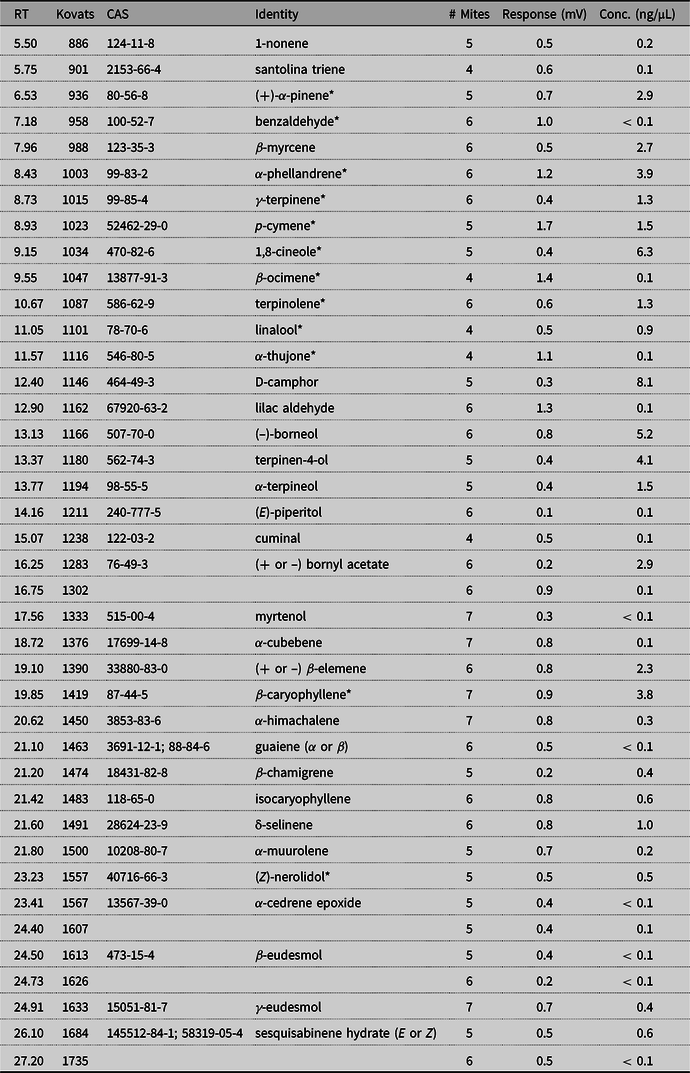
The major constituents of yarrow essential oils were terpenes, with the most dominant being sabinene, based on per cent composition tentatively identified through both NIST and Kovats retention indices (Supplementary material, Table S3). Many of the primary components did not elicit electrotarsographic responses from varroa. In contrast, several minor components of yarrow essential oil had a high proportional electrotarsography response relative to proportional abundance in gas chromatography–electrotarsography (Table 1). Myrtenol elicited the strongest proportional response (0.3 mV) relative to its proportional abundance (0.02%), although D-camphor was the most abundant component in yarrow essential oil that induced electrotarsographic responses in varroa. Several electrophysiologically active components of yarrow essential oil were not present in concentrations that allowed a high degree of confidence in identification through the NIST database or Kovats retention indices.
Varroa destructor electrotarsographic responses towards volatiles from common yarrow (Achillea millefolium) essential oil tested at a relative concentration of 0.01% v/v in hexane solvent. Responses were collected using gas chromatography–electrotarsography. The five volatiles with the highest Varroa destructor electrotarsographic responses relative to tentative volatile concentrations are indicated with bold lettering.

Compounds marked * were confirmed using chemical standards (see Supplementary material). RT, retention time using DB-5 capillary column; Kovats, retention index determined from hydrocarbon standard series (C8–C20); CAS, Chemical Abstracts Service registry number; Identity, compound identity based on the United States National Institute of Standards and Technology (NIST) database match, Kovats index match, and supporting literature; all identified compounds had a NIST reverse match between 700 and 900, similarly reported retention times and matching retention indices in literature or else were left unidentified (blank); # Mites, number of Varroa destructor mites eliciting responses out of nine replications through gas chromatography–mass spectrometry; Response (mV), average strength of electrotarsographic response (in millivolts) from Varroa destructor preparations; Conc. (ng/µL), relative concentration based on amount and peak area of nonyl acetate internal standard
Discussion
Several components of yarrow essential oil elicited strong varroa electrotarsographic responses relative to their concentrations. Some of these essential oil components are repellents to insects and other mites (Supplementary material, Table S1; Jaenson et al. Reference Jaenson, Pålsson and Borg-Karlson2006; Bissinger and Roe Reference Bissinger and Roe2010; Ali et al. Reference Ali, Radwan, Wanas and Khan2018). Many of these electrophysiologically active components have been previously reported to be repellent to varroa (Kraus et al. Reference Kraus, Koeniger and Fuchs1994; Jaenson et al. Reference Jaenson, Pålsson and Borg-Karlson2006). In particular, eucalyptol, thujone, and (Z)-nerolidol are repellent (Imdorf et al. Reference Imdorf, Bogdanov, Ochoa and Calderone1999; Isman Reference Isman2020) and activate TRPA1 receptors in varroa that may respond to noxious stimuli (Peng et al. Reference Peng, Kashio, Morimoto, Li, Zhu, Tominaga and Kadowaki2015). Avoidance of α-terpineol by varroa has also been observed (Peng et al. Reference Peng, Kashio, Morimoto, Li, Zhu, Tominaga and Kadowaki2015) and appears to be a response of both olfactory and gustatory cues, although it might be difficult to differentiate these modes of detection (Bissinger and Roe Reference Bissinger and Roe2010). Some compounds may vary in activity depending on how they are presented to an organism (e.g., as a volatile or by direct contact). For example, DEET (N,N-diethyl-m-toluamide) as a volatile may inhibit host detection by varroa (Singh et al. Reference Singh, Eliash, Kamer, Zaidman, Plettner and Soroker2015) and through direct contact is repellent to ticks (Bissinger and Roe Reference Bissinger and Roe2010).
Myrtenol elicited the strongest electrotarsographic response relative to its calculated proportional abundance. Among the compounds that elicited strong electrotarsographic responses in varroa, p-cymene produced the greatest proportional responses compared to the internal standard; p-cymene is also one of the primary components of thyme essential oil (Imdorf et al. Reference Imdorf, Bogdanov, Ochoa and Calderone1999) and is toxic to some flies (e.g., Drosophila melanogaster Meigen (Diptera: Drosophilidae)) and termites (e.g., Coptotermes formosanus Shiraki (Isoptera: Rhinotermitidae)) (Enan Reference Enan2005; Siramon et al. Reference Siramon, Ohtani and Ichiura2009). (E)-β-ocimene was among the five compounds with the highest relative electrotarsographic responses in varroa compared to relative abundance; its importance in honey bee communication suggests that it may play a role in host detection by varroa (Maisonnasse et al. Reference Maisonnasse, Lenoir, Costagliola, Beslay, Choteau and Crauser2009; Light Reference Light2019). α-Phellandrene and (–)-borneol elicited strong electrotarsographic responses and are primary components of essential oils that are currently used in varroa treatment (Imdorf et al. Reference Imdorf, Bogdanov, Ochoa and Calderone1999). In contrast to previous findings examining honey bee colony volatiles, limonene did not elicit electrotarsographic responses in the mites we assessed (Light Reference Light2019). This could be due to several electrophysiologically active essential oil volatiles eluting in short sequence, thereby precluding varroa recovery during electrotarsographic depolarisations following responses to these stimuli (Syntech 2015). Other components in yarrow essential oil that did not elicit electrotarsographic responses in varroa may be relevant to other arthropods (e.g., Aedes aegypti Linnaeus and Anopheles quadrimaculatus Say are repelled by carotol; Ali et al. Reference Ali, Radwan, Wanas and Khan2018).
Per cent composition of the various terpenes that we detected in the leaf portion of the plant, such as sabinene, β-pinene, p-cymene, and 1,8-cineole, are consistent with previous research, although considerable variation exists among studies (Supplementary material, Table S3). Yarrow essential oil composition can vary among plant chemotypes, structures, localities where plants are collected, seasonality, environmental conditions, and plant age (Chandler et al. Reference Chandler, Hooper and Harvey1982; Judzentiene and Mockute Reference Judzentiene and Mockute2010; Nadim et al. Reference Nadim, Malik, Ahmad and Bakshi2011). Another source of variation arises from difficulty in differentiating Achillea spp. based on morphology (Chandler et al. Reference Chandler, Hooper and Harvey1982; Warwick and Black Reference Warwick and Black1982), although they do differ in essential oil constituents (Chandler et al. Reference Chandler, Hooper and Harvey1982; Warwick and Black Reference Warwick and Black1982). In North America, two common species are A. millefolium L. and A. lanulosa Nutt. (Asteraceae) (Warwick and Black, Reference Warwick and Black1982). Azulene is present in the essential oil of A. lanulosa but not in that of A. millefolium (Chandler et al. Reference Chandler, Hooper and Harvey1982); because we did not detect azulene in our chemical analyses, we are fairly confident that the Achillea species we used was A. millefolium.
Preliminary behavioural results from trials with grouped mites suggest that mites preferred solvent control over yarrow-treated sides of two-choice Petri dish assays (see Supplementary material, Fig. S1). Future work should evaluate whether mites in isolation behave differently than those in groups.
Yarrow essential oil contains several primary components that are repellents and insecticides and that are shared with some essential oils currently used in varroa management (Imdorf et al. Reference Imdorf, Bogdanov, Ochoa and Calderone1999; Tutun et al. Reference Tutun, Koç and Kart2018). Future studies are required to better investigate, via field trials and laboratory assays with honey bees, the efficacy of yarrow essential oil in varroa management. Repellent and insecticidal components of yarrow essential oil may elicit activity from other important arthropod pests, but the full essential oil mixture should be analysed further (Bissinger and Roe Reference Bissinger and Roe2010). Although over 120 compounds of yarrow essential oils have been identified, their activity in the context of pest management is not well characterised (Chandler et al. Reference Chandler, Hooper and Harvey1982; Jaenson et al. Reference Jaenson, Pålsson and Borg-Karlson2006; Judzentiene and Mockute Reference Judzentiene and Mockute2010; Nadim et al. Reference Nadim, Malik, Ahmad and Bakshi2011). Further behavioural studies with honey bees and varroa are required, in particular studies that focus on those compounds from yarrow essential oil that elicit electrotarsographic responses in varroa mites. By selecting active essential oil components, more effective formulations may be developed for management of varroa infestation via in-colony applications.
Acknowledgements
We thank Megan MacIsaac for technical assistance and data collection, Margie Tate (Dalhousie Agricultural Campus, Truro, Nova Scotia, Canada) for technical support, and Kevin Spicer for access to honey bee colonies and varroa. We also thank two anonymous reviewers for their constructive input. This research project was funded by Project Apis M, Atlantic Canada Opportunities Agency Atlantic Innovation Fund (197853), Canada Foundation for Innovation (22087), and Natural Sciences and Engineering Research Council of Canada (RGPIN-2017-04319) funding to NKH.
Supplementary material
To view supplementary material for this article, please visit https://doi.org/10.4039/tce.2020.65.