Introduction
Pasture-based livestock has a large territorial extension in intertropical zones, mainly due to the low cost of maintenance and implementation of the system (Poppi et al., Reference Poppi, Quigley, da Silva and McLennan2018). A consequence of animals raised in a pasture system is contamination by gastrointestinal nematodes. Cattle are contaminated during ingestion of contaminated pasture, where the infective larvae (L3) become adults, reproduce and eliminate their eggs in the faeces (Bowman, Reference Bowman2010). The control of gastrointestinal nematodes in cattle is mainly based on the regular administration of anthelmintics. However, a meta-analysis performed by Baiak et al. (Reference Baiak, Lehnen and Rocha2018) evidenced anthelmintic resistance to different chemical groups, arising from indiscriminate use of medications. In addition, the use of anthelmintics can compromise the quality of the products, due to the residual power of the drugs in the animals’ organism (Novaes et al., Reference Novaes, Schreiner, Silva and Franco2017). Considering the aforementioned, the study of alternative parasite control is extremely important for livestock to remain healthy.
The use of biological control is a great alternative to anthelmintic drugs, as it contributes to the prophylactic control of nematodes, reducing the number of L3 in the environment (Baiak et al., Reference Baiak, Gasparina and Ianke2021), and consequently decreasing the recurrences of helminth infections (Braga et al., Reference Braga, Ferraz, da Silva and de Araújo2020). Alternative nematode control (e.g., nematophagous fungi) has the potential to mitigate anthelmintic resistance as it can be used in organic animal production, in which parasite control is a major challenge, since the use of chemosynthetics is strictly limited. Another issue of organic animal production is that the animals are raised predominantly on pasture, with low environmental control; thus, both animals and pasture are constantly being affected by environmental factors (e.g., rain, wind, frost, hail and solar radiation). As a result, the silvopastoral system (SPS) has been adopted as an alternative to improve the thermal environment of farms (Deniz et al., Reference Deniz, Schmitt Filho and Farley2019; Pezzopane et al., Reference Pezzopane, Nicodemo and Bosi2019). When raised in an SPS, animals have the opportunity to access different areas of the paddock, remaining in the sun on cold days (de Sousa et al., Reference de Sousa, Deniz and do Vale2021a) or seeking shade on hot days (Deniz et al., Reference Deniz, Schmitt Filho and Hötzel2020). This opportunity to choose the most comfortable location can change the dynamics of the deposition of faeces in the pasture, since shaded areas are variable throughout the day; this means that some faecal pads will remain exposed to solar radiation for longer than others.
Trees in the pasture alter the local microclimate, as they reduce the radiant thermal load by promoting lower air temperatures and soil surface temperatures in shaded areas (de Sousa et al., Reference de Sousa, Deniz and Moro2021b). Thus, we hypothesized that the different conditions (shaded and sunny) of the SPS influence the effectiveness of D. flagrans. Our study was based on previous work (Bilotto et al., Reference Bilotto, Fusé and Sagües2018; Baiak et al., Reference Baiak, Gasparina and Ianke2021) that showed good D. flagrans’ predatory activity in pasture areas. Baiak et al. (Reference Baiak, Gasparina and Ianke2021), when evaluating D. flagrans’ predatory activity in real conditions (natural defecation pattern), did not consider the environmental factors. On the other hand, Bilotto et al. (Reference Bilotto, Fusé and Sagües2018) found a low number of L3 in faecal pads in an artificially shaded condition; however, the authors placed the faecal mass in an experimental area, simulating the defecation pattern. As the fungus is subject to several factors in pasture conditions, more studies are needed to understand the effectiveness of D. flagrans in alternative pasture systems. The aim of this study was to test and analyse the predatory effect of D. flagrans under sunny and shaded conditions on L3 in the faeces, pasture and soil from dairy heifers in an SPS of an agroecological farm.
Materials and methods
Before beginning the experiment, the project was evaluated by the ethics committee for the use of animals at the ‘Federal University of Paraná’. The committee's function is to judge the use of animals in teaching and research. After evaluation, the work was approved according to the ethics of animal experimentation and received protocol number 082/2018.
Location, meteorological and microclimate data
This study was carried out between December 2019 and April 2020 at the ‘Estação de Pesquisa Agroecológica – CPRA’ at the ‘Instituto de Desenvolvimento Rural do Paraná – IDR’, Paraná state, in Southern Brazil (25°26′41″S, 49°11′33″W). The climate of the region has already been described by Baiak et al. (Reference Baiak, Gasparina and Ianke2021). The meteorological data from the experimental region were collected daily by an autonomous station (station ID 25254905) belonging to SIMEPAR (in Portuguese Sistema de Tecnologia e Monitoramento Ambiental do Paraná) located in ‘Piraquara’ – PR (25°26′30″S, 49°03′48″W), 10 km from the experimental area. Hourly local microclimatic variables – air temperature (AT, °C), black globe temperature (BGT, °C), relative humidity (RH, %), and soil surface temperature (SST, °C) – were measured in an area adjacent to the experimental paddock, at 5-min intervals, by four autonomous dataloggers, to measure environmental variables (ADEF; for details and validation, see Deniz et al., Reference Deniz, de Sousa and Gomes2021). Two ADEF were located in full sun exposure (sunny area – distant from the trees), and another two were located 2 m distant from the trees (shaded area).
Experimental area
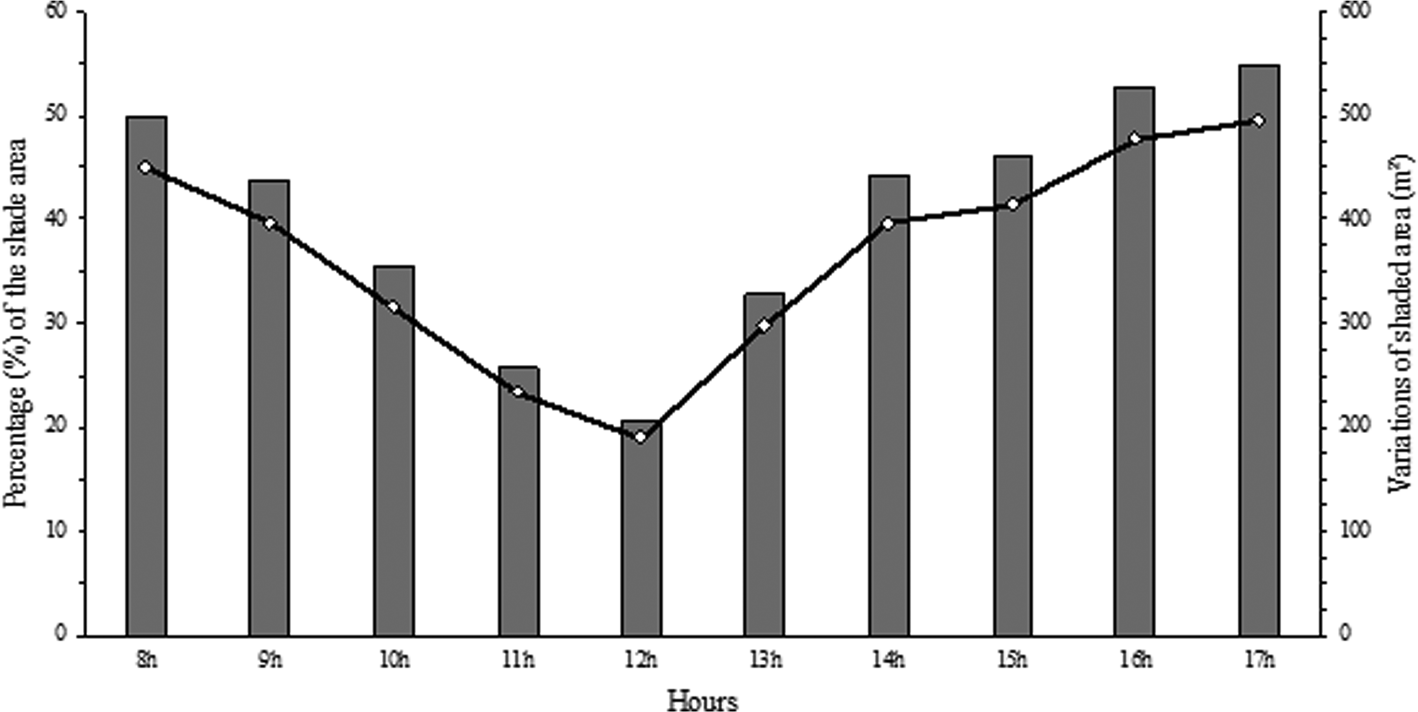
The farm is divided into paddocks, under the Voisin Rotational Grazing system (Voisin, Reference Voisin2001), in which animals are raised permanently on pasture with mineral salt and water ad libitum (see details in Baiak et al., Reference Baiak, Gasparina and Ianke2021). The experimental area consisted of an SPS with trees (100 trees/ha) in a single row along the border fences. The system was implemented 10 years before this study and includes approximately eight trees per paddock (Eucalyptus urograndis, Patagonula americana, Psidium cattleyanum, Eugenia uniflora, Campomanesia xanthocarpa and Cordia trichotoma), in a north-east–south-west orientation, with 20 m between rows and 3 m between trees. Tree height during the experimental period was on average 8 m and the trees provided a variable shaded area in relation to the time of day (fig. 1). The experimental area consisted of a paddock (900 m²), with a 60-d pasture rest period set before the start of the tests.
Percentage (%) and variation (m2) of the total shaded area by hour throughout the experimental period.

Animals and definition of treatments
Ten Jersey heifers with an average (mean ± standard deviation) age of 12 ± 5 months and an average weight of 154 ± 31 kg were selected for this study. The groups were homogeneously divided (5 animals per group) based on the eggs per gram (EPG) test (for more details access Baiak et al., Reference Baiak, Gasparina and Ianke2021); there was no difference (U = 15.5; P = 0.299) in EPG distribution between the groups (treated = 33.3; 33.3 (median and interquartile interval) and control = 467.0; 683.0), according to the Wilcoxon–Mann–Whitney test. Our treatments consisted of faeces obtained from animals treated with fungus (treated group) and faeces from animals that did not receive fungus (control group). Each animal received 150 g of pellets mixed with wheat bran (500 g); the treated group received pellets containing mycelial mass of the fungus D. flagrans (0.2 g of mycelium), and the control received pellets without mycelial mass. The amount of fungus provided was based on the work of Silva et al. (Reference Silva, Araújo, Braga, Soares and Rodrigues2013). The isolate of the nematophagous fungus D. flagrans (AC001) was obtained using the method of Duddington (Reference Duddington1955), and all the procedures followed the methodology of Braga et al. (Reference Braga, Araújo and Silva2009). For more details about the production of D. flagrans see Baiak et al. (Reference Baiak, Gasparina and Ianke2021).
Evaluation of the D. flagrans passage through the digestive tract of animals – in vitro analysis
Before starting the field experiment (12 h after pellet administration), faeces samples were collected from all animals for in vitro evaluation. The collection time (12 h) was based on previous studies (Silva et al., Reference Silva, Araújo, Braga, Soares and Rodrigues2013; Braga et al., Reference Braga, Ferraz, da Silva and de Araújo2020; Baiak et al., Reference Baiak, Gasparina and Ianke2021). All laboratory procedures for in vitro evaluation were adapted from Mauad (Reference Mauad2008) and described by Baiak et al. (Reference Baiak, Gasparina and Ianke2021). In total, two Petri dishes were used per group containing faeces with L3 ((approximately 3.000 of Haemonchus spp. (41.1%) and Cooperia spp. (58.9%)) obtained through coprocultures according to Roberts & O'Sullivan (Reference Roberts and O'Sullivan1950). The amount of L3 present in the coprocultures was estimated by counting the larvae in ten aliquots of 10 μl. The samples (faeces + L3) remained in an oven at 24°C for 14 d. After this, the L3 were recovered by the Baermann method (Staniland, Reference Staniland1954), and identified according to Keith (Reference Keith1953). The L3 reduction percentage (LR, %) attributed to the fungal predatory activity was obtained according to the following equation (1):

where X – number of larvae in the control group and Y – number of larvae in the treated group.
Definition of the experimental unit
The heifers were taken to the experimental paddock 12 h after administration of the pellets (entry 6:00 and exit 14:00), and an observer registered the hour that each heifer defecated and identified the group for each faecal pad (control or treated). In order not to interfere in the animals’ behaviour, the observer entered the paddock only to identify the faecal pad. After the heifers left the paddock, 10 faecal pads from the treated group and 10 faecal pads from the control group were randomly selected, after which the diameter (cm) of each faecal pad was measured.
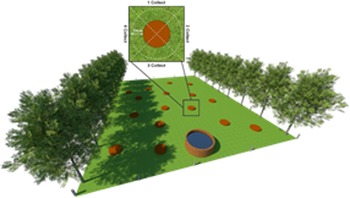
To evaluate the influence of the shaded and sunny conditions on the predatory activity of the D. flagrans, we registered the condition of the location of each faecal pad per hour. Each faecal pad was an experimental unit (N = 20). A minimum distance of 100 cm and a maximum distance of 350cm were respected between the faecal pads; in this way, interactions among the faecal pads were not possible, according to (Skinner & Todd, Reference Skinner and Todd1980). Each faecal pad was divided into four equal parts, where each one represented a collection. To identify the collection area of each experimental unit, a transect that exceeded 10 cm from the largest radius of the faeces was delimitated (fig. 2).
Schematic representation of the experimental and collection areas.

Data collection in the paddock
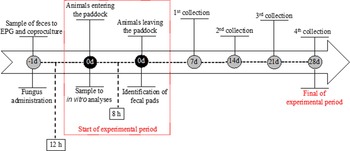
During the rest of the experimental period, the paddock remained without the presence of animals. The collections were performed at intervals of 7 d, totalling four assessments over 28 d, with the first collection performed 7 d after the faecal pad delimitation (fig. 3). The weekly collection, beginning at 8 h and ending at 11 h, was always performed by the same evaluator. To recover the non-predated L3 from the pasture (upper and lower), faecal pad and soil samples were collected according to Baiak et al. (Reference Baiak, Gasparina and Ianke2021). Laboratory analyses were performed at the ‘Laboratório de Parasitologia Animal’ from the ‘Universidade Estadual de Ponta Grossa’.
Schematic representation of the experimental period in relation to the collection period.

Laboratory analysis – recovery of L3
All procedures to recover the non-predated L3 from the pasture (upper and lower), faecal pad and soil were performed using the Baermann technique described in a previous study (Baiak et al., Reference Baiak, Gasparina and Ianke2021). The non-predated L3 were quantified and identified according to the methodology proposed by Keith (Reference Keith1953); the results were expressed in number of L3 per kg of dry matter (L3/Kg DM).
Statistical analysis
All analyses (influence, descriptive – average, standard deviation, minimum and maximum – and confirmatory) were performed through the statistical software R version 4.0.5 (R Core Team, 2021). For the influence analysis, the data were submitted to a mixed model (generalized linear models (GLMs), with Poisson distribution and logarithmic link function, and a 95% confidence interval (CI), since the variable of interest (Y) followed a Poisson distribution, as it is related to data counts or score assignments, using the parameter θ. The models were adjusted through the maximum likelihood–Laplace approximation method in the statistical package lme4 (Bates et al., Reference Bates, Mächler, Bolker and Walker2015). The CIs were estimated using Type II Wald chi-square tests and the fit of the model was given by a likelihood-test. The fitness of the models was tested by inspecting the residual in the graphs, through a line of best fit. The normality of the random facts was given by quartile plot means with a CI of 95%. The incidence rate ratio was used for the interpretation purposes of GLM and the details of each statistical model performed are described below.
Firstly, we used the Wilcoxon–Mann–Whitney test to confirm if there was any difference in EPG between the groups (treated and control). Lastly, the experimental design of the in vitro analysis was composed of two treatments (faecal pad with fungus and faecal pad without fungus) and four experimental units (two Petri dishes of the treated group and two Petri dishes of the control group). For analysis, a simple GLM with Poisson distribution, logarithmic bonding function and a 95% CI were used.
The experimental design of microclimate analysis consisted of two independent variables (shaded and sunny areas) and four dependent variables (air temperature, black globe temperature, relative humidity and soil surface temperature) measured over time. To confirm that the areas (shaded and sunny) influenced microclimate variables, the data were analysed using a mixed GLM at 95% CI, with the SPS areas (shaded and sunny) as the fixed effect and days and hours as the random effect. The results were plotted in box plot graphics to facilitate interpretation. Additionally, daily (24 h) weather data of air temperature (AT, °C) relative humidity (RH, %) and rainfall (RF, mm) from the closest official meteorological station (SIMEPAR station ID 25254905) were used for descriptive analysis of the climate pattern during the experimental period.
To assess the influence of the group (treated and control) and condition (shaded and sunny) on the number of non-predated larvae per kg (L3/kg), multilevel regression models were built. When the parameter was significant, multiple comparisons of the means were made using the Wilcoxon–Mann–Whitney test, at a 95% CI. The experimental design was composed of two treatments (faecal pad with fungus and faecal pad without fungus), two conditions (shaded and sunny), four replications (parts of the faecal pad) and 20 experimental units (10 faecal pads from the treated group and 10 faecal pads from the control group). Animals, diameter of the faecal pad (DF), and eggs per gram EPG of faeces were defined as random effects following the model:

where Yij is the non-predated L3 (L3/Kg DM); αijk is the fixed effect, i corresponds to group (treated and control); j corresponds to collections; k corresponds to passage time, and l corresponds to the SPS conditions (shaded and sunny); Ai is the random effect of animals; βij is the random effect, i corresponds to DF; j corresponds to EPG; and eij is the residual effect.
Results
Evaluation of the D. flagrans fungus passage – in vitro analysis
There was an influence (P < 0.001) of group on the number of non-predated L3. The odds of L3 occurrence in the treated group was 35% lower compared to control. This influence resulted in a difference (CI: 8.35–26.90; t = 4.07; DF = 15; P = 0.001) in average numbers of L3 between the groups (treated: 76 and control: 217). In addition, after 12 h of gastrointestinal transit of dairy heifers, a reduction of 65% was obtained in vitro.
Evaluation of D. flagrans predatory activity in an SPS
Climate monthly averages of the region during the experimental period are shown in table 1. The values of the microclimatic variables differed according to the condition (shaded and sunny) of the SPS. In the shaded condition, the lowest values (P < 0.05) of microclimatic variables were recorded, except for relative humidity (fig. 4).
Variation in the microclimate variables by conditions (shaded and sunny) of the silvopastoral system.

Average values (Av) ± standard deviation (SD) during experimental period for air temperature (AT, °C), relative humidity (RH, %), and rainfall (RF, mm).

The predominance of gastrointestinal nematode genera recovered during the experimental period from pasture (upper and lower), faecal pad and soil by group is shown in the online supplementary table S1. Regarding genera, there was a predominance of Cooperia spp. and Haemonchus spp. in both groups.
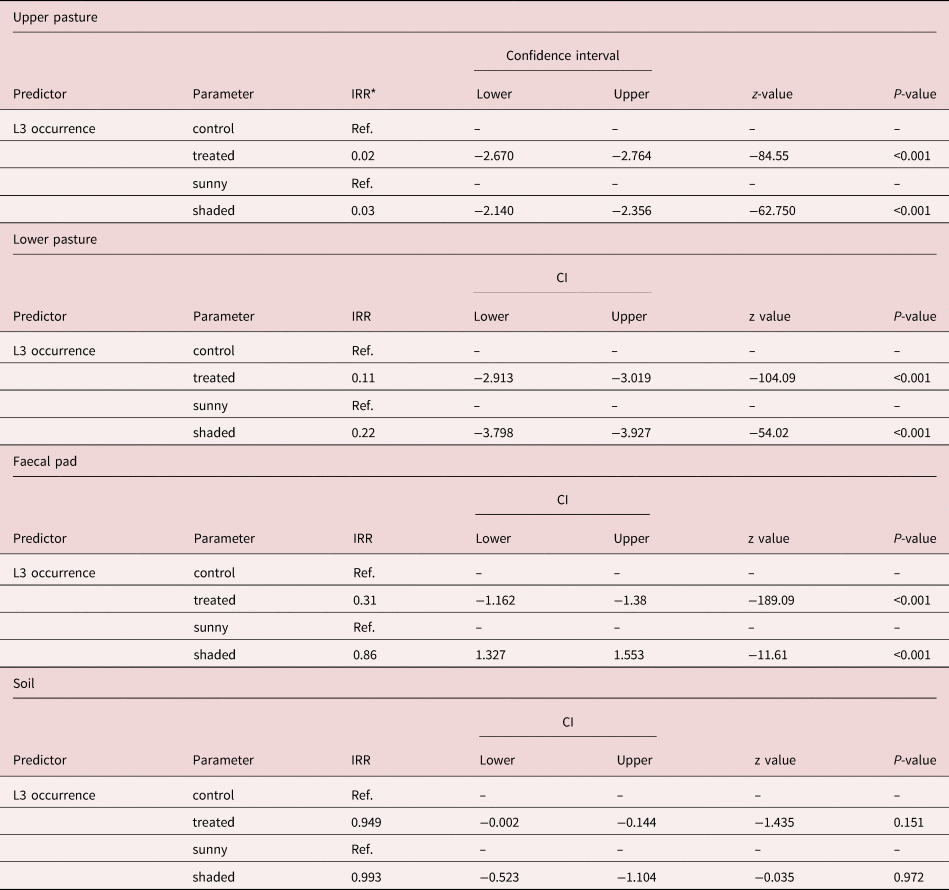
There was no influence (P = 0.78) of the gastrointestinal transit (range: 622 min. to 1160 min.) on the fungus predatory activity of the treated group. The details from the multilevel regression models built to determine the relationship between group and condition with the L3 are shown in table 2. There was significance (P < 0.01) of model parameters (groups and conditions) on non-predated L3 numbers in the pasture (upper and lower) and faecal pad; in summary, the L3 occurrence was less likely (P < 0.001) in the treated group and shaded condition (P < 0.001).
Details of multilevel generalized linear regression models of group (control and treated) and condition relationships (sunny and shaded) on the number of non-predated larvae per kg (L3/kg) from pasture (upper and lower), faecal pad and soil at the four collections.

* The incidence rate ratio (IRR) represents the odds of L3 occurrence in relation to the reference (Ref.) category.
There was a difference in the numbers of non-predated L3 in the faecal pad (W = 983; P = 0.02; treated range: 0 to 9349.6 and control range: 0 to 20720.7) and upper pasture (U = 980; P = 0.009; treated range: 0 to 775.2 and control range: 0 to 7692.3) between groups (control and treated). In the lower pasture, there was a tendency (U = 915; P = 0.06) for the treated group to present a lower number of L3 (treated range: 0.00 to 2857.1 and control range: 0.00 to 9803.9). In addition, a difference in L3 numbers was observed between the conditions (sunny and shaded) in the faecal pad of the control group (U = 117; P = 0.02; sunny: 4080 and shaded: 950); while in the treated group there were no differences between the conditions (U = 155; P = 0.63; sunny: 1065 and shaded: 416).
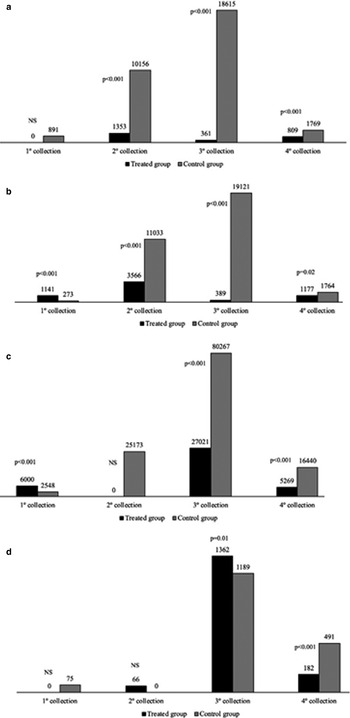
There was an influence (P < 0.05) of the collections and treated group on the non-predated L3 numbers (details of models are shown in the online supplementary table S2). For the treated group, there was a tendency (W = 3; P = 0.08) to present a low number of L3 in collection 3 compared to collection 2, for the upper and lower pasture. Meanwhile, for the control group, there was a difference (W = 19; P = 0.037) in the L3 numbers in the upper pasture between collections 3 and 4. In addition, the numbers of L3 in each collection site between groups (treated and control) are shown in fig. 5.
Number of non-predated L3 (L3/kg/DM) recovered from: (a) upper pasture; (b) lower pasture; (c) faecal pad; and (d) soil during the collections. Value of P < 0.05 indicates that the parameter (treated group) influenced the generalized linear mixed model in relation to the reference category (control group).

Discussion
The predatory activity of D. flagrans during the in vitro analysis resulted in a reduction (65%) in L3 number even 12 h after pellet administration. The efficacy of the D. flagrans in vitro has been reported by several authors in different farm animal species (Buske et al., Reference Buske, Santurio and De Oliveira2013; Araújo et al., Reference Araújo, Braga and Mendoza-de-Gives2021; Baiak et al., Reference Baiak, Gasparina and Ianke2021; Rodrigues et al., Reference Rodrigues, Roque and Álvares2021). Since 2014, experiments have shown the effectiveness of the fungus Duddingtonia sp. in decreasing the recurrence rates of animals’ helminth infections (Saumell et al., Reference Saumell, Fernández and Fusé2015; Rodrigues et al., Reference Rodrigues, Alvares and Silva2020; Araújo et al., Reference Araújo, Braga and Mendoza-de-Gives2021). Rodrigues et al. (Reference Rodrigues, Roque and Álvares2021), when evaluating the in vitro efficacy of the fungus D. flagrans observed a reduction of ~88% in L3 even 48 h after fungus administration. From these results, it is possible to note that the effectiveness in vitro of D. flagrans, remains for a long time (72 h) after fungus administration (Silva et al, Reference Silva, Araújo, Braga, Soares and Rodrigues2013).
We reject the hypothesis that the conditions (shaded and sunny) of the SPS influence the efficacy of the fungus D. flagrans, since there was no difference in the number of L3 in the treated group between the conditions (shade and sun). However, a lower number of L3 was observed in the shaded condition regardless of the group, with a difference in the number of L3 only for the control group between the conditions. The lower number of L3 recovered in the shaded condition in the control group may have been due to microclimate conditions, as shaded areas in an SPS have a lower soil surface temperature (de Sousa et al., Reference de Sousa, Deniz and do Vale2021a) and lower air temperature (Deniz et al., Reference Deniz, Schmitt Filho and Farley2019) which may have hindered the development of the larvae. Consequently, there was greater recovery of L3 in the sunny condition due to the exposure to sunlight, which favoured the increase in air temperature along with favourable relative humidity. Another related factor is that the infective larvae are able to survive several cycles of desiccation, where metabolic activity is diminished and the time of survival is prolonged (Lettini & Sukhdeo, Reference Lettini and Sukhdeo2006). In the treated group, a smaller number of L3 were also recovered from the faecal pads that remained in the shaded area. This fact occurred due to the maintenance of humidity in the faecal pad, since low humidity values can inhibit the fungus action (Faedo et al., Reference Faedo, Larsen, Dimander, Yeates, Höglund and Waller2002); while air temperature does not seem to be a limiting factor for its action (Buske et al., Reference Buske, Santurio and De Oliveira2013). Bilotto et al. (Reference Bilotto, Fusé and Sagües2018) also evaluated the predatory effect of D. flagrans on L3 of gastrointestinal parasites under sunny and shaded conditions in cattle faeces, and found a lower number of L3 in shade (92.3 ± 1.3 212% – P < 0.0001) than in sunlight (58.7 ± 19.3% – P < 0.01), corroborating our results.
In our study, the air temperature in the shaded condition was lower than that suggested as ideal (20 to 25°C) for the development of D. flagrans by Gronvold et al. (Reference Gronvold, Henriksen, Larsen, Nansen and Wolstrup1996); however, this factor did not harm the growth of D. flagrans. Vieira et al. (Reference Vieira, Oliveira and Campos2020), evaluating the effects of temperature on the performance of nematophagous fungi, concluded that the fungal strains achieved mycelial growth, chlamydospore production and nematicidal activity in parasitic nematodes at all temperatures tested (15, 20, 25, 30 and 35°C); however, D. flagrans showed greater growth at intermediate temperatures (20, 25 and 30°C) than at the extremes of 15 and 35°C. Other studies also demonstrate better effectiveness at intermediate conditions (Santos et al., Reference Santos, Padilha and Rodrigues2001; Buske et al., Reference Buske, Santurio and De Oliveira2013). These results are especially important for subtropical climatic conditions, which present annual average temperatures of 20°C (Perissinoto et al., Reference Perissinoto, Moura and Cruz2009), favouring predatory activity. In addition, D. flagrans is not selective in the predation process (Araújo et al., Reference Araújo, Assis and Campos2006), so the different genera recovered do not interfere with predatory activity but demonstrate the prevalence by animal species. In this study, the genera of L3 recovered from the samples corresponds to the most prevalent genera (Haemonchus spp. and Cooperia spp.) in Brazilian cattle (Dias et al., Reference Dias, Araújo, Campos and Braga2007), which are directly related to the reduction in weight gain and production losses (Sutherland & Leathwick, Reference Sutherland and Leathwick2011).
The dynamics of development and survival of L3 differed according to the collection periods. In our study, we observed a reduction in the number of L3 in both groups (treated and control) with 28 d (4th collection) of faeces deposition, but a lower number of L3 was observed in the treated group due to the action of the fungus D. flagrans. This may be related to the fact that at 21 d (3rd collection), there was an increase in the number of L3. The number of L3 may have stimulated D. flagrans to release chemoattractants, facilitating L3 predation (Wu et al., Reference Wu, Zhang and Zhu2013). This is an interesting result, as in a rotational grazing system (such as in the current study) the optimum pasture recovery time during hot seasons is approximately 30 d (Machado Filho, Reference Machado Filho2011). Our findings highlight that D. flagrans was efficient as a biological control for rotational grazing and we strongly suggest that further studies assess the predatory activity of D. flagrans more than 28 d after faeces deposition and during cold seasons.
Conclusion
The predatory activity of the D. flagrans fungus was efficient, as the treated group showed a lower number of non-predated L3 in the faecal pad and upper pasture. The fungus D. flagrans was also efficient over time in the shady and sunny conditions of an SPS, so that we could estimate that a lower L3 intake could lead to lower parasite burdens in the future and less contamination of the system paddocks. Our findings suggest that the use of D. flagrans may be a key component for the control of nematodes on agroecological farms since its action was not influenced by gastrointestinal transit and the fungus was apparently able to overcome challenges of environmental conditions to maintain its predatory activity.
Supplementary material
To view supplementary material for this article, please visit https://doi.org/10.1017/S0022149X22000128.
Acknowledgements
We thank Evandro M. Richter and João A. G. Hill for the opportunity to perform this study at the ‘Estação de Pesquisa Agroecológica’, the ‘Universidade Estadual de Ponta Grossa’ and the ‘Laboratório de Controle Biológico de Fitonematóides da Universidade Federal de Viçosa for their support, and Kleber da S. Junior for their help with the graphical design.
Funding
KTS and MD acknowledge CAPES (Coordination for the Improvement of High Education Personnel, Brazil) for the scholarship.
Conflicts of interest
None.