




No CrossRef data available.
Article contents
Young People in the American Electorate
Published online by Cambridge University Press: 26 February 2018
Abstract
An abstract is not available for this content. As you have access to this content, full HTML content is provided on this page. A PDF of this content is also available in through the ‘Save PDF’ action button.
Information
- Type
- Words of Wisdom
- Information
- Journal of Race, Ethnicity, and Politics , Volume 3 , Special Issue 1: Race, Religion, Gender and the 2016 U.S. Presidential Election , March 2018 , pp. 77 - 80
- Copyright
- Copyright © The Race, Ethnicity, and Politics Section of the American Political Science Association 2018
Footnotes
1. Author's examination of ANES, not shown. The Gen Forward survey (https://genforwardsurvey.com/) also has useful factsheets and reports that examine Millennial attitudes on a wide range of issues by race.
References
REFERENCES
Alba, Richard D. 2016. “The Likely Persistence of a White Majority.” The American Prospect, 2016. http://prospect.org/article/likely-persistence-white-majority-0.Google Scholar
Fowler, Matthew, Medenica, Vladimir E., and Cohen, Cathy J.. 2017. “Why 41 Percent of White Millennials Voted for Trump.” Washington Post, 2017. https://www.washingtonpost.com/news/monkey-cage/wp/2017/12/15/racial-resentment-is-why-41-percent-of-white-millennials-voted-for-trump-in-2016/.Google Scholar
Klar, Samara, and Krupnikov, Yanna. 2016. Independent Politics. New York: Cambridge University Press.Google Scholar
McGrane, Victoria. 2016. “Is Donald Trump Alienating Young Republicans?” Boston Globe, 2016. https://www.bostonglobe.com/news/nation/2016/08/20/gop-critics-say-donald-trump-alienating-new-generation-republicans/E1sTMY1MWWXQ81u48DI9CL/story.html.Google Scholar
Pew Research Center. 2015. “Comparing Millennials to Other Generations.” Pew Research Center's Social & Demographic Trends Project. March 19, 2015. http://www.pewsocialtrends.org/2015/03/19/comparing-millennials-to-other-generations/.Google Scholar
Schildkraut, Deborah J. 2017. “Does the Republican Party Really Have a Young Person Problem?” Washington Post, October 6, 2017. https://www.washingtonpost.com/news/monkey-cage/wp/2017/10/06/does-the-republican-party-really-have-a-young-person-problem/.Google Scholar
Schildkraut, Deborah J., and Marotta, Satia A.. 2017. “Assessing the Political Distinctiveness of White Millennials: How Race and Generation Shape Racial and Political Attitudes in a Changing America.” Paper presented at the annual meeting of the American Political Science Association; San Francisco, CA; September 2017.Google Scholar
Sides, John. 2014. “Most Political Independents Actually Aren't.” Washington Post, January 8, 2014, sec. Monkey Cage. https://www.washingtonpost.com/news/monkey-cage/wp/2014/01/08/most-political-independents-actually-arent/.Google Scholar
Sides, John, Tesler, Michael, and Vavreck, Lynn. 2018. Identity Crisis: The 2016 Presidential Campaign and the Battle for the Meaning of America. Princeton, NJ: Princeton University Press.Google Scholar
Wagner, Carl. 2015. “The GOP Is Letting Millennials Slip Away.” Real Clear Politics. 2015. http://www.realclearpolitics.com/articles/2015/11/25/the_gop_is_letting_millennials_slip_away_128826.html.Google Scholar
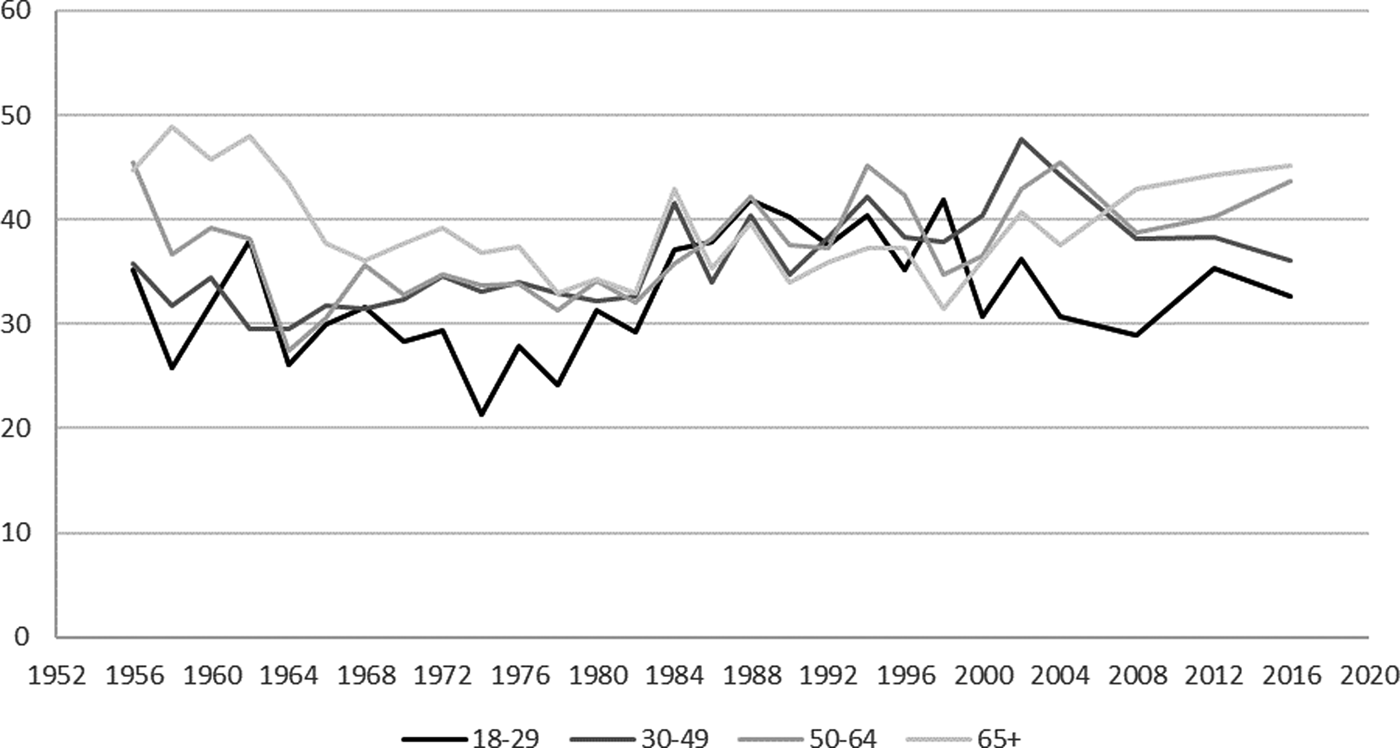
Figure 1. Proportion of each age cohort that identifies as Republican (leaners counted as partisans). Source: American National Election Study, weighted.
 You have
Access
Like many scholars of American political behavior, I cringe at headlines claiming that more and more Americans are political independents. I shout at my computer screen that such headlines are misleading, that partisan leaners are a fascinating and important category to acknowledge for a proper understanding of partisanship in the United States (Klar and Krupnikov Reference Klar and Krupnikov2016; Sides Reference Sides2014). Lately, my new version of this “screen shout” is when I see headlines generalizing about the political attitudes and behaviors of young people. In particular, articles that argue that the Republican Party's issue positions and campaign rhetoric are driving young people away are problematic (McGrane Reference McGrane2016; Wagner Reference Wagner2015). “Which young people?” I ask to no one, shaking my fist in the air. A growing body of work has made it abundantly clear that when assessing the attitudes and behaviors of young people, disaggregating by race is essential.
Leading up to the 2016 election, it was not uncommon to hear that Donald Trump's racially antagonistic rhetoric was going to cause long-term problems for the Republican Party because young people are more comfortable with diversity and immigration than older Americans. Since his victory, analysts and observers have spent considerable time trying to sort out whether economic anxiety or racial threat was more influential in shaping the 2016 election. To date, evidence on the side of racial threat is arguably more convincing (Sides, Tesler, and Vavreck Reference Sides, Tesler and Vavreck2018). What is more, research on Millennials indicates that racial resentment was a key factor that led many white Millennials to support Trump (Fowler, Medenica, and Cohen Reference Fowler, Medenica and Cohen2017; also see Medenica, this volume). One also finds notable racial differences when looking beyond vote choice to examine attitudes on issues such as immigration and affirmative action (Schildkraut and Marotta Reference Schildkraut and Marotta2017). As Medenica concludes, “the Democratic preferences displayed by millennials in the aggregate are largely driven by the cohort's increased racial and ethnic diversity” (this volume).
Put simply, white Millennials and non-white Millennials often have quite different attitudes and policy preferences.
It is true that the youngest cohort of American voters is more diverse than older cohorts (Pew Research Center 2015), which could mean that sheer numbers alone would lead us to expect that the Republican Party would have to change its tune on matters pertaining to race if it hopes to have a viable future. I offer two points of caution to this take. First, due to our complicated history of racial classification and the nuances of assimilation, some scholars argue that young people who are classified as ethnic minorities may ultimately see themselves as part of America's cultural majority, just as Irish and Italians of earlier eras did (Alba Reference Alba2016). Second, when one takes the long view and examines trends within the Republican Party by age cohort over time, one finds that the proportion of young people who identify as Republicans has been fairly stable since 2000 and is roughly 10 points higher than it was during the 1970s (see Figure 1). Moreover, data from the American National Election Study indicate that Republican identifiers are becoming more rather than less unified by age on certain measures that have been asked over time, including questions about the size and scope of government, health care, and attitudes about racial groups (Schildkraut Reference Schildkraut2017).
Proportion of each age cohort that identifies as Republican (leaners counted as partisans). Source: American National Election Study, weighted.
This is not to say that there are not issues about which young people of different races appear more like each other and more different from older Americans. Such issues include climate change, gay marriage, and the legalization of marijuana.Footnote 1 In my view, however, the similarities among whites of different generations deserve far more attention than they get.
Besides tracking these trends over time, there are other important questions scholars should investigate. They include: What is the nature of interracial contact among white Millennials, and how does that contact affect their political outlook? In what ways are the experiences of “Generation Z” similar to, or different from, the experiences of Millennials with respect to diversity, contact, and politics? How will ideas about white racial identity change as whites lose their majority status, and how much will this dynamic vary across whites of different ages? How do other contexts, such as living in a rural or urban setting, condition how race affects political outlooks among young people?
The 2016 election hastened a political moment in which racial identity is at the forefront of electoral politics. Many scholars were caught off guard, especially with respect to white identity. Luckily, we have many excellent data sources that are now tracking attitudes on the kinds of questions listed above, which we will need to address for a better understanding of our current political climate and consider how it will evolve as 2020 draws near.