





Introduction
As a prominent research methodology within Applied Linguistics and an established topic strand at the annual conferences of the American Association of Applied Linguistics, we would expect Corpus Linguistics to focus predominantly on addressing existing language-related problems in the real world and offering solutions for those problems. However, as observed by Egbert and Römer-Barron (Reference Egbert and Römer-Barron2024, p. 1), “the use of corpora and corpus linguistic methods is often relegated to descriptive linguistics or to research that is one or two steps removed from real people with an actual language problem to be solved.” An emerging interdisciplinary area of research intends to address this limitation by encouraging a direct dialogue between corpus linguists and legal scholars. This area, known as “legal corpus linguistics” (Egbert & Römer-Barron, Reference Egbert and Römer-Barron2024; Gries, Reference Gries, Coulthard, May and Sousa-Silva2020, Reference Gries2021; Solan, Reference Solan2020; Phillips et al., Reference Phillips, Ortner and Lee2016), applies corpus methods to the interpretation of legal texts and ideally involves truly collaborative work between experts from both fields: law and linguistics. The present article provides an example of this type of collaborative work between a legal scholar and two corpus linguists. It discusses a study in legal corpus linguistics, which has the goal of facilitating the interpretation of the U.S. Constitution’s Appointments Clause.
A recent special issue of the journal Applied Corpus Linguistics (Römer-Barron & Egbert, Reference Egbert and Römer-Barron2024) illustrates the impact and reach that corpus research applications to the law can have. The contributions to this special issue reference dozens of publications in legal corpus linguistics, including amicus briefs (friend of the court briefs) and articles in law reviews (e.g., Cunningham & Egbert, Reference Cunningham and Egbert2020b; Cunningham & Römer-Barron, Reference Cunningham and Römer-Barron2025; Ren et al., Reference Ren, Wood, Cunningham, Abbady, Römer, Kuhn and Egbert2020). These publications have led to a better understanding of words and phrases in various sections of the U.S. Constitution, for example, of “emolument” in Article I, “misdemeanors” in the Impeachment Clause, or “cases” in Article III. Corpus linguistics as an approach to textual interpretation has also been referenced in the decisions of several state supreme courts (e.g., People v. Harris, 2016; Richards v. Cox, 2019; State v. Lantis, 2019; State v. Misch, 2021). Inspired by these publications and court decisions that showcase the value of corpora and linguistic analysis in legal interpretation, the present article applies corpus methods to a contentious part of the U.S. Constitution, the Appointments Clause (Article II, section 2, clause 2), which specifies how federal officials are appointed.
The Appointments Clause consists of two parts: the Default Provision (presented in Example (1)) and the Excepting Provision (see Example (2)). The Default Provision requires nomination by the U.S. President and confirmation by the Senate; the Excepting Provision allows exceptions “as they [Congress] think proper.”
(1) [the President] shall nominate, and by and with the Advice and Consent of the Senate, shall appoint Ambassadors, other public Ministers and Consuls, Judges of the Supreme Court, and all other Officers of the United States, whose Appointments are not herein otherwise provided for, and which shall be established by Law:
(2) but the Congress may by Law vest the Appointment of such inferior Officers, as they think proper, in the President alone, in the Courts of Law, or in the Heads of Departments. (U.S. Constitution, Article II, section 2, clause 2)
Although the text of the Appointments Clause would appear to give Congress the power to decide when to except an appointment from the requirements of the Default Provision, in a series of decisions described below, the U.S. Supreme Court has given judges a role to second-guess Congressional use of the Excepting Provision: deciding whether an officer not appointed under the Default Provision is actually “inferior,” according to the Supreme Court’s evolving definition of “inferior officer.” As a result, there has been an increasing wave of court challenges to the actions and decisions of federal officials based not on the legal merits of those actions and decisions but by claiming the officials were not properly appointed.
The real-world implications of this litigation tactic have been and continue to be significant. For example, one of the most recent Supreme Court cases to be decided under the Appointments Clause involved the work of a Task Force in the U.S. Department of Health and Human Services (HHS) that had the power to identify preventive healthcare services that must be provided through health insurance at no cost (Kennedy v. Braidwood Management, Inc., 2025). Federal law stated that recommendations of this Task Force “shall be independent and, to the extent possible, not subject to political pressure” (p. 757). A company that did not want its employees to receive insurance coverage for services related to contraception and sexually transmitted diseases filed a lawsuit arguing that the recommendations of the Task Force were invalid because the legal requirement that their recommendations be “independent” meant the Task Force members were not “inferior officers” and thus could not be appointed by the HHS Secretary pursuant to the Excepting Provision (Braidwood Management Inc. v. Becerra, 2022). The trial judge agreed and issued an order invalidating all the mandates for no-cost health care coverage based on Task Force recommendations, potentially affecting millions depending on such no-cost coverage (Braidwood Management Inc. v. Becerra, 2023; Duff-Brown, Reference Duff-Brown2025).Footnote 1
Our study tests the Supreme Court’s precedents about the Appointments Clause’s meaning against a linguistic analysis of the text with the aim of elucidating the meaning of the clause. We do so using corpus research methods and applying linguistic theory, particularly Construction Grammar (Goldberg, Reference Goldberg1995, Reference Goldberg2006), which allows us to identify constructions and functionally classify them. The study aims to address the following two research questions (RQs):
RQ 1: Does “such inferior officers” in the Excepting Provision of the Appointments Clause refer back to “all other Officers of the United States” in the Default Provision?
RQ 2: How does the “such… as” construction in the Excepting Provision inform our understanding of the Appointments Clause?
Before introducing the data and methods that our study draws on, we will further describe the legal context of the study and provide an overview of the functions of what turns out to be an important word in the Appointment Clause’s Excepting Provision: “such.” We will then present the results of our study, organized by RQ, and discuss how legal interpretation consistent with our results might change the course of future litigation in the United States.
The legal context
Origin of the Appointments Clause
The U.S. Constitution was drafted by the Constitutional Convention, 55 persons representing the 13 states of the new American republic, meeting in Philadelphia in 1787. The draft constitution became legally effective after a process of ratification in each state, involving thousands of citizens participating in state conventions. Because “the Constitution was written to be understood by voters,” for purposes of legal interpretation courts assume that “its words and phrases were used in their normal and ordinary … meaning.” (District of Columbia v. Heller, 2008, p. 576). This bedrock principle of U.S. constitutional law means that empirical evidence of “normal and ordinary meaning” in the Founding Era when the Constitution was enacted – such as corpus linguistics can provide – is of potentially great legal significance (Solan, Reference Solan2016; Solum, Reference Solum2018).Footnote 2
Over the months that the Constitutional Convention met, there was a tug of war among the delegates as to the allocation of the power of appointment between Congress and the President. As late as August 1787, the delegates were considering a draft that gave the Senate the power to appoint ambassadors and judges of the Supreme Court (Farrand, Reference Farrand1911, p. 169) and the President the power “to appoint to offices not otherwise provided for <by the constitution>” (Farrand, Reference Farrand1911, p. 145). However, by September 7, a compromise had been reached to share the appointment power, giving the President power to nominate, subject to approval by the Senate. At that point, the draft language was essentially the same as the Default Provision, but it did not yet include the final phrase, “and which shall be established by Law” (Farrand, Reference Farrand1911, p. 495). Two days before the exhausted delegates concluded the convention, on September 15, Gouverneur Morris moved to amend the Appointments Clause by adding the Excepting Provision: “but the Congress may by law vest the appointment of such inferior Officers as they think proper, in the President alone, in the Courts of law, or in the heads of Departments.” We have only two recorded comments on this motion. According to his own notes, James Madison said, “[i]t does not go far enough if it be necessary at all – Superior Officers below Heads of Departments ought in some cases to have the appointment of the lesser offices.” Morris responded rather cryptically, “[t]here is no necessity. Blank Commissions can be sent —.” Initially, the motion failed on a tie vote. Then, according to Madison’s notes, “[i]t was urged that it be put [to a vote] a second time, some such provision being too necessary, to be omitted. [sic] and on a second question it was agreed to” (Farrand, Reference Farrand1911, pp. 627–28). The final amendment to the Appointments Clause was a successful motion to add “and which shall be established by law” to the end of the Default Provision to make clear that Congress was still in charge of creating the offices to be filled by the approved appointment process (Farrand, Reference Farrand1911, p. 628).
Judicial interpretation of the Appointments Clause
In the last 50 years, the U.S. Supreme Court has heard challenges based on the Appointments Clause in many important cases, for example, compliance with fair election laws (Buckley v. Valeo, 1976); investigation of alleged false statements to Congress (Morrison v. Olson, 1988); criminal convictions by courts martial (United States v. Weiss, 1994; United States v. Edmond, 1997); investigation of auditing practices (Free Enterprise Fund v. Public Company Accounting Oversight Board, 2010); penalties for defrauding investors (Lucia v. Securities and Exchange Commission, 2018); consumer protection investigation (Seila Law LLC v. Consumer Financial Protection Bureau, 2020); a multimillion dollar patent dispute (United States v. Arthrex, Inc, 2021); and the mandatory health insurance coverage issue mentioned above (Kennedy v. Braidwood Management, Inc., 2025).
The current approach to the Appointments Clause taken by the U.S. Supreme Court is based on the idea that this clause creates two distinct categories of officers – principal officers and inferior officers – and that it is up to courts to decide case-by-case whether a challenged official fits into one category or the other. This idea can be traced back to the 1879 Germaine decision by the U.S. Supreme Court that stated:
The Constitution for purposes of appointment very clearly divides all its officers into two classes. The primary class requires nomination by the President and confirmation by the Senate. But […] in regard to officers inferior to those specially mentioned, Congress might by law vest their appointment in the President alone, in the courts of law, or in the heads of departments. (United States v. Germaine, 1879, pp. 509–510)
In 1976, the Supreme Court converted the phrase used by the Germaine case, “primary class,” into the term “principal officer”: “Principal officers are selected by the President with the advice and consent of the Senate. Inferior officers Congress may allow to be appointed by the President alone, in the courts of law, or in the heads of departments” (Buckley v. Valeo, 1976, p. 132). Building on these two precedents, the U.S. Supreme Court stated in Morrison v. Olson (1988) that the Appointments Clause is to be interpreted and applied by asking whether the challenged official “is an ‘inferior’ or a ‘principal’ officer” (p. 671). If the official is a “principal officer,” then the official’s appointment is invalid unless the official had been nominated by the President and confirmed by the Senate pursuant to the Default Provision. If the official is an “inferior officer,” Senate confirmation is not necessary, but appointment by the President, a Court of Law, or the Head of Department is required pursuant to the Excepting Provision (Morrison v. Olson, 1988).
During his 30 years on the U.S. Supreme Court (1986–2016), Justice Antonin Scalia became the intellectual leader of the Court’s conservative wing and the leading exponent for the legal doctrine known as “original meaning” that advocated interpretation of the Constitution in terms of how its words would have been understood during the period it was written and subsequently ratified by state conventions (1787–1788), see Scalia (Reference Scalia1997). In 1997, in the Edmond case, considered the leading decision on applying the Appointments Clause, Justice Scalia stated, in writing the Court’s opinion: “we think it is evident that ‘inferior officers’ are officers whose work is directed and supervised at some level by others who were appointed by Presidential nomination with the advice and consent of the Senate” (Edmond v. United States, 1997, p. 663).
After Scalia’s death in 2016, Justice Clarence Thomas was seen as taking Scalia’s place as the Supreme Court’s leading practitioner of “original meaning” interpretation. However, in a 2021 case, Justice Thomas dissented from a majority court opinion that purported to apply Justice Scalia’s approach from the Edmond case, saying:
it may be worth taking a closer look at whether the functional element of our test in Edmond […] aligns with the text, history, and structure of the Constitution. […] The founding era history surrounding the Inferior Officer clause […] [does not point to] a case-by-case functional examination of exactly how much supervision and control another officer has. The rationales on which Edmond relies to graft a functional element into the inferior-officer inquiry do not withstand strict scrutiny. […] At some point, we should take stock of our precedent to see if it aligns with the Appointments Clause’s original meaning. (United States v. Arthrex, Inc, 2021, p. 60, p. 67)
This article takes up the suggestion by Justice Thomas to see if the principal officer/inferior officer approach used by the Supreme Court “aligns with the Appointments Clause’s original meaning,” by paying particular attention to the use of the “such + adjective + noun + as” phrase in the Excepting Provision. The implications of the choice of this construction have largely been ignored by the Supreme Court in its Appointments Clause cases. However, in the Arthrex case, both the dissenting opinion by Justice Thomas and a separate opinion by Justice Stephen Breyer do take note of the “such… as” construction.
Justice Thomas wrote: “By using the adjective ‘such’ before ‘inferior Officers,’ the Clause about inferior officers could be understood to refer back to ‘all other Officers of the United States, whose Appointments are not herein otherwise provided for, and which shall be established by Law’” (United States v. Arthrex, Inc, 2021, p. 62). This suggestion by Justice Thomas prompted our first research question.
Justice Breyer said in his separate opinion:
in my view, the Court should interpret the Appointments Clause as granting Congress a degree of leeway to establish and empower federal offices. Neither that Clause nor anything else in the Constitution describes the degree of control that a superior officer must exercise over the decisions of an inferior officer. To the contrary, the Constitution says only that ‘Congress may by Law vest the Appointment of such inferior Officers, as they think proper, […] in the Heads of Departments.’ […] [These words] strongly suggest that Congress has considerable freedom to determine the nature of an inferior officer’s job, and that courts ought to respect that judgment. (United States v. Arthrex, Inc, 2021, p. 38)
The validity of this suggestion by Justice Breyer will be tested as we address our second research question.
The functions of “such” in present-day and Founding Era American English
The word “such” can perform multiple functions in a sentence, which are often difficult to assign (Biber et al., Reference Biber, Johansson, Leech, Conrad and Finegan1999; Spinillo, Reference Spinillo2003). It also appears across different word classes, for example, as a determiner (e.g., “such methods”), pronoun (e.g., “coffee, tea, and such”), or adverb (e.g., “such good news”). In the phrase “such inferior officers,” “such” is used as a determiner, that is, a modifier that determines what kind of reference a noun has. In its determiner use, “such” is a common tool to create links between items in the text, a function known as endophoric reference (as opposed to exophoric reference, pointing from within the text to the external world). Endophoric reference can be expressed anaphorically or cataphorically (Carter & McCarthy, Reference Carter and McCarthy2006). Anaphoric references refer back to something mentioned earlier in the text, as in Example (3), where “such goods” (in bold) refers back to “goods entered into your district after the 29th of May” (underlined). Cataphoric references refer forward to something mentioned later in the text, as in Example (4), where “such a way” (in bold) refers forward to “neither to subject myself to Any Mortification by Refusal, nor to A personal Obligation by granting them” (underlined). Both examples represent Founding Era American English language use.
(3) It is therefore my opinion that any bond given for duties on goods entered into yourdistrict after the 29th of May is considered null. It is however necessary that satisfactory proof be adduced to you that such goods were imported into the State of Rhode Island prior to that day. (emphasis added); source: From Alexander Hamilton to Sharp Delany, 2 December 1790; http://founders.archives.gov/documents/Hamilton/01-07-02-0197)
(4) I shall make them known, whenever they are forwarded to me, in such a way as neither to subject myself to Any Mortification by Refusal, nor to A personal Obligation by granting them. (emphasis added); source: To Thomas Jefferson from Pierce Butler, 17 August 1793; http://founders.archives.gov/documents/Jefferson/01-26-02-0632Year1793)
In these two examples, both from documents available in the Founders Online database (https://founders.archives.gov), the determiner “such” expresses two different meanings. In its anaphoric use in (3), “such” means “of the type mentioned in the preceding text,” while in its cataphoric use in (4), “such” means “of the type about to be mentioned in the following text.”
One interesting thing that we know from comprehensive corpus-based language descriptions such as Carter and McCarthy (Reference Carter and McCarthy2006) is that, in present-day English, anaphoric references are by far the more common of the two types and are created most typically by pronouns and determiners. Contemporary speakers of English are hence likely primed to expect anaphoric rather than cataphoric reference when they encounter the determiner “such” in a text and may, in reading the Appointments Clause, instinctively look back at the preceding text when they get to the phrase “such inferior officers” in order to determine what “such” refers to. This might explain why Justice Thomas, in his Arthrex dissent, suggested that “such inferior officers” in the Excepting Provision could be understood as referring back to “all other Officers of the United States” in the Default Provision. In interpreting the Appointments Clause, it is hence important to determine which type of reference “such” has in the clause’s Excepting Provision.
This study: Data and methods
Corpus linguistics principles and corpus data
The empirical investigation of the meaning of “such” is grounded in two central principles of corpus approaches to language and meaning. First, corpus linguistics emphasizes that linguistic meaning must be examined in context, since usage patterns, co-text, and discourse environments shape how linguistic forms function and are interpreted (e.g., Hunston, Reference Hunston2022; Sinclair, Reference Sinclair2004). Studying “such” in naturally occurring data therefore allows its meaning to emerge from the distributional and pragmatic patterns in which it appears. Second, within the framework of Construction Grammar (Goldberg, Reference Goldberg1995, Reference Goldberg2006), meaning is viewed as inherent to constructions, defined as recurring form-function pairings entrenched in a speaker’s mind. Constructions range in size and complexity from small units like morphemes and words to larger phrases and grammatical frames, which carry meaning as a whole. Against this backdrop, linguistic items (in our case, the determiner “such”) acquire their interpretive properties through the constructions they constitute or occur in, rather than from isolated, abstract semantic definitions. These two principles together support a usage-based analysis in which the meaning of “such” can be understood as an emergent property of its recurrent patterns of form, function, and context in actual language use.
Following these two principles, a critical step in our analysis was to use two corpora of language data to reflect how the target language item was used in Founding Era American English. In other words, we aimed to analyze the target form in the language context that is representative of the time during which the U.S. Constitution was drafted and ratified.
One corpus we used was the Corpus of Founding Era American English (COFEA; Hashimoto, Reference Hashimoto2023). COFEA is a 136-million word corpus consisting of more than 126,000 texts produced between 1760 and 1799, drawn from six major sources: the National Archives Founders Online, HeinOnline, Evans Early American Imprints, Elliot’s Debates in the State Conventions on the Adoption of the Federal Constitution, Farrand’s Records of the Federal Constitutional Convention of 1787, and the U.S. Statutes at Large from the First through Fifth Congresses. The corpus has been widely used in legal-linguistic research, including in Cunningham and Egbert’s (Reference Cunningham and Egbert2020b) empirical investigation of the original meaning of “emolument” in the U.S. Constitution, and in Ren et al.’s (Reference Ren, Wood, Cunningham, Abbady, Römer, Kuhn and Egbert2020) study of the ordinary meaning of “cases” in the Constitution’s Article III.
Our study also created and used a second corpus of Founding Era American English which goes beyond COFEA in its temporal coverage, containing texts from 1772 to 1836, by downloading all public papers of U.S. President James Madison (around 20,000 texts) from Founders Online, an official website of the U.S. government administered by the National Archives and Records Administration, https://founders.archives.gov. We created this second corpus in order to be able to apply the concordance software AntConc (Anthony, Reference Anthony2020) to our research. Unlike COFEA, Founders Online has a feature that allows the retrieval of plain-text transcription in machine-readable format that can then be used as data for offline corpus analysis.Footnote 3 In addition to the Madison Papers, Founders Online contains collections for six other influential persons from the Founding Era (John Adams, Benjamin Franklin, Alexander Hamilton, John Jay, Thomas Jefferson, and George Washington); we selected the Madison Papers because this was one of the smaller, and thus more manageable, collections, yet also represented a wide range of types of texts from a broad time period.Footnote 4
Analytic methods
To answer RQ 1 and determine the referent of “officers” in the construction “such inferior officers” in the Appointments Clause, we used the BYU Corpus Linguistics Tool (https://lawcorpus.byu.edu/) to access COFEA, and exhaustively extracted all instances of “such inferior N” through a concordance search for “such inferior” and examined the nouns following the phrase. This search allowed us to observe how the modifier “such inferior” combines with different nouns in Founding Era usage and to determine what type of reference “such” typically expresses in these combinations.
To address RQ 2, which was informed by observations made in response to RQ 1, we studied corpus examples of the “such + adjective + noun + as” construction. An initial search in COFEA for “such” with “as” in its right-hand context resulted in more than 69,000 concordance examples. However, many of these examples did not contain the target construction with an adjective and noun immediately following “such.” To focus more precisely on the target construction, we used the corpus we created from the Madison Papers to annotate the corpus files for parts of speech (POS) and carry out a POS search for the target construction, a function that was not available through the COFEA interface at the time of data collection. Working with AntConc, we defined the search pattern as “such + ADJ + NOUN + as” to remain faithful to the target construction “such… as” while allowing variation in the adjective and noun slots of the construction rather than restricting the analysis solely to “such inferior officers as.” We exported the AntConc results to Excel to conduct a manual functional classification of the retrieved concordance lines. The manual classification followed a recursive bottom-up approach in which two independent coders manually examined all concordance lines and developed categories inductively from the data. Any disagreements in the categorization were resolved through discussion until consensus was reached.
In a final step, we then compared the Madison Corpus examples across the functional categories that emerged against the target linguistic pattern that appears in the Appointment Clause, that is, “such inferior officers as.”
RQ 1 results: The use of such in the Excepting Provision of the Appointments Clause
Our first research question asked whether “such inferior officers” in the Excepting Provision of the Appointments Clause refers back (anaphorically) to “all other Officers of the United States” in the Default Provision, as suggested by Justice Clarence Thomas. To determine the type of reference of “such” in the text of the Appointments Clause (anaphoric or cataphoric reference), we followed a plain reading of the text with a systematic analysis of “such inferior N” in COFEA (as described in the methods section). The Default Provision is written using a construction common in Founding Era American English: “noun1 + noun2 + all other noun3,” where noun1 and noun2 are examples of noun3, which is a more inclusive term (see, e.g., Cunningham & Egbert, Reference Cunningham and Egbert2020b; Cunningham & Römer-Barron, Reference Cunningham and Römer-Barron2025). Thus, the Default Provision refers to all Officers of the United States, including but not limited to “Ambassadors, public Ministers and Consuls and Judges of the Supreme Court.” The only Officers of the United States excluded from the scope of the Default Provision are those officers whose appointment is provided for elsewhere within the text of the Constitution.
“Such inferior Officers” operates in the Exception Provision to identify officers for whom Senate confirmation is not required, whereas “all other Officers of the United States” refers to a universe of officers for whom, by default, Senate confirmation is required. Thus, “such inferior Officers” does not refer anaphorically to “other Officers” in the Default Provision but in fact contrasts with the use of “Officers” in the Default Provision, as indicated by the conjunction “but.” Instead of expressing anaphoric reference, “such” must be used cataphorically to refer to a word or phrase in the following text. This reference to “inferior Officers” hence needs to be identified in the subsequent discourse.
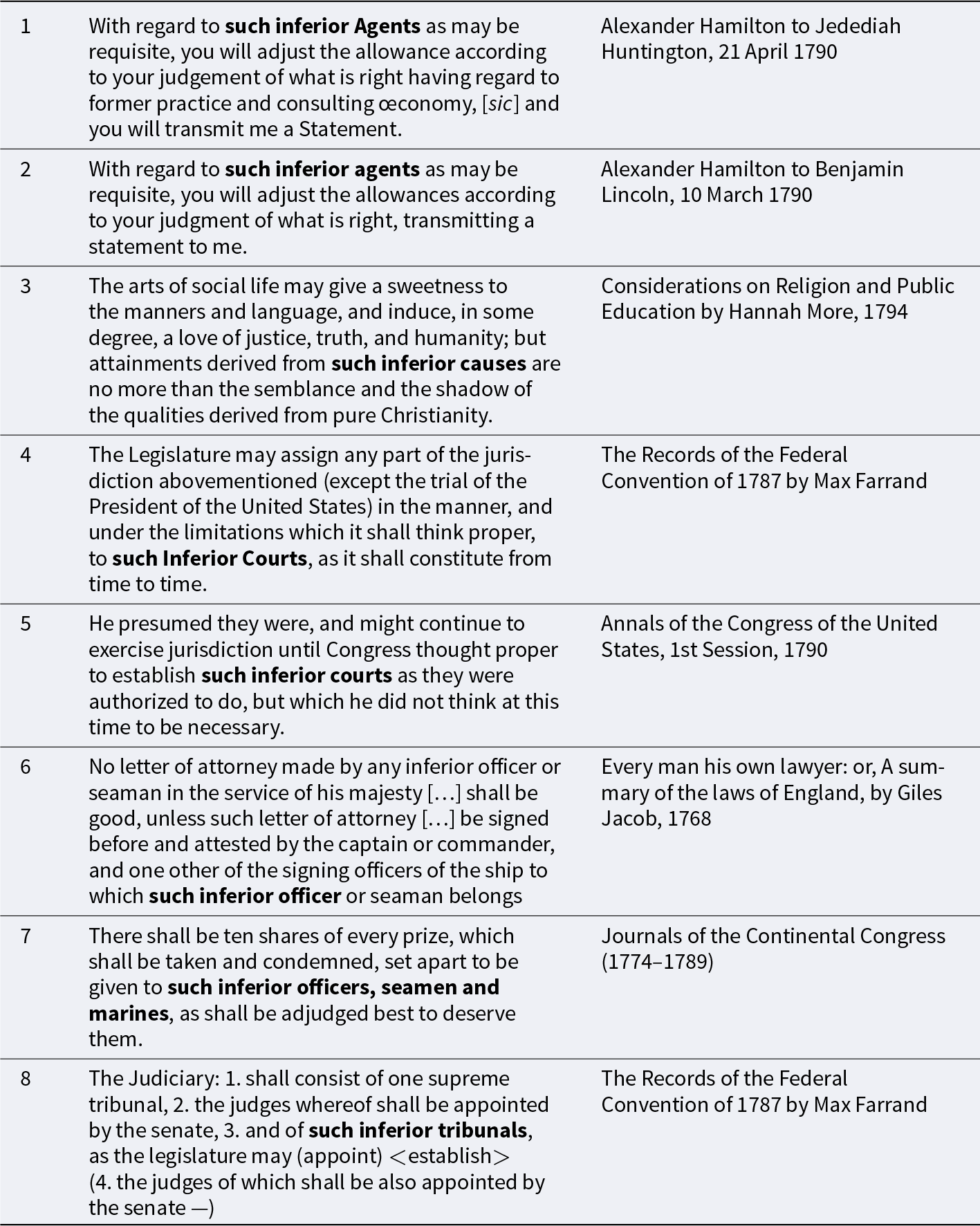
Our analysis of all sequences of “such” followed by “inferior” followed by a noun or noun phrase that occur in COFEA indicates that cataphoric reference was by far the most common usage. Of the 113 instances of the “such inferior N” construction in COFEA, 31 were discarded because they were duplicates or mentions of the Appointments Clause. Of the remaining 82 examples, 74 quoted the Judicial Vesting Clause (Article III, section 1 of the U.S. Constitution), which reads: “The judicial Power of the United States, shall be vested in one supreme Court, and in such inferior courts as the Congress may from time to time ordain and establish.” In this clause, “such” is clearly used cataphorically as it refers forward to “as the Congress may from time to time ordain and establish.” (“Such inferior courts” can obviously not refer anaphorically to “supreme Court.”) The eight COFEA concordance examples that remain are listed in Table 1 together with their textual sources. A review of these examples indicates that two of them (numbers 3 and 6, attributed to Hannah More and Giles Jacob, respectively) express anaphoric reference, while six illustrate the cataphoric use of “such.”Footnote 5 For instance, in numbers 1 and 2 from letters written by Alexander Hamilton, “such inferior agents” refers forward to “as may be requisite.” Also, in example number 8, “such inferior officers, seamen and marines” is cataphorically related to the phrase “as shall be adjudged.” So, overall, only two of 113 examples of “such inferior N” in COFEA contain anaphoric “such” with cataphora constituting the dominant reference type of the determiner in this phrase.
COFEA examples of “such inferior N” not quoting the Appointments Clause or judicial vesting clause

Table 1 Long description
The table lists eight source excerpts that contain the phrase “such inferior,” along with the author, work, and date. Two entries are letters from Alexander Hamilton in 1790 referring to “inferior agents” and adjusting their allowances. Three entries relate to courts and jurisdiction, including two from Farrand’s records of the 1787 convention and one from the 1790 Annals of Congress discussing establishing inferior courts. Three entries use the phrase in non-judicial contexts: Hannah More’s 1794 religious writing, a 1768 English legal summary about powers of attorney for inferior officers or seamen, and the Continental Congress journals on prize shares for inferior officers, seamen, and marines. The dates span from 1768 through 1794, with most examples clustered around the late 1780s and 1790. The excerpts vary in capitalization and spelling, indicating they are quoted as originally printed. The table provides examples only and does not quantify frequency beyond the eight listed items.
A pattern that emerged in our review of the COFEA results for this search and that applies to the “such inferior N” examples from the Appointments Clause and the Judicial Vesting Clause, as well as the eight additional examples with cataphoric reference, is that “such” is followed by “as.” In all these examples, “such” appears as part of a discontinuous construction together with an as-phrase or as-clause that serves to further elaborate the noun or noun phrase that is introduced by “such.” In other words, the noun phrase that contains “such” is followed by a phrase or clause that clarifies or further specifies this noun phrase. The “such” noun phrase and the as-clause that follows it together “form a discontinuous syntactic and semantic unit” (Ghesquière, Reference Ghesquière2012, p. 529), and the content of the as-clause is needed to understand the meaning of the such-phrase. The next part of our analysis toward determining the meaning of the Excepting Provision of the Appointments Clause therefore focused on further exploring the context following “such” and analyzing “such… as” as a construction in Founding Era American English. The results of this analysis are discussed in the following section.
RQ 2 results: The meaning of the “such… as” construction in the Excepting Provision of the Appointments Clause
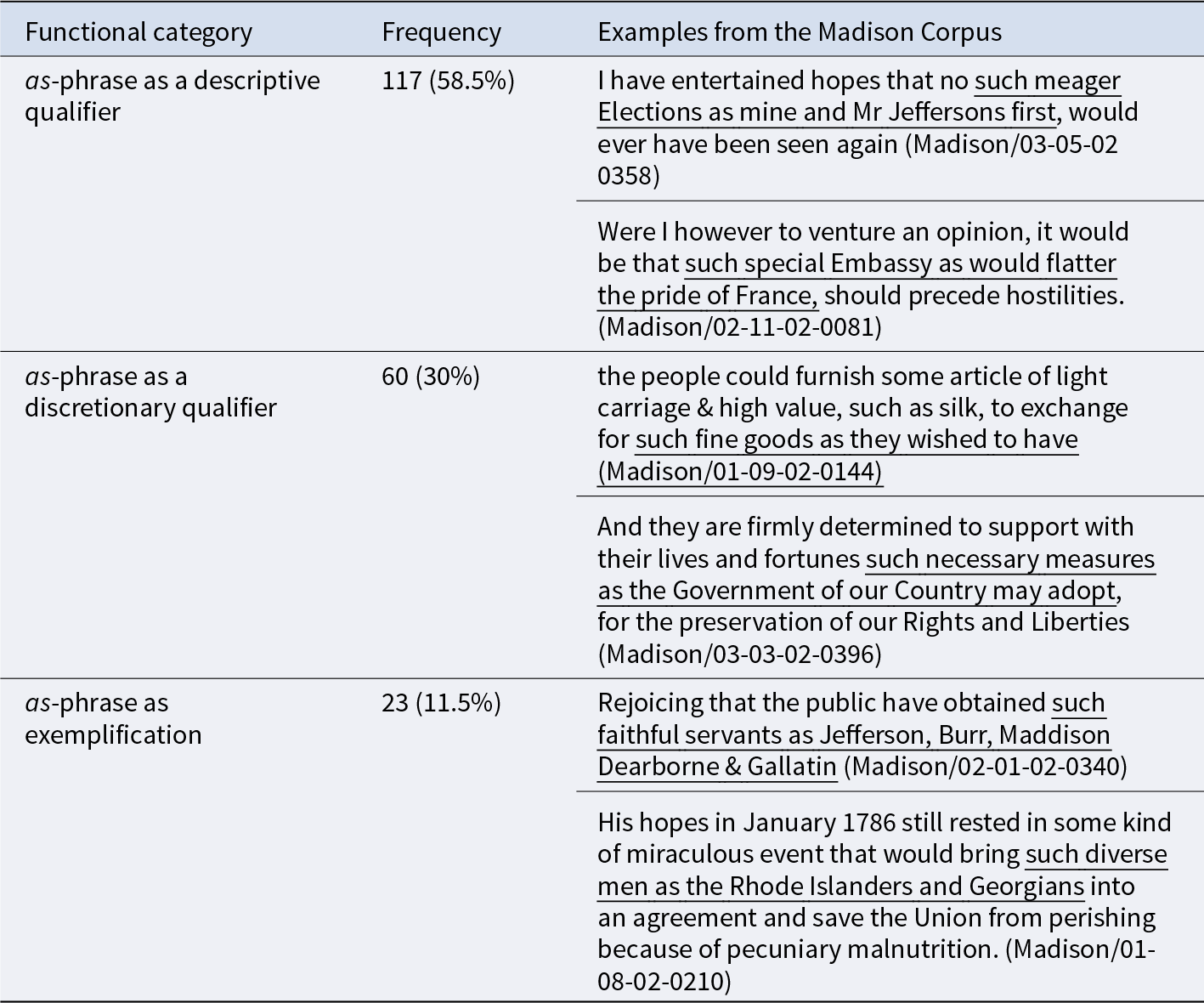
The second research question guiding our study asked how the “such… as” construction in the Excepting Provision informs our understanding of the Appointments Clause. The retrieval of all instances of the sequence “such + adjective + noun + as” from the 10.8-million-word Madison Corpus resulted in 389 concordance lines. From these results, two random samples of 100 concordance lines each were extracted and manually inspected by two independent coders (see methods section) to determine the function of the as-phrase in each example. The results of this functional classification are presented in Table 2. We found that each of the 200 Madison Corpus examples of the construction (underlined in the selected examples) expressed one of three functions: as-phrase used as a descriptive qualifier, as-phrase used as a discretionary qualifier, and as-phrase expressing exemplification.
Results of a functional classification of 200 examples of the “such… as” construction in the Madison Corpus

Table 2 Long description
The table classifies 200 Madison Corpus instances of the “such… as” construction into three functional categories and reports counts, percentages, and sample quotations. The largest category is “as-phrase as a descriptive qualifier,” with 117 occurrences, representing 58.5 percent of the dataset. “As-phrase as a discretionary qualifier” is the second most common, with 60 occurrences, or 30 percent. “As-phrase as exemplification” is least frequent, with 23 occurrences, or 11.5 percent. Descriptive qualifiers occur nearly twice as often as discretionary qualifiers and about five times as often as exemplification. The examples illustrate each category but are illustrative only and do not indicate how representative any single quotation is of the full set.
As Table 2 indicates, the first one of these three categories is the most frequently expressed one in our dataset. In 117 (58.5%) of the 200 analyzed concordance examples, the as-phrase that follows “such + adjective + noun” serves as a descriptive qualifier, offering additional details to further qualify the noun (in addition to the modification provided by the preceding adjective). For instance, in the two examples provided in the table, “mine and Mr Jefferson’s first” further describes “meager Elections,” and “would flatter the pride of France” further describes “special Embassy.”
Sixty (30%) of the 200 corpus examples contain an as-phrase which functions as a discretionary qualifier and further qualifies its preceding noun by conferring discretion. In the first representative example selected for this functional category, it is up to “the people” to decide which goods “they wished to have” in exchange. Similarly, the “such… as” construction in the second example gives “the Government of our Country” discretion to adopt what they consider “necessary measures.” In these category two examples, the scope of the noun is defined and limited by the discretionary qualifier that follows the “such… as” phrase. The adjectives that precede the nouns – “fine” and “necessary” – complement the nouns but do not significantly limit their scope, unlike the discretionary qualifiers in the first functional category.
In the remaining 23 examples (11.5%), the as-phrase functions to express exemplification of the noun that precedes “as.” In the first concordance line selected for this category, “Jefferson, Burr, Maddison Dearborne & Gallatin” are examples of “faithful servants,” in the second one, “the Rhode Islanders and Georgians” are examples of “diverse men.” The three uses of the as-phrase identified in our corpus data correspond to what Ghesquière (Reference Ghesquière2012) describes as the identification function of “such… as.” In her analysis of prenominal “such,” Ghesquière distinguishes between intensification, where “such” functions like a degree modifier similar to “very,” and identification, where “such… as” further specifies the noun’s referent. The patterns observed in our data align with this identification function and connect to the cataphoric uses of “such” discussed earlier.
If we now compare the examples of the “such… as” construction in the three functional categories with the Excepting Provision of the Appointments Clause, it becomes clear that, in the Excepting Provision, the as-phrase is used as a discretionary qualifier in that it captures all “inferior officers” that “they,” that is Congress, “think proper,” rather than as an exemplification or as a descriptive qualifier. Linking back to the theoretical framework adopted in this study, namely Construction Grammar, we can now see, based on the COFEA and Madison Corpus examples included above, that the “such + adjective + noun + as” construction constitutes an established form-meaning pairing in that it encodes forward specification (cataphora) and selection criteria or discretion.
Discussion and conclusion
Our corpus-based analysis of a linguistic pattern in the U.S. Constitution’s Appointments Clause, the “such… as” construction, indicates that the Supreme Court’s approach to applying the Appointments Clause by attempting to categorize the federal official whose actions are being challenged as either a “principal officer” or an “inferior officer” is unsupported by a plain text reading of the Default Provision and is inconsistent with the use of the discretionary “such… as” construction in the Excepting Provision.
The term “principal officer” is not used anywhere in the Appointments Clause. It does appear elsewhere in the Constitution with the limited meaning of the head of an executive department: “The President […] may require the Opinion, in writing, of the principal officer in each of the executive Departments, upon any Subject relating to the Duties of their respective Offices” (U.S. Constitution, Article II, section 2, clause 1; emphasis added). This is the same narrow meaning of “principal officer” that appears in the examples of early congressional legislation relied upon by Justice Scalia in the Edmond case.
The Default Provision also cannot be interpreted as describing a class of “principal officers.” To the contrary, it refers to all “Officers of the United States” (with the exclusion of officers whose appointments are provided for elsewhere in the Constitution). It therefore makes no sense to say, as the Court said in the Germaine case, that the “inferior officers” referenced in the Excepting Provision are “officers inferior to those specially mentioned [in the Default Provision].” The only named officers “specially mentioned” in the Default Provision are ambassadors, public ministers and consuls, and judges of the Supreme Court, and the scope of officers covered by the Excepting Provision is surely not limited to officers who have an “inferior” relationship to this small group of federal officials. And the other “officers specially mentioned” in the Default Provision are “all other Officers of the United States,” a phrase clearly not limited to one category of officers who have some kind of superior relationship to another category of officers.
As to the Excepting Provision, our conclusion that “such inferior officers” cannot be an anaphoric reference back to the Default Provision means that the Excepting Provision cannot end with a period after “inferior officers.” “The Congress may by Law vest the Appointment of such inferior officers” would be an incomplete expression, requiring more information to understand the referent of “such inferior officers.” The information that gives meaning to “such inferior officers” is provided by the following discretionary qualifier, “as they [Congress] think proper.”
The choice made by the Constitutional Convention to use this discretionary qualifier to define the scope of the Excepting Provision is consistent with Justice Breyer’s statement in the Arthrex case that the words of the Excepting Provision “strongly suggest that Congress has considerable freedom to determine the nature of an inferior officer’s job.” (United States v. Arthrex, Inc, 2021, p. 1994). By reading into the Appointments Clause a principal officer/inferior officer distinction that the text does not support and then giving to itself the power to decide whether a given federal official is sufficiently “inferior,” the Supreme Court has repeatedly undermined the discretion that the text of the Constitution confers on Congress.
By illuminating one aspect of legal text interpretation and supporting a clearer understanding of a passage of the U.S. Constitution, we hope to have illustrated the potential of true interdisciplinary collaboration between scholars from such diverse fields as linguistics and legal studies. We believe that applied linguists have a lot to offer to the field of legal interpretation and should feel encouraged to offer their expertise about how language is used and how meaning is expressed through linguistic constructions to legal scholars. We look forward to seeing the field of legal corpus linguistics as a “rapidly developing field of interdisciplinary scholarship” (Römer-Barron & Cunningham, Reference Römer-Barron and Cunningham2024, p. 1) continue to evolve and trust that it may offer new answers to questions of legal interpretation.
Acknowledgments
This article has its origin in a seminar paper by Abigail Coker, written while she was a student in a law school course taught by Clark Cunningham, with the assistance of Haoshan Ren, who was then a teaching assistant for Clark Cunningham and a Ph.D. candidate in applied linguistics under the supervision of Ute Römer-Barron. This article is substantially expanded and revised from Coker’s original seminar paper, and Coker, now a practicing attorney, has given her permission for its publication without inclusion of her name as a coauthor.

 Open access

