INTRODUCTION
In August 2007, the last of Ituri's militias laid down their arms (IRIN 21.8.07). Full disarmament would allow the remaining 200,000 internally displaced persons (IDPs) to go home, paving the way for peace and recovery. Aid workers emphasised that when militias joined the national army, or rejoined civilian life, peace would return and allow humanitarian needs to be addressed (IRIN 28.5.2007). But the head of the UN Office for the Coordination of Humanitarian Action (OCHA) in Ituri warned that the DR Congo authorities needed to be on hand to facilitate the return of IDPs. Worryingly, it was also reported that the number of combatants had risen in previous months, despite militia leaders joining the newly integrated national army, the FARDC (Forces Armées de la République Démocratique du Congo).
Still, the picture overall seemed positive. Since December 2006, after nearly a decade of intense fighting and displacement, Ituri's internally displaced had been going home. OCHA (2007) declared that:
IDPs who fled FNI [militia] attacks against Hema villages [in Djugu territory] in December 2004 – January 2005 returned home over the course of 2005 and 2006. Of the 247,500 displaced during and after FARDC/MONUC operations against militia groups in Irumu, Djugu and Mahagi [in 2006], 213,500 were estimated to have returned home that same year.Footnote 1
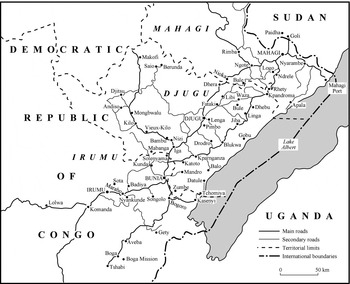
It is mostly the situation in Djugu territory (see map), where the conflict ignited in 1999, on which this article focuses. If the roughly 100,000 Hema who fled their burning villages in 2004–5 had returned home, how should we comprehend their situation today? That there is cause for concern, that going home, even voluntarily, does not necessarily mean returning to a peaceful inter-ethnic coexistence, this article makes clear. Ethnic reintegration is not just a question of going home and facing ethnic others who were once trusted: it is also a matter of confronting and reconciling disparate memories of a turbulent past. Under these circumstances, continued protection may be necessary.
Ituri district possesses ‘a high degree of ethnic variability and of temporal and spatial fluidity and mobility’ (Southall Reference Southall1954: 165). Like its Ugandan neighbour, Arua district, Ituri ‘stands out as a multi-national region … representing a living evidence of ethnic coexistence through diversity’ (Leopold Reference Leopold2005: 5, citing a local report). In Ituri, this coexistence had become pronounced prior to the recent conflict. Back in 1951, there were no marriages between Lendu men and Hema women, whereas Lendu women married Hema men; by 1990, marriages between Lendu men and Hema women had become more common (Thiry Reference Thiry2004: 114).
Ituri has five administrative territories, two of which feature here: Djugu and Irumu. Djugu is associated with ethnic Hema, also known as Gegere Hema or North Hema, and with ethnic Lendu. During the conflict, Hema formed the UPC militia (Union des Patriotes Congolais), led by Thomas Lubanga; Lendu formed the FNI (Front Nationaliste et Intégrationiste), led by Floribert Njabu. Irumu's Hema, in contrast, are referred to as South Hema; its Lendu are commonly known as Lendu-Bindi or Ngiti. Ngiti formed the FRPI militia (Force de Résistance Patriotique d'Ituri), while South Hema joined the UPC. In membership terms, FNI and FRPI did not distinguish between Lendu and Ngiti. Ituri is also home to about a dozen other ethnic groups. With the exception of Bira and Alur people, they do not feature much in this article.
Central Ituri, DR Congo

DEBATING DISPLACEMENT
The possible need for protection after IDPs return home is acknowledged in the UN guideline that such persons cease to be IDPs (Principle 29) but ‘continue to enjoy the rights of returnees as long as they need … protection’ (Principles 28–30) (Mooney Reference Mooney2007: 30). For Ituri, returnee protection relates in the first instance to the ever-present danger of ethnic discrimination and hostility. In everyday discourse, ethnic Hema fear Lendu/Ngiti, Lendu/Ngiti fear Hema, ethnic Bira fear everyone, and so on. In highlighting the ethnic dimension of the post-conflict situation, I hope to redress the imbalance caused by the humanitarian focus on material needs which, although justified, dehistoricises displaced populations (cf. Colson Reference Colson2003: 2). I shall also demonstrate that the expression of ethnic fervour does not result entirely from external manipulations, as is sometimes claimed.
Also of significance are humanitarian views on when an IDP crisis ends. Walter Kälin (Reference Kälin2007: 1), Representative of the UN Secretary-General on IDPs, wrote in his Foreword to the recently formulated Framework for Durable Solutions: ‘In the absence of agreed upon criteria as to when an IDP should cease to be considered as such, approaches have varied, or have been ad hoc, even arbitrary, reflecting dramatically different conclusions among the different national and international actors’. Roberta Cohen (Reference Cohen2001: 12; cited in Mooney Reference Mooney2007: 19) endorses this: sometimes ‘governments decide it, organizations that count decide it or no one decides it’. Moreover, IDPs and political or humanitarian authorities may have different understandings of what constitutes the end to a crisis. As the Framework explains:
IDPs may continue to see themselves as displaced long after national authorities and international observers may determine that their situation has been resolved using a set of objective criteria. Conversely, IDPs may see their displacement at an end on returning home, even though a more objective analysis would indicate that they remain vulnerable.(Brookings/Bern 2007: 6)
The first of these scenarios is the more likely one to apply to Ituri: national and UN authorities may decide sooner rather than later that the so-called objective conditions for declaring an end to the IDP crisis have been fulfilled. They are likely to emphasise that militias have disarmed, that commerce and farming are picking up, and that former warlords now serve in the army or have been jailed. In contrast, IDPs and former IDPs are more likely to be concerned about future insecurities, asking what guarantees are in place to halt the manipulations of ethnic sentiment.
One well-remembered occasion during which the arbitrary nature of end-to-the-IDP-crisis declarations manifested itself was when the international NGO Atlas Logistique stopped running the Aéro IDP camp in Bunia, Ituri's capital, in July 2005. The organisation told reporters: ‘there has been considerable progress in efforts to restore the socio-economic and security situation in Bunia and in the rest of Ituri District so we prefer, right now, to encourage people to return to their homes’ (IRIN 8.7.2005).Footnote 2 But the 7,000 IDPs still at the camp declined. Many had no homes to go to because they used to rent property in Bunia; others originated from Djugu, a territory they considered too insecure to return to. After the district authorities threatened to use force,Footnote 3 which was in breach of the right of IDPs to make informed and voluntary decisions, Atlas Logistique (2005) clarified that its decision had to do not with lingering insecurity but with camp conditions. Aéro camp offered amenities well above those enjoyed by Bunia residents. This contravened the Guiding Principles on Internal Displacement.
Which should be given more weight, living standards inside a camp or insecurity back home? The issue is complex, controversial, and begs the question of who should have the authority to determine that conditions of insecurity have ceased. In 2000, Francis M. Deng (Reference Deng2000: 154), Kälin's predecessor, insisted that the root causes of internal displacement needed to be addressed before an IDP crisis could be declared over. Causes might include ‘mismanagement of identity conflicts, gross inequities in the shaping and sharing of power, national wealth, opportunities for development, and chronic abuse of power resulting in egregious violations of human rights’. All of these apply to Ituri. Deng (ibid.: 154–5) also articulated a hierarchy of responsibilities, stressing
the need to reapportion responsibility, with the State concerned assuming the primary role, countries of the region who are affected by the overflow of internal crises coming next. But, the international community is still needed to play a supporting role as the ultimate guarantor of universal human rights and humanitarian standards.
Applying Deng's hierarchy of responsibilities to Ituri is not straightforward however. At every level – national, regional and international – actors have been implicated in the conflict. Some have had a hand in Ituri's massacres (e.g. Mbusa Nyamwisi, now Minister for Regional Cooperation), others stand accused of involvement in the illegal exploitation and trade of natural resources, which fanned the flames of conflict (UNSC 2002). Can the agenda for ethnic reintegration be left to the state? Can the so-called international community be the ultimate guarantor of human rights in Ituri? To begin to answer these questions, it is useful first to consider how relations between Hema and Lendu, the main protagonists in the conflict, have evolved over time.
HEMA–LENDU RELATIONS: A BRIEF HISTORY
Until the onset of the conflict, there was consensus about the historical migrations into Ituri. The earliest Hema migration, situated in the late seventeenth century, involved Hema from Bunyoro, Uganda, where they were known as Hima. A later Hema migration took a different route. Southall (Reference Southall1954: 151) has the details:
The earliest Hima chiefs to cross Lake Albert were the Gegere who settled among the Lendu south-west of Mount Aboro … Presumably Bantu speakers on arrival, they gradually became entirely Lendu in speech. Other Hima [nowadays known as South Hema] crossed further south near Kasenyi. These retained a form of Nyoro speech, but as they dominated Lendu and Bira they learnt those languages as well.
The Lendu groupings Gegere encountered had themselves arrived from the north, possibly before the sixteenth century (ibid.: 142–7). Southall accepts the consensus view that one branch of Lendu, the Lendu-Bindi, then migrated further south to settle at Gety (hence the name Ngiti), where they were later joined by Lendu who had come south along the eastern shore of the lake. Lobho (Reference Lobho1971b: 90–1), a Hema anthropologist, accepts that Lendu lived in Ituri before Gegere Hema arrived. He argues that, being outnumbered by Lendu, Hema arrived peacefully and used diplomatic skills (and the prestige of cattle) to impose a political system that ended the constant violence among Lendu. While there is no academic disagreement about the timing of the migrations, missionary–ethnographer Edmond Thiry (Reference Thiry2004: 111) has questioned Lobho's assertion that Lendu society was rife with in-fighting. Thiry believes that Gegere Hema may have mediated in certain conflicts between Lendu groups, perhaps as a way of forging or strengthening certain ties, but he rejects the portrayal of Lendu social life as inherently violent. Thiry is also critical of the idea that Hema would have subjugated all Lendu in a tightly controlled manner, suggesting instead that interactions were varied and less exploitative than commonly claimed. Nonetheless, little by little, Hema dispossessed Lendu of a part of their domain (Lobho Reference Lobho Lwa Djugudjugu1980: 160–1), especially in the Blukwa region, which became the Gegere Hema heartland. Here subjugation was most marked.
Historically, Hema and Lendu have interacted differently depending on whether they lived north or south of the Irumu–Bogoro–Kasenyi route. This difference still matters today. To the north, in Djugu territory, Hema and Lendu developed relations of subservience, but Lendu imposed on Hema their language and made them adopt certain practices and values (Pottier, forthcoming). Interactions south of the Irumu–Bogoro–Kasenyi road, in Irumu territory, have a different history. The initial Hema migration from Bunyoro was incident-free, but this changed in 1880 when King Kabalega led an attack that could only be pushed back with the help of H. M. Stanley's troops. A decade later, people from Bunyoro attacked again, won and declared independence, but their victory was short-lived. Determined to protect their wealth in cattle and plantations, Lendu-Bindi (Ngiti) staged a series of revolts, and in 1911 murdered South Hema chief Bomera. His death signalled a complete liberation, even the Belgian occupier was kept at bay. To this day, Ngiti maintain a strong sense of autonomy.
Also relevant to relations today is the colonial attempt to separate Lendu and Hema. This issue is embedded in the collective conscience, and, as we shall see, contentious recollections of what ‘really’ happened have now started to circulate. The colonial strategy for separation developed around the imposition of strict administrative boundaries to reduce interaction between Djugu and Irumu on the one hand, and between Hema and Lendu on the other. Belgium also gave Lendu their own chiefs, something many Lendu rejected at first, preferring instead to stay with their Hema masters. A few decades later, however, Lendu embraced their ‘compulsory emancipation’ and trekked around ‘to join their brethren under newly established chiefs from their own stock’ (Southall Reference Southall1953: 18). As a result, Djugu developed into a mosaic of ethnic villages that dovetail into each other (Lobho Reference Lobho1971a: 571). For Lobho, however, the mosaic is proof that the Belgian strategy failed; the separation did not go far enough. Given contemporary interpretations of this colonial policy (see below), it is worth pointing out that the colonial authorities did not attempt the wholesale expulsion of one or other group from Djugu. Although Belgium clipped the political power of the Hema king, most Belgian administrators (and missionaries) regarded Hema as a god-sent superior race, qualified to assist them in their ‘civilising mission’. Hema enjoyed priority access to the realms of education (including religious instruction), administration and commerce. Hema domination on all these levels came to fruition in 1973, when Mobutu's zaïreanisation campaign transferred the ownership of nearly every ex-colonial plantation and ranch in Ituri to elite Hema, a small number of powerful families. From here on, Ituri's wealth centred on ‘the cattle market, the sale of gold and commerce in general, all avenues where Lendu miss out’ (Lobho Reference Lobho Lwa Djugudjugu2002: 75).
While Hema elite domination is pervasive, the idea of ethnic segregation is something ordinary Iturians continue to resist, as already seen in the increase of Hema–Lendu marriages. Even during the conflict, non-elite Hema were well aware that class, not ethnicity, had triggered the crisis. As a Hema woman put it, this ‘war is not between Hema and Lendu, but between the rich Hema and the rest of us’ (quoted in IRIN 18.12.2002: 10). Inter-ethnic cohabitation has indeed proved resilient, as evidenced also in the number of times displaced people moved in ethnically mixed groups (see below). Lendu refugees I interviewed in Kampala in July 2004 impressed this resilience on me. In the small town of Kpandroma from which they originated, and which is predominantly Lendu, it had needed an extreme form of external interference to break the bonds of Hema–Lendu solidarity. Here is a condensed version of what refugees told me:
Life in Kpandroma, a stronghold of Lendu resistance to Hema domination, started to change only in 2001. Until then, life had not been too bad, we had not had any massacres and Hema families were still living with us.Footnote 4
In 2001, however, two UPDF [Ugandan army] dissidents, Peter Karim and Anthony Kyakabale, visited Kpandroma. They had left the UPDF because they did not accept that Museveni had won the elections for a second time. They supported Dr Kizza Besigye, who had lost the elections. The pair talked to our chief and notables, who agreed to set aside land for a training camp. The dissidents now belonged to the People's Redemption Army (PRA) and received support from Rwanda. Our leaders had known these men since 1996, when Mzee Kabila launched his war against Mobutu. Supporting Kabila's war, the Ugandan army had trained young Lendu to fight for him. At this stage, Kpandroma's Lendu did not mind the Rwandan connection.
Later we heard that the Rwandan army was interested in working with Hema. At first, this made us nervous, then we became angry. Congolese militia leaders who supported the PRA came to talk to us, even Tutsi commander Bosco Ntaganda did. Ntaganda tried hard to win Lendu over to the UPC/Hema way of thinking, and for a while it seemed he would succeed. Even though there was now open conflict between Hema and Lendu throughout most of Djugu, we still managed to live together. Then, more soldiers trained in Rwanda arrived, and we learned that Rwanda was sending weapons to Kpandroma, via Mongbwalu. Lendu became suspicious.
The tolerance between Lendu and Hema snapped after UPDF commander Edison Muzoora also dissented to join the PRA. For the Lendu of Kpandroma that was hard to stomach. Muzoora had been in Ituri for some time and was known to have hired troops out to Hema to kill Lendu, even here in Kpandroma. When Muzoora showed up, Lendu became very worried. We had listened to Bosco Ntaganda when he urged we should accept the UPC programme, but when Muzoora came along with that same message, the situation turned unbearable.
The Lendu of Kpandroma decided to get rid of Muzoora, but failed in their attempt. Narrowly escaping death, Muzoora swore never to work with Lendu again. This was the point at which Lendu–Hema relations broke down, and Hema families were forced out of Kpandroma.
That inter-ethnic solidarity in Kpandroma remained alive for so long tells analysts why they must refrain from essentialising ethnicity. The lingering solidarity, severed only by extreme conditions, should be remembered. As with the Rwandan genocide, however, there is always a danger that acts of inter-ethnic human kindness are lost from sight when history is rewritten (Pottier Reference Pottier2002). I harbour no illusions: there is every likelihood that counter-narratives about life in Kpandroma in 2001 will surface; narratives that may bring June 1999 back into focus. At that point, a confrontation between Lendu and (Hema) farmer Singa Kodjo, the latter backed by UPDF elements, had resulted in the first Lendu deaths. The Blukwa massacre of Hema which followed this confrontation, widely regarded as an act of revenge, may for some Kpandroma residents have been the point at which every trace of inter-ethnic solidarity vanished. Only time will tell whether opposing narratives, which already exist (see Vlassenroot & Raeymaekers Reference Vlassenroot and Raeymaekers2004: 391), have gathered momentum, and what part they will play when Iturians come to confront their recent past as contested terrain. I shall return to this issue.
ITURI CONFLICT: PATTERNS OF DISPLACEMENT
Ituri's conflict is a modern conflict: high-quality gold has attracted warlords and mining corporations alike. We note in particular the active presence of AngloGold Ashanti, part of Anglo-American, which developed links with the Lendu-dominated Front Nationaliste et Intégrationiste (FNI) (HRW 2005a). Along with other natural resources (timber, coltan, diamonds), Ituri's gold has been systematically taken out of the country to reach global markets. Other militias too have coveted Ituri's gold. When the Hema-dominated UPC took Mongbwalu in September 2002, it too exported the gold in exchange for weapons.
But the conflict was also driven internally. For Djugu, it originated in the accelerated acquisition, allegedly under dubious circumstances, of Hema concessions in Lendu villages. For Irumu, where it started later, the conflict was grounded in the post-colonial incorporation of certain Ngiti villages into a South Hema chefferie. This reorganisation, agreed in colonial days but not implemented until 1966, deprives these villages of access to Lake Albert. In Djugu, however, the ultimate raison-d'être for land conflict is Mobutu's zaïreanisation campaign, which began in 1973 and made him use land to reward political followers. The General Property Law of 1973 – through which all land could be privatised, ancestral land included – speeded up the process whereby Hema cattle herders could displace ‘autochthonous’ Lendu agriculturalists. Being the main (not to say sole) beneficiaries of zaïreanisation in Ituri, elite Hema approve of this law. Lobho (Reference Lobho Lwa Djugudjugu2002: 68; emphasis added) reflects:
The majority of land conflicts stems from ignorance regarding the procedure for land acquisition. Often, the population is not informed about the law. People still believe that they can inherit ancestral land. Hence, no sooner has the occupier left or died then people think they can recuperate the land for settlement without any formality whatsoever. When the state [decides otherwise and] allocates the concessions to new owners, the people rise up in surprise.
This is the heart of the matter. In Ituri, as in the Kivus, the General Property Law has de facto abrogated community rights in land. For Lobho, though, there is nothing wrong with the law. Turning a blind eye to the scale of the expropriations by wealthy Hema, and to the ‘assistance’ of Ugandan troops, he shifts the emphasis to Lendu ignorance of how the land law is implemented. Many in Ituri disagree. As Iturians know, the General Property Law stipulates that the occupiers of land sold privately should be given two years notice before being asked to leave. This period of grace was ignored once Ugandan troops arrived on the scene; evictions of Lendu from ancestral land became instant.
The Uganda People's Defence Force (UPDF) first occupied Ituri at the onset of Congo's Second War (August 1998), roughly a year before the first Hema–Lendu squabbles over land broke out. As these squabbles multiplied, opportunistic commanders reached ‘accommodations’ with elite Hema, declaring war on Lendu agriculturalists, who set up village defence groups and resorted to violence. By the end of 1999, the death toll stood at 7,000 with some 180,000 villagers, Hema and Lendu, displaced from their Djugu homes (IRIN 28.1.2000). Instances of mass slaughter were ethnic in nature; over 400 Hema died in Dhendro (Hema village) in September 1999; over 300 Lendu died in Bambu (Lendu village) the following December (IRIN 14.9.1999, 1.12.1999). Displacements, too, had a pronounced ethnic character: Hema tended to flee towards Bunia, where local administrators guaranteed their protection; Lendu made for the district's interior.Footnote 5
With the Ugandan army openly supporting UPC leader Lubanga, the civil war escalated. Seizing Bunia in August 2002, Lubanga launched a virulent racist discourse in which Ituri's original inhabitants (called originaires) – now redefined as Hema – were distinguished from non-originaires, especially Lendu, Ngiti, Bira and Nande. It was a death sentence for many non-originaires. Bunia's Lendu population fled the town, while tens of thousands of displaced rural Hema filed in to occupy abandoned homes. Bunia's IDP population grew to 60,000, predominantly Hema (AI 2002). That same month Lubanga's UPC attacked Songolo, killing many Lendu/Ngiti civilians. To avenge the atrocities, Lendu/Ngiti combatants then carried out their (second) attack on Nyankunde, supported by rebel RCD-ML troops under the command of Mbusa Nyamwisi. They callously massacred 1,200 Hema and Bira civilians.Footnote 6 The attackers regarded Bira as allied to South Hema, which they were in and around Nyankunde. Paradoxically, however, Bira were by then also hunted down by Lubanga's UPC, especially in Bunia.
After he was excluded from the DRC peace talks in South Africa, Lubanga signed a collaborative agreement with the RCD-Goma rebels, Rwanda's proxy. Angered by the betrayal, Ugandan president Museveni dropped his support for Lubanga and made Chief Kahwa (Hema) his new protégé. On paper, Kahwa's military faction became a political party named PUSIC (Parti pour l'Unité et la Sauvegarde de l'Intégrité du Congo). Kahwa joined forces with the FNI and one Alur group to form FIPI, Front pour l'Intégration et la Paix en Ituri. On 6 March 2003, a combined UPDF–FIPI force ousted Lubanga from Bunia, driving Hema out of town.
Weeks later, at the insistence of the ‘international community’, the Ugandan military departed from Bunia under the terms set by the Luanda Agreement of September 2002. The UN Mission in the Congo (MONUC) misread the politico-military landscape: the excesses of individual UPDF commanders notwithstanding, the Ugandan army had provided a modicum of stability. The consequence of Uganda's premature pull-out was horrendous. Lubanga returned, with Chief Kahwa back in support, took on the Lendu and Ngiti militias and plunged Bunia into the abyss. The battle killed over 400 civilians and caused the displacement, often a second fleeing, of most town dwellers. Bunia was cut in half: FNI/FRPI troops controlled its southern half, UPC/PUSIC the north. Fleeing civilians followed the retreating UPDF regiments: Lendu went north towards Mahagi; Hema took the south-eastern axis towards Kasenyi. Many crossed into Uganda. Hema who stayed in Bunia sought refuge at the MONUC headquarters in the centre of town. A third group fleeing Bunia comprised tens of thousands of so-called non-originaires; they made their way south towards North Kivu, where they were joined by others who had fled the fighting in Mambasa and Irumu (Pottier Reference Pottier2007). Among the IDPs were many Bira from Bunia and Nyankunde. I shall discuss their plight further down.
The exodus to Uganda had already begun in January 2001, when thousands of South Hema arrived in Bundibugyo, among them Lendu who lived in Hema villages – another sign that inter-ethnic cohabitation continued despite the conflict. This first wave of refugees was later joined by 2,000 Hema from Bogoro, following UPC–FIPI clashes and a massacre in March 2003, and by Hema from Drodro, following a massacre there in April. The big ‘streams’ got under way when the UPDF withdrew. Already hosting numerous Ugandan IDPs, the people of Bundibugyo accommodated the Hema refugees as best they could, but the reception awaiting non-Hema north of Lake Albert was less welcoming. In Nebbi district, in February 2003, ethnic Alur attacked Lendu refugees, killing twelve and displacing 3,000 (New Vision 12.2.2003). Eventually, after they refused to move inland to Uganda's Kyaka II camp, refugees fell foul of local administrators who were frustrated that Congolese with refugee status, fishermen in particular, frequently visited Ituri to gauge the situation (Hovil Reference Hovil2003: 11). Ugandan officials expelled 10,000 in September 2004.
The arrival of a rapid intervention force in June 2003, sanctioned by the UN Security Council, thwarted Lubanga's ambition to drive MONUC out of Ituri. Led by France and mandated under Chapter VII of the UN Charter, Operation Artemis quickly secured most of Bunia, but could not stem the violence that now moved to the countryside. Rural Hema became a soft target for FNI/FRPI assaults. When Artemis ended and MONUC troops were boosted, the UN continued to struggle to make Ituri secure (GAA 2003). By now, the population in Bunia's two improvised camps for internally displaced, one being the Aéro camp, had risen to 20,000 (IRIN 31.7.2003). Many IDPs had Bunia homes in the ‘wrong’ section of town.
Although Bunia's IDP population rose sharply in the early years of the conflict, many never reached the district capital and ended up in small trading centres near their homes. Here too, as with refugees in Bundibugyo (Hema refugees, int.), women were anxious to return home each time a planting season approached, but were invariably forced back by rebel soldiers or militias. In these small towns, women could secure only poorly paid farm work, and faced ethnic discrimination. Thus in Drodro, where farms were owned mostly by Hema, Lendu women could not get seasonal work (IRIN 3.3.2000). Notwithstanding such discrimination, July 2003 brought further evidence that the displaced often moved in ethnically mixed groups. After an attack on Fataki, for example, the survivors who arrived in nearby Bule were mostly Hema, but also comprised Lendu, Alur and Ndo-Okebo (IRIN 9.9.2003).
When Ituri's warring factions declared peace on 14 May 2004 and signed the Kinshasa Act of Commitment (Acte d'Engagement de Kinshasa), the arrangement was yet another example of the ‘international community’ rushing in in search of a much needed victory. The Act had no future. Warlords had ‘entered the negotiations knowing that if their largely unreasonable demands for status, jobs and immunity from prosecution were refused, they would continue their activities without fear of sanction’ (ICG 2004: i). Still, with humanitarian encouragement, preparations for going home began in earnest: 5,000 (mostly Hema) IDPs from a camp north of Bunia prepared to return to Drodro and Fataki. Some IDPs also left Bunia's Aéro camp, but their number fell below the UN expectation. Villages throughout Djugu (and parts of Irumu) witnessed the return of IDPs. For many, however, the dream of going home was short-lived, as new fighting made the Kinshasa Act obsolete and displaced about 100,000 people in Djugu and Mahagi. Then, amid rumour of an impending militia attack on MONUC, humanitarians scaled down or ceased operations (OCHA Monitoring 2004). All over Ituri, the rape of women and young girls once again became a weapon of war (cf. HRW 2002). As the year drew to a close, MONUC dismantled FNI camps west of Mahagi town, but the dislodged fighters regrouped to attack a series of villages causing mayhem, death, and more displacements.
In 2005 and 2006, displacements intensified. Firstly, MONUC and FARDC forces carried out reactive ‘cordon and search’ (and destroy) operations against militia camps in Djugu and Irumu. They set ultimatums, albeit moveable ones, for militias to surrender. Some warlords were arrested; others disarmed and accepted high-ranking positions in the army (HRW 2005b). But Ituri's programme for Disarmament, Demobilisation and Reintegration (DDR) faced an uphill struggle because of a lack of sustainable livelihood alternatives for those who handed in their weapons.Footnote 7 To make matters worse, certain militia leaders who accepted to join the FARDC, notably Peter Karim, maintained combatants on the ground (OCHA 2006).
Secondly, 2005–6 saw a resurgence of the ‘ethnic cleansing’ that had galvanised militias in the early years of the conflict. Over three months, Karim's FNI attacked and burnt some seventy Hema villages and hamlets in Djugu, causing the displacement of about 100,000 or roughly the entire Hema population. Four IDP camps sprung up. Ironically, the destruction of Hema villages coexisted with cross-ethnic operations in which UPC (Hema) and FNI (Lendu/Ngiti) troops joined forces to attack FARDC/MONUC positions. It was yet another manifestation of the complexity of Ituri's ethnic scene. Ethnic cleansing also spread to Irumu territory, as when Bira were chased from certain villages, but never reached the same level as in Djugu. More commonly in Irumu, civilians fled sites of combat between FARDC/MONUC and local militias, especially FRPI and MRC.Footnote 8 In Irumu too, over 100,000 people, mostly Ngiti, would become displaced.
The resumption of ‘pure ethnic’ fighting in Djugu, whilst not as murderous as in 1999–2001, suggested that the FNI aimed to dramatically alter Djugu's ethnic composition. As Louis-Marie Bowaka, MONUC coordinator for human rights in Ituri, explained, ‘The strategy of the Lendu militias is to chase away the Hema from their territory in Djugu. The means to achieve this is a policy of burnt earth, selected killing, rape, total destruction of entire villages and kidnapping for sexual slavery’ (IRIN 23.3.2005). Bowaka used the term ‘ethnic cleansing’, but was emphatic that ‘what we see is definitely not genocide’. There was, however, no playing down the atrocities, or indeed the complicity of Lendu civilians. Eyewitnesses revealed how the FNI raids followed a pattern: militias attacked with guns and machetes, and were followed by women, children and even elderly people who looted the villages. They then burnt homes to the ground (ibid.). On the other hand, and this is significant for the peace process, there is also evidence of Lendu villagers becoming wary of their own FNI fighters. At Kpandroma in May 2005, after Lendu civilians reached an agreement for peaceful cohabitation with Alur from nearby Mahagi, a number of FNI combatants residing in the town were killed (OCHA Monitoring 30.4–6.5.2005). Likewise, Lendu civilians grew tired of the cross-ethnic militia operations against MONUC and the FARDC, and began to resent the presence of Hema (or Tutsi) commanders in their villages, just as had happened in Kpandroma, 2001. Thus in July 2005, the Lendu of Jiba village opposed the presence of UPC warlord Bosco Ntaganda, and made him leave (ibid. 23–29.7.2005).
In the second half of 2006, the security situation in Djugu eased and the displaced started to go home (again). By now, Ituri's militia leaders were either imprisoned (Lubanga at the ICC in The Hague; Njabu in Kinshasa; Kahwa in Bunia) or integrated into the army. While commanders Peter Karim (FNI) and Cobra Matata (FRPI) kept combatants in the field, and played hard-to-catch, their virtual surrender resulted in optimism among UN and humanitarian workers. But new concerns also surfaced, as when Lendu politicians accused the FARDC, now the main perpetrator of human rights abuses, of siding with Hema against Lendu. Sources close to the Lendu community spoke of Hema complicity with the FARDC, whose soldiers accused Lendu villagers, traders especially, of failing to end their support for the FNI (ibid. 3–10.2.2007). The parallel with the default position of the UPDF in 1999 was uncanny.
The reported return of Djugu's displaced Hema notwithstanding, it is doubtful whether all IDPs will have arrived home. The prospect of future discrimination and hostility, after years of ‘ethnic cleansing’, is likely also to have resulted in alternative solutions. What I learned in Nyankunde in 2004 may well apply to Hema villages in Djugu: IDP camps were left behind, but the road did not lead home.
NYANKUNDE: FOCUS ON DISPLACED BIRA
In August 2002, Lubanga's UPC/Hema troops swept through Bunia, killing Lendu civilians and other non-originaires, especially Nande and Bira, whom they regarded as allied to Lendu. In Nyankunde, however, the situation differed as Bira and South Hema were allied. Nonetheless, when Nyankunde's Bira chief, Bulamuzi Dieudonné, was asked to join the UPC, he refused and paid with his life (HRW 2003: 27).
Bulamuzi's successor, Chief Herabo (2004 int.), told me that IDPs exercise great caution when going home:
After Nyankunde was attacked on 5 September 2002, I fled towards Bunia. I reached there in January 2003, and stayed for a year. Then I returned to Nyankunde with 230 of my people, but we did not come straight here. First we went to Marabo, which MONUC had made secure. Last January [2004], there was still almost no one in Nyankunde. So we stayed in Marabo for a month.
On 2 February 2004, a group of us, all men, returned to Nyankunde, escorted by a MONUC patrol. The women stayed in Marabo until MONUC patrolled Nyankunde twice a day, which was in March. Then, slowly, more and more people came back – from Komanda, Luna, Erengeti and Oicha on the Beni road, and from Lolwa and other places on the road to Mambasa. But today, I have yet to go farther than 5km from my home. Most of my [Bira] people are back, but many families remain in Oicha camp as they still fear for their safety.
Chief Herabo made two further points: first, several ethnic groups previously living in Nyankunde would never return; second, the power of Ngiti militia commanders was causing serious concern:
When you are the chief of Nyankunde you hear a lot about rehabilitation and peace initiatives. This is good. But whatever others can do for us, there will be no peace until I sit down with the Ngiti chief Akobi to discuss how I feel. We Bira and our Ngiti neighbours need to sit together and talk. I have written to Chief Akobi to invite him to a meeting in the best possible spirit. But he has written back to say that his councillors (notables) are still displaced. I have replied that my people are traumatised, they cannot wait.
While we [Bira] are today back in numbers, my people continue to live in fear since Ngiti combatants remain at large. You [JP] will have seen them on the road coming from Bunia. Officially, these combatants were chased away by MONUC last December, but they are still there, fully armed. In the daytime they come to Nyankunde in civilian clothes, at night they return in their FNI uniforms. We know them, we see them at the market in Marabo. They will not easily give up their arms. Nowadays, a weapon is like a pen (un stylo) or a hoe, it comes in handy when you need 20 francs.
There is another problem. Chief Akobi, my Ngiti counterpart, has no power over the militia in his area. He may originate from Gety [FRPI stronghold], yet he is still in Bunia, too frightened to come home. C'est un homme infiltré!
An infiltrated man. These parting words aptly summarised how Ngiti commanders have eclipsed the power of Ngiti chiefs (chefs de collectivité), who, being colonial products, never enjoyed the authority and respect customarily bestowed on Hema and Bira chiefs (see Southall Reference Southall1953: 152–66).
Herabo estimated that 1,527 IDP families (or 9,000 persons) had returned from North Kivu to his collectivité. Significantly, many among them were still in transit to other villages within the collectivité, villages too dangerous to return to.Footnote 9 Facing what could become a long delay, these IDPs had approached Chief Herabo for permission to clear land and cultivate (Vlassenroot & Huggins Reference Vlassenroot, Huggins, Huggins and Clover2005: 171).Footnote 10 Allocating land, however, turned into a lengthy process. Indeed, IDPs interviewed in early April, just before my visit, reported that they had not yet received land, even though they had been in town for several months.
The situation in Nyankunde in 2004 revealed how leaving an IDP camp is not necessarily the same as going home. There may be stops en route where returnees once again turn into IDPs. Alexandre Gashangi (OCHA, 2004 int.) confirmed this, saying:
Returning IDPs [from North Kivu] may arrange to stay with friends or with people from a shared religious denomination. They may occupy abandoned houses, sometimes for lengthy periods. Or they sleep in churches and schools, which they vacate during the day. It is not uncommon for returning IDPs to stay with hosts for a while, even for an entire agricultural season. In such a situation, IDPs may be given a plot of land to work.
One problem is that host communities are often worse off than the returning IDPs themselves. In such situations, when returnees receive seeds and tools, OCHA tries to ensure that hosts too receive assistance.
Assistance to hosts is a way of compensating families for their generosity. In the ecologically varied Great Lakes Region, hosts and IDPs often know one another well as they maintain long-term relationships of mutual assistance, which means that hosts must not skimp on generosity (see Pottier Reference Pottier1996: 69). What seemed striking about Nyankunde, however, was that an initial delay in going home might become more permanent. Two years after I interviewed Chief Herabo, the UN news outlet IRIN (17.9.2006) reported what the chief's Ngiti counterpart, Edouard Akobi, thought of Cobra Matata, the most feared among Ngiti warlords. Akobi claimed that Cobra had now become ‘so ruthless that many of his combatants [were] defecting’. He also thought Cobra was planning new attacks on civilians who had food or medical supplies. Akobi's statement suggests that the situation in and around Nyankunde will have changed little in the intervening years, and that initial delays in going home may indeed have become more permanent, especially with the radicalisation of anti-Hema sentiment in Djugu in 2004–5. It is to Ituri's more radical discourses, the calls for segregation, that I now turn.
TRAWLING THROUGH THE PAST: APARTHEID AS SOLUTION?
That Ituri still lacks a fully functioning administration does not mean that peace initiatives are lacking. On the contrary, the search is on and progress is being made. Iturians seem to agree, for instance, that peace initiatives must start with locals taking the lead. Bold statements have been issued. At a workshop in April 2006, community leaders from all five territories stated that ‘the devastating conflict was due to the presence of foreign troops in the country and in the region, assisted by local opportunist politicians who pitted us against each other. There is no longer a conflict between different communities in Ituri’ (cited in AIP/FEWER 2006: 26). While there is truth in this position, as this article has shown, the statement also underrates the role of local demagogues. As emerged from a series of workshops and memoranda in 2002, influential opinion-makers use history, often creatively, to propose radical solutions. This matter deserves attention.
In a memorandum dated 10 March 2002, the Communauté Hema (2002a) spelled out that the complete separation of Hema and Lendu, an act of apartheid, is key to any durable solution:
Congo's Hema Community proposes to spatially reorganise the territories of Djugu and Irumu in order to promote the harmonious development of each [ethnic] group and to establish security in the region. The familiar [mosaic of] Hema and Lendu enclaves must be abolished to bring about a more coherent management of the social space … Such territorial reorganisation (redécoupage territorial), to note the effective separation of Lendu and Hema, had already been proposed by the Commissaire du Peuple Shatchu Bele Dytsi (Lendu subject) before the National Parliament in June 1977, and was entered also into proposals for conflict resolution on 4 August 1999 and 17 February 2001.
Concretely, the Communauté Hema du Congo demanded the ‘forceful resettlement of Lendu in villages to be created and placed under army surveillance with a view to their urgent social reinsertion’.
This apartheid-style solution is found also in documents that circulated among UPC commanders, in which full segregation and relocation was said to fit into God's wider plan for Ituri. Here are excerpts from such a UPC document.Footnote 11 Written in English, and deviating from history as we know it, the document hails the wisdom of Belgian colonialists:
Seeing that the Lendu and Hema belong to the same territory of Djugu, and that the former are warriors, killers, rough, untameable or ungovernable, [the Belgians] decided that all the Lendu should be moved away from the Hema … to start [a] lonely and new life in the territory of Mambasa. This was in [the] 1950s. By the way, this decision was good for both tribes. Since Hema people are cattle breeders, the whole … territory of Djugu is providentially meant to graze their herd[s] in it. However, the Lendu are meant to live by hunting game and cultivating the soil leisurely. The territory of Mambasa too is providentially meant [for] this kind of farmers …
The best solution to end … the hatred, jealousy and murder among Lendu and Hema was already dreamt by the Belgian government – moving the Lendu away from the Hema. As for me, I opt for it. As the saying goes, ‘out of sight, out of mind’.
Some Lendu community leaders also favour a form of apartheid, but on a much smaller scale. Thus in January 2002, at a workshop in Kinshasa, LORI, the Lendu cultural association, proposed that the colonial decision to move Hema to Berunda be implemented in order to reduce population pressure. As for Irumu, the solution was to undo the post-colonial reform through which several Ngiti villages had become part of the South Hema collectivité. With hindsight, the wholesale purging of Hema in Djugu in 2004–5, which involved FNI/Lendu fighters and civilians, may have been a reminder that extreme solutions continue to appeal. Even though the attempt stopped short of expelling Hema from Djugu, and IDPs may have returned home, the displacement of 100,000 Hema who saw their villages burnt to the ground, along with the proposal for Berunda, suggests that extremists on both sides have apartheid solutions in mind. In volatile Ituri, declaring an end to the IDP crisis could be premature for some years to come.
While there can be no doubt that the peace process will take time, must be owned by Iturians, and requires sensitivity and diplomacy, there is a danger that peace workshops ignore how opinion-makers trawl through the past to legitimate radical solutions. This danger exists because workshop participants may fall for the idea of a nebulous, glorified past in which law and order were maintained with relative ease. Here is an example from the already mentioned Bunia workshop in April 2006. Addressing ‘Justice and Reconciliation’, civil society representatives declared:
Our ancestors did not settle their disputes by using bows and arrows. The reaction was to gather people of same conditions together and to settle the conflict peacefully. Whether it was related to land, dowry, forced marriage or crime, the elders around the wood fire or under the tree, would find a way that would favour the renewal of the social fabric and reconciliation, and this would end up in palm drinks, celebration, dance and feast.(quoted in AIP/FEWER 2006: 26)
Relax, rejoice, reconcile. It has been tried before. In February 2001, a spectacular machete-burying ceremony took place in Bunia in which 156 notables participated. Before the buzz of celebration had ebbed away, however, a UN–NGO mission observed that these notables had just two weeks ‘to gain the support of their respective communities for the symbolic process of reconciliation on which they [had] staked their authority’ (UN–NGO mission 2001). It was beyond the notables' reach. Ceremonial hype also enthused Zumbe village on New Year's Day 2004 with the performance of a traditional ballet (senior humanitarian worker, 2004 int.). Again, the celebration did not end hostilities.
Ituri's history must be addressed in all its complexity: it does not serve anyone to dehistoricise and evoke a mythical golden past. Today's playing field is rough and uneven, and difficult questions emerge. Who will rein in the opportunistic local politicians? Who will stop the rumour (or fact?) that the FARDC has become pro-Hema? Who will rein in the national leaders, and neighbouring governments, who see their opportunity in Ituri? Who will stop the well-entrenched discourses of ethnic segregation? And for the whole of eastern DRC, who will transform the practices of opportunistic global traders?
The temptation to go easy on Ituri's history and dilute its complexities is in evidence:
Many Iturians consider that they have been passive actors in the definition of their history, manipulated by external actors in the events that have been affecting their history on a long-term basis. There is a widespread desire to shape their own destiny as Congolese and as Iturians. To ignore these voices is to reinforce a long-standing history of lack of popular representation and government accountability. In short, it prepares the ground for the next explosion of violent mayhem.(AIP/FEWER 2006: 27, emphasis added)
While the goal of a more inclusive definition of history must stand paramount in the search for peace, the emphasis on external actors writing history is misplaced. By now, there is a trail of internal statements on history, including strong recent challenges to received wisdom. For example, when DRC government delegates visited Ituri in 2002, Hema representatives presented a document with forty-seven signatures, forcefully denouncing Lendu attempts to demonise Hema and seek their extermination. The document accused Lendu of promoting ‘intoxication, disinformation, the deformation and reversal of facts, in short, the falsification and rape of the region's history’ (Communauté Hema 2002b).Footnote 12 For a ‘correct’ understanding of history, the document proposed that
Ituri's Hema are the longest established inhabitants immediately west of Lake Albert. They rafted across the lake (previously called Mtanzige in the Nyoro/Hema language), living on both shores before the twelfth century. Their establishment into the interior of Ituri happened progressively until the sixteenth century.
Quite a reversal of conventional wisdom.
LORI, the Lendu cultural association, has a different view. What Iturians have is an internal history spread by Hema intellectuals and biased through external/western influences. LORI (2002b: 4–5) alleges that Lobho's 1974 doctoral thesis,
which copies the history of Hutu and Tutsi in Rwanda and Burundi [as recorded in colonial times], develops with a delay of some fifty years the controversial thesis on racial inequalities spread by ‘old school’ western ethnologists. This xenophobic, racist ideology, which lay at the root of Hitler's Nazism, has already been debunked by more rigorous researchers, Cheik Anta Diop among them.
Beyond the war of words, LORI lodged a complaint at the Tribunal de Grande Instance de Matete (Kinshasa), requesting that the DRC government study its dossier. The organisation called for a recrafted version of history that would incorporate Lendu voices (ibid.).
And then there are new contestations – for instance, the question of whether Bogoro, a pivotal trading centre, was originally Lendu or Hema. Bogoro was inhabited by Hema just before the conflict began, but the FNI drove them out in 2002. Who ‘owns’ Bogoro is now contested. In January 2005, one Hema commander vowed to ‘liberate Bogoro from the Ngiti to let our communities return to their homes’, while Ngiti leaders asserted that Bogoro was a traditional Ngiti village, only recently taken over by Hema (AIP/FEWER 2005: 9). In addition, understandings of recent violence are also being contested. As seen earlier, opinion on how the conflict began is already divided.
Because opposed interpretations of history exist inside Ituri, working for peace must entail taking on the challenge of reconciling locally contested articulations, or at the very least ensuring that they can exist side by side. AIP/FEWER (2006: 27) are right that ‘there is an increased need to incorporate local realities into the ongoing democratisation process’, and this should include the compelling reality that inter-ethnic solidarity can persist in the face of hostility, but the local struggle over definitions of history is equally real. While an emphasis on external actors may take the heat out of preliminary discussions,Footnote 13 dealing with local realities demands a level-headed acknowledgement of how Iturians shape and reshape their past.
* * *
Any attempt to apply to Ituri Deng's notion that an IDP crisis should be a national wake-up call for addressing internal structural ills will run into problems. Firstly, ‘nation state’ (also neighbouring states) and ‘international community’ are categories implicated in this human catastrophe. Secondly, Iturians are disinclined to rely on the state for solutions. After all, the most visible representative of the state today, the integrated national army, has become the region's worst perpetrator of human rights abuses. In addition, some Lendu believe that the army has become pro-Hema, just as the UPDF was when the conflict began.
Of the others mentioned in Deng's (Reference Deng2000) ‘hierarchy of responsibilities’, international actors are viewed with suspicion. Throughout the conflict, UN institutions and some implementing agencies have struggled to maintain their legitimacy, either because they misread the security situation in Bunia or because they told IDPs to return home when their protection could not be guaranteed. Moreover, it is hard for Western and Congolese (i.e. non-Iturian) humanitarians to convince others of their impartiality when trans-national mining and logging corporations operate without restraint. Suspicions also exist locally, since influential ‘ethnic others’ cannot be trusted. Opinion-makers on either side of the conflict, albeit to differing degrees, still regard ethnic segregation as part of the search for durable peace. Given the continued ethnic character of recent mass displacements, it is not exaggerated to suggest that there will be no peace in Ituri without a long hard look at – and rebuttal of – the lingering proposals for an apartheid solution. The plight of the not-yet-home Bira in Nyankunde revealed the possibility that the conflict may already have resulted in a more compartmentalised ethnic map than is generally realised.
We know the theory. It is essential that Iturians build a common history freed from the stranglehold of extremist interpretations. For this to happen, Iturians must create space to share experiences – understandings of reality and of recent pain – without the interference of those who strive to monopolise history-writing and history-making (see Mamdani Reference Mamdani2001: 268). This may not be easy to achieve. Post-conflict attempts at rewriting history in other parts of Africa suggest that interference is common, since governments are rarely keen to help articulate the full range of voices needed for a shared history. In Rwanda, for instance, the government is constructing a collective memory of the nation's history which is selective in its choice of highlights (Longman & Rutagengwa Reference Longman, Rutagengwa, Stover and Weinstein2004); in Zimbabwe and Ethiopia too, national leaders are involved in revaluing memories and recrafting narratives (Alexander Reference Alexander and Kaarsholm2006; Triulzi Reference Triulzi and Kaarsholm2006). Will Ituri be different?
While Hema forced out of their Djugu homes in 2005 may be back home, this does not mean that the threat of future ethnic confrontations has ceased. As returnees, former IDPs will continue to see themselves as potentially displaced and in need of protection, even should national authorities and international observers determine that their situation has been resolved. So-called objective criteria may be met, but the subjective ones – the overarching concern over safety on account of one's ethnicity – will make the challenge of ethnic reintegration quite formidable. One particular challenge here will be to gauge the extent to which civilians supported their militias and inflicted pain on other civilians. Fortunately, there are also signs of hope. It is clear from the Kpandroma testimony I took, and from other evidence of continued inter-ethnic solidarity against the odds, that there exists a popular will to challenge those who continue to exploit ethnic sentiment for personal gain. Ituri can be different.