


Introduction
Post-traumatic stress disorder (PTSD) is experienced by between 3 and 88% of adult asylum seekers and refugees (ASR) (Morina et al., Reference Morina, Akhtar, Barth and Schnyder2018). While a diverse service user group, this group often shares common histories of multiple and severe trauma including persecution, torture and sexual violence (e.g. Carswell et al., Reference Carswell, Blackburn and Barker2011), and can experience re-traumatisation navigating the asylum process, together contributing to a diagnosis of complex PTSD (CPTSD).
A phase treatment approach, including stabilisation, is recommended for individuals with CPTSD and for individuals with PTSD, accessing trauma-focused interventions such as eye movement desensitisation and reprocessing (EMDR). Existing evidence has demonstrated that cognitive behavioural therapy (CBT) treatment for PTSD in ASR was effective compared with waitlist and treatment as usual (Turrini et al., Reference Turrini, Purgato, Acarturk, Anttila, Au, Ballette and Hall2019). Moreover, stabilisation work as a stand-alone treatment has been found to be equally effective to EMDR treatment (Ter Heide et al., Reference Ter Heide, Mooren, Van de Schoot, De Jongh and Kleber2016b). Services supporting ASR must consider whether to offer stabilisation work to ASR experiencing PTSD and CPTSD, with a limited body of evidence to guide clinical decision-making.
Despite a long-term commitment to inclusivity in mental health services, people from Black, Asian and Minority Ethnic (BAME) communities including ASR are still less likely to access therapy, less likely to have good outcomes and more likely to report negative experiences in therapy, compared with White majority service users (e.g. Crawford et al., Reference Crawford, Thana, Farquharson, Palmer, Hancock, Bassett and Parry2016). Structural and cultural barriers have been identified which result in people from BAME communities simply being less likely to benefit from Improving Access to Psychological Therapies (IAPT) interventions (Beck et al., Reference Beck, Naz, Brooks and Jankowska2019). ASR also report substantial areas of unmet needs, such as social isolation and high levels of anxiety linked to processing their asylum applications (e.g. Morgan et al., Reference Morgan, Melluish and Welham2017). The current COVID-19 pandemic has further exacerbated existing disparity in access to services. In the absence of specific mental health commissioning guidance there is a risk that ASR presenting with PTSD or CPTSD fall in the gap between IAPT and secondary mental health services.
Offering specialist stabilisation treatment for all individuals before moving onto trauma-focused work, irrespective of diagnosis of CPTSD or PTSD, has potential benefits, for example in building trust and engagement while providing support around practical needs via liaison with local community organisations. While group interventions are commonly offered as a first-line intervention within IAPT services followed by individual therapy, there is little evidence supporting the use of group trauma treatment for ASR. This study evaluated a model of PTSD treatment, delivering stabilisation work via IAPT as a culturally responsive specialist group provision for ASR.
The use of ROMs is fundamental to the ongoing evaluation of the effectiveness of all IAPT services. While standardised measures [e.g. Patient Health Questionnaire-9 (PHQ-9)] have been translated and tested for reliability and validity within various cultures, this has not been done for all the BAME communities who use IAPT services. Even if translations exist, service users do not always have literacy in their first language in order to access translations and require an interpreter.
This study investigated: (1) does a group-based stabilisation intervention for ASR with PTSD reduce anxiety, depression and PTSD symptoms? and (2) is it feasible to administer routine outcome measures in a group-based intervention for ASR with PTSD?
Method
Study design
This study investigated the feasibility of a group-based stabilisation intervention for ASR delivered within an NHS IAPT service. We aimed to investigate how reliably outcome measures could be completed with non-English speakers, from many different countries. ROMs and additional idiosyncratic measures assessed mental health outcomes pre- and post-treatment.
Procedure
Following initial assessment, patients were screened for suitability and consent to group treatment. Each group had 8–10 participants and up to four interpreters who had experience of working in these groups.
The courses were delivered by a clinical psychologist and co-facilitated by an assistant psychologist. On completion of the course, patients were offered one-to-one trauma work. Data reported were taken from groups delivered between April 2017 and January 2020. Ethical approval was not required as data collected was part of routine service evaluation.
Participants
All patients who agreed to take part in a MOAT course were entered into the study (N = 82). Seventy-one per cent of these (n = 58) attended at least five of the eight sessions. All participants who had completed pre- and post-outcome measures were entered into the analysis. The average age of participants was 30 years old (range 16–65 years, SD = 11), and 66% (n = 54) were male. Participants came from 22 different countries and spoke 14 languages. Sixty-one per cent of participants (n = 50) accessed the treatment via an interpreter.
Measures
All ROMs were administered at baseline and again in the final session and were administered via interpreters where translated versions of the questionnaires were not available or if the patient did not have literacy in their first language. Although session-by-session measuring is preferable in most settings, this was not possible as measures took considerably longer to complete when translation was required.
Patient Health Questionnaire-9 (PHQ-9)
This is a nine-item questionnaire for depression, with scores ranging from 0 to 27, with 15 and over indicating ‘severe depression’.
Generalised Anxiety Disorder-7 (GAD-7)
This is a seven-item questionnaire measuring generalised anxiety with scores ranging from 0 to 21, with 15 and over indicating ‘severe anxiety’.
Revised Impact of Events Scale (IES-R)
This is a 22-item scale used to assess for PTSD. Scores range from 0 to 88, with 33 representing the cut-off for probable PTSD.
Idiographic scales
Capturing change in a patient group whose complex life circumstances often remain constant throughout treatment, presents a challenge. With this in mind, clinicians within this service piloted a qualitative snapshot of psychological functioning in key areas drawn from a thematic analysis of responses to a focus group discussion with a group who had completed a previous course. From this analysis, areas of impact informed the development of a three-part idiographic measure, administered three times pre-treatment and completed weekly. Each area was scaled from 0 to 10 using the statements provided as a guide to the lowest and highest score and prompts:
(1) Connection: (‘I feel unconnected and alone’ to ‘I feel connected to other people in a meaningful way’);
(2) Integration: (‘I feel socially isolated’ to ‘I feel socially integrated’);
(3) Understanding symptoms (‘I don’t understand my symptoms/I feel I am going mad’ to ‘I understand my symptoms to be part of PTSD’).
Intervention
The MOAT intervention is an 8-week, CBT-based stabilisation course for ASR with PTSD. Weekly sessions lasted two hours and topics were facilitated by a clinical psychologist using interpreters throughout. Structured within a psychoeducation framework, manualised sessions covered topics such as ‘Understanding the Brain’s Response to Trauma’, ‘Feeling Too Much or Too Little’ and ‘Improving Sleep’. Each session included a hands-on skills-based relaxation or grounding technique, which emphasised the use of strategies which can be employed in day-to-day life. Topics were explored by the facilitators using diagrams, material props and resources, and reinforced in group discussion. Metaphors and visual aids reinforced concepts and were selected for their broad accessibility.
Analysis
Data analysis was completed in SPSS and looked at the completion rates of outcome measures as a percentage of the number of participants who started treatment. A repeated measures MANOVA compared participants’ scores before and after treatment on the PHQ-9, GAD-7, IES-R and idiographic scales. All participants for whom pre- and post-group scores were available and who had completed a minimum of five sessions were included.
Results
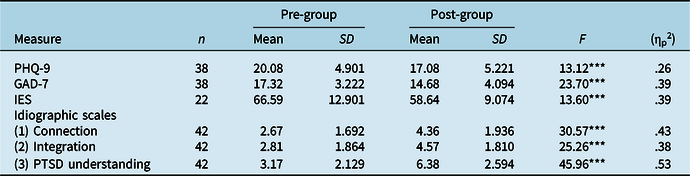
Average number of sessions attended was 5.21 (SD = 1.20) (N = 82). Seventy-one per cent of participants (n = 58) attended five or more sessions. PHQ-9 and GAD-7 data were collected for 46% of participants (n = 38), IES pre- and post-scores were available for 27% of participants (n = 22), and idiographic data were collected for 51% of participants (n = 42).
There was a significant improvement with large effect sizes in PHQ-9 (depression) and GAD-7 (anxiety) among participants following MOAT group attendance. There were significant improvements with large effect sizes on all three items of the idiographic scales: Connection, Integration and PTSD understanding (see Table 1).
Means, standard deviations and repeated measures MANOVA for dependent variables

***p<.001.
Discussion
In this study we identified outcomes of a low-intensity, group-based stabilisation programme for ASR with PTSD presentation.
Participants reported significantly lower rates of depression, anxiety and PTSD post-treatment, although the lack of comparison group and non-randomised design necessitates some caution in the interpretation of findings. This suggests that group-based stabilisation work warrants further investigation as a treatment for PTSD and CPTSD in ASR.
Administering requisite standardised IAPT measures posed various issues in terms of accessibility. Patients without literacy in English or in their first language and in the absence of translations relied on translation by interpreters, which compromises validity and reliability standards. Questionnaires vary in length but even relatively short questionnaires (e.g. GAD-7), together with the additional time required for translation can represent strain on already compromised cognitive function, attention and concentration. The use of a shorter measure of change, translated into the patient’s own language, and ideally including an option to access in audio form, would have clear benefits.
Frequent snapshot data collection during the group session accommodated missed sessions more easily, was less time consuming to administer than standardised measures and allowed questions to be more closely linked to patients’ common experiences.
In the absence of a control group, the observations and reflections from this service evaluation are speculative. Outcome data nevertheless demonstrated a significant reduction in symptoms of depression, anxiety and PTSD. PTSD scores remained well above the cut-off for probable PTSD, indicating the importance of providing a PTSD focused intervention following the group. It may well be that offering a PTSD intervention first is most effective, as argued by Ter Heide and colleagues (Reference Ter Heide, Mooren and Kleber2016a). Another possibility is that a minority of participants met the criteria for CPTSD, and so the stabilisation group was effective for just this minority of participants. Future research should therefore carefully establish the rate of CPTSD versus PTSD in participants and investigate the utility of a pre-trauma treatment phase on stabilisation in this group.
In comparison with one-to-one interventions, there were efficiencies in offering group-based stabilisation interventions in terms of reduced clinical time and in the use of interpreters often with more than one patient.
The principles underlying the delivery of these groups reflect key messages in the IAPT BAME Positive Practice Guide (Beck et al., Reference Beck, Naz, Brooks and Jankowska2019), for example, the need to provide specialist training, the benefits in multi-agency working and the need for culturally responsive or culturally adapted therapy.
Key recommendations include:
-
Clarity on commissioning responsibility for such specialist interventions which could inform the allocation of appropriate resources.
-
The need to promote accessible services for ASR which incorporate measures to address structural and cultural barriers.
-
Formal translation of key routine outcome measures including audio-translation for those who cannot access outcome measures in written form.
Acknowledgements
None.
Financial support
Kate Cooper is funded by the NIHR (ICA-CDRF-2018-04-ST2-047). This report is independent research. The views expressed in this publication are those of the authors and not necessarily those of the NHS, NIHR or the Department of Health and Social Care.
Conflicts of interest
None.
Ethical statement
The authors have abided by the Ethical Principles of Psychologists and Code of Conduct as set out by the BABCP and BPS.
Data availability statement
The data are not available due to the restrictions under NHS confidentiality and data protection policy for patients’ information.
Supplementary material
To view supplementary material for this article, please visit: https://doi.org/10.1017/S135246582100028X




Comments
No Comments have been published for this article.