

Introduction
In 2003, Severe Acute Respiratory Syndrome (SARS) shocked the world as an unknown epidemic. Within a few months, the disease spread across 32 countries over the world, with over 8,000 people infected and over 900 dead.Footnote 1 Treatments offered by the Western medical profession involved broad-spectrum antibiotics and supportive care, as well as antiviral agents and immunomodulatory therapy. Yet, there is still no consensus as to what is the best therapeutic regime.Footnote 2
In mainland China, one of the areas most seriously hit by the outbreak, SARS patients were treated with both Chinese and Western medicines. Among the approximately 5,300 SARS patients, at least 3,100 (58%) received Chinese medicine treatment during the inpatient phase. Such integrative medicine is sanctioned by the Chinese state. However, in Hong Kong, as part of the British colonial legacy, Western medicine dominates the medical profession. Though the sovereignty of Hong Kong was handed over to China in 1997, using Chinese medicine to treat hospital inpatients is still officially prohibited. However, the SARS outbreak led to some contingency exceptions. Among the 1,750 SARS patients in Hong Kong, about 50 (3%) received Chinese medicine treatment during acute hospitalization, and about 90 (5%) received Chinese medicine from public hospitals during the convalescent phase.Footnote 3
This paper will explain how the above could happen, by situating the event in the over 160 years' long history of Chinese medicine in Hong Kong. Specifically, we will focus on the role of Tung Wah Hospital, which was established in 1870 as a Chinese hospital in a British colony. ‘Chinese hospital’ here, means a hospital where inpatients were treated with Chinese medicine (which will be explained in greater detail in the next section), rather than a hospital using Western medicine to serve Chinese patients.Footnote 4 After the bubonic plague in 1894, Tung Wah Hospital was gradually converted from a Chinese hospital into a Western one. In 1931, Tung Wah expanded into a group consisting of three Western hospitals, known as the Tung Wah Group of Hospitals.Footnote 5 Subsequently, the group has grown into one of the largest voluntary organizations in Hong Kong. In 2003, it was a hospital under this group that made the breakthrough by allowing Chinese medicine practitioners to enter the hospital to treat SARS patients. This paper will show how the fall and revival of Chinese medicine in this hospital were related to two epidemics: the bubonic plague in 1894, and the SARS outbreak in 2003.
Chinese Medicine, Traditional Chinese Medicine, and the Chinese Hospital
This paper will use the term ‘Chinese medicine’ (CM, or zhongyi 中 醫) as distinguished from ‘traditional Chinese medicine’ (TCM, or chuantong zhongyi 傳 統 中 醫). Coined in the nineteenth century in face of serious challenges from Western medicine, CM refers to all forms of medicine that had been practiced in China before the arrival of Western medicine. As CM already carries the meaning that it is part of Chinese tradition, in Chinese language there is no specific term for TCM. The term TCM was created in the mid-1950s by China's foreign-language publications, for the purpose of gaining foreign recognition of the kind of state medicine sanctioned by the newly established People's Republic of China. It refers to the ‘modernized’, ‘scientific’, ‘systematic’, and ‘standardized’ CM. So ironically, CM is in fact more traditional than TCM.Footnote 6
The origin of CM can be traced to 2700 BC, and from the very beginning it has been an integral part of Chinese traditional culture, which believes in the harmony of nature among heaven, earth and man. Such a worldview perceives health and tranquility as a reflection of equilibrium of two cosmological forces, namely yin and yang. Derived from this is CM's pathology, according to which all disease could be explained in terms of disharmony between yin and yang, and the task of CM practitioners is to restore the equilibrium by means such as prescribing herbal medicine, applying surgery, or performing acupuncture.Footnote 7
As early as the second century BC, there were exchanges of medical knowledge between China and Japan, Korea, Vietnam, India, and the Arab world. The arrival of the Jesuits in China in the late sixteenth century marked the beginning of contact between CM and Western medicine, and by the mid-nineteenth century a number of Western medical works had been translated into Chinese. CM and Western medicines co-existed in China for some time. However, the subsequent failure of China to resist Western imperialistic invasion resulted in a loss of confidence in almost everything about Chinese tradition, including its medicine. CM was criticized as lacking scientific foundation, and was regarded as an obstacle to the modernization of China's heath care system. In 1929, the Nationalist government of China attempted to outlaw CM, as part of its efforts to build a modern state. However, the move was abandoned in the face of strong public protest.Footnote 8
In 1949, the communist People's Republic of China was founded. During the early years of the new regime, CM continued to be excluded from state health care, branded as pre-modern and a ‘feudal’ medicine. But in 1953, CM received political support from the political head, Chairman Mao Zedong. The possible reasons for this sudden policy reversal included a rising sense of national pride, the need to utilize all possible resources when the country was short of everything, and the intention to reduce reliance on imports and foreign know-how. This was followed by the transformation of CM into a new form of medical knowledge known as TCM. According to TCM, CM is too ‘coarse’ and ‘primitive’, and the contribution of TCM was to ‘modernize’ and ‘standardize’ CM, making it ‘scientific’ enough for integration with Western medicine. By 1956, TCM was founded as the state medicine of the newly established People's Republic of China, through the formulation of a ‘basic theory of TCM’, standardization of it in the national curriculum and textbooks, establishment of TCM academies, application of TCM in the primary health care system, and integration of TCM with national health care and labour insurance schemes. Although based on CM, TCM is ‘Westernized’ in the sense that it employs Western biomedical terms and concepts, and is institutionalized under a structure that is based on Western medicine. As such, TCM is a specific kind of medicine that exists only in contemporary China, but not in overseas Chinese communities such as Hong Kong, Singapore, and Taiwan, where CM has been less Westernized.Footnote 9
From the mid-1950s, TCM as a ‘scientific’ and ‘institutionalized’ medical knowledge was promoted in China under the slogan of ‘integration of Chinese and Western medicines’. However, the state health care sector remained dominated by Western medicine. During the political turmoil of the Cultural Revolution (1966–1976), professional development of both TCM and Western medicine was paralyzed. With the downfall of the radicals in 1976 and the introduction of subsequent reforms, a new policy was launched, whereby TCM and Western medicine were given equal status. This marked the success of TCM in securing an autonomous position in the official health care system.Footnote 10
However, for CM practitioners, the ‘integration of Chinese and Western medicines’ in TCM has been so biased in favour of Western medicine that CM has not been able to maintain its identity. It is Western medical doctors who certify TCM knowledge, the administrative hierarchy is staffed mostly with Western medical doctors, and some CM practitioners are ranked according to the Western medical knowledge they possess. Under the hegemony of ‘scientism’, CM is actually ‘Westernized’ and ‘governed’ by Western medicine.Footnote 11
The inferior position of CM is particularly observable in the institutional setting of hospitals. Strictly speaking, hospitals are not essential to CM. The CM's ‘four methods of diagnosis’ (inspection, listening and smelling, questioning, and palpation) could be conducted in simple clinics, and herbal medicine could be prepared at home. There is nothing in CM that can only be practiced in a hospital-like setting.Footnote 12 Nevertheless, CM hospitals did exist in Chinese history. They can be traced back to AD 2, when the imperial government ordered those who were sick resulting from a severe draught and plague be housed in empty buildings for treatment.Footnote 13 In AD 491, a Buddhist royal kinsman opened his own residence to take care of those who were sick in a plague following an inundation, making it the first permanent CM hospital with a dispensary. About two decades later, the imperial government founded a charitable hospital to take care of the poor or destitute suffering from disabling diseases. During the Tang Dynasty (AD 618–907), CM hospitals, which came to be known as ‘bing fang’ (病 坊) (stalls for the sick), emerged in a number of cities across the country. Most of them were located in temples and were run by monks and nuns. Subsequently, due to conflicts between religious (Buddhist and Taoist) leaders and the imperial government, administration of these hospitals was handed over to local gentry officials.Footnote 14
During the Song Dynasty (AD 937–1279), CM hospitals became part of state institutions. Known as ‘an ji fang’ (安 濟 坊) (safety refuges), they grew significantly in terms of number and scale. According to ‘an ji fa’ (安 濟 法), or China's first hospital ordinance, CM hospitals were established by different levels of governments, and were managed by court physicians. The one in the capital was so large that it could accommodate 1,200 patients. Funds were derived from rice fields granted to the hospitals by the government. CM practitioners were required to keep medical records of patients, based on which, annual assessments of CM practitioners were made.Footnote 15
Growing corruption, however, impeded further development of CM hospitals. During the Ming (1368–1644) and Qing (1644–1911) dynasties, there was a withdrawal of state involvement in public health services, and public CM hospitals decayed. This has led to the impression that, since the Ming-Qing period, CM hospitals have completely disappeared.Footnote 16 The fact is that in the late sixteenth century, private CM hospitals emerged in China. Merchants and intellectuals gradually replaced the state to become the major organizers of charitable dispensaries, clinics, and infirmaries. By the mid-nineteenth century, hospitals as places for medical relief were established all over imperial China, mostly run and financed by the local elite.Footnote 17 In short, it is a misconception that hospitals were largely absent in the history of CM. However ‘pre-modern’ they were, CM hospitals did exist and even flourish in China under the sponsorship and management first by religious monasteries, then by the state, and finally by private businessmen and affluent scholars.
Nevertheless, as mentioned above, hospitals are not essential to CM. In contrast, TCM is inseparable from hospitals, so we need to differentiate CM hospitals from TCM hospitals. While CM hospitals refer to simple places where CM services are provided without employing any major scientific-medical apparatus, TCM hospitals are modern institutions equipped with Western biomedical diagnostic devices ranging from blood tests to MRI scans. Standard Western medical procedures such as blood tests, urine analysis, and stool examination are required when patients are admitted to TCM hospitals. Moreover, since the making of TCM in the mid-1950s, TCM hospitals have become major institutions for the transmission of TCM knowledge. In fact, the creation of TCM as a state medicine was closely linked with the construction of TCM hospitals across the country, making hospitals as vital to TCM as to Western medicine.Footnote 18
As one researcher noted, in the transformation of CM into TCM, there has been a ‘shift from what was previously an ‘ambulatory’ practice by individual practitioners to a hospital-based, bureaucratized, collective practice by the hierarchically organized medical staff of clinical departments’, resulting in a ‘hospitalized’ TCM.Footnote 19 In the post-Mao period, the emphasis of China's health care policies has switched from primary or community care to hospital-based services, and this applies also to TCM. As indicated in Table 1, since the 1950s, TCM hospitals have grown significantly both in terms of number and size. However, it is Western medicine that is dominant in these TCM hospitals. In most cases CM is used only for outpatient service.Footnote 20
Number and Average Size of CM/TCM Hospital

Source: Scheid, Chinese Medicine in Contemporary China, p. 86.
Chinese Medicine in Hong Kong
British Rule (1842–1941) and Japanese Occupation (1941–1945)
When the sovereignty of Hong Kong was ceded to Britain in 1842, the Chinese inhabitants were assured that local customs and practices would not be interfered with. The early colonial government's plan was to govern this new acquisition with Chinese laws. Moreover, influenced by laissez faire philosophy, the colonial government adopted a minimum intervention policy. Under such conditions, CM was allowed to continue in Hong Kong despite British colonial rule. Practitioners only had to obtain business licenses, and registration with the health authority was not required. In 1884, the colonial government published its first legislation on health registration, requiring Western medical doctors, but not CM practitioners, to register with the government with the result that CM practitioners were excluded from the social privileges enjoyed by Western medical doctors. Officially translated as ‘herbalists’, CM practitioners were not allowed to title themselves ‘doctors’, and the places where they provided services could not be called ‘clinics’. Most importantly, the absence of an official regulatory system resulted in great variation in the quality of CM services.Footnote 21
In any event, until World War II, CM continued to play an important role in providing healthcare for the people of Hong Kong. In 1870, Tung Wah Hospital was established to provide free CM services to both inpatients and outpatients.Footnote 22 From 1891–1895, Tung Wah treated an annual average of 2,550 inpatients and 160,000 outpatients, when the population of Hong Kong was just about 240,000. On the other hand, patients treated by the Government Civil Hospital, a Western hospital established by the colonial government in 1850, were mainly European and Indian patients. In 1891, the Government Civil Hospital admitted a total of 1,867 patients, of which only about 600 were Chinese, compared with over 2,500 Chinese inpatients in Tung Wah. During that early period the Chinese generally trusted CM more than Western medicine.Footnote 23
In December 1941, Hong Kong fell under Japanese occupation, and the Japanese Government of Occupation was very serious about public health. An Anti-Epidemic Bureau was established, and health campaigns such as ‘total war’ against flies, mosquitoes and rats, and mass inoculations against smallpox and cholera were launched.Footnote 24 On the issue of CM, in contrast to the British laissez faire approach, the Japanese Government of Occupation formed a Hong Kong CM Association of the Governor's Office to establish rules and criteria for the registration of CM practitioners. About 1,000 CM practitioners registered, and they were allowed to practice CM with approval by the Chief Medical Officer of the Governor's Office. Like Western medical doctors, registered CM practitioners could apply for special permission to go out on the street under curfew,Footnote 25 suggesting that the social statuses of CM practitioners and Western medical doctors might be less unequal during the Japanese occupation than they were under British rule.
The Post-War Period and the Political Handover (1945–1997)
During and after the war, some reputable CM practitioners migrated from mainland China to Hong Kong. However, this did not prevent a decline in the popularity of CM in Hong Kong in the post-war period, due to further Westernization of social life, and the rapid development of antibiotics. Meanwhile, as mentioned above, in the mid-1950s CM in mainland China was transformed into TCM. But the political boundary between mainland China and Hong Kong prevented this change from taking place in Hong Kong, thereby allowing CM to remain less Westernized in the British colony. However, by the 1980s, with the passing away of older-generation practitioners, CM in Hong Kong suffered a shortage of local successors. On the one hand, the gradual opening of China allowed a number of TCM practitioners to migrate from mainland China to Hong Kong.Footnote 26 But on the other hand, being abstracted from the relevant institutional setting (such as the hospital and other health care systems), without official recognition of qualifications, these TCM practitioners from mainland China had to work indistinguishably from CM practitioners. That is: what has prevailed in Hong Kong is CM but not TCM.Footnote 27
It has been estimated that there are now about 7,000 CM practitioners in Hong Kong, and CM accounted for about 23% of all primary care consultations. A surveyFootnote 28 found that, when sick, 20% of the Hong Kong population would consult a CM practitioner. However, by the 1990s only about 40% of the CM practitioners had received formal training. In 1989, in response to a series of cases of illness and deaths due to the distribution of poisonous and hazardous substances in the course of CM treatments, the Hong Kong government established a Working Party on Chinese Medicine to collect views, and to make recommendations on the regulation of CM. Under the advice of the Working Party, a Preparatory Committee on Chinese Medicine was established to work out a regulatory framework of CM. In March 1997, the Preparatory Committee published a report, recommending the formation of a statutory Council on Chinese Medicine to regulate CM in Hong Kong. But before this was realized, British rule over Hong Kong came to an end.Footnote 29
The case of Tung Wah HospitalFootnote 30
Emergence (1870–1893)
In the mid-nineteenth century, with the emergence of Hong Kong as a trade port, there was a constant flow of mainland Chinese people to the British colony to make a living. Many of them died alone on this ‘alien’ island, and the corpses were often disposed of in the hills. With contributions from local gentry and businessmen, a common ancestral hall, the Kwong Fook I-ts'z (廣 福 義 祠), was established in 1851 to house the death tablets and coffins awaiting shipment. Some poor and terminally sick people also came here to wait for death. In 1869, the local press reported on the intolerable sanitary conditions of Kwong Fook I-ts'z, and raised the question of who was officially responsible. This was at the time when unsanitary conditions in prisons and some new hospitals in Britain were also under attack by social reformers.Footnote 31 Being embarrassed, and anticipating annoyance from London, the colonial government in Hong Kong planned to remove Kwong Fook I-ts'z. But a group of local gentry and businessmen managed to convince the government to provide land and funding for the conversion of Kwong Fook I-ts'z into a Chinese charity hospital. The Tung Wah Hospital was thus established in 1870.Footnote 32 This could be seen as a continuation of the above-mentioned tradition of provision of charitable heath care services by the local Chinese elite from the late sixteenth century. The hospital also served as an informal ‘tribunal’ to settle disputes among Chinese people. This helped the early British colonizers to maintain social stability at a time when they knew little about local customs and traditions.Footnote 33
According to the Chinese Hospital Ordinance of 1870, the Tung Wah Hospital was established as a ‘public free hospital for the treatment of the indigent sick among the Chinese population’. While implicit autonomy was given to the Chinese elite to run the hospital, the Ordinance made provisions for government intervention. Though titled ‘Chinese Hospital Ordinance’, it did not specify that Tung Wah was a CM hospital. Nevertheless, there were tacit understandings that the hospital would be run according to Chinese customs and principles, as long as the Governor of Hong Kong did not find them objectionable.Footnote 34 Tung Wah was thus founded mainly on the basis of CM, and the hospital was staffed with CM practitioners.Footnote 35 It provided only CM treatments to patients, while those requesting Western medical treatment might be referred to Western physicians. Moreover, CM practitioners in Tung Wah had the authority to save dead bodies from post-mortem examination—a practice that was repugnant to many Chinese—by asserting that the death was caused by natural illness.Footnote 36 As a result, Tung Wah was much more popular than the Western hospitals that were established in Hong Kong in the late nineteenth century. In fact, in the early twentieth century, a number of CM hospitals, modelled on Tung Wah, were founded in mainland China as well as overseas.Footnote 37
Tung Wah was also successful in obtaining funding. It received abundant donations and subscriptions from the government, guilds, shops, passenger ships, and individuals. The hospital also earned bank interest and rent. With increasing wealth and popularity, Tung Wah gradually grew beyond its original role as a CM hospital. Apart from taking care of patients, it also provided non-medical welfare services to the poor, acted as a bridge between local people and the colonial government, arbitrated disputes among Chinese according to traditional principles, maintained local customs and social practices, and protected Chinese interests under colonial rule. Despite the hostility towards Tung Wah from the European community in Hong Kong, three successive Governors (Richard MacDonnell, Arthur Kennedy, and Pope Hennessy) supported the CM hospital, leading to the growing autonomy of Tung Wah during the period 1869–1882. This was also a result of the colonial policy of relying on private organizations and funding to provide public services.Footnote 38
However, the colonial government's policy towards Tung Wah turned after the arrival of the new Governor, William Marsh, in 1882. First of all, there was growing intolerance about Tung Wah's involvement in non-medical affairs. Secondly, the colonial government was concerned with the increasing influence of Tung Wah among the local Chinese community. Finally, direct contact between Tung Wah leaders and imperial Chinese officials was regarded as a threat to British rule in Hong Kong. Hence, the colonial government began to set boundaries for Tung Wah's activities and to balance its influence with other societal groups, in order to prevent it growing into an uncontrollable native power. On the other hand, solidarity within Tung Wah declined as some local elites became more receptive to Western ideas. Finally, a plague in 1894 dealt a severe blow to Tung Wah's autonomy.Footnote 39
From Bubonic Plague to the End of CM Services for Inpatients (1894–1945)
In early 1894, bubonic plague broke out in Guangzhou, resulting in a large number of deaths in the city. In response, the Colonial Surgeon of Hong Kong sent the acting superintendent of the Civil Hospital, Dr. J. A. Lowson, to Guangzhou to appraise the situation. On his return in May, the first case of plague in Hong Kong was confirmed, and Lowson was subsequently ordered to inspect some cases in Tung Wah Hospital. This marked the first examination of Tung Wah by a Western doctor other than the Colonial Surgeon, and the beginning of a power struggle between the CM hospital and Western medical authorities.Footnote 40
Confirmation of the bubonic plague in Hong Kong led to the Sanitary Board announcing a series of measures, including house-to-house searches for infected persons, and the quarantine of patients on a hospital ship, which was originally designed for the isolation of smallpox cases. Worked out on the basis of Western public health concepts, these sanitary measures ran into conflict with Chinese customs. Quarantine was resisted, and there were widespread rumours that the real intention of the hospital ship was to carry patients to Europe to be ground into powder for medicine for the royal family!Footnote 41
Chinese patients, in deep fear of Western medical treatment, sought shelter at Tung Wah, bringing the hospital to the forefront of the battle between Chinese and Western medicines and their respective institutions. At the same time, Tung Wah leaders were split by the plague. While some were more amenable to the Sanitary Board's suggestions, others regarded the sanitary measures as serious threats to Tung Wah's autonomy. After all, the forcible removal of patients from Tung Wah to the hospital ship was an unbearable humiliation of CM in general and of the hospital in particular.Footnote 42 Moreover, it was doubtful whether inadequate sanitation was the real cause, or just an excuse to put Tung Wah under closer government supervision. In the founding ward regulations of Tung Wah, there were specific sanitary requirements for clothing and bedding, which were strict according to the standard of the time; and there was no complaint about Tung Wah's sanitary conditions in two government reports in the early 1870s.Footnote 43 In contrast, according to a 1920 survey, some 73% of all missionary Western hospitals in China had no means of sterilizing bedding or mattresses, and 50% seldom or never bathed their patients.Footnote 44 That is to say, Tung Wah might not have been particularly insanitary compared with Western hospitals of that time in that region.
The struggle between Tung Wah's CM approach to the plague and the government's sanitary measures led to diplomatic confrontations between China and Britain. While Tung Wah succeeded in sending a number of plague patients to Guangzhou for CM treatment, it failed to keep Western doctors out of the CM hospital. It was forced to issue a proclamation to convince Chinese people to accept the sanitary measures, and to welcome the presence of Western doctors in Tung Wah. The plague, which subsided in July 1894, devastated not only the economy of Hong Kong, but also the political strength of Tung Wah. From the very beginning, the plague was considered to be Chinese, in the sense that it was carried by Chinese and caused by Chinese unsanitary habits. The effective solution to the crisis, according to the colonial government, lay in Western medical measures, but not Tung Wah's CM practices. Worse still, the Chinese hospital was portrayed by the local English press as being a vested interest striking for political power in the name of traditional medical care. The government was under pressure to end Tung Wah's autonomy.Footnote 45
Tung Wah was in retreat in this struggle throughout. Shortly after the plague broke out, the CM hospital was criticized for not registering causes of death. As a matter of fact, Tung Wah did record death, but in Chinese medical terms. In the face of this pressure, it conceded by employing a Chinese doctor with Western medical training as visiting surgeon to register causes of death in Western terms. This, however, was not enough to prevent an increase in the number of inspections of Tung Wah by Dr Lowson, acting superintendent of the Government Civil Hospital, who made unfavourable public comments about Tung Wah. About six months after the plague had subsided, Lowson wrote a report on the plague, which directed the attention of the Colonial Office in London to the sanitary conditions among the Chinese community in Hong Kong. Inspection of Tung Wah by colonial health officials became even more frequent. Patients were checked not only at the receiving wards, but also before they were discharged. Some patients were even transferred to the Government Civil Hospital involuntarily.Footnote 46
To protest against the decreasing autonomy of the CM hospital, Tung Wah leaders petitioned the Governor of Hong Kong. But they were told that Tung Wah's autonomy was granted at the Governor's discretion. He might, according to the Chinese Hospital Ordinance, not only intervene in the administration of the hospital, but even abolish it altogether. Despite such threatening words, the Governor decided not to directly confront Tung Wah, as it would be too costly for the government to replace the social services that the CM hospital was providing. Instead, a Commission was established to review the management and operation of Tung Wah.Footnote 47
In the Commission's report submitted in September 1896, Tung Wah's role as a unique CM hospital was recognized. Yet, recommendations were made to station a European steward to oversee general sanitary conditions of the CM hospital, and to further institutionalize inspection of the hospital by Western medical officers. Subsequent to this report, reforms were introduced to the effect that Tung Wah was gradually Westernized. Beginning in 1897, patients were admitted to different wards according to their illness. For diseases such as malaria, Western treatment was used even against the wishes of the patients. In 1899, major surgery, which was inconceivable in CM, was performed for the first time in Tung Wah. Moreover, Tung Wah had to cease giving away free Chinese herbs to the destitute. While the hospital's autonomy declined on the one hand, on the other, its financial dependence on government increased. Starting in 1903, the hospital received an annual grant of HK$6,000 from the government. Three years later, the Tung Wah Hospital Advisory Board was established. Though it had no official status in Tung Wah's constitution, and was supposed to be a purely consultative body, the Advisory Board became an agent of increasing government intervention. Initially most of its board members were past directors of the hospital; but they were gradually replaced by outsiders and government representatives.Footnote 48
In the 1930s, private donations to Tung Wah plummeted as a result of the Great Depression, and the hospital thus had to seek government subvention. The government agreed to provide financial help, but on condition that Tung Wah would entirely cease its CM services. This was not enforced after some resistance by Tung Wah's Board of Directors.Footnote 49 In 1935, the Advisory Board asked for more power, including supervision over financial and personnel matters. Despite strong opposition from the hospital and some concession of the government, Tung Wah's autonomy was further eroded.Footnote 50 In the same year, a Medical Committee was established, which further institutionalized government intervention of Tung Wah's medical decisions. Its members, mainly Western physicians, proposed ceasing CM treatment of inpatients. Though the idea could not get through Tung Wah's Board of Directors, this committee imposed increasing restrictions on the practice of CM in the hospital. In 1939 the Medical Committee resolved that inpatients suffering from infectious diseases could only receive Western medical treatment. In the next year, the committee rejected a proposal from the Board of Directors to appoint six ‘honorary herbalists’ to serve outpatients, on the grounds that CM is ‘an inferior method of treatment’. When the Board of Directors re-asserted its unanimous demand for such appointments, the Honorary Secretary for Chinese Affairs advised the Medical Committee to accede, but only in exchange for the Board of Directors’ agreement to reduce CM treatment for inpatients.Footnote 51
Compared with members of the Advisory Board and Medical Committee, colonial health officials were more direct in implementing the government's policy of replacing CM with Western medicine in Tung Wah. In July 1940, a colonial medical inspector instructed Tung Wah administrators that all cases of beriberi, malaria, and malnutrition should be treated with Western medicine, on the grounds that CM was unable to handle such diseases. Despite ‘strong protest’ against this, the Board of Directors had no choice but to comply. In November 1941, the issue of whether to completely discontinue CM services for Tung Wah inpatients was finally put on the agenda.Footnote 52 But before a decision was made, the British colonial government was taken over by Japanese troops.
During Japanese Occupation, Tung Wah came under the Health Section of the Civil Administration Department. It remained a major charity in Hong Kong. Among other relief organizations, it was the largest recipient of subvention from the Japanese Government of Occupation. Moreover, with the discontinuation of interference from the British colonial government, Tung Wah's Board of Directors regained some autonomy, including over matters related to recruitment of medical staff. Patients could choose to be treated by CM or Western medicine. In November 1942, a decision was made to add a CM ward to the hospital.Footnote 53
However, soaring prices of Chinese herbal medicines during wartime made it difficult for Tung Wah to maintain its CM services. In August 1944, the Board of Directors adopted a series of measures to reduce expenditure in the provision of CM services. These included switching to Western medicine whenever possible, reducing free provision of CM, admitting fewer inpatients, and reducing dosages for mild sickness. In November, free provision of particular Chinese herbal medicines that were in serious shortage was suspended. In July 1945, as the situation continued to deteriorate, Tung Wah finally ceased its CM services, and all inpatients (except for bone-setting cases) were treated with Western medicines. This marked the end of Tung Wah's 75 years of CM treatment of inpatients. But, at the time, it was expected that CM services would resume after the war.Footnote 54
Post-War Changes (1946–2004)
In August 1945, the Japanese surrendered and British colonial rule was restored in Hong Kong. Soon after the end of the war, there were proposals to resume CM services for Tung Wah inpatients. But the hospital's Board of Directors had to leave the decision to the Medical Committee, which had been reinstated by the British colonial government to continue to exert its influence on Tung Wah. The result was that CM services for inpatients were never revived during British rule after World War II.Footnote 55 According to a Tung Wah spokesperson, their records offer no explanation for this.Footnote 56 The author's research amongst press reports on Tung Wah activities found that from the end of the Japanese Occupation in 1945 up to the mid-1990s, there was no voice, at least not in public, from the hospital for restoring its role as a unique CM hospital. The CM origin of Tung Wah was acknowledged in many reports, but the ‘Westernization’ of it was depicted as if it was a voluntary and natural response to the 1894 bubonic plague. The hospital's fight against the change was rarely mentioned, and even when it was, the resistance was described as due to ‘prejudice’ or ‘misunderstanding’.Footnote 57 In this way, Tung Wah has become a purely Western hospital, with its CM services reduced only to the provision of free CM diagnoses (herbal medicines not included) to outpatients. Today, not all medical staff of Tung Wah are mindful of the CM origin and identity of the hospital.Footnote 58
Tung Wah's autonomy was further eroded in 1991, when it was incorporated into the Hong Kong Hospital Authority. As mentioned above, as early as 1903 Tung Wah received government subventions. Although whilst receiving some financial support from the government, hospitals still retained a certain degree of autonomy. However, with the establishment of the Hospital Authority in 1990 as a statutory, independent agency for the management of hospitals in Hong Kong, if hospitals were to continue to receive subventions from public funding, they had to hand over their autonomy to the new central administration of public hospitals. Those opting for independence would have to be run entirely with private funds. Like other hospitals that received government subventions, Tung Wah agreed to join the Hospital Authority, with the original Board of Directors converted into an advisory body. After negotiation with the government, the only ‘autonomy’ that Tung Wah could retain was to continue offering free services to outpatients and to 600 hospital beds. The issue of CM seemed to be absent in the agenda throughout.Footnote 59
It was not until the mid-1990s that Tung Wah's emphasis of its CM origin was seen again. But by this time what it was promoting was no longer CM, but TCM. TCM practitioners from mainland China, instead of local CM practitioners, were hired in its outpatient clinics. In 1997, a collaboration project was launched with the University of Hong Kong, by which Western medical students were sent to Tung Wah's TCM outpatient clinics for training. An official agreement was signed with the First Hospital of the Guangzhou Zhongshan Medical University in China, making it a ‘friend’ of Tung Wah.Footnote 60
In 2000, Tung Wah announced that it already had a ‘comprehensive plan’ for developing TCM services. Instead of re-establishing a CM hospital, Tung Wah proposed to offer combined Chinese-Western medical treatments to inpatients, thereby placing the hospital in a ‘leading role in integrating East and West’.Footnote 61 The whole idea was based on TCM hospitals in mainland China.Footnote 62 Other efforts in this respect included collaborations with universities to conduct TCM research, establishment of TCM special clinics, provision of TCM training to nursing staff, and computerization of medical records of TCM patients.Footnote 63
However, all these efforts stopped short of actually allowing TCM practitioners to treat hospital inpatients. It was the SARS outbreak that led to a breakthrough in this regard. In November 2002, the first known case of SARS occurred in Foshan, a Chinese prefecture about 100 kilometres from Hong Kong. Within a few months it resulted in a worldwide outbreak.Footnote 64 As the plague was caused by a new, unknown virus, Western medicine was uncertain about what would be the best treatment for the disease. But for TCM practitioners, SARS is a kind of ‘warmth-factor disease’ (wenbing 溫 病), which they claim to have the experience to handle.Footnote 65 In May 2003, shortly after the identification of the first SARS victim in Hong Kong,Footnote 66 the Hospital Authority permitted two TCM practitioners from mainland China to participate in the treatment of SARS patients in a hospital under the Tung Wah Group.Footnote 67 This marked the first entry of TCM practitioners into Tung Wah's inpatient care wards, after the hospital had been completely Westernized for almost six decades. But most other hospitals in Hong Kong still refused to offer TCM treatment to SARS patients, even in cases when they could not offer any effective Western medical treatment. This was because these hospitals, being Western medical institutions, had no legitimate way to employ TCM. Even in cases where family members of SARS patients had prepared herbal medicine under instructions of qualified TCM practitioners, western physicians-in-charge still disallowed the use of it, as this involved huge legal risk.Footnote 68
However, about a year later, the Hospital Authority said that there were positive signs about the effectiveness of Tung Wah's TCM treatment of SARS patients.Footnote 69 The Hospital Authority also agreed ‘in principle’ that Tung Wah might extend its TCM treatment to inpatients of general medicine, oncology, and dermatology, if the patients so request and if the Western physicians-in-charge so agree. The plan was to offer TCM treatments to 30–40 hospital beds on a trial basis. The Hong Kong Government's Secretary for Health supported this initiative by saying that Tung Wah was the best place for such a ‘pilot study’. According to a local press report, it was SARS that caused this new trend.Footnote 70
Concluding Remarks
In summary, the story of the revival of Chinese medicine in a Western hospital in Hong Kong since the SARS outbreak in 2003 can be traced back to over 130 years ago. This hospital, Tung Wah, was established in 1870 as a CM hospital. Ironically, it was another epidemic, the bubonic plague in 1894, which triggered the Westernization of Tung Wah. However, instead of a restoration of a CM hospital, what Tung Wah has been striving for in recent years is to offer TCM services to its inpatients. It achieved a breakthrough in this regard by capturing the contingency situation during the SARS outbreak.
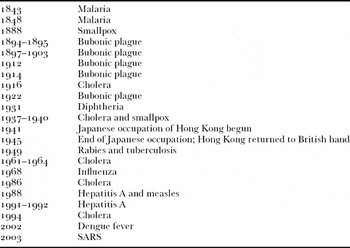
The above seems to suggest that unknown epidemics are conducive to changes in medical institutions. To be sure, new medical knowledge and new forms of health organizations are called for in the face of new challenges. However, as indicated in Table 2, epidemics have recurred throughout the history of Hong Kong. CM conceptualizes most epidemics as ‘warmth-factor disease’ with fever as the common symptom;Footnote 71 and there are claims that CM offers effective ways to cope with at least some kinds of epidemics that have prevailed in Hong Kong, such as bubonic plague, cholera, and smallpox.Footnote 72 Then why did only the bubonic plague in 1894 and the SARS outbreak in 2003, but not the other epidemics, cause such controversy about the institutional status of CM hospitals in Hong Kong? One possible approach to this question is to pay attention to the fact that the two epidemics were both preceded by changes in political sovereignty: the ceding of Hong Kong to Britain in 1842, and the return of the sovereignty of Hong Kong to China in 1997. While these issues are beyond the scope of this paper, further research along these lines may provide an insight into the role of politics in determining the medical-institutional consequences of epidemics.
Epidemics in Hong Kong Since 1842

Source: Hong Kong Museum of History, ‘We Shall Overcome: Plagues in Hong Kong’, 2003 leaflet distributed in the Special Exhibition.