Background
High quality healthcare communication has been shown to have a positive effect on patient outcomes such as treatment adherence (Thompson and McCabe, Reference Thompson and McCabe2012), wellbeing (Kinmonth et al., Reference Kinmonth, Woodcock, Griffin, Spiegal and Campbell1998), illness recovery (Kelley et al., Reference Kelley, Kraft-Todd, Scahpira, Kossowsky and Riess2014) and physiological reactions to diagnoses (Sep et al., Reference Sep, van Osch, van Vliet, Smets and Bensing2014). Street et al. have argued that effective communication enhances understanding, decision making and the doctor-patient therapeutic relationship, leading to patient empowerment (Street, Reference Street2013).
However, there are challenges in doctor-patient communication in dementia care that may impede effective communication. Dementia can cause problems in comprehension, word finding and short term memory loss (Blair et al., Reference Blair, Marczinski, Davis-Faroque and Kertesz2007). Additionally, unfounded presumptions of impaired patient abilities (Srinivas Rao and Blake, Reference Srinivas Rao and Blake2002) or ethical issues surrounding dementia diagnosis delivery (Karnieli-Miller et al., Reference Karnieli-Miller, Werner, Aharon-Peretz and Eidelman2007) can impact interactions. Furthermore, although companions have an increasingly important role in supporting a person with dementia, their presence can result in additional difficulties for professionals in terms of balancing patient needs with that of the third party (Robinson et al., Reference Robinson, Bamford, Briel, Spencer and Whitty2010).
Studies of doctor-patient communication in outpatient dementia care are scarce (Zaleta and Carpenter, Reference Zaleta and Carpenter2010). Research into dementia diagnostic disclosure has shown that patients and carers experience anxiety and confusion due to a lack of support in the early stages of dementia care (Robinson et al., Reference Robinson2011), and that treatment suggestions are often not utilized (Wolfs et al., Reference Wolfs2011). Additionally, theories of person and relationship-centered dementia care (Adams and Gardiner, Reference Adams and Gardiner2005) and communication training interventions have been developed (Eggenberger et al., Reference Eggenberger, Heimerl and Bennett2012). However, to improve communication it is important to first identify how patients and healthcare professionals are currently communicating (Street, Reference Street2013).
To date, studies that observe communication in outpatient dementia care have not been reviewed. The aim of this study was to systematically review research on naturally occurring communication between healthcare professionals, people with dementia and their companions in outpatient settings, in order to identify evidence on how communication problems are manifested in professional-patient communication and whether particular strategies have been identified as effective in communicating with these patients.
Methods
Inclusion and exclusion criteria
Included studies were original English language articles due to insufficient resources for translation and reviewing non-English articles. The included studies used objective methods (audio or video recording) to observe communication, and analyzed communication between patients with dementia, professionals that work in outpatient dementia healthcare settings, and patient companions when present.
Studies observing residential care were excluded as they captured a different type of communication involving personal care. Studies only observing communication between people with dementia and/or their companions were excluded. Studies of communication using other ethnographic methods (not audio or video recordings) were excluded, as were studies focusing on group therapy and interventions that focused solely on memory retrieval.
Search strategy
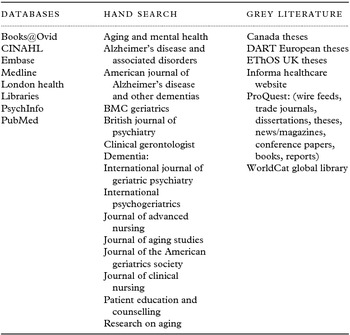
A rigorous search of all electronically registered references up to 13th August 2014 was undertaken. A hand search of relevant journals was also performed for the past five years, as well as a grey (unpublished) literature search (see Table 1 for details).
Search resources

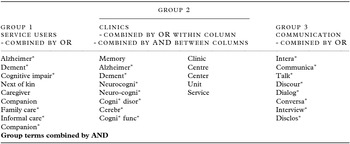
Search terms were grouped into illness, clinic and communication categories, and then combined (see Table 2). They were further developed and databases chosen after consulting experts in the field of dementia and communication, and were kept intentionally broad to ensure maximum scope.
Search terms (with truncation)

Screening
Two authors reviewed the search results independently. Full texts of selected abstracts were obtained for inspection, again performed independently by two authors. Any diverging views were discussed with the third author until reaching a consensus.
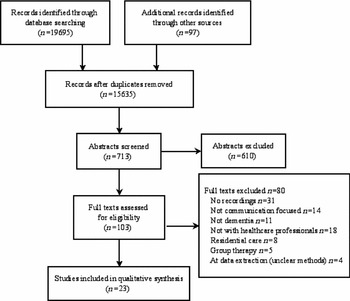
On the removal of duplicates, 15,538 titles were retrieved after the database search. Broad search terms yielded many irrelevant results and thus initial screening was based on title. 597 abstracts were reviewed, 519 of which were excluded. 78 full texts were examined and 15 included.
Hand searching retrieved 16 articles, with 2 included in the review. The grey literature search produced 25 abstracts: all were excluded. Reference lists of 32 relevant reviews identified in the database search were examined, 11 full texts were reviewed and 2 included. Authors of included studies were emailed to establish if there were any additional relevant studies, and 1 book chapter was identified and included. Forward and back citation searching was performed of included studies, 23 were screened, and 7 were included. See figure 1 for a PRISMA flow diagram.
PRISMA flow diagram.

Data extraction and quality assessment
Two authors independently extracted data using a tool designed to elicit relevant information including setting, participant information, number and method of recordings, and the analysis of and findings from the recorded data.
For five studies, it was not possible to extract data due to difficulty in establishing whether the data represented directly observed findings rather than participant recollections or other forms of triangulated interpretations (Hutchinson et al., Reference Hutchinson, Leger-Krall and Wilson1997; Keady et al., Reference Keady, Woods, Hahn and Hill2004; Robinson et al., Reference Robinson, Bamford, Briel, Spencer and Whitty2010), or findings related to people with dementia rather than older adults without cognitive impairment (Hasselkus, Reference Hasselkus1992a; Reference Hasselkus1992b). Authors clarified methodological aspects for four studies, three were excluded (Hasselkus, Reference Hasselkus1992a; Reference Hasselkus1992b; Keady et al., Reference Keady, Woods, Hahn and Hill2004) and one included (Robinson et al., Reference Robinson, Bamford, Briel, Spencer and Whitty2010). One study was excluded as the authors could not be contacted (Hutchinson et al., Reference Hutchinson, Leger-Krall and Wilson1997).
The CASP (Critical Appraisal Skills Programme (CASP), 2002) was used for quality assessment. It is widely used (Dixon-Woods et al., Reference Dixon-Woods2007) and fitted the needs of the review in allowing examination of each study in terms of a basic methodological standard and adequate interpretation of results (Hannes, Reference Hannes and Noyes2011). Each question and prompt was scored, with 34 items in total. Items were scored from 0–2: 0 for ‘‘no’’, 1 for ‘‘partially’’ (for example, if the criteria was only met for one method), and 2 for ‘‘yes’’. A percentage score was calculated and a consensus was reached through discussion to give each study a single quality score.
Data synthesis
Narrative synthesis was conducted using the protocol developed by Popay et al. (Reference Popay2006). Textual descriptions of the studies were grouped and tabulated. Two authors independently coded the findings and put together descriptive themes of each study. Techniques recommended by Popay et al. were used: primarily ‘‘reciprocal translation’’ of the themes to explore relationships, and ‘‘ideas webbing’’ to create a visual representation of the emerging themes. More details, including graphic representations of the analysis, are available from the authors.
Results
Description of studies
The characteristics of the 23 included studies can be found in Table 3. Thirteen of the studies were conducted in the USA, three in Finland, two in Israel, two in Sweden, two in the UK and one in Canada. Eight studies observed communication in dementia assessment and/or diagnosis meetings, six in day centers, and three in support groups. One study observed communication in routine meetings with old age psychiatrists, one follow up consultations in a neurology clinic, and three in primary care. One study observed research consent procedures in an Alzheimer's disease research center.
Summary of papers included in the review

Study quality
The quality scores from the CASP ranged from 45–89% (mean 64%). Overall, the studies were robust in reporting clear aims, analysis methods and results. There were some limitations across studies in addressing researcher bias and the selection of data to illustrate findings.
Participants
The majority of the studies included patients with dementia, five also included older patients who were not cognitively impaired. Twelve of the studies included patients with any type of cognitive impairment, six included only patients with Alzheimer's disease and in five of the studies the patient diagnosis was not explicitly stated beyond cognitive impairment. Thirteen of the studies reported cognitive test scores: seven reported MMSE (range 5–30), and one used the serial 7s (range 11–26) and the WORLD (12–27) tests. Two reported the clinical dementia rating (from “no dementia” to “mild dementia’’) and two studies used the cognitive performance scale (range 2–3, moderate dementia). Patient age was reported for 18 studies, the majority were over 65. The patients’ gender ranged from 15–73% female (unreported in 3 studies). Companions were present in 14 studies, although only 8 reported their characteristics. All these reported gender, and for all of them the majority of companions were female. Companions were typically spouses or adult children, occasionally another family member, and a single study included one paid companion. Companion age was reported in 6 studies, ranging from 36–86.
Five studies included nurses in a day center; two observed a nurse running a support group and one used volunteer day center workers. Two studies observed neurologists, one observed psychiatrists, and one primary care physicians. Nine studies included multidisciplinary staff. In two studies, healthcare professional type was not stated. Fourteen studies reported characteristics: 14 reported gender (range 12.5–100% female), 4 reported age (range 28–73), and 4 reported number of years practicing as a healthcare professional (range 1–42).
Study methods
Thirteen studies used audio recordings, nine used video and one used both. Nine studies developed their own coding system to look at a particular communication feature. Three studies used conversation analysis, and two used discourse analysis. Two studies used the Roter Interaction Analysis System (Roter and Larson, Reference Roter and Larson2002) to code patient centered communication, and one study used Behavioral Interaction Codes (Roberts et al., Reference Roberts1991) to record types of turns of talk in groups. One study employed thematic analysis, one content analysis, one abductive content analysis, one grounded theory and one Goffman's frame theory. In one study, the recordings were used to compare the diagnosis delivered versus diagnosis reported by participants. In seven studies quantitative measures of participant involvement were documented.
Findings
Three overarching themes emerged: the communication of the dementia diagnosis, participant involvement and participant communicative strategies when faced with cognitive impairment.
Communication of the dementia diagnosis
Five studies observed professional-patient-companion triads during diagnostic feedback. The results fell into two subthemes: emotional impact and understanding.
Emotional impact
Amizandeh et al. (Reference Aminzadeh, Byszewski, Molnar and Eisner2007) examined patient and companion verbal and non-verbal emotional reactions to the diagnosis. More severe distress was associated with a diagnosis of Alzheimer's disease than with other forms of dementia, even when clear explanations were given as to the consequences of the other diagnoses. Karnieli-Miller et al. (Reference Karnieli-Miller, Werner, Aharon-Peretz and Eidelman2007) noted however, that professionals avoided emotional exploration of the impact of the diagnosis, with minimal time spent on explanations of the diagnosis. They speculated that frequent “ums” and hesitancy may demonstrate professional anxiety in diagnosis delivery. Zaleta and Carpenter (Reference Zaleta and Carpenter2010) found that “emotional rapport building”, e.g. reassurance and empathy, were infrequent, and hypothesized that professionals are focusing on ensuring comprehension and treatment compliance rather than providing emotional support. However, Amizandeh et al. argued that strong emotional reactions may interfere with cognitive processing of the information given.
Understanding the diagnosis
Zaleta et al. (Reference Zaleta, Carpenter, Porensky, Xiong and Morris2012) showed that consensus on the diagnosis between patients, companions, and physicians after the diagnostic meeting was only moderate (76.6%), despite high patient rating of thoroughness (mean 4.62/5) and clarity (4.33/5) of delivery. Even agreement between physician, nurse, and researcher ratings (obtained from watching the recordings) was far from perfect (84.7%). Consensus was lower for those receiving a diagnosis of very mild (66.7%) or mild dementia (71.5%), and 16.7% of companions disagreed with the clinicians, suggesting patient's impaired cognition was not the only cause of confusion. Qualifying statements, such as ‘‘what we might be seeing is..’’, were identified by the authors as a potential reason for ambiguity. Additionally, both Zaleta (Zaleta and Carpenter, Reference Zaleta and Carpenter2010) and Karnieli-Miller et al. (Reference Karnieli-Miller, Werner, Aharon-Peretz and Eidelman2007) found that professionals rarely explicitly checked patient understanding when delivering diagnoses.
Patient involvement
Quantitative profiling of triadic interactions provided some evidence of decreased patient involvement, but many studies did not fully explore the reasons and implications of this. Schmidt et al. (Reference Schmidt, Lingler and Schulz2009) and Hunsaker et al. (Reference Hunsaker, Schmidt and Lingler2010) observed primary care consultations. Schmidt et al. examined total speech, while Hunsaker et al. examined initiation of discussion of dementia related behaviors, with both finding that professionals spoke approximately half (53% and 48% respectively) and companions a third of the time (31% and 35%). Sugarman et al. (Reference Sugarman2007) found in consent interactions that professionals spoke slightly more (62% of statements), which may be expected given the need to explain study procedures. In all three studies, patients spoke for approximately half the time of their companions. Hasselkus (Reference Hasselkus1994) qualitatively explored patient involvement in internal medicine and geriatric clinics in a hospital, and also observed patient marginalization, describing the doctor-companion interactions as one of “two practitioners in a dyadic exchange”.
However, Sakai and Carpenter (Reference Sakai and Carpenter2011) examined power dynamics in diagnostic feedback and found that while professionals spoke for 83% of the time, patients spoke for 10.3% of the time and companions only 6.3%. Saunders et al. (Reference Saunders, de Meiros and Bartell2011) also found that patients with dementia take more turns than their companions, 34% versus 25%. Professionals also spoke less, taking 41% of the turns at talk. However, Saunders’ study was in a neurology setting where patients were undergoing neuropsychological examinations, and therefore the higher proportion of speech may be due to the examination process. This could also be the case in Sakai and Carpenter's diagnostic consultations, where the patient plays a more central role as they are the one receiving the diagnosis. This is explored in Karnieli-Miller et al's (Reference Karnieli-Miller, Werner, Neufeld-Kroszynski and Eidelman2012) qualitative description of participant involvement, in which they illustrated the patient-companion-professional triad as a series of dyads directed by the professional: focusing on the patient at examination stage, and the companion at diagnostic delivery, sometimes to the point of patient exclusion (e.g.: corridor conversations with the companion prior to formal discussion).
Cognitive impairment was identified as a factor affecting patient involvement. Schmidt et al. (Reference Schmidt, Lingler and Schulz2009) found that involvement is lower and Sugarman et al. (Reference Sugarman2007) found consent discussions were shorter with patients with lower cognitive test scores. Hasselkus (Reference Hasselkus1994) found that if there were clues to incapacity, professionals addressed the companion over the patient, and that professionals and companions make more effort to include patients with sensory impairments than those with cognitive impairment. Saunders et al. (Reference Saunders, de Meiros and Bartell2011) also found that companions of those with cognitive impairment took more turns of talk than those accompanying people without cognitive impairment, however companions were present for only 34% of consultations with people without cognitive impairment.
There was also evidence that professionals found interacting with people with dementia in a group presented particular challenges. Schmidt et al. (Reference Schmidt, Lingler and Schulz2009) identified that the presence of a companion affected involvement in primary care consultations on a quantitative level: with their participation being negatively correlated with that of professional and patient. Additionally, Lindholm (Reference Lindholm, Guendouzi and Davis2013) described problems when professionals were interacting with groups of patients with heterogeneous capabilities in day centers, indicating overlapping speech and the use of overly complex sentences when addressing patients. Mason et al. (Reference Mason, Clare and Pistrang2005) found in support groups that 87.9% of interactions that involved the facilitator occurred between facilitator and individual participants. The authors suggested that this indicates that groups with people with dementia require more facilitator input than ordinary support groups.
Mason et al. (Reference Mason, Clare and Pistrang2005) also observed that individual professional styles and the patient characteristics will affect support group climate, which is likely to affect involvement. They observed two support groups run by two different pairs of professionals, both members led in terms of discussion topics. Different facilitator styles were observed to result in different patterns of group communication. For example, one group consisted of one-on-one conversations between individuals and facilitators whereas the other consisted of conversations across the group as a whole. The authors suggest that groups with heterogeneous abilities may require varying degrees of input and support and flexible facilitation is required.
Patient face work, companion roles, and professional challenges and strategies
The patient, companion, and professional demonstrated a variety of different behaviors to compensate for the perceived or actual cognitive impairment of the patient.
Patient face work: compensatory strategies for memory, comprehension, and pragmatic difficulties
Strategies to maintain one's self image in social interactions is defined by Goffman (Reference Goffman1967) as ‘‘face work’’. Lindholm (Reference Lindholm2008) observed that problems for people with dementia in interactions can occur: (1) immediately after the professional has spoken, suggesting comprehension difficulties, (2) in the midst of patients speaking, possibly due to word finding, and (3) after speaking, possibly due to an awareness of an inappropriate response. Hedman et al. (Reference Hedman, Hellstrom, Ternestedt, Hansebo and Norberg2014b) also noted language difficulties, such as decreased fluency, content and comprehension, as evident in support group interactions. Patients deploy various coping techniques in response to these problems.
Saunders (Reference Saunders1998a) identified patient face work when undergoing assessments. Patients attempted to account for their difficulties, for example using emotional reactions, e.g. “you rattled me so I am off,” or blame lack of attention, e.g. “I was not listening,” to explain poor performances. In addition, complex metaphors were used, for example “my brain is off key”. Hedman et al. (Reference Hedman, Hellstrom, Ternestedt, Hansebo and Norberg2014b) also described use of metaphor in discussions about dementia in support groups, with participants describing an increasing prevalence of dementia as “a social tsunami” that will “put us back in the stone age”! These subtle uses of language may evidence intact creativity and contextual understanding, and Saunders argues that this enables patients with dementia to maintain their identity despite loss of memory and other abilities.
Furthermore, there was evidence that patients used humor to assert themselves, for example to raise concerns (Robinson et al., Reference Robinson, Bamford, Briel, Spencer and Whitty2010), manage difficult feelings and lighten serious discussions (Hedman et al., Reference Hedman, Hansebo, Ternestedt, Hellstrom and Norberg2014a), claim control in assessments and group conversations (Saunders, Reference Saunders1998b; Hedman et al., Reference Hedman, Hellstrom, Ternestedt, Hansebo and Norberg2014b), and hide miscomprehension and maintain interactional flow (Saunders, Reference Saunders1998b; Lindholm, Reference Lindholm2008). These studies argued that by using humor flexibly to both dominate talk and be self-deprecating, patients are showing insight into their expected responses and limitations and demonstrating that they are “productive members of the interaction” (Saunders et al., Reference Saunders, de Meiros and Bartell2011). However, Sugarman et al. cautioned interactional partners of people with dementia to be aware of the possible negative effect of patient face work: patients with lower cognitive scores were found to devote more turns to agreement in consent discussions, and the authors suggested that this may represent an attempt to remain engaged with the interaction, through assent, rather than actual agreement (Sugarman et al., Reference Sugarman2007).
There were several studies that evidenced the assistance that patients give each other to maintain face in support groups (Mason et al., Reference Mason, Clare and Pistrang2005; Hedman et al., Reference Hedman, Hansebo, Ternestedt, Hellstrom and Norberg2014a, Reference Hedman, Hellstrom, Ternestedt, Hansebo and Norberg2014b) or day center group interactions (Lindholm, Reference Lindholm, Guendouzi and Davis2013). Lindholm found that group members would compensate for others’ difficulties, for example by slowing down their talk and repeating turns. Mason et al. coded types of turns at talk in two support groups, and although they found a low incidence of what they classified as ‘‘helping behaviors’ (9% of talk in group A and 16% in group B) they found that in interviews patients reported feeling supported, and suggested that this might be due to the sense of containment within the group. Hedman et al. also examined support groups and found that patients supported each other's expressions of sense of self, especially in discussions of dementia as a burden and in developing coping strategies. The authors compared (anecdotally) the group discussions with individual interviews with the patients prior to the support group, and found that patients emphasized their difficulties more in a group with other people with dementia than in discussion with the researcher. Additionally, although not all patients spoke up about their difficulties in the groups, all reported a feeling of collective identity and support.
Companion as patient advocate and professional informant
Hunsaker et al. (Reference Hunsaker, Schmidt and Lingler2010) found that companions were twice as likely as patients to initiate discussion of dementia related behaviors, and Sugarman et al. (Reference Sugarman2007) similarly found that companions delivered more biomedical information about the patients than the patients themselves. In both studies, the patients were in mild or moderate stages of the illness, and Sugarman et al. found no statistical relationship with illness severity and the information provided by companions. Hasselkus (Reference Hasselkus1994) suggests that companion interjections can result in patient marginalization due to assumptions of (in)capacity, which may be attributable to agist or paternalistic attitudes, or long standing family relationships. Alternatively, Hunsaker et al. (Reference Hunsaker, Schmidt and Lingler2010) argued that companion assertiveness is important to increase support for patients. However, they found that while memory difficulties were more readily discussed, disruptive behaviors (e.g. irritability or wandering) were underreported. They suggested there might be discomfort for the companion in divulging sensitive information in the presence of their relative. Similarly, Hasselkus describes episodes of ‘‘protective caregiving’’ (Hasselkus, Reference Hasselkus1994), where companions subtly communicate with professionals ‘‘without overtly highlighting the patient's incapacity’’. However, Hunsaker found that companion reports of behaviors were more likely when their burden was higher, suggesting that in an attempt to save patient embarrassment, companions may only raise issues when the need is great.
Professional challenges and communicative strategies
Several studies noted the particular importance of the increased conversational role of the professional in dementia care, given the likely cognitive impairment of patients (Mason et al., Reference Mason, Clare and Pistrang2005; Hedman et al., Reference Hedman, Hellstrom, Ternestedt, Hansebo and Norberg2014b). However, Robinson et al. (Reference Robinson, Bamford, Briel, Spencer and Whitty2010) noted that psychiatrists found certain areas challenging, namely balancing patient and companion needs, presenting information for shared decision making and exploring patient experiences. Additionally, Bohling (Reference Bohling1991) observed that patients may change the topic or meaning of conversations in a place that may not be socially expected, and professionals often cope with the confusion by returning to their own topic immediately or after only a brief attempt at understanding the patient, resulting in patient frustration. These difficulties also occurred in support group settings, with Hedman et al. (Reference Hedman, Hellstrom, Ternestedt, Hansebo and Norberg2014b) presenting evidence of some patients explicitly showing annoyance when other patients dominate the conversation or repeat themselves and the facilitator does not intervene.
Hence, interactional work to ensure mutual understanding was a recurrent theme. Bourgeois and Mason (Reference Bourgeois and Mason1996) aimed to enhance patient-professional communication by developing a memory wallet intervention, which they showed decreased “ambiguous” patient statements, but had varying effects for the four patients trialed. Kemper (Reference Lindholm1994) found professionals subtly adapted their speech when addressing elderly people and specifically used longer pauses, shorter sentences and fewer cohesive devices when interacting with people with dementia, although the study did not address if this enhanced the interaction. Lindholm and Wray (Reference Lindholm and Wray2011) examined a game played in day centers, and argued that game playing assumes that the person with dementia has entered the “world” of the game with the professional – that it is a game rather than a test. They note that if the game is introduced unclearly, any work the professional may do to maintain the patient's dignity within the game would be lost.
The strategies to address cognitive impairment in interactions were also identified. Lindholm's papers (Lindholm and Wray, Reference Lindholm and Wray2011; Lindholm, Reference Lindholm, Guendouzi and Davis2013) raised the issue of whether factual correctness should really be the aim when conversing with people with dementia in a day center, or whether compensatory work by the professional may result in less testing interactions. They also, perhaps conversely, found that elaborate responses highlighting the patient's shortcomings might provide patients with more of an opportunity to repair understanding and continue the interaction, or to insert humor into the exchange, therefore maintaining common ground with the professional. However, different professionals and patients responded differently, making blanket recommendations for communication difficult. Hasselkus (Reference Hasselkus1994) reported that some professionals carried out their tasks while masking their knowledge of the patient's incapacity, although no examples of this were described. Hunsaker et al. (Reference Hunsaker, Schmidt and Lingler2010) noted that when professionals asked directly about dementia related behaviors in GP consultations, ensuing discussions on the topic were not more likely to occur. They argued that this might be due to patients and carers not wanting to explicitly foreground sensitive problems in front of each other. They therefore suggested that professionals utilize more subtle techniques to elicit discussions, for example by being aware of and responding to oblique allusions to difficulties. Robinson et al. (Reference Robinson, Bamford, Briel, Spencer and Whitty2010) suggested that practical and structural factors, such as seating arrangements and whether patients and carers are seen separately, may also be important to encourage patient centered care in outpatient settings.
Discussion and conclusions
The overarching themes in the 23 studies of naturally occurring communication between people with dementia, their companions and healthcare professionals in outpatient settings were the diagnostic delivery, involvement of people with dementia, and participant strategies used in adapting to the impact of cognitive impairment on interactions.
There was evidence that differing patient capabilities and companion and professional roles in these healthcare interactions can create difficulties for all participants. Cognitive impairment impacts on the patient's involvement and a preserved awareness of their incompetence at certain points in the interaction is manifested in considerable attempts to save face. The companion's dual role as an informant and an advocate of the patient is a recurring theme, and also one that is evident in other literature on triadic healthcare interactions, for example in doctor communication with adolescents (van Staa, Reference van Staa2011) and patients with psychosis (McCabe et al., Reference McCabe, Heath, Burns and Priebe2002). Professionals can understandably struggle in striking a balance between fulfilling their institutional role and providing emotional support to both patient and companion. This has not only been noted in other diagnosis settings, such as HIV and learning disabilities, but is also a feature of delivering bad news in general conversation, where speakers will convey information in an abstract, fact-based way and avoid emotional language (Maynard, Reference Maynard2003). Further additional challenges for professionals are manifested by the presence of a third party with additional needs and expectations. These sometimes conflicting roles and differing participant concerns often shaped the interactions and were identified as potential explanations for the communication difficulties observed.
The ethical dilemmas that arise with diminishing capacity also emerged in the studies. For example, Lindholm and Wray (Reference Lindholm and Wray2011) illustrated how professionals will vary between highlighting incorrect patient responses or glossing over misunderstandings. In day center activities, it may not be deemed ethically problematic to save the patient embarrassment by moving on in the interaction. However, whether this still acceptable when delivering diagnoses or making treatment decisions or whether ensuring factual understanding should be the primary goal at this stage is uncertain. There is now a general acceptance that dementia diagnosis disclosure should be the norm (van den Dungen et al., Reference van den Dungen2014). However, there was evidence of both subtle and overt marginalization with studies showing companions speaking twice as much as patients in primary care, and corridor conversations taking place prior to diagnosis delivery. This may lead to patient disempowerment, future withdrawal from social situations, and feelings of frustration and diminished self-worth (Sabat et al., Reference Sabat, Johnson, Swarbrick and Keady2011). However, given the emotional impact of the diagnosis for all involved, and the frustration and anxiety patients are shown to experience when they have been misunderstood or do not understand, the ideal level of patient involvement remains an ongoing discussion (Abley et al., Reference Abley2013). Additionally, while patients and companions might want to know all the facts about their illness, it still needs to be communicated in a sensitive manner. While there is some research on ‘‘truth telling’’ in dementia care, e.g. (Pinner, Reference Pinner2000), it is clear that more research is required on how this is best done, in terms of both how it is communicated and the physical setting, and the effects this has on patient and companion involvement and understanding. For example, in those studies that explored diagnostic delivery it was found that mitigating language left room for patients and companions to misinterpret important diagnostic information. However, while clearer and more straightforward delivery may improve understanding, it may cause a more negative emotional impact. Similarly, ‘‘protective caregiving’’ could minimize distress and save face, but may result in barriers to shared decision making and patient centered communication.
Strengths and limitations
The strengths of this review lie in the systematic and transparent methods of data searching, extraction and synthesis, and the focus on direct recordings of communication. The inclusion of a variety of professional types and settings increases generalizability. However, given the heterogeneity of qualitative research, the variation in reporting and the need to exclude studies based on lack of methodological clarity, the resulting quality of included studies was only moderate. There was wide variation in the type and stage of dementia, which will impact on the communication, but this information was sometimes lacking from the studies. Finally, only papers published in English were included.
Conclusions and future research
Three-way patient-companion-professional communication in the management of dementia raises a number of ethical questions: in particular, how to strike a balance between the different communicative needs of patients and carers; how to moderate the emotional impact of a diagnosis of dementia while ensuring clarity; and whether to minimize or expose interactional difficulties and misunderstandings to enrich patient understanding and participation.
Future research should specify the interactional context and degree of cognitive impairment along with communicative strategies that appear to be effective. Rather than assuming that particular communicative behaviors are positive or negative, specific consequences for patients and companions should be explored. An area of clear importance is the delivery of a diagnosis of dementia, and the emotional impact for all parties, including professionals, who may require support in attending to the emotional import for patients and companions. Further research is therefore important to inform guidance for healthcare professionals to ensure clear communication and understanding in outpatient care whilst still maintaining a sensitive and empathic approach.
Conflict of interest
None.
Description of authors’ roles
JD formulated the research objective, set up the search strategy, performed the systematic search, screened the results, and conducted the thematic analysis and narrative synthesis. CB screened the results, and assisted in the thematic analysis and the narrative synthesis. RM provided support in formulating the research objective, mediated when discussions were needed in the screening process, and assisted with the narrative synthesis. JD wrote the article, with CB and RM editing and providing additions.