Introduction
This article investigates candidate turnover in 10 European established democracies with a list-PR electoral system. The degree of renewal of candidate lists from one election to another is referred to as candidate turnover. Candidate turnover is related to, yet distinct from the concept of parliamentary turnover. Unlike the former, parliamentary turnover has been extensively studied (e.g., Matland and Studlar, Reference Matland and Studlar2004; Gouglas et al., Reference Gouglas, Maddens and Brans2017). It can be looked at as the entry of new MPs in the hemicycle or the exit of incumbents leaving the legislature (François and Grossman, Reference François and Grossman2015). It ‘affects core democratic tenets of political accountability and representation, and has extensive implications for policy-making’ (Gouglas et al., Reference Gouglas, Katz, Maddens and Brans2020). Candidate turnover and parliamentary turnover are obviously related, as high candidate turnover will normally translate into high parliamentary turnover, especially when candidate turnover occurs at top list positions (Golden and Picci, Reference Golden and Picci2015; Put et al., Reference Put, Muyters and Maddens2021). Therefore, understanding candidate turnover is key to profoundly grasp parliamentary turnover and thus the key democratic process of representation.
Moreover, apart from its relation with parliamentary turnover, candidate turnover in itself also functions as a barometer for the dynamic character of legislative elections, as it is an indicator for renewal on electoral lists presented to the voters on election day (Galasso and Nannicini, Reference Galasso and Nannicini2015; Ecevit and Kocapınar, Reference Ecevit and Kocapınar2018; Koskimaa et al., Reference Koskimaa, Mattila, Papageorgiou and von Schoultz2021). First, renewing candidate lists allows parties to adapt to the preferences of the electorate (Koskimaa et al., Reference Koskimaa, Mattila, Papageorgiou and von Schoultz2021). For example, citizens may consider a party as more honest, cooperative, and democratic due to an increased presence of women (Valdini, Reference Valdini2019). Apart from offering a genuine choice for citizens on election day, this also facilitates traditionally underrepresented groups in society to become involved in elections (Van Trappen, Reference Van Trappen2021).
Second, candidate turnover can signal party change or stability (Barnea and Rahat, Reference Barnea and Rahat2011; Sikk and Köker, Reference Sikk and Köker2015). For example, a leadership change may lead to new candidates being placed on the electoral lists. After all, a ‘sharp reshuffle in the parliamentary ranks’ (Verzichelli, Reference Verzichelli, Vogel, Gebauer and Salheiser2019: 95) as a result of leadership change (Gouglas et al., Reference Gouglas, Katz, Maddens and Brans2020) either implies new candidates on top positions, or candidates on top positions who previously ran from a lower list position (which then have to be replaced in turn).
Third, scholars have linked candidate turnover to intra-party competition (Hazan and Rahat, Reference Hazan and Rahat2010). On the one hand, low turnover implies a certain inertia involving the re-nomination of the same candidates time and again (Koskimaa et al., Reference Koskimaa, Mattila, Papageorgiou and von Schoultz2021; Slegten and Heyndels, Reference Slegten and Heyndels2021). When candidate turnover is high, on the other hand, opportunities for electoral candidates to build political capital and ultimately obtain a political mandate are scarce (Cotta and Best, Reference Cotta and Best2007). Put et al. (Reference Put, Muyters and Maddens2021) find that building experience as an electoral candidate by running several times, from low-ranked list positions, yields political capital for ultimately attaining a top list position, which paves the way for a seat in parliament.
Fourth, building on the previous point and given the historical overrepresentation of men, turnover has important implications for gender representation and quota effectiveness (Bjarnegård, Reference Bjarnegård2013; Muyters et al., Reference Muyters, Put and Maddens2021).
Despite this societal relevance, only a few studies have explicitly focussed on candidate turnover (Galasso and Nannicini, Reference Galasso and Nannicini2015; Ecevit and Kocapınar, Reference Ecevit and Kocapınar2018; Koskimaa et al., Reference Koskimaa, Mattila, Papageorgiou and von Schoultz2021; Slegten and Heyndels, Reference Slegten and Heyndels2021; Muyters et al., Reference Muyters, Put and Maddens2022). What this emerging field lacks is a comprehensive framework in which the determinants of candidate turnover are identified and empirically analyzed. Koskimaa et al. (Reference Koskimaa, Mattila, Papageorgiou and von Schoultz2021) recently made an important contribution by studying candidate renewal, building on the seminal model of political recruitment developed by Norris and Lovenduski (1993, Reference Norris and Lovenduski1995). Yet, like the other scholars mentioned above, they carried out a single-case study. More specifically, the importance of party variation – electoral swing, the number of party members and party events such as leadership change – has been stressed in order to understand the balance between supply and demand of candidates and hence to understand candidate turnover (Koskimaa et al., Reference Koskimaa, Mattila, Papageorgiou and von Schoultz2021; Slegten and Heyndels, Reference Slegten and Heyndels2021; Muyters et al., Reference Muyters, Put and Maddens2022). But this equilibrium may not only depend on characteristics of the party (Pedersen, Reference Pedersen, Cotta and Best2000; Matland and Studlar, Reference Matland and Studlar2004) but also on systemic variables (Sudulich and Trumm, Reference Sudulich and Trumm2017; Ecevit and Kocapınar, Reference Ecevit and Kocapınar2018). Therefore, this article investigates turnover drivers at the party level and the systemic level through a comparative design.
We also attempt to break new ground empirically by making a distinction between general and weighted turnover. General turnover only takes into account the percentage of new candidates on the list. While this is the most straightforward way to measure turnover, it can be argued that both candidate supply and demand follow a particular dynamic for the higher positions on the list, as these are scarce and more salient (e.g., De Coninck, Reference De Coninck2020; Söderlund et al., Reference Söderlund, von Schoultz and Papageorgiou2021). In order to capture this dynamic, we calculate a measure of weighted turnover, which takes into account both the list position and party strength, and we investigate to what extent this weighted turnover is affected differently by certain systemic and party-level variables, compared to general turnover.
With regard to supply, the challenge for parties to recruit electoral candidates is likely to be much less tough for top positions. The scarce top positions with high visibility and good chances for obtaining a seat in parliament are more sought after and often taken by incumbents or experienced candidates (Golden and Picci, Reference Golden and Picci2015; Put et al., Reference Put, Muyters and Maddens2021). Concerning demand, risk-averse party elites (e.g., Bértoa and Weber, Reference Bértoa and Weber2019) may be less inclined to place new candidates on highly visible top positions. This boils down to the question whether and, if yes, in what circumstances parties are inclined to take risks. Scholars have argued that losing votes or office makes parties more likely to take a risk and change their position (e.g., Hobolt and De Vries, Reference Hobolt and De Vries2015; Breyer, Reference Breyer2022). From this perspective as well, it is particularly relevant to investigate whether candidate turnover drivers have the same effect on weighted as on general turnover.
In sum, this article focusses on the question: Which party- and system-level determinants explain the level of candidate turnover on ballot lists in established democracies with a list-PR system? By means of a multilevel analysis of political party list renewal rates in 10 European established democracies with list-PR systems, we contribute to this newly developing literature. For this purpose we built an original dataset containing 3344 electoral lists of 86 represented parties within 52 national and European Parliament (EP) legislative elections. On the one hand we formulate and test hypotheses, both with respect to party variables and systemic variables, to explain both general turnover and weighted turnover, as explained above.
The analysis shows that the systemic level is crucial, both for general and weighted turnover. Most of the variation is situated here. At the system level, general turnover is higher in elections with closed lists and high electoral volatility. At the party level, leadership change and larger party size in terms of members coincide with higher general turnover. When focussing on weighted turnover, these effects are less strong and often not significant, indicating risk-averse party elites.
Theory and hypothesized effects
This comparative investigation of candidate turnover is embedded within the broader scholarly debate on ‘institutionalism vs. agency’ (e.g., Abdelnour et al., Reference Abdelnour, Hasselbladh and Kallinikos2017). By analyzing the effect of both party- and system-level variables on candidate turnover, we want to find out whether it is the strategic decisions of parties which matter the most, or the institutional framework. The role of party agency has been accentuated in studies centering on the strategic positioning of parties with the aim of maximizing votes, offices and policies (Strøm, Reference Strøm1990). For instance, Ecevit and Kocapınar (Reference Ecevit and Kocapınar2018) found that even in party-driven closed-list systems, electoral defeats incentivize party leaders to seek strategic list changes and thus to take the risk when designing the ballot.
Yet on the other hand, Sudulich and Trumm (Reference Sudulich and Trumm2017: 381) argue that: ‘a long tradition of studies in political science has unveiled the effects of electoral institutions on party systems and parliamentary representation. Nevertheless, their effects on campaign activities remain overlooked’. To the best of our knowledge, it has never been investigated whether these institutional factors also have a dominant impact on candidate turnover, yet there are some indications that these systemic variables are highly relevant. For example, Valdini (2012, Reference Valdini2019) found that the selection of woman candidates depends on institutional factors such as district magnitude. Also, candidate selection is more centralized when districts are larger (Gallagher, Reference Gallagher, Gallagher and Marsh1988; Rahat and Hazan, Reference Rahat and Hazan2001). Similarly, it has been shown that an election system with open ballots incentivizes parties to nominate candidates with strong personal vote earning attributes (Shugart et al., Reference Shugart, Valdini and Suominen2005).
To construct a comprehensive framework for understanding candidate turnover, we build further on the supply and demand framework developed by Norris and Lovenduski (1993, Reference Norris and Lovenduski1995). The equilibrium between the party gatekeepers’ preferences for candidates (demand) and the availability of candidates who are willing to run (supply) determines the observed candidate turnover. The level of demand and supply can be influenced by two types of independent variables: (1) organizational and electoral characteristics at the party level (Koskimaa et al., Reference Koskimaa, Mattila, Papageorgiou and von Schoultz2021; Slegten and Heyndels, Reference Slegten and Heyndels2021; Muyters et al., Reference Muyters, Put and Maddens2022) and (2) systemic variables at the election level (Valdini, Reference Valdini2012; Galasso and Nannicini, Reference Galasso and Nannicini2015; Ecevit and Kocapınar, Reference Ecevit and Kocapınar2018; Koskimaa et al., Reference Koskimaa, Mattila, Papageorgiou and von Schoultz2021; Muyters et al., Reference Muyters, Put and Maddens2021). Indeed, apart from party variables such as electoral swing, the number of party members and party events such as leadership change, it can be assumed that systemic factors, such as the nature of the electoral system (Shugart et al., Reference Shugart, Valdini and Suominen2005; Valdini, Reference Valdini2012; Sudulich and Trumm, Reference Sudulich and Trumm2017), the competitiveness of the party system (Ecevit and Kocapınar, Reference Ecevit and Kocapınar2018; Koskimaa et al., Reference Koskimaa, Mattila, Papageorgiou and von Schoultz2021) and the presence of quota rules (Muyters et al., Reference Muyters, Put and Maddens2021), will also have a strong effect on candidate turnover.
In what follows, we describe for each variable how a particular demand and/or supply dynamic is expected to affect candidate turnover. As explained above, we formulate separate hypotheses for general and weighted turnover, each time starting with the former.
Party-level predictors
The first variable of interest is Electoral swing (e.g., Koskimaa et al., Reference Koskimaa, Mattila, Papageorgiou and von Schoultz2021). Prior electoral success of a party will lead to a drop in demand for new candidates by the selectorate. That is, success means that there are more incumbents. As incumbents are mostly retained on the list (e.g., Golden and Picci, Reference Golden and Picci2015), this will also imply less available slots for newcomers. Also, the party elites will normally not be inclined to change their winning team of the previous election. According to the same demand-side logic, electoral loss will result in higher demand and hence more turnover. There will be less incumbents, more free slots on the list, and a desire of the party elite to start with a fresh slate of candidates in order to turn the electoral tide. However, when focussing on the supply dynamic, the electoral success of a party can be expected to increase the supply of potential new candidates. More politicians will have a realistic chance of obtaining a seat, or will be optimistic about these chances. There will also be more supply for the clearly ineligible positions on the list, as people will be eager to jump on the bandwagon of the winning party and have a share in its success. This may result in more turnover. Conversely, when the party is in a downward electoral spiral, the prospects of actually winning a seat will be bleak, and citizens will not want to be associated with a losing party. The party will therefore fall back on its pool of regular candidates. In sum, a supply logic would lead to a positive relationship between electoral swing and general turnover (electoral success increases turnover), while a demand logic would imply the reverse (electoral success diminishes turnover).
The second variable of interest is Party size, because party members constitute a pool of potential candidates. When a political party has fewer members, all else equal, the supply of potential candidates can be expected to be lower. This lower supply may limit the leadership’s strategic capacity to adapt electoral lists to the voters (Koskimaa et al., Reference Koskimaa, Mattila, Papageorgiou and von Schoultz2021). Therefore one can expect general candidate turnover to be higher for parties with more members.
Third, Transformational party events can also be expected to affect general candidate turnover. Such transformations stem from strategic choices that reallocate power within parties, bring about identity changes, and/or modify alliances between parties (Gouglas et al., Reference Gouglas, Katz, Maddens and Brans2020). In terms of organizational theory, these events can be considered as disturbances invoking transformational change (Burke, Reference Burke2018). Such events will arguably lead to list changes from one election to another. Regarding the intra-party power redistribution, party leadership change is a crucial variable. Given that party leaders often have the prerogative to nominate candidates or to veto party lists (Musella, Reference Musella2015), a new leader can be expected to bring ‘a sharp reshuffle in the parliamentary ranks’ (Verzichelli, Reference Verzichelli, Vogel, Gebauer and Salheiser2019: 95). In other words, a leadership change should increase the demand for new candidates. This effect could be reinforced by a complementary supply logic. More specifically, the supply of new candidates may increase as specific demographic or regional groups with a similar profile as the party leader are more attracted to the party and show increased willingness to run as a candidate (Van Trappen, Reference Van Trappen2021). Party name changes are often the exponent of a broader identity change. They can be seen as an attempt of the party to rebrand and to present itself to the electorate with renewed commitments (Kim and Solt, Reference Kim and Solt2017). Presenting new candidates is an obvious way to express this rebranded identity. Name changes are therefore expected to increase the demand for new candidates. This search may be met by a larger supply, to the extent that the name change enhances the party’s appeal and creates a new momentum for the party.Footnote 1
Fourth, we look at Party candidate requirements. While transformational events can potentially disrupt electoral recruitment, the candidate selection procedure is mentioned in the literature as a more gradual mechanism in candidate selection (Gallagher, Reference Gallagher, Gallagher and Marsh1988; Hazan and Rahat, Reference Hazan and Rahat2010). However, as also pointed out by Koskimaa et al. (Reference Koskimaa, Mattila, Papageorgiou and von Schoultz2021), measuring the organizational structure of party selectorates poses operational challenges. The most obvious aspect of candidate selection which will impact candidate turnover is the exclusiveness with regard to candidate requirements. This refers to the formal candidate criteria described by the party in their statutes (Hazan and Rahat, Reference Hazan and Rahat2010), which can be measured and compared objectively. The more exclusive these requirements (in terms of, for instance, party membership or age), the more difficult it will be for the party to renew its candidates, and hence the lower the general turnover.
Turning to weighted turnover, both the demand and the supply dynamics caused by the electoral swing are likely to be less strong because risk-averse party elites can always pick from previous candidates to fill the limited number of top positions. Regarding the number of party members, the key logic, that it is not always easy for small parties to recruit new candidates, applies particularly for lower list positions. Concerning transformational party events, it will be easier for new party elites to start recruiting new candidates for the lower positions on the list, as they may not have enough political capital to impose these candidates for the high-ranked positions. Regarding party candidate requirements, stricter conditions will normally not have an impact on recruitment for the highest list positions, for which there will always be ample supply. Hence, even though there are fewer studies, and thus theoretical insights about the determinants of turnover at the higher ranks, it can be hypothesized that the effects of electoral success, number of party members, party transformational events and candidate requirements will disappear once the turnover measure is weighted according to list position.
Table 1 summarizes all independent party variables together with their hypothesized effects and positions within the hierarchical structure of our research design.
Independent variables (party) with hypothesized effect

System-level predictors
Two types of system-level variables can be distinguished: institutional system and party system variables. As concerns the electoral system, the distinction between closed and open ballots is crucial in explaining general candidate turnover (Valdini, Reference Valdini2012; Sudulich and Trumm, Reference Sudulich and Trumm2017, Reference Valdini2019). In closed systems, involving a rank order of candidates which cannot be changed by the voters, party elites have more leeway in selecting candidates. They can easily replace them if candidate renewal is considered to be in the interest of the party (Ecevit and Kocapınar, Reference Ecevit and Kocapınar2018). Therefore closed lists can be expected to facilitate general candidate turnover. In open list systems, where voters can change the rank order by casting a preferential vote, candidates can develop a strong individual electoral support base through ‘personal vote earning attributes’ (Carey and Shugart, Reference Carey and Shugart1995; Shugart et al., Reference Shugart, Valdini and Suominen2005). This acts as a brake on candidate renewal. Replacing candidates with a strong personal support base is always risky, because it can lead to internal conflicts and/or aggregate electoral loss.
The presence of a legislative gender quota is a second institutional variable that may affect candidate turnover. These can involve a required percentage of women on the list, a placement mandate and sanctions for non-compliance (e.g., Dahlerup Reference Dahlerup2006). The required percentage of women is crucial to explain candidate turnover: a higher percentage of list positions for women will normally increase general candidate turnover in the short run, as established male candidates are replaced by new women. But Muyters et al. (Reference Muyters, Put and Maddens2021) have shown that, in the long run, quotas tend to prolong the careers of both men and women candidates because the strongest male candidates are retained on the list, while experienced women candidates gain list access. We therefore hypothesize that a stricter quota rule, in terms of a higher percentage, will result in less general candidate turnover. This may also apply to a party voluntary quota (PVQ), i.e., the percentage of women candidates which parties impose on themselves (Dahlerup, Reference Dahlerup2006). This variable, which is actually located at the party level, will also be included in the analysis.
With regard to the party system, Ecevit and Kocapınar (Reference Ecevit and Kocapınar2018) argue that the strategic decisions of party selectorates are dependent on the competitiveness of the system. The more competitive the election, the more parties will be incentivized to distinguish their lists from those of other parties. Such active strategic positioning with regard to list formation will normally involve a certain degree of candidate renewal (Koskimaa et al., Reference Koskimaa, Mattila, Papageorgiou and von Schoultz2021). Conversely, a lack of competitiveness will arguably lead to a certain inertia, involving the recycling of the same candidates. The competitiveness of the system is mainly contingent on two factors: the effective number of parties and the electoral volatility. A larger number of relevant parties in the system will normally imply a fiercer competition (O’Brien and Schomer, Reference O’Brien and Schomer2013), for instance, because center-left or –right parties not only have to contend with a center party, but also with more radical flank parties. Hence, a larger number of effective parties, involving more competition, is expected to result in more general candidate turnover.
The same applies to electoral volatility. It has also been shown that, in highly volatile elections, the greater dispersion of preferential votes goes along with a higher supply of candidates (Moser, Reference Moser1999). This means that the uncertainty of volatile elections could activate a larger number of citizens to take their chances and present their candidacy to party selectorates. This larger supply is met by the party’s demand for new candidates, as part of their strategic positioning in an uncertain context. In short, a more volatile system is expected to result in more general candidate turnover.
When zooming in on weighted turnover, the argument that replacing candidates in closed list-PR systems does not entail much risk no longer holds. Even in closed list-PR systems, high-ranked positions yield higher visibility (e.g., De Coninck, Reference De Coninck2020; Söderlund et al., Reference Söderlund, von Schoultz and Papageorgiou2021) and party elites show an inhibition to replace top candidates (e.g., Golden and Picci, Reference Golden and Picci2015). Bearing in mind our assumption of risk-averse party selectorates, we expect a much weaker effect of ballot type on weighted turnover. Legislative gender quotas, on the other hand, have been shown to result in the presence of stronger and more experienced (men and women) candidates on the list, also on top positions (Muyters et al., Reference Muyters, Put and Maddens2021). This can be expected to involve an even stronger inhibition of party elites to replace candidates on these top positions.Footnote 2 Therefore we expect a stronger negative effect of the quota rule on weighted turnover (compared with the effect on general turnover).
As far as the party system is concerned, we hypothesize that the competition incentive to present renewed ballot lists will not apply to high-ranked list positions. While party elites may consider lower list positions as a strategic testing ground, the aversion to risk will make them reluctant to reshuffle the top positions. This inertia will arguably nullify the effect of competiveness on weighted turnover.
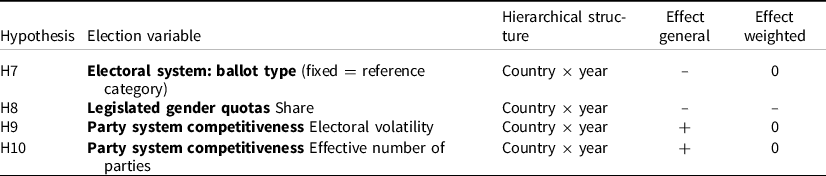
Table 2 summarizes the system-level variables together with their hypothesized effects and positions within the hierarchical structure.
Independent variables (election) with hypothesized effect

Methodology
Case selection and data structure
We limit the analysis to 10 European established democracies with a list-PR system: Austria, Belgium, Denmark, Finland, Luxembourg, Netherlands, Norway, Portugal, Spain, and Sweden.Footnote 3 The first limitation is to focus on list-PR systems. While turnover processes in majoritarian systems are straightforward – incumbents and experienced candidates are generally re-nominated (e.g., Ansolabehere et al., Reference Ansolabehere, Hansen, Hirano and Snyder2007; Hazan and Rahat, Reference Hazan and Rahat2010), candidate renewal rates in proportional electoral systems are related to a larger set of party characteristics (e.g., Koskimaa et al., Reference Koskimaa, Mattila, Papageorgiou and von Schoultz2021; Muyters et al., Reference Muyters, Put and Maddens2022) and the institutional context (e.g., Valdini, Reference Valdini2012). The second limitation is to exclude new democracies from the analysis because these are often considered as less stable and are expected to have radically different candidate turnover dynamics (Sikk and Köker, Reference Sikk and Köker2015). Applying Lijphart’s criterion, democracies are considered ‘established’ if they have been a democracy for an uninterrupted period of at least 20 years at the time of the first election under investigation (Lijphart, Reference Lijphart1999; Karp and Banducci, Reference Karp and Banducci2007). This assessment is based on the Polity IV Project and Freedom House indexes.Footnote 4
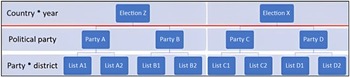
Apart from this substantial motivation, the case selection is also based on some technical considerations relating to the research design and upper-level sample size. Our data have a hierarchical structure, as electoral lists are clustered into political parties, which are in turn clustered in elections. Electoral lists are the units of analysis in our models and thus constitute the lowest level in the multilevel analysis. This strategy was also followed by Koskimaa et al. (Reference Koskimaa, Mattila, Papageorgiou and von Schoultz2021) and makes sense as lists are the ‘natural level’ where candidates are presented. This hierarchical structure results in a 3-level model as shown in Figure 1.
Classification diagram.
Note: The red bar distinguishes between party and election variables, as they are mainly addressed in literature.

The number of elections under investigation (i.e. 52) is sufficient to yield reliable statistical results (e.g., Snijders and Bosker, Reference Snijders and Bosker2012). Because the election level is in fact a combination of country and election year, institutional changes within a country over time cannot be modeled explicitly. However, in this comparative research design, time variation is negligible.Footnote 5 Therefore, not opting for a four-level structure which distinguishes between countries and election years does not result in a substantial loss of information (cf. variance decomposition at the end of the results section). This allows us to proceed with a three-level model, with elections as the upper-level unit, which results in a sufficient sample size. Possible national differences are accounted for via cluster robust standard errors.Footnote 6
We compare candidate lists at the level of the electoral district, for four consecutive national and (Norway excepted) EP elections. Candidate names and list positions were gathered from official election bulletins, which were requested from the respective ministries of interior if not available online.Footnote 7 ,Footnote 8 After aggregating the turnover rates at the list level (cf. dependent variable section), all unique list records were kept, resulting in a dataset in which each row equals one electoral list.
For the national parliaments, Table 3 summarizes the elections under investigation: t − 3/t − 2, t − 2/t − 1, and t/t − 1. EP elections always take place in 2004, 2009, 2014, and 2019. Due to practical problems related to data accessibility and General Data Protection Regulation compliance, we could only collect data for the two most recent elections in Portugal. For each comparison, only the parties which obtained parliamentary representation are included. Extra-parliamentary political parties are excluded, as they often have weakly developed party organizations and turnover levels and often present lists in a limited number of constituencies. This results in a dataset of 3344 electoral lists, clustered within 86 different political parties. In total we include 52 elections, 28 national elections, and 24 EP elections.
Country cases with relevant elections

Note: Belgium has a largely split party system, with the Flemish parties running in the north of the country, and the Francophone parties running in the south. The analysis is limited to the Flemish parties.
Variables
The dependent variable is the level of turnover on candidate lists. This can be calculated in its simplest form as the proportion of candidates on a party list who did not appear as a candidate for that party in the previous election. Alternatively, we apply the method proposed by Sikk and Köker (Reference Sikk and Köker2015) to calculate a weighted candidate turnover measure which accounts for relative list position, depending on the party result at the district level.Footnote 9 The mathematical details of this calculation are discussed in the online supplemental material (Appendix A). We will estimate models with both the general and the weighted measure of candidate turnover as dependent variable.
The supplemental material (Appendix B) also includes a list of independent variables, with measurement details. At the party level the independent variables are: the size of the party (i.e., number of party members), transformational events (leadership change and party name change), the level of candidate requirements (with three separate indicators), and the electoral success. The typical way to operationalize the latter variable is to calculate the electoral swing between the elections t − 2 and t − 1, in order to explain candidate turnover at election t, taking into account that the result is not yet known at the time of the candidate selection for election t. However, it can be argued that this t − 2/t − 1 swing is outdated at the time of election t and does not capture the extent to which a party is in the winning mood in the run-up to election t. As we lack survey data, the best proxy measure for this mood at the time of the candidate selection is the electoral swing between election t and t − 1. We will apply both electoral swing measures in our analysis. In order to properly capture the effect of electoral swing, measured in percentage points, we also include the electoral result of the party at the previous election. This static variable captures the restricted maneuvering space for larger parties with a lot of incumbents, which are hard to replace on the list. Hence we expect a mechanical negative effect of the electoral result at t − 1 on candidate turnover (Daniel, Reference Daniel2016).
Even though legislative turnover and candidate turnover are two distinct concepts, they are obviously related. Some determinants of legislative turnover, identified in the relevant literature, will therefore be included as additional controls in our analysis. More specifically, we control for party ideology (e.g., Matland and Studlar, Reference Matland and Studlar2004), radical party position (Mudde, Reference Mudde1996; Daniel, Reference Daniel2016: 267), party age, and government status (Norris, Reference Norris2004).
The independent variables at the system level are ballot type, the extent of legal gender quota (LGQ) and the competitiveness of the party system (measured on the basis of both the mean electoral volatility and the mean number of effective electoral parties). We control once again for variables at the system level which have been shown to affect legislative turnover. More specifically, we control for district magnitude (Matland and Studlar, Reference Matland and Studlar2004), length of the legislative term (Matland and Studlar, Reference Matland and Studlar2004), and countrywide candidate requirements (ACE, 2021).
Analytical model
As the dependent variable is a percentage, the normality assumption of the classic Ordinary Least Squares regression framework will not be met. Moreover, fractional logit models, which are fitted using quasi-likelihood methods, typically rely on asymptotic approximations that are unlikely to be met given the small number of higher-level units (elections) in the study (Maas and Hox, Reference Maas and Hox2005). Two types of techniques are more suitable. The main approach is to run a fractional logit model (Papke and Wooldridge, Reference Papke and Wooldridge1996) estimated through a restricted maximum likelihood algorithm (Restricted Iterative Generalised Least Squares) to take into account the lower number of higher-level cases (Elff et al., Reference Elff, Heisig, Schaeffer and Shikano2016). More specifically we apply a two-step approach: fixed effects are estimated in a first step via an Iterative Generalised Least Squares algorithm. In a second step, we re-estimate the full model with Ristricted Iterative Generalised Least Squares (RIGLS) to estimate the variance components (and higher-level fixed effects). The likelihood function is approximated via a second-order Taylor series, with starting values based on a first-order approximation. Inference is based on (multiple) Wald testing. In this way, we can have efficient estimators and accommodate for approaching the likelihood function via a Taylor series. For robustness sake we rerun the main model following recent work (e.g., Gelman, Reference Gelman2006) which has shown that Bayesian inferential methods yield accurate estimates for hierarchical models with few clusters. In line with Galvis et al. (Reference Galvis, Bandyopadhyay and Lachos2014) we fit an augmented beta model, which is a zero/one imputed extension of the beta regression as proposed by Ferrari and Cribari-Neto (Reference Ferrari and Cribari-Neto2004), because there are exceptionally a few lists with new candidates only.
Results
Party-level results
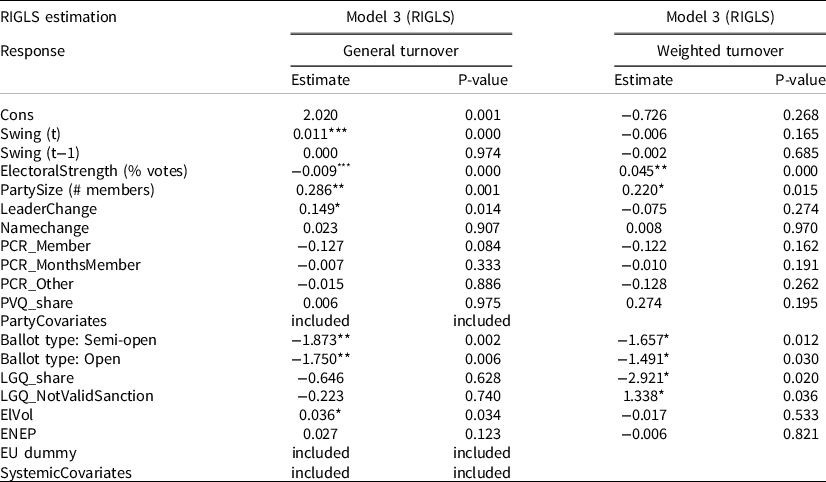
Table 4 summarizes the fixed effects of the full RIGLS model (model 3) on general turnover and weighted turnover, respectively.Footnote 10 We start by focussing on party variables (indicated in gray).
Main RIGLS models for simple and weighted turnover as dependent variable

Notes: ElVol = electoral volatility; ENEP = effective number of electoral parties; LGQ = legislative gender quota; PVQ = party voluntary quota; PCR = party candidate requirements. Significance codes: 0 ‘***’ 0.001 ‘**’ 0.01 ‘*’ 0.05 ‘ ’ 1.
The number of party members has the strongest effect on general turnover. As expected under hypothesis 3 ‘general’, parties with more members have a significantly higher turnover. This effect is also significant for weighted turnover, but the effect is considerably weaker even though it does not disappear as expected under hypothesis 3 ‘weighted’. Next, leadership change has a positive and significant effect on general turnover, confirming hypothesis 4 ‘general’. But the effect is slightly negative, though not significant, when turnover is weighted. As expected (hypothesis 4 ‘weighted’), the renewal effort of new party leaders does not extend to weighted turnover. Leadership change is the only transformational party variable which has a significant effect. A name change also coincides with a higher turnover, as expected (hypothesis 5 ‘general’), but this effect is not significant. This is also due to the wide confidence intervals resulting from the relatively low instances of name changes (only in 3.2% of the cases a name change occurred). The effect size of name change on weighted turnover (hypothesis 5 ‘weighted’) is considerably smaller and not significant, which is in line with the expectations.
Regarding candidate requirements, the effect of the membership condition on general turnover is negative but not significant (although borderline: P-value = 0.084). The remaining party candidate requirements (membership duration and other, i.e., the need to collect signatures, age, and mandate incompatibility) are not significant. Thus, hypothesis 6 ‘general’ is not confirmed by our results. The effects of these candidate requirements on weighted turnover are all clearly insignificant, in line with hypothesis 6 ‘weighted’.
The electoral swing does not have a significant effect on general turnover if it is measured as t − 2/t − 1. However, the swing significantly impacts general turnover if it is measured on the basis of election t.Footnote 11 If the swing is positive, general turnover is significantly higher. This is indicative of a prevailing supply dynamic (hypothesis 2 ‘general’), implying that a winning party will attract a larger supply of candidates. But this dynamic does not extend to the viable positions, as neither operationalization of electoral swing has a significant effect on weighted turnover, confirming hypothesis 2 ‘weighted’.
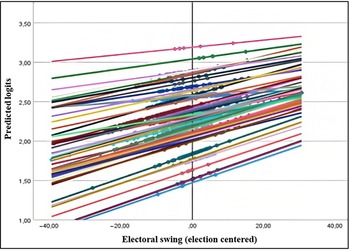
We also tested for random slopes for the main variables of interest. When a random slope for electoral swing at t is allowed, we find a negative (−0.002) and significant (P-value = 0.002) covariance between the random intercept and the random slope for general turnover.Footnote 12 This implies that the effect varies between elections. Figure 2 plots the predicted marginal logit scores for each election separately.
Random effect (election level) of electoral swing at t.

It can be seen that the effect of electoral swing at time t on general candidate turnover is positive for each separate election. But the slope is steepest when the predicted candidate turnover is lowest. In a context where candidate turnover is already high, the positive electoral swing has a smaller effect on list renewal, compared to a context where candidate turnover is low. This indicates that there is a ceiling effect, which confirms the assumption of risk-averse political parties, also with regard to general turnover. More specifically, it appears that parties avoid taking the risk of entirely renewing the list, in spite of the larger supply induced by a positive electoral swing.
Election-level results
Of the various system-level variables (Table 4, shown in white), ballot type comes to the fore as the main determinant of candidate turnover. As expected, (hypothesis 7 ‘general’), lists presented in closed list-PR systems are characterized by higher renewal rates than in systems with open lists. At the same time, the difference between semi-open and open systems appears to be minor and non-significant. The ballot type also has a significant effect on weighted turnover, but it is smaller and less significant. This indicates that even in closed-list systems, party elites show an inhibition to replace high-ranked candidates, but the effect does not disappear completely, as expected (hypothesis 7 ‘weighted’).
The effect of legislative gender quota on general turnover is negative, in line with hypothesis 8 ‘general’, but not significant. Neither are the effects of PVQ and a legal sanction mechanism for non-compliance. On the other hand, LGQ does have a significant negative effect on weighted turnover. This effect is not only stronger but also larger, as expected under hypothesis 8 ‘weighted’. In other words, when strict gender quotas apply, particularly the candidates at the top manage to stay in place. PVQ has no significant effect on weighted turnover, but legal sanctions do.
Turning to the party system variables, the effect of electoral volatility on general turnover is significant and positive as expected (hypothesis 9 ‘general’), although the effect size is rather small. Thus, highly volatile elections lead to higher turnover. The effect on weighted turnover, by contrast, is not significant and even negative, in line with hypothesis 9 ‘weighted’. This suggests that party elites, when faced with electoral unpredictability, opt for safety with regard to the top positions. On the other hand, the hypothesis that a larger number of effective parties would have a positive effect on candidate turnover (hypothesis 10) is not confirmed, as the parameter is not significant, neither for general nor for weighed turnover.
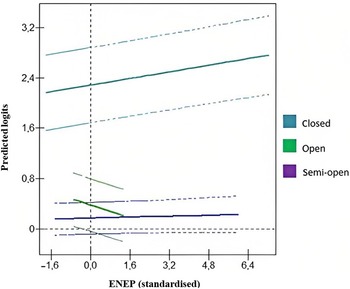
The fact that the ballot format stands out as the system variable with the most robust effect suggests that the dynamics of candidate selection and list renewal are entirely different in open and closed-list systems. The variables discussed above may have a significantly stronger effect in closed-list systems, where party elites clearly have more leeway for list renewal. We therefore checked for interaction effects between ballot type and the other variables in our model. The interaction between ballot type and the effective number of parties proved significant for general turnover. Figure 3 visualizes the marginal predicted logits for the interaction between effective number of electoral parties (ENEP) and list-PR type.
Predicted marginal logits for the interaction between ENEP and List PR type.

In the case of closed lists, a larger number of effective parties does coincide with more candidate turnover, as predicted under hypothesis 10 ‘general’. But this effect is reversed in the case of open lists: a more fragmented party system implies less candidate turnover. In semi-open list systems, the number of parties does not have a significant effect on turnover. This result confirms again that party elites are risk-averse, and that this dynamic also impacts general turnover, as was the case with the ceiling effect evident from the electoral swing random effect model. It is only in a setting of closed lists that part elites dare to opt for list renewal when faced with a more intense competition. If lists are open, by contrast, such intense competition appears to trigger a conservative response, as party elites are even less inclined to replace candidates.
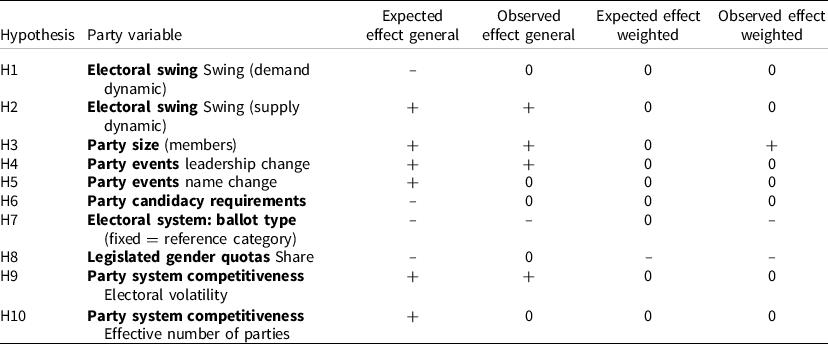
Table 5 summarizes the previous results by comparing for each hypothesis the expected and observed effect. First, with respect to general turnover, the effect of changing a party name as well as the effect of candidate requirements are not statistically significant (although they are in the expected direction). Also, at the election level, the effects of legislative gender quota and the effective number of parties are not significant either (even though the expected effect of ENEP was found in closed-list systems). Second, concerning weighted turnover, we found that the investigated drivers have less explanatory power. Only party membership size, ballot type and legislative gender quota have a significant effect (in the expected direction). The effect of quota is, in line with expectation, stronger for weighted turnover.
Summary of expected and observed effects

Variance decomposition
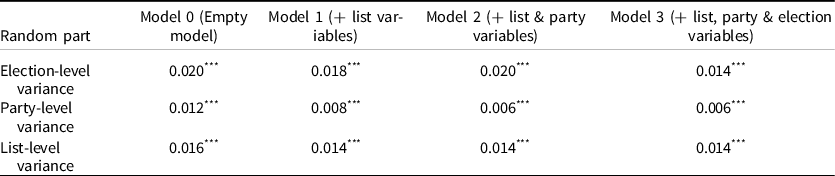
Which of the two clusters of independent variables have most explanatory power, those at the party or those at the system level? The answer is found in the variance decomposition table belowFootnote 13 Table 6.
Variance partitioning based on full RIGLS models

Notes: Variance components are tested via one-sided tests as negative values are excluded from the parameter space: significance codes: 0 ‘***’ 0.001 ‘**’ 0.01 ‘*’ 0.05 ‘.’ 0.1 ‘ ’ 1. We made use of the standard logistic link function for estimating beta parameters, but the variance component results above are reweighted to undo the model-implied constant first-level variance.
Model 0 can be interpreted as an ANOVA analysis. The election level is most important: about 42% of the total variation is located here (0.020/0.048). Regarding explained variance, our model explains about 30% of the total variance in candidate turnover.Footnote 14 The included independent variables yield a 30% drop in random election-level variance, while random party-level variance decreases by 50% (each time comparing model 3 to model 0).Footnote 15 Explained election-level variance is entirely due to the election-level variables that were introduced in the model. On the contrary, when it comes to the party level, there is a 33.3% random variance drop when list-level variables are included. Introducing the party-level variables further reduces 17.7% of the remaining random party-level variance, with party members as a key variable. We have to bear in mind however that electoral results of lists of the same party correlate strongly. It is therefore logical that those variables capture a substantial amount of party-level variance.
The fact that the model only explains 30% of the total variance makes it difficult to unequivocally explain aggregate differences between individual countries on the basis of the significant explanatory variables. In the online Appendix C, the ten investigated countries are ranked according to their average level of general turnover. As concerns general turnover, 60.9% of the candidates on the average list in the ten countries under investigation was not a candidate in the previous election. But the variation across countries is substantial. The renewal rate ranges from 48.2% in Belgium, to 84.4% in Portugal and 67% in Spain at the other extreme. According to our model, the top positions of Portugal and Spain on this list may be related to the fact that both countries have a closed-list system. In addition, Spain has the highest level of party members. Reversely, the strict quota rules and the semi-open list system can explain why Belgium is the country with the lowest turnover.
Conclusion
Which party- and system-level determinants explain the level of candidate turnover on ballot lists in established democracies with a list-PR system? By means of a multilevel analysis of political party list renewal rates within 10 European list-PR systems we contributed to this newly developing literature and aimed at improving our understanding of the dynamics in candidate recruitment in general, and candidate turnover in particular. For this purpose we built an original dataset that contains 3344 electoral lists of represented parties in established democracies. We looked at both general turnover (considering all list positions equally), and weighted turnover (taking into account the relative importance of list positions).
Regarding general turnover, the results first of all confirm that demand and supply dynamics indeed interact with each other. In the sphere of party transformational events, our results suggest that a new party leader increases the demand for new candidates, which may go along with an increased supply as well, and thus with higher turnover. At the same time, the substantial and positive effect of party size in terms of members points at a supply side effect: parties with more members have a higher supply of candidates, which facilitates the recruitment of new candidates.
A positive electoral swing at the time of an election coincides with more general turnover, indicating that people are more willing to jump on the bandwagon of a political party in the winning mood. The magnitude of this effect depends on the level of turnover within a certain election. Presenting a largely renewed candidate list to the voters is apparently considered as too big a risk, as a result of which the positive supply effect is topped off in an electoral context with more turnover in general. Finally, a more volatile and unpredictable party system also results in more candidate renewal, because parties are more inclined to strategically reshuffle the lists, and/or it becomes more attractive for citizens to take a chance as a candidate.
Nevertheless, this effect of electoral volatility on turnover disappears when turnover is weighted according to list position. However willing selectorates might be to renovate lists when faced with electoral uncertainty, they are risk-averse when it comes to replacing the top positions on the list. Of course, this reflects the well-known incumbency advantage in candidate selection. But such a fundamental risk-averseness of party selectorates was also hinted at by other results in our analysis. In closed-list systems, the more intense competition due to party system fragmentation translates into more turnover. But in open list systems this relationship is reversed as party elites tend to cling to existing candidates and their personal vote earning capacity when faced with intense competition.
More in general, the effects of independent variables on general turnover often decrease or become insignificant when the position on the list is taken into account. This means that high-ranked candidates are more immune to candidate turnover effects. For instance, the candidate renewal set in motion by a new party leader does not extend to top positions, as this variable does not have a significant effect on weighted turnover. Put differently, new chefs indeed want to revamp the menu, but signature dishes remain unaltered. Neither is weighted turnover affected by the competitiveness of the party system in terms of volatility and number of parties. Also, the strong effect of the ballot type was smaller for weighted turnover, indicating that even in closed-list systems, the top candidates are difficult to replace.
The finding that these effects do not always disappear completely for weighted turnover could be due to the fact that this measurement gives a stronger weight to top positions but does not exclude low-ranked positions completely. However, the conclusions hold when the weights are adapted in such a way that they drop steeply toward low values and the lower list positions are almost completely disregarded.
One noticeable exception is the effect of legislative gender quota. In line with previous research we find a negative effect of LGQ on weighted turnover: the stricter the quota, the smaller the turnover. The inhibition to change candidates at the top of the list appears to be reinforced in a setting with less degrees of freedom for selectorates due to quota rules. This can be attributed to the fact that, in the long run, quotas result in stronger and more experienced (men and women) candidates on the list, as shown by earlier research (Muyters et al., Reference Muyters, Put and Maddens2021).
A final important conclusion is that electoral institutions matter more than party agency, as shown by the variance decomposition. Our data point at a nuanced answer, as both the party and the system levels appear important. Yet, a major part of the variation in candidate turnover can be attributed to the election level. Predictors at this level are essential in order to explain this particular variation. At the same time, party-level variables also explain a substantial part of the variation, and the variables at party level or below included in our model explain about half of the party variation. This is an important finding, given that so far the empirical literature has not focussed on the election-level context.
To conclude this article, we reflect upon the implications of our key findings and suggest routes for further research. As explained above, our results suggest in various ways that parties are risk-averse as concerns candidate turnover. This suggestion may fuel further research on specific drivers for candidate turnover (on top list positions), for example by applying qualitative research techniques probing into the intentions of party selectorates. They might indeed be aiming at candidate renewal, but on the other hand, jumping into the dark by presenting an entirely new list seems to be a bridge too far and presenting new candidates on top positions also implies higher exposure. Further research could build on the specific conditions of this risk-aversiveness, for example depending on the party type or the internal party organization. Moreover, party leaders might use top positions to reward personal loyalty and/or party loyalty, which in turn might impact risk-aversiveness.
This risk-averse tendency hinted at by our findings may also be relevant beyond the candidate selection process. It may be indicative of a general dynamic of inertia within a democratic system, especially in systems with a large influence of party leaders, such as in Belgium. Moreover, our findings suggest that, despite the general tendency of decreasing party membership in European democracies (e.g., Hooghe and Dassonneville, Reference Hooghe and Dassonneville2014), party members remain important. From an academic point of view, our findings once more highlight the importance of the electoral system as a crucial factor determining candidate recruitment.
We were not able to opt for a panel approach, given that our dataset is rich on the spatial component but less so on the time dimension, with only four measurement points for each party list. Further research could include more time points in order to investigate the effect of institutional changes over time within a country. Coping with possible data collection constraints and looking for electoral lists far back in time would probably require returning to a longitudinal single-country case. For example, Greece could provide an interesting test case for such a longitudinal design, as the institutional context has been rather volatile there. When it comes to the spatial dimension, additional research could be conducted to focus on new (central and east European) democracies. Pending such further research, in terms of external validity our claims are limited to established democracies with list-PR systems.
Finally, the quota aspect of our research also opens a door to further research. Quotas appear to increase the inertia of candidate recruitment at the top of the list. This may turn out to be positive from a gender perspective, as it can enable women candidates to maintain themselves at the top and consolidate their careers. But drawing such a conclusion would require a more detailed investigation comparing turnover for men and women candidates separately.
Supplementary material
To view supplementary material for this article, please visit https://doi.org/10.1017/S1755773922000601.
Acknowledgments
This work was supported by the Research Foundation Flanders (FWO) [grant number G070418N].
The authors certify that they have NO affiliations with or involvement in any organization or entity with any financial interest, or non-financial interest in the subject matter or materials discussed in this manuscript. Furthermore they ensure objectivity and transparency in research and that accepted principles of ethical and professional conduct have been followed while collecting publicly available information on electoral candidates and anonymously processing and analyzing them in further research stages.