The necessity for rapid and, most importantly, accurate identification of the deceased has been at the forefront of forensic and emergency response in the wake of disasters for many years. Narratives of mistakes are routinely included in training eventsReference Evans 1 - Reference Hicks 6 and errors are procedurally managed through a series of International Criminal Police Organization (Interpol) guidance documents. 7 However, inaccuracies have occurred not only in the identification of the deceased but also in the identification of the living. Analysis of the aftermath of a number of recent terrorist incidents suggests that this may be a continuing concern.
Cases of identification errors of living incapacitated victims have occurred, albeit on a smaller scale, yet significant enough to warrant scrutiny into how and why such failings could occur. As the number of mass casualty and fatality events continues to increase, so too will the errors and consequences of misidentification of the survivors.
In this article, the authors discuss the circumstances surrounding misidentification of the living and the consequences of mistaken identity. Through the application of testimony from recent terrorist attacks, analysis of mass casualty and fatality exercises, and interviews with emergency responders, the authors explore available methods to determine identity such as those used in Interpol’s Disaster Victim Identification (DVI) process. We also briefly discuss the potential barriers to the identification process, such as ethical and legal implications, and offer some suggestions as to how responders can work around these issues.
METHODOLOGY
The approach to analyze and study the challenges faced by frontline responders needed careful consideration given the complexity of emergency response and the numerous difficulties faced within the disaster setting. A qualitative ethnographic approach was taken, triangulating fieldwork, interview, and doctrine analysis. This included observation of Exercise Unified Response in Kent, United Kingdom, in 2016 and Exercise Lock at the Royal Free Hospital in London, United Kingdom, in 2017. This was triangulated with 20 interviews involving multinational emergency responders and Disaster Victim Identification specialists and was followed by discourse analysis of legal doctrine and responder documentation.
Owing to substantial ethical considerations with real-world research,Reference Armstrong, Langlois and Laparidou 8 2 major exercise scenarios were used for field work. However, responders from international incidents in 2016 and 2017 provided testimony reflecting experience on actual practice,Footnote a and media accounts of hospital critical care personnel experience were analyzed through thematic analysis.
DISCUSSION
Consequences of Assumptions
The primary role for emergency responders in the immediate aftermath of a mass casualty event is to save life. The rapid extraction of injured survivors is a key requirement to maximize the chances of survival. Interviews with paramedic responders and prehospital care clinicians highlight the primacy that life-saving takes over any need for identification.
Naming the patient is important here; the personalized medical considerations such as access to a shared computer database about the person or ensuring that a treatment approach is aware of blood type or allergies will come later, but at the scene it is much more about a human to human connection. When observed by the researchers, it was the person’s name that was always asked first of a conscious or semiconscious patient, as the quotation below illustrates.
“‘Hello, can you hear me, what’s your name, hello…hello’ shakes patient gently on the opposite ‘uninjured’ arm” [Patient ‘Stacey’ found alongside tube carriage unconscious with traumatic limb amputation. Osborn D. Field notes Exercise Unified Response 2017].
Responders will attempt to find out a person’s name as a high priority. There may be an understandable assumption that the personal effects near a casualty belong to that person and as such should accompany them to the hospital. These methods, commonly utilized in daily incidents, have proven unreliable and problematic.
This was the case in Northern Ireland when two girls were mistakenly identified as each other after deaths in a road traffic collision. In the review of Danica O’Rourke and Anica Swift’s case, Mr Justice Weir called for all individuals concerned, where they fall within same sex or similar ages, to be “positively identified using reliable means.”Reference Weir 4 It is usually taken that reliable when used in this context equates to scientific.
Exercise Unified Response, held in the United Kingdom in February 2016, offered a unique opportunity for frontline responders and hospitals to test their ability to respond to a mass casualty event. The exercise was a live, multiagency, multinationalFootnote b disaster exercise set over 4 days. The scenario was based on a building collapse over a main rail line and underground tube station in central London. Over 2,000 actors were used to play injured casualties allowing Hazardous Area Response Teams, Helicopter Emergency Medical Service, paramedics, and other frontline responders to test their ability to extract and treat casualties in a high tempo and life-like environment.
Observation of the exercise, alongside interviews with responders, demonstrated that the placing of nearby personal effects with the unconscious patient was normal practice across the international community. This was seen in 5 of the patient journey studies observed by D. Osborn. Bags, wallets, and coats accompanied victims extricated from the wreckage, some of which were the victim’s own, some of which belonged to passersby or the deceased.
Sometimes the assumption will be an accurate one. In most cases, it causes no harm and proves to be extremely useful. Furthermore, the information contained in a wallet may highlight medical needs, family contacts, and the funds for the individual to get home when recovered. However, in mass casualty events (defined as potentially involving up to 2,000 casualties) 9 and mass fatality incidents (where numbers of fatalities exceed local mortuary arrangements), 10 the automatic assumption that the identity of the individual matches a wallet or item near the individual may be more problematic.
Misidentification of the deceased
Based on critical analysis of over 20 incident reports, coupled with interview analysis, it is clear that mass casualty events by their very nature are initially chaotic and destabilizing and are understandably difficult to maintain a sense of control over. There is a multitude of ways in which communications flow, and information management can add to the burden of the response. In this complex environment it is therefore understandable that the risk of misidentification has increased.
There is a growing recognition within the forensic and pathology communities that scientific identification should be used to identify the deceased from mass casualty incidents. Yet even with deceased patients, there is still acceptance of the visual recognition carried out by friends and family members, including day-to-day hospital settings and single casualty events, even in societies where scientific means are readily accessible. Catteneo and Gibelli state that visual identification is “frequently and sufficiently”Reference Catteneo and Gibelli 11 (p305) used to identify nondecomposed family or acquaintances. Whilst Catteneo and Gibelli acknowledge that visual identification must not be used for identification of decomposed bodies or remains and that Interpol standards “stress this,” there remains tolerance of the use of visual identification as one of the primary techniques. Subedi claims that visual identification is “quite acceptable” and that “Identification in nondecomposed and intact dead bodies can be easily done by visual examination and affirmation by the relatives once they arrive.”Reference Subedi 12 Although Subedi does refer to the standards set by Interpol and the acceptance that mistakes occur if DVI is not adhered to, there remains an underlying theme that visual identification is acceptable when the cases seem straightforward.
Yet, events such as the Egyptian massacreReference Nuthall 13 in Luxor in 1997 and the Indian Ocean tsunami in 2004 include examples of well-known mistaken identification errors and there are a surprising number of other examples not as frequently cited. The 2003 Bali bombings resulted in 9 out of 16 bodies being incorrectly visually identified by family members.Reference Lain, Griffiths and Hilton 14 Furthermore, Iino and Aoki report that 89% of victims in the 2011 Japan Tsunami were identified using visual and personal belongings.Reference Iino and Aoki 15 It was stated that seventeen cases of mistaken identification occurred due to visual identification errors by family members.
Disaster Victim Identification is an internationally recognized process applied to the deceased which aims to use means of identification that are scientifically sound, reliable, and applicable in the field.
The primary and most reliable means of identification are fingerprint analysis, comparative dental analysis and DNA analysis. Secondary means of identification include personal description, medical findings as well as evidence found on the body. These means of identification serve to support identification by other means and are not sufficient as sole means of identification. 7
Despite the need for a universal standard, there remains international variation; for example, some jurisdictions might require one primary means accompanied by two secondary means, another may ask for at least two primary means. The procedures are inextricably linked to the jurisdiction’s post mortem judicial process. An overriding point to note is that all of these techniques involve an intervention/interaction with the patient’s body, usually by a pathology team, in the mortuary. They also involve interactions with databases and with pre-existing legislation, such as that around the taking of DNA samples as per each jurisdiction’s requirements.Footnote c
Misidentification of the living
United Kingdom guidance issued to family members of patients in intensive/critical care units warns about the changes in a patient’s features due to not only the incident itself but also the effects of the procedures undertaken by the hospital: “The patient may well be connected to a number of machines and drips and will often look very different from how they normally look. The fluids given to the patient to keep them hydrated may make them look bloated and bruising can be caused by tubes and injections” 16 and may leave them “looking very different from normal.” 17
It is acknowledged that often these patients will have been accompanied by family members or via self-admission, with clear knowledge of who they are. Yet for those who arrive without someone to accurately identify them, or where there may be some doubt as to their identification, the accurate identity of the patient should be questioned and verified rather than simply accepted.
In the 2005 London terrorist attacks, Gill Hicks had both legs amputated as a result of the bomb blast on the Piccadilly line. Her injuries were so critical that she was not expected to survive having lost between 75% and 80% of her blood. She was unrecognizable on arrival with no discernible identification and as a result was entered into the hospital system as “One Unknown.”Reference Hicks 6 The medical teams faced with the prospect that she might die without family by her bedside took the decision to bring her out of a medically induced coma in order to blink her name through the alphabet. Armed with her name, the medical teams and police were able to reunite her with her fiancé. Her partner, family, and friends had been frantically calling the UK Police Casualty Bureau and began searching hospitals for any news of her. Her fiancé and family, after 12 hours of torment, were finally able to be by her side. The case of Gill Hicks illustrates the consequences of misidentification for the living and the option of bringing someone out of a coma to determine their identity. Yet the decision was not taken lightly and was taken based on her dire prognosis.
In interview data collected by the authors, some clinicians have suggested there is “minimal harm,” “an unlikely problem,” “not an issue,” and “if misidentified - they are not misidentified for long.” Yet the families of those missing and/or presumed dead would clearly feel otherwise. This was especially true for those children and their families caught up in the wake of the Manchester, UK bombings in May 2017, where media reported that several unidentified pediatric patients were treated, as discussed below.Reference Reid 18
Consequences of Misidentification
The failure to identify one individual will usually result in an error of the identification of another victim who is either alive or deceased; a mantra in UK police training is “where there is one, there will be two.” For either family, this situation would cause distress and anguish.
There are a number of iconic cases, accompanied by extensive media reporting, where there has been confusion between living and deceased patients, including the aftermath of the Boston Marathon bombings in 2013 where a father, believing his daughter to be alive, was taken to her bedside, and realized her friend was there instead.Reference Evans 1 His daughter was already dead. In the case of Whitney Cerak and Laura van Ryn in 2006, the families were mistakenly informed that Whitney had died and Laura was unrecognizable from her injuries.Reference Van Ryn, Van Ryn and Cerak 5 Whitney’s family believed they were burying her with over 1400 mourners, but in fact Laura was deceased and Whitney was in an induced coma for over 5 weeks. She was eventually able to communicate the mistake to her family through a few words. The girls had originally been identified through visual identification (they were very similar in appearance) and also by personal effects, although the families had already asserted to responders that they did not recognize the shoes that were returned to them as belonging to their daughters. Once the true situation emerged, the responders utilized dental records to bring a more reliable and scientific tool to bear, but by then the mistakes had been made.
There may also be legal implications for errors in this area, particularly relating to consent to treatment, access to medical records, contraindication information, and requirements for “safeguarding arrangements” for children and vulnerable adults as discussed briefly above.
Furthermore, there would also be financial implications. For those families with a loved one in a hospital, the costs of treatment in some jurisdictions can be significant, especially if in intensive care. Whilst this would not be an issue for citizens in their home country, overseas victims would be expected to reimburse the costs of any procedure not considered emergency treatment. If this amount is not covered by an insurance policy, the individual’s families would be expected to reimburse the state. Those informed of their loved one’s death would need to consider the costs associated with funerals and potential issues regarding burial or cremation of the wrong individual. (There have been repeated examples of families conducting cremations on the wrong loved one, which is of course irreversible, in both mass casualty scenarios but also after nonemergency mortuary audits).Reference Mathews-King 19
For the institutions at fault, the potential damage to their reputation would seriously impact their ability to be trusted in the future. The field interviews with DVI teamsFootnote d from the international mass casualty response community reported that this was a growing concern.
International Learning
The attacks in Paris in November 2015 led to over 130 deaths, hundreds of wounded, and 100 in critical condition.Reference Yardleu, Carson-Stevens and Donaldson 20 In the rush to save lives and extricate casualties and the deceased from the streets of Paris and the Bataclan nightclub, police forces and paramedics made assumptions of identification based on identity cards, personal effects, and belongings lying on or near the victims. As a result, some individuals were mistakenly named. One young victim was in a coma in hospital with gunshot injuries to the head resulting in difficulties in visual recognition by staff and family members. 21 , 22 The lessons from Paris enabled the prosecutor’s office in the Belgian attacks to correctly identify 4 unconscious victims. This was of particular importance to the prosecutor responsible for the identification commission because, as she said, “One family was sitting next to a family member who they weren’t sure was in fact family” (Van Wymersch, Substitute Prosecutor for the King, Brussels, oral communication, February 2017). In terms of identifying the deceased, it allowed her to ensure that these “missing persons” were not lying in the mortuary while their families were waiting, desperate for information.
New Innovative Practice: The Applications of DVI Techniques to Living Patients
The positive implementation of DVI processes to identify the living was then subsequently used in the 2016 terrorist attack in Nice by the French DVI police team. Again, 4 identities were in doubt and the use of scientifically accurate methods allowed the families to be quickly reunited with their loved ones (Elvire Arrighi, Commissaire de Police, Service Central de Police Technique et Scientifique, oral communication, August 2017). This was a ground-breaking move for a DVI team and medical responders and offers a unique opportunity for international learning within the disaster response field.
In the United Kingdom, the attack outside the Houses of Parliament, the bomb in Manchester, and the marauding attackers in Borough market during 2017 all demonstrated a need for a “smarter way” of identifying the critically injured. The Manchester Arena bombing had the added complication of the victims being children and young adults who were unlikely to have identification on them and therefore harder to ascertain identities. Clinicians, in the wake of this attack, spoke publicly of their discomfort with not knowing the identities of these childrenReference Hubert and Absalon 23 ; one trauma clinician stated, “I am devastated by some of the stories I have heard from my patients this week. I know colleagues in the children’s hospital were dealing initially with unidentified patients, which they found very hard.”Reference Reid 18 Furthermore, this raised specific child safeguarding concerns for health authorities in the United Kingdom, which have been reported by the authors to the National Health Service Emergency Response Strategic planners for further consideration.
Potential Barriers
The implementation of this new approach for emergency responders is not without challenges. There are potential issues in respect to the scientific vacuums in relation to the use of DNA, fingerprints, and odontology and their use on living patients. Furthermore, there is a clear lacuna in relation to the legality of the process, and this will endure until the issues raised are debated more fully by the medicolegal community.
While emergency treatment of an incapacitated patient is in their best interest and considered a necessity according the UK 2005 Mental Capacity Act,Reference Fisher and Gribben 24 the determination of identification for nonmedical means sits within a grey area of the law. Although ethically and morally it could be argued that the patient would wish to have their family notified and their identity determined, the law in terms of patient autonomy and privacy would need to be overcome.
There is the potential to use the ruling in the case of Montgomery v Lanarkshire Health Board [2015], “what a reasonable person might wish,” which may be considered a landmark argument for common sense. 25 This argument also supports the decision behind emergency treatment without the need for consent for incapacitated patients—it is automatically presumed that most people would wish to be saved. Yet this may be a misguided complacency regarding the presumed consent for such treatment, or even, as Jones argues, a “fairy story” in relation to patient consent. 26
2016 and 2017 saw a number of challenges arising from police requests in the medical setting, both nationally and internationally, which should highlight an opportunity for cliniciansFootnote e and policeFootnote f to reflect on their own assumptions in this arena.Reference Jones 27 , Reference Ortiz and Siemaszko 28 Without case law to guide professional practice within either the police or medical community, this area of response will continue to operate within an uncertain medicolegal paradigm.
A Scientific Solution?
The recent events in Europe have all had a common thread of terrorism as the underlying cause. Terrorism incidents can allow for a certain leeway when investigating the missing and deceased. The ability for the police to request DNA samples and fingerprints from the incapacitated could be argued as a means of confirming the identity as a part of the terrorist investigation. However, in circumstances not relating to terrorism or a criminal investigation, the ability to take a DNA sample, fingerprint, or dental x-ray would be hampered by the need for the patient’s consent. Without the consent to treatment (which is not considered emergency treatment), the procedure could not be carried out. In the circumstances described here, the unidentified patient’s family could not be scientifically proven until after the tests were carried out. Arguably, they could not act as proxy decision-makers. Furthermore, the medical teams could be challenged regarding the arguments of best interest, necessity, patient autonomy, and respect for privacy, regardless of the needs and wishes of the families desperate to confirm identities.
Lastly, gaining the relevant identification information from the incapacitated patient for comparison to corresponding identifiable material from families searching for their missing loved ones or from national databases would need to be conducted. The point to point comparison of samples presents the fewest issues; however, the testing of samples with national databases may raise concerns with respect to privacy and data protection.
In rare circumstances, an individual may contest their identity being determined and shared with estranged family members. This could be due to any number of reasons ranging from witness protection or avoidance of abusive family members to fears over data privacy and the misuse of their information on a wider scale. Charges of assault for treatment without consent and invasion of privacy could be brought against the responsible institution. Furthermore, the organization could be charged with failure in their duty of care and negligence in the care and treatment of their patient. The teams responsible for determining the identity would need to ensure that the procedure conducted to determine identity was carried out with clear consideration as to how the information was used and data retained, if at all.
Regardless of the potential penalties, there remains little excuse to rely solely on visual identification when scientifically accurate methods exist to confirm an identity. This is reinforced with the moral and ethical arguments for reuniting family members.
An Interim Solution
It is acknowledged that the implementation of DVI techniques to identify the critically injured will require resources and upskilling or training of individuals and teams. It is also acknowledged that it is not without its own legal and ethical challenges. Although the procedure would undoubtedly occur within the medical setting, it may not necessarily be conducted by the hospital teams. The identification process would more appropriately be situated with police documentation teams who are required to attend hospitals in the wake of a declared major incident involving mass casualties. These teams are tasked with collecting patients’ details, which are then entered into the casualty bureau process. An alternative, as has been used by French DVI teams, may be a subcell of a DVI team who are already trained in the correct techniques, software, and equipment, and, importantly, already have knowledge of the overall identification process and awareness of the importance to families. This will inevitably speed up the process of confirming identities in the wake of a mass casualty incident.
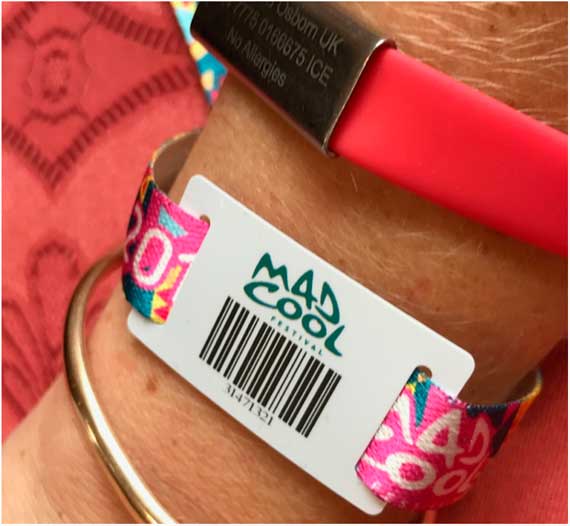
Part of the solution for identifying individuals and family members at public events such as concerts, which could be implemented quickly, could be the mandatory use of wristbands which are affixed to the individual prior to entry. An advantage of this solution is also that it is relatively inexpensive and commonly used. Examples of these are used in multiple settings across the world, some with a bar code which is linked to personal details (such as the MadCool festival in Madrid; see Figure 1). Some wristband IDs are linked to credit cards to allow rapid payment for refreshment. Other examples exist for entrants in sports events where tracking beacons are attached to the entrant’s leg to ensure their timings are captured. Again, these details would link an individual to their personal details and enable emergency services to identify them and link to next of kin in the aftermath of an incident.
ID Bracelet Examples.

For families and those concerned about wandering children (or indeed those who simply wish to have an identity bracelet on their person), there exist a myriad of solutions. Although these versions are removable, they can contain details such as name, next of kin details, and an “in case of emergency,” or ICE, number.
The use of identification aids, such as those outlined above, are a useful additional tool to assist in identifying possible family members. However, these are not infallible in all circumstances. The use of these is limited because individuals could swap them or in the event of body fragmentation the personalized item could be separated from the individual or destroyed. As such they should be treated with the same caution as personal effects found near or on victims and used only as a secondary identification method.
Alternative identification methods do exist and could be considered in the future, such as biometric recognition software or the use of specialized facial recognizers or superrecognizers, individuals who are particularly adept at recognizing facial characteristics.Reference Robertson, Noyes and Dowsett 31 However, the numbers of superrecognizers are understandably small and the process would undoubtedly be flawed in circumstances where the victim(s) had been affected by the incident thereby rendering their face distorted due to injury and the effects of emergency treatment. Furthermore, the application and accuracy of biometric facial recognition software is neither universal nor infallible.Reference White, Dunn, Schmid and Kemp 32 The authors would certainly support further research into viable technological solutions to support rapid and accurate identification of disaster victims.
CONCLUSION
Recent mass casualty events have demonstrated that identification errors are reoccurring. There is a clear need to rethink how incapacitated individuals are identified. Families desperately searching for information regarding their loved ones require the authorities to have clear protocols for accurately identifying the deceased and also those who remain unidentified in hospitals. Processes do exist in the form of DNA, fingerprinting, and dental X-rays that provide a scientific solution; however, there are some potential legal barriers that may need careful consideration. Nevertheless, the ethical and moral obligation of the responders should be to ensure that the missing are found and that families are provided with information that is timely, accurate, and not reliant on visual identification assumptions. The failure to correctly identify the victims of a mass casualty and fatality disaster results in unnecessary distress and potentially leads to a safeguarding issue and rights to appropriate treatment and care, which could be lifesaving.
There is the additional factor that a complicated victim identification process adds a significant burden on responders’ services and rapidly becomes a focus of media scrutiny. Under normal circumstances, the news of a loved one caught up in such a disaster would be shocking; the failure to correctly identify them when science has paved the way for an accurate solution would be inconceivable and unjustified. Although additional solutions exist in the form of wristbands, “dog tags,” or tracking devices, these would be of limited use for events outside of an arena or organized event. As stated in Interpol’s latest DVI guide for identification of the deceased.
As far as Interpol is concerned, one of the most important requirements for victim identification is the application of international standards, which aims to promote a consistent and widely understood approach, especially in multinational DVI operations. 7
The authors have brought to the fore the clear need for addressing the identification issue in the wake of these events, and specifically a need for responders to be trained and exercised effectively in the appropriate techniques and processes for identifying all victims of a disaster, the living and the deceased. Ultimately the justice afforded to the deceased in terms of determining their identities using DVI scientific techniques should be extended to those incapacitated and unknown in a hospital bed. Whatever the solution is, moving forward, it is imperative that this is debated, especially given the increasing frequency of mass casualty and fatality events.