Major depressive disorder (MDD) is a commonly diagnosed disorder across the United States (Kessler et al., Reference Kessler, Berglund, Demler, Jin, Koretz, Merikangas and Wang2003), with an economic burden in the billions (Greenberg et al., Reference Greenberg, Kessler, Birnbaum, Leong, Lowe, Berglund and Corey-Lisle2003). For example, the World Health Organization (2017a) reports that MDD is responsible for the heaviest burden of disability among mental and behavioral disorders. Though past 12-month prevalence estimates for MDD are considered to be lower during childhood (1%–3%; Centers for Disease Control, 2015; Costello, Erkanli, & Angold, Reference Costello, Erkanli and Angold2006), by middle adolescence estimates are more similar and perhaps even a little higher than those in adulthood (4%–13% in adolescence, 6%–8% in adulthood; (1%–3%; Centers for Disease Control, 2015; Garber, Reference Garber, Sameroff, Lewis and Miller2000; Kessler et al., Reference Kessler, Berglund, Demler, Jin, Koretz, Merikangas and Wang2003; National Institute of Mental Health, 2015a, 2015b). Furthermore, rates of depression are on the rise in the United States, as reported rates of clinical depression in the past few decades have increased by about 1.5 to 2 million adults per decade (Greenberg, Fournier, Sisitsky, Pike, & Kessler, Reference Greenberg, Fournier, Sisitsky, Pike and Kessler2015; Marcus & Olfson, Reference Marcus and Olfson2010); this increase is not entirely explained by increases in population growth and is reflective of the increases of the rates of MDD (Greenberg et al., Reference Greenberg, Fournier, Sisitsky, Pike and Kessler2015). Clearly, continued research is needed to understand how MDD develops to augment effective treatment and mitigate this burden (Greenberg et al., Reference Greenberg, Kessler, Birnbaum, Leong, Lowe, Berglund and Corey-Lisle2003; Kessler et al., Reference Kessler, Berglund, Demler, Jin, Koretz, Merikangas and Wang2003).
A Developmental Cascade Approach
Interpersonal theories of depression (Joiner & Coyne, Reference Joiner and Coyne1999; Rudolph, Flynn, & Abaied, Reference Rudolph, Flynn, Abaied, Abela and Hankin2008) posit that a significant aspect of the development of depression is the context of interpersonal relationships and interactional style. Based on this approach, one would expect that depressed individuals may be more likely to elicit negative affect in their interactions with others as a result of their own levels of negative affect. Moreover, one would expect that poor quality of close relationships would increase the likelihood of feeling depressed (Rudolph et al., Reference Rudolph, Flynn, Abaied, Abela and Hankin2008). Thus, depression can be either a predecessor or a consequence of a weaker social support network and fewer close relationships at multiple stages across the life span (Eberhart & Hammen, Reference Eberhart and Hammen2006; Lin, Dean, & Ensel, Reference Lin, Dean and Ensel1986; Vanderhorst & McLaren, Reference Vanderhorst and McLaren2005). Some argue that interpersonal relationship quality and associated interpersonal skills may be particularly important to the development of depression in adolescence and young adulthood (Eberhart & Hammen, Reference Eberhart and Hammen2006; Rudolph et al., Reference Rudolph, Flynn, Abaied, Abela and Hankin2008), as these time periods are associated with heightened vulnerability for depression and other health outcomes (Garber & Rao, Reference Garber, Rao, Lewis and Rudolph2014).
To better evaluate the association between interpersonal relationships and depression, it is important to tease apart the possible effects of both antecedent versus consequence. Consequential effects, in this case, refer to how an individual may select into or be exposed to more problematic interpersonal relationships based on their own levels of depression. For example, individuals with depression may be more likely to respond negatively, withdraw, or behave aggressively to family members and friends, which can lead to increased conflict or disengagement in relationships (Rudolph et al., Reference Rudolph, Flynn, Abaied, Abela and Hankin2008). Antecedent effects refer to how more problematic relationships with parents, peers, or romantic partners influence the development of an individual's subsequent depressive symptoms. For example, problematic interactions and relationships with family members and friends may also lead to the development of depression (Rudolph et al., Reference Rudolph, Flynn, Abaied, Abela and Hankin2008).
The present study aimed to evaluate the extent of both antecedent and consequential effects using a developmental cascade model (Masten & Cicchetti, Reference Masten and Cicchetti2010; Masten et al., Reference Masten, Roisman, Long, Burt, Obradović, Riley and Tellegen2005). Specifically, we evaluated prospective associations between parent–child relationship problems in late childhood and adolescence (at ages 11, 14, and 17), antisocial peer affiliation from late childhood through young adulthood (at ages 11, 14, 17, 20, 24, and 29), and young adult romantic partner relationship problems (at ages 24 and 29) in relation to subsequent MDD symptoms (at ages 11, 14, 17, 20, 24, and 29). We also evaluated the extent to which prior MDD symptoms significantly predicted subsequent parent–child relationship problems, antisocial peer affiliation, and romantic partner relationship problems during this same time frame. After accounting for the stability in traits and within-assessment correlations between traits, this type of model also tests the extent to which earlier interpersonal relationship features in late childhood (e.g., parent–child and peer relationships) are prospectively associated with later interpersonal relationship features in young adulthood (e.g., peer and romantic partner relationships). It is worth noting that although developmental cascade models involving interpersonal relationship influences have been applied to understanding the development of several problematic outcomes, such as adolescent substance use (Dodge et al., Reference Dodge, Malone, Lansford, Miller, Pettit and Bates2009), and internalizing and externalizing problems (Masten et al., Reference Masten, Roisman, Long, Burt, Obradović, Riley and Tellegen2005), there has been no study to date that we are aware of that has applied a developmental cascade model to understand the effects of multiple interpersonal relationship risk features as they relate to depression from late childhood through young adulthood.
Review of the Literature
It has long been shown that aspects of parenting quality, such as lower levels of parental warmth or higher levels of parental rejection, are associated with an increased likelihood of child and adolescent depression (Branje, Hale, Frijns, & Meeus, Reference Branje, Hale, Frijns and Meeus2010; Heaven, Newbury, & Mak, Reference Heaven, Newbury and Mak2004; McLeod, Weisz, & Wood, Reference McLeod, Weisz and Wood2007; Shah & Waller, Reference Shah and Waller2000; Wilson, Vaidyanathan, Miller, McGue, & Iacono, Reference Wilson, Vaidyanathan, Miller, McGue and Iacono2014). Although there is less longitudinal work on this topic, a recent longitudinal study (Samek, Wilson, McGue, & Iacono, Reference Samek, Wilson, McGue and Iacono2016) provided support that earlier parent–child conflict was an antecedent of later MDD symptoms, but MDD symptoms were not an antecedent of later parent–child conflict. Thus, this study suggests parent–child relationship problems are likely a risk factor for subsequent MDD symptoms rather than a consequence. Yet, this study only examined the developmental transition from age 15 to 18, so it is unclear how this may unfold in relation to other important interpersonal relationships or over a larger span of time. For example, in later childhood and earlier adolescence, depressed children may elicit strain and evoke a negative parent–child interaction style in early adolescence (Garber & Rao, Reference Garber, Rao, Lewis and Rudolph2014; Graber & Sontag, Reference Graber, Sontag, Lerner and Steinberg2004).
Features of problematic parent–child relationship quality often do not operate in isolation. For example, parent–child relationship problems and punitive discipline have been linked to a greater degree of antisocial peer affiliation (Kretschmer et al., Reference Kretschmer, Sentse, Meeus, Verhulst, Veenstra and Oldehinkel2015; Pike & Eley, Reference Pike and Eley2009). Greater affiliation to antisocial peers may result in greater parent–child problems or vice versa. Samek, Goodman, Erath, McGue, and Iacono (Reference Samek, Goodman, Erath, McGue and Iacono2016) showed there was evidence of antisocial peer affiliation as a risk factor for subsequent externalizing disorders earlier in time (i.e., ages 17 to 20), but as a consequential factor later in time (i.e., from ages 20 to 24 and 24 to 29). This study follows Scarr and McCartney's (Reference Scarr and McCartney1983) developmental theory of gene–environment correlation, which proposes that selection or niche-picking processes should become more prominent as children and adolescents get older, as they have more freedom in selecting into environmental niches that align with their unique and genetically influenced traits and interests. The same principle may hold true in our evaluation of interpersonal relationship features and MDD symptoms.
Finally, research has consistently shown that romantic relationship problems and overall relationship quality are associated with depression (Blais & Renshaw, Reference Blais and Renshaw2014; Garber & Rao, Reference Garber, Rao, Lewis and Rudolph2014; La Greca & Harrison, Reference La Greca and Harrison2005). In line with an antecedent hypothesis, high-quality relationships may provide a buffer against depressive symptoms, whereas low-quality or problematic relationships may amplify depressive symptoms. Conversely, depression has been negatively associated with subsequent intimacy in romantic relationships (Rao, Hammen, & Daley, Reference Rao, Hammen and Daley1999), thus supporting the notion of potential consequential effects as well. Nonetheless, much of the prior research on depression and romantic relationship characteristics has been cross-sectional in nature (Garber & Rao, Reference Garber, Rao, Lewis and Rudolph2014), making it unclear whether antecedent versus consequence are more salient and how this varies by developmental stage.
Although this body of research has demonstrated the importance of interpersonal relationships in the development of MDD, less is known about the developmental unfolding of the associations between parent–child, peer, romantic partner relationships, and MDD in the critical transition from late childhood to later young adulthood. This is important to address as these interpersonal relationships do not develop in isolation of one another. Attachment and other longitudinal research studies have documented that earlier relationships with parents and peers are very important to the development of later relationships, including romantic relationships in adolescence and young adulthood (Rauer, Pettit, Lansford, Bates, & Dodge, Reference Rauer, Pettit, Lansford, Bates and Dodge2013; Rauer et al., Reference Rauer, Pettit, Samek, Lansford, Dodge and Bates2016; Simpson, Collins, Tran, & Haydon, Reference Simpson, Collins, Tran and Haydon2007; Sroufe, Carlson, Levy, & Egeland, Reference Sroufe, Carlson, Levy and Egeland1999). An attachment perspective (Sroufe et al., Reference Sroufe, Carlson, Levy and Egeland1999) suggests these cross-relationship associations are likely influenced by early relationship experiences. They do not necessarily cause later pathology but do “set the stage,” so to speak, for a series of complex, systematic, and probabilistic pathways to later relationship experiences, in part through the development of a working model that constitutes what close relationships are and how they operate. In contrast, associations between parent, peer, and romantic relationship problems could also be explained by continuity in an individual's behavior, such as depressed or negatively reinforcing thought patterns, including fear of rejection. Thus, more attention is needed as to how depression may act as an antecedent or consequence in relation to this continuity of interpersonal relationship quality throughout a time period when depression levels peak (American Psychological Association, 2013) and interpersonal relationships change (Aquilino, Reference Aquilino, Arnett and Tanner2006; Collins & van Dulmen, Reference Collins, van Dulmen, Arnett and Tanner2006; Schulenberg & Zarrett, Reference Schulenberg, Zarrett, Arnett and Tanner2006).
Gender Differences
A final gap this study addresses is exploring whether there are gender differences in antecedent versus consequential effects within the proposed developmental cascade framework. Research has consistently shown that prevalence estimates of depression tend to be higher for females than for males (Cicchetti & Toth, Reference Cicchetti and Toth1998; Hankin et al., Reference Hankin, Abramson, Moffitt, Silva, McGee and Angell1998; Kessler, Reference Kessler2003; Piccinelli & Wilkinson, Reference Piccinelli and Wilkinson2000). For example, the National Institute of Mental Health (2015a) indicates that 5.8% of adolescent males versus 19.5% of adolescent females experienced a major depressive episode in the past year. Gender differences in rates have also been reported for adults (4.7% of adult males vs. 8.5% of adult female; National Institute of Mental Health, 2015b).
Furthermore, there is some evidence that the association between interpersonal relationships and depressive symptoms and other mental health outcomes may be larger for females as compared to males. That is, research has shown that compared to males, females tend to be more interpersonally dependent and are more likely to respond to stress within interpersonal relationships in a way that further exacerbates depressive symptoms (Rhule-Louie & McMahon, Reference Rhule-Louie and McMahon2007; Rose & Rudolph, Reference Rose and Rudolph2006; Rudolph et al., Reference Rudolph, Flynn, Abaied, Abela and Hankin2008). Hankin et al. (Reference Hankin, Young, Abela, Smolen, Jenness, Gulley and Oppenheimer2015) also indicate that the relationship between experiencing higher peer stress and developing depression was considerably stronger for females than for males. To build on this striking but limited body of research, we also aimed to examine gender as a potential moderator of the development of depressive symptoms within the context of interpersonal relationships.
Study Overview and Hypotheses
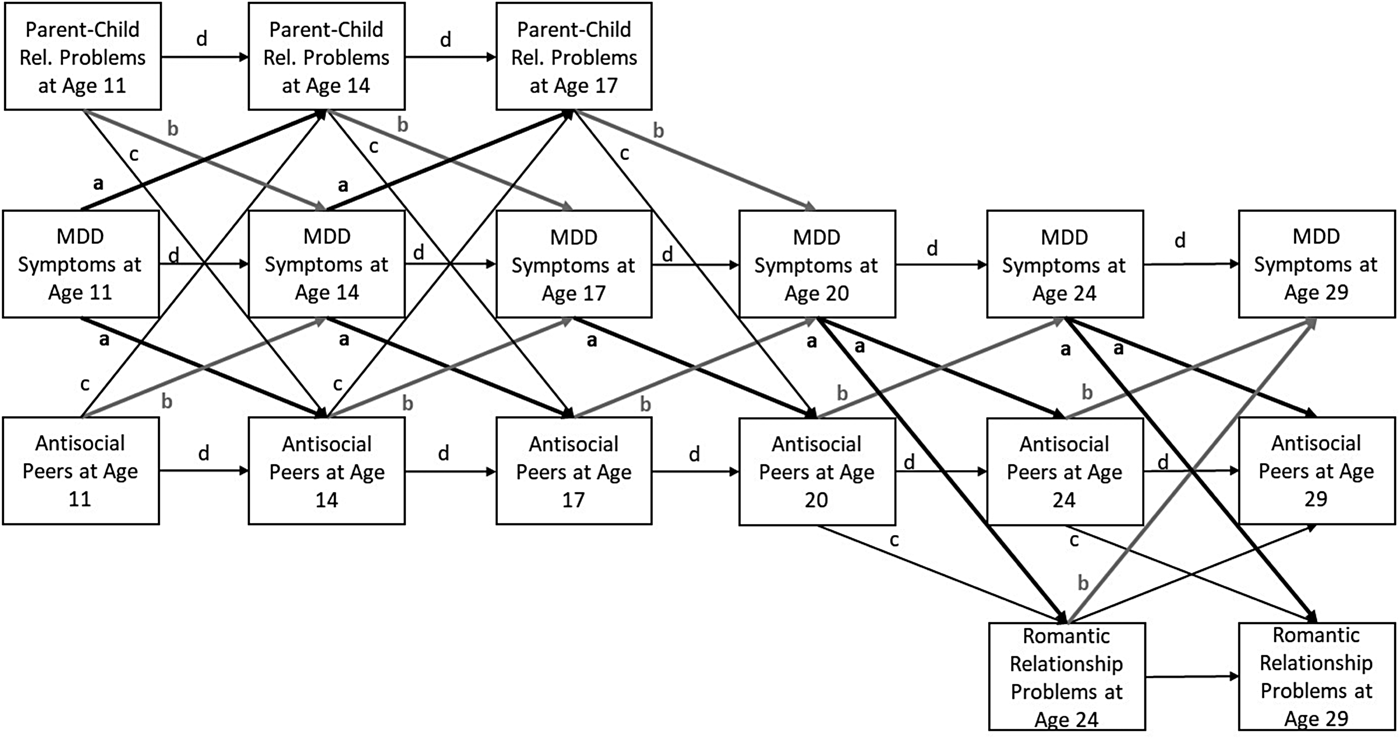
In summary, the purpose of this study was threefold. Using a developmental cascade model (see Figure 1), we first hypothesized that greater parent–child relationship problems would predict a greater degree of subsequent antisocial peer affiliation, which would then predict a greater degree of subsequent romantic partner relationship problems over time, thus supporting a developmental cascade of problematic social relationships. Second, we evaluated the prospective and potentially transactional associations between these interpersonal relationship variables as they relate to MDD symptoms over time. In general, we expected that greater depression would be associated with poorer subsequent interpersonal relationships, thus supporting consequential effects, and that poorer interpersonal relationships would be associated with greater subsequent depressive symptoms, thus supporting antecedent effects and an overall transactional model of interpersonal relationship features and MDD. Based on developmental theory (Scarr & McCartney, Reference Scarr and McCartney1983), we also hypothesized that features of problematic relationships as an antecedent of MDD symptoms would be more important earlier in development and features of problematic relationships as a consequence of MDD symptoms in later development. Third, we evaluated gender differences in the overall developmental cascade model. Based on limited prior research (Rose & Rudolph, Reference Rose and Rudolph2006; Rudolph et al., Reference Rudolph, Flynn, Abaied, Abela and Hankin2008), we tentatively expected features of problematic relationships as an antecedent of MDD symptoms would be more relevant for females, in comparison to males, across each developmental transition.
Conceptual model depicting the proposed developmental cascade of major depressive disorder (MDD) symptoms in the context of interpersonal relationships from early adolescence through young adulthood. Antecedent and consequential effects were examined by evaluating cross-paths: consequential effects refer to the effects of MDD symptoms on subsequent social relationships (shown in bolded black, labeled a) and antecedent effects refer to the effects of social relationships on subsequent MDD symptoms (shown in bolded gray, labeled b). The developmental cascade of problematic relationships are also modeled (labeled c), which included the paths from parent–child relationship problems at ages 11, 14, and 17 in relation to antisocial peer affiliation at ages 14, 17, and 20, as well as the paths from antisocial peer affiliation at ages 20 and 24 in relation to romantic relationship problems at ages 24 and 29. Stability paths are also shown (labeled d). Modeling included within-assessment correlations but are not shown here for clarity of presentation.

Methods
Participants
Data from the Minnesota Twin Family Study (MTFS) were used (Iacono, Carlson, Taylor, Elkins, & McGue, Reference Iacono, Carlson, Taylor, Elkins and McGue1999). The MTFS is a longitudinal, cohort-sequential twin sample that was designed to evaluate the genetic and environmental influences on substance use disorders and related psychopathology. Two cohorts of twins, a younger cohort (assessed first at age 11) and an older cohort (assessed first at age 17) were sampled, with overlapping assessments at ages 17, 20, 24, and 29. The younger cohort provides data from assessments at the target ages of 11, 14, 17, 20, 24, and 29. This younger cohort was evaluated for this study in connection to study goals, including to get a better understanding of how early parent–child and peer factors (i.e., at ages 11, 14, and 17) are prospectively associated with later adolescent and young adult romantic relationship quality and MDD in young adulthood (i.e., at ages 20, 24, and 29).
The younger cohort included 1,517 male and female participants (from 756 sets of twins, including 3 triplets) born between 1977 and 1984 and identified via public birth records. They and their families were recruited when the twins were 11 years old. About 90% of families were successfully located, and 83% of those eligible and located families agreed to participate. To be eligible, families had to live within a day's drive of the lab. Twins were excluded if they had a mental or physical handicap that prevented them from being able to complete the assessments. Half of the sample was female (50.2%), and the majority was Caucasian (96%), consistent with the demographics of the state from the twins’ birth years (U.S. Census Bureau, 2000). Although there was a lack of diversity in race/ethnicity, there was ample diversity in socioeconomic status in the MTFS sample. For example, the highest education for most parents was a high school diploma or equivalent (62%–63% of the mothers and fathers), with 25%–29% of mothers and fathers obtaining a bachelor's degree or higher. The median income was $50,000 to $60,000 with about a quarter of families earning less than $35,000 and another quarter earning over $60,000. Of note, the MTFS sample had high retention rates: 92.9% completed the first follow-up assessment (at age 14), 87.3% completed the second follow-up assessment (at age 17), 88.3% completed the third follow-up assessment (at age 20), 87.8% completed the fourth follow-up assessment (at age 24), and 87.5% completed the fifth follow-up assessment (at age 29). There were no significant differences in those that participated versus did not participate in follow-up assessments by baseline number of MDD symptoms (at age 11). There were also no significant differences in those that participated versus did not participate at follow-up assessments by gender, with two exceptions. At ages 20 and 24, females were slightly more likely to participate than males (age 20: 92.7% of eligible females vs. 83.8% of eligible males; age 24: 89.8% of eligible females vs. 85.6% of eligible males).
It is important to point out that in addition to the twin design component of the MTFS, it is also by design a community sample and therefore can also be used to evaluate basic epidemiology and the development of MDD symptoms in the context of close relationships. Major strengths of the MTFS include the large sample size; the use of clinical, diagnostic interviews to identify symptoms of MDD; multiple reporters (parent, child, and teacher); and in-depth measurement of several different types of interpersonal relationship factors assessed prospectively from preadolescence (age 11) through later young adulthood (age 29).
Procedures
Procedures were approved by the University of Minnesota Institutional Review Board. Written informed consent was provided by participants and parents for those age 18 and older (children under age 18 also provided written assent). A variety of measures were used at each assessment, including self-, parent-, and teacher-report questionnaires and structured clinical diagnostic interviews conducted with participants and their parents (separately). Typically, participants were scheduled for in-person follow-up visits, with phone interviews scheduled if an in-person interview could not be conducted (for 8%–21% of the sample across follow-up assessments).
Measures
MDD symptoms
MDD symptoms were examined at all assessments (ages 11, 14, 17, 20, 24, and 29). For the baseline and first follow-up assessment (ages 11 and 14), the Diagnostic Interview for Children and Adolescents (Reich, Reference Reich2000; Welner, Reich, Herjanic, Jung, & Amado, Reference Welner, Reich, Herjanic, Jung and Amado1987) was used to assess MDD symptoms. Separate interviews were conducted with children and parents concerning the children's MDD symptoms. Consistent with MTFS protocols, a “best-estimate” of both child and parent report was used so that each symptom was assigned if either the parent or the child endorsed the symptom (see Iacono et al., Reference Iacono, Carlson, Taylor, Elkins and McGue1999, for further detail on best-estimate procedures). For subsequent assessments (ages 17, 20, 24, and 29), the Structured Clinical Interview for DSM-III-R and IV (Spitzer, Williams, Gibbon, & First, Reference Spitzer, Williams, Gibbon and First1992) was used to assess MDD symptoms for the target participants. Postinterview(s), each symptom was assigned based on consensus from two individuals with advanced clinical training (who were supervised by a doctoral-level clinical psychologist). MDD symptoms were only assigned if initial gateway criteria were met (i.e., they must have met criteria for depressed mood or loss of interest or pleasure [i.e., anhedonia] for most of the day, for at least most of the days, for 2 weeks). Kappa coefficients indexing diagnostic reliability of MDD symptoms = .84.
Parent–child relationship problems
The 50-item Parent Environment Questionnaire (PEQ; Elkins, McGue, & Iacono, Reference Elkins, McGue and Iacono1997) was used to examine parent–child relationship quality at ages 11, 14, and 17 (the PEQ was not assessed after age 17 in the MTFS). Each item was rated on a 4-point scale (4 = definitely false, 3 = probably false, 2 = probably true, and 1 = definitely true). Four scales from the PEQ were used, including conflict with parent, involvement with parent, child's regard for parent, and parent's regard for child. Both parent and child report were assessed at ages 11, 14, and 17. Examples of parent and child items for the conflict scale include “My child and I often get into arguments” and “My parent often criticizes me.” Example items for the involvement scale include “My child shares their concerns and his/her experiences with me” and “My parent comforts me when I am discouraged or have had a disappointment.” Example items for the regard for parent scale include “I am really proud of my parent” and “My child respects me.” Example items for the regard for child scale include “I know my parent loves me” and “I love my child no matter what they do.” Alphas for child report ranged from 0.83 to 0.90 across all scales and all assessment periods; α for parent report ranged from 0.85 to 0.89 across all scales and assessment periods. At each time point in which the PEQ was assessed (ages 11, 14, and 17), the scales from both the parent and the child were summed then averaged to create a total score for parent–child relationships problems (parent report referred to the parent who accompanied the child to the assessment, which was predominately the mother). The last three scales were reverse scored so that the total aggregate score represents parent–child relationship problems (the higher the score, the more problems). Parent and child report summed scales were significantly correlated at each assessment (rs ranged from .27 to .42 across time).
Antisocial peer affiliation
The 19-item Friends Inventory (Samek, Goodman, et al., Reference Samek, Goodman, Erath, McGue and Iacono2016; Walden, McGue, Burt, Iacono, & Elkins, Reference Walden, McGue, Burt, Iacono and Elkins2004) was used to assess antisocial peer affiliation at all assessments (ages 11, 14, 17, 20, 24, and 29), with the exception that males were not given this self-report survey at age 11. This survey asks participants to answer a series of questions about their friends on a scale of 1 = all of my friends are like that to 4 = none of my friends are like that. The antisocial peer affiliation scale was created using a summed score across all items in the scale (e.g., “break the rules” or “get into trouble with police”), after reverse scoring so that a higher score indicated a greater degree of antisocial peer affiliation. A total of 7 to 9 items were used to assess self-reported antisocial peer affiliation across assessments; items were dropped, added, or adapted based on developmental relevance (measurement details have been discussed at length in Samek, Goodman, et al., Reference Samek, Goodman, Erath, McGue and Iacono2016). Alphas for self-reported antisocial peer affiliation ranged from 0.80 to 0.88 across assessment periods.
In addition, teacher reports of peer group affiliations from the Teacher Rating Form, adapted from the Conners Teacher Rating Scale (Conners, Reference Conners1969) and the Rutter Child Scale (Rutter, Reference Rutter1967) were available at ages 11, 14, and 17 for both males and females. Adolescents nominated up to three teachers, and those teachers rated how characteristic behaviors were for the student on a scale from 1 (lowest 5% of students in his/her class) to 5 (highest 5% of students in his/her class). Five items (e.g., “drug/alcohol using” and “rebellious”) were coded so that a higher score indicated greater antisocial peer affiliation; α ranged from 0.74 to 0.92 across assessment periods). Intraclass correlations of teacher ratings of antisocial peers ranged from 0.70 to 0.86 across assessments. Scales were computed for each teacher, and the average of the scales across teachers was used as the final teacher assessment of antisocial peer affiliation.
Correlations between antisocial peer affiliation scales for child and teacher report ranged from .49 to .50 at ages 14 and 17, respectively. However, at age 11, the correlation between child and teacher report was weak (r = .09, p = .04). This correlation was likely underpowered in comparison to the correlations at ages 14 and 17, as males were not given the self-report assessment of antisocial peers at age 11. We double-checked that interrater agreement was consistent by gender for child and teacher report at age 14 (boys r = .49, girls r = .45) and at age 17 (boys r = .52, girls r = .44; all ps < .001), and it was. In order to maximize the data we had for males at age 11 and to follow what was done for antisocial peer affiliation at ages 14 and 17, we still elected to use the average of self-report and teacher report despite the low interrater agreement. We did evaluate results for the whole sample using just child-reported antisocial peer affiliation versus just teacher-reported antisocial peer affiliation at age 11 and found generally a similar pattern of results (see online-only Supplementary Materials, Figures S.1–S.2), suggesting our approach was adequate and retained maximal power.
Romantic partner relationship problems
The MTFS assessed romantic relationship problems for the first time at age 24 and then again at age 29 using the shortened 12-item version (see South, Krueger, Elkins, Iacono, & McGue, Reference South, Krueger, Elkins, Iacono and McGue2016) of the Dyadic Adjustment Scale (Spanier, Reference Spanier1976). Five items examined agreement versus disagreement (e.g., “philosophy of life” and “demonstrations of affection” with answers ranging from 1 = always disagree to 6 = always agree); 3 items examined frequency of discord (e.g., “how often do you discuss or have you considered divorce, separation, or terminating your relationship?” ranging from 1 = never to 6 = all of the time); 3 items examined dyadic cohesion (e.g., “have stimulating exchange of ideas” ranging from 1 = more often to 11 = never); and the last item rated overall happiness (ranging from 1 = perfect to 7 = extremely unhappy). This scale was only completed by participants who reported on a romantic relationship (N = 1,127 or 74% of the original sample by age 29; n = 519 for males and n = 608 for females). All 12 items were standardized and summed to create an overall romantic relationship problems score after reverse coding all but dyadic discord items (i.e., higher scores indicated higher romantic relationship problems). Alphas were 0.77 at age 24 and 0.83 at age 29.
Analytic plan
All analyses described were conducted using Mplus 7.2 (Muthén & Muthén, Reference Muthén and Muthén1998–2018). The robust standard errors estimator was used and the CLUSTER specification was used to account for nonindependence (i.e., “twinness”) of cases. MDD symptom counts were log-transformed to better approximate normality prior to analysis. In addition, full information maximum likelihood was used to account for missing data, which was minimal for this study. For example, less than 1% to 13% of MDD symptom data were missing across assessments (due to either missing the assessment or failure to complete the structured clinical interview). Less than 2% of data were missing for the composite parent–child problematic relationship measure at age 11, with minimal missing data at age 14 (8%) and age 17 (13%). There was somewhat more missing data for the antisocial affiliation to peers measure (ranging from 15% at age 29 to 23% at age 11) and romantic partner relationship problems (ranging from 12% to 26% from ages 29 and 24, respectively), due to missing the assessment or failure to complete the measure (e.g., not having a romantic partner at age 24). Missing data were well within the 10% minimum covariance coverage necessary to use full information maximum likelihood, which has been shown to be optimal in treating missing values (Enders & Bandalos, Reference Enders and Bandalos2001; Johnson & Young, Reference Johnson and Young2011).
To examine the prospective associations between parent–child relationship quality, antisocial peer affiliation, romantic relationship quality, and MDD symptoms, we tested a developmental cascade model (see Masten & Cicchetti, Reference Masten and Cicchetti2010). Analyses for these models were restricted to those who had reported on their relationship with their romantic partner by age 29 (N = 1,127; 74% of the total sample). As shown in Figure 1, after accounting for the stability of traits over time and within-assessment residual correlations, we evaluated the extent to which earlier parent–child relationships problems predicted subsequent rank-order change in antisocial peer affiliation and romantic relationship problems (i.e., the developmental cascade of problematic social relationships hypothesis), as well as whether parent–child, peer, and romantic relationship problems predicted subsequent rank-order change in MDD symptoms (i.e., the antecedent hypothesis), and whether MDD symptoms predicted subsequent rank-order change in parent–child, peer, and romantic relationship problems (i.e., the consequential hypothesis).
To explore for gender differences, we first tested the full developmental cascade model separately for males versus females. We tested for significant differences in each path by gender by constraining each path in the full model to be equivalent across gender and using the Satorra–Bentler chi-square difference test (ΔSB χ2) to determine if constraining that path resulted in a significant decrement of model fit. Model fit statistics were examined, including the chi-square (χ2) statistic, root mean square error of approximation (RMSEA), comparative fit index (CFI), Tucker–Lewis index (TLI), and standardized root means square residual (SRMR). Adequate model fit is indicated by RMSEA < .05, CFI > .90, TLI > .90, and SRMR < .08 (Kenny, Reference Kenny2015; Kline, Reference Kline2005).
Results
Preliminary analyses
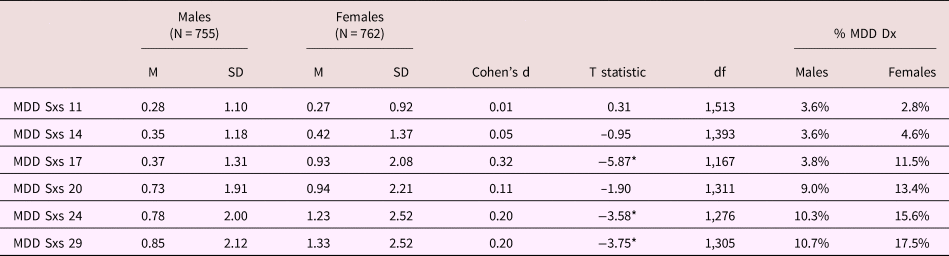
Table 1 shows descriptive statistics for average MDD symptom counts by gender. As expected in a community sample, MDD symptom counts were typically low, with average symptom counts ranging from <1 to 1.33 symptoms (see Table 1). Consistent with prior estimates (National Institute of Mental Health, 2015a), females had significantly greater average MDD symptoms than males at ages 17, 20, and 29 (Cohen's d ranged from 0.20 to 0.32), though not at ages 11 (p = .76, Cohen's d = 0.01), 14 (p = .34, Cohen's d = 0.05), or 24 (p = .06, Cohen's d = .011). However, meeting criteria for a MDD diagnosis (as shown by the percentage of participants at each age) was also quite rare at ages 11 and 14 and became more common by age 17, particularly for females (see Table 1 for details).
Descriptive statistics for major depressive disorder (MDD) symptoms by gender (N = 1,517)
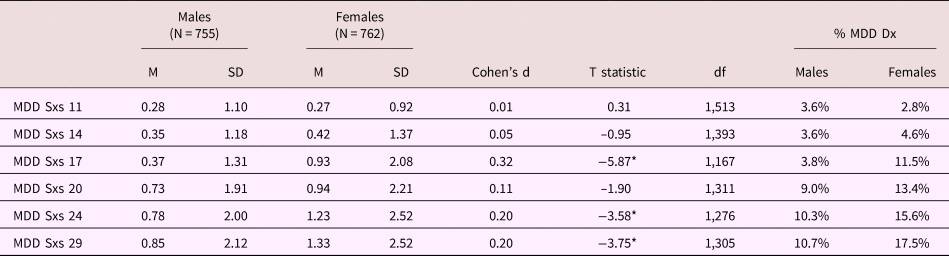
Note: MDD Sxs, major depressive disorder symptom count (range 0 to 9; raw data). Cohen's d and t statistic refer to the magnitude of the effect and significant difference in average symptom counts for males versus females. % MDD dx refers to the percentage of males and females who met a probable or definite MDD diagnosis since the last assessment. Statistical significance is denoted by *p < .001.
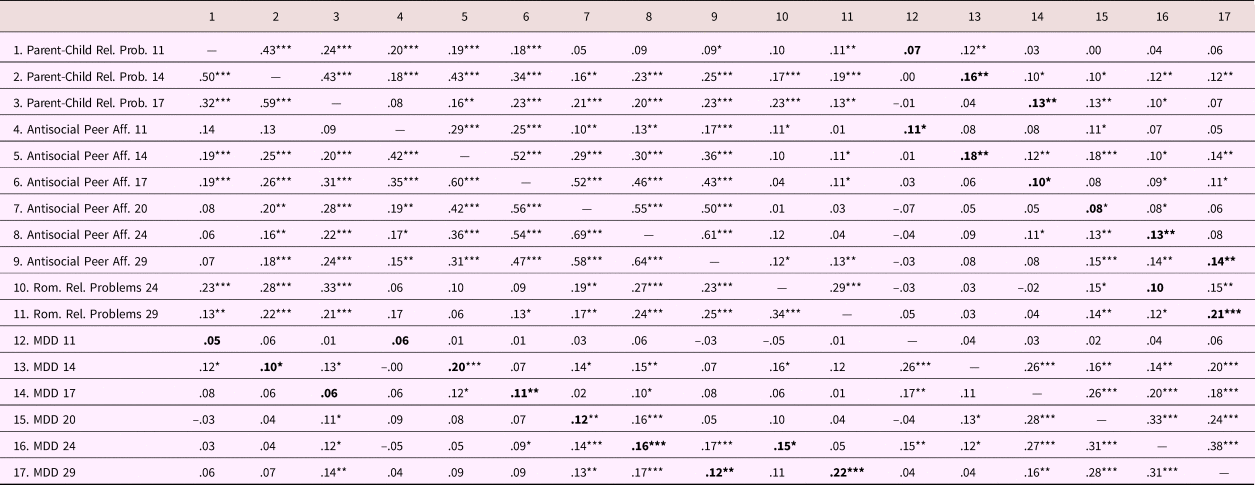
Table 2 shows correlations among study variables. Generally, problems in each of the relationship domains (parents, peers, and romantic partners) and MDD symptoms were significantly correlated. As a preliminary evaluation of our hypotheses about gender differences, we evaluated the magnitude of the within-assessment correlations between interpersonal relationship variables (i.e., parent–child relationship problems, antisocial peer affiliation, and romantic partner relationship quality) in relation to MDD symptoms at each time point and whether they significantly differed by gender. All within-time correlations (between interpersonal relationship features and MDD symptoms) were similar in magnitude and direction of effect for males and females, and accordingly, were not significantly different by gender at p < .05 (see Table 2, bolded coefficients for details). This provides preliminary evidence that there may not be significant gender differences in these associations over time.
Correlations among study variables for males (N = 755; shown below the diagonal) and females (N = 762; shown above the diagonal)
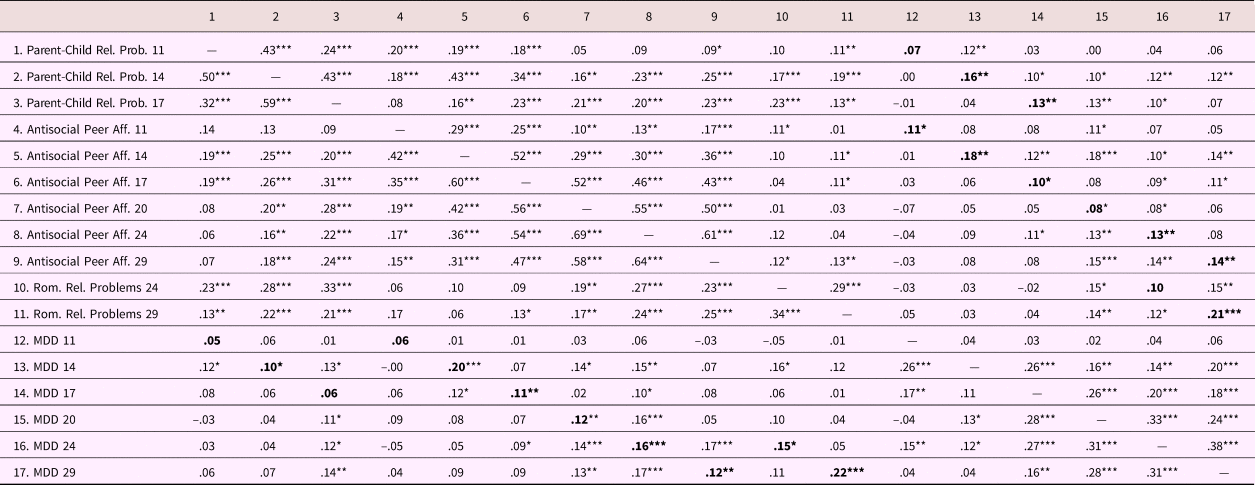
Note: Parent-Child Rel. Prob, parent–child relationship problems. Antisocial Peer Aff., antisocial peer affiliation. Rom. Rel. Problems, romantic relationship problems. MDD, major depressive disorder symptom count. This table shows correlations by gender (correlations for males are below the diagonal and correlations for females above the diagonal). MDD symptoms were log-transformed prior to correlation and multivariate analyses. Bolded correlations refer to within-in time correlations between interpersonal relationship domains and MDD symptoms (at ages 11, 14, 17, 20, 24, and 29). None of the within-time correlations were significantly different by gender (p < .05), as tested by constraining covariances to be equivalent across gender and testing for significant decrement in model fit between free and constrained models using the Satorra–Bentler chi-square difference test. Statistical significance of each correlation is denoted by *p < .05, **p < .01, ***p < .001.
Developmental cascade model: Results
Table 3 shows all unstandardized coefficients associated with each path by gender, as well as whether constraining each path to be equivalent across gender resulted in a significant decrement of model fit. Contrary to expectations, and consistent with correlations, results showed that there were no significant differences by gender in any of the cross-paths from the developmental cascade model at p < .05. The only significant differences corresponded to stability paths. None of these gender differences in stability paths reached statistical significance when correcting the α for multiple testing by gender (α = 0.05/55 paths tested [13 stability tests + 26 cross-paths + 16 residual correlations]), as a Bonferroni correction would require p < .0009. The only exception concerned the stability path of antisocial peer affiliation from ages 14 to 17, which was significantly more stable for males than females.
Results for males versus females for the developmental cascade model evaluating MDD symptoms in the context of interpersonal relationships (N = 1,127)

Note: Parent-Child Rel. Prob, parent–child relationship problems. Antisocial Peer Aff., antisocial peer affiliation. Rom. Rel. Problems, romantic relationship problems. MDD, log-transformed major depressive disorder symptom count. Shown are unstandardized coefficients (standard errors) for associated stability and cross-paths. Model fit statistics for this model that allowed all paths to vary by gender were as follows: χ2 (162) = 386.85, p < .001; RMSEA = .05, p = .53; CFI = .91; TLI = .85; SRMR = .07 (standardized coefficients are presented in Figure 2). Significant differences in unstandardized coefficients for corresponding paths by gender were tested by constraining each path to be equivalent and using the Satorra–Bentler chi-square difference test (ΔSB χ2 on 1 df) to test for significant decrement in fit between the free and constrained models. Results showed no statistically significant differences in any of the cross-paths by gender at p < .05. The only significant differences found concerned stability paths, and none of these differences reached statistical significance when correcting the α for multiple testing by gender (0.05/55 paths tested [13 stability tests + 26 cross-paths + 16 residual correlations]) would require p < .0009, except for the path Antisocial Peer Aff. 14 → Antisocial Peer Aff. 17 (see row 5), which was significantly more stable for males than for females. Statistical significance is denoted by *p < .05, **p < .01, ***p < .001. Coefficients that are not significantly different zero are also indicated in gray.
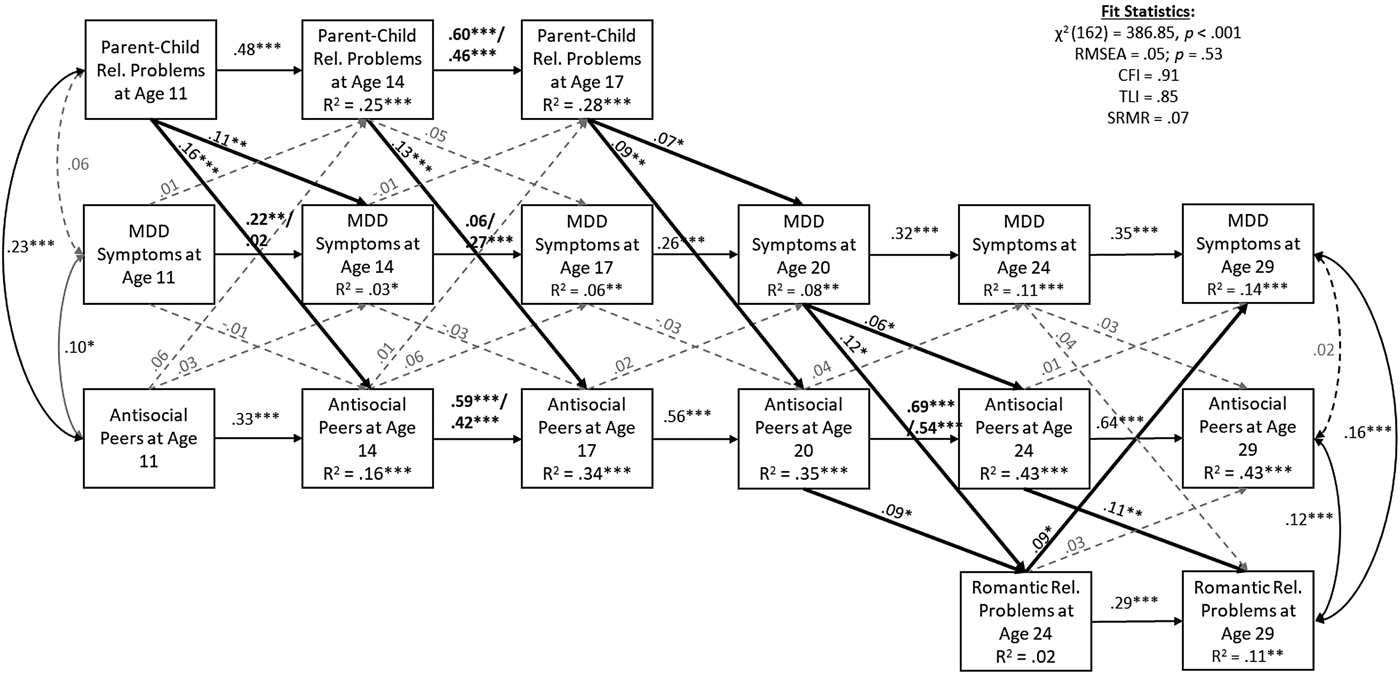
Figure 2 illustrates the full developmental cascade model results in standardized coefficients and any differences in stability paths by gender at p < .05. Results showed support for significant antecedent effects, such that greater parent–child relationship problems at age 11 significantly predicted subsequent MDD symptoms at age 14, with a small effect size (β = .11, p = .003). Similar antecedent effects were demonstrated later on, as parent–child relationship problems at age 17 significantly predicted subsequent MDD symptoms at age 20, with a small effect size (β = .07, p = .04), and romantic relationship problems at age 24 was a significant but small in effect size antecedent of MDD symptoms at age 29 (β = .09, p = .04). There was some evidence for consequential effects later in development, as greater MDD symptoms at age 20 predicted small but significant rank-order increases in antisocial peer affiliation and romantic relationship problems at age 24 (βs ranged from .06 to .12, ps ≤ .01).
Developmental cascade model evaluating major depressive disorder (MDD) symptoms in the context of interpersonal relationships from early adolescence through young adulthood (N = 1,127). This figure shows standardized coefficients from the full developmental cascade model for males and females involved in a romantic relationship by age 29 (unstandardized coefficients are shown in Table 2). Model fit statistics shown above refer to those from the model that allow all paths to vary by gender. Coefficients that were not significantly different by gender were replaced with standardized coefficients from the model that evaluated for results for the entire sample: fit statistics for that model, χ2 (81) = 323.78, p < .001; RMSEA = .05, p = .32; CFI = .91; TLI = .85; SRMR = .06; R 2 shown also refer to those from the model using the entire sample. There were no significant differences in any cross-paths at p < .05; the only significant difference by gender were found for stability paths (results that significantly varied by gender are shown in bold, results shown before the slash are those for males and after the slash are those for females). None of these gender differences reached statistical significance when correcting the α for multiple testing by gender (0.05/55 paths tested [13 stability tests + 26 cross-paths + 16 residual correlations]), as a Bonferroni correction would require p < .0009. The only exception concerned except for the stability path of Antisocial Peer Aff. 14 → Antisocial Peer Aff. 17, which was significantly more stable for males than for females. Residual correlations are included at each time point but are not shown at ages 14, 17, 20, and 24 for clarity of presentation. At age 14, the residual correlation between parent–child relationship problems and MDD symptoms was not significant (r = .09, p = .05), but the correlation between parent–child relationship problems and antisocial peer affiliation was (r = .28, p < .001), as was the correlation between MDD symptoms and antisocial peer affiliation (r = .17, p < .001). At age 17, the residual correlation between parent–child relationship problems and MDD symptoms was not significant (r = .03, p = .37), neither was the residual correlation between MDD symptoms and antisocial peer affiliation (r = .01, p = .69). However, the residual correlation between parent–child relationship problems and antisocial peer affiliation at age 17 was significant (r = .18, p < .001). At age 20, the residual correlation between MDD symptoms and antisocial peer affiliation was not significantly different than zero (r = .06, p = .10). At age 24, the residual correlation between MDD symptoms and antisocial peer affiliation was not significant (r = .07, p = .05) nor was the residual correlation between MDD symptoms and romantic relationship problems (r = .07, p = .11). The residual correlation between antisocial peer affiliation and romantic relationship problems at age 24 was significant (r = .17, p < .001). For clarity, paths that are not significantly different from zero (p > .05) are dashed and shown in gray. Cross-paths that are significantly differenct from zero are in bolded black. Statistical significance is denoted by *p < .05, **p < .01, ***p < .001.
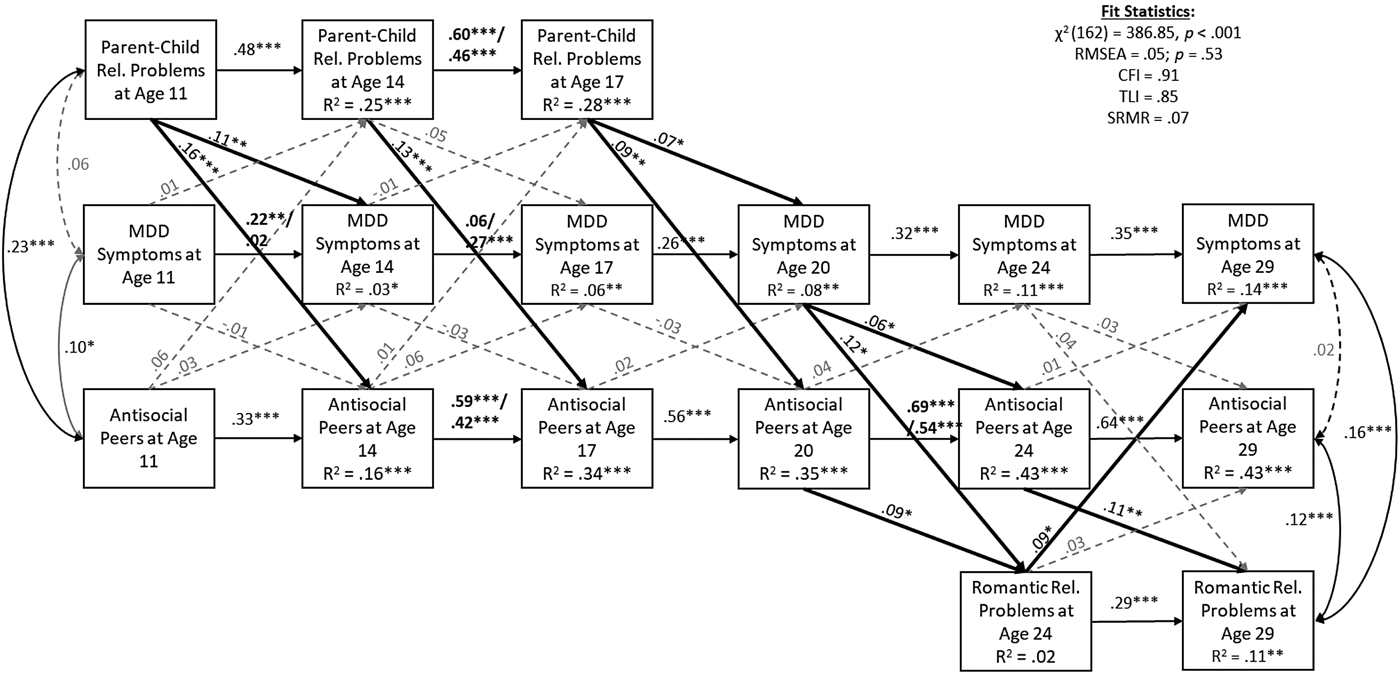
Supporting a developmental cascade of problematic social relationships hypothesis, results also showed evidence that greater parent–child relationship problems at ages 11, 14, and 17 significantly predicted greater affiliation to antisocial peers at ages 14, 17, and 20, with small effect sizes (βs ranged from .09 to .16, ps ≤ .002). Greater antisocial peer affiliation at ages 20 and 24 also predicted significant but small rank-order increases in romantic relationship problems at ages 24 and 29, respectively (βs from .09 to .11, ps ≤ .03, see Figure 2 for details).
Summary
As there were no significant differences by gender in cross-paths, results did not support our tentative hypothesis that antecedent effects would be stronger for females than males. As there was evidence of both antecedent and consequential effects across the developmental unfolding of interpersonal relationship risk and MDD symptoms, results did not support our hypothesis that antecedent effects would be stronger earlier in time and consequential effects later in time. Constraining all antecedent paths (i.e., paths predicting MDD symptoms from ages 11 to 29) and all consequential effects (i.e., paths MDD predicts) did not result in a significant decrement in model fit, ΔSB χ2 (15) = 12.22, p = .66, confirming these effects did not vary by developmental transition. Thus, there was no support for this hypothesis.
Results did support expectations about the continuity of interpersonal relationship problems, as parent–child relationship problems in early adolescence predicted subsequent antisocial peer affiliation, which predicted subsequent romantic relationship problems, and this was true for both males and females. We tested the indirect effects for parent–child relationship problems at age 17 on romantic relationship problems at age 24 via antisocial peer affiliation at age 20, however, and likely given the small effect size of the direct effects, this indirect effect was not significant (β = .008, SE = .005, p = .12). In contrast, the indirect effect for parent–child relationship problems at age 17 on romantic relationship problems at age 29 via antisocial peer affiliation at ages 20 and 24 was significant (β = .006, SE = .003, p = .04), but also quite small in effect size.
Post hoc analyses
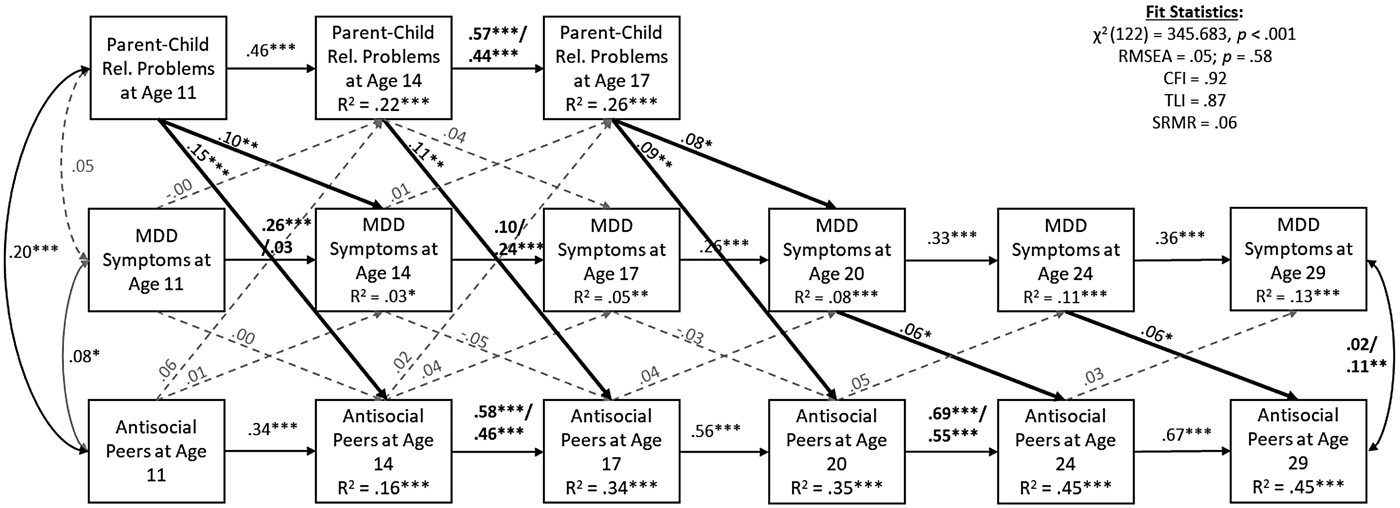
To maximize power and take advantage of the larger data set, we conducted a subsequent analysis using the entire sample to evaluate the developmental unfolding of parent–child relationship problems, antisocial peer affiliation, and MDD symptoms alone (excluding romantic relationship problems and no longer restricting the sample to those that had been in a romantic relationship by age 29). Results are shown in Figure 3. Results generally followed those for the romantic relationship restricted model in that there was evidence for a developmental cascade of problematic relationships (greater parent–child problems predicting greater subsequent affiliation to antisocial peers), and support for both significant antecedent effects (greater parent–child relationship problems predicting subsequent MDD symptoms) and significant consequential effects (MDD symptoms predicting greater subsequent affiliation to antisocial peers). Finally, we evaluated a multigroup model comparing results using the entire sample (not restricted to those in a romantic relationship and excluding romantic partner problems from the model) for those in versus not in a romantic relationship by age 29 and found no significant difference in any of the stability, cross-paths, or residual correlations (detailed table listing unstandardized coefficients and associated ΔSB χ2 statistics are provided in the online-only Supplementary Materials, Table S.2).
Developmental cascade model evaluating major depressive disorder (MDD) symptoms in the context of interpersonal relationships (excluding romantic partner relationship problems) from early adolescence through young adulthood (N = 1,517). This figure shows standardized coefficients from the full developmental cascade model for males and females (excluding the romantic relationship problem variables and criterion of having to be in a romantic relationship by 29). Unstandardized coefficients and associated chi-square difference tests for gender differences are shown in online-only Supplementary Table S.1. Model fit statistics shown above refer to those from the model that allowed all paths to differ by gender. Coefficients that were not significantly different by gender were replaced with coefficients from the model that evaluated results for the entire sample: fit statistics for that model, χ2 (61) = 303.97, p < .001; RMSEA = .05, p = .35; CFI = .92; TLI = .87; SRMR = .06; R 2 shown also refer to those from the model using the entire sample. There were no significant differences in any cross-paths at p < .05; the only significant difference by gender were found for stability paths and residual correlations (results that significantly varied by gender are shown in bold; results shown before the slash are those for males and after the slash are those for females). None of these gender differences reached statistical significance when correcting the α for multiple testing by gender (0.05/44 paths tested [12 stability tests + 20 cross-paths + 12 residual correlations]), as a Bonferroni correction would require p < .001. The only exception concerned the stability path of Antisocial Peer Aff. 14 → Antisocial Peer Aff. 17, which was significantly more stable for males than for females. Residual correlations are included at each time point but are not shown at ages 14, 17, 20, and 24 for clarity of presentation (none were significantly different across gender). At age 14, the residual correlation between parent–child relationship problems and MDD symptoms was significant (r = .09, p = .01), as was the correlation between parent–child relationship problems and antisocial peer affiliation (r = .27, p < .001), and the correlation between MDD symptoms and antisocial peer affiliation (r = .17, p < .001. There was also one significant gender difference in age 14 residual correlations; chi-square difference testing results showed a significantly greater residual correlation between parent–child relationship problems and antisocial peer affiliation for females (r = .38, p < .001) than for males (r = .18, p = .001); ΔSB χ2 (1 df) = 7.17, p = .007, but that did not reach the conservative threshold of p < .001 (see above) when considering multiple testing. At age 17, the residual correlation between parent–child relationship problems and MDD symptoms was not significant (r = .04, p = .28), nor was the residual correlation between MDD symptoms and antisocial peer affiliation (r = .02, p = .40). However, the residual correlation between parent–child relationship problems and antisocial peer affiliation at age 17 was significant (r = .19, p < .001). At age 20, the residual correlation between MDD symptoms and antisocial peer affiliation was significant (r = .07, p = .02). At age 24, the residual correlation between MDD symptoms and antisocial peer affiliation was not significant from zero (r = .05, p = .10). These results appear to support our hypothesis of more antecedent than consequence effects earlier in time and greater consequence than antecedent effects later in time, but constraining these cross-paths (all paths leading to or following MDD symptoms) did not result in a significant decrement in model fit, ΔSB χ2 (14) = 15.93, p = .32, and thus these effects did not significantly vary across developmental transition. For clarity, paths that are not significantly different from zero (p > .05) are dashed and shown in gray. Cross-paths that are significantly differenct from zero are in bolded black. Statistical significance is denoted by *p < .05, **p < .01, ***p < .001.

Discussion
Prevalence estimates of MDD are on the rise both nationally and internationally (Greenberg et al., Reference Greenberg, Kessler, Birnbaum, Leong, Lowe, Berglund and Corey-Lisle2003, Reference Greenberg, Fournier, Sisitsky, Pike and Kessler2015; World Health Organization, 2017b), and factors contributing to the rise are imperative to understand. It is especially important to understand the development of MDD from puberty into early young adulthood as the onset of symptoms peaks during this time (American Psychological Association, 2013). Previous research has indicated that interpersonal relationship quality and associated interpersonal skills may be particularly important to the development of depression during this developmental period (Eberhart & Hammen, Reference Eberhart and Hammen2006; Rudolph et al., Reference Rudolph, Flynn, Abaied, Abela and Hankin2008), as adolescence and young adulthood are associated with heightened vulnerability for depression and other health outcomes (Garber & Rao, Reference Garber, Rao, Lewis and Rudolph2014).
Developmental cascade of relationships and depression
Results supported expectations that earlier parent, peer, and romantic partner relationship contexts subsequently predict one another across time, consistent with prior research (Garber & Rao, Reference Garber, Rao, Lewis and Rudolph2014; Rubin, Bukowski, & Laursen, Reference Rubin, Bukowski and Laursen2011). Specifically, it was expected that more problematic parent–child relationships would be related to greater subsequent antisocial peer affiliation, which would then be positively related to subsequent increased romantic partner problems. Results supported this pattern for both males and females, in line with previous findings (Parker, Rubin, Erath, Wojslawowicz, & Buskirk, Reference Parker, Rubin, Erath, Wojslawowicz, Buskirk, Cicchetti and Cohen2006; Rhule-Louie & McMahon, Reference Rhule-Louie and McMahon2007). Thus, relationship problems in one interpersonal domain do appear to influence the development of problems in other domains, in line with attachment theory (Agerup, Lydersen, Wallander, & Sund, Reference Agerup, Lydersen, Wallander and Sund2015; Simpson et al., Reference Simpson, Collins, Tran and Haydon2007; Sroufe et al., Reference Sroufe, Carlson, Levy and Egeland1999) and interpersonal theories of depression (Joiner, Brown, & Kistner, Reference Joiner, Brown and Kistner2006; Joiner & Coyne, Reference Joiner and Coyne1999). As results from this study show problematic relationships with parents at age 11 appear to influence problematic relationships with peers and romantic partners later on in adulthood, intervention and prevention efforts aimed at strengthening the parent–child bond at age 11 (or earlier) are advised.
Antecedent versus consequence
From the framework of interpersonal theories of depression (Joiner et al., Reference Joiner, Brown and Kistner2006; Joiner & Coyne, Reference Joiner and Coyne1999; Rudolph et al., Reference Rudolph, Flynn, Abaied, Abela and Hankin2008), it was expected that depressive symptoms may be either an antecedent or a consequence of problems in close relationships (Eberhart & Hammen, Reference Eberhart and Hammen2006; Lin et al., Reference Lin, Dean and Ensel1986; Rudolph et al., Reference Rudolph, Flynn, Abaied, Abela and Hankin2008; Vanderhorst & McLaren, Reference Vanderhorst and McLaren2005). Whether poor interpersonal relationships are an antecedent or a consequence of depressive symptoms was expected to vary across time, following Scarr and McCartney's (Reference Scarr and McCartney1983) developmental theory of gene–environment correlation. We expected that consequential effects (i.e., how earlier MDD symptoms predict subsequent interpersonal relationship risk) would become more salient as children and adolescents get older, but that antecedent effects (i.e., how earlier interpersonal relationship risk predicts subsequent MDD symptoms) would be more relevant earlier in time. We also tentatively hypothesized that antecedent pathways may be more relevant to females than males across development (Hankin et al., Reference Hankin, Young, Abela, Smolen, Jenness, Gulley and Oppenheimer2015; Rose & Rudolph, Reference Rose and Rudolph2006; Rudolph et al., Reference Rudolph, Flynn, Abaied, Abela and Hankin2008).
Contrary to expectations, results indicated that there were important consequential and antecedent effects from early adolescence through young adulthood, and that this was true for both males and females. That is, earlier parent–child relationship problems predicted subsequent rank-order increases in MDD symptoms from ages 11 to 14 and from ages 17 to 20. However, MDD symptoms did not predict subsequent rank-order increases in parent–child relationship problems in this same time frame, following results by Samek, Wilson, et al. (Reference Samek, Wilson, McGue and Iacono2016). There was also support for consequential effects later in development, in that MDD symptoms at age 20 predicted subsequent rank-order increases in antisocial peer affiliation and romantic relationship problems at age 24. Romantic relationship problems at age 24 also predicted rank-order increases in MDD symptoms at age 29, indicating important antecedent effects later in time. Given the findings of both antecedent and consequential effects of close relationships and MDD across development, results support the notion that efforts to prevent or treat depression should aim to strengthen social support networks. Such efforts may not only offset risk for depression but also could educate those suffering from depression on how their close relationships may be impacting their health. Thus, effective prevention and intervention efforts should focus not only on the symptoms but also the social context of depression and earlier social relationship history.
Nonetheless, the effect sizes for these prospective associations were generally small. Such findings may not replicate when evaluating other aspects of interpersonal relationships, including interpersonal relationship stress or a more severe measures such as victimization or abuse, as well as parent, peer, and romantic partner's level of depression or corumination. In addition, the interplay between individual differences and social context may need to be accounted for to better understand any cascading effects. Future research should examine how interpersonal relationship features work together with individual difference factors (e.g., genetics and personality traits related to negative emotionality) to influence the development of MDD in adolescence and young adulthood (Garber & Rao, Reference Garber, Rao, Lewis and Rudolph2014; Shahar, Joiner, Zuroff, & Blatt, Reference Shahar, Joiner, Zuroff and Blatt2004).
Gender differences in interpersonal relationships and depression
In line with previous findings (National Institute of Mental Health, 2015a, 2015b), females had significantly more depressive symptoms than did males from late adolescence into young adulthood. The nature of the effect size seems largest in late adolescence, which is similar to previous estimates that suggest a larger gender gap in adolescence than in young adulthood (Crane, Langenecker, & Mermelstein, Reference Crane, Langenecker and Mermelstein2015; Hankin et al., Reference Hankin, Abramson, Moffitt, Silva, McGee and Angell1998; National Institute of Mental Health; 2015a, 2015b). Others have found that females also had significantly more depressive symptoms than males in earlier adolescence (Hankin et al., Reference Hankin, Young, Abela, Smolen, Jenness, Gulley and Oppenheimer2015; Piccinelli & Wilkinson, Reference Piccinelli and Wilkinson2000). Though this was not found at earlier ages in this study, which employs a community (rather than clinical) sample, MDD was quite rare in general at these ages in general, so it was not surprising that no gender differences emerged. Though rates of MDD symptoms were very low at ages 11 and 14 for both males and females, they increased over time in line with national statistics on depressive symptoms and gender differences (National Institute of Mental Health, 2015a). Given the small effect sizes, it was not surprising that no antecedent or consequential effects significantly differed by gender. Thus, there was no support for our exploratory hypothesis on gender (concerning antecedent effects would be greater for females than males). Perhaps with larger sample sizes or analysis of other measures of interpersonal relationship risk (e.g., stress or abuse) such effects would bear out.
Future directions
This study is not without limitations. Results should not be generalized to all racial and ethnic groups, as the sample is almost entirely White, being representative of the state from which it was sampled, and prior research has demonstrated prevalence estimates in MDD differ by race and ethnicity (e.g., Riolo, Nguyen, Greden, & King, Reference Riolo, Nguuyen, Greden and King2005). In addition, as this was a community sample, it is unclear how results would generalize to a clinical or higher risk population. The study also used a twin design, and it is important to replicate findings in nontwin samples, although we would expect a similar pattern of findings given twins are representative of the general population in terms of mental health outcomes and intelligence (Barnes & Boutwell, Reference Barnes and Boutwell2013; Postuma, De Geus, Bleichrodt, & Boomsma, Reference Posthuma, De Geus, Bleichrodt and Boomsma2000; Pulkkinen, Vaalamo, Hietala, Kaprio, & Rose, Reference Pulkkinen, Vaalamo, Hietala, Kaprio and Rose2003). Although multiple reporters were available at the earlier assessments (e.g., parent and teacher report in adolescence), multiple reporters were not available at the later assessments (e.g., for romantic partners or peers in young adulthood), and it would be ideal to incorporate multiple reporters across the time span. We were unable also to evaluate romantic partner effects earlier in adolescence as this data was not collected until age 24. It will be important for future research to better address this, as we know that romantic partners have been shown to influence depressive symptoms in adolescence (Connolly & McIsaac, Reference Connolly, McIsaac, Underwood and Rosen2011; La Greca, Davila, & Siegel, Reference La Greca, Davila and Siegel2008; La Greca & Harrison, Reference La Greca and Harrison2005).
Future research should also examine the interplay between interpersonal relationship features and individual development features (e.g., genetic and personality factors) in their influence on the development of MDD in adolescence and young adulthood. For example, negative emotionality is a strong risk factor for depressive symptoms (Bylsma, Morris, & Rottenberg, Reference Bylsma, Morris and Rottenberg2008; Neiss, Stevenson, Legrand, Iacono, & Sedikides; Reference Neiss, Stevenson, Legrand, Iacono and Sedikides2009; Wetter & Hankin, Reference Wetter and Hankin2009). Investigating negative emotionality in relation to interpersonal relationship risk and their interactions via a developmental cascade approach would be useful to address. This approach might also better reflect stability of vulnerability to depression risk over time given its continuous, normal distribution versus needing to meet gateway criteria for MDD symptoms to be assigned.
Despite limitations, there were numerous strengths for this study, including the longitudinal design, the large sample size, and high retention rates across assessments. The use of structured clinical interviews to assess MDD symptoms is also a strength. Multiple informants were available for several measures as well. Together, study strengths allowed study aims to be addressed successfully and showed support for both antecedent and consequential effects involving interpersonal relationship features and MDD symptoms, for both males and females.
Conclusion
Interpersonal relationships have the potential to have very nuanced effects on human development and likely work together in complex ways to influence the onset of depression, including the continual interplay between intrapersonal and interpersonal factors. Results from this study support the importance of efforts to strengthen social support networks (e.g., focus on decreasing conflict in relationships) to offset risk for, as well as potentially treat, depression during the developmental time when depressive symptoms are typically beginning to manifest and peak. Interventions such as those that target positive parent and peer support have been shown to be effective in reducing symptoms of depression (Pfeiffer, Heisler, Piette, Rogers, & Valenstein, Reference Pfeiffer, Heisler, Piette, Rogers and Valenstein2011; Solantaus, Paavonen, Toikka, & Punamäki, Reference Solantaus, Paavonen, Toikka and Punamäki2010), but it is important to understand the potential pitfalls of negative relationship qualities to effectively strengthen existing and design new interpersonal support interventions. Our results suggest that prevention and intervention efforts should focus on both the antecedent and the consequential effects of MDD, such that clinicians are working to help clients to alter negative thoughts and behaviors to improve their close relationships with others, as well as work with others together in the therapy room to address relationship-level problems like communication or trust.
Supplementary material
The supplementary material for this article can be found at https://doi.org/10.1017/S0954579418001037
Financial support
This research was supported by Grant AA09367 from the National Institute on Alcohol Abuse and Alcoholism and Grant DA05147 from the National Institute on Drug Abuse. D.R.S. was also supported by Grant AA024282 from the National Institute on Alcohol Abuse and Alcoholism and Project 1006129 from the USDA National Institute of Food and Agriculture. S.W. was also supported by Grant K01DA037280 from the National Institute on Drug Abuse. The content is solely the responsibility of the authors.