INTRODUCTION
Ilha Grande Bay, in south-east Brazil, has been intensely exposed to environmental impacts, namely soil erosion, constructed areas, oil leakage and pouring, in addition to the thermal pollution caused by the hot waters pouring from Angra I and II thermal nuclear plants located at Ribeira Bay (Costa, Reference Costa1998).
Two invasive azooxanthellate corals, Tubastraea coccinea Lesson, 1829 and Tubastraea tagusensis Wells, 1982 (Dendophyllidae), have invaded rocky reefs at Ilha Grande Bay. Fenner & Banks (Reference Fenner and Banks2004) and De Paula & Creed (Reference De Paula and Creed2004) suggested that T. coccinea has been dispersed by colonization and transport on ships' hulls and/or oil platforms. Both species caused necrosis to the near side of the native colony of Mussismilia hispida (Verrill, 1901). Dead areas were usually overgrown by sponges or crustose coralline algae and the evidence suggested that the two azooxanthellates are competitively dominant and can reduce or exclude the native coral (Creed, Reference Creed2006).
The diversity of sessile invertebrates of rocky reefs is highly dependent upon spatial association and interactions among species. Biological interactions between sessile organisms play important roles in the structure and organization of reef communities and invasive species could be an aggressive competitor for vital resources such as space (McLean & Yoshioka, Reference Mclean and Yoshioka2008).
In general, sponges are sessile invertebrates abundant in the shallow subtidal of rocky reefs and can overgrow and negatively affect corals, hydrocorals and other gorgonians. Desmapsamma anchorata Carter, 1882 is a species that affects corals and other benthic organisms (McLean & Yoshioka, Reference Mclean and Yoshioka2008). This sponge is a native species of Ilha Grande, Brazil that lives in shallow waters on vertical and horizontal rocks (Muricy & Hajdu, Reference Muricy and Hajdu2006).
MATERIALS AND METHODS
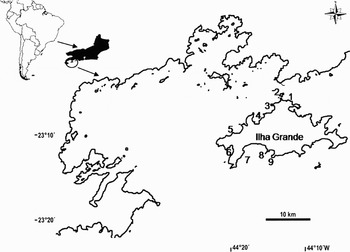
All records were made by underwater photographs taken in 2009 during a non-destructive diurnal visual censuses sampling campaign at Ilha Grande. The observations and samplings were carried out by four divers in 16 transects of 20 × 6 m (120 m2). At each transect the benthic coverage using five random quadrants (250 cm2) was quantified. During this study we sampled a total of 17,280 m2 on nine different sites in the shallow subtidal rocky reefs (1–6 m). The study sites were: (1) Japariz (23°05′S and 044°12′W); (2) Lagoa Azul (23°05′S and 044°14′W); (3) Bananal (23°06′S and 044°15′W); (4) Tapera (23°08′S and 044°17′W); (5) Araçatiba (23°09′S and 044°20′W); (6) Provetá (23°11′S and 044°20′W); (7) Aventureiro (23°11′S and 044°18′W); (8) Praia do Leste (23°11′S and 044°16′W); (9) Parnaióca (23°11′S and 044°15′W) (Figure 1).
Study sites of Ilha Grande: (1) Japariz (23°05′S and 044°12′W); (2) Lagoa Azul (23°05′S and 044°14′W); (3) Bananal (23°06′S and 044°15′W); (4) Tapera (23°08′S and 044°17′W); (5) Araçatiba (23°09′S and 044°20′W); (6) Provetá (23°11′S and 044°20′W); (7) Aventureiro (23°11′S and 044°18′W); (8) Praia do Leste (23°11′S and 044°16′W); (9) Parnaióca (23°11′S and 044°15′W).

RESULTS AND DISCUSSION
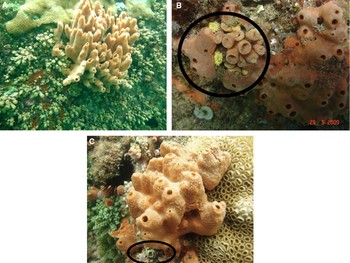
Desmapsamma anchorata was recorded overgrowing Tubastraea coccinea and T. tagusensis only at Araçatiba and Japariz. In the outer part of Ilha Grande Bay, which presents higher hydrodynamism, this sponge was not observed indicating that wave action also plays an important role in the growth and survival of Desmapsamma (see McLean & Yoshioka, Reference Mclean and Yoshioka2008).
Records of D. anchorata overgrowing and killing T. coccinea and T. tagusensis in different sites of Ilha Grande (Figure 2) showed that this native sponge could be an important competitor for the invasive corals. The sponge did not suffer any necrosis caused by invasive corals, showing an aggressive growth over polyps of T. coccinea and T. tagusensis. Carballeira & Maldonado (Reference Carballeira and Maldonado1988) have investigated various substances that may have allelochemical effects in Desmapsamma. Therefore the presence of these substances could also explain why Desmapsamma has been characterized as the most aggressive sponge species in relation to its effect and occurrence on corals (Aerts & van Soest, Reference Aerts and van Soest1997), including Tubastraea spp.
(A) The sponge Desmapsamma anchorata growing over Tubastraea tagusensis and T. coccinea on a rocky reef in Ilha Grande, RJ, Brazil; (B & C) D. anchorata growing over invasive corals and killing a polyp in detail.

ACKNOWLEDGEMENT
We would like to thank Projeto de Conservação e Pesquisa Água Viva for financing the field trip.