Introduction
There is growing evidence that plants and their extracts can be useful in various aspects of medicine and wellbeing due to their phytoconstituents substances. In the poultry industry, specialist feed ingredients are added to enhance growth performance and improve FCR (Babazadeh et al., Reference BABAZADEH, VAHDATPOUR, NIKPIRAN, JAFARGHOLIPOUR and VAHDATPOUR2011; Waseem Mirza et al., Reference WASEEM MIRZA, REHMAN and MUKHTAR2016). Since the 1990s, due to the ban on antibiotic use throughout the world, researchers have been studying on phytogenic growth promoters to attain better performance in animals. Nowadays, growth promoters derived from herbal sources are used commonly (Gong et al., Reference GONG, YIN, HOU and YIN2014; Dhama et al., Reference DHAMA, LATHEEF, MANI, ABDUL SAMAD, KARTHIK, TIWARI, KHAN, ALAGAWANY, FARAG, ALAM, LAUDADIO and TUFARELLI2015). Other benefits from plant extracts, beyond AGP replacement, are now a focus of research interest in plants and extracts such as quercetin, yacon (Smallanthussonchifolius), chicory (Cichoriumintybus), kalongi (Nigella sativa), ginger (Zingiberofficinale) and neem (Azadirachtaindica) as well as others (Saeed et al., Reference SAEED, BALOCH, WANG, SOOMRO, BALOCH, BUX, ARIAN, FARAZ and ZAKRIYA2015; Saeed et al., Reference SAEED, ABD ELHACK, ALAGAWANY, ARAIN, ARIF, MIRZA, NAVEED, CHAO, SARWAR, SAYAB and DHAMA2017a; Reference SAEED, XU, REHMAN, ARAIN, SOOMRO, ABD ELHACK, BHUTTO, ABBASI, DHAMA, SARWAR and CHAO2017b; Reference SAEED, NAVEED, ARAIN, ARIF, ABD EL-HACK, ALAGAWANY, SIYAL, SOOMRO and SUN2017c).
Milk thistle (Silybum marianum) is a native herb that belongs to the family Carduus marianum. This plant grows in Canada, North America, Mexico, China, Pakistan and Kashmir, and has reddish-purple flowers with large leaves which are usually thorny. The fruits and seeds of this herb have been investigated for various medicinal uses (Dermarderosin, Reference DERMARDEROSIN2001), the first being for its antioxidant and hepatoprotectant activities (Federico et al., Reference FEDERICO, DALLIO and LOGUERCIO2017). Since ancient times, this plant has been used as a potent medicinal tool in the treatment of diseases such as gallbladder and liver disorders and shows promising effects in protecting the liver against snake bite, as a growth promotant, immunostimulant, for symptoms of alcohol abuse, to treat insect stings and treat mushroom poisoning (Chand et al., Reference CHAND, MUHAMMAD, DURRANI, QURESHI and ULLAH2011). It is known as a natural treatment for icterus and metabolic disorders affecting the liver (Federico et al., Reference FEDERICO, DALLIO and LOGUERCIO2017). Moreover, this plant has been used as a treatment for digestive difficulties in upper gastrointestinal tract, biliary tract diseases, antituberculosis, varicose veins and menstrual disorders (Saller et al., Reference SALLER, MELZER, REICHLING, BRIGNOLI and MEIER2007; Luangchosiri et al., Reference LUANGCHOSIRI, THAKKINSTIAN, CHITPHUK, STITCHANTRAKUL, PETRAKSA and SOBHONSLIDSU2015).
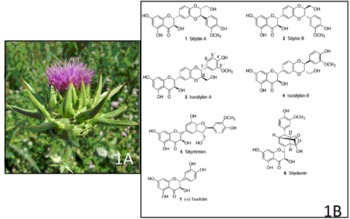
The most active component of milk thistle is silymarin that is derived from seeds and is the main active compound for hepatoprotection (Polyak et al., Reference POLYAK, FERENCI and PAWLOTSKY2013; Aller et al., Reference ALLER, IZAOLA, GOMEZ, TAFUR, GONZALEZ, BERROA, MORA, GONZALEZ and DE LUIS2015). Compounds comprise silybins A and B (known as silibinins A and B), followed by isosilybins A and B. Three other flavonolignans such as isosilychristin, silychristin, and silydianin have been isolated, in addition to the flavonoid taxifolin (Ottai and Abdel-Moniem, Reference OTTAI and ABDEL-MONIEM2006; Pferschy-Wenzig et al., Reference PFERSCHY-WENZIG, ATANASOV, MALAINER, NOHA, KUNERT, SCHUSTER, HEISS, OBERLIES, WAGNER, BAUER and DIRSCH2014) (Figure 1a, b).
The hepatoprotective activities of silymarin, such as immunomodulating, inhibiting free radicals, and restoring the function of antioxidative enzymes e.g. glutathione concentrations, decreasing oxidative stress, antifibrotic, anti-inflammatory effects and generating cell membrane stabilisation have been reported (Karimi et al., Reference KARIMI, VAHABZADEH, LARI, RASHEDINIA and MOSHIRI2011; Salomone et al., Reference SALOMONE, GODOS and ZELBER-SAGI2016). Using silymarin in the treatment of disorders of CNS, lungs, prostate, pancreas, kidneys, gallbladder, and skin have been indicated (Karimi et al., Reference KARIMI, VAHABZADEH, LARI, RASHEDINIA and MOSHIRI2011; Kazazis et al., Reference KAZAZIS, EVANGELOPOULOS, KOLLAS and VALLIANOU2014). In a feeding study, milk thistle supplemented in broiler diets significantly increased the activities of hepatic enzymes such as ALT and AST (Dumari et al., Reference DUMARI, SARIR, MAKKI and AFZALI2014). In diabetic rats, silymarin significantly reduced plasma levels of triglycerides, cholesterol, ALT and AST (Tuorkey et al., Reference TUORKEY, EL-DESOUKI and KAMEL2015). Silymarin is thought to act mainly through its anti-inflammatory and antioxidant properties and stimulates liver cell regeneration (Vargas-Mendoza et al., Reference VARGAS-MENDOZA, MADRIGAL-SANTILLÁN, MORALES-GONZÁLEZ, ESQUIVEL-SOTO, ESQUIVEL-CHIRINO, GARCIA-LUNA, GONZALEZ-RUBIO, GAYOSSO-DE-LUCIO and MORALES-GONZALEZ2014).
However, a few studies have reported that the positive effects of silymarin in animal feeding models, and more data is needed on its effects on poultry liver function. Therefore, the aim of this review is to gather the scientific literature regarding silymarin as a hepatoprotectant to overcome the liver diseases and help to replace antibiotics and overall reduce veterinary costs for poultry producers.
Chemical structures of silymarin (A) (accessed on https://pixabay.com) (Ottai and Abdel-Moniem, Reference OTTAI and ABDEL-MONIEM2006) and (B) (Pferschy-Wenzig et al., Reference PFERSCHY-WENZIG, ATANASOV, MALAINER, NOHA, KUNERT, SCHUSTER, HEISS, OBERLIES, WAGNER, BAUER and DIRSCH2014).

Biological effects of silymarin
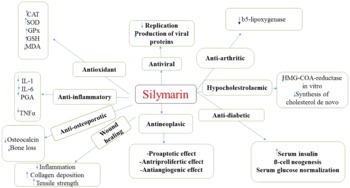
The available literature has evidenced the biological effect of silymarin on several ailments ( Figure 2 ), osteoporosis, arthritis, hypercholesterolemia, cancer, viral infections, diabetes, Alzheimer's disease and Parkinson's disease (Mohd Fozi et al., Reference MOHD FOZI, MAZLAN, SHUID and ISA2013; Kumar et al., Reference KUMAR, PARK, AWASTHI and PRASAD2015; Lee et al., Reference LEE, PARK, CHUN and LEE2015; Lani et al., Reference LANI, HASSANDARVISH, CHIAM, MOGHADDAM, CHU, RAUSALU, MERITS, HIGGS, VANLANDINGHAM, ABU BAKAR and ZANDI2015; Tuorkey et al., Reference TUORKEY, EL-DESOUKI and KAMEL2015).
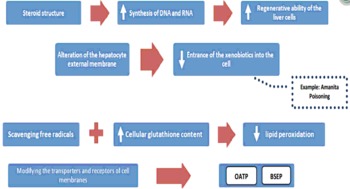
Silymarin undergoes enterohepatic circulation and moves from plasma to the bile, and is concentrated in hepatocytes ( Figure 3 ). This increases the regenerative ability of the liver cells via increasing synthesis of DNA and RNA, and as silymarin has a steroid structure; it alters the structure of the hepatocyte external membrane, that changes the entry of xenobiotics into the cell; inhibiting free radicals and elevating the cellular content of glutathione. Another mechanism of silymarin is by modifying receptors and transporters in cell membranes, such as ABC transporters (P-gp), bile salt export pumps, organic anion uptake transporter peptides (OATP) and TNF-α-dependent transporters (Dermarderosin and Beutler, Reference DERMARDEROSIN and BEUTLER2012; Saller et al., Reference SALLER, MELZER, REICHLING, BRIGNOLI and MEIER2007).
The incredible biological effect of silymarin reported in the literature.

Various mechanisms of action of silymarin.

Metabolism and absorption of silymarin
The metabolism and bioavailability of silymarin and its six main flavonolignans (silydianin, silychristin, silybin A (SBA), silybin B (SBB), isosilybin A (ISBA), and isosilybin B) constituents, have been reviewed in many papers (Zhu et al., Reference ZHU, BRINDA, CHAVIN, BERNSTEIN, PATRICK and MARKOWITZ2013). Oral supplementation with standardised milk thistle extract silymarin (also known as Legalon,) were swiftly absorbed and eliminated within six hours (Zhu et al., Reference ZHU, BRINDA, CHAVIN, BERNSTEIN, PATRICK and MARKOWITZ2013). It is notable that silymarin (as silibinin), similar to other flavonoids, is recognised by the body as foreign matter and is rapidly metabolised. Indeed, oral consumption of silymarin was associated with a significant enhancement in both quinone reductase (QR) and glutathione s-transferase (GST) and has activity in the lungs, liver, skin stomach, and small bowel in a dose and time dependent manner (Zhao et al., 1999). In human and rat studies, silymarin (as silibinin), showed fast clearance of both the conjugated and free forms with 6.32 hours mean elimination time (Zhao et al., 1999). Therefore, similar to other flavonoids, after oral ingestion silibinin, the chief part of silymarin, is characterised by comparatively low availability, fast metabolism and concentration in plasma, mostly within nano-molar range, with only in a few cases reaching micro-molar concentrations.
Beneficial effects of silymarin
hepatoprotectant effects of silymarin
To better use silymarin and to assist the development of a potent, hepatoprotective feed additive, it is essential to understand the mechanism of action of this supplement as a liver tonic. To this date, the process is underlying the hepatoprotective effects of silymarin has not been fully explored. The liver is a key organ which performs many physiological functions in animals. The nutritional status of birds is not only determined by what they eat, but also depends on the function and processing status of the liver. Unfortunately, it is very difficult to identify the initial symptoms of liver imbalances and long-term disorders due to the continuous usage of chemical (antibiotics) in broiler production as growth promoters (Handa, Reference HANDA1991) Trease and Evans (Reference TREASE and EVANS1983) have revealed that the liver has complex chemistry and it plays a main function in the physiology of the poultry. The ingested toxins absorbed from the guts, firstly enter the liver and can accumulate, resulting in disease. Liver damage ranges from acute hepatitis to hepatocellular carcinoma, caused through immune response, inflammation, necrosis, fibrosis, apoptosis, altered gene expression, regeneration and ischemia (Shaker et al., Reference SHAKER, MAHMOUD and MNAA2010). Although the mechanism of action silymarin still remains unclear, silymarin has been reported to have immunomodulatory, antioxidant, antiproliferative, antifibrotic and antiviral properties to combat such problems. Silymarin has a short half-life and fast conjugation in the liver and is primarily excreted in bile. To control hepatic inflammation in vivo, it should be used in high or frequent oral doses (Morishima et al., Reference MORISHIMA, SHUHART, WANG, PASCHAL, APODACA, LIU, SLOAN, GRAF, OBERLIES, LEE, JEROME and POLYAK2010). Italian researchers reported that silymarin (silybin) dosed at 240 mg/day showed significantly reduction in serum liver enzymes ALT, AST, GGT, ALP, which are indicators of liver stress and damage, and also total bilirubin in chronic active hepatitis patients (Buzzelli et al., Reference BUZZELLI, MOSCARELLA and GIUSTI1993; Salmi et al., 1982). Currently, silymarin is used as a treatment for Amanita phalloides fungal intoxication, where silymarin plays a key role in hepatoprotection through the mechanisms such as discontinuing the inhibition of phalloidin, the α-amanitinentero-hepatic cycle, α-amanitin binding to membranes of hepatocyte, and preventing α-amanitin membrane transport (Stickel et al., 2007; Shaker et al., Reference SHAKER, MAHMOUD and MNAA2010).
antioxidant effect of silymarin
Antioxidative mediators are crucial for poultry nutrition as they decrease lipid peroxidation, subsequently increase the organoleptic characteristics and nutritional value of eggs and meat, increasing meat and egg shelf life (Fellenberg and Speisky, Reference FELLENBERG and SPEISKY2006). Regardless of being effective antioxidants, polyphenolic flavonoids have been shown to have immunomodulatory and in particular, anti-inflammatory properties (Serafini et al., Reference SERAFINI, PELUSO and RAGUZZINI2010). The most well-known exogenous antioxidant substances, oligoelements such as amino acids, selenium, glycine and flavonoids such as silymarin have been identified (Parra-Vizuet et al., Reference PARRA-VIZUET, CAMACHO-LUIS, MADRIGAL-SANTILLAN, BAUTISTA, ESQUIVEL-SOTO, ESQUIVEL-CHIRINO, GARCIA-LUNA, MENDOZA-PEREZ, CHANONA-PEREZ and MORALES-GONZALEZ2009). Silymarin has been reported to enhance gene expression of antioxidant enzymes (SOD, GSH, MDA and CAT) as protection mechanisms acting against free radicals (Upadhyay et al., Reference UPADHYAY, TIWARI, PRAKASH, JYOTI, SHANKER and SINGH2010). Silymarin's anti-inflammatory benefits operate by reducing TNF-α, protection against erythrocyte lysis and cisplatin-induced acute nephrotoxicity, as determined in published studies. (Karimi et al., Reference KARIMI, VAHABZADEH, LARI, RASHEDINIA and MOSHIRI2011; Saller et al., Reference SALLER, MELZER, REICHLING, BRIGNOLI and MEIER2007). Different mechanistic explanations for the antioxidant influences of silymarin have been described, including (a) imbibing free radical formation by preventing specific reactive oxygen species (ROS)-generating enzymes or improving the integrity of mitochondria in stressful circumstances (b) reducing inflammatory responses by preventing the nuclear factor κB (NF-κB)-dependent pathways (c) and maintaining an optimal redox balance in the cell by activating a range of non-enzymatic antioxidants (vitamins C and E) and antioxidant enzymes (GST, CAT, SOD, GSH-Px and GR) through the activation of nuclear factor-erythroid two-related factor (Surai, Reference SURAI2015; Tan et al., Reference TAN, HU, HE and CUI2015; Zhao et al., Reference ZHAO, SHI, LI, LI and ZHAO2015).
immunomodulation effect of silymarin
Based on a splenocyte investigations using flow cytometric techniques, silymarin significantly decreased the number of the CD3+ T-lymphocytes and CD4+ population when applied as a 10 mg/kg dose in mice. The rodents were exposed to different doses (0, 10, 50 or 250 mg/kg) of silymarin. In the lowest dose group, there was an increase in proliferation of phytohemagglutinin-induced T-lymphocyte. Doses at 10 and 50 mg/kg of silymarin resulted in increased B-lymphocyte blastogenesis induced by lipopolysaccharide and diminished expression of IL-4 and IL-2. However, it increased the expression of TNF-α, IL-1β, iNOS, and IL-6 mRNA dose-dependently. As a result, in vivo exposures to low doses of silymarin reduced the function of T-lymphocyte and increased inflammatory pathways at higher doses (Saller et al., Reference SALLER, MELZER, REICHLING, BRIGNOLI and MEIER2007). In further studies, silymarin significantly reduced interferon gamma (IFN-γ) and IL-2 production and, in turn, blocked nuclear translocation of transcription factor κB (NF-κB) which activates IL-2 transcription. These findings indicated that silymarin is able to regulate the immune system, and boost the IL-4, IFN-γ, and IL-10. In addition, it can be concluded that silymarin suppresses activation and proliferation of T cells, particularly by influencing pathways of NF-κB activation or translocation (Gharagozloo et al., Reference GHARAGOZLOO, VELARDI, BRUSCOLI, AGOSTINI, SANTE, DONATO, AMIRGHOFRAN and RICCARDI2010).
immunomodulatory and anti-inflammatory effects of silymarin
Silymarin has shown its anti-inflammatory effects through diminishing TNF-α, and protective effects on erythrocyte lysis and cisplatin-induced acute nephrotoxicity have been demonstrated in animal models (Karimi et al., Reference KARIMI, VAHABZADEH, LARI, RASHEDINIA and MOSHIRI2011). Moreover, silymarin can increase IFN-γ, IL-4 and IL-10 secretion in cultures containing lymphocytes (Katiyar et al., Reference KATIYAR, ROY and BALIGA2005). Several studies have ascertained a variety of anti-inflammatory effects, containing mast cell stabilisation (Fantozzi et al., Reference FANTOZZI, BRUNELLESCHI, RUBINO, TARLI, MASINI and MANNAIONI1986) preventing neutrophil migration (De La Puerta et al., Reference DE LA PUERTA, MARTINEZ, BRAVO and AHUMADA1996), Kuppfer cell scavenging (Dehmlow et al., Reference DEHMLOW, ERHARD and GROOT1996), strong scavenging of leukotriene synthesis and prostaglandin formation (Dehmlow et al., Reference DEHMLOW, ERHARD and GROOT1996).
General beneficial effects of silymarin in poultry
Plant bioflavonoids are well known to prevent free radical formation, which are the foremost cause of autoimmune diseases and chronic inflammatory problems like ascites (pulmonary hypertension syndrome) in broilers (Iqbal et al., Reference IQBAL, CAWTHON, BEERS, WIDEMAN and BOTTJE2002). Almost all bioflavonoids have antioxidative activity in vitro and in vivo studies (Middleton, Reference MIDDLETON1996). Malayeri et al. (Reference MALAYERI, TEHRANI and REZAEI2014) reported that supplementation with silymarin could be effective against hepatotoxicity induced by carbon tetrachloride in broilers. It decreased the toxicity of aflatoxins B1, and showed a positive effect on feed intake, body weight gain and liver morphology in the broilers (Fani et al., Reference FANI, AFZALI and OMIDI2013). Silymarin can protect the spleen against adverse effects of aflatoxicosis as well as the protection afforded by synthetic toxin binders (Kalorey et al., Reference KALOREY, KURKURE, RAMGAONKAR, SAKHARE, WARKE and NIGOT2005). Zahid and Durrani (Reference ZAHID and DURRANI2007) fed broilers diets containing different levels of silymarin and found significantly better breast weights at levels of 15 g/ kg in feed.
Silymarin supplementation showed significant effects on meat quality and shelf life by increasing post-mortem oxidative stability (Schiavone et al., Reference SCHIAVONE, RIGHI, QUARANTELLI, BRUNI, SERVENTI and FUSARI2007). The broilers fed silymarin showed positive effects on hepatic enzyme ALT in chicks (Tedesco et al., Reference TEDESCO, STEIDLER, GALLETTI, TAMENI, SONZOGNI and RAVAROTTO2004). In another study, silymarin supplementation was shown to promote growth performance, reduce muscle and hepatopancreas fat levels and modulate lipid metabolism enzymes and antioxidant capability in liver (Gengwu et al., Reference GENGWU, MING, FAN, WEI, JUAN and CHANGGENG2016). Using silymarin at the rate 10 g/kg in feed may be used as a growth promoter and immunostimulant in the presence of immunosuppressant aflatoxin B1in the poultry feed (Chand et al., Reference CHAND, MUHAMMAD, DURRANI, QURESHI and ULLAH2011).
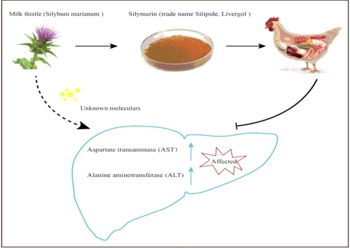
Milk thistle may be used as mycotoxin binder and liver protection supplement in broilers (Muhammad et al., Reference MUHAMMAD, CHAND, KHAN, SULTAN and A.2011; Amiridumari et al., Reference AMIRIDUMARI, SARIR, AFZALI and FANIMAKKI2013; Dumari et al., Reference DUMARI, SARIR, MAKKI and AFZALI2014), e.g. in cases where diets include the gossypol pigment derived from cotton seed meal that is a hepatic toxin for chickens (Blevins et al., Reference BLEVINS, SIEGEL, BLODGETT, EHRICH, SAUNDERS and LEWIS2010) ( Figure 4 ).
The relationship between silymarin herbal extract from milk thistle plant and liver function.

Conclusions
Milk thistle may be a good candidate for nutritional and pharmaceutical aspects in poultry and animals. The beneficial effects of silymarin supplementation as a natural liver protectant, anti-inflammatory, immunomodulating, antidiabetic, antioxidant show promise from poultry trials. Its low toxicity, promising pharmacokinetics, protective, preventive, regenerative and antifibrotic effects have been found to be extremely safe and suitable for clinical and in-feed use in different animal models. However, the hepatoprotective effect of silymarin in poultry farming is poorly understand, but almost all the cited literature speculated that it could provide a safe and cheap feed additive to promote growth performance and support liver function.