Introduction
As the ageing population is becoming an international health concern, researchers and clinicians agree that traditional medical health outcomes, such as morbidity and mortality, are not enough to understand lives of older adults. Measuring quality of life is important among older adults for the exploration of health-related outcomes and the improvement of social and physical living environment for this population. Quality of life is defined as ‘an individual's perceptions of their position in life in the context of the culture and value system in which they live and in relation to their goals, expectations, standards, and concerns' (World Health Organization (Quality of Life Group) 1998: 551). Health (e.g. self-rated health (SRH), functioning and wellbeing) and the individuals' characteristics (e.g. lifestyle, self-determination and self-perception) have been found to be the two central indicators of quality of life (Corless, Nicholas and Nokes Reference Corless, Nicholas and Nokes2001; Smedley and Syme Reference Smedley and Syme2000). Quality of life measurement and research concerned with specific cities or metro areas can be referred to as quality of urban life (QoUL). QoUL has been found to be directly affected by the livability of cities (Marans Reference Marans2002), influence residential location decisions (Marans Reference Marans2012; Pacione Reference Pacione2003), and have major implications for patterns of regional migration, economic growth and environmental sustainability (Kemp et al. Reference Kemp, Manicaros, Mullins, Simpson, Stimson and Wester1997).
Although resources for social participation and engagement are more available in urban areas, proximity to major roads, the presence of graffiti, crime and exposure to varieties of pollutions might negatively impact QoUL among older adults (Richard et al. Reference Richard, Gauvin, Gosselin and Laforest2008). In contrast to the abundance of research on quality of life, particularly health-related quality of life, understanding about QoUL among older adults is insufficient. The major gap in the existing literature of QoUL is that the current measurement of QoUL is developed based on Western samples. Due to substantial cultural differences between the East and West, the available QoUL instrument might not be suitable to measure QoUL of the older population in both cultures. Furthermore, QoUL is not a universal term but a relative and contextual phenomenon laden with individual meaning (Richard et al. Reference Richard, Laforest, Dufresne and Sapinski2005). Personal characteristics and subjective perceptions of quality of life in urban areas can be affected by external environmental factors. Literature suggested that environmental factors such as community, organisational and interpersonal themes are more meaningful to the QoUL among older adults (Patterson and Chapman Reference Patterson and Chapman2004; Richard et al. Reference Richard, Laforest, Dufresne and Sapinski2005). Second, there is substantial variation in the domains that are used to measure QoUL and it is uncertain which domains are valid and reliable for measuring QoUL for older adults who live in different socio-cultural settings.
Identifying what elements are typically conceived as indicators of QoUL among older adults who live in densely populated urban areas in different cultures as well as investigating invariance of the structure associated with QoUL is needed to improve the psychometric properties of the measurement of QoUL. In an effort to fill these gaps, the objective of this study is to identify underlying themes relevant to QoUL and examine the equivalence of the underlying structure for older adults who live in ten world metropolises.
Background
Most studies of QoUL in older adults primarily focus on identifying subjective determinants of QoUL and detecting the association between health and QoUL. Only a few studies investigate the objective including social environmental measures of QoUL (Marans Reference Marans2012; Richard et al. Reference Richard, Laforest, Dufresne and Sapinski2005). These studies attempt to identify intrapersonal, community, organisational and political indicators of QoUL among older adults by interviewing older adults as well as professionals (Pacione Reference Pacione2003; Richard et al. Reference Richard, Laforest, Dufresne and Sapinski2005). According to Western literature, environmental domains of QoUL include accessibility to social and health-care services, quality of housing, accessibility to public transportation and safe physical environment, whereas personal/subjective domains are health and independence, adequate income, opportunities for personal growth and learning, positive personal attitude, social activities and feeling useful/adequate (Marans Reference Marans2002; Richard et al. Reference Richard, Laforest, Dufresne and Sapinski2005).
Furthermore, SRH has been found to be associated with environmental factors and QoUL among older adults in studies conducted in Western societies (Browning and Cagney Reference Browning and Cagney2002; Parra et al. Reference Parra, Gomez, Sarmiento, Buchner, Brownson, Schimd, Gomez and Lobelo2010). Older adults were found to report better SRH scores and quality of life if they can get convenient access to public parks, social interaction and active recreation, while lower SRH and quality of life were found if the noise pollution level is high and environmental safety is low (Parra et al. Reference Parra, Gomez, Sarmiento, Buchner, Brownson, Schimd, Gomez and Lobelo2010). SRH has been shown as an important indicator of quality of life that provides a subjective understanding of an individual's general health status and other non-medical perspectives of their lives (Franks, Gold and Fiscella Reference Franks, Gold and Fiscella2003; Latham and Peek Reference Latham and Peek2013; Magee, Caputi and Iverson Reference Magee, Caputi and Iverson2011; Østbye et al. Reference Østbye, Krause, Norton, Tschanz, Sanders, Hayden, Pieper and Welsh-Bohmer2006; Sargent-Cox, Anstey and Luszcz Reference Sargent-Cox, Anstey and Luszcz2008). The commonly used measure of SRH is a global question that asks participants to rate their health in general based on a five-point scale (excellent, very good, good, fair and poor). Such a global SRH measure allows individuals to reflect on personal experiences, family history, and perceptions of stress and health behaviours in relation to their overall health status (Sargent-Cox, Anstey and Luszcz Reference Sargent-Cox, Anstey and Luszcz2008). It has been shown as a valid measure and worthwhile health outcome in clinical and population studies (Zack et al. Reference Zack, Moriarty, Stroup, Ford and Mokdad2004).
In addition to SRH, researchers found that important domains of QoUL for older adults include intrapersonal factors, interpersonal factors and community factors based on Western samples (Hoi, Chuc and Lindholm Reference Hoi, Chuc and Lindholm2010; Richard et al. Reference Richard, Laforest, Dufresne and Sapinski2005). Mentioned by both professionals and older adults, prominent themes in the domain of intrapersonal factors include opportunities for personal growth and learning, financial security, positive personal attitude and active lifestyle (Richard et al. Reference Richard, Laforest, Dufresne and Sapinski2005). Interpersonal factors include human contacts and social networks, feeling useful and social involvement; accessibility of services, quality housing, public transportation and safe environment are significant community factors (Richard et al. Reference Richard, Laforest, Dufresne and Sapinski2005). Older adults place more importance on health, socio-cultural resources, local government and political system, and neighbourhood safety for their QoUL compared to other age groups (Borglin, Edberg and Hallberg Reference Borglin, Edberg and Hallberg2005; Widgery Reference Widgery1982).
Existing cross-cultural research suggested that the concept of QoUL might vary across different socio-cultural contexts (Schalock et al. Reference Schalock, Verdugo, Jenaro, Wang, Wehmeyer, Xu and Lachapelle2005). The manner in which QoUL is interpreted and perceived by populations in a non-Western setting such as East Asian (e.g. Chinese, Japanese and Korean) culture might not be the same as in Western culture. Furthermore, variations in socio-political environment and language might also contribute to the difference in life experiences and perceptions of QoUL. Researchers have attempted to advance cultural sensitivity of the standard measure of quality of life in non-Western urban settings by testing validity and reliability of measures, such as the Short Form 36 (SF-36), among urban older Chinese (Zhou et al. Reference Zhou, Chen, Wang, Wang, Zhang and Zheng2011). Personal themes of QoUL, such as morale, life satisfaction and happiness, have also been tested among older adults in South Korea (Kim et al. Reference Kim, Hisata, Kai and Lee2000). These studies not only provide support for utilising the QoUL measure, but they also identify differences in the use of Western scenarios with non-Western participants by considering the influence of cultural background (Pacione Reference Pacione2003).
Within the scientific community, there is little consensus about whether QoUL has the same meaning in different socio-cultural settings (Richard et al. Reference Richard, Laforest, Dufresne and Sapinski2005). A cross-cultural measure of QoUL is not often available in the existing literature and, therefore, investigation of validity and reliability of the measurement is not sufficient. Additionally, while evidence at the individual level demonstrates that psycho-social factors like distrust, control, quality of interpersonal relationships and SRH affect QoUL (Patterson and Chapman Reference Patterson and Chapman2004), little is known about the extent to which environmental-level factors contribute to QoUL (Lynch et al. Reference Lynch, Smith, Hillemeier, Shaw, Raghunathan and Kaplan2001). Inquiries related to whether these psycho-social factors and health outcomes explaining QoUL at the population level is analogous to evidence at the individual level and whether the explanation differs across cultures still remain vague (Lynch et al. Reference Lynch, Smith, Hillemeier, Shaw, Raghunathan and Kaplan2001). The lack of evidence suggests a need for researchers to investigate whether these factors explain QoUL similarly among older adults in metropolises of the Western and East Asian culture.
The rapid growth of urban metropolises in East Asian countries, particularly in China, over the past several decades has posed great challenges for policy makers and city planners. The development of metropolitan cities also provides opportunities for researchers to understand further what fundamental factors contribute to the quality of life among urban residents in these countries. Local quality of life has been found to be a driving factor that influences population density, economic productivity and a growing demand for amenities such as metro-based social and residential services (Rappaport Reference Rappaport2009). Research on the potential relationship between urban environments and quality of life can be useful for policy makers and developmental planners to improve city designs and metro areas that enhance the residents' quality of living (Marans Reference Marans2012). Providing such insight for city developers will require additional research that investigates the importance of measuring QoUL in different cities across cultures. Therefore, it is crucial to optimise the measuring of QoUL for the older population in different socio-cultural settings before examining the inferences of QoUL. In the current study, we address the uncertain findings in the existing literature by first identifying consistent indicators of QoUL for the older population across different socio-cultural contexts, and second, by verifying QoUL measures that meet invariance requirements across these same contexts.
Methods
Data and measurement
Data for this study was selected from the Assessing Happiness and Competitiveness of World Major Metropolises, 2006. There were 10,014 adults aged 18 and older surveyed by computer-assisted telephone interview on quality of life on multiple domains including the economy, culture and education, welfare, safety, environment, living conditions, city administration, community life, health and happiness in ten major cities of the world: Seoul, Toronto, London, Paris, Berlin, Milan, Tokyo, Beijing, Stockholm and New York City. The survey adopted representative random sampling, and gender and age distribution of the completed sample were in line with the overall population of the surveyed cities. Demographic questions included city of residence, gender, age, education level, income level and marital status. Given the current study focuses on QoUL among older adults (i.e. age 60 and older), our sample consists of 2,011 participants (54% women and 46% men) with a mean age of 68.
Measures
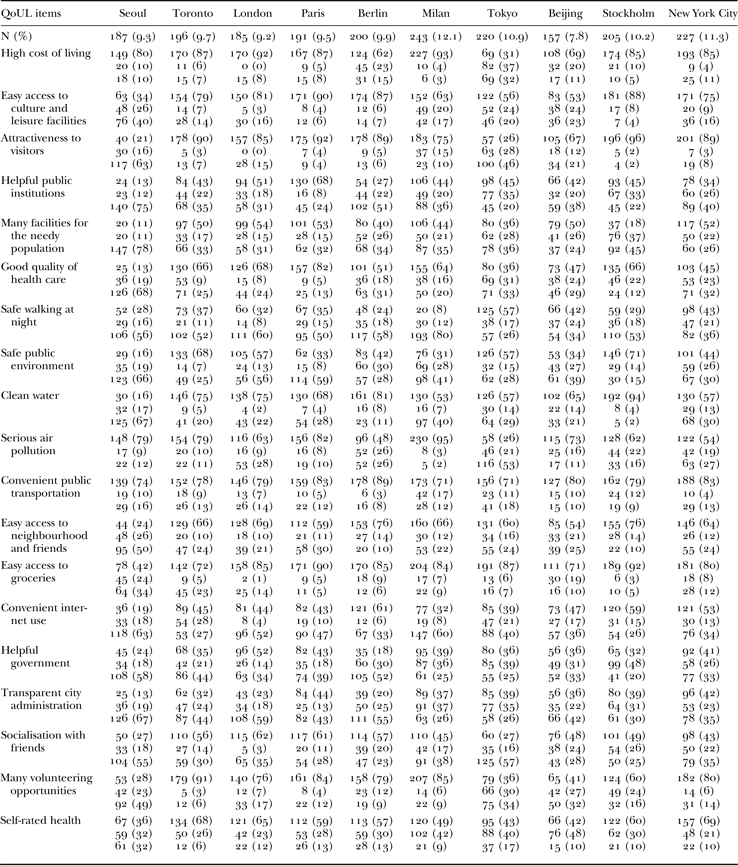
Quality of life in these metropolises was measured by 22 questions that assessed multiple indicators including the economy (i.e. job opportunities and price of living), culture and education (i.e. attractiveness to visitors, easy cultural and leisure facility access, and good quality of education), welfare (i.e. public facility and institution support, good place to rear children, facilities for needy populations and good quality of health care), safety (i.e. safe walking at night and public environment), physical environment (i.e. water and air), living condition (i.e. transportation and easy access to friends and groceries), city administration (i.e. the performance of government), community life (i.e. socialisation with friends and volunteering opportunities) and SRH. Widgery (Reference Widgery1982) suggested that education system, employment opportunities and environment for rearing children were significant predictors of satisfaction with QoUL among the young and the middle-aged rather than the old-aged. Given that the current study focused on the old-aged population, questions on job opportunities, education and place to rear children were excluded. Finally, 19 questions were selected and used in the analyses. Each respondent indicated their level of agreement using a standard five-point Likert scale (strongly agree, agree, neither agree or disagree, disagree, strongly disagree) with statements in each of these domains. Due to the relatively small proportions of ‘strongly agree’ and ‘strongly disagree’ response categories, we collapsed both categories with their adjacent categories, and thus, response values were recoded into three categories (i.e. disagree, neutral and agree). For statements with negative directions (i.e. high cost of living and serious air pollution), the response categories were reverse-coded so that the higher scores indicated greater satisfaction. SRH was measured using the question ‘How is your health in general?’, utilising an ordinal category with five responses ranging from ‘very good’ to ‘very bad’. The SRH variable was also recoded into three categories consisting of ‘good’, ‘fair’ and ‘bad’. Table 1 shows the descriptive statistics of QoUL-related items for the ten metropolises in the sample.
Distributions of 19 items of quality of urban life (QoUL) among ten metropolises

Notes: Values represent the number (and percentage) of people in the categories ‘agree/good’, ‘neutral/fair’ and ‘disagree/bad’ for each QoUL item. N = 2,011.
Analysis
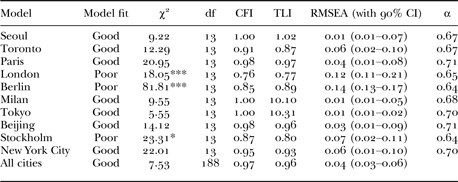
Descriptive statistics were used to examine the overall distribution, missing values and potential outliers for the sample. Our factor analyses are divided into two steps. First, it was necessary to establish the overall measurement properties of the QoUL measures across cities and cultures. In order to establish the overall QoUL scale, we conducted an exploratory factor analysis (EFA) on the set of 19 questions to identify the latent factor structure of QoUL in the data. Second, once the factor structure was identified, the consistency of this structure within each of the different cultures represented by each major city, as well as across all ten cities, was verified. For this purpose, we conducted measurement invariance tests using multiple-group confirmatory factor analysis (CFA) to test the factor invariance of QoUL across these socio-cultural contexts. Given the ordinal data used in the study, ordinal alpha (α) based on polychoric correlation was used to measure the reliability of the measure. Gadermann, Ghun and Zumbo (Reference Gadermann, Guhn and Zumbo2012) argued that compared to Cronbach's α, ordinal α is a more accurate estimator of reliability coefficients for Likert-type or mixed items, with two to seven response options. In addition, acceptable internal (consistency) reliability requires α values of 0.52–0.93 for comparable multi-dimensional measures of quality of life (de Silva et al. Reference de Silva, Jayasuriya, Rajapaksa, de Silva and Barraclough2016). The ordinal α values for each city are given in Table 4.
All models were evaluated with the consideration of non-significant chi-square statistics: Root Mean Square Error of Approximation (RMSEA) value < 0.06; and Comparative Fit Index (CFI) and Tucker–Lewis Index (TLI), both of which require values greater than 0.96 to indicate acceptable fit between the model and the data (Byrne Reference Byrne2011; Schmitt Reference Schmitt2011). For the EFA model, weighted least square with mean and variance (WLSMV) was used as an estimator for factor extraction. WLSMV is a robust estimator that does not assume normally distributed variables and provides the best option for modelling categorical or ordinal data (Brown Reference Brown2006; Muthen, du Toit and Spisic Reference Muthen, du Toit and Spisic1997). Parallel analysis (PA) for EFA was performed to determine the appropriate number of factors. PA is the best empirical method for producing the most accurate number of factors in EFA (Schmitt Reference Schmitt2011). Minimum criterion is if the difference between the PA eigenvalue and the EFA eigenvalue is greater than zero then a factor should be retained.
With respect to the rotation method, Schmitt (Reference Schmitt2011) and Finch (Reference Finch2011) suggested that low correlations between factors should be assumed in factor analysis and oblique rotation is strongly recommended because they will generate more realistic and more statistically sound factor structures. Furthermore, when researchers are testing a new measure, CF-Equmax (oblique) criterion is valued as a more reasonable choice. In our study, CF-Equmax was performed and we assume that items may relate to multiple factors (e.g. more cross-loading), therefore primary factor loadings > 0.40 to one factor structure and no cross-loading of 0.30 or above to other factors were also utilised to identify factors associated with observed measures of QoUL (Neill Reference Neill2008).
The measurement invariance test was completed by following four steps that were conducted sequentially: (a) baseline model, (b) test of configural invariance, (c) test of metric invariance and (d) test of scalar (strong) invariance (Vandenberg and Lance Reference Vandenberg and Lance2000). Each step imposed stricter constraints on parameters in the model to test the measurement invariance. A good baseline model fit was the requirement for satisfying the configural invariance, which is the first real measurement invariance test (Gregorich Reference Gregorich2006). The same applied for subsequent invariance tests. If any previous step did not achieve good or adequate fit to the data, the subsequent invariance test was unnecessary (Byrne Reference Byrne2011). The baseline model specified the factor model for each city separately and all ten cities jointly. In the second step, a configural test with no constraints imposed was conducted to examine whether patterns of factor loadings that define the structure of the measurement of QoUL were equal across cities. In the third step, multiple-group analysis with constraints imposed on factor loadings was conducted. This test was to examine if difference scores on a certain item could be meaningfully compared by constraining the loadings to be the same across cities (Steenkamp and Baumgartner Reference Steenkamp and Baumgartner1998). The fourth step to impose constraints on factor loadings and intercepts was conducted. The purpose of this step was to compare the latent means (means of latent factors) across the cities. Based on the preliminary analyses, 45 sets of invariance tests (all possible combinations of two cities) were conducted for the latent means comparison to identify comparable and incomparable pairs of cities. Each pair was examined using the scalar tests and for all 45 sets. Descriptive analysis was conducted in SAS 9.4; EFA and multiple-group CFA were conducted in Mplus 7.2.
Results
Table 1 shows the distribution of 19 indicators related to QoUL among older adults in ten metropolises. Generally, responses to most QoUL statements were positive such as ‘agrees’ or ‘good’ in most cities. The ‘neutral’ responses were relatively low among European metropolises compared to East Asian cities such as Seoul, Tokyo and Beijing. London was the city that was particularly lower for this measure. There were zero ‘neutral’ responses to the statement of ‘high cost of living’ and ‘serious air pollution’ in London. More than 50 per cent of older adults reported dissatisfaction with safety of walking at night, air pollution and high living expense, regardless of locations or cultures. More than 50 per cent of older adults in Seoul reported negatively (disagree) to culture and education, welfare, safety, environment and city administration. On the other hand, SRH was scored relatively high (⩾50% reported as ‘good’) in all ten cities.
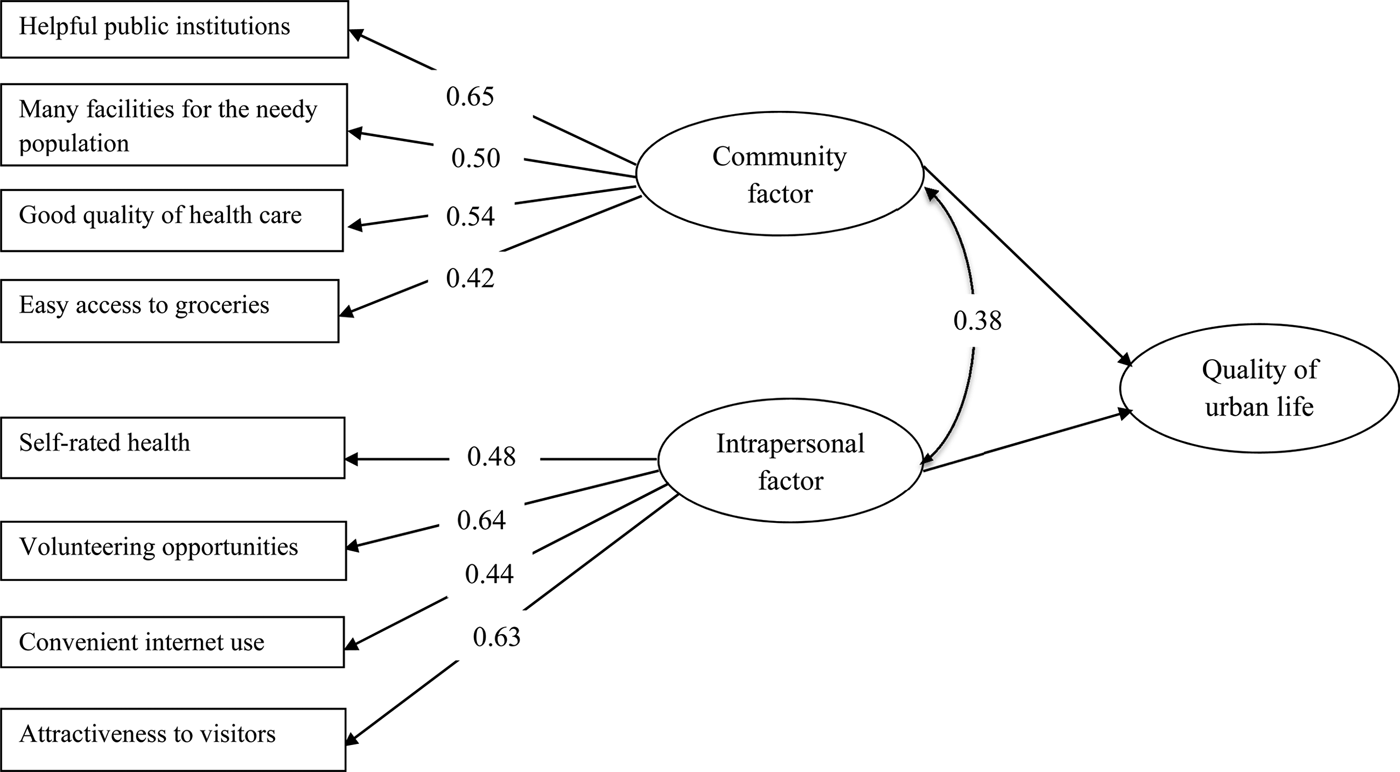
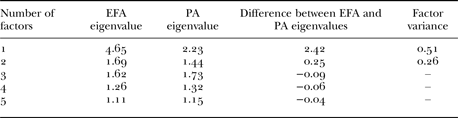
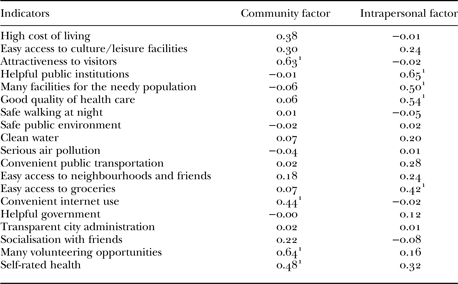
The PA results indicated that two factors with adjusted eigenvalues of 2.42 and 0.25 were retained for multiple-group analysis, which explained 51 and 26 per cent of the variances in the measure of QoUL, respectively (see Table 2). Of 19 items, eight items loaded on two factors. The first factor consisted of four indicators that relate mostly to convenience and accessibility to social and public amenities: we labelled this ‘community factor’. The second factor consisted of four indicators of intrapersonal themes including SRH and opportunities for personal growth and learning, which was labelled ‘intrapersonal factor’. The remaining 11 items did not load on any identified factors, and thus, were omitted from further analyses. The two-factor EFA model provided evidence of acceptable model fit, χ2 = 75.56, df (degrees of freedom) = 140, p = 0.30, CFI/TLI = 1.00, RMSEA ⩽ 0.001. The results of the EFA are shown in Table 3 and Figure 1.
Underlying factors associated with quality of urban life.

Comparison of exploratory factor analysis (EFA) and parallel analysis (PA) eigenvalues and factor variances

Notes: The eigenvalues for the first two EFA components are larger than the corresponding PA eigenvalues and are thus significant at p = 0.05. Retaining these components for interpretation and subsequent analysis is appropriate.
Factors and rotated factor loadings in exploratory factor analysis of quality of urban life

Note: 1. Factor loading on single factor exceeds 0.04 without cross-loading of 0.03 or above.
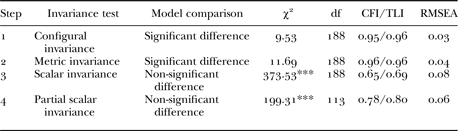
Using the factor structure identified in the EFA model above, multiple-group CFA was used to test the measurement invariance across ten cities. The baseline models examined all cities together and separately. The single group models for ten cities showed good fit to the data (see Table 4). When all cities were tested simultaneously, the model fit the data well (χ2 = 7.53, df = 188, CFI/TLI = 0.97/0.96, RMSEA = 0.04). The configural test was the initial step of invariance tests to examine whether the pattern of factor loadings of QoUL measurement were invariant across cities. As Table 5 shows, the configural invariance was achieved as indicated by good model fit (χ2 = 9.53, df = 188, CFI/TLI = 0.95/0.96, RMSEA = 0.03). Subsequently, the metric invariance (i.e. all factor loadings were constrained to be equal across nations) was also achieved (χ2 = 11.69, df = 188, CFI/TLI = 0.95/0.96, RMSEA = 0.03). The full scalar test (i.e. factor loadings and intercepts were all constrained to be equal for the purpose of comparing latent means across nations) was not achieved (χ2 = 373.53, df = 188, CFI/TLI = 0.65/0.69, RMSEA = 0.08, p < 0.001).
Model fit indices from confirmatory factor analyses

Notes: χ2: robust standard errors and chi-square statistic (weighted least square with mean and variance command in Mplus 7.2). df: degrees of freedom. CFI: Comparative Fit Index. TLI: Tucker–Lewis Index. RMSEA: Root Mean Square Error of Approximation. 90% CI: 90 per cent confidence interval. α: ordinal alpha coefficient.
Significance levels: * p < 0.05, *** p < 0.001.
Summary of measurement invariance test using multiple-group confirmatory factor analyses

Notes: χ2: robust standard errors and chi-square statistic (weighted least square with mean and variance command in Mplus 7.2). df: degrees of freedom. CFI: Comparative Fit Index. TLI: Tucker–Lewis Index. RMSEA: Root Mean Square Error of Approximation.
Significance level: *** p < 0.001.
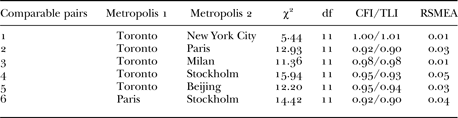
To improve model fit, we examined modification indices (MI) of indicators. Relaxing the factor loading of any indicator with an MI that is 3.84 or greater would improve the model fit (Bowen Reference Bowen2014). MI values for items of access to groceries and internet use were greater than 3.84, thus we conducted a partial scalar invariance test by relaxing factor loadings of these items. Although the overall model fit of partial scalar invariance was improved compared to the full scalar invariance, the partial scalar invariance was still not achieved (χ2 = 199.31, df = 113, CFI/TLI = 0.78/0.80, RMSEA = 0.06, p < 0.001). Results of the partial invariance analyses for each pair of metropolises indicated that Toronto was more likely to be comparable with other cities. Toronto was not only comparable to New York City, Milan, Paris and Stockholm, but also to Beijing. Among European nations, only two cities were comparable: Paris and Stockholm. Results for comparable pairs of metropolises can be found in Table 6.
Summary of measurement compatibility for quality of urban life measure for each comparable pair of metropolises

Notes: χ2: robust standard errors and chi-square statistic (weighted least square with mean and variance command in Mplus 7.2). df: degrees of freedom. CFI: Comparative Fit Index. TLI: Tucker–Lewis Index. RMSEA: Root Mean Square Error of Approximation.
Discussion
This study identified the underlying factors associated with QoUL items and examined the consistency of measures of QoUL among 60 and older populations across ten world metropolises. The results showed that the community factor and intrapersonal factor were two consistent major themes associated with the measure of QoUL in different socio-cultural contexts. These findings are generally consistent with the existing literature in supporting that factors such as health, social and economy are considered to be important in determining quality of life in older individuals (Borg, Hallberg and Blomqvist Reference Borg, Hallberg and Blomqvist2006; Lee, Ko and Lee Reference Lee, Ko and Lee2006; Pinquart and Sörensen Reference Pinquart and Sörensen2000). However, only eight indicators were consistently loaded on the community and intrapersonal factors, which explained 77 per cent of variance in the measure of QoUL across countries, suggesting that there might be quite a number of important aspects of QoUL for older adults in East Asian and Western cultures not included in the scale. It is therefore imperative to revise the current scale or develop new scales to capture aspects associated with QoUL that are important to older adults in East Asian and Western societies. Due to a large amount of ‘unexplained’ variance associated with the measure of QoUL, findings of the study should be interpreted cautiously.
The invariance test results showed that the overall conceptualisation of QoUL was consistent and achieved the metric invariance. In other words, the QoUL items in the current study could be measured on the same scale for all metropolises. However, the scalar invariance was not achieved and, therefore, mean comparisons across these cities were not applicable. Establishing scalar invariance indicates ‘individuals who have the same score on the latent construct would obtain the same score on the observed variable regardless of their group membership’ (Milfont and Fischer Reference Milfont and Fischer2010: 115). In this light, a revision such as developing questions to identify items that affect older people's daily life while capturing nuances in different socio-cultural settings might be useful to improve the psychometric quality of the instrument. In addition, our findings are consistent with previous studies, which suggested that scalar invariance might be a little strict for cross-national comparisons with many groups (more than five) (Horn, McArdle and Mason Reference Horn, McArdle and Mason1983). The purpose of our study is to explore the basic meaning and structure of QoUL in order to establish whether this construct is conceptualised in the same way cross-culturally, thus for this purpose, our study also demonstrates that the configural invariance test is minimum and metric invariance and more stringent forms of invariance are desirable but might not be strictly necessary for this purpose (Steenkamp and Baumgartner Reference Steenkamp and Baumgartner1998). Freeing items of access to groceries and internet use improve the model fit in the partial invariance test, therefore, paying closer attention to these two items is worth considering when comparing QoUL across cities.
The follow-up analyses implied that the measure of QoUL was more comparable across Western societies. The findings of this study suggested that the QoUL measure is not always comparable between Western and East Asian cultures. In the current study, the only cross-culturally comparable pair was Toronto and Beijing. Studies have revealed that economic circumstances in a society directly contribute to the access to social support and services, which influences quality of life among older adults (Pinquart and Sörensen Reference Pinquart and Sörensen2000). Previous research has found that a prosperous economic environment characterised with easy access to social resources (e.g. volunteering opportunities, job openings and leisure activities) is positively related to quality of life among older Americans (Pinquart and Sörensen Reference Pinquart and Sörensen2000). The economy in China has dramatically boomed during the past decades, as China has been the second largest economic nation in the world in recent years (Geng and Doberstein Reference Geng and Doberstein2008). It is possible that the booming economy improves the living conditions and provides numerous job opportunities for both young and older adults. Furthermore, the open and prosperous economic market prompts the increase of social resources and social services. There are more volunteering and re-employment opportunities for older adults than ever before, particularly in metropolitan areas in China. In contrast, the economy in South Korea and Japan is not flourishing as much as China, thus job openings and volunteering opportunities for the older individuals in both countries are relatively low (Lee, Ko and Lee Reference Lee, Ko and Lee2006; Oshio and Urakawa Reference Oshio and Urakawa2013). Due to such an inequality in economic development, Beijing was more comparable to the Western metropolises in comparison to Seoul and Tokyo. Additionally, the interpretation of QoUL-related items such as access to leisure and cultural facilities (e.g. in East Asian culture, access could mean transportation to or the use of leisure and cultural facilities) by older adults differs between Western and Eastern Asian cultures. Identifying the interpretation of QoUL items in the East Asian culture is the first step before comparing the conceptual structure cross-culturally.
Beyond the difference between Western and Eastern cultures, each metropolis has its own defined culture that complicates cross-over comparisons. It is interesting to find that the measure of QoUL was consistent among most metropolises in the current study except London and Seoul. For Seoul, there was a higher proportion of ‘disagree’ responses, while the proportion of ‘neutral’ responses was low for London. A higher proportion of negative responses to QoUL items in Seoul might solicit the need for qualitative research to explore the needs of older individuals in the city and the availability of socio-cultural resources of city living for older adults. With respect to London, it might be possible that ambiguous expression might not be embraced in the local culture; therefore ‘neutral’ responses are rarely observed among respondents in London. It is also possible that by only studying older adults, positive perspectives such as ‘agree’ and ‘good’ across cultures are more commonly observed compared to other response options (for details, see Table 1). Prior studies using survey measures of QoUL have shown that older adults are more likely to optimise emotional meaningfulness to maintain the positive effect and reduce the negative effect compared with young adults (Charles, Mather and Carstensen Reference Charles, Mather and Carstensen2003).
This study made several contributions to the existing literature in QoUL. First, we conducted a relatively in-depth analysis in an under-studied area in order to understand the consistency of QoUL conceptualisation in different socio-cultural settings. Findings of this study suggested the similarities and compatibilities in some properties of QoUL across urban environments in different cultures. Despite the same culture, urban life, particularly metropolitan life, in different countries can be strikingly different. A deeper discussion of factors that contribute to the differences in urban life of the same culture in the older population and understanding how and why they make the differences would be beneficial for improving the quality of the QoUL measurement. Methodologically, hierarchical modelling might be meaningful to identify potential indicators related to urban characteristics that are nested within a specific culture and to investigate how this phenomenon influences QoUL among older adults. However, the consistency of the measure of QoUL between Toronto and Beijing would inspire future research to explore the underlying mechanism for developing sound theories related to urban development that could apply to both cities.
Furthermore, our study found that environmental safety and political concerns were not significant indicators of QoUL regardless of culture, i.e. Western or Eastern. This finding is different from what previous studies have suggested: that older adults place more importance on local government and political systems and neighbourhood safety for their QoUL compared to other age groups (Borglin, Edberg and Hallberg Reference Borglin, Edberg and Hallberg2005; Widgery Reference Widgery1982). Further investigation using mixed methods would be useful to explore important issues for older adults living in urban areas under different cultures and to develop theoretical and operational constructions that examine QoUL among the older population in major metropolitan cities worldwide. Therefore, findings of the study could provide insights for policy makers to consider developing policies and redirecting resources to improve city life for older adults in both Western and non-Western societies.
Limitation
Similar to any study, this study is not without limitations. First, the findings on the measure of QoUL might be biased for London since the ‘neutral’ response to a few QoUL statements was zero. Therefore, the multiple-group analysis could not compare London with other cities for items with zero response for certain categories. Second, cross-sectional data analysis does not allow any inference of causal relationships between underlying factors and QoUL for older adults cross-culturally. While the study provides some new perspectives regarding the QoUL comparison between East Asian and Western cultures, the findings should not be generalised to older populations in all urban areas in Western societies or across different populations in other nations. Last, as the study focused on examining the psychometric property of QoUL across cultures, the impact of socio-demographic covariates on the measure of QoUL was not assessed which should be considered by future studies.
Acknowledgements
We thank J. Scott Brown, Associate Professor, at Miami University, Oxford, Ohio for all his energy put into this study and for assisting with the manuscript preparation.