Exploring and describing the nature of variability in second language (L2) grammars reflects an important line of research in the field of second language acquisition (SLA). Variable aspects of L2 speech, be they targetlike or nontargetlike, have allowed us to observe the systematic nature of learner grammars (e.g., Corder, Reference Corder1967) and to document how learner grammars develop over time. Analyses of L2 variability have further facilitated our understanding of how learners come to use multiple forms to express numerous meanings in the L2 (Andersen, Reference Andersen1984), as well as the role of linguistic and situational factors in establishing form-meaning connections in the L2 (e.g., Ellis, Reference Ellis1985). With respect to language use, learners are faced with the task of varying aspects of their speech to communicate appropriately in the L2. This means demonstrating sensitivity to the relevant linguistic and extralinguistic factors to alter speech for successful participation in a variety of communicative settings. Thus, investigating L2 variability contributes to our understanding of learners’ development of sociolinguistic competence (i.e., the ability to use the L2 in linguistically and socially appropriate ways), an essential component of communicative competence in a L2 (Canale & Swain, Reference Canale and Swain1980).
Previous research on the L2 acquisition of Spanish copula choice has contributed notably to the discussion of variability in L2s (e.g., Geeslin, Reference Geeslin, Leow and Sanz2000, Reference Geeslin2003). Learners’ use of the Spanish copulas with adjectives (e.g., Ella es/está bonita “She is [looks] pretty”) in particular is an ideal candidate for variationist L2 research precisely because there are linguistic contextual features that condition variability in native grammars, and a variationist framework allows us to document and explain the extent to which learners acquire sensitivity to the relevant combination of features mediating variable copula choice. Geeslin’s work on the acquisition of variable copula choice with adjectives has been central to the discussion of how learners come to demonstrate (or not) sensitivity to the factors (linguistic and extralinguistic) that mediate variability in native grammars. However, this research has been conducted primarily on native English-speaking learners, limiting the generalizability of attested findings. The current study addresses this gap in the literature by investigating the development of Spanish copula choice by 66 adult Korean-speaking learners. Specifically, this study examines the range and frequency of copula forms produced in [copula + adjective] (i.e., attributive) contexts across four distinct levels of Spanish language instruction as well as the linguistic and extralinguistic variables that predict copula use. The current study builds on work initiated by Geeslin and Long (Reference Geeslin, Long, Pérez-Jiménez, Leonetti and Gumiel-Molina2015) by including an examination of predictors of estar use with a larger dataset and by comparing findings to adult English-speaking learners who completed the same data elicitation tasks. In addition to confirming the persistence of nontargetlike copula omission at higher learner levels, findings from the present study show that a similar combination of linguistic and extralinguistic factors influence estar production for both Korean- and English-speaking learners.
RESEARCH CONTEXT
THEORETICAL FRAMEWORK
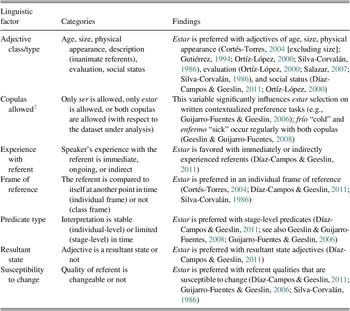
The present study adopts a variationist approach to the study of the acquisition of Spanish copula choice.Footnote 1 Variationist approaches to research on language variation have their origins in quantitative sociolinguistics (e.g., Labov, Reference Labov1972; Preston, Reference Preston and Fought2004), which seeks to identify the internal and external factors that influence language variability. As such, variationist approaches to L2 acquisition seek to identify the linguistic and extralinguistic (or social) factors that influence L2 variation and to quantify their probabilistic influence on the occurrence of the dependent variable (Adamson & Regan, Reference Adamson and Regan1991; Bayley, Reference Bayley, Chambers and Schilling2013; Bayley & Preston, Reference Bayley and Preston1996; Bayley & Regan, Reference Bayley and Regan2004; Geeslin, Reference Díaz-Campos and Geeslin2011; Geeslin & Long, Reference Geeslin and Long2014; Gudmestad, Reference Gudmestad and Geeslin2014). This approach is ideal for the examination of copula choice in Spanish because it offers a framework (and corresponding tools) for modeling language variability in a probabilistic manner. That is, in addition to documenting the frequency of use of ser and estar (and other forms) by learners of Spanish over time, a variationist approach permits prediction of the selection of one copular verb over the other based on an examination of the factors that influence copula choice. To illustrate, a variationist analysis of copula choice allows us to identify the factors driving the selection or use of estar over ser in utterances such as Ella está bonita. In this particular context, a variationist analysis allows us to determine whether the speaker’s preference for estar is conditioned by factors such as semantic features of the adjective and/or pragmatic features related to the speaker’s experience with the referent (see Table 1 for a summary of linguistic factors examined in previous research on variable copula choice). This type of analysis permits a detailed, linguistic description of why speakers use one copula over another in certain speech contexts.
Linguistics factors examined in previous research on variable copula choice

Beyond modeling language variability probabilistically, investigating L2 acquisition from a variationist perspective contributes to our understanding of how learners acquire sociolinguistic competence (Canale & Swain, Reference Canale and Swain1980) in L2s. The ability to use language for social purposes is central to the notion of sociolinguistic competence, and this observation is relevant for communication in native and nonnative languages. Learners must acquire sensitivity to the factors that constrain variability in the target language; this sensitivity is crucial for accurate comprehension and production of socially meaningful utterances. Thus, using tools of variationist sociolinguistics, the present study demonstrates how learners’ selection between the Spanish copular verbs ser and estar reflects sensitivity to factors relevant to the description of Spanish copula choice. Further, this study offers an examination of that selection for two distinct L1 learner groups, including one group that has received very limited attention in previous research (Korean-speaking learners), to explore potentially universal constraints on this variability.
COMPARISON OF SPANISH AND KOREAN COPULA FUNCTIONS
Spanish has two main copular verbs, ser “to be” and estar “to be,” that present well-documented challenges to L2 learners (see Geeslin, Reference Geeslin and Geeslin2014). Regarding syntactic structure, these verbs link noun phrases and pronouns to other noun phrases, adjectives, and prepositional phrases. Specifically, ser can link a referent, animate or inanimate, to either a noun phrase (e.g., Julia es profesora “Julia is a professor”) or an adjective (e.g., El perro es marrón “The dog is brown”) for the purpose of describing the referent. However, estar can also be linked to an adjective to describe a referent (e.g., Él está contento “He is happy”). The syntactic context of interest in the present study is this [copula + adjective] (or preadjectival) structure (shown in [1]), wherein either ser or estar may be used to link a referent to its corresponding attribute(s).
(1) a. El perro es marrón “The dog is (SER) brown”
b. Él está contento “He is (ESTAR) happy”
Although either ser or estar may theoretically be used to connect a referent to its corresponding attribute(s), these verbs are not freely interchangeable (cf. free variation; Ellis, Reference Ellis1999; Lavandera, Reference Lavandera1978). First, some adjectives change in meaning depending on their occurrence with ser or estar. As shown in (2), the adjective verde “green” refers to the color when used with ser but the state or condition of the referent when used with estar.
(2) a. La manzana es verde “The apple is (SER) green”
b. La manzana está verde “The apple is (ESTAR) unripe”
Similarly, the adjective listo conveys the idea of preparedness when used with estar but intelligence when used with ser, as shown in (3).
(3) a. La profesora es lista “The professor is (SER) smart/clever”
b. La profesora está lista “The professor is (ESTAR) ready”
For several adjectives that co-occur with ser and estar, a change in meaning does not fully capture the nature of copula selection in preadjectival contexts. Research in the field of sociolinguistics has been instrumental in showing that a speaker’s choice of one copula over the other reflects a complex interplay of semantic and pragmatic factors that reflects the speaker’s experience with the referent (or understanding of the relationship between the referent and its corresponding attribute[s]).Footnote 3 This body of research has demonstrated that linguistic factors such as predicate type, adjective class, referent susceptibility to change, and speaker experience influence the selection or production of estar over ser. Table 1 offers a summary of the linguistic factors examined in previous research on native speakers of Spanish as well as findings from studies that have investigated those factors.
Korean, however, contains only one copular verb: ida. Footnote 4 Regarding its syntactic structure, this verb may be preceded by a noun or noun phrase, and it is used to express equational utterances such as I = student (see [4]) or time = 4 o’clock (see [5]) (Sohn, Reference Sohn2001).
(5) shigan eun ne shi ida
time TOP four hour be.INF
“It is four o’clock”
An important observation here is that there are fewer functions of the Korean copula ida as compared to the Spanish copulas ser and estar, which are used to express weather, nationality, marital status, actions in progress (estar only), and so forth in addition to time and identifying people and things.
With respect to the linguistic structure under study (i.e., [copula + adjective]), the syntactic structure of Korean does not permit syntactic sequences such as I am happy (e.g., *na neun haengbok ida). Instead, Korean, similar to languages that permit verbal encoding of predicate adjectives (see Croft, Reference Croft, Vogel and Comrie2000), contains a system of predicate adjectives that are marked for tense, aspect, and mood in the same manner as predicate verbs. Thus, an utterance such as I am happy is expressed using the adjectival predicate haengbokhada “to do/make happiness,” as illustrated in (6). The Korean copula ida is not used to connect a referent with its corresponding attribute(s).
(6) na neun haengbokhada
I TOP happiness.have.INF
“I am happy”
With this comparison of copular verbs in Spanish and Korean in mind, we can posit that an additional learning challenge facing Korean-speaking learners in the acquisition of Spanish copula choice in preadjectival contexts is developing and producing a syntactic context that is not present in their L1. That is, prior to acquiring constraints on the use of the Spanish copulas in [copula + adjective] contexts, L1 Korean learners must first develop and produce this context, which is absent in their native language. This particular challenge is not shared with native English-speaking learners whose L1 has the [copula + adjective] structure. However, the Korean learners in the present study are also L2 learners of English, a language that has the syntactic context under investigation. That stated, one is unlikely to find Korean-speaking learners of Spanish who are not also learners of English as a L2. In light of these observations, the current investigation additionally seeks to examine the relationship between Korean learners’ knowledge of English and their use of Spanish copulas in [copula + adjective] contexts.
L2 ACQUISITION OF SPANISH COPULA CHOICE
The acquisition of Spanish copula choice by L2 learners has garnered extensive attention in previous research. This body of work has been instrumental to the discussion of key concepts in the field such as stages of development (e.g., VanPatten, Reference VanPatten1985, Reference VanPatten, VanPatten, Dvorak and Lee1987), context of learning (e.g., Guntermann, Reference Guntermann1992; Ryan & Lafford, Reference Ryan and Lafford1992), and the acquisition of variation in L2 Spanish (see Geeslin, Reference Díaz-Campos and Geeslin2011). VanPatten’s seminal research on developmental stages in classroom learners’ acquisition of the Spanish copular verbs laid the groundwork for research on the acquisition of Spanish copula choice by L2 learners. He showed that learners pass through the following stages:
-
1. Copula omission
-
2. Overuse of ser
-
3. Use of estar for progressive functions
-
4. Use of estar in locative contexts
-
5. Use of estar in preadjectival contexts
The generalizability of these stages was tested in research that followed (Briscoe, Reference Briscoe1995; Guntermann, Reference Guntermann1992; Ramírez-Gelpi, Reference Ramírez-Gelpi1995; Ryan & Lafford, Reference Ryan and Lafford1992). These studies confirmed that learners overuse ser in early stages and gradually use estar over time as proficiency or experience with the language increases. A notable inconsistency across the stages of development reported was the order of acquisition of functions of estar. For example, Ryan and Lafford (Reference Ryan and Lafford1992) found that learners acquired use of estar in preadjectival contexts prior to locative contexts, whereas VanPatten (Reference VanPatten, VanPatten, Dvorak and Lee1987) reported the opposite. Regardless of the proposed ordering of development of functions of estar, what is clear is that estar use with adjectives presents a learning challenge for learners.Footnote 6
An important line of research initiated by Geeslin explored the nature of the acquisition of estar with adjectives by learners of Spanish. Geeslin’s (Reference Geeslin, Leow and Sanz2000) seminal work on English-speaking learners’ acquisition of Spanish copula choice paved the way for variationist research on this topic. Her study revealed that, as course level increased, rates of estar production in preadjectival contexts increased gradually (from 20.7% at Level 1 to 25.9% at Level 4). Additionally, she found that a distinct combination of linguistic features (see, e.g., Table 1) explained learners’ production of estar (as opposed to ser) at each of the four course levels examined (see Table 4 in Geeslin, Reference Geeslin2003, p. 717). In her follow-up comparison of highly advanced English-speaking learners and native speakers of Spanish, Geeslin (Reference Geeslin2003) found distinct rates of estar selection in [copula + adjective] contexts on a written contextualized preference task for each group (43.7% for learners and 48.5% for native speakers). Her study further revealed a different combination of linguistic contextual features predicting estar selection on the written contextualized preference task for each group. For advanced learners, all but two of the linguistic features examined (predicate type and experience with referent) significantly predicted selection of estar. For the native speakers, only predicate type, referent susceptibility to change, and adjective class significantly predicted estar selection. The implications of these findings are that, even into advanced levels, native English-speaking learners demonstrate differences from native speakers with respect to variable Spanish copula use. Importantly, analysis of the linguistic contextual features influencing variable copula choice for learners has permitted a more nuanced understanding of this phenomena as it relates to L2 development and use.Footnote 7
With respect to the acquisition of Spanish copula choice by distinct L1 learner populations, Geeslin and Guijarro-Fuentes (Reference Geeslin, Guijarro-Fuentes and Eddington2005) examined the role of learner L1 background (either English, French, or German) on Spanish copula choice and found no effect for this learner characteristic on copula selection in a written contextualized preference task. Examining native Portuguese-speaking learners, Geeslin and Guijarro-Fuentes (Reference Geeslin and Guijarro-Fuentes2006) found that learners selected estar at a significantly higher rate than native Spanish speakers on a written contextualized preference task (59.1% vs. 43.8%, respectively). Interestingly, this finding has also been reported for native English-speaking learners (cf. Geeslin, Reference Geeslin2003). With respect to linguistic features predicting estar selection, predicate type, referent susceptibility to change, frame of reference, and adjective class were significant predictors for the learner group, whereas only adjective class and the variable copulas allowed were significant for the native Spanish speaker group. Collectively, these studies demonstrate that, similar to native English-speaking learners (e.g., Geeslin, Reference Geeslin2003), rates and predictors of estar selection show subtle but important differences from native speakers. However, all these studies focus on learner populations whose L1s feature a [copula + adjective] context and employ at least one copula in this syntactic context.
Cheng et al.’s (Reference Cheng, Lu and Giannakouros2008) study was the first study to examine the development and use of variable Spanish copula choice by learners whose L1 does not typically employ a copular verb in this context. Cheng et al. examined the use of this variable structure in the writing of native Chinese-speaking learners of Spanish. Similar to Korean, Chinese has a copular verb but it is not used to link nouns or noun phrases (i.e., referents) and adjectives (see Li & Thompson, Reference Li and Thompson1981). Cheng et al. found a higher rate of ser (as opposed to estar) in learners’ written essays at the lowest level; rates of estar use increased as learner experience with Spanish (operationalized as hours of formal instruction) increased (from 16.7% at the lowest level to 32.8% at the highest). Regarding contextual features influencing estar use, Cheng et al. found that frame of reference, change in animacy, and prior experience with the referent (i.e., pragmatic and semantic features) influenced estar use in learners’ writing at Group 3 (the highest level); only adjective class (a semantic feature) was influential in learners’ writing at Group 2; and only essay topic (an extralinguistic feature) influenced estar use by Group 1 learners.
Of particular relevance to the current study, Geeslin and Long (Reference Geeslin, Long, Pérez-Jiménez, Leonetti and Gumiel-Molina2015) explored variable Spanish copula choice in the speech of 23 native Korean-speaking learners of Spanish. Specifically, they sought to identify the range and frequency of copula forms produced in [copula + adjective] contexts during a sociolinguistic-style interview as well as linguistic and extralinguistic correlates of copula use. Their findings showed that omission of the copula was the most frequent production pattern in this context for Level One learners (86.6%) whereas ser was the most frequent form for Level Two and Level Three learners (58.3% and 60.1%, respectively). Similar to previous findings, production of estar increased as level increased (from production in 1.9% of relevant contexts at Level One to 8.3% at Level Three), although the rate of estar produced by Level Three learners was much lower than rates previously attested for lower-level English-speaking learners (cf. 20.7% Level One learners in Geeslin, Reference Geeslin, Leow and Sanz2000). With respect to linguistic correlates of use, estar production was more frequent in [+susceptible to change] contexts. Further, learners who spent a year or more studying abroad in a Spanish-speaking country produced estar at higher rates than learners with less than a year abroad (11.8% vs. 5.6%, respectively), and learners with 3 years or more of prior Spanish language study exhibited higher estar rates than learners with fewer than 3 years (11.1% vs. 2.7%, respectively).
In sum, the body of research on L2 Spanish copula choice has shown that learners progress through predictable stages, and later stages reveal the difficulty associated with acquiring the use of estar with adjectives (e.g., Briscoe, Reference Briscoe1995; Guntermann, Reference Guntermann1992; Ramírez-Gelpi, Reference Ramírez-Gelpi1995; Ryan & Lafford, Reference Ryan and Lafford1992; VanPatten, Reference VanPatten1985, Reference VanPatten, VanPatten, Dvorak and Lee1987). Using methods of quantitative sociolinguistics, variationist research on copula choice in preadjectival contexts has been instrumental in identifying the linguistic contextual features that influence variable copula choice for L2 learners, and how this differs from native speakers (Geeslin, Reference Geeslin, Leow and Sanz2000, 2003). Fewer studies have examined the acquisition of variable copula choice by learners whose L1 is typologically distinct from Spanish and does not use a copular verb to express attributive functions (e.g., Cheng et al., Reference Cheng, Lu and Giannakouros2008; Geeslin & Long, Reference Geeslin, Long, Pérez-Jiménez, Leonetti and Gumiel-Molina2015). While these studies reveal developmental patterns that are similar to the case of native English-speaking learners (e.g., estar use increases as experience increases), they also suggest key differences (e.g., prevalence of omission at early stages) that merit continued investigation and corroboration with a larger dataset.
THE PRESENT STUDY
The preceding review has identified a general lack of studies on the acquisition of Spanish copula choice by speakers whose L1 exhibits typological differences from Spanish with respect to copula functions. By extending the scope of investigation to learners of typologically distinct L1 backgrounds, previously attested patterns of L2 learning can be corroborated and L1 specific challenges may be identified. The present study builds on the research initiated by Geeslin and Long (Reference Geeslin, Long, Pérez-Jiménez, Leonetti and Gumiel-Molina2015) by confirming patterns of development of Spanish copula choice for Korean-speaking learners but with a larger, cross-sectional dataset of native Korean-speaking learners. This study uniquely compares observed patterns with those of English-speaking learners who completed the same data elicitation tasks, as well as offers an analysis of predictors (as opposed to trends) of estar use. The research questions guiding the present study are:
-
1. What forms do Korean-speaking learners of Spanish produce in [copula + adjective] contexts?
-
2. With what frequency do Korean-speaking learners of Spanish produce each form at four different levels of instruction?
-
3. What linguistic and extralinguistic factors predict Korean-speaking learners’ production of estar in [copula + adjective] contexts?
-
4. How do the findings from (1)–(3) compare to English-speaking learners?
Hypotheses for each research question follow:
H1. Korean-speaking learners will produce the full range of forms attested in previous research on the acquisition of the Spanish copula with adjectives (e.g., Geeslin, Reference Geeslin, Leow and Sanz2000).
H2. Based on the findings of Geeslin and Long (Reference Geeslin, Long, Pérez-Jiménez, Leonetti and Gumiel-Molina2015), it is hypothesized that Korean-speaking learners’ production of ser and estar will increase as instructional level increases, but rates of ser will be higher than rates of estar at each level. Rates of developmental or nontargetlike omission will be highest at the lowest level but will decrease as instructional level increases.
H3. In line with previous research on the acquisition of the Spanish copula with adjectives (e.g., Cheng et al., Reference Cheng, Lu and Giannakouros2008; Geeslin, Reference Geeslin, Leow and Sanz2000), it is hypothesized that a combination of linguistic and extralinguistic factors will predict Korean-speaking learners’ production of estar (as opposed to ser or developmental omission).
H4. Based on the findings of Geeslin and Long (Reference Geeslin, Long, Pérez-Jiménez, Leonetti and Gumiel-Molina2015), it is hypothesized that English- and Korean-speaking learners will produce a similar range of forms in [copula + adjective] contexts. However, the frequency with which these forms are produced will differ between each L1 learner group: Korean-speaking learners are expected to produce developmental omission at a higher rate than English-speaking learners cross-sectionally. Each L1 learner group is expected to demonstrate an increase in estar production as instructional level increases, and a distinct combination of linguistic and extralinguistic factors will predict learners’ production of estar for each L1 learner group.
PARTICIPANTS AND SETTING
Participants for this study included adult Korean-speaking learners and adult English-speaking learners of Spanish. English-speaking learners were enrolled in university-level Spanish language courses at a public university in the midwestern United States, and Korean-speaking learners were enrolled in a private university in Gwangju, South Korea, at the time of data collection.
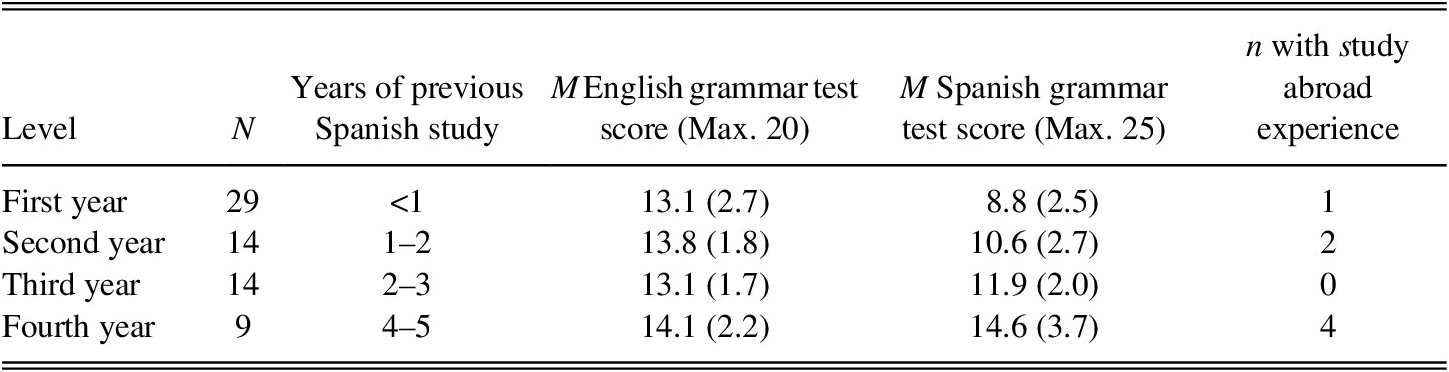
Native Korean-speaking participants were 66 learners (46 women, 20 men; M age = 21.0 years, SD = 2.0) divided into four levels according to reported years of previous university-level Spanish language study (see Table 2). All Korean learners reported Korean as their native language, the language spoken at home, and the native language of their parents. The average age at which Korean learners reported starting their study of Spanish was 20.1 years (SD = 2.7), and they reported spending 8.5 hours each week on average in a Spanish language class (SD = 4.1). As shown in Table 2, Spanish language knowledge (as determined by an independent, grammar-based measure; see “Data Elicitation Tasks and Procedure”) increased as level increased. A one-way ANOVA showed that differences in average grammar scores were significant across all levels, F(3) = 97.75, p < .001; however, post hoc analyses revealed that mean scores were not significantly different between second- and third-year learners, p = .256.Footnote 8 Korean learners’ English language knowledge (also measured independently) was very similar across the levels established. Additionally, although few Korean learners had previous experience studying abroad in a Spanish-speaking country, nearly half of fourth-year learners reported previous study abroad experience. Regarding the learning setting, classroom meetings followed a form-focused, communicative approach that targeted review and practice of vocabulary and grammar needed to communicate in a variety of everyday activities in Spanish. Further, only one instructor was a native speaker of Spanish (all other Spanish instructors were native speakers of Korean who had completed a PhD in Spanish), and there were few speakers (native or nonnative) of Spanish in the surrounding university and regional communities.
Characteristics of Korean-speaking learners by level

Note: SDs are provided in parentheses.
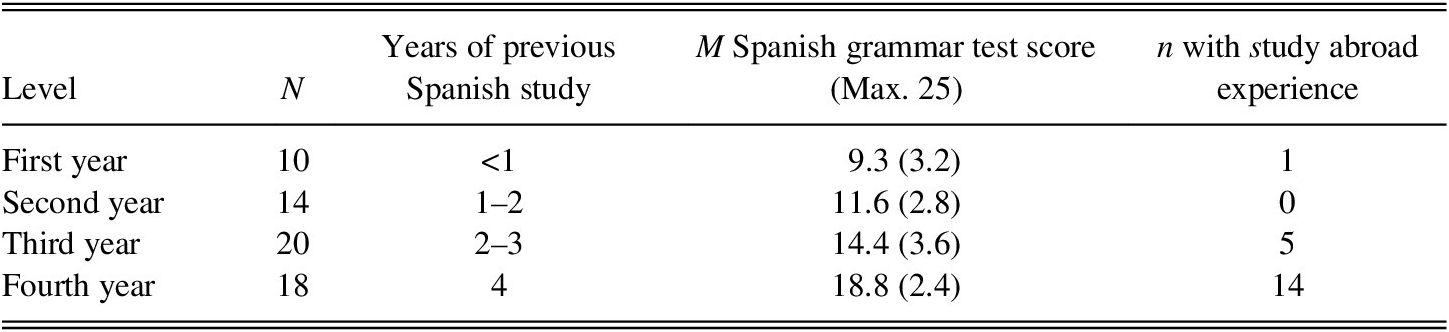
Native English-speaking participants included 62 learners (46 women, 16 men; M age = 21.6, SD = 6.0), who were also divided into four levels according to reported years of previous university-level Spanish language study. All English-speaking learners reported English as their native language, the native language of their parents, and the language spoken at home. The average age at which English-speaking learners reported beginning their learning of Spanish was 12.5 years (SD = 3.8). Table 3 further shows that, as level increased, the average Spanish grammar test score for each level also increased. Average grammar test scores were significantly different by level, F(3) = 486.68, p < .001, and all levels were significantly different from each other (all ps < .001). Several English-speaking learners reported previous experience studying abroad in a Spanish-speaking country, with well more than half of fourth-year English-speaking learners reporting some previous study abroad experience. The courses in which English-speaking learners were enrolled also targeted practice of vocabulary and grammar that facilitated communication in Spanish. These courses were taught by both native and nonnative speakers of Spanish, several of whom were graduate students pursuing a graduate degree in Hispanic linguistics or literatures.
Characteristics of English-speaking learners by level

Note: SDs are provided in parentheses. English-speaking learners also completed the English grammar test, but all performed at ceiling and, thus, results are not reported.
DATA ELICITATION TASKS AND PROCEDURE
The researcher met individually with each participant in a small classroom or recording room to complete the following tasks in the order listed: sociolinguistic interview, picture book description task, Spanish grammar test, English grammar test, and background questionnaire.Footnote 9
The oral production tasks (i.e., sociolinguistic interview and picture book description) were selected to elicit two styles of semispontaneous oral production data in Spanish. The sociolinguistic interview was designed to cover a range of topics that would permit production of contexts for use of the Spanish copula, as well as reflect the interests of each participant (e.g., hobbies, friends and family, university life, and future plans). Warm-up questions were included to familiarize participants with the task format and to establish a relaxed setting for speaking. For the picture book description task, participants were instructed to describe in Spanish a sequence of images from dePaola’s (Reference dePaola1978) wordless picture book entitled Pancakes for Breakfast. This particular book was selected because it afforded multiple opportunities to produce the copulas for different functions or uses during an earlier pilot phase of the present study. All participants were audio recorded while completing each oral production task, and all interaction between the researcher and each participant occurred in Spanish unless the participant expressed confusion (verbally and/or nonverbally) with the task.
Following completion of the oral production tasks, all participants completed three written tasks. The first was a Spanish grammar test, used extensively in previous research on L2 variation by Geeslin and colleagues (see Geeslin & Gudmestad, Reference Geeslin, Gudmestad, Garavito and Valenzuela2008). This test contained 25 multiple-choice items that targeted grammatical structures known to be challenging in the L2 acquisition of Spanish (see Geeslin, Reference Geeslin and Geeslin2014). Each item was contextualized within a short reading passage on the topic of a Hispanic college student. The second written task was an English grammar test, designed to provide an independent measure of English language knowledge for each participant group. This test contained 20 multiple-choice items, based on the format and content of the Michigan Test of English Language Proficiency (MTELP Series by CaMLA, 2014), that similarly targeted challenging morphosyntactic phenomena for L2 English learners. Each item was contextualized within its own sentence or dialogue. Finally, all participants completed a background questionnaire designed to gather demographic information and information related to participants’ experience with Spanish (including reported years of university-level Spanish) and other languages they reported knowing or using. Korean learners completed this questionnaire in Korean, and English-speaking learners completed this questionnaire in English.
Learners completed all tasks within 1 hour. All oral production data, approximately 20–30 minutes per participant, were analyzed for coding as described in the following section.
DATA CODING
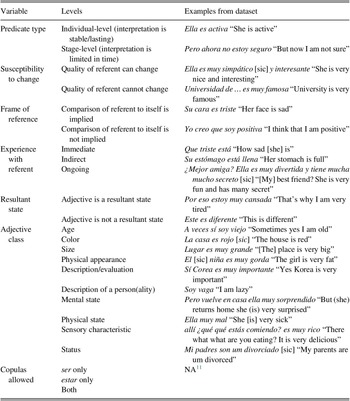
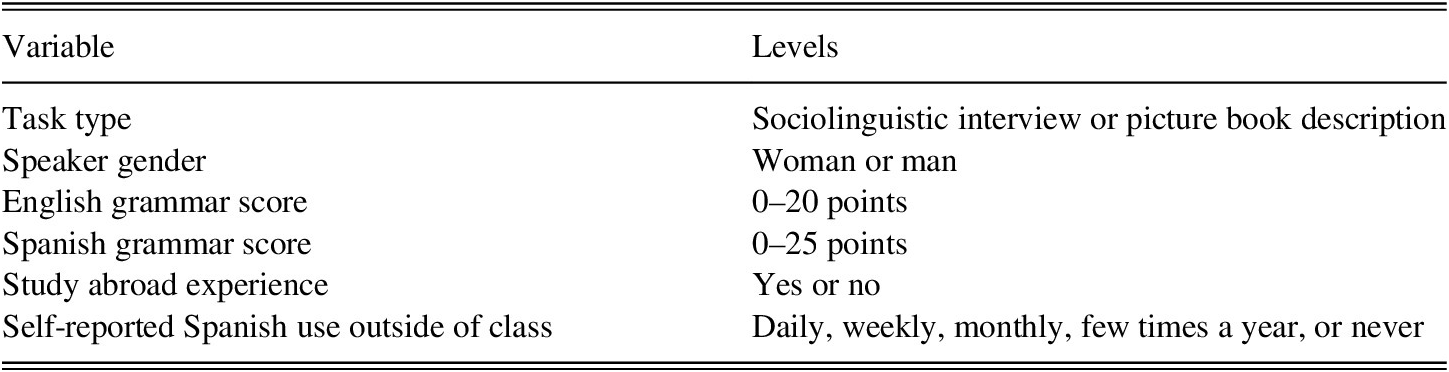
All recorded oral production data were transcribed by the researcher to facilitate identification of [copula + adjective] contexts and subsequent coding. Following linguistic analyses carried out in the variationist research paradigm,Footnote 10 each [copula + adjective] context was identified and coded for the copula form produced (i.e., the dependent variable) and the seven independent linguistic variables outlined in Table 4. Each independent linguistic variable was selected based on previous research of variable copula use in L2 Spanish (e.g., Geeslin, Reference Geeslin, Leow and Sanz2000, 2003).
Each [copula + adjective] context was further coded for the six extralinguistic independent variables listed in Table 5. Information regarding speaker sex, study abroad experience, and self-reported use of Spanish outside of class was gathered from completed background questionnaires.
Summary of coding scheme for linguistic independent variables

Note: NA = Not applicable.
Summary of coding scheme for extralinguistic independent variables

DATA ANALYSES
Following coding of each [copula + adjective] context, all data were entered into SPSS 26 for several analyses. The first was a frequency analysis to determine the rate of use (expressed as a percentage) of each form identified in [copula + adjective] contexts. Frequency analyses were carried out for each L1 learner group as well as each level within each L1 learner group.Footnote 12
Cross-tabulations between the dependent variable and each categorical independent variable outlined in Tables 4 and 5 were also examined. Scatterplots were drawn to examine the relationship between each level of the dependent variable (i.e., rates of use of the Spanish copulas produced) and each continuous independent variable (English grammar score, Spanish grammar score). These analyses were carried out for each level within each L1 learner group to visually inspect patterns of Spanish copula use for each independent variable and to provide descriptive information about the behavior of independent variables included in the inferential models.
The primary statistical methodology employed in the present study was multilevel binary logistic regression using generalized mixed models (lme4 package; Bates et al., Reference Bates, Mächler, Bolker and Walker2015) in R (R Core Team, 2019). This methodology was selected to fit predictive models that could account for (a) an outcome variable with a nonnormal distribution (as was the case in the present study), (b) correlated observations, and (c) hierarchical groupings in the data (IBM Knowledge Center, n.d.). Two multilevel mixed effects models were built and run for each L1 group—that is, one model for Korean-speaking learners and one model for English-speaking learners. This method of statistical analysis departs from Geeslin (Reference Geeslin, Leow and Sanz2000) and other variationist L2 acquisition studies that seek to predict a single outcome of a variable linguistic structure for several important reasons. Geeslin ran a forward stepwise regression for each instructional level sampled in her study. In the present study, visual inspection of the data using cross-tabulation revealed that there were empty cells in one or more levels of several independent variables. Furthermore, as the results will show, lower-level learners (e.g., first year and second year) produced estar very infrequently. As a result, to generate reliable predictions, a single model was fitted for each L1 learner group and Spanish grammar score was included in each model as a proxy for level.
For each model, the outcome variable was the copula form produced, operationalized as a dichotomous variable (either ser or estar). Although previous research has shown that omission is a frequent outcome in [copula + adjective] contexts for Korean-speaking learners (e.g., Geeslin & Long, Reference Geeslin, Long, Pérez-Jiménez, Leonetti and Gumiel-Molina2015), the present study focused on the alternation between ser and estar to directly compare results in the present study to those reported in previous investigations conducted with native English- (Geeslin, Reference Geeslin, Leow and Sanz2000) and Chinese-speaking learners (Cheng et al., Reference Cheng, Lu and Giannakouros2008). Each model initially included the independent variables listed in Tables 4 and 5 as fixed effects and participant and adjective as random effects.
RESULTS
In this section, findings are organized into subsections following the order of the first three research questions presented in the previous section. In each subsection, findings are presented first for the Korean-speaking learners and then for the English-speaking learners to facilitate comparison between the L1 learner groups.
FORMS PRODUCED IN [COPULA + ADJECTIVE] CONTEXTS
A total of 1,966 forms were observed in [copula + adjective] contexts in the dataset. These included ser, estar, developmental omission (e.g., pero ahora no seguro “but now I not sure”), discourse-based omission (e.g., un poco … un poco nervioso “a little … a little nervous”), contexts of ellipsis (e.g., soy vaga … pero muy divertida y habladora “I’m lazy … but fun and talkative”), other targetlike forms, and other nontargetlike forms. With respect to omission, developmental omission was considered to be nontargetlike, whereas discourse-based omission was considered to be targetlike.
Korean-Speaking Learners
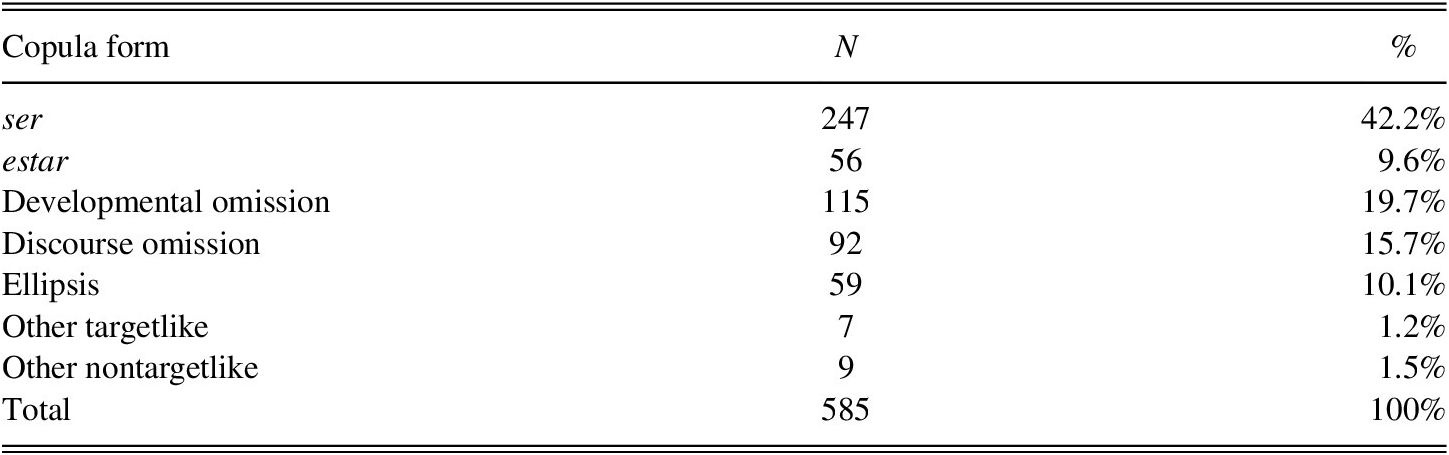
The overall distribution of forms produced by Korean-speaking learners in [copula + adjective] contexts is presented in Table 6. Ser was the most frequent form produced by Korean-speaking learners in [copula + adjective] contexts. The second and third most frequent forms produced by Korean-speaking learners were developmental and discourse-based omission, respectively, together comprising just more than 35% of observed forms. Contexts of ellipsis represent a tenth of the dataset, and, finally, estar was produced in 9.6% of [copula + adjective] contexts. Other targetlike forms (e.g., parecer “to seem” and sentir “to feel”) as well as nontargetlike forms (e.g., tener “to have”) were produced very infrequently and did not exceed 3% of observed forms.
Forms produced in [copula + adjective] contexts by Korean-speaking learners

English-Speaking Learners
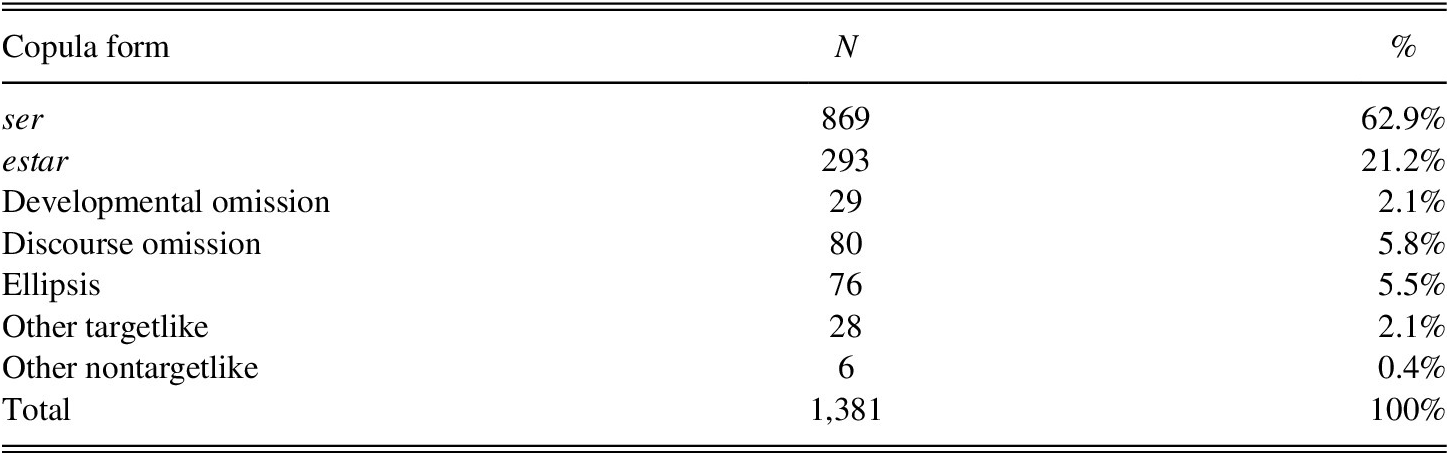
The distribution of forms produced by English-speaking learners in [copula + adjective] contexts is presented in Table 7.
Forms produced in [copula + adjective] contexts by English-speaking learners

Ser was likewise the most frequent form produced by English-speaking learners in [copula + adjective] contexts. The second most frequent form English-speaking learners produced was estar followed by discourse omission and ellipsis, respectively. The remaining forms (developmental omission and other forms, both targetlike and nontargetlike) comprised just less than 5% of observed forms in the English-speaking learner dataset.
DISTRIBUTION OF FORMS PRODUCED IN [COPULA + ADJECTIVE] CONTEXTS BY LEVEL
Korean-Speaking Learners
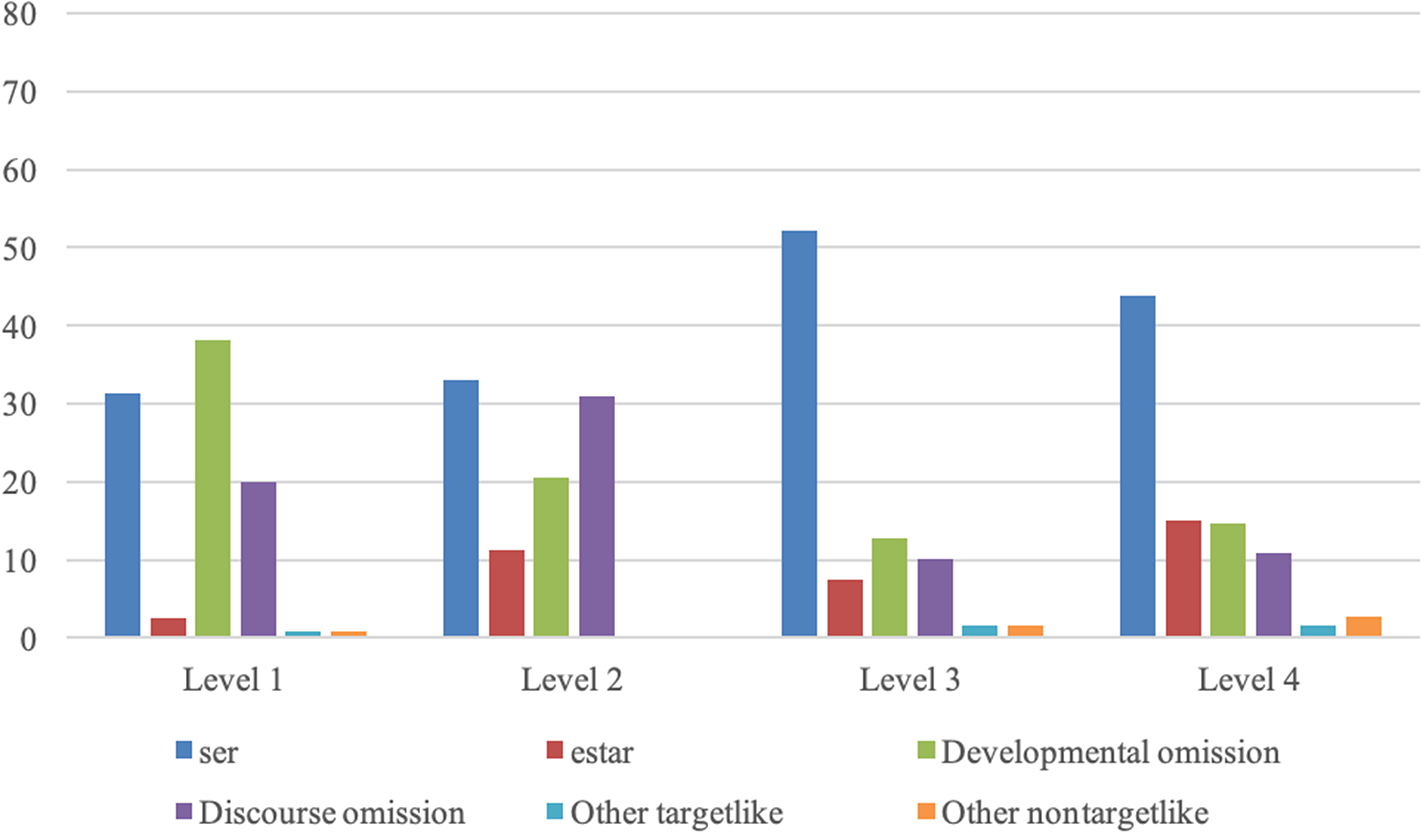
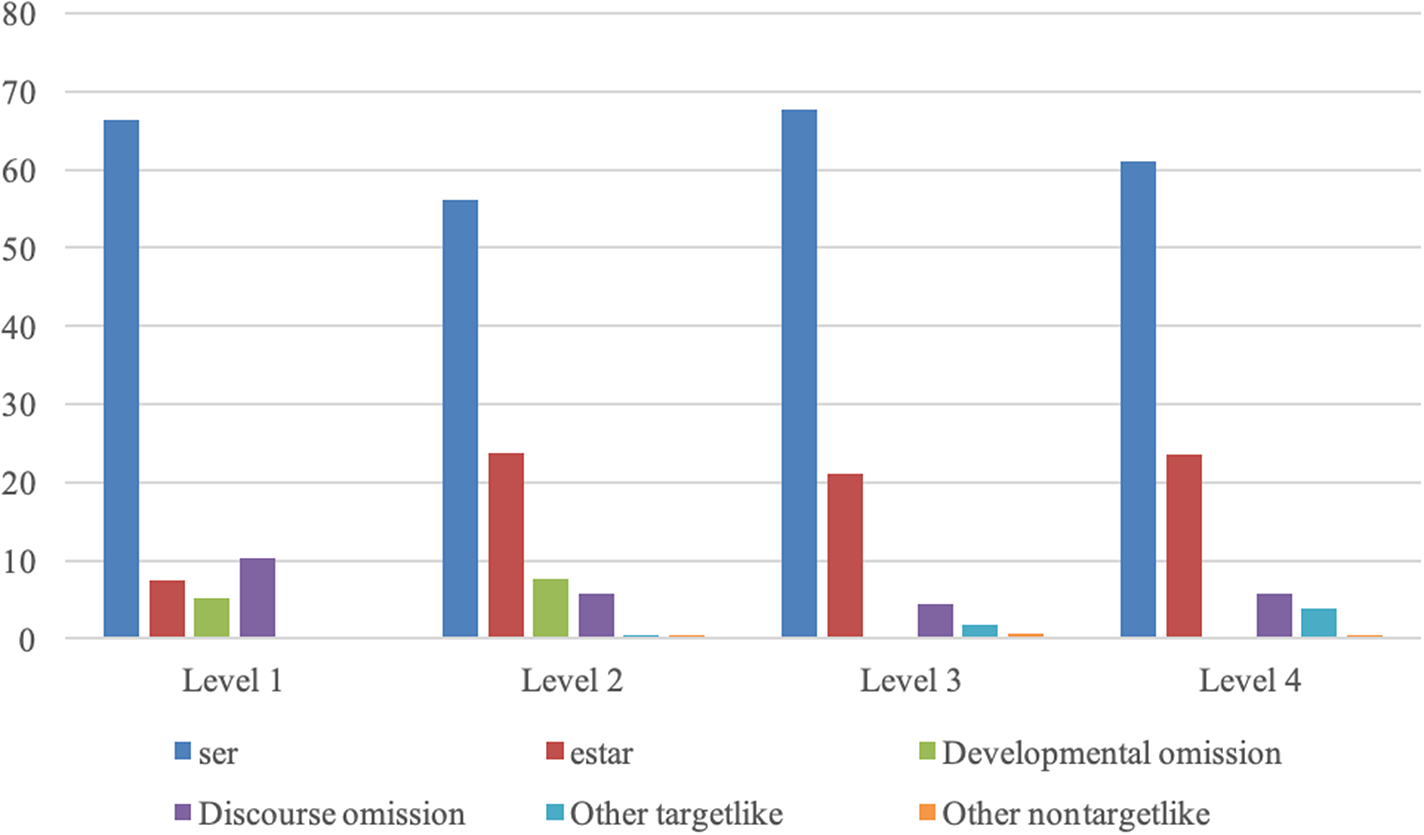
The distribution of copula forms produced by Korean-speaking learners in [copula + adjective] contexts for each instructional level sampled in the present study is presented in Figure 1.
Distribution of forms produced in [copula + adjective] contexts by Korean-speaking learners at four instructional levels.

Figure 1 shows several developmental trends with respect to forms produced in [copula + adjective] contexts. First, ser is the most frequent form produced by Korean-speaking learners starting at the second-year level and use of ser continues to increase (with a notable peak at the third-year level) as instructional level increases. Second, use of estar tends to increase as instructional level increases, although the overall trend for estar is an up-and-down pattern moving from the first to the fourth year. A Fisher’s Exact test showed that ser and estar use differed significantly across the four levels (p = .012). Third, developmental omission was the most frequent form observed for first-year learners but decreases notably as level increases (albeit with a slight rise from the third to fourth year). Strong developmental trends were not observed for other forms (targetlike or nontargetlike).
English-Speaking Learners
The distribution of copula forms produced by English-speaking learners at each instructional level is presented in Figure 2.
Distribution of forms produced in [copula + adjective] contexts by English-speaking learners at four instructional levels.

The most notable trend is that ser is the most frequent form produced by English-speaking learners at each level, and the frequency of ser demonstrates an up-and-down pattern as instructional level increases. A second trend of note is that estar increases sharply from first year to second year, and learners’ rate of estar use then remains relatively stable through the fourth year. Ser and estar use differed significantly across the four levels according to a Fisher’s Exact test (p < .001). Developmental omission is present only in the speech of first- and second-year English-speaking learners.
PREDICTORS OF ESTAR USE IN [COPULA + ADJECTIVE] CONTEXTS
It will be recalled that multilevel mixed effects models were fitted for each L1 group to identify the independent variables that significantly influence learners’ production of estar over ser while accounting for participant and adjective as random effects. For these analyses, the dataset was limited to the [copula + adjective] contexts in which ser and estar were produced.
Korean-Speaking Learners
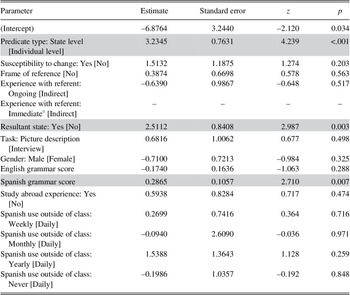
The final model for Korean-speaking learners reported in this section was based on 303 observations and did not include two linguistic variables (or fixed effects), Adjective Class and Copulas Allowed, due to empty cells across two or more levels of these variables. The final model reported here also did not include participant as a random effect.Footnote 13
Table 8 presents the details of the final generalized linear mixed model fitted for estar production by Korean-speaking learners. Each linguistic and extralinguistic independent variable is listed as a parameter in the first column. Coefficients indicate the direction of effect for each independent variable. For continuous variables, a positive coefficient means that the log-odds of producing estar increased as the scale of the variable increased, whereas a negative coefficient indicates that the log-odds of producing estar decreased as the variable scale increased. For categorical variables, a positive coefficient means that speakers were more likely to use estar for the level of the variable indicated as compared to a prespecified reference level (indicated in brackets beneath each parameter); a negative coefficient indicates that speakers were less likely to use estar. For Korean-speaking learners, significant predictors of estar use included Predicate Type, Resultant State, and Spanish grammar score. Learners were significantly more likely to produce estar (as opposed to ser) with stage-level predicates and with resultant state adjectives. Additionally, as learners’ Spanish grammar scores increased, so too did the log-odds of producing estar. No other variables statistically contributed to Korean-speaking learners’ production of estar over ser.
Fixed effects of mixed effects model of predictors of estar production for Korean-speaking learners

Note: Reference levels appear inside square brackets. The reference level for the dependent variable is ser. Statistically significant variables and levels are shaded.
a This level was excluded from analysis given that no contexts for its use were observed in the Korean learner dataset.
English-Speaking Learners
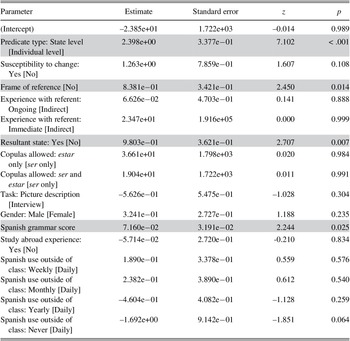
The final model for English-speaking learners reported in this section was based on 1,162 observations and excluded adjective class as a fixed effect and participant as a random effect.Footnote 14 Table 9 presents the details of the final generalized linear mixed model fitted for estar production by English-speaking learners. As shown in Table 9, several independent variables were significant predictors of estar use. English-speaking learners were significantly more likely to use estar with stage-level predicates, when a comparison of the referent to itself was implied, and with resultant state adjectives. Additionally, the log-odds of estar use increased significantly as Spanish grammar score increased. Although not statistically significant at the alpha = .05 level, English-speaking learners who reported never using Spanish outside of class used estar less than ser as compared to learners who reported using Spanish daily.
Fixed effects of mixed effects model of predictors of estar production for English-speaking learners

Note: Reference levels appear inside square brackets. The reference level for the dependent variable is ser. Statistically significant variables and levels are shaded.
DISCUSSION
In this section, the findings for each research question are summarized and discussed in relation to previous research on the acquisition of the Spanish copulas with adjectives. With respect to forms produced in [copula + adjective] contexts (Research Question 1), it was hypothesized that Korean-speaking learners would produce the full range of forms attested in previous research. The findings confirmed this hypothesis: Korean-speaking learners in the present study produced ser, estar, other forms (both targetlike and nontargetlike), and omission (both targetlike and nontargetlike) in attributive contexts. Regarding the frequency with which Korean-speaking learners produced each form at the four instructional levels sampled (Research Question 2), several predictions were made in line with previous research on Korean-speaking learners (Geeslin & Long, Reference Geeslin, Long, Pérez-Jiménez, Leonetti and Gumiel-Molina2015), and the findings confirmed each prediction. Specifically, the rates at which ser and estar were produced by Korean-speaking learners in this study increased as instructional level increased; however, ser was produced with greater frequency than estar regardless of level. Furthermore, nontargetlike or developmental omission was highest for first year learners but decreased as level decreased. Taken together, these findings lend additional empirical support for patterns of Spanish copular form use by Korean-speaking learners initially observed by Geeslin and Long (Reference Geeslin, Long, Pérez-Jiménez, Leonetti and Gumiel-Molina2015). Specifically, the present study has confirmed, using a larger dataset, that rates of developmental omission are extensive for Korean-speaking learners, and developmental omission persists into later stages of Spanish language learning. Nevertheless, the developmental path proposed for Spanish copula acquisition (VanPatten, Reference VanPatten, VanPatten, Dvorak and Lee1987) still holds for the Korean-speaking learners in this study given that they demonstrated overgeneralization of ser followed by a gradual increase of estar use (albeit at very low rates) as level increased. Thus, it appears that learners whose L1 does not employ a copula in attributive contexts (such as Chinese- and Korean-speaking learners) may proceed along a universal path of Spanish copula development but may do so at a slower rate than learners whose L1 employs at least one copula in the same context. An additional comparison of relevance is that Korean-speaking learners in the present study produced a similar range of nontargetlike forms (e.g., tener “to have”) as the Korean-speaking learners in Geeslin and Long (Reference Geeslin, Long, Pérez-Jiménez, Leonetti and Gumiel-Molina2015) but different from the nontargetlike forms produced by Geeslin’s (Reference Geeslin, Leow and Sanz2000) English-speaking learners. The implication of this finding is that the use of other nontargetlike forms likely reflects instances of language-specific lexical transfer, and in the case of Spanish copula choice this type of transfer appears to originate from the L1 (not other L2s) for Korean-speaking learners. Future research should examine this observation in greater detail and with more advanced Korean-speaking learners, given the well-documented role of language proficiency in lexical transfer (see, e.g., Bardel & Lindqvist, Reference Bardel, Lindqvist, Chini, Desideri, Favilla and Pallotti2007; Pfenninger & Singleton, Reference Pfenninger and Singleton2016; Williams & Hammarberg, Reference Williams and Hammarberg1998).
Regarding the linguistic and extralinguistic factors that predict Korean-speaking learners’ production of estar in [copula + adjective] contexts (Research Question 3), a generalized linear mixed effects model (that included all but two of the linguistic factors listed in Table 4 and each extralinguistic factor listed in Table 5) was built and examined. The findings confirmed the hypothesis that a combination of linguistic and extralinguistic factors predict Korean-speaking learners’ production of estar as opposed to ser in [copula + adjective] contexts. Specifically, learners were more likely to produce estar with stage- (as opposed to individual-) level predicates and with resultant state adjectives. Additionally, the probability of producing estar increased as scores on the Spanish grammar test increased. These findings overlap with Geeslin and Long’s (Reference Geeslin, Long, Pérez-Jiménez, Leonetti and Gumiel-Molina2015) investigation on Korean-speaking learners in several ways. First, like Geeslin and Long, the present study showed that production of estar is indeed connected to greater proficiency (operationalized as grammar test scores) in the target language. Second, although Geeslin and Long carried out only descriptive analyses of estar production, there is overlap in the linguistic contexts in which estar is used for Korean-speaking learners in both studies. Specifically, resultant state (as compared to other linguistic factors) appears to bear notable influence on Korean-speaking learners’ production of estar. It is worth noting here that Cheng et al. (Reference Cheng, Lu and Giannakouros2008) found that Chinese-speaking learners’ estar use in written essays was constrained by the susceptible to change variable, but this variable does not appear to constrain estar use in oral production for Korean-speaking learners. Lastly, Geeslin and Long found that Korean-speaking learners with three or more years of previous Spanish language study and with one year or more of experience abroad in a Spanish-speaking country used estar more than learners with fewer than three years studying Spanish and less than a year (or no time) abroad. The present study did not include years of previous Spanish language study in the mixed effects analysis, and study abroad was not a significant predictor of estar use; however, the trend for study abroad influence on estar use was the same reported by Geeslin and Long. Thus, using a larger dataset, the present study has confirmed some of the patterns uncovered by previous research on Korean-speaking learners. At the same time, these findings have offered additional insight into the relative influence of linguistic and extralinguistic constraints that govern estar use for this learner population.
Perhaps the most important objective of the present study was the comparison of variable Spanish copula use between Korean- and English-speaking learners (Research Question 4). In this vein, a unique methodological strength of the current investigation was a research design for which learners in the L1 groups under comparison completed the same data elicitation tasks. With respect to forms produced in [copula + adjective] contexts, findings showed that Korean- and English-speaking learners produced a very similar range of forms, confirming the original hypothesis. There were differences, however, in the types of other nontargetlike forms produced, and this difference likely reflects language-specific lexical transfer as previously discussed. Regarding the frequency of forms produced by level, the comparison of Korean- and English-speaking learners revealed more differences than similarities. Except for first-year Korean-speaking learners, ser was the most frequently produced form in attributive contexts at each level for each L1 learner group. Nevertheless, rates of developmental omission were much higher for Korean-speaking learners than for English-speaking learners and persisted into higher levels (third and fourth year) for the Korean-speaking learners. Additionally, although rates of estar use were low relative to ser for each L1 learner group, English-speaking learners at each level produced estar with higher frequencies than Korean-speaking learners at each level. Overall, the distribution of forms produced in [copula + adjective] contexts differed significantly between the Korean- and English-speaking learner groups, χ2(2) = 243.90, p < .001. The finding for developmental omission lends strong support for Geeslin and Long’s (Reference Geeslin, Long, Pérez-Jiménez, Leonetti and Gumiel-Molina2015) supposition that, because the [copula + adjective] structure is absent in Korean, Korean-speaking learners will take longer than English-speaking learners to simply use a copular form in this syntactic context (p. 317). In fact, VanPatten (Reference VanPatten, VanPatten, Dvorak and Lee1987) similarly hypothesized that learners who have no copula in their L1 would spend more time in the omission stage than English-speaking learners (p. 71), and the present study appears to confirm his hypothesis. The finding that ser is by and large the most frequent copular form produced after developmental omission subsides confirms that, similar to English-speaking learners, Korean-speaking learners overgeneralize ser to express attributive functions in Spanish. Thus, this finding additionally lends support for the generalizability of the stages of acquisition of Spanish copula choice originally proposed by VanPatten (Reference VanPatten1985, Reference VanPatten, VanPatten, Dvorak and Lee1987).
Lastly, with respect to the linguistic and extralinguistic factors influencing estar (as opposed to ser) use, the L1 learner groups exhibited more similarities than differences. The mixed effects analyses showed that scores on a Spanish grammar test was a significant predictor of estar use for Korean- and English-speaking learners, and the direction of effect was the same (as scores increased, the probability of producing estar instead of ser also increased). Predicate type and resultant state were also significant predictors of estar use for Korean- and English-speaking learners, and these linguistic factors constrained estar use in the same way for both groups (greater probability of estar over ser for stage-level predicates and resultant state adjectives). An additional factor that statistically influenced estar use for English-speaking learners (but not Korean-speaking learners) was contexts in which a comparison of the referent to itself was implied (frame of reference). This finding is consistent with Kanwit and Geeslin’s (Reference Kanwit and Geeslin2020) research on English-speaking learners’ interpretation of this variable; however, for Korean-speaking learners it may be that sensitivity to this variable is delayed precisely because copula production is delayed for this learner group. Future research should aim to identify the linguistic factors influencing estar use by level to shed light on the development of linguistic predictors of use. Overall, these findings support the continued examination of linguistic factors constraining variable copula choice in L2 Spanish initiated by Geeslin’s (Reference Geeslin, Leow and Sanz2000) research on English-speaking learners. That stated, it is important to note that rates of estar use were very low for Korean-speaking learners (even for fourth year learners). Consequently, it may be, as stated by Geeslin and Long (Reference Geeslin, Long, Pérez-Jiménez, Leonetti and Gumiel-Molina2015), that “analyses based exclusively on charting the development of estar over time that dominate the literature on English-speaking learners are not applicable to this learner group precisely because the rates of estar remain so low for such a long period of time” (p. 318). To evaluate more comprehensively the relevance and/or usefulness of these linguistic factors for explaining Korean-speaking learners’ variable Spanish copula choice, analysis of speech data from more advanced learners is needed.Footnote 15 Furthermore, our understanding of Korean-speaking learners’ use of copular forms in attributive contexts will benefit from future research that compares analyses based on tracing development of ser (versus developmental omission) with the present analysis that traced estar (versus ser).
One final topic that merits attention in this discussion is the potential role of other L2s in the development of variable Spanish copula choice. Arguably many (if not the majority) of the world’s Spanish language learners have some knowledge of English as either a L1 or L2. This is certainly the case for the Korean-speaking learners in the present study, for the Korean-speaking learners in Geeslin and Long (Reference Geeslin, Long, Pérez-Jiménez, Leonetti and Gumiel-Molina2015), and for the Chinese-speaking learners in Cheng et al. (Reference Cheng, Lu and Giannakouros2008, p. 305). Previously I argued that Korean-speaking learners must develop and produce a syntactic context that is absent in their L1 prior to acquiring constraints on variable copula use in [copula + adjective] contexts. However, these Korean-speaking learners have knowledge of English, a language that has the same structural context. With these observations in mind, the present investigation measured English language knowledge to examine its potential effect on Korean learners’ use of Spanish copulas. The present study showed no effect for English language knowledge measured in this way. Geeslin and Guijarro-Fuentes (Reference Geeslin, Guijarro-Fuentes and Eddington2005) likewise found no effect for knowledge of additional languages (self-reported by participants) on learners’ selection of estar on a written preference task. Future research on Korean-speaking learners should examine more carefully the potential role of English language knowledge on Spanish copula choice. Specifically, comparison of patterns of copula use in [copula + adjective] contexts in English with the same in Spanish is needed to initiate clearer understanding of (and a more informed discussion on) the role of the L1 and additional L2s in the acquisition of Spanish copula choice by Korean- (and, in general, non-English-) speaking learners. Future research of this kind will lend additional insight into the nature of crosslinguistic influence on the acquisition of sociolinguistic variation in second languages, at least for morphosyntactic structures. Furthermore, additional research on this learner population can offer useful insight into the role of language typology in crosslinguistic transfer in L3 acquisition (see, e.g., Amaro et al., Reference Amaro, Flynn and Rothman2012; Foote, Reference Foote2009; Hammarberg, Reference Hammarberg, Cenoz, Hufeisen and Jessner2001; Rothman, Reference Rothman2011) as well as more generally the role of prior linguistic knowledge at different stages of acquiring an additional language beyond the L2 (Rast, Reference Rast2010; Rothman & Cabrelli Amaro, Reference Rothman and Cabrelli Amaro2010). Research on Spanish language learners from typologically distinct L1 and L2 backgrounds ultimately strengthens our understanding of the nature and role of processes such as transfer in adult multilingualism.
CONCLUSIONS AND IMPLICATIONS
The present study compared Korean- and English-speaking learners’ production and patterns of use of Spanish copula forms in [copula + adjective] contexts at four distinct levels of Spanish language experience. Results showed that, similar to English-speaking learners (Geeslin, Reference Geeslin, Leow and Sanz2000), Korean-speaking learners overused ser and demonstrated a gradual integration of estar in [copula + adjective] contexts as experience with Spanish increased. However, unlike English-speaking learners, the Korean-speaking learners in this study omitted copulas in a nontargetlike manner (i.e., developmental omission) at notable rates, and this trend continued into higher levels (fourth-year learners), a finding that is attributed to the lack of a copula with adjectives in their L1. Additionally, results from the present study showed that a similar combination of linguistic and extralinguistic factors influenced production of estar (as opposed to ser) for each L1 learner group. Future research that includes more advanced Korean-speaking learners (who [presumably] produce estar at higher rates) will shed light on the nature of constraint development for Spanish copula choice in preadjectival contexts between learners who possess this structure in their L1 versus learners who do not. Future research should also examine individual patterns of variable copula choice against group patterns reported in the present study (see, e.g., Bayley & Langman, Reference Bayley and Langman2004; Geeslin et al., Reference Geeslin, Linford, Fafulas, Long, Díaz-Campos, Amaro, Lord, de Prada Pérez and Aaron2013) given well-attested variation in individual learning outcomes in L2 acquisition (Ellis, Reference Ellis, Davies and Elders2004). Nevertheless, this study expands research on the L2 acquisition of the Spanish copulas with adjectives by examining the role of learners’ L1 in patterns of copula use. In doing so, the study contributes to both the literature on the acquisition of variation and to research on less commonly studied language pairs in SLA.
These findings bear important implications for Spanish language pedagogy. Spanish is a global language whose classroom learners come from a diverse array of L1 backgrounds and language learning experiences. Based on the present study’s findings, there are at least two key takeaways for instructors facilitating classroom learners’ study of arguably one of the most challenging grammatical structures in Spanish. First, it is important to recognize that the use of the Spanish copulas with adjectives (as opposed to, e.g., participles) is particularly challenging for learners regardless of their L1 background. This means that instructors may expect very similar types of errors across students that may not benefit from extensive correction during early stages of learning, and there is likely little need to differentiate correction according to students’ L1 background. In practice, instructors can highlight these errors explicitly in the classroom to facilitate learners’ developing awareness of the (sometimes subtle) differences in meaning associated with the use of one copula over another in distinct situational contexts. Second, some errors (such as the use of tener with adjectives to express attributive functions) will be notably different across students from diverse L1 backgrounds, and it is worth investigating whether these errors can be traced to how meaning is expressed in the students’ L1 or other L2s. For example, instructors can engage learners in identifying similarities and differences in the expression of attributive functions in their L1s and Spanish, as well as any other L2s they use or know. By investigating the potential source of these errors, instructors and students can gain a better understanding of how copulas are used differently to express attributive meanings in the target language, which in turn may promote awareness of the source of language-specific transfer errors. In sum, the present study contributes to ongoing discussion regarding the role of transfer in L2 acquisition and offers a practical means for addressing it in the Spanish language classroom.