1. Introduction
Cable-driven parallel robot (CDPR) is a kind of parallel robot that replaces traditional rigid links with cables. CDPRs have many advantages over traditional parallel robots, such as simple structure, large workspace, low inertia of moving parts, fast-moving speed, high modularity and low cost [Reference Bosscher and Ebert-Uphoff1–Reference Abbasnejad and Carricato3]. It is widely used in radio telescopes, [Reference Yao, Tang, Li and Ren4] tactile interaction, [Reference Dominjon, Perret and Lécuyer5] construction tasks, [Reference Hamida, Laribi, Mlika, Romdhane, Zeghloul and Carbone6] high-speed pick and place manipulators [Reference Gonzalez-Rodriguez, Castillo-Garcia, Ottaviano, Rea and Gonzalez-Rodriguez7] and other fields. Since the 1980s, the CDPR has been a research hotspot in the field of robotics and attracted the attention of many researchers [Reference Albus, Bostelman and Dagalakis8,Reference Gosselin and Grenier9].
With the continuous innovation and development in modern manufacturing and scientific technologies, robots need to carry out many tasks at the same time and work in more complex environments, which results in higher requirements for the robots’ performance. The error of robots can be defined as the deviation between the theoretical position orientation and the actual position orientation, which is a significant problem in the industries that demand high precision on the completion of robots’ tasks [Reference He, Zhao and Yang10–Reference Santolaria, Juan-José, José-Antonio and Pastor13]. As for a CDPR, the rigid-flexible coupling in the structural design, manufacturing, assembly process and other factors can lead to its failure in achieving the desired precision. A CDPR is required not only for operations with high accuracy but also applications with greater flexibility. Therefore, it is essential to conduct error analysis for a CDPR.
Some research has been conducted on the error modeling and sensitivity analysis of parallel robots. The basic method for dealing with the error modeling of parallel robots is based on D-H parameter analysis method. Many scholars have proposed the influence coefficient method, the position and orientation error significance analysis and the distance error analysis for the parallel robots. Maurine et al. [Reference Maurine and Dombre14] established the error mapping model of 3-DOF parallel robot Delta 4 by the coordinate transformation method and dealt with sensitivity analysis. A two-stage calibration method for the parallel robot Delta 4 is presented. The results revealed the robustness of the protocol and validated this procedure. The simulation showed that the random errors should be less than 0.3 mm to have the accuracy about ±0.1° for the orientation and the offsets errors, and the identification procedure is robust with respect to these variations. This method can allow one to identify the absolute location of the robot base and the offsets on the three first joints. Nevertheless, the problem still existed that the contribution of each error component to the parallel robot Delta 4 cannot be calculated. Wang et al. [Reference Wang and Ehman15] established the error modeling of Stewart platform of 6-DOF and analyzed the position and orientation accuracy of the robot while considering the errors of spherical hinge and limb length. The method of sensitivity analysis can describe the contribution of each error component to the total position and orientation error of the mechanism, which was useful to understand the character and propagation of errors of 6-DOF Stewart platform.
There are also some studies on error modeling and sensitivity analysis of CDPRs. Reicherts et al. [Reference Reicherts, Blume, Reichert and Schramm16] proposed a method for the accurate estimation of the kinematic parameters of a CDPR, where the calibration process was simplified, and the calibration accuracy was improved through sensitivity analysis of the CDPR. The results showed that the parameter influence generally decreases with its interaction level. This characteristic can be explained by the kinematic loops, which is a particular property of the CDPR. The parameter effects and interactions were calculated to carry out the sensitivity analysis, but local sensitivity of the kinematic parameters like the cable length was not presented, and it is important to determine the sensitivity kinematic parameters. Baklouti et al. [Reference Baklouti, Caro and Courteille17] carried out a sensitivity analysis of geometric and mechanical uncertainties for the CDPR to achieve robust control which is based on elastic geometric models. Considering 62 geometric and mechanical error sources, the effects of external loads on static deflection of the moving platform of the CDPR were analyzed. The proposed model was verified for the purpose of model-based control of the CDPR. This research revealed that the integrating cables hysteresis effect on the error modeling is important to enhance the cables’ mechanical behavior, especially when there was no feedback about tension measurement. However, a better error modeling can be used for the calibration and identification of geometrical parameters. There were some limitations on the research of the error local sensitivity and sensitivity coefficient. Aref et al. [Reference Aref, Gholami and Taghirad18] studied the impact of mechanical assembly tolerances on the closed-loop control performance of a CDPR, where the sensitivity analysis of the precision in the construction and assembly of the system was performed in the closed loop. The results of the research indicated that most of position and orientation errors of the CDPR are originating from the components. The induced errors are caused by mechanical and measurement errors in this research, which leads to the result that the error mapping function of the CDPR is not obvious. Therefore, the uncompensated error sources can be controlled through error analysis, which is helpful for the minimization of error [Reference Shi and Liu19]. The sources of error for uncompensated errors can be eliminated or minimized according to the sensitivity of the system response to each error source [Reference Liu, Huang and Chetwynd20,Reference Huang, Li, Tang, Li, Zhao, Whitehouse, Chetewyn and Liu21]. The approach is helpful to determine the parameters of the mechanism and the dynamic analysis of the system during the design process [Reference Zi22]. The studies of error modeling and sensitivity analysis can be used for the optimization design, error compensation and accuracy synthesis of the CDPR.
In these above-mentioned former works, the robots are either rigid-body robots or robots only driven by cables. Although the influence of pulleys is obviously one of the error sources of cable-driven mechanisms, it is rarely concerned in error analyses of CDPR, as pulleys are simplified to be ideal points in many works [23]. In this paper, the conceptual design of a CDPR driven by the mixed action of the cables and a limb is developed. A method which can be used for the error modeling and sensitivity analysis of this kind of CDPR is provided. By combining the inverse position analysis with the relationship between cables’ length and pulleys’ radius, the error mapping model of the CDPR is established efficiently. This model can be applicable for the parallel robots with the characteristics of rigid-flexible coupling. Through sensitivity analysis including the error local sensitivity and the error sensitivity coefficients, the influence of each source of error can be presented visually. Except for the ability to graphically depict the error distribution throughout the workspace, it is instrumental in selecting the best regions in the workspace to perform the work.
The overall work of this paper is listed as follows. In Section 2, the conceptual design of the CDPR is carried out and the final mechanical design scheme is determined. The description of the mechanical structure and kinematics analysis of the CDPR are introduced in Section 3. The geometric error modeling and analysis of the CDPR based on kinematics are provided in Section 4. The sensitivity analysis based on the error modeling is presented in Section 5. In Section 6, the numerical examples are carried out to verify the validity of the error modeling and sensitivity error sources of the CDPR. The conclusions are given in Section 7.
2. Conceptual design of a CDPR
A CDPR with two rotational degrees of freedom can be designed for fields like wind tunnel testing, [Reference Liu, Qiu and Sheng25] patient rehabilitation [Reference Rosati, Gallina and Masiero26] and wearable equipment [Reference Ying and Agrawal27]. The inertia of the CDPR is reduced due to the use of the light-weight cable instead of the rigid link as the transmission component, and the CDPR has a higher ration of load capacity/weight.
Most of the cable-driven parallel mechanisms connect one side of the cable to the moving platform, and the other side is connected to the motor through a fixed platform. The tension cable has a certain rigidity, so it can be equivalent to the effect of a moving pair in theory [Reference Cui, Zhang, Zhang and Hao24]. As the flexible cable can only bear tension along its axis direction instead of pressure, n cables cannot realize the complete constraint of n degrees of freedom position. At least (
 $n + 1$
) cables are needed to realize the complete constraint of position, and the extra one or more cables are used to ensure that all the driving cables in the mechanism are in tension state. As a result, CDPRs can be divided into the following three categories according to the relationship between the degrees of freedom of the platform n and the number of cables m [Reference Verhoeven28]: (i) incompletely restrained mechanisms (
 $m \le n$
), (ii) completely restrained mechanisms (
 $m = n + 1$
) and (iii) redundantly restrained mechanisms (
 $m \gt n + 1$
). And the completely restrained cable mechanisms can be divided into the following types, as shown in Table I.
Degrees of freedom and types of motion of mechanisms.

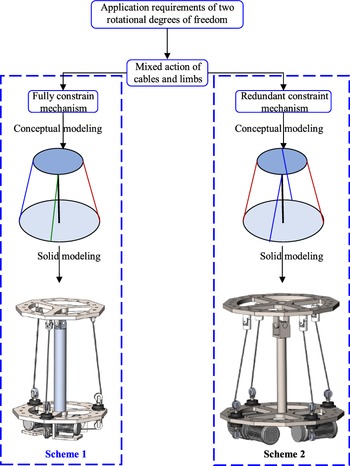
According to the above analysis of the degree of freedom and the type of motion, it can be determined that a CDPR with two degrees of freedom needs three cables to realize its expected motion. As for the redundantly restrained mechanism, there can be four cables, each two cables in the opposite positions drive one degree of freedom. Both the completely restrained mechanism and the redundantly restrained mechanism are useful in some applications, so they are both considered and designed. Comparison of the characteristics of the two schemes are given in Table II. The flow charts of conceptual design schemes of the CDPR are given in Fig. 1.
Comparison of the characteristics of schemes.

The flow charts of conceptual design schemes of the CDPR.

The above-mentioned conceptual designs shown in Fig. 1 can both achieve the expected motion, but there are differences in working performances. Considering the cost and the complexity of control, [Reference Zhao, Gao, Dong and Zhao29] the design of Scheme 1 is better than that of Scheme 2. In order to simplify the model and facilitate the calculation, the Scheme 1 is investigated in this paper.
3. Kinematics analysis of the CDPR
3.1 Structure description
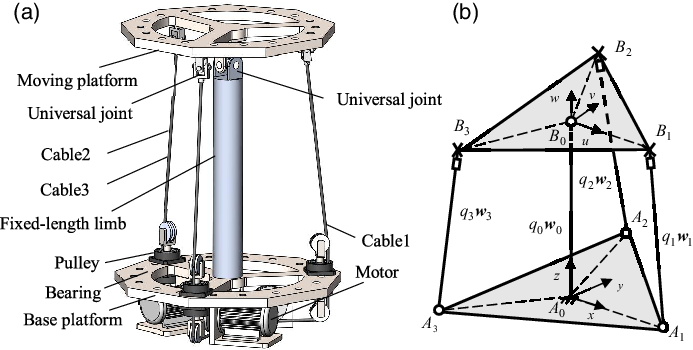
A three-dimensional model of a CDPR is shown in Fig. 2(a). This structure consists of a moving platform, a base platform, three external cable-driven chains and a fixed-length limb chain. The three external cable-driven chains are the same as each other. One end of the three cable-driven branching chains is connected with the moving platform through a universal joint. The other end is coiled on the motor through a pulley. Motors are placed under the base platform. The three cable branching chains of the CDPR are distributed outside. Each cable is driven by a motor, and all the cables are axis symmetrically distributed in space. One end of the supporting chain of the fixed-length limb is connected with the moving platform through the universal joint, and the other end is vertically fixed with the center of the base platform through bolts, which are placed at the center of the CDPR. The hinge points of both the moving platform and the base platform are designed to be placed at the vertex of the triangle.
The CDPR: (a) three-dimensional model of the CDPR and (b) structure diagram of the CDPR.

Figure 2(b) shows the structural scheme of the CDPR. Point A i and B i (i = 1,2,3) represent the center point of the cable-driven branched pulley and the cable-supported universal joint, respectively. On the base platform and moving platform, the distribution is designed to be an equilateral triangle. The central fixed-length limb connects the base platform and moving platform on the point A 0 and B 0, respectively.
3.2 Kinematic model
As shown in Fig. 2(b), a fixed coordinate system A
0
-xyz is established on the center point A
0 of the base platform. The x-axis points in the direction of point A
0 to point A
1, and the vertical base platform of the z-axis points to the moving platform. The y-axis satisfies the right-hand rule. A fixed coordinate system B
0
-uvw is established on the center point B
0 of the moving platform, in which the u-axis is pointed in the direction from point B
0 to point B
1, and the w-axis is perpendicular to the plane of the moving platform, and the v-axis satisfies the right-hand rule. To establish the kinematics model of the CDPR and simplify the subsequent calculation, the universal joints of the three cable-driven branches and the universal joints of the fixed-length limb branches are all located on the moving platform, and the pulleys of the three cable-driven branches are all located on the base platform. Therefore, the center point B
0 of the moving platform can be described by position vector r and rotation matrix
 ${}^{{A_0}}{\boldsymbol{R}_{{B_0}}}$
, which is defined as the rotation matrix from the moving platform to the base platform. It can be expressed by three Euler angles, namely rotates angle
 $\phi$
x
first around the fixed x-axis and then rotates with the angle
 $\phi$
y
around the fixed y-axis and finally rotates with the angle
 $\phi$
z
around the fixed z-axis. So
 ${}^{{A_0}}{\boldsymbol{R}_{{B_0}}}$
can be written as
 \begin{align}{}^{{A_0}}{\boldsymbol{R}_{{B_0}}} = {\rm{Rot(}}z,{\phi _z}{\rm{)Rot(}}y,{\phi _y}{\rm{)Rot(}}x,{\phi _x}{\rm{)}}\end{align}
where
 \begin{align}c{\phi _x} = \cos {\phi _x},s{\phi _x} = \sin {\phi _x}\end{align}
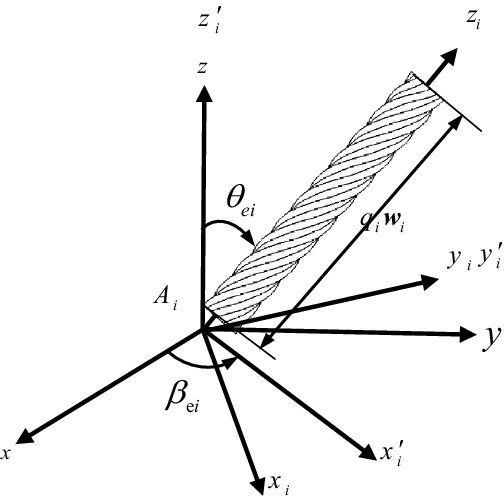
As shown in Fig. 3, the coordinate system A
i
-x
i
y
i
z
i
(i = 1,2,3) is established at point A
i
to describe the cable-driven branching chain. The orientation rotation angle of each cable-driven branched-chain in the base platform coordinate system can be expressed by two Euler angles. It can be regarded as a rotation with the angle
 $\beta$
ei
about the z-axis resulting in the coordinate system B
i
-x
i
′y
i
′z
i
′
followed by another angle
 $\theta$
ei
about the rotated y
i
′
-axis.
 ${}^{{A_0}}{\boldsymbol{R}_i}$
is defined as the rotation change matrix from the connected coordinate system to the base platform fixed coordinate system. Therefore,
 ${}^{{A_0}}{\boldsymbol{R}_i}$
can be obtained as
 \begin{align}{}^{{A_0}}{\boldsymbol{R}_i} = {\rm{Rot(}}z,{\beta _{ei}}{\rm{)Rot(}}{y'_i},{\theta _{ei}}{\rm{)}}\end{align}
The local coordinate system of the ith cable.

The unit vectors w 0 of the fixed-length limb A 0 B 0 and the unit vectors w i of the cable branched-chain A i B i are described as
 \begin{align}{\boldsymbol{w}_0}{\rm{\;=\;}}{\left[ {\begin{array}{*{20}{c}}0\;\;\;\;\;\;0\;\;\;\;\;\;1\end{array}} \right]^T}\end{align}
 \begin{align}{\boldsymbol{w}_i}\;=\;{}^{{A_0}}{\boldsymbol{R}_i}{[\begin{array}{*{20}{c}}0\;\;\;\;\;\;0\;\;\;\;\;\;1\end{array}]^T}\;=\;{\left[ {\begin{array}{*{20}{c}}{c{\beta _{ei}}s{\theta _{ei}}}\;\;\;\;\;\;{s{\beta _{ei}}s{\theta _{ei}}}\;\;\;\;\;\;{c{\theta _{ei}}}\end{array}} \right]^T}\end{align}
Therefore, the position orientation rotation angle of the cable-driven branched-chain, Euler angle
 $\theta$
ei
and Euler angle
 $\beta$
ei
can be calculated as
 \begin{align}\left\{ \begin{array}{l}c{\theta _{{\rm{e}}i}}{\rm{\;=\;}}{\boldsymbol{w}_{iz}}\\[4pt] s{\theta _{ei}}\;=\;\sqrt {\boldsymbol{w}_{ix}^2 + \boldsymbol{w}_{iy}^2}, \left( {0 \le {\theta _{ei}} \lt \pi } \right)\\[4pt] c{\beta _{ei}}\;=\;{\boldsymbol{w}_{ix}}/s{\theta _{ei}}\\[4pt] s{\beta _{ei}}\;=\;{\boldsymbol{w}_{iy}}/s{\theta _{ei}}\\[4pt] {\rm{if}} {\theta _{ei}}{\rm{\;=\; }}0,\;\;\; {\rm{then}}\;\;\; {\beta _{ei}}{\rm{\;=\;}}0\end{array} \right.\end{align}
3.3 Inverse position analysis
As shown in Fig. 2(b), the position closed-loop constraint equation is described as (7) according to the principle of vector closure in the fixed coordinate system of the base platform.
 \begin{align}{\boldsymbol{a}_i} + {q_i}{\boldsymbol{w}_i}{\rm{\;=\;}}\boldsymbol{H} + {}^{{A_0}}{\boldsymbol{R}_{{B_0}}}{}^{{B_0}}{\boldsymbol{b}_i},(i\;=\;1,2,3)\end{align}
The length of the cables can be obtained as
 \begin{align}{q_i} \;=\; \sqrt {{{\left( {\boldsymbol{H} - {\boldsymbol{a}_i} + {}^{{A_0}}{\boldsymbol{R}_{{B_0}}}{}^{{B_0}}{\boldsymbol{b}_i}} \right)}^T}\left( {\boldsymbol{H} - {\boldsymbol{a}_i} + {}^{{A_0}}{\boldsymbol{R}_{{B_0}}}{}^{{B_0}}{\boldsymbol{b}_i}} \right)} \end{align}
where
 \begin{align}\boldsymbol{H} = {q_0}{\boldsymbol{w}_0}{\rm{ \;=\; }}{\left[ {\begin{array}{*{20}{c}}0\;\;\;\;\;0\;\;\;\;\;{h'}\end{array}} \right]^T}\end{align}
 \begin{align}{\boldsymbol{a}_0}{\rm{ \;=\; }}{\left[ {\begin{array}{*{20}{c}}0\;\;\;\;\;0\;\;\;\;\;0\end{array}} \right]^T}\end{align}
 \begin{align}{\boldsymbol{a}_i} \;=\; R{\left[ {\begin{array}{*{20}{c}}{c{\alpha _i}}\;\;\;\;\;{s{\alpha _i}}\;\;\;\;\;0\end{array}} \right]^T}\end{align}
 \begin{align}{}^{{B_0}}{\boldsymbol{b}_0}{\rm{ \;=\; }}{\left[ {\begin{array}{*{20}{c}}0\;\;\;\;\;0\;\;\;\;\;0\end{array}} \right]^T}\end{align}
 \begin{align}{}^{{B_0}}{\boldsymbol{b}_i} = r{\left[ {\begin{array}{*{20}{c}}{c{\gamma _i}}\;\;\;\;\;{s{\gamma _i}}\;\;\;\;\;0\end{array}} \right]^T}\end{align}
 \begin{align}{\alpha _i} \;=\; {\left[ {\begin{array}{*{20}{c}}{{\alpha _1}}\;\;\;\;\;{{\alpha _2}}\;\;\;\;\;{{\alpha _3}}\end{array}} \right]^T} \;=\; {\left[ {\begin{array}{*{20}{c}}0\;\;\;\;\;{\dfrac{{4\pi }}{3}}\;\;\;\;\;{\dfrac{{2\pi }}{3}}\end{array}} \right]^T}\end{align}
 \begin{align}{\gamma _i} = {\left[ {\begin{array}{*{20}{c}}{{\gamma _1}}\;\;\;\;\;{{\gamma _2}}\;\;\;\;\;{{\gamma _3}}\end{array}} \right]^T} = {\left[ {\begin{array}{*{20}{c}}0\;\;\;\;\;{\dfrac{{4\pi }}{3}}\;\;\;\;\;{\dfrac{{2\pi }}{3}}\end{array}} \right]^T}\end{align}
Here, R, r, H, h
′
, q
i
,
a
i
,
 ${}^{{B_0}}{\boldsymbol{b}_i}$
, and
b
i
represent the radius of the base platform, radius of the moving platform, the position vector of point B
0 on the moving platform, the length of the fixed-length limb, the length of cable A
i
B
i
, the position vector of point A
i
expressed in the fixed coordinate system A
0
-xyz of the base platform, the position vector of point B
i
expressed in the moving coordinate system B
0
-uvw, the position vector of point B
i
described in the fixed coordinate system A
0
-xyz of the base platform, respectively. α
i
is the angle between the vector
a
i
and the x-axis in the fixed coordinate system A
0
-xyz, and Γ
i
is the angle between the vector
 ${}^{{B_0}}{\boldsymbol{b}_i}$
and the u-axis in the moving coordinate system B
0
-uvw.
3.4 Pulley modeling
Earlier analysis of cable-driven robots generally regarded the cable around the pulley as a center point in the theoretical analysis. However, the cable does not pass through one point in the course of the movement when the cable crosses the pulley. The wrap angle of the cable on the pulley also affects the length of the cable, which influences the accuracy of the CDPR [Reference Gallina and Rosati30]. To establish a more accurate error model of the CDPR, it is necessary to take the influence of the pulleys into consideration.
The cable of CDPR passing through the pulley is shown in Fig. 4. A i is the center of the pulley on the base platform. A is the tangent point between the cable and the pulley. B i is the hinge point between the cable and the moving platform. Assuming the tangent point between the cable and the pulley is A ′ after some time, the hinge point between the cable and the moving platform is B ′ i . As the change in cable length depends on the radius of the drum connected to the motor, the influence of motor is not considered in this paper. The variation in the actual cable length after movement can be obtained as
 \begin{align}\Delta {l_i}{\rm{ \;=\; }}\left\| {{{A'}_{\!\!i}}{{B\kern0.5pt'}_{\!\!i}}} \right\| - \left\| {{A_i}{B_i}} \right\|{\rm{ \;=\; }}\sqrt {q_{i}^{2} - r_{oi}^{2}} - \sqrt {q{'}_{i}^{2} - r_{oi}^{2}} + \Delta {\alpha_i} \cdot {r_{oi}}\end{align}
where Δl i , ||A i B ′ i ||, ||A i B i ||, r oi , Δα i , q i and q ′ i represent the variation of the ith cable length, the length of the ith cable after movement, the initial length of the ith cable, the radius of the ith pulley, the variation of the ith wrap angle, the nominal length of the ith cable before movement and the nominal length of the ith cable after movement, respectively.
Systematic structural diagram of a cable passing through the pulley.

According to geometric relations shown in Fig. 4, Δα i can be calculated as
 \begin{align}\Delta {\alpha_i} = \left({\beta_{ei}} - \arcsin \frac{{{r_{oi}}}}{{{q_i}}}\right) - \left({\beta'_{\!\!ei}} - \arcsin \frac{{{r_{oi}}}}{{{{q'}_{\!\!i}}}}\right)\end{align}
where
 $\beta$
ei
and
 $\beta'_{\!\!ei}$
are calculated in (6).
4. Error analysis
Assume that the processing errors of the cable, moving platform, base platform, middle fixed-length limb and pulleys are dl
i
, dr
i
, dR
i
, dh
′
i
and dr
oi
, respectively. The installation point A
i
of the cable and the pulley is evenly distributed on the base platform, and the pulley installation angle is
 $\beta$
i
, which represents the angle between the vector
a
i
and the normal vector of the surface of the pulley. The installation point B
i
of the cable and the moving platform is evenly distributed on the moving platform, and the cable installation angle is
 $\theta$
i
, which represents the angle between the normal vector along the cable direction and the plane where the moving platform is located. Assembly errors corresponding to the pulley installation angle and the cable installation angle are d
 $\beta$
i
, and d
 $\theta$
i
, respectively. In order to establish the error modeling for the CDPR, (17) can be rewritten as
 \begin{align}{f_i}({r_{oi}},{\phi_x},{\phi_y},{\phi_z},{\beta_i},{\theta_i},{h'_{\!\!i}},{R_i},{r_i},{l_i}) = 0,(i = 1,2,3)\end{align}
By differentiating (18) with respect to all the variables
 \begin{align}\begin{array}{l}\dfrac{{\partial {f_i}}}{{\partial {r_{oi}}}}d{r_{oi}} + \dfrac{{\partial {f_i}}}{{\partial {\phi_x}}}d{\phi_x} + \dfrac{{\partial {f_i}}}{{\partial {\phi_y}}}d{\phi_y} + \dfrac{{\partial {f_i}}}{{\partial {\phi_z}}}d{\phi_z} + \dfrac{{\partial {f_i}}}{{\partial {\beta_i}}}d{\beta_i}\\[10pt] + \dfrac{{\partial {f_i}}}{{\partial {\theta_i}}}d{\theta_i} + \dfrac{{\partial {f_i}}}{{\partial {{h'}_i}}}d{{h'}_{\!\!i}} + \dfrac{{\partial {f_i}}}{{\partial {R_i}}}d{R_i} + \dfrac{{\partial {f_i}}}{{\partial {r_i}}}d{r_i} + \dfrac{{\partial {f_i}}}{{\partial {l_i}}}d{l_i}{\rm{ \;=\; }}0\end{array}\end{align}
The matrix form of (19) is described as
 \begin{align}\boldsymbol{Q}{\boldsymbol\varepsilon} = \boldsymbol{U}\end{align}
where
 \begin{align}\boldsymbol{Q} = \left[ {\begin{array}{*{20}{c}}{{Q_{i{\phi _x}}}}\;\;\;\;\;{{Q_{i{\phi _y}}}}\;\;\;\;\;{{Q_{i{\phi _z}}}}\end{array}} \right]\end{align}
 \begin{align}{\boldsymbol{Q}_{i{\phi _x}}} = {\left[ {\begin{array}{*{20}{c}}{{Q_{1{\phi _x}}}}\;\;\;\;\;{{Q_{2{\phi _x}}}}\;\;\;\;\;{{Q_{3{\phi _x}}}}\end{array}} \right]^T}\end{align}
 \begin{align}{\boldsymbol{Q}_{i{\phi _y}}} = {\left[ {\begin{array}{*{20}{c}}{{Q_{1{\phi _y}}}}\;\;\;\;\;{{Q_{2{\phi _y}}}}\;\;\;\;\;{{Q_{3{\phi _y}}}}\end{array}} \right]^T}\end{align}
 \begin{align}{\boldsymbol{Q}_{i{\phi _z}}} = {\left[ {\begin{array}{*{20}{c}}{{Q_{1{\phi _z}}}}\;\;\;\;\;{{Q_{2{\phi _z}}}}\;\;\;\;\;{{Q_{3{\phi _z}}}}\end{array}} \right]^T}\end{align}
 \begin{align}{Q_{i{\phi _x}}} = \frac{{\partial {f_i}}}{{\partial {\phi _x}}},{Q_{i{\phi _y}}} = \frac{{\partial {f_i}}}{{\partial {\phi _y}}},{Q_{i{\phi _z}}} = \frac{{\partial {f_i}}}{{\partial {\phi _z}}}\end{align}
 \begin{align}{\boldsymbol{\varepsilon }}{\rm{ \;=\; }}{\left[ {\begin{array}{*{20}{c}}{d{\phi _x}}\;\;\;\;\;{d{\phi _y}}\;\;\;\;\;{d{\phi _z}}\end{array}} \right]^T}\end{align}
 \begin{align}\boldsymbol{U} = {\left[ {\begin{array}{*{20}{c}}{{U_1}}\;\;\;\;\;{{U_2}}\;\;\;\;\;{{U_3}}\end{array}} \right]^T}\end{align}
 \begin{align}{U_i} = \boldsymbol{C}_{i}{\boldsymbol{\delta }}{\boldsymbol{p}_i}\end{align}
 \begin{align}\boldsymbol{C}_{i}{\rm{ \;=\; }}\left[ {\begin{array}{*{20}{c}}{ - \dfrac{{\partial {f_i}}}{{\partial {r_{oi}}}}}\;\;\;\;\;{ - \dfrac{{\partial {f_i}}}{{\partial {\beta_i}}}}\;\;\;\;\;{ - \dfrac{{\partial {f_i}}}{{\partial {\theta _i}}}}\;\;\;\;\;{ - \dfrac{{\partial {f_i}}}{{\partial {{h'}_i}}}}\;\;\;\;\;{ - \dfrac{{\partial {f_i}}}{{\partial {R_i}}}}\;\;\;\;\;{ - \dfrac{{\partial {f_i}}}{{\partial {r_i}}}}\;\;\;\;\;{ - \dfrac{{\partial {f_i}}}{{\partial {l_i}}}}\end{array}} \right]\end{align}
 \begin{align}{\boldsymbol{\delta }}{\boldsymbol{p}_i}{\rm{ \;=\; }}{\left[ {\begin{array}{*{20}{c}}{d{r_{oi}}}{d{\beta _i}}\;\;\;\;\;{d{\theta_i}}\;\;\;\;\;{d{{h'}_i}}\;\;\;\;\;{d{R_i}}\;\;\;\;\;{d{r_i}}\;\;\;\;\;{d{l_i}}\end{array}} \right]^T}\end{align}
Here, ε represents the orientation error of the center point of the CDPR’s moving platform. Δp i represents the collection of error sources including the size error, assembly error and driving error of the moving platform, base platform and middle fixed-length limb. C i represents the orientation error coefficient matrix related to the mechanical structure of the CDPR.
According to (23), the error mapping function of the CDPR can be transferred as
 \begin{align}{\boldsymbol{\varepsilon }} = \boldsymbol{M}\boldsymbol{C}_{i}{\boldsymbol{\delta }}{\boldsymbol{p}_i}\end{align}
where
M
is the error transfer matrix of the CDPR, which represents the path expression of the error from the design variable (r
o1,r
o2,r
o3,R
1,R
2,R
3,r
1,r
2,r
3,h
’
1,h
’
2,h
’
3,
 $\beta$
1,
 $\beta$
2,
 $\beta$
3,
 $\theta$
1,
 $\theta$
2,
 $\theta$
3) and the driving cable space (l
1,l
2,l
3) to the orientation space (
 $\phi$
x
,
 $\phi$
y
,
 $\phi$
z
) of the moving platform.
5. Sensitivity analysis
According to the previous error analysis and modeling, there are 21 static sources of error in the CDPR. To facilitate further analysis and calculation, a sensitivity model is established to analyze the influence of each error on the position orientation accuracy of the moving platform of the parallel mechanism [Reference Chen, Xie, Liu and Zhou31–Reference Fan, Wang, Zhao and Chang33]. When the number of error components in the source of a mechanism error is large enough, and the position orientation errors of the end effector and the error components are independent random variables, the errors obey a normal distribution [Reference Miermeister, Kraus, Lan and Pott34]. Because the action mechanisms between errors are complicated, this paper considers the case that the error components are independent for each other. Assuming that each error obeys the standard normal distribution, the variance of ε can be calculated as
 \begin{align}D({\boldsymbol{\varepsilon }}) = E({{\boldsymbol{\varepsilon }}^2}) = \sum\limits_{j = 1}^{21} {\left( {\sum\limits_{i = 1}^3 {\lambda _{ij}^2} } \right)} E({\boldsymbol{\delta }}p_{ij}^2)\end{align}
where
 \begin{align}{{\boldsymbol{\lambda }}_{i} = \boldsymbol{M}\boldsymbol{C}_i},(i = 1,2,3)\end{align}
Here, Λ
ij
represents the ith row and the jth column element in
Λ
i
. Δp
ij
represents the jth element in
 ${\boldsymbol\delta}$
p
i
.
Because the three cable branches of the CDPR are evenly distributed in space, the mean value of Δp ij can be obtained as
 \begin{align}E({\boldsymbol{\delta }}p_{ij}^2) = E({\boldsymbol{\delta }}p_{1j}^2) = E({\boldsymbol{\delta }}p_{2j}^2) = E({\boldsymbol{\delta }}p_{3j}^2)\end{align}
Combining (33) and (34) into one expression, the standard deviation of ε can be obtained as
 \begin{align}\sigma ({\boldsymbol{\varepsilon }}) = \sqrt {\sum\limits_{j = 1}^{21} {\left( {\sum\limits_{i = 1}^3 {\lambda _{ij}^2} } \right)} E({\boldsymbol{\delta }}p_{ij}^2)} = \sqrt {\sum\limits_{j = 1}^{21} {S_j^2D({\boldsymbol{\delta }}{p_{ij}})} } \end{align}
where
 \begin{align}{S_j} = \sqrt {\sum\limits_{i = 1}^3 {\lambda _{ij}^2} } ,(j = 1,2, \cdots 21)\end{align}
Here,
 $\sigma(\varepsilon)$
represents the standard deviation of orientation error. S
j
represents the local sensitivity of orientation error
ε
at the center point of the moving platform of the CDPR to the 21 error sources.
It is shown that
 $\lambda$
ij
varies with the orientation of the moving platform of the CDPR and the sensitivity matrix [Reference Zi, Ding, Wu and Kecskeméthy35] cannot be calculated directly due to the nonlinearity of the elastic geometry model of the cable in (32). For the traditional variance-based global sensitivity analysis, the total influence of an individual variable commonly involves the interactions with other variables [Reference Cheng, Lu and Zhang36]. Therefore, taking its global mean value in the overall workspace as a global average sensitivity of the CDPR and setting it as
 ${\bar S_j}$
, it can be expressed as
 \begin{align}{\bar S_j}{\rm{ \;=\; }}\dfrac{{\int_V {{S_j}dV} }}{V}\end{align}
where V represents the design space of the CDPR. To identify, analyze and compare the sources of sensitive error, the global average sensitivity of the CDPR is treated by standardized dimensionless processing [Reference Zi37]. The error sensitivity coefficients corresponding to each error source are obtained as
 \begin{align}{K_j} = \sqrt {\frac{1}{{n - 1}}\sum\limits_{j = 1}^n {{{\left( {S_j^ * - \frac{1}{n}\sum\limits_{j = 1}^n {S_j^ * } } \right)}^2}} } ,(n = 21)\end{align}
where
 \begin{align}S_j^ * = \dfrac{{{{\bar S}_j} - \frac{1}{n}\sum\limits_{j = 1}^n {{{\bar S}_j}} }}{{\sqrt {\frac{1}{{n - 1}}\sum\limits_{j = 1}^n {{{\left( {{{\bar S}_j} - \frac{1}{n}\sum\limits_{j = 1}^n {{{\bar S}_j}} } \right)}^2}} } }}\end{align}
Here, K
j
represents the error sensitivity coefficients,
 $S_j^ * $
represents the standardization of data between the mean and standard deviation of error local sensitivity, so that
 ${\bar S_j}$
of different units or orders of magnitude can be compared and weighed easily. It satisfies
 $\sum\limits_{j = 1}^{21} {{K_j}} = 1$
. Therefore, (38) describes the error sensitivity model of the CDPR in a statistical sense.
6. Example and results
The structure parameters of the CDPR are shown in Table III. As shown in Fig. 5(a), the position of the center point of the moving platform remains unchanged, so the workspace of the parallel mechanism cannot be described by the position of the center point of the moving platform. During the movement of the CDPR, the position orientation of the center point of the moving platform can be determined by the endpoint of the unit normal vector of the center point. Therefore, for the center point of the moving platform, the unit normal vector’s endpoints are adopted to represent the motion space of the CDPR.
Structure parameters of the CDPR.

CDPR: (a) simplified diagram and (b) normal vector reachable workspace of moving platform.

It is assumed that the rotation angle of the universal joint in the CDPR is
 $\psi$
and its maximum rotation angle is
 $\psi$
max. The normal unit vector of the center point of the moving platform is expressed as
n
p
in the moving coordinate system B
0
-uvw, so the constraint conditions of the rotation angle of the universal joint can be expressed as
 \begin{align}\psi {\rm{ \;=\; }}\arccos \frac{{\boldsymbol{H}\left( {{}^{{A_0}}{\boldsymbol{R}_{{B_0}}}{\boldsymbol{n}_p}} \right)}}{{\left\| \boldsymbol{H} \right\|}} \le {\psi _{\max }}\end{align}
where
 \begin{align}{\boldsymbol{n}_p} = r{\left[ {\begin{array}{*{20}{c}}0\;\;\;\;\;0\;\;\;\;\;1\end{array}} \right]^T}\end{align}
The normal vector workspace of the CDPR’s moving platform is shown in Fig. 5(b). The design space of the CDPR is taken as the area which is enclosed by z
0 = 290 mm, z
f
= 300 mm and the normal vector workspace of the moving platform. The length of the three cables is l
i
= 200 mm. The motion law of servo motor is as follows:
 $\theta$
i
= Ωt-cos
 $\beta$
i
, Ω = 0.5 rad/s. The trajectory of the CDPR is in (42), where t and T are the run time and motion period:
 \begin{align}\left\{ {\begin{array}{*{20}{c}}{{\phi _x} = 0.35[35{{(t/T)}^4} - 84{{(t/T)}^5} + 70{{(t/T)}^6} - 20{{(t/T)}^7}]}\\[5pt] {{\phi _y} = 0.35[35{{(t/T)}^4} - 84{{(t/T)}^5} + 70{{(t/T)}^6} - 20{{(t/T)}^7}]}\end{array}} \right.\end{align}
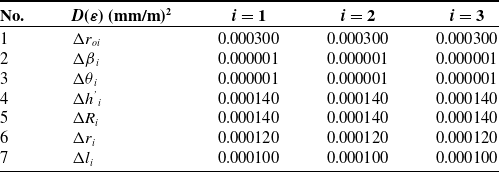
The rand function in the MATLAB software is employed to generate randomly the variance of the 21 error sources of the CDPR in a statistical sense, which obeys the normal distribution and its mean value is zero, as shown in Table IV.
Variance of the error sources for the CDPR.

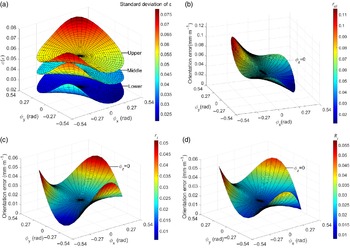
When calculating the standard deviation of the orientation error of the moving platform of the CDPR in the design space, the space is divided into upper, middle and lower layers. The angle
 $\phi$
z
of each layer are
 $\phi$
z1 = 0.54 rad,
 $\phi$
z2 = 0.27 rad and
 $\phi$
z3 = 0 rad, respectively. The geometric parameter error with zero mean value is selected randomly. The standard deviation of linear error is 0.01 mm, and the standard deviation of angle error is 0.02 mm/m. For the geometric errors of the moving platform, base platform and pulleys, the orientation error distribution for the moving platform of the CDPR is calculated by Monte Carlo method in the whole workspace and
 $\phi$
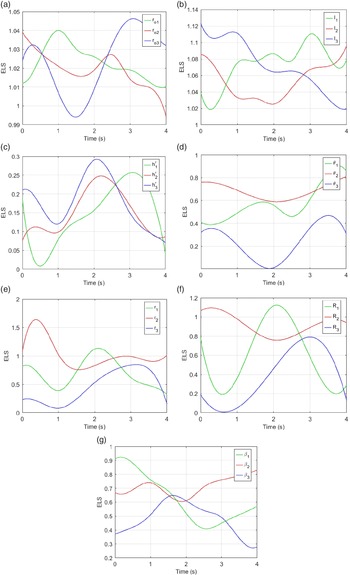
z3 = 0 rad under the premise of controlling the variables. Because the local sensitivity of the error is only the sensitivity of the CDPR in the local design space, the running time of the CDPR is set as 4 s. The standard deviation of the orientation error of the CDPR’s moving platform with different parameters and spatial levels, the error local sensitivity curve of each error source and the sensitivity coefficients bar chart are shown in Figs. 6–8, respectively.
Distribution of Σ(ε) and the orientation errors of the moving platform: (a) distribution of
 $\sigma$
(ε) in different spatial levels, (b) orientation error only considering r
oi
, (c) orientation error only considering r
i
and (d) orientation error only considering R
i
.

Error local sensitivity of various parameter error sources: (a) ELS of r
oi
, (b) ELS of l
i
, (c) ELS of h
′
i
, (d) ELS of
 $\theta$
i
, (e) ELS of r
i
, (f) ELS R
i
and (g) ELS of
 $\beta$
i
.

Histogram of the error sensitivity coefficients of various error sources.

As shown in Fig. 6(a), the error standard deviation of the CDPR’s moving platform increases with the angle
 $\phi$
z
, and the error standard deviation in the upper space is more significant than that in the middle and lower spaces. Compared with Fig. 6(c) and (d), the variation trend of the standard deviation distribution curve of orientation errors caused by the geometric errors of the moving platform and base platform are the same in the whole working space (
 $\phi$
z3 = 0).
As shown in Figs. 7 and 8, the local sensitivity of error sources
 $\theta$
i
, r
oi
, R
i
and
 $\beta$
i
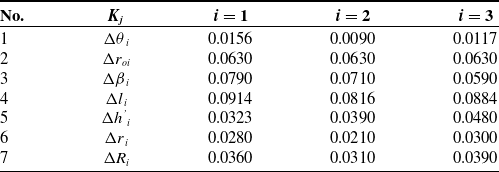
are more evident than that of other error sources. The local sensitivity of length errors for the three cables is greater than one. The standard value of the sensitivity coefficient comparison is set as ζ. Since the error sensitivity coefficients of each error source range from 0 and 0.1, ζ = 0.05 is set as a criterion to judge whether each source of error is a sensitive error or not [Reference Zi37].
From the error sensitivity coefficients of Fig. 8 and Table V, it can be seen that the effects of the geometric errors of the pulleys, installation errors of the pulleys and geometric errors of the cable length are relatively larger among the 21 error sources. The sources of sensitivity error in the CDPR can be identified by the standard value of sensitivity coefficient comparison ζ, and they are Δr
o1, Δr
o2, Δr
o3, Δ
 $\beta$
1, Δ
 $\beta$
2, Δ
 $\beta$
3, Δl
1, Δl
2 and Δl
3. From Fig. 6(b), it can be seen that the radius of the pulley has a significant influence on the orientation error of the moving platform.
Error sensitivity coefficients of various error sources.

7. Conclusions
This paper presents the conceptual design of a CDPR with rigid-flexible coupling and guiding pulleys and then deals with its error analysis. The kinematics analysis and error modeling of the CDPR considering the influence of pulleys is formulated. The contribution of each error component to the total orientation error of the CDPR is described by sensitivity analysis. The error analysis of the CDPR including the error’s local sensitivity analysis and identification of sources of sensitivity error is presented.
The geometric errors and installation errors affecting the orientation errors of the CDPR’s moving platform were refined into 21 sources of error. The geometric errors of the pulleys have a significant influence on the orientation error of the CDPR’s moving platform through error analysis, which has guiding significance for the conceptual design. The sensitivity coefficients of pulleys’ geometric errors and geometric errors in the cable length are relatively larger among these error sources. Therefore, the importance of manufacturing tolerances for the pulleys is proven. The cable length errors and pulleys’ geometric errors should be given higher priority in the design and processing, which provides a guidance for the mechanism optimization and prototype development of a CDPR.
The provided method for the error modeling and sensitivity analysis in this paper can be applied to the CDPR and the parallel mechanisms with rigid-flexible coupling. Based on this method, further researches about precise control of CDPRs can be developed.
Acknowledgements
The authors would like to thank the anonymous reviewers for their very useful comments.
Financial Support
The research is jointly supported by the National Natural Science Foundation of China (Grant No. 51375288), the Science and Technology Program of Guangdong Province (Grant No. 2020ST004), and the Special Project for Science and Technology Innovation Team of Foshan City (Grant No. 2018IT100052).
Conflict of Interest
The authors declare that they have no known competing financial interests or personal relationships that could have appeared to influence the work reported in this paper.