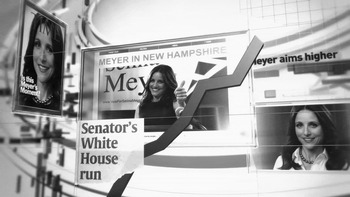
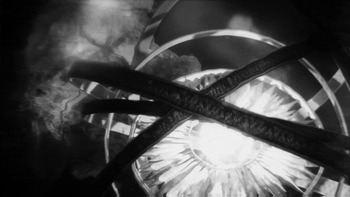
The opening credits of Veep rhyme loosely with those of Game of Thrones, which airs the same evening on HBO's spring lineup. In each sequence, the camera orbits a radiant if differently figured core: in Veep, instead of a glowing orb encircled with a solar system of clockwork lands, we find an empty space of white, an irradiated hub that gestures to and yet occludes what is presumably the Seal of the President of the United States (Figures 1 and 2). The implied center of gravity evokes the one in Game of Thrones: Selina Meyer would sit within the Oval Office and in this way win the game of thrones that is the subject of both productions. That solar axis is here appropriately invisible: at HBO, the stars that really matter are corporate offices, closed doors past which the viewer never sees. Even the planets are corporate properties: though each bears the VP's image, the astronomical bodies that orbit the missing insignia are within the Time Warner universe: Meyer's image appears on the cover of Time Magazine, People Magazine, and what seems to be a CNN news program. A bold red line tracks her stock in public opinion as it rises and falls as a function of her appearance on these outlets, all of which Time Warner owned in 2012, when the series premiered.
Veep solar system.

Game of Thrones solar system.

Time Warner has since sold Time and People, and the confidently rising and then precipitously falling red line tells us a good deal about why it did. After its 2000 merger with AOL, the company's stock fell 240 points in two years. Faced with mountains of debt, it began to break itself apart. The banks to which it was indebted cared less about its vision of synergy or the quality of its programs than about the shareholder value that sold-off corporate units might unlock. Henceforth, during a period defined not by mergers but by their undoing, no unit would be safe from the possibility of a spinoff. The corresponding imperative to discover new efficiencies and sustain profitability finds voice on recent HBO programming, like Game of Thrones, for instance, when the Iron Bank rebuffs a royal going broke in a war of succession. The bank is not interested in the legitimacy of his claim to the throne, and sees no reason to back a pretender when it is owed vast sums by those already in power. It knows only bottom lines. “Across the narrow sea, your books are filled with words like ‘usurper’ and ‘madman’ and ‘blood right,’” a banker tells him. “Here, our books are filled with numbers. We prefer the stories they tell. More plain” (4·6).
Recent HBO comedies document a similar preference: on Veep, Meyer battles poll-driven number-crunchers; on Enlightened, Amy Jellicoe discovers late in her tenure with a pharmaceutical corporation that she has been inputting employee efficiency numbers that will justify their firing; on Ballers, the money manager Spencer Strasmore, his body aching from years in the NFL and his bank account now empty, realizes it is time to “monetize his friendships” (1·1). These shows might therefore seem to lampoon what Mary Poovey calls “the language of numbers” adopted by “a new axis of power” running through multinational corporations, offshore tax havens, corporate pension funds, banks, the IMF and, ultimately, “the wallets of ordinary investors.”Footnote 1 If HBO becomes exercised over quantitative thinking, it does so largely to defend managerial autonomy during an era of downsizing. That defense typically invokes long-standing claims about aesthetic autonomy. The network protests that it produces something more than plain stories – not industrially managed entertainment but serious art (“It's Not TV, It's HBO”). It cares little for quantitative measures of viewership, above all; we are “not determining success on the basis of numbers,” avers CEO Richard Plepler. “We're determining success on the basis of quality and we believe the numbers will follow.”Footnote 2 Many similar statements position HBO as our foremost practitioner of autonomous corporate art. Being committed to “quality,” these statements declare, means rising on the wings of aesthetic integrity above the short-sighted calculus, so preoccupied with immediate gain, that dominates traditional broadcast networks, just as it means eschewing the quantitative metrics used by Netflix, for instance, which is reported to have developed “76,897 micro genres” for tracking audience responses to programming.Footnote 3
Still, the numerical conversions on HBO do more than register a threatened aesthetic autonomy. Even as it beats its chest about the virtues of “quality,” the network's programming quietly theorizes, as Barbara Cassin says Google does in relation to its search engine, how “quantity becomes in and of itself a quality.”Footnote 4 The difference is that HBO's version tends to move in the opposite direction: its “quality” programming self-consciously anticipates its exchange into the quantitative. That fascination with numerical measure does more than reflect the imperative to increase profit: it explores the possibility conditions of corporate synergy. Proprietary media, so the theory goes, orbit the same corporate headquarters, and should thus be convertible into and out of equivalent measures of “brand equity”; HBO’s language of numbers is in this respect a language of exchange, an effort to think through how one measure of “quality” might be rendered commensurate with another. Corporations are internalized markets, and unimpeded exchange between the brand equity represented by media within a single corporate unit, like HBO, or between the equity represented by media produced by different units, like HBO and Warner Bros., was to be one of the benefits of the mergers that defined the industry at the start of the twentieth century. But on the whole, synergy’s benefits did not materialize; the Time Warner solar system began to break apart soon after the AOL merger. Faced with the attendant sale of Time Warner Cable, HBO began to explore the possibility of producing direct delivery platforms that might distribute the network's programming over the Internet. As we will see, True Detective registers this coming undone of the parent company, and a subsequent autonomization of distribution, even as it struggles to imagine a general equivalent that might unite an otherwise diverse library of Time Warner properties.
That struggle takes an unmistakably gendered form in the programs treated below. The tension between “quality” and quantity, no less than the effort to imagine the integral corporate form that is Time Warner, takes its toll on the bodies of HBO's women, especially. Criticisms of the network's misogyny are too numerous to cite, and are typically well deserved. But that misogyny tends to follow an idiosyncratic logic. For close to a century, critics have noted the emblematically capitalist manner in which modern media discipline women's bodies. The mechanical orchestration of the Tiller Girls – replicated by the Warner Bros. Gold Digger musicals – captured for Siegfried Kracauer how cabarets, shop windows, and newsreels employed, in the words of Miriam Hansen, the “Taylorist principle of breaking down human labor into calculable units.” Intent to describe a “diffuse, flexible, [and] precarious” post-Fordism decades later, and thus track how media representations of women “follow symmetrically the evolutions of the capitalist mode of production,” the Tiqqun collective generated a theory of “the Young Girl,” a media figure endowed with “the magical ability to convert the most heterogeneous ‘qualities’ . . . into a single ‘social value.’” For Tiqqun, media images of young women become a “[l]iving currency [that] has taken the place of money as a general equivalent.”Footnote 5 In what follows, I draw on insights like these, but apply them to a more specific corporate context. On recent HBO comedy and drama, women figure the means traditionally requisite to a brand's propagation; they are living currency, their bodies vehicles for the exchange of brand equity and even its delivery into the home. But that programming also stages the superannuation of women's bodies, and a range of dangerous domestic entanglements, by direct delivery platforms that transform the “home box office” that the network first pioneered. Once associated with the heteronormative living room and its television set, HBO would now shatter that domestic sanctum on behalf of a personalized viewing experience that takes place everywhere and nowhere. Such flexibility and ambiguity no doubt represent for media companies the possibility of still more absolute forms of mediation: even as phone and tablet screens shrink the television interface, their portability radically enhances the implicitly male viewer's separation not simply from the family, but from any particular viewing location at all.
In True Blood and Veep, the problem of converting people into brands figures the problem of converting the television program into fungible equity; on Silicon Valley and True Detective, these problems become indistinguishable from the problem of converting the television program into streaming data. The contradictory nature of these nested projects manifests with particular clarity on the bodies of HBO's female actors, those stars and less exalted media workers who embody both use and exchange – who are, in the words of Richard Dryer, “both labor, and the thing that labor produces.”Footnote 6 In these shows, women concretize “quality” even as their bodies often remain, scarified and branded, abject residua, left in the wake of “quality's” conversions into more liquid forms. Male bodies disappear more readily – into data, brand equity, or even money – but nevertheless register signal problems now animating the death and rebirth of television. The contradictions at hand are themselves palimpsests of different fault lines: where from one perspective tensions between quality and quantity will seem to mirror a Marxian account of the commodity's double body, torn between use and exchange, from another, those same tensions will rehearse a more specific formal dynamic, in which diegetic spaces and narratives anticipate not simply changes within the implied television interface and its viewing context, but changes within the corporate forms attendant upon that transformed viewing experience. The corporate form confronts us as most visibly changed in True Detective, a drama in which the network’s quality will appear as exhausted and hollowed out as the implied body of Time Warner, whose broken fragments it projects upon the ruined landscape of Louisiana. In True Detective, violence against women is inextricable from the violence required to break apart a parent company.
THE BRAND'S DOUBLE BODY
HBO's fascination with physically branding human bodies, and turning people into media brands, has a history. The opening sequence of Oz – the male prison drama that premiered in 1997 and with The Sopranos ushered in the golden age of the network's quality programming – tracks a needle tattooing the logo of the show onto human flesh. The pilot makes plain what's at stake in this embodied inscription. “Like my tattoos?” an Aryan Brother asks his new cellmate. “I'm gonna brand you myself.” The terrified cellmate says, “Livestock gets branded,” to which the Aryan replies, “That's what you are. My livestock. Because now, Tobias, your ass belongs to me.” The cellmate belongs to the Aryan as the characters belong to the network. These characters are as disciplined by corporate power as they are by state power. They are held within the imaginary space of Time Warner, their collective spokesman a disabled black man who will die in Season 5 and yet remain the narrator of the series.
True Blood elaborated a version of that logic. It was the network's first hit after The Sopranos, and followed on the heels of other critically acclaimed fare like Deadwood, The Wire, and Six Feet Under. Though it would continue to trumpet its commitment to “quality,” HBO redressed the passing of these shows mainly with innovative branding, which begins to account for the pervasive worry over network “quality” detailed below. A network that had achieved fame because of the freedoms it gave its creators would now carefully curate its programming with in-house marketing executives. HBO had already sold branded goods to the fans of its popular series. But True Blood witnessed the sale of an unprecedented array of show-related paraphernalia and served as the basis for a partnership with at least six different creative agencies. Above all, HBO's new branding dispensation was at its most campy and self-conscious in the sale of a beverage named after True Blood and the synthetic blood drunk by vampires on the show: “Tru Blood.”
A curious drink, this “slightly tart, lightly sweet blood orange drink,” is redolent of both blood and money. Vampires have long modeled the capitalist's extraction of value: “Capital is dead labor which, vampire-like, lives only by sucking living labor,” Marx writes. David McNally understands metaphors like these as crucial to Marx's account of abstract labor, which is “effectively disembodied, detached from the persons who perform it,” the better to be exchanged.Footnote 7 Where the blood traditionally sucked by vampires might represent stolen labor rendered abstract and transformed into value, the synthetic blood in True Blood – developed by Yakonomo, a fictional Japanese corporation – might represent the technological advances that allow capitalists to replace workers with machines and that lead to lower wages, unemployment, and, Marx thought, crisis. But if Tru Blood recalls to us abstract labor, it also satirically rehearses network anxieties over the loss of once defining “qualities”: what does it mean, the series asks, to turn so soon on the heels of HBO's critically acclaimed dramas toward Gothic romance? The synthetic blood is “tru,” which is to say both true and not true, both really like but not actually real blood. In this way, the blood combines cure (it allows vampires to go mainstream, by providing them with something other than humans to drink) and poison (it consigns them to something far less exciting than the human blood they crave). Taking its name from the synthetic blood, the series is as analogous an amalgam, at war with its commitment to transform a once edgy underground brand into something more mainstream. This allegory allows the brutal but so-much-more-interesting vampires who abjure Tru Blood to announce on behalf of HBO a principled repudiation of the synthetic: here are real gore and guts, the network declares, the very stuff of “quality,” if only because forbidden by the FCC on broadcast television. At the same time, a vampire like Bill Compton will argue, in his defense of the drink and of mainstreaming, on behalf of a more capacious, if banal, HBO brand.
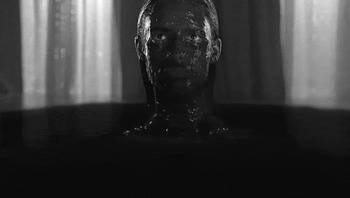
Carnal in the extreme, True Blood trades in erotic physicality. Pointedly so: the show's vampires often stand in for an LGBT community struggling for civil rights in the South. “God hates Fangs,” reads a telltale road sign: evangelicals terrorize fangs as they already do fags. But this allegory sits atop another, in which physical transformations code the vacillation between materialization and abstraction essential to brand management. “Where is your southern accent?” a character asks the vampire Steve Newlin, who has changed his accent even as he has come out of the closet as gay. “It's such a part of who you are, of your brand!” she exclaims. “Yes, but sometimes I like to keep the brand evolving,” he replies (5·12). Corporate brands always evolve; never identical to the material form of any particular product, the brand assumes a constantly changing body (first this shoe, then that one; first this program, then another). It is not surprising that the female body should, on a network as misogynist as HBO, serve as the most malleable site for those incarnations. Associated at least since Aristotle with materiality – Elizabeth Grosz reminds us that patriarchal culture has long cast women as “somehow more biological, more corporeal, and more natural than men” – women's bodies have also, since the early nineteenth century, figured the desire integral to consumer markets.Footnote 8True Blood complicates but does not abandon these assumptions when conjuring its vampires, witches, werewolves, shape-shifters, and faeries, all of which represent diverse technologies for giving the slip to an original and limiting body. The point is not that True Blood's human bodies are implicitly female and its supernatural bodies implicitly male, but rather that the show genders the movement between these bodies in often familiar ways. In “9 Crimes” (3·4), for example, Debbie Pelt undergoes an initiation into a mostly male werewolf pack, which requires her to get branded on the shoulder with the pack's insignia (Figure 3). In their first instances, brands were markings that burned the skin, the better to concretize the brand and transform the skin into property. Here, the marking of Debbie's human “pelt” signals the pack's collective ownership of her and, at a second remove, the pack's transcendence of their human skins: the branding so excites those present that they transform into werewolves. Then, as if to suggest the degrees of attachment that this brand might command, the leader of the pack, now transformed, approaches Debbie, and begins feverishly to lick her singed skin. The brand binds the pack together, as blood does the vampire community, which descends from an original goddess named Lilith whose physical form emerges from a pool of blood in the fifth season (Figure 4). Vampires evolve from and return to a primordial liquidity, and as with vampire bodies, so too with media bodies: Tru Blood produces an object of attachment by transcending the barrier between the inside and the outside of the series from which it is derived (as most tie-in products do). That object of attachment – ultimately, the network brand – emerges in an act of liquefaction that volatilizes the “true” body of True Blood. As a vampire drains his victim, while keeping him alive, the drink extracts liquid from the series, the better to extract the equity lurking in its form.
Human branding in True Blood.

Extreme liquidity in True Blood.

HBO's female characters reveal the bruising nature of that extraction with special lucidity. The network's hallmark “quality” tends to admix male pornographic fantasy with appropriately serious social themes. But as television critics have not failed to note, that “quality” springs from overarching narrative trajectories popularized by daytime soaps.Footnote 9 HBO derived one measure of its “quality,” in other words, from serial formats long associated with gendered domestic labor – labor that the network seems intent to disown. The network's foray into serial programming involved a gendered distancing that was, moreover, explicitly monetary. HBO insisted that its offerings were not television at all, but film, and that insistence went hand-in-hand with its ambition to transform the home into a box office. Men would be the agents of that transformation: the macho leads who headlined shows like Oz, The Sopranos, The Wire, and Deadwood would take serial television and the domestic sphere back from the women who had once defined it – the characters' misogyny always a kind of crypto-financial discipline that stood in for the network's as it dreamt a world in which the only women were hookers, monetized vessels of male desire.
The network has tended to cast its relatively few female leads in comedies, typically as authors and actresses (Carrie Bradshaw in Sex and the City, Valerie Cherish in The Comeback, Hannah Horvath in Girls). Rarely, until Veep, have those leads been either mothers or managers (distraught that she never had a child, Enlightened's Amy Jelicoe is an executive before suffering a nervous breakdown). These leads are sometimes sexually humiliated (Cherish is forced to fellate a man on film) and sometimes confused with prostitutes (Bradshaw is mistaken for a sex worker; Horvath takes money for sex).Footnote 10 Meanwhile, HBO's men have overseen radical expansions of the domestic economy with often unquestioned power. The Sopranos scaled “the family” business ever larger. Big Love transformed the household into a corporation, in which all workers were women, subject to the rule of one patriarch. Six Feet Under cast the home as a funeral business; here, two brothers run the concern after their father's death. More recent programming understands women's bodies as Six Feet Under understood its corpses: as valuable objects it must curate. HBO returns compulsively, if half-knowingly, to that curation, whether in its allegedly gratuitous sex or its notorious fascination with prostitution.Footnote 11 Throughout, the network seems both to acknowledge and to repress the manner in which, as feminists from Gayle Rubin to Leopoldina Fortunati and Maria Mies point out in the context of sex work, it converts women's bodies into money.
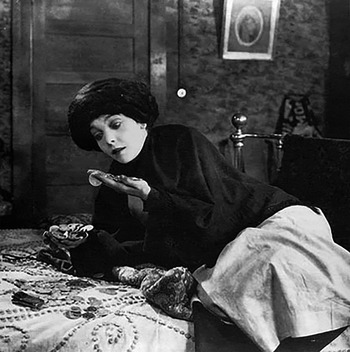
David Milch's prostitutes are in this respect the most revealing. Much of Deadwood transpires within a saloon, the Gem, whose name evokes Jewel, the disabled sex worker who maintains the property, and whom Al Swearengen keeps around, he jokes, in case a potential client “only has 9 cents.” The prostitutes working the Gem, and its in-town rivals, are natural resources, akin to the Dakota hills surrounding the eponymous mining town. They are mined for gold and used up in the process (one of many on this show to beat women, George Hearst's gold-hunting geologist will cut into prostitutes, he thinks, just as his employer cuts into the earth). That gold, the money extracted from their bodies, is the only offspring they are allowed (Alma Garret is the single woman possessed of both gold and child, but the child is adopted). The Tiqqun collective dubs its Young Girl “true gold, the absolute numeraire,” and its related claim that this figure has become a post-Fordist “general equivalent” draws implicitly on Luce Irigaray's account of prostitution, which account builds on Marx in arguing that sex workers embody both use- and exchange-value, and as such are “two things at once,” endowed by men with “a physical or natural form, and a value form.” Assuming that “woman has value on the market by virtue of one single quality: that of being a product of man's labor,” Irigaray argues, “Women-as-commodities are thus subject to a schism that divides them into the categories of usefulness and exchange value; into matter-body and an envelope that is precious but impenetrable.”Footnote 12 On Deadwood, gold-generating women contain that precious but impenetrable envelope, and in this way figure what Slavoj Žižek, building on Alfred Sohn-Rethel, calls “the body within the body” of money – the “sublime material” of money, “that ‘indestructible and immutable’ body which persists beyond the corruption of the body physical.”Footnote 13 To elaborate by way of a song from Gold Diggers of 1933, women are not simply “in the money,” but embodiments of it (Gold Diggers nods to Eric Von Stroheim's Greed, an early version of Frank Norris's McTeague that famously depicts a woman rolling on a bed covered in money; Milch's HBO drama Luck reshoots that scene (Figures 5 and 6)). Within the terms of Marx's actual analysis, the laboring body cannot be currency and still possessed of labor power. And Irigaray's terms are less rigorous in their Marxism than, say, those of Fortunati, whose paradigm-shifting analyses of housework and sex work reveal how women's “indirectly waged labor” allows capital “to reproduce individuals as labor power.” For Fortunati, “the body within the body” of the sex worker contains something other than the sublime material of money; as she insists, “there is a commodity contained within the individual: that labor power which as capacity for production has exchange value.”Footnote 14 But Irigaray and Žižek both allow us nevertheless to register how HBO's women capture what is most contradictory in the network's desire to convert people into exchangeable quantity. Their physical bodies are in constant tension with the ostensibly sublime material they are imagined to bear.
The gender of money, in Greed.

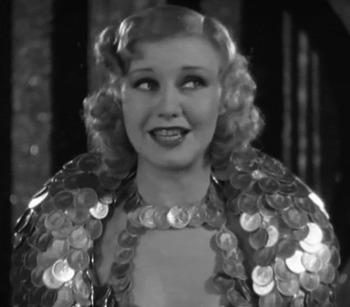
In the money, in Gold Diggers of 1933.

HOLOCAUSTS AND CARNIVALS
The sublime material long at stake on HBO – the indestructible body within the body most important to its industrial reflexivity – has never been gold itself, but brand equity. Since Deadwood, network programming has become increasingly explicit about that fact. “Rebranded!” announces Selina Meyer in Veep, as she walks into a room with a new haircut (3·8). Like Julia Louis-Dreyfus, Meyer is the brand at the center of a media circus. And brands must be managed, as Kent Davidson makes clear when he sits down the vice president's daughter to talk with her about her unfavorable “likeability index” (4·2): “This is about the brand image of Catherine Meyer™,” he monotones. It matters, of course, that Catherine is Selina's progeny. As on Mildred Pierce so too on Veep: when working mothers do appear on HBO, they raise not simply children, but surrogate media brands.
Meyer's person figures the quasi-monetary conversion of network brand equity, and men wishing to control that process beset her. The personal trainer Ray would condition her body as a kind of money management. A workout guru, Ray aims for a less abject and more exchangeable body. Doing so requires a theory of money and value, the show suggests. “Money is just a concept,” the American Ray informs a representative of the Bank of England: “we believe in it because we're too scared not to. There's no intrinsic value to it, you know, like muscles in your arms” (3·7). Silicon Valley offers a rejoinder to this claim during an argument over the relation between money and value. “I'm selling [my house],” one character says. “That's just money,” the other replies, “it has no real value.” The decisive rebuke: “It literally defines value” (2·10). Ray, on the other hand, thinks there is nothing intrinsically valuable – no sublime material – within money's physical form; this distinguishes it from arm muscle, whose value derives from its capacity to exert force, in this case on Meyer. Ray's muscular arms work the VP during their training sessions, and he would extend his discipline to other areas of her life. He offers to “normalfy” a florid speech she rehearses as he vigorously kneads her shoulders; he will happily replace the literary language with something “more plain,” to recall the Iron Banker from Game of Thrones, something more like the numbers that banker contrasts to traditional storytelling. The very lowbrow Ray is a sign of both the material regrounding of quality and its consequent undoing. He is simultaneously a spokesman for concrete embodiment and a harbinger of the incipiently quantitative thinking that HBO casts as the death of refinement. Likewise, Meyer's body is tantamount to the plain story that is Veep, available for so many numerical conversions.
At the apex of the show's quantitative thinking, the President governs by the numbers, and it makes sense, given HBO's commitment to “quality,” that Veep should heap contempt on his style of rule; the strategic distancing recalls the viewer to HBO's ostensible indifference to figure-driven programming. “It's insane over here,” whispers Mike McLintock, Meyer's communications director. “It's like a math prison: they rape you with numbers” (2·5). He's been assigned to Davidson, (the “Pol Pot of Pie Charts”), a strategist who works for the President and is so devoted to quantitative methods that the White House Chief of Staff tells him, “I bet when you take a crap, it actually comes out as a number two” (2·5). Throughout, the President seems like nothing so much as the Time Warner CEO, admonishing HBO through intermediaries to more effectively cross-market parent-company brands. Having it both ways, Veep will lampoon that imperative and fulfill it all the same. During the second season opener, the VP learns from White House statisticians that her campaign appearances generate a 0·9 percent bump in approval, “a consistent integer,” for whichever candidate she shows up to support. She is a walking numerical phenomenon; “You're like Neo,” an awe-filled statistician tells her. The reference to The Matrix clarifies how she functions on behalf of HBO: just as Neo moves in and out of code at will, Meyer's statistically magical person constitutes a reflexive locus of conversion, the ground upon which Veep exchanges itself into and out of otherwise heterogeneous forms of Time Warner brand equity, like The Matrix. In this spirit, the comedy will feature an extended conversation about Harry Potter, and this gesture to another proprietary brand: “Are you familiar with the Eye of Sauron, the fire-rimmed, all-seeing eye from Tolkien's Lord of the Rings?” Davidson asks McLintock. “The Eye of Sauron is the near perfect analog for the modern media,” he tells him, insofar as it can be tricked into fixing on the wrong object. The gaze of the media, he adds, must be distracted from “what's going on here” (2·5). The phrase reveals an essential confusion. What is going on, and where exactly is “here”? If Veep acknowledges the primacy of numerical thinking in official politics, it acknowledges the same primacy in media products designed to rationalize their conversion into and out of other brands. More basically, Davidson's language suggests our own confusion over the means and ends of television itself: viewers do not know, he implies, what television is and what it does.
Witness, for example, the arcane registers activated when Veep places its star before the eye of the modern media. Meyer tasks Gary, her body man, with securing the lipstick recommended by her stylist, “Miami Sunburst.” It is Congressional election night, and the President has assigned her to the morning talk shows (he has noticed her 0·9 percent bump). She wants the lipstick, she says, “So when it hits 2 a.m., my eyes will say Holocaust and my mouth will say carnival.” Meyer's outrageous metaphor likens her performance before the camera to the forced labor and mass liquidation of Jews in Nazi camps – just as Oz likens its own logo to the Nazi swastika. The parent company's corporate brand is a death camp; it imprisons and disciplines bodies before liquidating them. The red and potentially skin-burning “Miami Sunburst” invokes the cover of Time magazine framed upon the walls of the vice president's office (the same cover that appears in the opening sequence), which pictures the telltale banner of the longtime Time Warner property printed in red across her forehead. Meyer's branded forehead in turn echoes her daughter's: the VP discovers a photo of Catherine with the word “Glue” printed upon her forehead. The word refers to Catherine's imagined ability to bring Meyer and her estranged husband together before the cameras. The word thus also recalls, by virtue of its placement, the brand equity into which Veep would convert Meyers: that equity binds the otherwise incommensurate, as a kind of glue. But glue is no sublime material, and taken together, the two foreheads make reference to still another Time Warner film property: Batman, the Warner Bros. picture in which the Joker – whose face screams Holocaust and carnival – applies cosmetics, derived from the same acid brew that once disfigured his leering face, to female models before placing them before news cameras. In that film, argues Jerry Christensen, Vicki Vale represents Time Inc., which Batman must rescue from a hostile takeover bid on behalf of Warner Bros., the film studio that aimed itself to merge with Time. Nobody rescues Meyer, manipulated as she is by Time Warner's quantitative imperatives. Her face branded with the insignia of the “quality” that Christensen says Warner Bros. purchased when merging with Time, she evokes the Joker's victims.Footnote 15 Placed before the camera, she becomes one of the abject bodies that Time Warner would melt, into something other than air.
HBO'S SNACK DICK
Becoming less dependent on cable companies means entering into more direct competition with companies like Google, and so it is not surprising that HBO should begin to engage and, more often than not, lampoon those companies. In the third season of Veep, Meyer brings her staff to Silicon Valley to meet the CEO of a thinly disguised Google. The autistic CEO will not defer to Meyer, or the political power she represents. Internet giants are arrogant and in need of federal restraint, the episode makes plain. Silicon Valley also satirizes Google, in the form of Hooli, a tech giant that employs Richard Hendrix, a programmer who in his free time codes a lossless compression algorithm that serves as the basis for a corporation he endeavors to fund over the course of the first season.
That algorithm extends the network's language of numbers in a very obvious way: it promises to revolutionize the information and entertainment industries by rendering content smaller and thus available for more efficient transport. The algorithm on Silicon Valley is so elegantly written that it renders highly compressed data both immune to loss and searchable. Where Veep and, below, True Detective testify to fraught conversions, and therefore to (data) bodies that will not melt away, Silicon Valley fantasizes a tidier dissolution. An instrument of abstraction and dematerialization, the Hendrix algorithm promises to halve the physical form of data (thus halving the size of ugly server farms, Hendrix brags to a small-businessman in the Central Valley). The algorithm extends the fantasy at the heart of the digital industries: look, we can disappear your bodies and the physical world, only to conjure them anew in fresher and more immortal form. The algorithm might also be said, more broadly, to elaborate the capitalist fantasy that muscle, or concrete human labor, might somehow survive its conversion into money: putatively “lossless” algorithms like Hendrix's don't sacrifice quality to quantity; they do no violence to their inputs, which, impossibly, they both preserve and exchange.
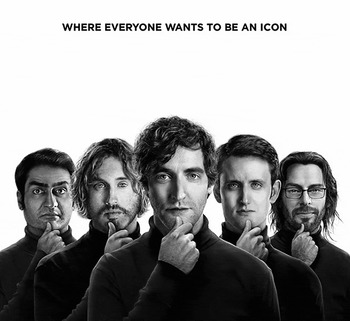
Silicon Valley works through these fantasies in its twinned fascination with converting bodies to brands on the one hand and digital signals on the other. It is useful to think of the show's opening title sequence as an analog to its compression algorithm: the cartooned sequence shows new companies squeezing themselves into both the crowded space of the “true” Silicon Valley and the crowded brandscape generated from within that geographical locale. Likewise, Hendrix's algorithm compresses data into a shortened annotation so that they require fewer bits; it makes room where before there was none. In fact, the algorithm eliminates redundancy in a manner loosely analogous to the way the two interlaced lowercase letters that ultimately form the corporate logo of Pied Piper excise unnecessary letters (Figure 7). The marketing campaign that advertises Silicon Valley describes the desire of those working in Silicon Valley to become thus compressed; at once real and virtual, Silicon Valley/Silicon Valley is a place “Where Everybody Wants to be an Icon.” Understood in relation to Figure 8, the tagline describes those who wish to become knockoffs of Steve Jobs; understood in terms of the Promethean ambition of Jobs himself, the language suggests an aspiration to disappear not simply into pictograms of the kind used in the graphical user interface, but into a brand logo so widely recognized that it becomes naturalized, a universal but nonetheless propertied cultural touchstone.
Silicon Valley, brand compression.

Silicon Valley, brand compression.

Silicon Valley dramatizes the birth of a corporation, an origin story that it casts in biomorphic terms. “This is your baby,” Monica says to Hendrix, about his new company (1·4). But like True Detective, Silicon Valley anatomizes male bonds in a world without women and children. The marketer Erlich Bachman runs the all-male “incubator” that houses Hendrix. Funds from the homosocial incubator come from his sale of a start-up, Avioto, whose name replicates the sound he makes while ejaculating. That ejaculate fertilizes male business fantasy: “Stop being a pussy and start being an asshole!” Bachman instructs Hendrix. The venture capitalist who has seeded them with start-up funds, Peter Gregory, is, according to Bachman, “a billionaire because he knows how and when to be an asshole” (1·2). Gregory's agent, and the carrier of his seed (money), Monica might be the only character capable of securing the future of Hendrix's corporate child. But she is also, in the first season, an alien female presence in a show that pushes to one extreme HBO's efforts to convert female into male “quality”: whereas Oz and The Sopranos dramatized male corporeality as an antidote to women's bodies and spheres, Silicon Valley eliminates the female body from its own cast in the service of a more abstract male corporate personhood. Pied Piper's financial officer, Jared Dunn, is said to “look like someone starved a virgin to death” (1·2). That ghostly demeanor, purchased through a symbolic crime against women, captures a fantasy of valorization in which capital reproduces itself without women – whose capacity for biological reproduction figures an archaic form of brand propagation that does not accommodate digital transcendence and sui generis corporatism. For True Detective's Rustin Cohle, we will see, “the honorable thing for our species to do is to deny our programming. Stop reproducing.” Silicon Valley reprograms that programming, such that “our species” will produce only male corporations, each an immortal brand avatar.
Pied Piper's first logo expresses that male fantasy in revealing ways. “It looks like a guy sucking a dick, and he's got another dick tucked behind his ear for later . . . like a snack dick,” says programmer Dinesh Chugtai. A simple joke presents itself: servicing consumers is akin to sucking them off. The comment anticipates the conclusion of the first season, in which Pied Piper produces a mathematical model for determining how most efficiently to masturbate the audience of mostly men before whom they are about to present their compression algorithm (the model was later published online, with formulae and graphs). Call this a perfect, if satirical, illustration of HBO's romance with numbers, its efforts to derive quantity from quality on behalf of a purely male audience. At the same time, Chugtai's joke offers another way of understanding the anxiety about women so prevalent on HBO. If the end of Silicon Valley's first season suggests the orgiastic and even queer nature of corporatization, it also clarifies the implicit feminization at risk in the media industry's service work. At the end of the second season, the Pied Piper team wrestles with cables and puts out fires, media and tech work suddenly rendered thingly and physical, more concrete than the mere manipulation of lines of code, or the servicing of clients. But here, at the end of the first season season, work emerges as it does for male leftists who invoke the female prostitute while writing on the horrors of the service economy. The vision on offer in Silicon Valley is more ecstatic than, say, Mark Fisher's, which likens communications work to bukkake – but it is in its crucial aspects otherwise identical.Footnote 16
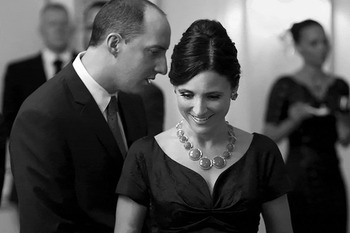
The logo scorned by Chugtai rewards further attention. To understand a man blowing into an instrument as sucking on a dick is to reverse the flow of inspiration, cast now as insemination. And to understand musical creation as an influx of seed (semen) is, in this show, to describe that creation as an incipiently financial borrowing. Above all, to see the Pied Piper logo as a man sucking on a dick that also enters his head from his back side is to see that dick not simply as a musical pipe that runs through the head, but as the kind of pipe that delivers broadband to consumers. A version of that pipe figures in Veep. Gary the body man, tasked with keeping her supplied with snacks, typically stands behind Meyer and whispers into her ear whatever she needs to know for the conversation at hand; as he puts it, “I've always imagined myself as like a pipeline who carries a lot of necessary information and I just feed it directly into her head” (4·9) (Figures 9 and 10). A piper with a pipe running through his head (or a vice president spouting lines whispered into her ear) is an author or actor whose lines are not really her own, and Chugtai's comments key into a story about originality and piracy. But Silicon Valley is as much about the loss of a delivery platform (and the invention of a new one) as it is about the loss of original material. Time Warner once possessed its own pipers (the Warner Music Group) and its own pipes (Time Warner cable). It also had a new media distribution platform in AOL. As we have seen, it would retreat, faced with the debt required to purchase its diverse assets, into film and TV production alone. And yet the fantasy behind the AOL merger, that a media company might control the digital distribution of its own content, lived on in the rush to produce HBO.GO and HBO Now, online platforms able to do what Time Warner hoped AOL might have done. The opening credits to Silicon Valley depict the taking down of an AOL sign from atop a large complex in the upper left of the screen; Facebook signs go up in their place (Figure 11). A small, if self-induced, humiliation for a conglomerate that hoped, at the start of the new millennium, to have led the way in digital content distribution. But already during the first season of Silicon Valley HBO was preparing to cut cord and offer itself directly online.
Silicon Valley, pipeline.

Veep, pipeline

Silicon Valley, compressed brand space.

The comedy anticipates this move – is, indeed, an instance of it. Hendrix first imagines his algorithm in the service of musicians who would check their music against vast quantities of already recorded songs, to determine if they are committing piracy when recording and selling what they hope will be considered original material. But by the second season, Hendrix and his team are streaming video; this is where the money is, and his algorithm holds the key to unlocking mountains of it. Online content providers aim to provide optimal picture and sound quality while taking up as little bandwidth as possible – in large part because consumers face caps on their allowed bandwidth speed. Doing so requires state-of-the-art compression algorithms, and during the making of Silicon Valley's first season, Netflix had the clear advantage in this technology.Footnote 17 It turns out, in other words, that the compression algorithm that is the subject of Silicon Valley is the very technology that HBO.GO had not yet then successfully implemented in its competition with Netflix. Silicon Valley dramatizes not simply the conversion of bodies into brands, but the genesis of an algorithm that might facilitate the program's own more efficient dematerialization for direct delivery over the Internet. A show that would compress a geographical locale into a thirty-minute comedy is in this way also a striking illustration of Raymond Williams's claim that “Every specific art has dissolved into it, at every level of its operations, not only specific social relationships, which in a given phase define it . . . but also specific material means of production, on the mastery of which its production depends.”Footnote 18
“TRUE QUALITY”
Like its cognate and predecessor True Blood, the first season of True Detective takes place in backcountry Louisiana; the opening credits to the two dramas rhyme visually, and while the two dramas dramatize different backwoods barbarisms, they share an interest in recondite knowledge and occult forms of corporeal transcendence. Both shows are interested in the “true,” the branded effect or simulated appearance of the ontologically sound, in just the way that HBO is interested in “quality.” And of course the two dramas share women with branded backs. True Detective begins with the discovery of a dead sex worker upon whose lifeless corpse a cryptic spiral has been branded. The mutilated body bespeaks a misogynist violence more extreme than any found in True Blood, Veep, or Silicon Valley.
At first pass, the show's ponderous cosmology seems to take the body as proof of a universal condition. In the words of Rustin Cohle, We are “programmed with total assurance that we are each somebody, when in fact everybody's nobody. I think the honorable thing for our species to do is to deny our programming. Stop reproducing” (1·1). The problem would seem to be children. “Children are a disappointment. Remain unfettered” (2·1), advises one of the many hard men in the second season. That advice has long been implicit on HBO. The network has abounded in children either separated from their parents or killed. On The Sopranos, Ralph Cifaretto beats a pregnant stripper to death. The Wire offers a virtual holocaust of the young, announced perhaps most crushingly with the death of Wallace in Season 1. On Game of Thrones, the only babies we see are the harvest of incest, and food for the undead. On Silicon Valley, Hendrix names his company after the fairy-tale flautist who kidnaps kids. Deadwood features two children, one of them run down by a stray horse. True Detective is similarly bereft. His wife and daughter taken from him in a car accident (the child is named “Sophia,” after the only child to survive Deadwood), the heartsick Cohle represents the surprising culmination of HBO's case against children. But the argument most important to that case is not finally existential, and if from one vantage Cohle exemplifies what it means for armchair philosophers to “have become too self-aware” (1·1), from another his invocation of “programming” suggests a pointed industrial self-awareness.
In Veep and True Blood, the always potentially reproductive female body functions as the brand's form of appearance, the privileged if disciplined carrier of HBO brand equity. True Detective and Silicon Valley, on the other hand, chasten their men to forgo heterosexual desire and biological reproduction even as they use their few female characters to figure the outmoded distribution networks from which HBO would free itself. Michelle Chihara asks us, “Call to mind the show's imagery: the river, and the way that the crimes are bundled around that pipeline. Remember all those long loving shots of telephone wires?” As she sees it, “The whole show is about pipelines and technology, choice and contract.” The choice in question involves the viewer's decision whether or not to opt out of a long-term cable contract for something less binding. At one point Cohle's partner, Martin Hart, passes on sex with a woman who appears looming out of a T-Mobile logo, the cell-phone carrier best known for its non-binding contracts. For Chihara, “The tampon is the visible symbol of the binding, monthly contract that Hart has entered into with his wife. The T-Mobile prostitute represents freedom from all that.”Footnote 19 Here again, a woman's capacity for biological reproduction (as opposed to casual sex) figures brand propagation and distribution at its most traditional and therefore problematic.
But what about Cohle's radical freedom, his ability to choose? It cannot be that the cut-rate T-Mobile represents a happy option, as indeed more generally Cohle is far from happy in his freedom (the existential philosophizing provides no final payoff, but it is not irrelevant either). Here we might turn to The Wire, which features extended conversations about the business models of phone companies with Stringer Bell (whose name evokes the regional companies – each a baby – created in the wake of antitrust litigation brought against AT&T). Obviously enough, The Wire turns on a race between the Baltimore police and drug gangs either to secure or gain access to phone lines, first landlines and later cell lines. But Bell is interested in the telecommunications giant WorldCom because it offers strategies for selling inferior products in a market defined by elastic demand. In this, WorldCom is pointedly not HBO, which later would, when launching HBO Now, almost double the $7.99 charged by Netflix for a monthly subscription, because of the imagined demand for its product. But long before that launch, David Simon thought that WorldCom represented precisely the disappearance of value that his show meant to document, and, implicitly, redress. He used WorldCom, he said, because it evoked the accounting scandals of the new millennium, which followed on the heels of Time Warner's 2000 merger with AOL and the subsequent popping of the tech bubble. Enron and WorldCom were “the first shots across our bow, economically. That people were trading crap and calling it gold. That's what The Wire was about. It was about that which is – has no value, being emphasized as being meaningful. And that which is – has genuine meaning, being given low regard.”Footnote 20
Simon's compressions offer more material than we can here unpack. How are the urban unemployed akin to gold? What does it mean to treat human life not as overvalued stock but as gold? More basically, what kind of “value” does Simon have in mind? Does he use the general sense of the word invoked on Veep and Silicon Valley, when characters debate the nature of money, or the valorized productive labor detailed by Marx in Capital? That last question speaks to True Detective, which, we have good reason to believe, is at least obliquely in dialogue with Marx's value. “I went liquid for this deal,” says Frank Semyon (2·2). The shady entrepreneur takes his name from Semyon Ludwigovich Frank, a “Legal Marxist,” as Lenin called those conservative Marxists whose books the czar allowed and who engaged in no revolutionary activity. In 1900, Semyon Frank published a critique of Marx's value theory, in which he faulted Marx's account while embracing liberal humanist values. Frank Semyon's name, in other words, gestures to debates over the relation between broadly defined cultural values and economic value as Marx defined it.
It does so by way of the reproductive metaphors already elaborated: the first name of the Legal Marxist is often transliterated as “Semen,” and it is easy to discern the drama's preoccupation with male reproductive dysfunction as it registers something essential about a US economy becoming less reliant upon industrial production. “Exclusively Industrial,” reads the seal of Vernon, California, the township upon which the second season of True Detective's Vinci is based; but in the drama, the motto changes to “Towards Tomorrow.”Footnote 21 Not so exclusive anymore: the season's preoccupation with transport systems points toward an economy increasingly reliant on the recirculation of already produced value, as Marx would understand it. It thus makes sense that the childless Semyon, desperately trying to squeeze further profits from his already strained businesses, has his sperm checked because he cannot impregnate his wife (who will accuse him of using her as an “incubator”); he thinks his sperm are fine, but he cannot but wonder if something is amiss within his reproductive liquid, which might be said, with the more obviously life-denying liquids featured throughout, to figure a financial liquidity bereft of value. The series offers repeated images of polluted liquids in storm drains streaming into poisoned fields no longer usable for agricultural production. Land assumes whatever value it has as prices are inflated by anticipated transport initiatives, and thus signals a broader shift from rents on land to rents on capital.
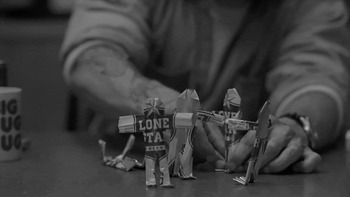
In the first season of True Detective, the camera frequently surveys landscapes ruined by the petrochemical industry. Meanwhile, Rustin Cohle's first name gestures to the rusting steel that might be considered, with the coal implied in his second, atavistic remnants within the ostensibly postindustrial. What do these remnants say about Cohle's relation to liquidity? In True Blood, vampires refer to humans as “blood sacks”; in True Detective, Cohle fashions tin men detectives from emptied “Lone Star” beer cans (Figure 12). The cans figure Matthew McConaughey, and thus capture the network's efforts to cast male actors as lone stars of a new kind of brand propagation. But as with Semyon's sperm, the beer in question registers depleted monetary liquids. Cohle hunts occultists who worship a mysterious “Yellow King,” taken from Robert Chambers's 1895 horror collection The King in Yellow. Chambers's “King in Yellow” is an obscure book within a book so deranging that it drives mad those who read it. The King points in two further directions, which are ultimately the same. First, toward The Yellow Book, a British quarterly, first published the year before Chambers's collection, that came to represent the decade's romance with decadence and aestheticism. The King in Yellow is a study in fin de siècle bohemianism: almost every story involves an artist suffering languidly for his art. But the King in Yellow is, most simply, gold. One character devoted to the King kills his cousin after he mistakes a gold crown for brass. Another confesses, “I was devoured by the desire for gold.”Footnote 22 Thus does aestheticism register the signal crisis of the British Empire, as it searches for stable stores of value in the wake of economic shocks begun in 1873.
True Detective, tin men

Cohle might therefore suggest that as branded tin men, HBO's male stars contain not beer but a network equity that is akin to gold. Cohle approaches a heavenly ether at the moment of his near death; risen like Christ from his hospital bed in the final moments of the first season, he will try to describe “whatever I'd been reduced to,” when, slipping into darkness, he felt himself entering something “warm, like a substance” (1·8). He thinks his daughter and father await him in what seems like nothing so much as the proprietary sublime material into and out of which all stars transform. And yet the brand equity implied by True Detective is demonstrably no longer sublime. Cohle's tinkering with the cans, for instance, is obsessive, the figures tiny and flat. They echo the primitive stick sculptures and lattices made by the drama's serial killer, Errol Childress, who worships the Yellow King. Cohle would replace Childress's primitive gold worship with something more substantial, but he produces nothing more than self-conscious critique. Consequently, even as the Yellow King evokes both the feudal conflict depicted in Game of Thrones and the glowing yellow orb at the center of its title sequence, for True Detective (as indeed for Game of Thrones) ontological authority remains banished to the margins of the world, present only in murderous form. What hope for “quality” in such a world? True Detective uses a cell-phone provider plagued by poor quality control to figure distribution platforms like HBO.GO and HBO Now; at some level, it knows it sells a similarly faulty product. The drama might be said in this way to understand Cohle's melancholy as both the cause and effect of a depreciated brand value: it cannot convince itself that it adds anything to its generic and network antecedents, and so anxiously becomes more and more “self-aware.” Thus do HBO's efforts to produce true quality become stagey exercises in “true quality.”
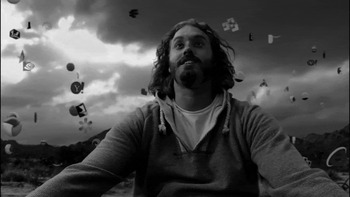
Problems now multiply and languish in the absence of a full account of how the drama's pervasive unease registers both a global economy hemorrhaging value-productive labor and a network diminished at the very moment that it achieves a long-dreamt-of stand-alone distribution autonomy. Any question of the ultimate source of that unease – here and on Game of Thrones and The Leftovers – requires seeing the network's relation to the global economy as a whole. In place of that account, beyond the scope of the present essay, we return temporarily to Silicon Valley. Hendrix receives funding from Patrick Gregory, who makes $250 million by purchasing sesame seed futures. Gregory generates seed funding for his start-ups by speculating on the vulnerability of sesame seed harvests in Brazil and Myanmar to the reproductive cycles of the cicadas native to those countries. Gregory's seed gambit, which brings the future into the present, sheds light on his construction of an island populated by an automated workforce that sits astride the international dateline. The island allows its robots to walk back and forth in time, from one side of the dateline to the other, and recalls the microseconds gained by straight cables between stock markets, and the algorithms used by high-frequency traders. But, crucially, Silicon Valley understands this temporal compression as the provenance of financiers and marketers alike, whose similarity it insists upon. Gregory contemplates Burger King sandwiches and the sesame seeds that sit atop them. As he does, we cut to Bachman's vision quest. The marketer has ingested a grotesque quantity of psilocybin in the hope that he'll discover a name for Hendrix's company better than “Pied Piper.” The quest leaves Bachman swimming in a sea of logos, and transports us back into the logo-strewn brand space represented in the title sequence, a brand space, we now understand, that also figures the space of global finance (Figure 13). The scene transports us, also, to the opening credits of Veep and Game of Thrones: Bachman sits at the center of logos that circle him as so many planets orbiting a sun, or, more apt, as so many courtiers gathered around the Yellow King's court jester.
Silicon Valley, brand master in space

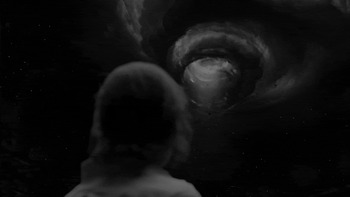
We discover that this hallucinogenic brand space is not an ethereal plane of intangible value, but made of the crap that Simon took WorldCom stock to be: Erlich has been holed up in a public toilet, and he emerges with telling smears upon his face. He has become the kind of asshole that he thinks billionaires must be. Even so, he thinks he has mastered time as only asshole financiers can. He reappears from his vision quest with a Mexican-speaking child. The youth is “from the future,” he says, a reincarnation of himself before his death. “Time is a sphere,” declares the spaced-out brand master. In this fantasy, men don't need women to reproduce biologically – they need time machines. That is a conclusion not different in substance from the gravely serious one offered by True Detective's Cohle: “Time is a flat circle” (1·5). Like Bachman, Cohle has a vision in which he imagines he's seen Time, laid out before him as an astral vortex (Figure 14). The philosophical abstraction is of course a corporate property. Picturing and mastering “Time,” these shows model the primal brand equities into and out of which they would convert themselves. But on Silicon Valley – as indeed in a different way on True Detective – that equity reveals itself as shit at the very moment that it acknowledges its intimacy with profits generated by the financial industry, which is to say profits generated in the noisy sphere of circulation rather than the hidden abode of production. We need not attribute to either Mike Judge or Nic Pizzolatto any precise understanding of Marx to note that they register something essential missing from the monies that move through the transnational that employs them.
Seeing time in True Detective.

HBO's in-house executives no doubt felt urgently at this juncture that they needed to master “Time.” As the network aired the first season of Silicon Valley and True Detective, Time Warner divested itself of the once prestigious but underperforming Time, Inc., a company sent packing carrying not simply the name, “Time,” once so redolent of “quality,” but also a large portion of Time Warner's debt: Time Inc. stock would become earthbound shit, so that Time Warner's could rise once more to improbable heights. But on True Detective, the highs and lows are as one: Cohle's temporal vortex (“Time” as a “flat circle”) evokes the spiral burned into the back of the murdered sex worker. Similar and yet different: one shape is transcendent and beckoning, while the other is embodied and abject. Reading these allegorical extremes, we might recall Walter Benjamin's claim that the seventeenth-century German mourning play renders temporal relations spatial, the better to master a debilitating sense of transience. The baroque morning play turns time into space, Benjamin claims, for the same reason as it turns to the occult: to allegorize in melancholy fashion a once-transcendental referent no longer able to compel belief. These plays treat occult signs as if they were “true”: they reach toward even as they fail to capture something they feel to be disappearing. But again, what has disappeared from True Detective? Ultimately, perhaps, value, as Marx understands it. More immediately, women and the domestic sphere: True Detective's two protagonists either have lost or are about to lose their wives and children, and I have argued that that loss registers a profound change in the nature of the television viewing experience, at least as HBO understands it. But we cannot stop here: HBO's women are complexly allegorical corporate forms. Which brings us back to the spiral: as fans and even the New Yorker were quick to point out, it evokes the logo of Time Warner Cable, the distribution company that Time Warner spun off in 2009, the same year it spun off AOL (Figures 15 and 16).
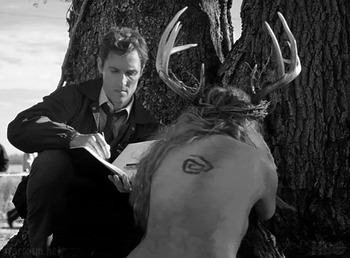
The occult logo in True Detective.

The Time Warner cable logo.

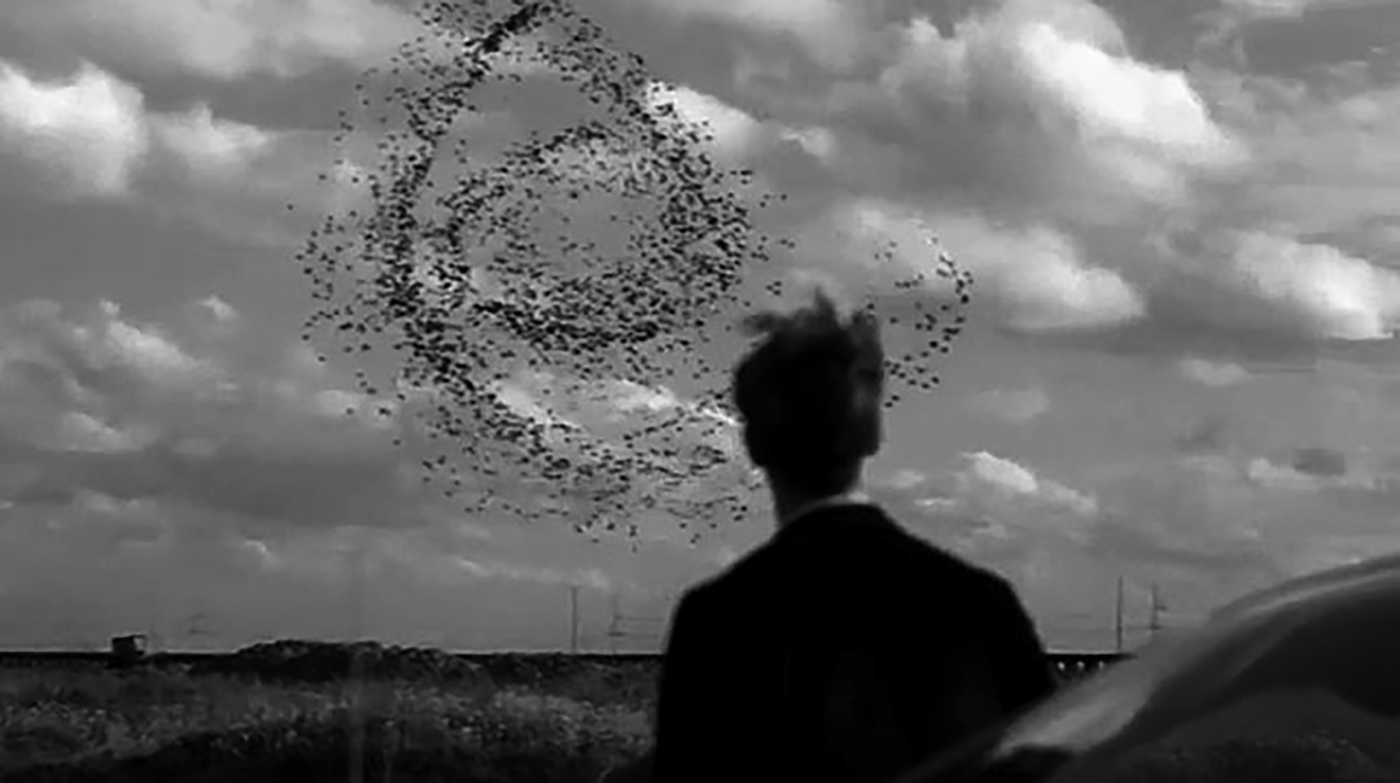
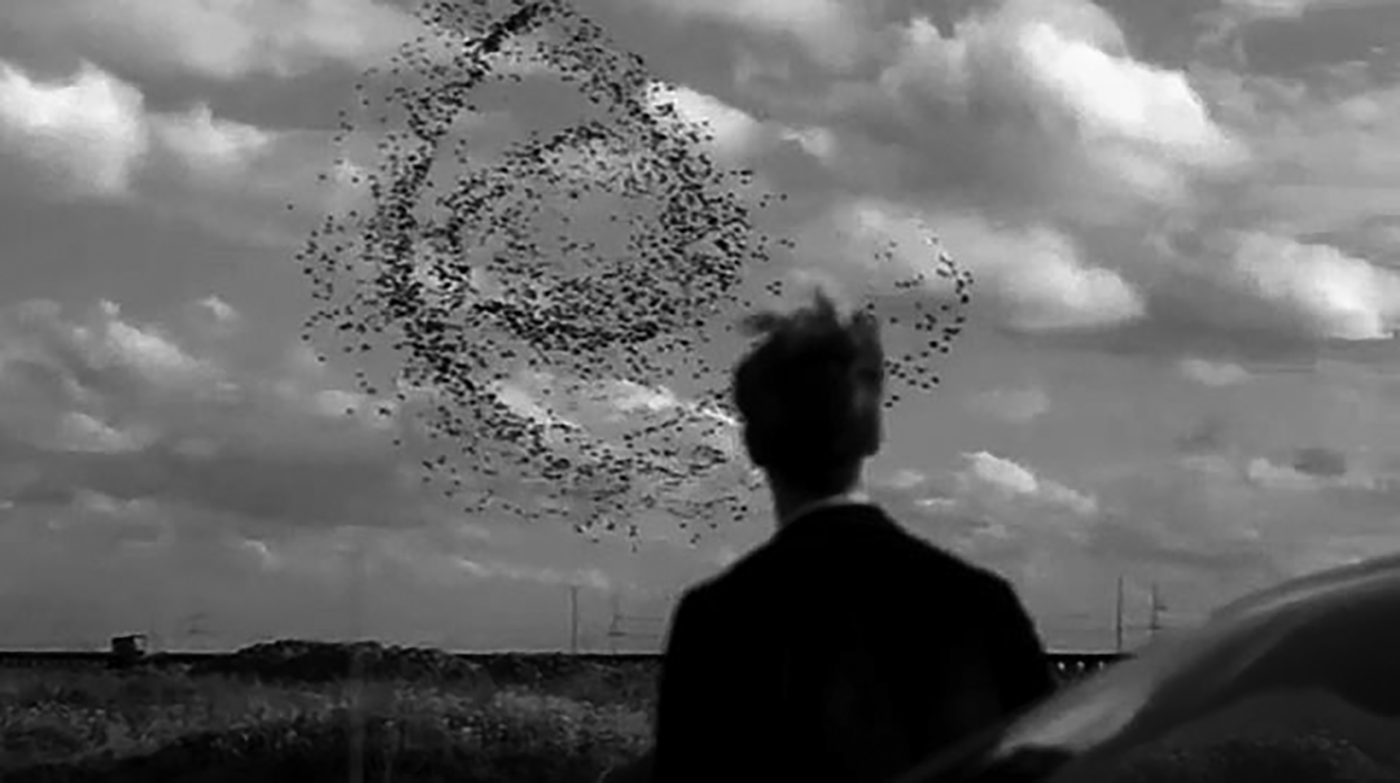
Like the astral vortex, the spiral will appear to Cohle printed upon the sky, temporarily formed from a flock of birds before it assumes another guise (Figure 17). Here, then, a vivid illustration of the supersession of cable television delivery by more potentially cellular agencies: the Time Warner logo disappears into the sky as television signals now do once more, this time to be received on a smartphone loaded with HBO.GO or HBO Now. But the flock and branded corpse, one evanescent and the other material, figure contradictory aspects of that transformation. True Detective registers Time Warner's equivocal freedom from Time Warner Cable, whose logo it imprints on a sex worker murdered in 1995, the year Time Warner cable launched its cable Internet service, appropriately enough, in the South.Footnote 23 When that crime is eventually solved, and Errol Childress killed, Time Warner Cable is exorcized, its demons driven out. But why is the freedom from cable equivocal at all? An account of the drama's corporate exorcism must explain in more than only psychological terms why its men cannot stop bemoaning the effects of their independence. In any final accounting, that explanation must take in a global economy no longer able to sustain its current phase of expansion. Not for nothing does Time Warner shed its assets in a desperate quest for greater profitability and share price. Here we ask more local questions: why should HBO stage a gendered wretchedness over the loss of a distribution outlet like Time Warner Cable? Is it because Time Warner still needs cable outlets (as of this writing, the majority of HBO consumers access the network through cable packages)? It certainly still needs telecommunication companies and Internet providers, and it seems plausible that these needs take heterosexual shape on True Detective as the male need for the female body. Or does the pervasive wretchedness stem from the fact that the cast-out corporation in question takes with it not simply much of the parent company's debt, as Time Inc. later would, but also its name, and hence some measure of Time Warner brand equity?
The Time Warner cable logo gone cellular in True Detective.
What is in a name? Series creator Nic Pizzolatto nicknamed Cohle “The Banker” in the original pilot, but later renamed him “The Tax Man.” The revision calls to mind the difference between hoarding an imagined value, like gold, for instance, and taking profits in the realm of circulation. More simply, it conflates Cohle's detection with a corporate fiscal discipline. He carries about a ledger while on the job, and when we see him writing in it, crouched beside the dead sex worker (Figure 15), we might imagine him assessing the tax implications of the cable spin off, which, Time Warner would have assured its shareholders, were negligible. Shareholders received stock in two companies after the split, and that doubled stock was not taxable. Crucially, the owners of each company were the same. “We own it. Every one of us still owns it,” Jeffrey Bewkes said of Time Warner Cable after its sale. “It's just a separate piece of paper so it can have stronger equity return.”Footnote 24 This is an astonishing confession, insofar as it conflates upper management with shareholders in general: two companies that have split from each other remain much the same, he suggests, because those running them, no doubt self-rewarded richly in company stock, share the same stakes in both. But Bewkes's casually separated pieces of paper testify to a radical revision of the corporation. As he has it, management stock distributions keep a once integral corporation more or less intact even after its nominal disarticulation. And yet the corporate body is now whole only as an occult form, existing somewhere beyond the legal codes that give corporations their personhood at all, and this surely explains the melancholy detection on offer. In True Detective, the splitting of the parent company into smaller units constitutes a breaking of the once whole corporate form that is analogous, I would suggest, to the shattering of the medieval corporatism, so important to Benjamin's account of baroque drama, that once underwrote the legal doctrine of the king's two bodies. This is to say that even as recent HBO television anticipates its viewers' dissolution into quantitative measure, it registers the analogous dissolution of the imaginary corporate body into which those viewers ostensibly dissolve.
The opening credits of True Detective's first season depict human forms containing landscapes: factories, truck stops, highway overpasses, deserted playgrounds, and ruined towns. The human shapes are incipiently corporate. But the real subject of the drama, I would suggest, is the coming apart of a corporate person no longer able to unify the proprietary landscapes of which it was once made up. The drama directs our attention to the hidden forces that precipitate that breaking apart. To be sure, the branded corpse with which the show opens remains a melancholy object whose “true” nature is in some important sense obscure, beyond detection. But that body enjoins us to name the occult agency responsible for its branding: who or what has scarred it? Perhaps the parent company that sells off its child, in which case our intrepid detectives confront the occult sign as actors (and even as representatives of HBO) ignorant of the corporate agencies that control their fates. But there are no more parent companies, at least as Bewkes has it, only siblings united by shared owners. Perhaps, then, the detectives confront the dead body on behalf of a far greater constituency, as that body has been scarred by the greater and more encompassing agency that is capitalism itself.