Introduction
Obsessive–compulsive disorder (OCD) ranks tenth in the World Health Organization's leading causes of disability (WHO, 1999) and has a substantial negative impact on academic, occupational, social and family functioning (Koran et al. Reference Koran, Thienemann and Davenport1996; Lochner et al. Reference Lochner, Mogotsi, du Toit, Kaminer, Niehaus and Stein2003; Eisen et al. Reference Eisen, Mancebo, Pinto, Coles, Pagano, Stout and Rasmussen2006). There are large gaps, however, in our understanding of the pathogenesis of this disorder. Although a growing literature has focused on uncovering genetic vulnerabilities for OCD (see Pauls, Reference Pauls2008, for a review), its etiology probably includes both environmental and genetic factors, and also interactions between them. Several neurodevelopmental, temperamental and environmental risk factors for OCD have been proposed (see Grisham et al. Reference Grisham, Anderson and Sachdev2008, for a review), but longitudinal evidence is lacking. Most of the existing studies have identified correlates of OCD, without being able to establish precedence of these factors (Fontenelle & Hasler, Reference Fontenelle and Hasler2008). We sought to extend the literature by investigating developmental risk factors for OCD diagnosis and obsessive–compulsive (OC) symptoms using data from adult members of the Dunedin Multidisciplinary Health and Development Study (DMHDS), a 32-year birth cohort study. We examined whether neurodevelopmental factors, temperament, behavioral characteristics, personality traits and adversity in childhood would predict OCD diagnosis, OC symptoms and OC symptom dimensions in adulthood.
OCD is associated with abnormal information processing in cortico-striatal-thalamo-cortical circuitry (see Rosenberg & MacMillan, Reference Rosenberg, MacMillan, Davis, Nemeroff, Coyle and Charney2002, for a review) and failures in cognitive and behavioral inhibitory processes (Chamberlain et al. Reference Chamberlain, Blackwell, Fineberg, Robbins and Sahakian2005, Reference Chamberlain, Fineberg, Blackwell, Robbins and Sahakian2006). Thus the first aim of the current study was to examine possible neurodevelopmental risk factors associated with OCD, such as neurological soft signs (NSS). NSS are minor neurological deviations signifying non-specific brain dysfunction. Several studies have reported a higher prevalence of NSS in patients with OCD compared to healthy controls, especially in the areas of motor coordination, sensory integration and primary reflexes (Mataix-Cols et al. Reference Mataix-Cols, Alonso, Hernandez, Deckersbach, Savage, Menchon and Vallejo2003). NSS are frequently associated with more severe OC symptoms (Hollander et al. Reference Hollander, Schiffman, Cohen, Rivera-Stein, Rosen, Gorman, Fyer, Papp and Liebowitz1990; Mataix-Cols et al. Reference Mataix-Cols, Alonso, Hernandez, Deckersbach, Savage, Menchon and Vallejo2003), as well as more pronounced disturbances of visual–spatial function and visual memory (Bolton et al. Reference Bolton, Raven, Madronal-Luque and Marks2000; Mataix-Cols et al. Reference Mataix-Cols, Alonso, Hernandez, Deckersbach, Savage, Menchon and Vallejo2003). In addition, the presence of NSS has been associated with poorer treatment response in some (Hollander et al. Reference Hollander, Kaplan, Schmeidler, Yang, Li, Koran and Barbato2005) but not all studies (Bolton et al. Reference Bolton, Raven, Madronal-Luque and Marks2000). A previous study with this cohort found certain neuropsychological deficits linked to a diagnosis of OCD (Grisham et al. Reference Grisham, Anderson, Poulton, Moffitt and Andrews2009), but no study has yet examined whether NSS predict OCD or specific symptom dimensions.
We were also interested in examining whether lower intelligence in childhood was linked to adult OCD. Lower cognitive reserve, as indicated by childhood IQ, has been associated with the development of several psychiatric disorders (Koenen et al. Reference Koenen, Moffitt, Roberts, Martin, Kubzansky, Harrington, Poulton and Caspi2009). Findings regarding an association between lower IQ and OCD, however, have been mixed. Early reports claimed that individuals with OCD had higher intelligence (Lewis, Reference Lewis1935; Eysenck, Reference Eysenck1947; Ingram, Reference Ingram1961) whereas more recent studies (Zohar et al. Reference Zohar, Ratzoni, Pauls, Apter, Bleich, Kron, Rappaport, Weizman and Cohen1992; Heyman et al. Reference Heyman, Fombonne, Simmons, Ford, Meltzer and Goodman2001; Fontenelle et al. Reference Fontenelle, Mendlowicz, Mattos and Versiani2006) have suggested that children with OCD have a lower than average IQ. This may reflect a referral bias in the earlier studies for higher socio-economic status (SES) patients, underscoring the importance of examining IQ with a representative sample.
Various investigations have also suggested a link between adverse prenatal, perinatal and postnatal environmental experiences and development of OCD. Several decades ago, Capstick & Seldrup (Reference Capstick and Seldrup1977) noted the association between abnormalities at the time of birth and the later development of OCD. Subsequent research provided additional support for perinatal risk factors for OCD (Santangelo et al. Reference Santangelo, Pauls, Goldstein, Faraone, Tsuang and Leckman1994; Lensi et al. Reference Lensi, Cassano, Correddu, Ravagli, Kunovac and Akiskal1996; Vasconcelos et al. Reference Vasconcelos, Sampaio, Hounie, Akkerman, Curi, Lopes and Miguel2007; Geller et al. Reference Geller, Wieland, Carey, Vivas, Petty, Johnson, Reichert, Pauls and Biederman2008). All of these studies, however, were retrospective. The only prospective study, also conducted with the Dunedin cohort (Douglass et al. Reference Douglass, Moffitt, Dar, McGee and Silva1995), found that the presence of perinatal problems/complications did not constitute a risk factor for OCD. However, the Douglass et al. study was conducted when the cohort members were 18 years of age and the median age of retrospectively recalled onset of OCD is 19 (Kessler et al. Reference Kessler, Berglund, Demler, Jin, Merikangas and Walters2005). In the current study, we examined whether adverse perinatal events increased risk for OCD symptomatology at ages 26 or 32.
A second objective of this paper was to explore the importance of temperamental differences in early childhood, behavioral characteristics in middle childhood, and personality traits in late adolescence in predicting adult OCD. A few studies examining the link between temperament and OCD exist, but they have all measured temperament during a period of active illness, confounding state and trait effects (Kusunoki et al. Reference Kusunoki, Sato, Taga, Yoshida, Komori, Narita, Hirano, Iwata and Ozaki2000; Lyoo et al. Reference Lyoo, Lee, Kim, Kong and Kwon2001; Ivarsson & Winge-Westholm, Reference Ivarsson and Winge-Westholm2004). Furthermore, although behavioral characteristics (e.g. emotional problems and poor interpersonal functioning) in childhood have been associated with a range of psychiatric outcomes in adulthood (e.g. Cannon et al. Reference Cannon, Caspi, Moffitt, Harrington, Taylor, Murray and Poulton2002), it is unclear whether they have a specific link to OCD. There have been some findings to suggest that children with OCD have problems with peer relationships and social isolation that precede onset of the illness (Allsopp & Verduyn, Reference Allsopp and Verduyn1990; Toro et al. Reference Toro, Cervera, Osejo and Salamero1992). Finally, although some studies have examined the relationship between personality dimensions and OCD (e.g. Samuels et al. Reference Samuels, Nestadt, Bienvenu, Costa, Riddle and Liang2000), they were not prospective.
The third aim of this study was to evaluate whether adversity in early childhood contributed risk to the future development of OCD. Several studies have found that stressful life events were linked to the onset of OCD (McKeon et al. Reference McKeon, Roa and Mann1984; Khanna et al. Reference Khanna, Rajendra and Channabasavanna1988; Toro et al. Reference Toro, Cervera, Osejo and Salamero1992), although Rasmussen & Tsuang (Reference Rasmussen and Tsuang1986) found that most OCD participants were unable to identify an environmental precipitant. There is also some support for the notion that traumatic events or post-traumatic stress disorder (PTSD) may act as a causal factor in the onset of OCD, at least in a subset of patients (Pitman, Reference Pitman1993; de Silva & Marks, Reference de Silva and Marks1999; Freeman & Leonard, Reference Freeman and Leonard2000; but see also Grabe et al. Reference Grabe, Ruhrmann, Spitzer, Josepeit, Ettelt, Buhtz, Hochrein, Schulze-Rauschenbach, Meyer, Kraft, Reck, Pukrop, Klosterkotter, Falkai, Maier, Wagner, John and Freyberger2008). In a large co-morbidity study, there was statistically significant covariation between lifetime diagnoses of PTSD and OCD (Brown et al. Reference Brown, Campbell, Lehman, Grisham and Mancill2001). Other studies have found an association between OCD and either a history of physical and sexual abuse during childhood (e.g. Lochner et al. Reference Lochner, du Toit, Zungu-Dirwayi, Marais, van Kradenburg, Curr, Seedat, Niehaus and Stein2002) or a higher frequency of negative or traumatic life events (Gothelf et al. Reference Gothelf, Aharonovsky, Horesh, Carty and Apter2004; Cromer et al. Reference Cromer, Schmidt and Murphy2007).
A fourth aim of the current investigation was to examine associations between the previously described potential risk factors and specific OC symptom dimensions (Mataix-Cols et al. Reference Mataix-Cols, Rosario-Campos and Leckman2005). OCD is a multifaceted disorder, and recent reviews have underscored the importance of taking into consideration the heterogeneity of OCD when identifying risk factors for the disorder (Leckman et al. Reference Leckman, Rauch and Mataix-Cols2007; Fontenelle & Hasler, Reference Fontenelle and Hasler2008; Grisham et al. Reference Grisham, Anderson and Sachdev2008). Additionally, recent investigations have highlighted the importance of studying individuals who experience OC symptoms but do not meet full criteria for the disorder (Fullana et al. Reference Fullana, Mataix-Cols, Caspi, Harrington, Grisham, Moffitt and Poulton2009). Factor or cluster analyses of OC symptoms have consistently identified four or five OC symptom dimensions, including contamination/washing, symmetry/ordering, harm/checking and hoarding (Bloch et al. Reference Bloch, Landeros-Weisenberger, Rosario, Pittenger and Leckman2008). These symptom dimensions may be associated with different patterns of neurocognitive dysfunction and may not even share a common pathophysiology (Stein et al. Reference Stein, Denys, Gloster, Hollander, Leckman, Rauch and Phillips2009). We therefore examined potential associations between the major OC symptom dimensions (excluding hoarding) and each of the proposed risk factors.
Method
Participants
Participants were members of the DMHDS, a longitudinal investigation of the health and behavior of a complete cohort of children born during a 1-year period in 1972–1973 in Dunedin, New Zealand. Cohort members are primarily white (91%) and represent the full range of SES in the general population of New Zealand's South Island. At each assessment age, participants, including emigrants living overseas, are invited back to the research unit within 60 days of their birthday for an 8-h day of individual interviews and tests. The study protocol was approved by institutional review boards of the participating universities. Study members gave informed consent before participating. Follow-ups have been performed at ages 5, 7, 9, 11, 13, 15, 18, 21, 26, and, most recently, 32 years of age (n=972; 96% of the living cohort members).
Measures
Psychiatric assessment at ages 26 and 32
At ages 26 and 32, psychiatric symptoms were assessed using a modified version of the Diagnostic Interview Schedule for DSM-IV (DIS-IV; Robins et al. Reference Robins, Cottler, Bucholz and Compton1995). The validity of diagnoses has been demonstrated by treatment seeking and functional impairment (Newman et al. Reference Newman, Moffitt, Caspi, Magdol, Silva and Stanton1996). Interviews were conducted by trained clinicians with degrees in social work, medicine or clinical psychology, blind to participants' psychiatric history. Twelve-month prevalence rates of OCD according to the DIS-IV were 2.3% at age 26 and 1.8% at age 32. These rates are similar to those reported in recent epidemiological surveys (Kessler et al. Reference Kessler, Berglund, Demler, Jin, Merikangas and Walters2005; Ruscio et al. Reference Ruscio, Stein, Chiu and Kessler2008). Among the members who met criteria for OCD at ages 26 or 32, most individuals met criteria at only one of these two assessment points (89%, n=31).
OC symptoms and symptom dimensions
An additional OCD group was constructed comprising cohort members who reported any obsessions or compulsions at age 26 or age 32 regardless of whether they met criteria for a diagnosis of OCD. As reported previously in Fullana et al. (Reference Fullana, Mataix-Cols, Caspi, Harrington, Grisham, Moffitt and Poulton2009), obsessions and compulsions were prevalent within the cohort: 265 members endorsed an OC symptom at either age 26 or 32 and 94 members endorsed one or more OC symptoms at both time points. In addition, we examined symptom dimensions that were created for a previous study (Fullana et al. Reference Fullana, Mataix-Cols, Caspi, Harrington, Grisham, Moffitt and Poulton2009) by grouping symptoms at ages 26 and 32 according to four dimensions of OC symptoms identified in past factor and cluster-analytic studies of clinical samples. Dimension 1 (contamination/washing) included contamination obsessions and washing compulsions. Dimension 2 (harm/checking) included obsessions about relatives being hurt/killed, hurting/killing someone beloved without wanting to, accidentally harming someone, and/or checking to prevent harm. Dimension 3 (symmetry/ordering) included ordering, repeating and counting compulsions. Dimension 4 (shameful thoughts) comprised a single item relating to ‘shameful’ obsessions. Hoarding is not assessed by the DIS-IV and was therefore not included. Symptom dimension scores represented the sum of individual symptoms from that dimension.
Childhood SES
Childhood SES was measured with a scale that places each occupation into one of six categories based on the educational level and income associated with that occupation in the New Zealand census (Elley & Irving, Reference Elley and Irving1976). Measures of both parents' SES were averaged from birth to age 15 years (Poulton et al. Reference Poulton, Caspi, Milne, Thomson, Taylor, Sears and Moffitt2002).
Neurodevelopmental factors
NSS are represented by non-localizing deviant performances on motor tests (Hollander et al. Reference Hollander, Kaplan, Schmeidler, Yang, Li, Koran and Barbato2005). They were measured in the current study with the Bayley Motor Scale at age 3 (Bayley, Reference Bayley1969), the McCarthy Motor Scales at age 5 (McCarthy, Reference McCarthy1972), and the Basic Motor Ability Test at ages 7 and 9 (Arnheim & Sinclair, Reference Arnheim and Sinclair1974). Intelligence at age 5 was measured by the Stanford–Binet Intelligence Scales. Intelligence at ages 7, 9 and 11 was assessed by scores on the Wechsler Intelligence Scale for Children – Revised (WISC-R; Wechsler, Reference Wechsler1974). Scores on these measures were standardized and averaged.
Perinatal insults included 12 prenatal and 12 neonatal problems recorded by clinicians during the mother's pregnancy (Stanton et al. Reference Stanton, McGee and Silva1991). Participants were coded as to whether they had at least one perinatal insult. The complications recorded at birth included: epilepsy; moderate or severe hypertension (diastolic blood pressure 100 to >109 mmHg); antepartum hemorrhage; delivery other than spontaneous (forceps and rotation vertex delivery, cesarean section or breech birth); small for gestational age (⩽10th percentile of birthweight for gestation age); preterm (<37 weeks gestational age); idiopathic respiratory distress syndrome; minor or major neurological signs; non-hemolytic hyperbilirubinemia (serum bilirubin concentration >15 mg/100 ml); and Rh incompatibility.
Childhood temperament
Temperament ratings were made by an examiner during a 90-min developmental testing session when the children were ages 3 and 5 years. Each child was rated by the examiner on 22 behavioral characteristics that were derived from those used in the Collaborative Study on Cerebral Palsy, Mental Retardation, and Other Neurological Disorders of Infancy and Childhood (see Goldsmith & Gottesman, Reference Goldsmith and Gottesman1981). Three temperament factors emerged from these ratings: Difficult, Sluggish, and Approach, and the ratings were averaged across the two ages (Caspi & Silva, Reference Caspi and Silva1995). The Approach factor included ratings of little caution around the examiner, quick adjustment to new situations, extreme friendliness, self-confidence, and self-reliance when presented with set stimuli. The Sluggishness factor included ratings of shyness, flat affect, passivity, and extreme malleability. Finally, the Difficult factor combined elements of emotional lability, restlessness, short attention span, and negativism.
Childhood behavior
Behavior ratings were made at ages 5, 7, 9 and 11 years by parents and teachers on the Rutter Child Scales (Elander & Rutter, Reference Elander and Rutter1996), which assess children's conduct problems, internalizing problems and hyperactive behavior. Scores on each scale were standardized and averaged across the ages. In addition, as an index of interpersonal adjustment, at ages 7, 9 and 11 years, parents and teachers evaluated the statements: ‘this child is not much liked by other children’ and ‘this child is a loner’ on a three-point scale. Scores on these two items were added, standardized and averaged across ages to create an index of social isolation.
Personality dimensions
At age 18, cohort members completed a modified 177-item version of the Multidimensional Personality Questionnaire (MPQ; Patrick et al. Reference Patrick, Curtin and Tellegen2002) adapted for use in New Zealand (Caspi et al. Reference Caspi, Begg, Dickson, Harrington, Langley, Moffitt and Silva1997). The Negative Emotionality scale measures interpersonal alienation, irritable-aggressive attitudes, and reactivity to stress. The Positive Emotionality scale measures well-being, social potency, achievement, and social closeness. The Constraint scale measures tendency to endorse conventional social norms, avoid thrills, and act in a cautious and restrained manner.
Childhood stressors
Childhood physical and sexual abuse were assessed retrospectively at age 26. Cohort members were assessed for unwanted sexual contact before age 11 (having one's genitals touched, touching another's genitals, and sexual intercourse) as part of an interview about reproductive health. They were also assessed for physical abuse before age 11 (multiple episodes of severe physical punishment resulting in lasting bruising or injuries) as part of an interview on victimization. Physical and sexual abuse are the only variables that were assessed retrospectively. Other childhood stressors before age 11 years included the number of residence changes and whether a biological parent became permanently absent from the family due to death, separation or divorce.
Statistical analyses
Participants were classified into three mutually exclusive groups. The OCD group comprised those who met criteria for an OCD diagnosis at age 26 or 32 (n=36). Healthy controls were cohort members who did not meet criteria for any anxiety disorder at age 26 or 32 (n=613). Anxious controls were members who met criteria for an anxiety disorder other than OCD at age 26 or 32 (n=310). We conducted two logistic regression analyses adjusted for sex and SES. In the first, the OCD group was compared to the healthy control group. In the second, the OCD group was compared to the anxious control group to determine whether associations were specific to OCD. We also conducted logistic regression analyses comparing members who reported any obsessions or compulsions at age 26 or 32 (n=359) to those who did not report obsessions or compulsions at either time point. Finally, we conducted additional logistic regression analyses to assess the strength of association between each of the risk variables and the four OC symptom dimensions. Again, all odds ratios (ORs) were adjusted for sex and SES.
Results
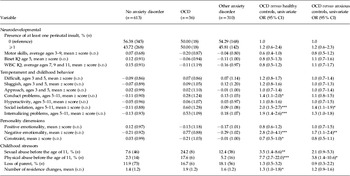
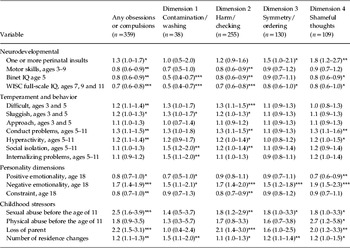
Table 1 presents the descriptive statistics for the neurodevelopmental, temperamental and childhood abuse variables for the OCD, anxious control and healthy control groups. Findings for categorical measures are reported as group percentages. Findings for continuous measures are standardized to a mean of 0 and standard deviation (s.d.) of 1. Table 2 presents the association between risk factors and OC symptom dimensions in adulthood. In both tables, the strength of associations is presented by ORs, adjusted for sex and SES, with 95% confidence intervals (CIs).
Risk factors for DSM-IV OCD at ages 26 or 32 (n=959)

OCD, Obsessive–compulsive disorder; OR, odds ratio; CI, confidence interval; WISC, Wechsler Intelligence Scale for Children; s.d., standard deviation.
ORs adjusted for sex and socio-economic status (SES).
* p<0.05, ** p<0.01, *** p<0.001.
Risk factors for DSM-IV OC symptom dimensions at ages 26 or 32 (n=959)

OC, Obsessive–compulsive; WISC, Wechsler Intelligence Scale for Children.
Values are odds ratios (95% confidence interval) adjusted for sex and socio-economic status (SES).
* p<0.05, ** p<0.01, *** p<0.001.
The number of perinatal insults and childhood intelligence were not associated with significantly increased odds of a diagnosis of OCD at ages 26 or 32. There was a marginally significant association between poor motor skills, ages 3–9, and adult OCD diagnosis (p=0.05), but it was not specific to OCD.
None of the temperament factors were linked to an adult diagnosis of OCD. Two of the childhood behavior characteristics, however, were associated with increased odds of adult OCD. The OCD group was distinguished from healthy controls by greater internalizing symptoms, as rated by parents and teachers. They were also more socially isolated than both anxious and healthy controls. With respect to personality, the OCD group was distinguished from the healthy control group with respect to higher negative emotionality and lower constraint scores on the MPQ. The OCD group was also distinguished from the anxious control group by significantly higher negative emotionality scores.
Finally, retrospectively reported physical abuse and sexual abuse in childhood were significantly associated with an adult diagnosis of OCD. Members who reported experiencing childhood sexual abuse had three times greater odds of developing OCD relative to healthy controls. In addition, members who reported experiencing childhood physical abuse had seven times greater odds of developing OCD relative to healthy controls and almost four times increased odds of developing OCD relative to anxious controls. This association remained significant even when adjusting for the presence of a PTSD diagnosis at ages 26 or 32, suggesting that co-morbid PTSD did not fully account for this association.
When risk factors were examined for adult OC symptoms rather than clinical diagnosis, the majority of the childhood risk factors were significant predictors. Each of the neurodevelopmental risk factors, several of the temperamental and behavioral characteristics, all of the personality dimensions, and most of the childhood stressors significantly predicted OC symptoms at age 26 or 32 (Table 2). Furthermore, several significant associations emerged between risk factors and specific OC symptom dimensions. The presence of at least one perinatal insult was associated with increased risk of developing OC symptoms related to either symmetry/ordering or shameful thoughts. Poor motor skills were significantly linked to the development of harm/checking OC symptoms and (marginally) to contamination/washing symptoms (p=0.05). Lower intelligence on the Stanford–Binet and WISC was associated with increased odds of developing all OC symptom dimensions except symmetry/ordering.
With respect to temperament, a more difficult temperament in early childhood was associated with the OCD harm/checking dimension. In addition, more hyperactivity and conduct problems in middle childhood were associated with increased risk of the harm/checking and shameful thoughts symptom dimensions. Internalizing problems in middle childhood, however, were associated with increased risk of the contamination/washing symptom dimension. Social isolation was associated with significantly increased risk of both contamination/washing and harm/checking. The associations between symptom dimensions and personality traits at age 18 were fairly consistent, with most symptom dimensions being significantly associated with higher negative emotionality scores. Finally, sexual abuse in childhood (reported retrospectively) was linked to increased risk of each of the symptom dimensions except contamination/washing, whereas physical abuse was associated significantly with increased risk for the shameful thoughts dimension. Loss of a parent significantly predicted both the harm/checking and shameful thoughts dimensions and the number of residence changes was significantly associated with each of the OC symptom dimensions.
Discussion
The current study prospectively identified a range of risk factors for developing OCD and OC symptom dimensions. Although childhood OC symptoms predicted later diagnosis in this cohort (Fullana et al. Reference Fullana, Mataix-Cols, Caspi, Harrington, Grisham, Moffitt and Poulton2009), OCD was not a stable diagnosis. Only 11% of the OCD group met diagnostic criteria at both age 26 and age 32 assessments. Although this is somewhat surprising, the true stability of OCD diagnoses within the community is unknown because of the dearth of longitudinal population-based studies. OCD is chronic in clinical samples selected for severity, co-morbidity and chronicity (e.g. Eisen et al. Reference Eisen, Goodman, Keller, Warshaw, DeMarco, Luce and Rasmussen1999); however, the proportion of non-chronic cases cannot be detected through clinic-based research, as they seldom seek treatment. This paradox has been described as ‘the clinician's illusion’ (Cohen & Cohen, Reference Cohen and Cohen1984). In addition, although OC symptoms are stable over time (Fullana et al. Reference Fullana, Mataix-Cols, Caspi, Harrington, Grisham, Moffitt and Poulton2009), their severity may fluctuate, explaining why many individuals met diagnostic criteria at one assessment point but not the other. This fluctuation above and below the OCD diagnostic threshold is similar to that seen in other anxiety disorders when examined in an unselected community cohort (Craske et al. Reference Craske, Poulton, Tsao and Plotkin2001) and underscores an advantage of the dimensional approach used in the current study.
Despite the lack of stability of the diagnosis in this cohort, several risk factors for adult OCD emerged. The specific association between childhood isolation and later OCD diagnosis is consistent with previous findings that poor peer relationships may predate the onset of OC symptoms (Allsopp & Verduyn, Reference Allsopp and Verduyn1990). Children demonstrated behavioral and relational characteristics that were observable by their parents and teachers and were associated with a later diagnosis of OCD in adulthood. Previous studies have found that certain patterns of biogenetic temperament and acquired character are associated with OCD (Pfohl et al. Reference Pfohl, Black, Noyes, Kelley and Blum1990; Richter et al. Reference Richter, Summerfeldt, Joffe and Swinson1996; Bejerot et al. Reference Bejerot, Schlette, Ekselius, Adolfson and von Knorring1998; Lyoo et al. Reference Lyoo, Lee, Kim, Kong and Kwon2001), but this study is the first to demonstrate prospectively that children's behavioral styles are linked to OCD in adulthood. These findings are of great interest because if a child's behavioral and interpersonal style can predict their vulnerability to OCD, these individual differences can be used to design parent-training and school-based interventions.
With respect to personality, adult OCD was specifically associated (i.e. the risk was greater for OCD than participants with anxiety disorders in general) with increased negative emotionality reported at age 18. Stress reaction is roughly equivalent to the Big Five construct of neuroticism (Costa & McCrae, Reference Costa and McCrae1985), whereas the higher-order trait of negative emotionality is more general than neuroticism and subsumes the Big Five neuroticism and agreeableness (inversely) (Tellegen, Reference Tellegen1982; Church, Reference Church1994). These findings are consistent with the increased internalizing problems and greater social isolation experienced by the OCD group in childhood. Of interest, the results of the current study did not replicate previously reported findings that OCD is associated with increased harm avoidance (Lyoo et al. Reference Lyoo, Lee, Kim, Kong and Kwon2001). This discrepancy may suggest the limitations of previous studies that have assessed personality traits in OCD patients during an active symptomatic period.
Cohort members who retrospectively reported a history of childhood physical or sexual abuse were more likely to be diagnosed with an anxiety disorder in adulthood, whereas those who reported physical abuse had a specific risk for OCD. Cognitive and biological models of OCD have been proposed to explain pathways by which traumatic events, such as childhood abuse, may lead to the development of OCD. Trauma exposure may evoke intense anxiety, which leads the individual to excessively label stimuli as threatening and to use compensatory mechanisms such as rituals to reduce arousal (Riggs, Reference Riggs2000).
Consistent with our conceptualization of OCD as a multidimensional syndrome (Mataix-Cols et al. Reference Mataix-Cols, Rosario-Campos and Leckman2005; Fullana et al. Reference Fullana, Mataix-Cols, Caspi, Harrington, Grisham, Moffitt and Poulton2009), the second set of analyses examined possible links between childhood risk factors and OC symptoms and symptom dimensions at age 26 or 32. When the requirement for OCD diagnosis was removed, all of the neurodevelopmental and personality risk factors predicted OCD symptoms at ages 26 and 32, and most of the temperament/behavior and childhood stressor variables. These findings underscore the importance of including subclinical cases in examining vulnerability for OC symptomatology. Furthermore, experiencing a perinatal insult, reduced motor skills, and decreased intelligence were all associated with increased risk of specific OC symptom dimensions in adulthood, suggesting that each of the major symptom dimensions of OCD may arise from a complex combination of common (generic) and unique risk factors, as predicted by the multidimensional model of OCD (Mataix-Cols et al. Reference Mataix-Cols, Rosario-Campos and Leckman2005; Leckman et al. Reference Leckman, Rauch and Mataix-Cols2007). There were also several associations between childhood behavior and specific adult OC symptom dimensions.
The finding that experiencing a perinatal insult was associated with increased risk of developing OC symptoms related to either symmetry/ordering or shameful thoughts is of particular interest. In OCD, symmetry/ordering and aggressive/sexual (i.e. ‘shameful’) symptoms are strongly associated with co-morbid tics and Tourette syndrome (Baer, Reference Baer1994; Mataix-Cols et al. Reference Mataix-Cols, Rauch, Manzo, Jenike and Baer1999), an earlier illness onset (Tükel et al. Reference Tükel, Ertekin, Batmaz, Alyanak, Sözen, Aslanta, Atl and Ozyildirim2005; Labad et al. Reference Labad, Menchon, Alonso, Segalas, Jimenez, Jaurrieta, Leckman and Vallejo2008), and male predominance (Mataix-Cols et al. Reference Mataix-Cols, Rauch, Manzo, Jenike and Baer1999; Labad et al. Reference Labad, Menchon, Alonso, Segalas, Jimenez, Jaurrieta, Leckman and Vallejo2008; Jaisoorya et al. Reference Jaisoorya, Janardhan Reddy, Srinath and Thennarasu2009). Lensi et al. (Reference Lensi, Cassano, Correddu, Ravagli, Kunovac and Akiskal1996) also found significantly greater history of perinatal trauma in males who had an early onset of OCD. Previous studies have also suggested that symmetry/ordering symptoms have a strong familial component compared to other symptom dimensions (Alsobrook et al. Reference Alsobrook, Leckman, Goodman, Rasmussen and Pauls1999; Leckman et al. Reference Leckman, Pauls, Heping, Rosario-Campos, Katsovitch, Kidd, Pakstis, Alsobrook, Robertson, McMahon, Walkup, van de Wetering, King and Cohen2003; Hasler et al. Reference Hasler, Pinto, Greenberg, Samuels, Fyer, Pauls, Knowles, McCracken, Piacentini, Riddle, Rauch, Rasmussen, Willour, Grados, Cullen, Bienvenu, Shugart, Liang, Rudolf, Wang, Ronquillo, Nestadt and Murphy2007). It remains to be seen to what extent these perinatal factors interact with genetic factors to cause these symptoms. The findings regarding intelligence demonstrate that, when considering symptom dimensions of OCD, children who later developed OC symptoms performed worse on intelligence tests than those who did not. This finding is consistent with studies (Zohar et al. Reference Zohar, Ratzoni, Pauls, Apter, Bleich, Kron, Rappaport, Weizman and Cohen1992; Heyman et al. Reference Heyman, Fombonne, Simmons, Ford, Meltzer and Goodman2001; Fontenelle et al. Reference Fontenelle, Mendlowicz, Mattos and Versiani2006) suggesting that children with OCD may have decreased overall intelligence. Of note, this association did not emerge in the initial set of categorical analyses, underscoring the importance of examining OCD dimensionally.
Unlike the association with decreased intelligence, which was consistent across symptom dimensions, a specific link emerged between decreased motor skills and harm/checking. Decreased motor skills may reflect a subtle dysfunction in motor brain regions and associated subcortical structures. It is possible that the harm/checking dimension of OCD is most strongly associated with a faulty error detection system and the feeling of doubt reported by OCD patients. This association may suggest decreased inhibitory function associated with this symptom dimension and is consistent with the notion of mild neurocognitive impairment among children who later develop the harm/checking OC symptoms. Collectively, these associations between adult OC symptom dimensions and pre-morbid factors such as perinatal insults, decreased IQ and NSS suggest that neurodevelopmental factors are important in the genesis of these symptoms.
Finally, the findings regarding childhood abuse and OC symptom dimensions support the proposition that specific characteristics of a traumatic event may play a role in determining the symptomatic profile of OCD. Sexual abuse and physical abuse were both specifically linked with the shameful thoughts dimension, but sexual abuse was not linked to the contamination/washing dimension as predicted by Rachman (Reference Rachman1994, Reference Rachman2004). The finding of a strong correlation between both types of childhood abuse and the shameful thoughts symptom dimension is consistent with a recent epidemiological study that found a strong association between PTSD and a Sexual/Religious OC symptom dimension (similar to the current shameful thoughts dimension) and no association between PTSD and a Contamination OC symptom dimension (Fullana et al. Reference Fullana, Vilagut, Rojas-Farreras, Mataix-Cols, de Graaf, Demyttenaere, Haro, de Girolamo, Lépine, Matschinger and Alonso2010). Thus the present findings provide further support for the concept of post-traumatic OCD, suggesting that some individuals may experience traumatic events that predispose them to certain types of OCD symptoms.
The primary limitation of the current study is that the results are limited to a single cohort of adults in New Zealand. Additional research is needed to determine whether the findings from the current study generalize to other populations. Other limitations of the study related to the DIS-IV are that hoarding symptoms are not assessed by this instrument and the specific content of the ‘shameful thoughts’ item is unknown, although it probably comprises sexual and religious obsessions. Future studies would benefit from the inclusion of a more comprehensive, OCD-specific measure, such as the Yale–Brown Obsessive Compulsive Scale (Goodman et al. Reference Goodman, Price, Rasmussen, Mazure, Fleischmann, Hill, Heninger and Charney1989). Nonetheless, the current study has several unique strengths, including the use of a birth cohort, prospective measures of a range of childhood characteristics, and a low attrition rate. In addition, although we examined risk for a categorical diagnosis of OCD in adulthood, we also applied a dimensional approach that was extremely fruitful in demonstrating specific associations between risk factors and OC symptoms and symptom dimensions. Thus, although most existing evidence refers to correlates of a categorical diagnosis of OCD, this study constitutes an important advance in the identification of risk factors for OC symptoms and specific OC symptom dimensions. These risk factors may be particularly valuable in investigations of OCD gene×environment interactions, and in guiding future efforts towards early intervention or prevention. In conclusion, the current investigation has demonstrated that a range of childhood developmental factors is associated with an OCD diagnosis and specific OC symptom dimensions in adulthood, thereby advancing our understanding of the etiology of this disabling disorder.
Acknowledgements
We thank the Dunedin Study members, their parents and teachers, Unit research staff, and Study founder P. Silva. The Dunedin Multidisciplinary Health and Development Research Unit is supported by the New Zealand Health Research Council. This research received support from the Australian Research Council (grant DP0984560), the Medical Research Council, UK (grants G0100527 and G0601483), the U.S. National Institute on Aging (grant AG032282) and the U.S. National Institutes of Health (grants MH45070 and MH49414), the William T. Grant Foundation, the Lady Davis Fellowship of the Hebrew University, and the Caselberg Trust. A. Caspi is a Royal Society Wolfson Merit Award holder.
Declaration of Interest
None.