

INTRODUCTION
Grain weight is a key yield component in wheat (Triticum aestivum L.), and thus is considered as a main factor in yield improvement. The weight of individual grains on a wheat spike is unevenly distributed, depending upon the spatial position of the kernel (Yin et al. Reference Yin, Wang, He, Fu and Lu1998; Stoddard Reference Stoddard1999; Calderini & Reynolds Reference Calderini and Reynolds2000; Wang et al. Reference Wang, Yin, He, Zhang, Lu, Li and Shi2003). Kernels at the base of the spikes have a higher single grain weight and are regarded as superior grains, whereas the distal kernels have a lower individual grain weight and are considered as inferior grains (Jenner et al. Reference Jenner, Ugalde and Aspinall1991; Zhao & Yu Reference Zhao and Yu2005). Large differences are seen in flowering time and the amount and size of vascular bundles among florets in a wheat spike, resulting in a wide variation in grain development and final weight within a spike (Li et al. Reference Li, Wei and Ding1999; Wang et al. Reference Wang, Cao, Dai and Zhou2000). However, the intrinsic factors responsible for variation in grain weight between superior and inferior grains remain elusive.
Starch, which accounts for 0·65–0·75 of wheat grain weight and can exceed 0·8 of the endosperm weight, is a major determinant of wheat yield (Stark et al. Reference Stark, Timmerman, Barry, Preiss and Kishore1992; Hurkman et al. Reference Hurkman, McCue, Altenbach, Korn, Tanaka, Kothari, Johnson, Bechtel, Wilson, Anderson and DuPont2003). It is generally believed that the grain-filling rate in cereals is closely associated with sink strength (Liang et al. Reference Liang, Zhang and Cao2001; Yang et al. Reference Yang, Zhang, Wang and Zhu2003; Reynolds et al. Reference Reynolds, Calderini, Condon and Vargas2007). During the grain filling period, wheat grains are major carbohydrate sinks (He et al. Reference He, Wang and Zhang2000; Liang et al. Reference Liang, Zhang and Cao2001; Fischer Reference Fischer2007); the sink strength can be described as the product of sink size and sink activity (Brocklehurst Reference Brocklehurst1977; Jenner et al. Reference Jenner, Ugalde and Aspinall1991; Liang et al. Reference Liang, Zhang and Cao2001; Guo et al. Reference Guo, Feng, Zhao, Xue, Wang, Wang and Yao2004). Sink size is a physical constraint determined mainly by cell number, and sink activity is a physiological constraint upon a sink organ's assimilate import (Ho Reference Ho1988). In wheat grain, it is assumed that the enzymes involved in starch synthesis, including sucrose synthase (SS), uridine diphosphorate glucose pyrophosphorylase (UGPP), adenosine diphosphorate glucose pyrophosphorylase (AGPP), soluble starch synthase (SSS) and granule-bound starch synthase (GBSS), are the prominent factors in determining the sink activity (Smyth & Prescott Reference Smyth and Prescott1989; Nakamura & Yuki Reference Nakamura and Yuki1992; Hurkman et al. Reference Hurkman, McCue, Altenbach, Korn, Tanaka, Kothari, Johnson, Bechtel, Wilson, Anderson and DuPont2003; Yan et al. Reference Yan, Wang, Dai, Li, Fu, He and Yin2007; Li et al. Reference Li, Yin, Yan, Dai, Li, Liang, Geng and Wang2008).
Spike shape is an important component of wheat plants, due to its close association with the canopy structure, thus affecting grain weight and grain yield (Guo et al. Reference Guo, Feng, Zhao, Xue, Wang, Wang and Yao2004). Compact-spike cultivars are characterized by high grain density (GD; grains/mm) on a spike and loose-spike cultivars by low GD (Wang et al. Reference Wang, Cheng and Zhang2006). Wang et al. (Reference Wang, Cao, Dai and Zhou2000) reported that the extent of difference in grain weight within a spike varies with the spike type: the cultivars with large spikes have greater variation in grain weight within a spike than those with small spikes. It has been reported that the compact-spike rice cultivars have particularly low individual weight of inferior grains compared to loose-spike cultivars (Cheng et al. Reference Cheng, Zhang, Yao, Wu and Wang2003; Zhu et al. Reference Zhu, Cheng, Wang, Zhong, Zhao and Liu2004). However, it remains unclear as to what the effect of GD is on the difference in grain weight within a wheat spike.
The aim of the present study is to investigate starch accumulation, endosperm cell number and activity of enzymes involved in starch synthesis in both superior and inferior grains in wheat spikes, and to determine whether the variations in starch accumulation between superior and inferior grains could be attributed to their sink strength.
MATERIALS AND METHODS
Plant materials and treatments
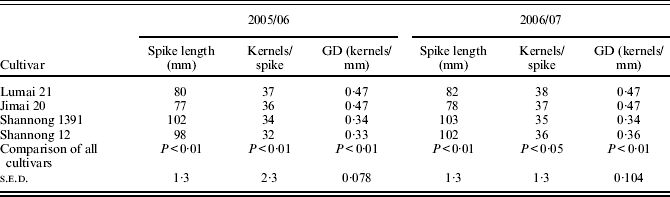
The experiment was conducted under irrigated conditions at the Tai'an Experimental Station of Shandong Agricultural University, Tai'an, Shandong, China (36°09′N, 117°09′E, 129 m asl) in two growing seasons from October 2005 to June 2006 and from October 2006 to June 2007. The soil was a sandy loam, and the 0–200 mm soil layer contained 12 g total organic matter (OM)/kg, 90 mg total nitrogen (N)/kg, 87·2 mg available N/kg, 18·6 mg available phosphate (P2O5)/kg and 57·5 mg available potassium (K2O)/kg. Maize (Zea mays L.) was the previous crop. In addition, 7·5 g farmyard manure (3·4 g N/kg, 1·6 g P2O5/kg and 4 g K2O/kg)/m2, 12 g N/m2, 7·5 g P2O5/m2 and 12 g K2O/m2 were applied as the basal fertilizer before planting, and 12 g N/m2 was top-dressed at the jointing stage (GS31, Zadoks et al. Reference Zadoks, Chang and Konzak1974). Four typical cultivars of winter wheat currently used in local production were chosen in the experiment (Table 1). Shannong 1391 and Shannong 12 were loose-spike cultivars (with lower GD within a spike), Lumai 21 and Jimai 20 were compact-spike cultivars (with higher GD within a spike). They were planted in plots (3×3 m) with 180 plants/m2. The experiment was a completely randomized design with three replications.
Spike characteristics between compact- and loose-spike wheat cultivars at maturity ( d.f.=59)

Sampling
At anthesis, c. 300 spikes flowering on the same date were labelled with red thread. From 5 days post anthesis (DPA), 10 labelled spikes of each plot were sampled at 4-day intervals till maturity. These spikes were killed by heating to 105°C for 30 min and then dried at 70°C for sucrose and starch determination. On the same sampling date, ten (from 5 to 10 DPA) or five (from 15 DPA to maturity) of the labelled spikes were sampled and frozen in liquid nitrogen for at least 30 min and then stored at −40°C till enzyme assay. From the basal 5 to 12 spikelets on the spikes of wheat, the first and second basal grains on the spikelets were detached and termed superior grains, whereas the third and fourth distal grains on the same spikelets were termed inferior grains. At maturity, 15 spikes were harvested for the assessment of spike length, kernels/spike and GD (grains/mm).
Enzyme extraction and assays
Preparation of enzyme extraction
The preparation procedure was according to the methods of Smyth & Prescott (Reference Smyth and Prescott1989) and Nakamura & Yuki (Reference Nakamura and Yuki1992). A 1 g sample of frozen grain was homogenized with a pestle in an ice-cold mortar, which contained 8 ml of 50 mm Hepes–sodium hydroxide (NaOH) (pH 7·5). To 50 μl of the homogenate, 2 ml of the buffer solution was added, which was centrifuged at 1700×g for 10 min at 0–4°C. The sediment was then suspended in 2 ml of the buffer solution for GBSS activity assay. The rest of the homogenate was centrifuged at 10 000 g at 0–4°C for 15 min for assay of activities of SS, AGPP and SSS. None of the enzymes were purified, to avoid enzyme activity loss. During assay, however, the background value of each sample was determined by adding the same volume of denatured enzyme extraction to correct the possible substrate in the crude enzyme extraction.
SS
The assay of SS activity was carried out following the procedure of Smyth & Prescott (Reference Smyth and Prescott1989). The reaction mixture contained 100 mm Hepes–NaOH (pH 7·5), 100 mm sucrose, 10 mm uridine diphosphate (UDP) and made up a volume of 0·1 ml. The reaction was started by adding 0·1 ml of enzyme crude extract. After incubation at 30°C for 30 min, the reaction was stopped by heating in boiling water for 1 min. Subsequently, 1 ml of 27·6 mm dinitrosalicylic acid (DNS) was added to the solution, which was heated for 5 min in boiling water. Finally, the formation of fructose catalysed by SS was measured with a spectrophotometer (Shimadzu UV-2450, Tokyo, Japan) at 540 nm.
AGPP and UGPP
The AGPP and UGPP activities were measured by the methods of Smyth & Prescott (Reference Smyth and Prescott1989). The assay was conducted in 50 mm Hepes–NaOH (pH 7·5), 1·2 mm adenosine diphosphoglucose (ADPG)/uridine diphosphoglucose (UDPG), 5 mm PPi (the pyrophosphate anion, P2O74−), 6 mm magnesium chloride (MgCl2), 3 mm dithiothreitol (DTT) and 50 μl of enzyme crude extraction in a reaction mixture of 450 μl. After incubation at 30°C for 20 min, the reaction was stopped by heating in boiling water. After cooling, 100 μl of 6 mm nicotinamide adenine dinucleotide phosphate (NADP+), 0·08 unit phosphoglucomutase, 0·07 unit glucose-6-phosphate dehydrogenase and 300 μl of 50 mm Hepes–NaOH (pH 7·5) were added to the reaction solution. The mixture was incubated at 30°C for 10 min, and then measured at 340 nm.
SSS and GBSS
The SSS and GBSS activities were determined according to the methods of Nakamura & Yuki (Reference Nakamura and Yuki1992). The reaction was initiated by adding 50 μl enzyme extraction and 0·35 ml of reaction medium (50 mm Hepes–NaOH (pH 7·5), 1·6 mm ADPG, 0·7 mg Amylopectin and 15 mm DTT), and then incubating at 30°C for 20 min. The reaction was stopped by heating in a boiling water bath for 1 min, and then added by 200 μl of a solution of 50 mm Hepes–NaOH (pH 7·5), 4 mm phosphoenolpyruvic acid (PEP), 200 mm potassium chloride (KCl), 10 mm MgCl2, 1·2 unit pyruvate kinase and incubated for 20 min at 30°C. The reaction was also stopped by heating in a boiling-water bath for 1 min. It was then mixed with a solution of 50 mm Hepes–NaOH (pH 7·5), 10 mm glucose, 20 mm MgCl2 and 2 mm NADP+, and absorption was measured at 340 nm after the addition of 1·4 unit hexokinase and 0·35 unit G-6-P dehydrogenase.
Amylose and amylopectin determination
Amylose and amylopectin contents were determined with a coupled spectrophotometer assay (He Reference He1985). A sample of 100 mg of milled grain was stirred with 10 ml of 0·5 m potassium hydroxide (KOH) for 15 min at 100°C and then diluted to a volume of 50 ml with distilled water. Of this solution, 2·5 ml was diluted with 30 ml distilled water and adjusted to pH 3·5 with 0·1 m hydrochloric acid (HCl), and then 0·5 ml of iodine-potassium iodide (I2-KI) reagent was added to the solution, which was diluted with distilled water to a final volume of 50 ml. After blending for 20 min, the mixture was monitored with a UV-2450 Shimadzu spectrophotometer at 471, 553, 632 and 740·3 nm. Standard amylose and amylopectin were purified from wheat. The absorption peaks of purified amylose reacted with I2-KI reagent were 632 and 471 nm, whereas those of amylopectin were 740·3 and 553 nm.
The processes of starch accumulation in single grains were fitted by logistic growth equations as described by Darroch & Baker (Reference Darroch and Baker1990):

where W is the starch accumulation in single grain, t is the time after anthesis, A and B are coefficients determined by regression and K is the final starch accumulation in single grain. The starch accumulation rate was defined as the derivative of

The active duration of starch accumulation (defined as being until c. 0·90 of the total starch accumulated) was estimated and the starch accumulation origination potential was calculated as the derivative of

The mean accumulation rate and the maximum accumulation rate were calculated as R mean=K/D and R max=−KB/4, respectively.
Endosperm cell number determination
The number of endosperm cells in grain was determined according to the procedures described by Yang et al. (Reference Yang, Liu, Wang, Lang and Zhu1999). Ten labelled spikes of each plot were sampled at 3, 5, 8, 10, 12, 15, 20, 25, 30 and 35 DPA, respectively. Briefly, fixed grains were transferred to 0·7∶1 (v∶v) ethanol and dehulled. The dehulled grains were then transferred to 0·5∶1 (v∶v) ethanol, then to 0·25∶1 (v∶v) and finally to distilled water for 5–7 h prior to the endosperm dissection. The endosperm was isolated under a dissecting microscope and dyed with a Delafield's hematoxylin solution for 12–14 h, washed several times with distilled water and then hydrolysed in a cellulose solution at 40°C. The proportion of cells recovered after digestion was 0·8–0·9. The isolated endosperm cells were diluted and taken to a counting chamber; the numbers of endosperm cells in 10 fields of view for each counting chamber were counted, using a light microscope. The total number of endosperm cells was calculated using the following equations:


Data analysis
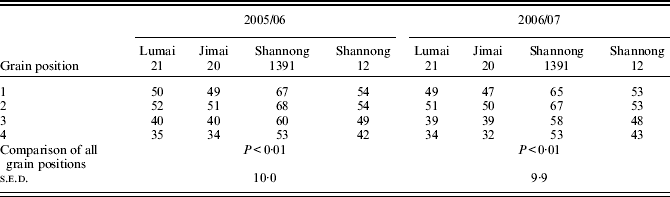
Analysis of variance (ANOVA) procedures for randomized complete designs were used to test differences in starch accumulation, endosperm cell number and enzyme activity between superior and inferior grains, and to calculate their standard errors of differences (s.e.d.). Statistical analyses on the experimental data were performed using SPSS statistical procedures. A repeated measure ANOVA has been used to compare grain position with four cultivars (Table 2), and to compare grain position with two compact-spike cultivars or two loose-spike ones.
Individual grain weight of the 1st, 2nd, 3rd and 4th grain on spikelets (mg/grain) ( d.f.=19)

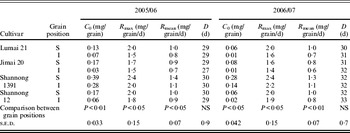
Characteristic parameters of starch accumulation in wheat grains

S and I represent superior and inferior grain, respectively.
RESULTS
Grain weight
At maturity, there was considerable difference in GD in both spike types, and compact-spike cultivars showed higher GD compared to loose-spike ones (Table 1).
The weight of superior grains was greater than inferior grains in all cultivars, but this difference varied with cultivar (Table 2). The mean grain weight of superior grains was 38 and 36% (in 2005/06) and 39 and 36% (in 2006/07) higher than that of inferior grains in compact-spike cultivars (high GD) Lumai 21 and Jimai 20, respectively. The equivalent values for the loose-spiked cultivars (low GD) Shannong 1391 and Shannong 12 were 20 and 18% (in 2005/06) and 18 and 16% (in 2006/07).
Starch accumulation
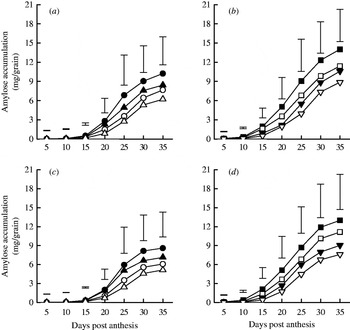
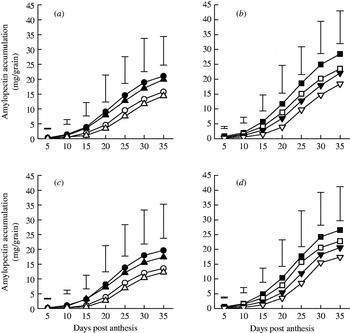
Both amylose (Fig. 1) and amylopectin (Fig. 2) accumulation increased gradually with grain development in all cultivars. At maturity, the final starch accumulation in superior grains was much higher than that in inferior grains, but its magnitude depended on cultivars. The differences in starch accumulation between superior and inferior types of grains were wider for compact-spike cultivars than loose-spike cultivars. This was possibly due to lighter inferior grains for compact-spike cultivars in this study.
Amylose accumulation in wheat grains in 2005/06 (a, b) and 2006–2007 (c, d) (●, Lumai 21-superior grain; ○, Lumai 21-inferior grain; ▲, Jimai 20-superior grain; △, Jimai 20-inferior grain; ▪, Shannong 1391-superior grain; □, Shannong 1391-inferior grain; ▼, Shannong 12-superior grain; ▽, Shannong 12-inferior grain). Vertical bars indicate 1 s.e.d.

Amylopectin accumulation in wheat grains in 2005–2006 (a, b) and 2006–2007 (c, d) (●, Lumai 21-superior grain; ○, Lumai 21-inferior grain; ▲, Jimai 20-superior grain; △, Jimai 20-inferior grain; ▪, Shannong 1391-superior grain; □, Shannong 1391-inferior grain; ▼, Shannong 12-superior grain; ▽, Shannong 12-inferior grain). Vertical bars indicate 1 s.e.d.

The starch accumulation processes in both grains were well described by the logistic equation relating starch content against DPA (R 2>0·999). The coefficients C 0, R mean and R max were higher in superior grains, while D showed a little variation (Table 3). R mean in superior grains were 39 and 38% (in 2005/06) and 47 and 46% (in 2006/07) higher than that in inferior grains of Lumai 21 and Jimai 20, respectively. The equivalent values for Shannong 1391 and Shannong 12 were 22 and 18% (in 2005/06) and 16 and 18% (in 2006/07).
Endosperm cell number
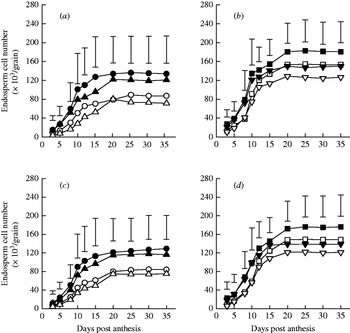
Endosperm cell number in both grains increased gradually, reaching maximum at 20 DPA for all cultivars (Fig. 3). The maximum number of cells in superior grains was significantly higher than those in inferior grains by 50, 51, 18 and 17% in 2005/06 for Lumai 21, Jimai 20, Shannong 1391 and Shannong 12, respectively, and by 52, 54, 16 and 14% in 2006/07.
Endosperm cell number in wheat grains in 2005–2006 (a, b) and 2006–2007 (c, d) (●, Lumai 21-superior grain; ○, Lumai 21-inferior grain; ▲, Jimai 20-superior grain; △, Jimai 20-inferior grain; ▪, Shannong 1391-superior grain; □, Shannong 1391-inferior grain; ▼, Shannong 12-superior grain; ▽, Shannong 12-inferior grain). Vertical bars indicate 1 s.e.d.

SS activity and sucrose content
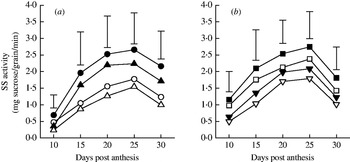
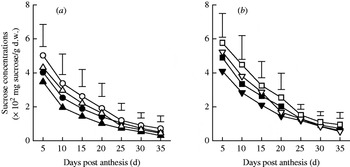
SS catalyses the cleavage of sucrose, the main transported assimilate in wheat, to form UDP-glucose and fructose, which is thought to be the first step in the starch synthesis in the wheat grains. SS activities showed single peak curves in both grains with the highest peak at 25 DPA for all cultivars (Fig. 4). The SS activity in superior grains was higher than that in inferior grains during grain filling, with differences in mean SS activity of 65, 69, 20 and 19% in Lumai 21, Jimai 20, Shannong 1391 and Shannong 12, respectively. The sucrose content in both grains decreased gradually with grain development, and the sucrose content in inferior grains was higher than that in superior grains during grain filling for all cultivars (Fig. 5).
The activities of SS in wheat grains (2005–2006) (●, Lumai 21-superior grain; ○, Lumai 21-inferior grain; ▲, Jimai 20-superior grain; △, Jimai 20-inferior grain; ▪, Shannong 1391-superior grain; □, Shannong 1391-inferior grain; ▼, Shannong 12-superior grain; ▽, Shannong 12-inferior grain). Vertical bars indicate 1 s.e.d.

Sucrose concentrations in wheat grains (2005–2006) (●, Lumai 21-superior grain; ○, Lumai 21-inferior grain; ▲, Jimai 20-superior grain; △, Jimai 20-inferior grain; ▪, Shannong 1391-superior grain; □, Shannong 1391-inferior grain; ▼, Shannong 12-superior grain; ▽, Shannong 12-inferior grain). Vertical bars indicate 1 s.e.d.

Enzyme activity involved in starch synthesis
UGPP activity
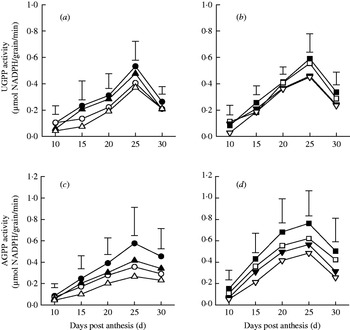
UGPP catalyses the reaction of UDPG produced from sucrose in the second step of the starch biosynthesis pathway and pyrophosphoric acid (Pi) into glucose-1-phosphate (G1P). The UGPP activity reached a maximum at 25 DPA, and then decreased gradually (Fig. 6a, b). The UGPP activity varied with grain type and cultivar. For compact-spike cultivars, UGPP activities were higher in superior grains than in inferior grains, except for 10 DPA, while this difference was small for the loose-spike cultivars. This might be one factor leading to a difference in the starch accumulation between two kinds of grains of both spike-type cultivars.
The activities of UGPP (a, b) and AGPP (c, d) in wheat grains (2005–2006) (●, Lumai 21-superior grain; ○, Lumai 21-inferior grain; ▲, Jimai 20-superior grain; △, Jimai 20-inferior grain; ▪, Shannong 1391-superior grain; □, Shannong 1391-inferior grain; ▼, Shannong 12-superior grain; ▽, Shannong 12-inferior grain). Vertical bars indicate 1 s.e.d.

AGPP activity
It is generally accepted that AGPP is responsible for the synthesis of ADPG, the substrate for the synthesis of starch polymers, and AGPP is regarded as the rate-limiting enzyme in starch biosynthesis (Stark et al. Reference Stark, Timmerman, Barry, Preiss and Kishore1992). The changes of AGPP activities showed peaks at 25 DPA in both grains for all cultivars (Fig. 6c, d). The AGPP activity in superior grains was much higher than in inferior grains, while this difference varied with cultivars. The mean AGPP activity was 47, 44, 22 and 20% higher in superior grains than in inferior grains of Lumai 21, Jimai 20, Shannong 1391 and Shannong 12, respectively.
SSS activity
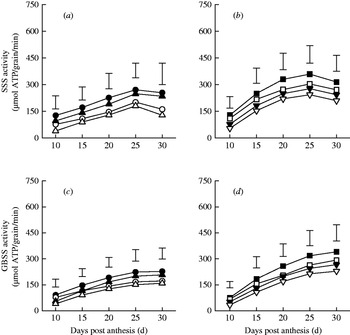
The function of SSS is to transfer a glucose residue from the ADPG molecule to a starch primer molecule, and it is responsible for amylopectin synthesis in wheat grain. The SSS activities in both grains exhibited single peak curves with a peak at 25 DPA for all cultivars (Fig. 7a, b). The mean SSS activity was 51, 53, 18 and 17% higher in superior grains than that in inferior grains of Lumai 21, Jimai 20, Shannong 1391 and Shannong 12, respectively.
The activities of SSS (a, b) and GBSS (c, d) in wheat grains (2005–2006) (●, Lumai 21-superior grain; ○, Lumai 21-inferior grain; ▲, Jimai 20-superior grain; △, Jimai 20-inferior grain; ▪, Shannong 1391-superior grain; □, Shannong 1391-inferior grain; ▼, Shannong 12-superior grain; ▽, Shannong 12-inferior grain). Vertical bars indicate 1 s.e.d.

GBSS activity
The function of GBSS, which is similar to SSS, elongates the starch molecular chain. However, GBSS is activated only when being bound in the starch granule. The GBSS activity found in superior grains was higher than that in inferior grains during grain filling, especially at late-grain filling (Fig. 7c, d). The mean GBSS activity in superior grains was 33, 32, 19 and 18% higher than that in inferior grains in Lumai 21, Jimai 20, Shannong 1391 and Shannong 12, respectively, which suggested that amylose synthesis in superior grains was noticeably higher than in inferior ones. These changes of SSS and GBSS activities indicate that the difference between superior and inferior grains in compact-spike cultivars is larger than that in loose-spike ones.
Relationship of starch accumulation to sink strength
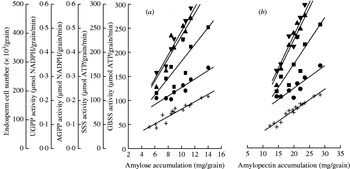
Total amylose (Fig. 8a) and amylopectin (Fig. 8b) accumulations in superior and inferior grains were significantly correlated to the endosperm number (r=0·948, P<0·01 and r=0·972, P<0·01 respectively) at maturity and to the mean enzyme activities of UGPP (r=0·938, P<0·01 and r=0·903, P<0·01), AGPP (r=0·862, P<0·01 and r=0·866, P<0·01), SSS (r=0·949, P<0·01 and r=0·97, P<0·01) and GBSS (r=0·977, P<0·01 and r=0·972, P<0·01) during grain filling. These data indicate the key roles of SS, UGPP, AGPP, SSS and GBSS activities in regulating the starch accumulation for grain growth in wheat.
Relationships of total amylose (a) and amylopectin (b) accumulation to the endosperm cell number at the maturity and mean activity of enzymes involving in starch synthesis during grain filling (+, Endosperm cell; ●, UGPP; ▪, AGPP; ▲, SSS; ▼, GBSS).

DISCUSSION
A wheat spike is composed of a number of spikelets. Based on their flowering date and locations within a spike, the grains can be classified as superior or inferior (Wang et al. Reference Wang, Cao, Dai and Zhou2000). In general, superior grains flower earlier than inferior grains. Superior grains usually exhibit a faster rate of increase in dry weight during development and higher final grain weight than inferior grains (Stoddard Reference Stoddard1999; Calderini & Reynolds Reference Calderini and Reynolds2000; Wang et al. Reference Wang, Cao, Dai and Zhou2000). The present results also show that the weight of superior grains was higher than that of inferior grains at maturity in all cultivars tested, but the difference varied with cultivar: the compact-spike cultivars showed larger differences than loose-spike cultivars. Therefore, it may be considered that spike panicle morphology, including GD, spike size and shape, is inherently associated with the magnitude of variation in grain weight among grains within a spikelet. Low grain weight of inferior grain has often been attributed to a limitation in carbohydrate supply (Stoddard Reference Stoddard1999; He et al. Reference He, Wang and Zhang2000; Liang et al. Reference Liang, Zhang and Cao2001). In the present study, the sucrose concentration in inferior grains of all cultivars was found to be higher than that in superior grains during grain filling, indicating that the intrinsic concentration of assimilates should not be the main limiting factor of grain filling for inferior grain.
The present results show that both amylose and amylopectin accumulation in superior grains were higher than those in inferior grains, but this difference varied depending on the cultivar. The variation of starch accumulation was larger for compact-spike cultivars and smaller for loose-spike ones. The logistic equation of simulation parameters revealed that the higher final starch accumulation in superior grains involved both earlier initiation of accumulation time and greater accumulation rate. The difference in the mean accumulation rate between two types of grains in compact-spike cultivars was much higher than in the loose-spike ones. It was concluded that this might be one of the reasons why compact-spike cultivars exhibit larger differences in starch accumulation between two kinds of grains than loose-spike ones.
Sink size is determined by the number of cells in the endosperm and the number of amyloplasts per endosperm cell (Yang et al. Reference Yang, Zhang, Wang and Zhu2003). Gleadow et al. (Reference Gleadow, Dalling and Halloran1982) reported that the final grain dry matter is potentially determined by the number of cells in the endosperm of wheat grains. Thus, the cell number in a sink organ is a good indicator of sink size in cereal crops (Kinet et al. Reference Kinet, Zune, Linotte, Jacqmard and Bernier1986; Stoddard Reference Stoddard1999; Liang et al. Reference Liang, Zhang and Cao2001). The present results showed that the cell number in superior grains was markedly higher than those in inferior grains, which is in accordance with the final grain weight and starch accumulation, and the grain weight was positively correlated to the endosperm cell number, suggesting that high grain sink size may be one of the factors resulting in the higher final grain weight. However, the difference in cell number was larger between the two kinds of grains for the compact-spike cultivars as compared to loose-spike ones. This may be one of the reasons why compact-spike cultivars exhibit greater differences in grain weight and starch accumulation between two types of grains than loose-type cultivars.
In wheat, grain filling is mainly a process of starch biosynthesis and accumulation: decrease in starch production also resulted in reducing the final grain weight (Jenner Reference Jenner1991; Hurkman et al. Reference Hurkman, McCue, Altenbach, Korn, Tanaka, Kothari, Johnson, Bechtel, Wilson, Anderson and DuPont2003). Various authors have documented that SS, AGPP, SSS and GBSS play key roles in starch biosynthesis and these enzyme activities represent the grain sink strength (Smyth & Prescott Reference Smyth and Prescott1989; Nakamura & Yuki Reference Nakamura and Yuki1992; Hurkman et al. Reference Hurkman, McCue, Altenbach, Korn, Tanaka, Kothari, Johnson, Bechtel, Wilson, Anderson and DuPont2003; Li et al. Reference Li, Yin, Yan, Dai, Li, Liang, Geng and Wang2008; Dai et al. Reference Dai, Yin and Wang2009). In the present study, the activities of SS, AGPP, SSS and GBSS of superior grains were noticeably higher compared to those in inferior grains for both spike-type cultivars, which was in accordance with the starch accumulation. Grain weight was significantly correlated to the mean enzyme activities, implying that sink activity might be directly related to grain filling. However, larger differences in the levels of these enzymes were found between the two classes of grains for compact-spike cultivars relative to loose-spike ones, proving that a large variation in grain weight and starch accumulation among grains within a spike resulting from high GD could be ascribed to the greater difference in the activity of starch synthesis-related enzymes.
In conclusion, the present results clearly suggest that the number of cells in the endosperm and the activities of SS, UGPP, AGPP, SSS and GBSS in endosperm are highly correlated to grain weight and starch accumulation during grain filling, while sucrose concentration (substrate for starch synthesis) was not a main limiting factor for starch synthesis in inferior grains of both spike-type cultivars. Meanwhile, the difference in variation in the sink strength between two kinds of grains varied with cultivars; compact-spike cultivars were much greater than that of loose-spike cultivars. Hence, this research indicates that cultivars with low GD can be selected by wheat breeding methods to improve grain weight and quality uniformity.
The authors are grateful to the reviewers and editors for their constructive review and suggestions for this paper. This research was supported in part by the National Basic Research (973) Programme of China (2009CB118602), the programme for Changjiang Scholars and Innovative Research Team in University, Ministry of Education (IRT0635) and the National Natural Science Foundation of China (30871477).