

INTRODUCTION
Trampolining has become a popular activity in recent times especially amongst young people. Media coverage indicates that people are choosing to purchase trampoline equipment for their own homes (Wechsler et al., Reference Wechsler, Kim and Hunter2001). In health care practice the activity has been used for a number of years within a therapeutic context although the literature suggests that this is mainly with people with learning disabilities under the modality known as Rebound Therapy (Association of Chartered Physiotherapists for People with Learning Disabilities, 1997). This paper will set out an argument for trampoline use as an option within a therapeutic recovery programme for people experiencing mental ill health. It will explain the practical processes and environments required to provide the intervention within an acute mental health care inpatient unit and will go on to illustrate the point by providing a case vignette of the utility of trampolining as a therapeutic activity.
HISTORY OF TRAMPOLINE USE AS THERAPY
Therapeutic trampolining or Rebound Therapy has been described as having healing properties and its use has been specifically tailored to develop motor skills, body awareness, balance, coordination and communication skills (Smith & Cook, Reference Smith, Cook and Rennie2007; Chartered Society of Physiotherapy, 2007). The initiative led by a physiotherapist and remedial gymnast began with children with physical and learning disabilities within a special school setting during the 1980s (Chartered Society of Physiotherapy, 2006). Since this time Rebound Therapy has been further cascaded into practice and is now widely used as a therapeutic medium with adults with learning disabilities (Smith & Cook, Reference Smith and Cook1990). There are also reports of its use in other specialist groups, for example people suffering from cystic fibrosis, multiple sclerosis and as part of stroke rehabilitation (Roberts, Reference Roberts2006).
Despite this emergent practice there remains little empirical investigation to support the use of therapeutic trampolining (Chartered Society of Physiotherapy, 2002). This was demonstrated when a literature search carried out for this paper revealed a paucity of research and no mention of its utility for people experiencing mental ill-health. Due to the lack of scientific research Miller (Reference Miller2007) suggested that the benefits of trampolining noticed by healthcare professionals are simply anecdotal. However, definitions of evidence based practice are clear that clinically orientated evidence and expert opinion in the field does serve as evidence to support practice (Guyatt et al., Reference Guyatt, Cook and Hayne2004). It remains the case then that for this activity the best available evidence is the report of practitioners in the field (Sacket et al., Reference Sackett, Rosenberg, Muir Gray, Haynes and Richardson1996). Practitioners do have an obligation to provide the interventions that could work for individuals within their recovery context (Health Professions Council, 2003). As such, the authors sought to set up routine sessions for service users as part of a comprehensive set of rehabilitation and recovery opportunities.
TRAMPOLINING AT WOTTON LAWN HOSPITAL, GLOUCESTER
Wotton Lawn hospital hosts three distinct but interrelated services to assist people requiring inpatient mental health care. The services include four acute care wards, a psychiatric intensive care unit (PICU) and a low secure unit (LSU). In total the hospital can accommodate 84 people at any one time.
People's needs, interests, aspirations and motivations relating to daytime activities vary, so a full programme of therapeutic activities is considered best practice (Department of Health, 2002). Members of the therapy department and nursing team at Wotton Lawn Hospital work collaboratively to meet the needs of service users and embrace an occupational model of practice to facilitate recovery (Melton et al., Reference Melton, Forsyth, Metherall, Robinson, Hill and Quick2008). The multidisciplinary team are also committed to the Star Wards initiative which has been championed nationally and implemented at Wotton Lawn to enhance inpatients’ daily experiences and treatment outcomes (Janner, Reference Janner2006). Furthermore, the World Health Organisation (WHO) definition of health and recovery is concerned not only with the alleviation of illness but also to promote sense of complete physical, mental and social well-being (WHO, 2007). Based on this it is possible to argue that trampolining is a useful activity to provide as part of a therapeutic milieu in acute mental health care. The benefits of this intervention will be presented next.
PROPOSED BENEFITS OF TRAMPOLINING
The benefits of using trampoline activity are considered in relation to how each person's engagement in human occupation is dynamically motivated, patterned and performed. For each person involved, the therapists aim to understand their client's ability to perform their occupations within their available temporal, physical and socio-cultural environment (Kielhofner, Reference Kielhofner2008). Whilst the proposed benefits will be presented here in separate sections, the authors believe that none are mutually exclusive in their impact upon a person's recovery journey supporting the notion of dynamic systems theory for personal development and recovery (Lewis, Reference Lewis2000).
Three broad areas of benefit will be considered here:
Physiological benefit
Social benefit
Motivational benefit
Physiological benefit
Mental wellbeing
There is a growing body of evidence to support the use of exercise having preventative and therapeutic benefits for people suffering from mental illness (Biddle et al., Reference Biddle, Fox and Boutcher2001; Cripps, Reference Cripps2008). The bio-psychosocial model of health accounts for biological, psychological, and sociological systems of the body (Everett et al., Reference Everett, Denni and Ricketts1995). These systems are interconnected and as a result a change in one system will affect another system; thus physical changes can affect mental health. This has been demonstrated where aerobic exercise has caused biochemical changes that can affect mental health such as mood elevation, improved sense of body image, reduced aggression, memory improvements and greater confidence (Everett et al., Reference Everett, Denni and Ricketts1995).
Cardio-respiratory
Trampolining is thought to have positive effects on the cardio-respiratory system. The heart and respiratory rate increase during trampolining due to the demand on the muscles to support the body against the increasing gravity (Smith & Cook, Reference Smith, Cook and Rennie2007). The increased pulse strengthens the heart and the muscular system, which improves cardiovascular fitness and also has a positive effect on lymphatic drainage by helping the body to remove toxins (Tortora & Grabowski, Reference Tortora and Grabowski2003). In addition only a short time using the trampoline is required in order to achieve a vigorous workout.
Motor skills
Bouncing and jumping on the trampoline requires the maintenance of a good sense of balance, coordination, posture and proprioceptive awareness, due to the changing centres of gravity. Trampolining is considered to be a special form of motor learning, because it requires unfamiliar patterns of motor coordination, such as rotation of the whole body in a three dimensional space (Smith & Cook, Reference Smith, Cook and Rennie2007). Therefore it can be used to improve motor skills such as balance and coordination.
Sensory processing
Sensory integration is the ability to organise, synthesise and manage all information received into the body from the environment to produce purposeful goal-directed responses (Spitzer & Roley, Reference Spitzer, Roley, Roley, Blanche and Schaaf2001). People experiencing mental ill-health can be challenged to process the range of sensory experiences that they encounter (Dunn, Reference Dunn, Crepeau, Cohn and Boyt Schell2008). Judiciously selected and carefully graded sensory input can be offered for therapeutic benefit to support a person to process information from their environment through their sensory systems (Roley & Jacobs, Reference Roley, Jacobs, Crepeau, Cohn and Boyt Schell2008). Trampoline activity can be helpful for this. Essentially the therapist can introduce trampoline activity to inhibit or facilitate various sensory experiences to support a person to calm or to be stimulated to participate in other daytime activities. For example constant changes in head position from jumping will stimulate the vestibular system and heighten a person's arousal. This has been noted as being helpful where a person is experiencing low mood. On the other hand small, slow, rhythmical movements in sitting, lying or standing will suppress the vestibular system and can be useful in assisting a person with more elevated mood to calm (Arkwright, Reference Arkwright1998).
Social benefit
Therapeutic trampolining can have many social benefits when undertaken in a group environment. Working in a group can give a sense of achievement through the acknowledgement of others and gives the opportunity to share experiences and support one another (Wood, Reference Wood2003). During group based trampolining sessions the authors have observed participants acknowledge and support others as members of the group are encouraged to take turns, help with spotting and provide encouragement for participants. This enables individuals to recognise and applaud success, which fosters group cohesion and conversation beyond the therapy environment.
Other communication skills developed through trampolining have been reported. For example, Smith & Cook (Reference Smith and Cook1990) found that trampolining increases vocalisation and eye contact amongst people with very limited communication skills suggesting that the activity has a place in promoting engagement between individuals. In relation to mental health care, the use of trampolining as a leisure pursuit beyond the hospital setting could be one way of promoting community participation and partnerships (Care Services Inprovement Partnership, 2007). Links can be fostered with local leisure establishments in order to introduce trampoline use along a person's recovery journey and foster social inclusion.
Motivational benefit
Many studies have shown that people with mental illness are significantly less likely to engage in active, productive or social activities than people not suffering from mental illness (Krupa et al., Reference Krupa, McLean, Easterbrook, Bonham and Baksh2003). Stewart & Craik (Reference Stewart and Craik2007) found that the activities that inpatients suffering from mental illness did choose to engage in were based on expectations of enjoyment and success. As trampolining is often perceived as a fun and enjoyable activity it is a good way to engage people in physical activities.
Using the trampoline can have a very positive effect on self-esteem and self-confidence, which are often reduced in people suffering from mental illness (Everett et al., Reference Everett, Denni and Ricketts1995). This could be argued to be in part a result of the encouragement and positive feedback gained from the trampoline coach and from peers. Trampolining can also offer immediate success and accomplishment. Basic trampoline skills are easy to learn and tasks can also be adapted so the perception of progress on self efficacy is tangible for positive effect (Lawrence, Reference Lawrence2004).
Therapeutic trampolining can be used to combat many of the negative characteristics of life as an inpatient. For example, Stewart & Craik (Reference Stewart and Craik2007) described the lives of mentally ill respondents in two epidemiological surveys as characterised by isolation, boredom, and a lack of daily structure and meaningful activity. Therapeutic trampolining can be used as a medium to provide structure, social opportunity and develop interest. For an activity to be meaningful to an individual it needs to provide opportunities to socialise, pass time, develop skills and make links with the outside world (Helbig, Reference Helbig2003). Recent studies have demonstrated statistically significant relationships between competent engagement in meaningful activities and improved quality of life for people with a mental illness (Shimitras et al., Reference Shimitras, Fossey and Harvey2003). Thus if a person has an interest in trampolining, participation can contribute to an improved quality of life.
PRACTICAL PROCESSES AND ENVIRONMENTS REQUIRED
In this section attention will be given to the practical administration of trampolining as a therapeutic activity for people using an acute inpatient unit. All of the elements described should be addressed in order to be an effective, safe, individually tailored and efficient intervention (Department of Health, 1998). In this section quality and safety aspects of trampolining will be considered. A broad range of clinical questions that need to be addressed for each potential participant will be presented. This will be followed by practical information about the facilitation skills and the environments necessary to host this intervention safely and effectively.
Therapeutic questions
A range of clinical questions should be asked for each participant in order to ensure the applicability of the activity and the safety of each individual. The following is a list of routine pre-activity questions that are answered prior to trampoline use. Where the person's mental state allows, these questions are asked of each person in direct conversation. However, in some circumstances therapists act in the best interests of an individual and gather information from other sources; for example from nursing staff, health records and observation of other activities. The questions include:
Does the person have an interest in trampoline activity or general physical fitness activities?
Does the person believe that they have the skills necessary to undertake the various components of the activity?
Has physical activity been part of their usual routine?
What role will the person play within a structured trampoline session?
Does the person have sufficient physical fitness and tolerance to engage in some form of trampoline activity?
Are there additional risks associated with offering trampoline activity for the person?
Does the environment (both physical and social) support the person's engagement in trampoline activity? (For example is there a suitably trained trampoline coach and support staff available?)
The following sections will consider some of these points in more detail.
Assessment of interest
Therapy and ward based staff work together to gain an understanding of a persons past and current interests and motivation toward trampoline activity (Melton et al., Reference Melton, Forsyth, Metherall, Robinson, Hill and Quick2008). For example the therapy department will routinely offer structured assessment of a person's self care, leisure and work interests on admission and this will be supported by information provided from multidisciplinary colleagues. An occupational intervention package which may include opportunities to take part in trampoline sessions will be developed with an individual.
Risk assessment
Individuals who use PICU and LSU are likely to present with higher risks. Prior to engaging in the trampolining sessions, a risk assessment for each individual is undertaken (Bacon, Reference Bacon1997). The risk assessment involves close co-operation between the therapists running the session and ward staff. A discussion of the patient's mental state and any level of risk present takes place. This is followed by the formulation of a management plan. For example, a patient may be at risk of absconding so this risk would be managed by staff escorting the individual to and from the session. It is also important to note that following the session the therapists will hand over to the ward staff and document how the patient performed in the session and whether there were any concerns raised.
Physical fitness assessment
It is important to note that prior to engaging in trampolining a physical assessment is undertaken with the individual by either a Sports Therapist or Physiotherapist. This assessment process includes taking measurements of blood pressure, respiratory rate and body mass index. As well as the objective measurements individuals will be asked what medication they are taking, which will allow the therapists to consider the possible side effects that could impact upon the individual’s ability to participate in physical activity. A Physical Activity Readiness Questionnaire (PAR-Q) will then be completed, which is an adapted procedure of an established self report assessment (Scheinowitz et al., Reference Scheinowitz, Dankner, Goldbourt and Marom-Klibansky2008). The assessment involves a series of questions related to general health and exercise such as ‘do you suffer from breathlessness or dizziness during or after exercise?’. This assessment process will form an objective and subjective measure of the individual's physiological safety and risk to participate in this physical activity (Biddle et al., Reference Biddle, Fox and Boutcher2001).
Facilitation skills
It is recommended that staff members taking responsibility for facilitating trampoline sessions undertake, as a minimum, the five day ‘Special Needs Coach Training’ through British Gymnastics. This qualification (whilst maintained through continued subscription) also provides a degree of insurance cover. In addition to specific trampoline coaching skills the coach also needs to have competencies to be able to intentionally select a mode of engagement which best suits the individual (Taylor & Melton, Reference Melton, Forsyth, Metherall, Robinson, Hill and Quick2008). This ability enables interest and engagement to be fostered with people who are experiencing the complexities and challenges of mental ill-health. Competencies in both these areas are recommended for facilitating trampolining in this environment. However, facilitating trampolining sessions also requires several general staff members to be present in order to help with erecting the equipment, supporting and encouraging people with the task and ‘spotting’ for safety at the sides of the trampoline. Experience suggests that practice development to engage hospital staff in occupation-focused intervention is helpful to build skills, confidence and to gain enough support for the sessions to occur on a routine basis (Melton et al., Reference Melton, Forsyth, Metherall, Robinson, Hill and Quick2008). This also promotes a whole culture of valuing the activity as a therapeutic option and allows staff to build skills in taking part both in the activity and in facilitating the session.
Environmental considerations
In order to provide trampoline sessions as a group activity, a gymnasium with suitable height and storage facility is required. Trampoline and associated equipment need regular checks for wear and tear. Time needs to be built into the sessions to allow for setting up and putting away the trampoline; this requires takes time and effort from several people who need training to undertake the task.
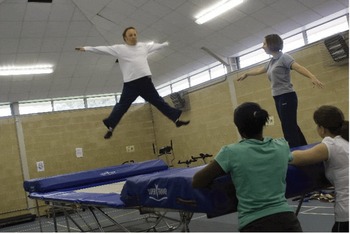
Hospital staff members undertaking a trampoline activity ‘Practice Development’ session in the gymnasium of Wotton Lawn Hospital, Gloucester

OVERVIEW
From a theoretical and practical perspective, trampolining as part of a recovery oriented program for people who are using acute, intensive care or secure hospital services can have benefits which work dynamically to support their recovery. For example, a positive experience of using a trampoline in the hospital environment, with support that has been graded (Kelly, Reference Kelly2007) to provide a suitable challenge together with positive, validating feedback, can enable a person to develop belief in their ability to repeat the activity. This reinforcement together with the well being experience gained from the calming sensory effects of bouncing and the physiological uplift of cardiovascular and muscular exercise adds to the persons ‘feel good’ factor. These influences can enable the person to be interested in forming a routine pattern of attendance thus building their tolerance for the activity, trust in their physical and social environment and continuing the positive cycle of rehabilitation. The next section will provide a case example to illustrate these points further.
Case vignette exampleFootnote 1
Morgan is a 20 year old man who was admitted to hospital whilst experiencing a psychotic illness. Before his admission Morgan had a physically active job and held an interest in team sports. On admission he was supported on the PICU. Part of his care plan was to offer routine physical activity sessions and he was initially invited to join sessions at the hospital gymnasium. Morgan engaged in assessment of his interests and physiological ability and it emerged that physical activity sessions would be a recommended part of his treatment plan. Morgan was prescribed haloperidol, a typical antipsychotic medication. The possible side effects of this medication were considered (such as altered blood pressure, loss of balance, muscle stiffness, muscle spasms, and dizziness) although Morgan reported not experiencing any of these.
Morgan was initially considered to have a medium risk of absconding so therapists escorted him to and from the gym for his sessions. During these gym sessions Morgan was observed to be focused on tasks but only interacting with others on a needs basis. Therapists were keen to increase his participation in activities requiring some interaction with others in order to build his confidence in working cooperatively with others through valued activity. When first invited to a trampolining session Morgan expressed interest in trying this new form of physical activity, and valued an extra opportunity to leave the ward environment. At this time Morgan's mental state was settled although he was still experiencing some psychosis. Morgan's level of risk of absconding had reduced so therapists negotiated with PICU staff and Morgan was able to make his own way to and from the sessions. However, it was agreed that therapists would telephone the PICU when he had arrived for the session and when he left.
Morgan was able to share his concerns about the task with therapists; for example he expressed some anxiety towards the feeling of jumping on a movable surface. With a graded introduction to the activity and through reassurance Morgan gained motivation to take part.
During the first session he quickly acquired the basic skills and shapes related to jumping, which seemed to help resolve his initial anxieties. He showed a responsible attitude towards the safety procedures of trampolining although his interaction with others remained limited.
Over continued sessions, Morgan's enthusiasm towards attending the sessions increased and he expressed confidence in his abilities as he saw his skills develop. His routine attendance provided the opportunity for Morgan to get to know staff and other patients, and resulted in an increase of his interaction with others present.
In several of the sessions that Morgan attended staff members were also trampolining as part of a staff development initiative. Some of these participants had never taken part in this activity before and were also anxious about the experience. Towards these staff he was particularly encouraging, sharing with them his experience and achievements of previous trampolining sessions. Engaging in the staff and patient sessions was observed to boost Morgan's self esteem, and gave him the opportunity to feel less in the role of a patient and more in the role of teacher and supporter.
Whilst this case illustration represents an anecdotal account of the beneficial use of trampolining for one individual, the feedback given by Morgan in routine service evaluation questionnaires suggests that the activity in this therapeutic context was significant to his recovery experience. The comment made on one of Morgan's feedback forms was:
‘The progressive teaching of each [trampoline] skill helped me to be less embarrassed about being a novice on the trampoline, and gave me confidence to take part in activity’.
Morgan also commented that he enjoyed the:
‘Enthusiastic, supportive but yet relaxed atmosphere of the sessions’.
SUMMARY AND CONCLUSION
This paper has championed the benefits of trampoline activity which can be divided into physiological, social and motivational benefits, characterising the activity as an holistic experience. The example of the case vignette illustrates these benefits. We have also explained the practical processes of how trampoline sessions can be set up within an organisation and looked at the facilitation skills and environmental considerations needed.
Trampolining has been used with a variety of patients within the mental health setting from inpatients on general wards to patients on the PICU and LSU. There has been a positive reaction from staff within the therapy department and on the PICU and LSU regarding new ways to engage individuals who are more acutely disturbed and involve higher levels of risks.
Trampolining has utility in this specialist area of healthcare and is more relevant in current practice because of its contemporary status as a popular leisure pursuit. To our knowledge the modality has not been used widely within the mental health setting before. This may be because it is an under researched area with most enquiry focusing on people with learning disabilities. Allied health professional groups have acknowledged this fact and Rebound Therapy was made a research priority for the Chartered Society of Physiotherapy (CSP) in 2002. There is, however, scope for far greater application, description, case study and empirical investigation across disciplines into this important area of practice.
ACKNOWLEDGEMENTS
All colleagues at WLH who have helped develop this aspect of the therapy programme. In particular: Alan Metherall, Matron Manager; Jayne Robinson, Clinical Specialist Occupational Therapist; Karen Dawe, Lead Physiotherapist Mental Health. Also Patricia Larrett and Pam Walters, for arranging the British Gymnastics trampoline coach training and Leon Hitchens for providing generous support and expertise. Carrie Marrow has also provided helpful professional and ethical advice.
Grateful thanks are especially extended to our service users for their feedback and enthusiasm to develop this new, hospital based therapeutic opportunity.