In July 1978, a week before the G7 summit started in the West German capital of Bonn, a strange advertisement appeared in German newspapers: “Mrs. Mueller buys a shirt from Ceylon. That saves her husband's job,” the headline claimed. It was followed by a lengthy explanation: that the shirt would have been produced in Ceylon, south of India, but with a German textile machine from Krefeld manufactured by Mrs. Mueller's husband. International economic relations—as the advertisement suggested—could no longer be ignored by the German public when discussing domestic unemployment and structural change. The advertisement was part of an official campaign by the German government's department for public relations that aimed at growing the understanding of the complex structures of the global economy among the German people.
However, Germany's textile and apparel industry showed a certain lack of empathy for this kind of economic education and attacked the government for its favorable attitude toward manufacturing at the expense of the small and mid-size firms in the textile sector and their predominantly female employees. For a few weeks, the “Colombo shirt” became a symbol for the misleading economic policy of the Social Democratic government that would “sacrifice” a well-organized traditional sector “on the altar of its export fetish.”Footnote 1
For economic and business historians this episode is puzzling. As with other industrialized countries, recent research has determined that a massive decline, in terms of employees, took place in the German textile and apparel industry starting in the 1960s.Footnote 2 But the remaining corporations and their employees were apparently powerful enough to articulate their indignation. Karl Buschmann, the head of the textile trade union, wrote a long telex to the minister of economics, Otto Graf Lambsdorff, blaming him for the government's “ruthless liberal economic and trade policy that resulted in a loss of 313,000 jobs over the last eleven years.” He threatened collective action if the government did not stop the campaign.Footnote 3 While historians agree that textiles and apparel became one of the most important exemptions within a global tendency toward liberalization of world trade after World War II, German trade unions criticized their government for not having been protectionist enough in the 1960s and 1970s.Footnote 4 Another part of the story is also puzzling: to calm the indignation, Lambsdorff's staff confessed that Germany's textile and apparel industry was in fact a misleading example for the campaign, since it had managed the “internationalization” in an ideal way and would have been the world's leading exporter in that sector in 1978.Footnote 5 At least in the eyes of German politicians, the sector was most successful during globalization and had achieved a productivity revolution. So why did business owners complain alongside the sector's trade union?
This article suggests that the recent literature on global value chains (GVCs) helps explain these contradictions. While older research mainly identifies the “industry” as the domestic manufacturing of textiles and apparel, the GVC approach connects manufacturing to preproduction activities (fashion, branding, creation, raising capital) as well as postproduction processes (distribution, logistics, retailing).Footnote 6 The industry's transformation is therefore no longer analyzed as companies’ making use of cheap foreign labor, which was the main focus of the 1970s contributions, especially the seminal books by Folker Fröbel, Jürgen Heinrichs, and Otto Kreye.Footnote 7 GVC literature starts from the fact that global supply-and-demand relationships existed well before the “global shift” in production, but starting in the 1970s the redistribution of added value moved “up” the chain, and pre- and postproduction activities profited at the expense of manufacturing.Footnote 8 This shift can be found in several countries and industries. This article will follow the evolution of the textile and apparel industry in this context. It adds to past research by demonstrating that the German industry did not actually “disappear” but transformed into headquarters of GVCs, with a very high value added per employee at the expense of less trained domestic labor.
The first section gives an overview of the decline of domestic textile and apparel manufacturing in Germany as well as descriptive statistics documenting its parallel international success. The second section explores how Germany's policy of moderate liberalization and selective protection of textile markets ultimately supported the industry's internationalization. The third section takes a brief look at the internationalization strategies of select German corporations.
Germany's Textile and Apparel Industry in the International Context
Germany's textile and apparel industry was already under pressure in the 1920s, when high labor costs and a less-productive capital stock burdened the sector. The industry around 1925 was organized into more than 200,000 small businesses employing 1.2 million employees in textiles alone. During the period of autarkic economic policy of the Nazi regime, the sector took advantage of subvention by developing synthetic fibers while the import of cotton was restricted. During the war, profits from army contracts skyrocketed, but productivity remained weak.Footnote 9 After World War II, the sector joined the West German “economic miracle,” when consumers refilled their closets in the so-called clothing wave of the mid-1950s.Footnote 10 The sector increased employment as well as revenue through the 1960s. The textile industry reached peak employment in 1956, with about 650,000 workers, and apparel production grew until the mid-1960s, when employment reached 400,000 (see Figure 1). The industry spread over the country, with traditional clusters in Baden-Württemberg and East Westphalia and new centers in the Ruhr district, where mostly women of iron- and steelworker families found employment. Production also took place in the eastern parts of Bavaria, which saw an inflow of migrants from the traditional East German textile clusters. Of a labor force of about 26.5 million, a good million found jobs in the textile and apparel sector, which represented a tenth of all manufacturing jobs.Footnote 11 But industrial organization in the sector was far from healthy and competitive. Most of the corporations remained small in terms of both employment and revenues.Footnote 12
Employees in the West German textile and apparel industry, 1950–2011. (Source: Author's figure based on Statistical Office of the Federal Republic of Germany, Statistical Yearbook [Wiesbaden, various years].)

The decline of jobs in textiles and apparel accelerated in the 1970s. The cotton spinning and, later, weaving parts of the sector especially came under pressure, as well as sewing in the apparel industry. By 1990, only half a million jobs had survived in the sector. Also, business practices had evolved. The use of special yarn and fabrics, as well as synthetic industrial fibers used in industrial carpet and car equipment, increased. A similar process of specialization and niche production occurred for apparel, where sportswear emerged as a powerful source of profit maximizing for market leaders like Adidas and Puma but also for small and medium-size firms. German textile and apparel companies became increasingly productive, using high investment in rationalization beginning in the 1960s and 1970s. While average employment in textile firms increased to 209 in 1970, it had moderately decreased to 169 by 1983 because of specialization and rationalization. In contrast to its competitors in France and Italy, where small firms dominated, the German textile and apparel industry consisted of medium-scale firms that had been successful through great flexibility and exploitation of world market niches.Footnote 13
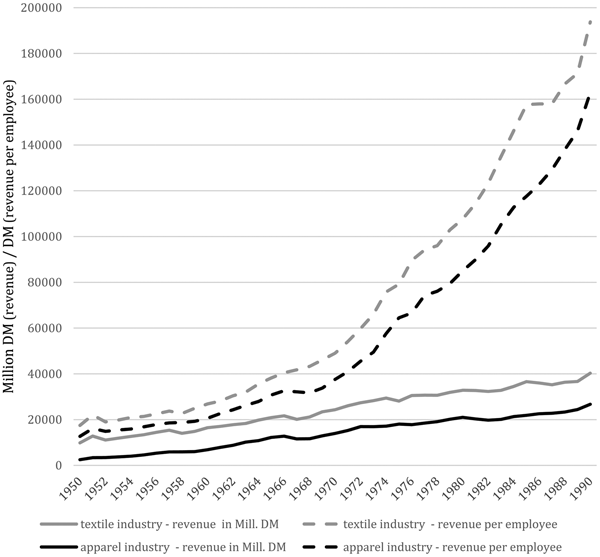
Success in economic terms started to increase sharply when employment started to shrink. While revenue more than doubled between 1968 and 1990—from DM 21.2 billion to DM 40 billion in textiles and from DM 11.6 billion to DM 26.7 billion in apparel—revenue per employee increased almost fivefold, from DM 40,000 to DM 194,000 in textiles and from DM 32,000 to DM 163,000 in apparel (see Figure 2).Footnote 14 This left the industry with a doubling of its revenue per worker when adjusted for the high inflation rates of the 1970s of 5 percent on average.Footnote 15 These figures indicate that the remaining corporations in the field increased productivity to an astonishing degree, though at the expense of (domestic) employment. While the 1970s are usually referred to as a crisis decade for the German economy as a whole—but especially for the “old industries” to which textiles and apparel belongFootnote 16—a handful of companies apparently still made profits. Of course, several corporations did not survive the 1970s and 1980s and collapsed spectacularly with much public fanfare. But some managed to overcome this crisis, and this article aims to show that those that survived understood the logic of GVC production.
Total revenue and revenue per employee in the German textile and apparel industry, 1950–1990. (Source: Author's figure based on Statistical Office of the Federal Republic of Germany, Statistical Yearbook [Wiesbaden, various years].)

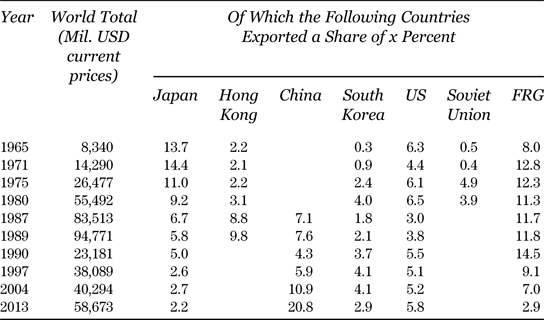
Profits of the surviving corporations were driven less by domestic manufacturing than before. Instead, German manufacturers increasingly had become traders and organizers of global production networks, in which they injected knowledge about the European consumer, effective organization and global logistics, and the provision of machinery.Footnote 17 The products of the global production network that eventually flooded back into the country were only partly absorbed by German consumers. The imports partly fueled the GVC with Germany as a hub, serving not only as an import magnet for textiles and apparel but also as a prominent exporter. It is important to note that in contrast to the account of trade unions and employers, the import of textiles and apparel was not overall “abnormal imports” generated by foreign corporations. Rather, in many ways it belonged to GVCs that originated from German headquarters—a fact that the employers’ association tried to obscure, as we will see later. In some categories, the country could even be found among the world's leading exporters (see Table 1).Footnote 18 Though trade balances in textiles and apparel turned negative during the 1970s, for some items we observe a small export surplus. Surprisingly, exports of yarn and fabrics remained surplus goods, whereas apparel turned negative. Though a net importer of apparel, even in this category West Germany remained the fourth-largest exporter. West Germany ranked behind only Italy, Hong Kong, and South Korea in 1988, with an export volume almost double the size of that of the United States and much higher also than that of China, which of course was still heavily restricted at that time.
World Market Shares of Selected Exporters of Cotton Fabric and Yarn, 1965–2013

Sources: United Nations, International Trade Statistics Yearbook (until 1989); after: Comtrade statistics; The International Trade Statistics uses the trade category “cotton fabric and yarn” (i.e., No. 65 of the SITC. Rev. 2. No. 65). Comtrade Statistics uses “textile yarn” (No. 651).
International trade data reveal that the German textile and apparel industry certainly could not be considered a crisis industry prior to the 1990s. The only crisis that can be identified is one of domestic manufacturing. The industry was probably more competitive at the end of this post–World War II period than at the beginning. German textile and apparel firms specialized in importing carefully selected raw materials and semi-finished products and sent them to offshore production facilities using either “outward processing” or subcontractor networks in Asia and eastern Europe. The finished products were shipped back to the home country or—though difficult to detect by trade statistics—directly to consumers in Asia and the Americas. While manufacturing increasingly was offshored by German textile and apparel firms, the headquarter units remained in Germany. Following almost perfectly the expectations of the Stolper-Samuelson theorem of trade, the transformation led to layoffs for less-trained labor and to increased rent for the well educated. The German government tried to draw attention to exactly this aspect of the “structural change” with its campaign of 1978. When German business owners criticized the imports from the low-wage countries, many did so for purely political reasons. Many of them directly profited from the cheap import of raw materials. Some of them actually count among the originators of low-price imports by their foreign subsidiaries. However, at home it was common practice to loudly protest any kind of liberalization and “unfair trade” to get additional protection or at least delay tariff reductions. And in so doing, business associations of the textile and clothing industry could count on the support of the sector's well-organized trade union.Footnote 19 Therefore, analysis of this issue is complicated and puzzling. To understand why businesspeople succeeded in pretending to have been victims of liberalization while in many cases profiting from it, we must turn to the labyrinthine paths of trade policies in the 1960s and 1970s.
The Political Economy of Textile Trade and Germany's Foreign Trade Policy
There is no doubt that global trade recovered quickly after World War II and that this helped rebuild the welfare of nations, especially in Europe.Footnote 20 However, the question of the extent to which trade liberalization drove this development is discussed much more critically. The General Agreement on Tariffs and Trade (GATT), for example, intended to reduce tariffs and other trade barriers. But it also established many exemptions and “emergency” paragraphs that were used in the following decades to actually protect national industries from global competition.Footnote 21 Trade in textiles and clothing was claimed as deserving increased protection. Therefore, trade scholars used contradictory labels like “liberal protectionism” or “selective protectionism” to refer to the inconsistent trade policy of nations.Footnote 22 Germany had a particularly complex role within the trade regimes of the postwar decades. On the one hand, it often is referred to as the “pacemaker of liberalization” in Europe, under the liberal minister of economics, Ludwig Erhard. Import tariffs for most goods had been reduced, which was often criticized by domestic industries.Footnote 23 Trade-weighted average tariffs leveled out at around 7 percent in West Germany in the early 1950s and were therefore only a little higher than in the United States and the Netherlands, but significantly lower than in the United Kingdom and France.Footnote 24 On the other hand, the country participated in and profited from the establishment of a regional “trade zone” in Europe that liberalized internal trade while protecting against global imports. Within that European framework, which led to the foundation of the European Economic Community (EEC) in 1957, and in combination with the GATT framework on the international level, the German textile and clothing industry ultimately received a comparatively high level of economic protection.
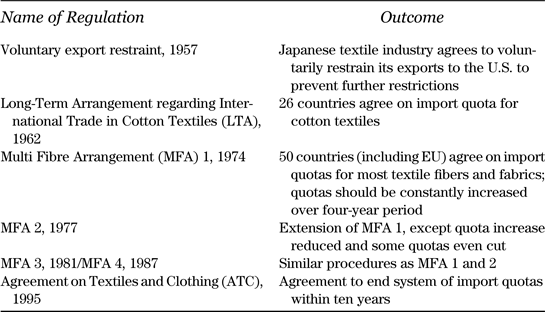
When the textile and clothing industries of the United States and Europe came under pressure in the 1950s, GATT was used to delay rather than promote trade liberalization in these sectors. Using Article XIX, about “emergency action” in cases in which increased imports would “threaten serious injury on domestic producers,” Western countries tried to restrict textile imports that flooded the markets, especially from Japan. Article XIX allowed the introduction of import quotas and other protectionist measures for a limited time when negotiations with the export nations failed.Footnote 25 By referring to that article, the U.S. government pushed Japan into a “voluntary self-restraint” arrangement in 1957, limiting its textile exports to the United States.Footnote 26 European countries negotiated bilateral trade agreements in a similar spirit starting in the late 1950s. Though Japan became a GATT member in 1957, West Germany kept its import restrictions with special permission from GATT in 1959 before it joined the expansion of the Long-Term Arrangement regarding International Trade in Cotton Textiles (LTA) together with the other EEC members in 1970.Footnote 27 By that time, the LTA had already grown into a multilateral system of “self-restraint” arrangements encompassing more than twenty countries.Footnote 28 Under the surface of GATT, a system of national and regional protectionist policies unfolded that protected textile and apparel manufacturing as well as other sensitive industries of the Western world from the exports of emerging countries (Table 2).
Regulation of Textile and Apparel Trade, 1957–2005

Source: Pietra Rivoli, The Travels of a T-shirt in the Global Economy: An Economist Examines the Markets, Power, and Politics of World Trade (Hoboken, NJ, 2009), 160–70.
In textile and apparel manufacturing, protectionism triggered an astonishing “global hopping” of production: as soon as the textile industry discovered a country without export quotas to the United States and EEC, it shifted its production facilities there; the quota system was extended to the new country, pushing the industry to move farther. In 1974 this dynamic led to the Multi Fiber Arrangement (MFA), signed by fifty countries and extending the system of “voluntary self-restraint” to synthetic fibers as well. Afterward, 75 percent of U.S. textile imports were “voluntarily” restricted by the export nations.Footnote 29 The MFA, as well as successor arrangements in the following decades, targeted a step-by-step process to unprotect world markets. This promise was the reason why the protective arrangements in GATT were tolerated. But as it turned out, successor arrangements lowered import quotas as well, when industrial countries were struggling with high unemployment and economic crises after the oil-price shock.Footnote 30 The speed of liberalization of global trade in textiles was slowed by the negotiations of new fiber arrangements based on tiny increases of import quotas for developing countries, among which China took the most powerful position during the 1990s. In 1995, the MFA system was replaced by another regulatory framework freezing the institutional structure for another decade. Not until 2005 did China gain more or less free access to European and American markets.
Within this complex global trade framework, West Germany had to deal with three different groups of trading partners. The first was trade within Europe, including important competitors France and Italy, which had been the objective of the EEC institutions. This group was temporarily split up in the 1960s, after the founding of the European Free Trade Association (EFTA) in 1959, and German industry hurried to establish affiliations in the EFTA countries (especially Austria, Spain, and Portugal) to circumvent duties and quotas. The second group encompassed all GATT members, with which West Germany negotiated bilaterally before the EEC took over responsibility during the GATT-Kennedy round of trade negotiations between 1963 and 1967. When the LTA was renegotiated under the supervision of the GATT in 1971, the EEC was already acting on behalf of all its member states.Footnote 31 A third group encompassed countries that were members of neither the EEC nor the GATT. These countries had to be treated bilaterally with no formal trade regime applied. Within this third group, countries from eastern Europe in particular became the most important trading partners of the German industry of the 1970s.
While the West German trade policy had to look for compromises with Western partners on the GATT and EEC level, it was largely independent in talks with eastern Europe, where it followed its agenda most clearly and directly. And this agenda was clearly “liberal” over all administrations, reaching from the Christian-Democrats in the early 1960s to Social Democrats between 1969 and 1972 to the liberal ministers of economics in the 1970s and 1980s. The governments aimed to liberalize textile and apparel imports to push the industry toward the higher-value-added parts of the GVC, while manufacturing was to be offshored to cheap-labor countries. Experts from the ministry of economics explicitly revealed this strategy as early as 1965.Footnote 32
After a coalition of Social Democrats and Liberals took over the government in 1969, liberal trade policy and support for “outward processing” was enforced. At regularly scheduled negotiations between economics minister Karl Schiller and the trade unions, the minister made it very clear that protection would be reduced in the future: “The minister emphasized,” according to the minutes of a meeting in March 1970, “that the force for further liberalization of imports cannot be denied and he let the trade union know, that the restrictive trade politics of other industrialized countries has led to backward textile industries in the end, while in contrast the liberal German attitude has forced the German industry to modernize early.”Footnote 33 German politics did not wait for business to engage in outward processing. Rather, it helped the industry in this respect. The minister of development even established a bureaucratic structure that would help the industry establish companies abroad or find contract partners to organize their GVC. At one of the big trade fairs for clothing manufacturers in Cologne, the ministry opened an information office that offered to assist German textile firms with offshoring activities, instantly leading trade unions to criticize the “doctrinaire liberal politics.”Footnote 34 In 1972, after the Liberal party took over the ministry of economics, the new minister, Hans Friderichs, continued and accelerated those policies. He suggested “scrapping premium” for the inefficient industries and social welfare for employees laid off by the industry's offshoring. Though reluctant to communicate this attitude publicly, especially in the aftermath of the oil-price crisis, Friderichs stated it clearly in private letters to textile entrepreneurs.Footnote 35 And eight years later even the representatives of the entrepreneurs’ associations conceded that without the government's pushing for “outward processing,” the sector “would not be able to survive.”Footnote 36
However, while German economic policy for textiles and apparel shared a “liberal” consensus encompassing all political forces of the German party system, it was more difficult to identify this attitude publicly because of two countervailing powers: the other EEC members on the one hand and a coalition of trade unions and the more backward parts of the domestic industry on the other.
At the European level, West Germany faced the very protectionist position of Italy and France, global competitors of German industry at that time, who also tried to redirect the inflow of textiles and apparel into the EEC to Germany.Footnote 37 The country had absorbed 85 percent of Hong Kong's imports to the EEC in the early 1960s, Germany's apparel industry complained.Footnote 38 Under these conditions, a relaxing of the very protectionist European policy would therefore partly relieve the German industry, while burdening Italy and France. The latter therefore pushed for an increase of trade barriers by suggesting a “common policy” for textiles and apparel as for coal and steel and agriculture in the Brussels “committee for medium-term economic policy.”Footnote 39
A report on the European textile industry that the committee had commissioned to the French economist Jacques de Bandt was the starting point for this debate. De Bandt assumed that the European textile industry, which altogether employed two million people in the mid-1960s, would further increase productivity while consumer spending on textiles would stagnate in the course of economic prosperity due to an income elasticity of textile consumption of about 0.8. His report forecasted a loss of 300,000 jobs in the sector through 1975. If the quota system expired and the European textile industry needed to compete even more with imports, the loss could even increase to 700,000 jobs.Footnote 40 Driven by such alarming predictions, France and Italy strongly favored an extension of protectionist foreign trade policy at the European level and prepared national laws that would support domestic producers with tax exemptions, investment, and direct payments. Germany, in contrast, criticized the findings of the de Bandt report, claiming it was focused too much on the situation in France and Italy, where very small businesses of fewer than ten employees dominated the industry, leading to a dramatic disadvantage in labor productivity (in comparison with the German—and much more with the Asian—textile producers).Footnote 41 Furthermore, the German delegates did not share the assumption that textile consumption would stagnate as dramatically. However, the greatest difference between the German attitude and the French and Italian attitude lay in how to improve the situation. Germany claimed governments were responsible for moderately supporting the necessary structural adjustment process rather than suppressing it. While France and Italy favored high tariffs on textiles and apparel, and ultimately favored economic planning, Germany preferred eliminating subsidies for marginal businesses in order to prepare its industry for free markets.Footnote 42
Despite the very clearly “liberal” attitude of the different German administrations, protection of the German textile and apparel industry remained relatively high, partly because of pressure from other EEC members and GATT regulations and partly because of public complaints by parts of the domestic industry that often succeeded—as we will see—in countering or delaying the liberalization strategy of the government. “Effective protection” (meaning that the quantitative restriction of import is translated into a tariff) decreased to 10 percent on average for all “industrial goods” between 1958 and 1982. For apparel, in contrast, it rose from 17 percent to 27 percent, and for textiles it peaked at 20 percent with a moderate decline to 17 percent in 1982.Footnote 43 There can be no doubt that German textile and apparel manufacturers received a good level of protection. The officers of the minister of economics continued to emphasize that fact in their negotiations with the trade unions and entrepreneurs’ associations in the late 1960s and 1970s. However, “it remains questionable,” an officer of the ministry disappointedly remarked, “if the German textile industry would ever acknowledge and appreciate the high level of protection that in the field of manufacturing only she is allowed.”Footnote 44
In eastern Europe, where the government was less restricted, it succeeded in applying its trade agenda much more completely. The region traditionally was an important trading partner for the German industry and trade relations were deepened in the interwar period.Footnote 45 While trade was difficult during the early years of the Cold War, the German government started a policy of détente under Willy Brandt, minister of foreign affairs from 1966 to 1969 and later chancellor. The political agenda was connected to a new interest in economic cooperation.Footnote 46 This was especially controversial, as long as the Christian-Democrats led the government under chancellor Kurt Georg Kiesinger. While the Social Democrats (Brandt and the economics minister Karl Schiller) tried to intensify trade with eastern neighbors, conservative textile producers used their personal relationship with Kiesinger to undermine the agenda. By writing several personal letters to his friend Kiesinger, the southwestern textile manufacturer Martin Adolff succeeded in intervening in ongoing negotiations with Romania and Hong Kong in January 1967. Import quotas negotiated by Schiller had to be decreased.Footnote 47 Similar letters were written by Rembert von Delden, who was a member of the federal parliament for the Christian-Democrat party but belonged to the family of the largest German manufacturer of cotton yarn. In his letters to Kiesinger, he heavily attacked the minister of economics and explicitly criticized the trade negotiations with Yugoslavia, which would only serve “the profits of big business.”Footnote 48 When the Social Democrats took over government in 1969, conservative business owners were joined by the trade unions in their lobbying activities, leaving the country with a strange coalition of capital and labor in the sector for a few years.Footnote 49 In fact, the government was so successful in promoting offshoring to eastern Europe that it became the trade policy most attacked by the coalition of trade unions and employers.
East Germany would have been the most obvious partner for offshoring, simply for the lack of language or cultural barriers, as well as the historical economic and personal relations. In terms of tariffs it was considered as belonging to the EEC. In fact, political conflict between the two Germanys was moderated and trade increased in the late 1960s.Footnote 50 But we do not yet know the extent to which “outward processing” in general, and in the textile and apparel sector in particular, was conducted. Besides some anecdotal evidence, we cannot conclusively say that East Germany appeared as a major or even important target of the West German industry's outward processing activities.Footnote 51 Apparently, other countries in eastern Europe were more attractive.
Eight percent of the value of all fabrics exported from West Germany in 1974 went to eastern Europe (the Soviet Union, Poland, Czechoslovakia, Hungary, Romania, Bulgaria) and 8.2 percent of import in cloths derived from there. However, the most important country was Yugoslavia. It alone received 7.1 percent of West German export fabrics and it sent 7.9 percent of all German imports of cloths.Footnote 52 The country became the manufacturing center of the German textile and apparel industry. Switching back and forth between the eastern and the western economic systems, which caused difficult economic relations with West Germany in the 1950s, Yugoslavia turned to “market socialism” in 1965. Private business activity, foreign direct investment, and trade with the Western world followed.Footnote 53 Exchange with Germany intensified when Willy Brandt became foreign affairs minister in 1966—this included foreign direct investment. By 1977, thirty-five German firms had received permission to invest in Yugoslavia.Footnote 54 But more important, especially for the textile and apparel industry, was trade. Over all categories, West Germany ranked as Yugoslavia's second-largest trading partner, behind Italy. Ninety-two percent of apparel imports to West Germany were conducted as “outward processing,” which means that the “exporters”—which had actually been subcontracting firms of the German headquarters—had to pay duties only on the value added from processing the material they had received from Germany.Footnote 55 It is difficult to explain why Yugoslavia was granted such a strong position by the German industry, while Yugoslavia's historic ties to Italy, with its own very strong textile industry, did not lead to a similar quantity of outward processing. Probably the structure of the Italian industry, which consisted of many very small firms, made it less attractive for Italy to be engaged in Yugoslavia. For France and the United Kingdom, transport costs might have made cooperation less attractive. The particular export goods that Germany had to offer in exchange for the service also played a role.
German economic policy used “outward processing” as both a way for the eastern countries to earn foreign currency to buy expensive German manufactures as well as an incentive for productive manufacturers in textiles and apparel to further improve their competitiveness. Therefore, when Schiller negotiated an extension of import quotas for textiles from eastern Europe in March 1969, he suggested not only increasing the quota for regular imports by 20 percent but also increasing the tax-free proportion of “outward processing” traffic by 33 percent.Footnote 56 For trade with Yugoslavia, unrestricted imports from outward processing was considered. But the plan was canceled after protests by the textile and apparel industry.Footnote 57
While the policy of selective liberalization formed an interesting political consensus encompassing all parties from Conservatives to Social Democrats between the mid-1950s and the early 1980s, politicians still tried to slow the economic adjustment process and to keep the social costs as low as possible. It was therefore important for the German ministry of economics to emphasize that the textile and apparel industry was still considered a “future industry” (Zukunftsindustrie) that German industrial politicians did not plan to completely give up to developing countries. They would rather see modernization to keep the largest possible number of workers in the country.Footnote 58 Following this strategy, the country participated in different negotiations for “voluntary” self-restraint arrangements during the 1970s in a return to a more protectionist policy in general. However, the government also promoted the strategy of “outward processing” to a larger extent than the other members of the EEC, which caused friction. Only 30 percent of total revenue was allowed in the very beginning, increasing to 50 percent in the 1990s. While French revenue in outward processing reached 200 million euros, and British 41 million euros, West German revenue reached 1.2 billion euros in 1988.Footnote 59 The German textile and apparel industry apparently relied on “outward processing” to confront market pressures to a much larger extent than their European competitors. The very early support for this strategy and the relations with eastern countries apparently pushed the German industry in a different direction, in contrast to its British, French, and Italian competitors.
While outward processing must be considered a very subtle shift in GVCs that shows up only partly in trade statistics but demands no transfer of capital or labor force, offshoring of manufacturing by the establishment or acquisition of foreign companies was applied at the same time. This was the more visible slicing up of GVCs and therefore is frequently mentioned in contemporary research, often with alarming tone: 23,000 employees of the German textile and apparel industry were to be found abroad in 1966, and the figure doubled by 1970.Footnote 60 While that equaled 6 percent of the total domestic workforce in textiles and apparel, the proportion reached 19 percent in 1983. The number of foreign subsidiaries reached 174 in textiles and 139 in clothing in 1983, mainly located in the EEC and EFTA countries or Asia, while outward processing dominated the Eastern Bloc countries.Footnote 61 According to the official figures from the apparel industry, in 1976, 25 percent of the total import of cloths resulted from outward processing.Footnote 62 As early as 1964, the ministry of economics had estimated that 30 percent of imports from Hong Kong, which had been highly criticized by the textile and clothing industry as “unfair competition,” actually was re-imported from the industry's “outward processing.”Footnote 63 In 1978, 9 percent of the total revenue in the textile sector and 18 percent in the clothing sector resulted from outward processing, as did 17 percent from the import value in textiles and 28 percent in apparel.Footnote 64 However, all the figures have to be treated with some skepticism and can only roughly illustrate the structural change of the industry because they were circulated by the interest groups (trade unions and entrepreneurs’ associations) themselves, providing incentives to report in one or the other direction. In their negotiations with politicians—so Alex Gretschen found out—trade unions and business associations agreed to stay silent about the issue of outward processing because it would have weakened their claim for stronger protection.Footnote 65
The Internationalization Strategy of German Corporations
The most spectacular bankruptcy in the West German textile industry happened in 1981. The Van Delden Group, one of the country's largest textile producers, with almost seven thousand employees and a total revenue of DM 756 million, failed. The company started in cotton spinning and weaving and acquired several competitors in the 1970s, including Ludwig Povel in Nordhorn, Eilermark in Gronau, and the “Mechanical Cotton Spinning” in Bayreuth, but only a few abroad. The company relied on horizontal expansion increasingly financed with credit, first by two German banks and later by a series of state guarantees by the regional governments of North Rhine-Westphalia and Lower Saxony. The state guarantees had accumulated to a total of DM 105 million by the end of 1981; total debt of the company had reached DM 250 million in 1978. Experts in the ministry of economics later blamed the company's downfall on a focus on low-price standard fabric instead of specialized fashion products, as well as on differences between the two main owners.Footnote 66 When the company finally collapsed in December 1981, the ministry was affirmed in its position that propping up inefficient and noncompetitive industries did not pay in the end. The liberal minister of economics, Otto Graf Lambsdorff, as well as the undersecretary of state, Dieter von Würzen, viewed any support by the local governments with skepticism.Footnote 67 But criticism of intervention by regional governments on behalf of the textile industry also came from the industry itself, as well as from many journalists, as in the following example:
The collapse of van Delden will be observed with a gasp of relief. Because the conglomerate, which was too weak to survive but, thanks to three state guarantees of a total of 105 million Marks, too strong to die, gave healthy competitors a hard time over the years by cutting prices.Footnote 68
The collapse should therefore not be taken as a sign of a “textile crisis,” this journalist claimed. Instead, it was a result of the large domestic spinning and weaving companies’ getting into trouble during the 1970s. Besides Van Delden, one could mention the Adolff company in Backnang and the Ravensberger Spinnerei in Bielefeld.Footnote 69
Successful stories are more difficult to detect in the published research, and access to company archives is still rare; this is the main obstacle to a more elaborate analysis of the role that GVCs played in the business strategy of German corporations. However, we have reason to believe that the companies that engaged in outsourcing activities and internationalized early had a better chance of adjusting to the global textile and apparel market. The brand Triumph, a lingerie manufacturer from southwestern Germany, built its first factory outside Europe in Hong Kong already in 1962.Footnote 70 The company had opened its first foreign sales office in Switzerland in 1933. Prior to the late 1970s, domestic employment had decreased from eighteen thousand to three thousand, while development abroad was favorable. Selling directly from Hong Kong to Japan and overseas markets grew foreign revenues while domestic revenues declined.Footnote 71 Though the corporation relocated its headquarters to Switzerland in 1977 for tax reasons, it kept facilities in Germany, where its market share leveled around 50 percent and where it has remained until today.Footnote 72 Sportswear became another successful field for German apparel manufacturers. More recent brands such as Trigema and Gerry Weber, which was founded in 1973, profited from the tennis boom in Germany and specialized in clothing and equipment. Much more successful was the sports shoe manufacturer Adidas, which also expanded into apparel manufacturing in the 1970s. Having already established GVCs for its shoe business, Adidas had no trouble setting up production structures for sportswear manufacturing. Being one of the best-known brands of the surviving German apparel industry, by the turn of the century Adidas controlled a network of 1,082 contract partners in sixty-five different countries that supplied 97 percent of the textiles and 76 percent of the apparel input for the company's exports from Germany.Footnote 73 Among other successful brands from the apparel sector are German producers of menswear, like the shirt manufacturer Seidensticker and the suit manufacturer Hugo Boss.Footnote 74
Less well known, though much larger, was the Steilmann Group, which became one of the largest apparel producers in West Germany in the 1980s, employing almost eight thousand workers domestically and another eighteen thousand in forty-three foreign companies with eighty-two production facilities.Footnote 75 The company was one of the most important contract partners for large fashion labels like Karl Lagerfeld but also sold to large department stores such as the German Karstadt AG as well as to fashion retailers like C&A. While retailers like Karstadt, Kaufhof, and Hertie, with revenues of more than $4 billion each, ranked as the largest retailers of textiles and cloth in Europe in 1979, it was the Steilmann Group and others that were actually behind this powerful position. In comparison, Marks & Spencer, with sales revenues in 1979 of $3.6 billion, organized the textile and apparel value chain itself, making extensive use of domestic manufacturers that had largely been dominated by the retailer. In contrast, in the European market, the manufacturer brands dominated and were used for exports. It was not until the 1980s that Marks & Spencer pushed for stronger sourcing among suppliers, shifting manufacturing to Asia.Footnote 76 Still, information and control costs had been comparatively high.Footnote 77 C&A chain stores gained a similarly powerful position in European markets. Since the company archive does not include any material for the period after 1961, an analysis of its business practices is difficult.Footnote 78 But in contrast to Marks & Spencer, the Brenninkmeijer family made use of the supplies of the Steilmann Group rather than individual manufacturers. In contrast to the United Kingdom, where 53 percent of the textile and apparel sales went to the multiple retailers, independents held a 25 percent share in Germany—still a significant difference from Italy and France, where independent retailers had market shares of 70 to 80 percent in textiles and apparel sales.Footnote 79 Without data on exact calculations along the value chain it is difficult to analyze where this difference in the production process between countries emerged from and why slicing up the value chain led to manufacturer-driven processes in Germany and retailer-driven processes in the United Kingdom. German expertise in outward processing in the East and in the management of transnational but regional value chains, together with their contacts in the textile machine industry, which was often used to equip foreign subcontractors as well as foreign subsidiaries, might be an explanation worth investigating once access to company archives is granted.
Though most examples of successful adjustment to global markets derive from the West German apparel industry, examples in the textile industry can also be found. Even capital-intensive parts of the production process such as spinning or weaving were offshored by companies like Kümper, a cotton spinner near Münster that bought a company in Greece in 1976. Some of the cotton manufacturers gave up their domestic business completely and became specialized traders in yarn or fabrics (e.g., the Beyerlein company in Bayreuth).Footnote 80 A shift to specialized fabrics that were patented in Germany but produced globally helped many of the textile manufacturers keep their companies on track. Some of the producers reached agreements with the auto industry, while others found niches—for example, the production of fireproof textiles by Webatex AG. The leading company among textile manufacturers became the Freudenberg company in Weinheim, which specialized in synthetic fibers that were used for everything from cleaning (“vileda”) to industrial use, and later diversified into other branches, including floor-covering and gasket production. The company expanded abroad with production plants in the United States and Japan in the 1950s.Footnote 81
Conclusion
The German textile and apparel industry ranked among the five largest exporters in several categories of international trade statistics from the 1960s until the early 2000s. When China increased its share of trade after the expiration of the Agreement on Textiles and Clothing (ATC) in 2004, and when the favorable arrangements for “outward processing” within the European Union fell in 1998, Germany's competitive advantage eroded and German exports lost their position on a global level.Footnote 82 Before that, the question of how the country managed to belong to the world's leading export countries without significant domestic production was puzzling. Germany's textile and apparel industry (the connection of both sectors via input relations as well as in political economy demands the sectors be considered together) experienced a dramatic change in the organization of production starting in the 1960s. While the industry initially consisted of a large number of mid-size companies that were scattered around the country (with local clusters in Westphalia, Württemberg, and Franconia), production was increasingly offshored, first to the European low-wage countries, then to the countries of eastern Europe, and, finally, to Asia. One might argue that the German textile and apparel industry was especially prepared for taking over the diversified mode of production faster than the industry of other countries, because it had traditionally been organized along regional and international value chains of production.Footnote 83 However, this article has identified some important factors that present the transformation as a mixture of corporate strategy of some larger firms and a policy agenda. Firstly, the collaboration with eastern European textile and apparel manufacturers gave the industry a favorable position compared to its British, Italian, and French counterparts, which could not as easily attach themselves to a similar production network. Second, the offshoring strategy was supported by German economic politicians from the very beginning, in the 1960s, while full protection dominated in other countries. Politicians’ insistence on the inclusion of quotas for outward processing in trade negotiations and the strategy of separating them from the regular quota system of the GATT and EEC helped the industry become an organizer of GVCs rather than solely a domestic manufacturer. In the 1980s the comparative advantage of Germany's textile and apparel industry resulted not from capital-intensive production or economies of scale, but from the ability to perfectly organize GVCs of production that could be governed and changed on short notice when consumer demand or the institutional framework changed.
In research on the structural change of Germany's postwar economy, this development has often been referred to as the decline of an “old industry.” In the course of economic development and increasing labor productivity, the country naturally would specialize in advanced technology branches like engineering and IT rather than consumer goods. The theoretical background for this kind of analysis is often the “three sector” model of industrial change, as coined by the French scholar Jean Fourastié in the 1950s. However, it remained a national explanation ignoring the international connections of structural change.Footnote 84 The case of the German textile and apparel industry shows that explanations relying on this set of theories fall short. Germany's industry did not disappear, or at least it disappeared only in terms of its share of national employment. The academic literature has often echoed the account of the textile and apparel industry itself, faulting the government's liberal trade policy for the domestic decline. This is flawed in two ways. First, as we have seen, German economic policy was not “liberal” in a general sense. Protection rates in textile and apparel trade remained high compared to other sectors over the course of the 1970s and 1980s. Second, a mid-size enterprise willing to engage in production offshoring and outward processing profited from the politics of “selective liberalization” (the combination of general import restrictions and special conditions for outward processing).
This article suggests analyzing the trajectory of the German apparel and textile industry from the theoretical framework of GVC literature. If we agree that the history of individual businesses as well as industrial sectors cannot be isolated from the (global) value chain in which the production is embedded,Footnote 85 the academic focus of business history has to shift from pure internal processes of investment, management organization, and labor relations to the question of where and to what extent on a global level the value added is skimmed off. The rich literature by economists, sociologists, and international political economy scholars offers a variety of explanations: in some cases, technology is seen as driving the global distribution of profits of some value chains; in others, knowledge of consumers’ wants is identified as the driving force of the “buyer-driven” value chains as opposed to the export-oriented “supplier-driven” value chains.Footnote 86 We have found an interesting difference between the retailer-driven value chain of the U.K. corporation Marks & Spencer and the market structure in Germany, where manufacturing companies played a larger role in the internationalization of the textile and apparel chain. Brand protection—as Teresa da Silva Lopes observed in her examination of the alcoholic beverage industries—apparently did not play a major role in the management of GVCs in Germany.Footnote 87
However, we found one feature in the history of German apparel and textile production that had been underexplored in value-chain research: the role of the government. It can clearly be shown that the German government actively supported offshoring and outward processing strategies, especially in trade negotiations with eastern European countries, but also in building up advisory bureaucracies and in negotiations with trade unions and employers’ associations. Eliminating subsidies and social welfare was used as an incentive to push the industry in that direction. This strategy was the background against which the advertisement described at the outset of this article ran. It was surprisingly frank and therefore irritated the public. But it accurately represented a political agenda that drove German trade politics in the sector from the Conservative governments of the 1950s to the Social Democrats and Liberals in the 1980s.